Munich Personal RePEc Archive
One dollar, one vote
Karabarbounis, Loukas
University of Chicago Booth School of Business
21 September 2010
Online at
https://mpra.ub.uni-muenchen.de/31371/
One Dollar, One Vote
∗
Loukas Karabarbounis
University of Chicago
September 2010
Forthcoming at the
Economic Journal
Abstract
This paper revisits the relationship between inequality and redistribution in a panel of ad-vanced OECD countries. Using panel data methods that hold constant a variety of determi-nants of redistributive spending, I find a non-monotonic relationship between pre-tax-and-transfer distribution of income and redistribution. Relative to mean income, a more affluent rich and middle class are associated with less redistribution and a richer poor class is as-sociated with more redistribution. These results are consistent with a one dollar, one vote politico-economic equilibrium: When the income of a group of citizens increases, aggregate redistributive policies tilt towards this group’s most preferred policies.
JEL-Codes: C23, D31, H50, P16.
Keywords: Inequality, Distribution, Redistribution.
∗Contact: University of Chicago, Booth School of Business, 5807 South Woodlawn Avenue, (+01)
1
Introduction
What determines the amount of resources that societies redistribute between their members? The current consensus in the literature, summarized in Persson and Tabellini (2003) and Alesina
and Glaeser (2004), is that the pre-tax-and-transfer distribution of income is not a significant
determinant of redistribution. The striking contrast between the US and Europe illustrates this
“paradox of redistribution.” The two workhorse models of distribution and redistribution, the
normative model of Mirrlees (1971) and the positive theory of Meltzer and Richard (1981), in
general predict that higher income inequality leads to more redistribution. However, in reality
the more pre-tax-and-transfer unequal US redistributes less than the more equal Europe.
Contrary to the conventional view in the literature, I argue that there is no paradox if we
introduce multiple income inequality statistics in the same empirical framework and interpret the findings as the outcome of a one dollar, one vote politico-economic equilibrium. The motivation
for interpreting cross-country differences in redistribution through the lens of this framework
is simple. Since different income groups have conflicting goals regarding the redistribution of
resources and since, as I show, income is strongly correlated with various measures of political
participation, in principle a single inequality statistic (e.g. the Gini coefficient or the distance of
median income from mean income) is unlikely to account for all conflicting preferences regarding
the size of the welfare state. In other words, when political influence is increasing in income and
redistribution responds to the political demands of various groups of voters, one would expect the
effect of inequality on redistribution to vary depending on what part of the income distribution is changing.
I measure income inequality with three variables. Inequality at the bottom of the income
distribution is given by the ratio of the gross earnings of the worker in the 10th percentile of the
distribution to mean gross earnings (y10
/y¯). The ratio of the gross earnings of the worker in the
90th percentile to mean gross earnings (y90
/y¯) captures the relative affluence of the rich. Finally,
the median to mean ratio of gross earnings (y50
/y¯) measures how median income changes relative
to any other income. Figure1explains why I summarize inequality with these three variables. The
vertical axis measures the unconditional correlation between redistribution (Total Public Social
Expenditure as a percentage of GDP) and the earnings of individuals located in each percentile of the gross earnings distribution relative to the mean. The horizontal axis measures the percentile
of the gross earnings distribution from a sample of advanced OECD countries. The Figure shows,
for instance, that the correlation between redistribution and the y10
/y¯ratio is around 0.60, when
the latter is measured with a three-year lag relative to redistribution.
gross earnings is positive for individuals poorer than the median, it falls to around zero for the
median and it turns negative for individuals richer than the median. This result arises at the
pooled sample but a similar pattern emerges at the cross-country dimension of the sample for
separate time periods. As Figure1shows, when the inequality ratios are measured with a fifteen-year lag relative to redistribution, the correlations for the poor and the rich do not decrease much
in magnitude. Based on this fact, I hypothesize that the omission of relevant variables is a more
serious concern than reverse causation in attempting to estimate a causal link from inequality to
redistribution. However, the econometric methodology is meant to address both concerns.
To test the hypothesis that inequality is relevant for redistribution, in Section2I construct a
panel of advanced OECD countries over 1975-2001. My measure of redistribution is standard in
the literature and includes expenditures on pensions, survivors and incapacity related benefits,
programs for the poor families, housing, unemployment, active labor market programs and health.
The empirical methodology, however, differs from previous papers in some or all of the following dimensions.1
First, and most importantly, I introduce three different indices of income inequality
in the same empirical framework to capture the idea that redistribution responds to the demands
of various groups of voters. Second, I measure inequality using gross earnings data which, as
explained below, helps to address a number of econometric issues. Third, I focus on the
within-country variation of the data to make my results consistent with a prominent strand of literature
which emphasizes the role of persistent determinants of redistribution (e.g. institutions, culture
and ethnicity; see below for references). In other words, the estimated effect of inequality on
redistribution holds constant all “long-run” factors that cause some countries to redistribute
more than others irrespective of differences in their income distributions.
Section3presents the results. Overall, I find a robust positive relationship between the relative
earnings of the poor and redistributive spending, a solid negative association for the median over
mean (the “Meltzer-Richard (1981)”) ratio and a broadly consistent negative association between
relative earnings of the rich and redistributive spending. Therefore, inequality between the tails of
the pre-tax-and-transfer distribution, in the sense of a richer rich class and a poorer poor class, is
associated with less redistribution. That the median to mean ratio of gross earnings is associated
with less redistribution shows how different indices of income inequality are important.
One contribution of the paper is to explain why previous empirical tests in the literature
have found scant evidence in favor of the basic median voter equilibrium mechanism proposed
1
by Meltzer and Richard (1981). To isolate which of the above three features of the empirical
methodology is responsible for my finding that the Meltzer-Richard coefficient has the expected
negative sign, I first note that previous studies using close proxies for the median to mean ratio of
gross earnings (e.g. Persson and Tabellini, 1994; Perotti, 1996; Rodriguez, 1999) have not found a robust negative association between this measure of inequality and redistribution. Second, in
my sample, the coefficient of the median to mean ratio of gross earnings is insignificant and often
has the wrong sign in various regressions with and without fixed effects, when I omit the relative
earnings of the poor and the rich from the specification. As a result, what reverses the sign and
the significance of the Meltzer-Richard coefficient is the inclusion of proxies for the poor’s and
the rich’s demand for redistribution. The intuition for this novel empirical result is rather simple
and accords with previous theoretical work (B´enabou, 1996; Epple and Romano, 1996; Saint-Paul
and Verdier, 1996). When we omit the earnings of the rich and the poor from the regression,
we are implicitly assuming that the median voter is the decisive voter. In reality, however, the political system is more complicated than what the “one person, one vote” model assumes and
various groups of voters may have a “say” for the equilibrium outcome. In other words, the
basic prediction that the median to mean ratio of gross earnings is negatively associated with
redistribution should be conditioned on the earnings of other groups of voters to control for the
probability that the median is not necessarily the decisive voter.
I provide a battery of robustness checks. The results remain unchanged when many controls
and interaction terms with time-invariant determinants of redistribution are included in the
re-gression. I verify my analysis using pensions and statutory income and payroll taxes as proxies
for redistribution to address measurement issues in the dependent variable. Dropping influential observations, excluding one country at a time from the sample, redesigning the structure of the
panel errors, accounting for country-specific trends and modeling the persistent nature of
redis-tribution do not affect the majority of my findings. Finally, most of the results are verified when
the inequality ratios are instrumented and therefore the empirical estimates are in general robust
to the strict exogeneity assumption necessary for the fixed effects estimator.
Section4discusses the results. A well known theoretical proposition is that income and most
preferred size of redistribution are negatively related across groups of voters. As I show, this
theoretical result finds considerable empirical support in microeconomic data. As a result, the
rich prefer less redistribution than the median and the median prefers less redistribution than the poor. Starting from this result, the effects of the inequality variables on redistribution are
consistent with what I define as a one dollar, one vote politico-economic equilibrium. In the one
dollar, one vote equilibrium, when a group of citizens becomes richer (relative to mean income),
redistribution decreases with their income, while for poor group this means that redistribution
increases with its income. In other words, the one dollar, one vote definition captures the positive
association between group income and distance of group most preferred outcome from equilibrium
redistribution. A natural explanation for the one dollar, one vote result is that political influence is not uniform across groups of voters. Using individual-level data from the World Values Survey,
I show that political participation increases in income. As a result, an increase in the income of
any group of voters implies more political influence in the equilibrium outcome, in line with the
one dollar, one vote result.
The one dollar, one vote result can explain the “paradox of redistribution.” Over 1980-2001,
the growth of redistribution was lower in the US than in a European aggregate of countries. The
poor and the middle class became poorer in the US relative to Europe. These two opposing effects
on the cross-Atlantic difference in the growth of redistribution tend to cancel off. Because the rich
became richer in the US (relative to the mean), political influence shifted towards the interests of the American rich class. Because the rich became poorer in Europe, political influence shifted
away from the interests of the European rich class. Since in both sides of the Atlantic the rich
prefer less redistribution, Europe’s growth of redistribution exceeded the US growth.
2
Empirical Methodology
2.1
Sample
I use various sources to construct an unbalanced panel of 14 advanced OECD countries over
1975-2001.2
The selection of the sample is based on the existence of data for income distribution
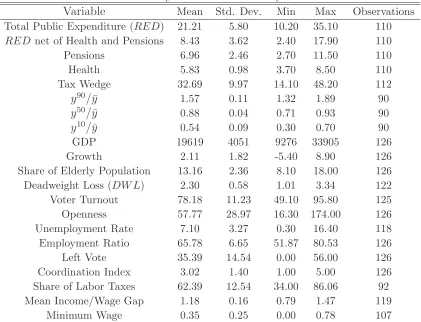
and redistribution. Table 1 presents the summary statistics. The Appendix discusses in more
detail the definition and the sources of the variables.
2.2
Data
Redistribution: The dependent variable is taken from the OECD SOCX Dataset.3
The measure
of redistribution is Total Public Social Expenditure as a percentage of GDP which includes
expen-ditures on old age (pensions), survivors, incapacity related benefits, health, family, active labor
market programs, unemployment, housing and other social policies. I examine the robustness of
2
The countries are: Australia, Austria, Canada, Finland, France, Germany, Ireland, Italy, Japan, Netherlands, New Zealand, Sweden, UK and USA. Canada is observed mostly in the 1980s. Italy is observed until 1995, i.e. before the change in its political institution. For Austria and Ireland there is only one inequality observation and thus these countries are dropped from the sample in some specifications that require two or more observations per country.
3
the results to alternative measures of redistribution by dividing Total Public Social Expenditures
into its three main components, namely health, pensions and expenditures net of health and
pensions. As an alternative dependent variable I also use OECD’s Tax Wedge variable, which
measures the sum of personal income taxes and Social Security contributions.4
Inequality: An important issue in the empirical investigation is the definition and quality of
the inequality variables. The quality of the data has improved in recent years but the data is
still far from perfect (Atkinson and Brandolini, 2001). My source is the OECD LFS Dataset
which presents gross earnings of full-time workers by deciles of the income distribution. This
Dataset has a number of desirable features. First, it offers the possibility to construct a variety of inequality measures and examine different parts of the gross earnings distribution simultaneously.
Moreover, the basic political economy model predicts a relationship between pre-tax-and-transfer
income inequality and redistribution (see e.g. Persson and Tabellini, 2000). Using the OECD
LFS Dataset, the inequality variables are constructed with gross earnings data and not with data
on expenditures, consumption, wages, net earnings or disposable income. As explained below
in more detail, using gross instead of net earnings has the important additional advantage that
redistribution does not overlap mechanically with the inequality variables.5
I map the theory close to the data and proxy for the Meltzer and Richard (1981) ratio with the
ratio of the gross earnings of the worker located in the 50th percentile of the income distribution to mean gross earnings, y50
/y¯.6
In addition, as discussed in Section4, the demand of the rich and
the poor can also affect redistribution and in reality the median voter may not be the decisive
voter. I proxy for the rich’s and the poor’s demand for redistribution with the y90
/y¯ and the
y10
/y¯ratios respectively.7
4
In addition, the results below are in general robust when redistribution is measured with Milanovic’s (2000) reduction in inequality variables. I prefer to use the Total Public Social Expenditure variable for two reasons. First, the number of observations drops to 32 or 34 when Milanovic’s (2000) sample is overlapped with my sample which increases significantly the variability of the estimates. Second, Lind’s (2005) argument that there is a mechanical positive correlation between the Gini coefficient and Milanovic’s measure of redistribution may also apply when I regress Milanovic’s measure of redistribution on my inequality variables (but it does not apply when I use Total Public Social Expenditure as a measure of redistribution).
5
The results are not sensitive to the few observations for which gross earnings data is not available.
6
Perotti (1996) uses the size of the middle class which is close to the y50
/y¯ variable. He finds that more inequality is associated with less growth, but he rejects that the link between these two variables occurs through redistribution as hypothesized by workhorse models. See also Bassett, Burkett, and Putterman (2003) on this point. Rodriguez (1999) tests carefully the Meltzer and Richard (1981) model using pre-tax median to mean earnings. He presents time series and cross sectional evidence from US states which reject the median voter model. See also Gouveia and Masia (1998) for a similar result. I explain the difference of my results from these papers in Section 3.2.
7
Other papers use they90
/y10
Some of the literature uses the Gini coefficient to proxy for inequality.8
The intuition developed
in the next Section is that the Gini coefficient cannot capture the non-monotonic relationship
between inequality and redistribution. An example that contrasts the distribution of factor income
in Sweden and the US in the early 1980s illustrates this point. While Sweden has a Gini coefficient of 0.463 and the US has a Gini coefficient of 0.464, the US is much less equal than Sweden when
we examine other dimensions of inequality. According to the OECD LFS Dataset, the y90
/y10
ratio of gross earnings is 3.79 in the US and only 2.05 in Sweden. If we use the Gini coefficient to
summarize the income distribution, then we overlook the fact that inequality between the tails
of the distribution is much more pronounced in the US than in Sweden.
2.3
Empirical Specification
The estimating equation is:
REDi,t =ci+τt+β1
y90
¯
y
i,t−1
+β2
y50
¯
y
i,t−1
+β3
y10
¯
y
i,t−1
+
K X
k=1
γkXk,i,t−1+εi,t (1)
where REDi,t is Total Public Social Expenditure as a share of GDP for country i = 1, ..., N in
period t = 1, ..., T, (yj/ y¯)
i,t−1 is the gross earnings of the worker in the jth percentile of the
gross earnings distribution divided by mean gross earnings for j = 90,50,10, Xk,i,t−1 is other
explanatory variables, ci is a time-invariant country-specific unobservable effect, τt is a common
unobservable year-specific effect and εi,t is the time-varying country-specific idiosyncratic error.
Variables are in logs and therefore the regression coefficients denote the elasticities of redistributive
spending.9
Assessing the causal effect of inequality on redistribution is certainly a challenging task; in
general we cannot expect inequality to be exogenous. The first source of endogeneity is contem-poraneous reverse causation and in fact the often reported insignificant and sometimes negative
relationship between pre-tax-and-transfer inequality and redistribution may simply reflect the
case that societies redistribute to decrease their post-tax-and-transfer economic inequality.10
Us-ing gross earnUs-ings instead of net earnUs-ings or consumption to construct the inequality ratios relaxes
somewhat this constraint because net earnings vary both “mechanically” and “economically” with
and the 10th percentile in the denominator drive the strong negative correlation. The same intuition applies for the 90-50 ratio. Because the 90-mean ratio is strongly negatively correlated with redistribution and the 50-mean is uncorrelated or weakly negatively correlated with redistribution, the 90-50 ratio is (weakly) negatively correlated with redistribution.
8
See, for instance, Milanovic (2000), Persson and Tabellini (2003) and Shelton (2007).
9
The coordination index, the government surplus, the growth rate and the minimum wage are not logged because they take negative or zero values. The results are similar when the equation is specified in levels.
10
the fiscal system, while gross earnings vary only through the endogenous response of labor supply
or the general equilibrium effect on factor prices. To mitigate the concern that redistribution
may affect inequality through labor supply or general equilibrium effects, I average all variables
using non-overlapping three-year intervals and lag the regressors by one period. For example, in period t = 2001, REDt is an average of redistributive spending over 1999, 2000 and 2001.
This is regressed on right hand side variables which are averaged over 1996, 1997 and 1998, and
therefore, on average, inequality leads redistribution by three years. The averaging procedure is
desirable because it removes transitory fluctuations due to economic business cycles, it captures
meaningful variations along the political cycle and it reduces serial correlation and measurement
error.11
Probably the most serious concern for my empirical investigation is the potential inconsistency
that arises from omitting relevant determinants of redistribution. The panel that I construct
read-ily controls for time-invariant observable or unobservable determinants of redistribution. This is important because the literature emphasizes the role of long-run, persistent factors that cause
some countries to redistribute more than others irrespective of differences in their income
dis-tributions. For instance, legal origins, initial technological capabilities and geography, political
institutions such as electoral rules, form of the government, judicial review and federalism
(Pers-son and Tabellini, 2003; Alesina and Glaeser, 2004), persistent cultural characteristics such as
beliefs in a just world (B´enabou and Tirole, 2006) and trust (Tabellini, forthcoming), ethnic
frag-mentation (Easterly and Levine, 1997; Alesina and Glaeser, 2004), prospects of upward mobility
(Piketty, 1995; B´enabou and Ok, 2001), social beliefs about fairness (Alesina and Angeletos,
2005) and initial wealth inequality (Galor and Zeira, 1993; Deininger and Squire, 1998) vary across countries and explain why some countries adopt more pro-redistributive policies than
oth-ers. However, these determinants are absorbed by the time-invariant country-specific effect (ci)
since they are fixed within country for the period considered. Because the path of inequality
in each country may be the result of certain political institutions, labor market regulations and
social perceptions about work ethics, luck and the redistribution of resources, I allow for any
arbitrary correlation between the country-specific effects and the regressors.
The inclusion of year-specific fixed effects (τt) controls for common shocks in redistribution
such as the technological slowdown caused by the oil shocks in the beginning of the sample and
the world rise of rightist movements in the 1980s. The time effects also help to reduce the effects of spurious trends and contemporaneous panel error correlations. AddingN+T−2 dummy variables into the model certainly creates a demanding environment to test my hypothesis since it removes
11
a large fraction of the cross-country and within-country variation of the data. However, I adopt
this technique because it mitigates the endogeneity problem and helps to identify the effects of
inequality on redistribution.
The consistency of the fixed effects estimator is subject to the strict exogeneity assumption. Specifically, factors affecting redistribution in periodt but omitted in the error term are assumed
to be orthogonal to past, present and future explanatory variables conditional on the fixed effect
(Wooldridge, 2002). As discussed below, this assumption may be too restrictive and is relaxed in
Section 3.3.
3
Income Inequality and Redistribution
3.1
Main Results
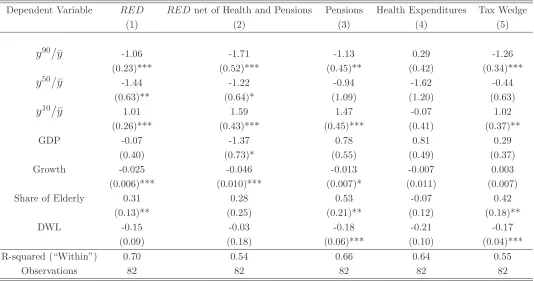
Table 2, column 1, presents the baseline specification. There is a positive association between
the y10
/y¯ratio and redistribution. This coefficient is significant at the 1% level. They50
/y¯ratio
is negatively associated with redistribution and its coefficient is significant at the 5% level. The
y90
/y¯ratio is negatively associated with redistribution. This coefficient is significant at the 1%
level.
In the following columns, I slice Total Public Social Expenditures (RED) into its three major components, namely RED net of Health and Pensions, Pensions and Health. I find a similar
pattern in terms of signs and significance for the inequality coefficients when Pensions andRED
net of Health and Pensions are used as the dependent variable. However, the inequality variables
do not seem relevant in explaining Health expenditures. This is a reasonable result in light of
the fact that the one dollar, one vote hypothesis should be stronger for more progressive social
programs and health is understood as one of the least progressive social expenditures. The fact
that the results do not change significantly when I use the Pensions variable instead ofREDshows
clearly how the association between inequality and redistribution is not artificial. The reason is
that the inequality ratios concern the gross earnings of full-time workers, while by definition pensions are given to retirees.12
As a result, the inequality measures do not overlap mechanically
with this measure of redistribution.
The baseline specification includes four control variables. GDP controls for the size of the
tax base and also for Wagner’s Law. There is no evidence that GDP affects redistribution which
12
is reasonable since the sample consists of developed economies. Economic growth accounts for
the countercyclicality of fiscal policy driven by automatic stabilizers (e.g. unemployment
com-pensations).13
Consistently with previous studies in OECD countries (see e.g. for a discussion
Gal´ı and Perotti, 2003), I find strong evidence of countercyclical redistribution. The share of the elderly population holds constant demographic characteristics and the bargaining power of the
elderly when demanding more directed transfers, i.e. pensions. I find that a larger share of elderly
population is associated with more redistribution.14
Finally, the deadweight loss, a measure of the
opportunity cost of taxation, is negatively associated with redistribution. When I omit all these
controls, the estimated inequality coefficients are very similar in magnitude but their variability
increases somewhat.
Column 5 of Table2uses the sum of personal income taxes and payroll taxes (“Tax Wedge”),
a measure of the net tax burden for the average earner, as the dependent variable. I repeat the
baseline regression with this measure of redistribution to verify that the results are not sensitive to the cyclical nature of redistribution. Spending on automatic stabilizers decreases during economic
booms. If in booms the income benefit for the rich exceeds the benefit for the poor, then the
y90
/y¯increases and the y10
/y¯decreases. This could explain the negative coefficient of the former
and the positive coefficient of the latter. The Tax Wedge variable addresses this concern since
personal income taxes and Social Security contributions are statutory. Column 5 of Table2shows
how the estimated coefficients of the rich and the poor remain robust, while the coefficient of the
median is still negative but loses significance. In addition, growth enters insignificantly which
verifies the initial hypothesis that the Tax Wedge is immune to cyclical fluctuations.
The pattern of the fixed effects emerging from the estimation mimics strongly the pattern of the averaged value of redistribution by country (with a correlation of 0.59). This shows that omitted
factors such as political and labor market institutions, ethnicity and social perceptions about
redistribution are important determinants of redistribution over the long-run. More formally, the
null hypothesis that all country fixed effects are not significant is rejected at the 1% level. The
time dummies also enter jointly significantly. Estimation with random effects does not change
significantly the estimated inequality coefficients and therefore the results are robust to a potential
sensitivity of the fixed effects estimator to measurement error.
The economic significance of the three inequality ratios is also large. According to the first
column in Table 2, the conditional elasticity of redistribution with respect to the demand of the rich, the Meltzer-Richard ratio and the demand of the poor is -1.06, -1.44 and 1.01 respectively.
13
Growth is not lagged in the regressions because the automatic stabilization take places contemporaneously.
14
To understand the magnitude of these coefficients, suppose that a country redistributes the mean
value ofRED in the sample, 21.21%. A 10% increase in the three inequality ratios would change
redistribution as a percentage of GDP by -2.25, -3.05 and 2.14 percentage points relative to its
mean sample value. The magnitude of these variations is reasonable both in the within-country and in the cross-country dimension of the sample.15
Factors that contribute to cross-country
differences in the time series variation of inequality include technological change and globalization
(Georgiadis and Manning, 2007, for the UK), market based factors such as the age or educational
premium that affect the relative supply of skills (Gottschalk and Joyce, 1998), but also
pre-existing labor market and political institutions, ethnic divisions and cultural beliefs (i.e. the
“fixed effect”). In Section 4.3 I analyze the singificance of the results in more detail by showing
how changes in inequality can account for the growth of the US-Europe difference in redistribution
over 1980-2001.
Table 3 adds other time-varying controls to the baseline specification. Since I analyze the relationship between redistributive expenditures and gross labor earnings inequality but some
expenditures are not necessarily financed by labor income taxes, it might be necessary to control
for the share of government spending financed by labor income taxes and a measure of the
gap between average labor earnings and average income. To calculate the share of government
spending financed by labor income taxes, I follow the methodology of Mendoza, Razin and Tesar
(1994), as updated recently by McDaniel (2007), and obtain measures of the average or “effective”
labor income tax rate. Multiplying the average labor income tax rate by wages and salaries and
dividing by government spending, I obtain the variable “Share of Labor Taxes.”16
The “Mean
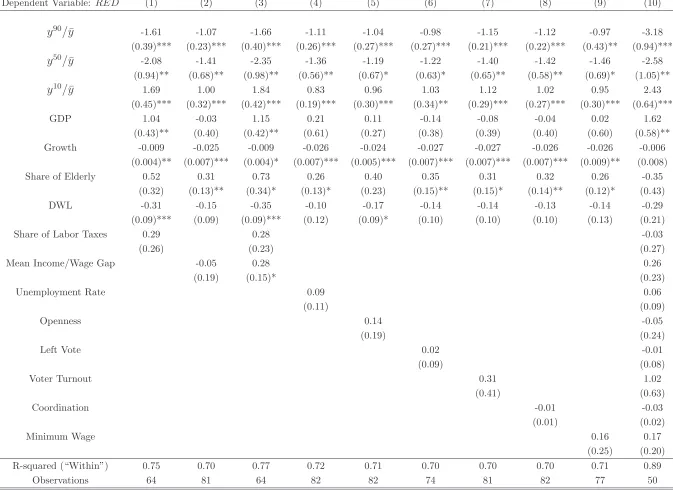
Income/Wage Gap” variable denotes the ratio of average income to average earnings. As columns 1-3 of Table 3show, the results remain robust to the inclusion of these two variables in isolation
or in combination.
In the next columns of Table3, I include the rate of unemployment, the degree of openness, the
share of left vote, the voter turnout, the wage coordination variable and the ratio of the minimum
wage to the average wage (in isolation in columns 4-9 and in combination in column 10). The
coefficients of these controls present signs in accordance with theory but are not significant at
conventional levels. Unemployment is positively associated with redistribution which is expected
since unemployment benefits are part of RED. Openness also enters with a positive coefficient
15
A 10% increase in the mean to median ratio is an increment of more than two standard deviations. In 1978, France’s y50
/¯y ratio was 10% smaller than US’s ratio. A 10% increase in the rich to mean ratio is somewhat more than one standard deviation increment, whereas a similar change in the poor to mean ratio corresponds to a somewhat less than one standard deviation increment. For instance, in 1999 they90
/y¯ratio is 20% larger in the US than in Sweden and they10
/¯y ratio is 40% smaller in the US than in Sweden.
16
which is consistent with Rodrik (1998), given that the size of the country is absorbed by the
fixed effect. Left vote enters positively as left-wing parties are associated with more redistributive
policies, however its sign changes when more controls are included. Voter turnout enters positively
in the regression as supposedly the poor voters are the ones more elastic to voting. The wage coordination variable enters with a negative coefficient which shows a substitutability between
labor market rigidities and cash redistribution. Finally, the coefficient of the minimum wage is
positive as more redistributive governments try to raise the minimum relative to the mean wage.
I have controlled for other potentially relevant variables (to save space these results are not
reported). Controlling for the percentage of right vote in the last elections, the unionization
of the economy, and the budget surplus of the government does not change significantly the
results shown in Tables 2 and 3. Adding the employment ratio into the regressions also does not
overturn the magnitude and the significance of the three inequality coefficients. The employment
ratio addresses a potential sensitivity of the poor’s coefficient due to the normality of leisure. If a more generous welfare transfer causes low ability workers to exit the labor market or participate
only part-time, then the earnings of the worker located in the 10th percentile of the distribution
of full-time gross earnings increase artificially with redistribution (for the median and the rich
this effect works against finding the negative coefficients).
The inequality variables have been interacted with other determinants of redistribution. First,
in the simplest formulation of a voting model it is assumed that everyone votes but in reality
inequality matters for redistribution to the extent that the poor vote. To test this hypothesis, I
interact the y10
/y¯ ratio with the turnout of the voters in the last elections. This coefficient has
the expected positive sign.17
In addition, the coefficients of the other inequality ratios do not change significantly. Second, the interaction of the Meltzer-Richard ratio with the ELF index of
Roeder (2001) provides a test of Lind’s (2007) conjecture that only in less fragmented societies
inequality increases redistribution. In accordance to his intuition, I find that less heterogeneous
societies redistribute more after an increase in inequality. Finally, I have used interaction terms
of political institutions (electoral rules and form of government) with the inequality ratios with
no significant difference in the results.
3.2
Comparison to Other Studies
The empirical methodology rests on three key features. First, I introduce various indices of income
inequality in the same empirical framework. Second, the inequality ratios are constructed with
17
gross earnings data. Third, I focus on the within-country variation of the sample.
The finding that the Meltzer-Richard (1981) ratio enters with the expected negative sign is
novel. To isolate which of the three features above is responsible for this result, I first note that
previous studies employing close proxies for the Meltzer-Richard ratio have not found the result. Specifically, Persson and Tabellini (1994), Perotti (1996) and Bassett, Burkett, and Putterman
(2003) use the (pre-tax) size of the middle class in a cross section of countries and Gouveia and
Masia (1998) and Rodriguez (1999) use pre-tax median over mean earnings in a sample of US
states. None of these papers, however, finds robust evidence that a higher Meltzer-Richard ratio
is associated with less redistribution.18
Second, to investigate whether the focus on the
within-country variation of the sample explains my result, Table 4 repeats the baseline specification of
Table 2, with and without fixed effects, with and without the additional controls and with and
without controlling for the y90
/y¯ and the y10
/y¯ ratios. As the Table shows, when I drop the
variables for the rich and the poor, the coefficient of the Meltzer-Richard ratio is insignificant and in many cases has the wrong sign, with or without the additional controls and with or without
the fixed effects. Therefore, what changes the sign of the Meltzer-Richard coefficient is that I
control for the probability that the median voter may not be the decisive voter by introducing
other dimensions of income inequality in the same empirical framework. As the Table shows, the
use of country-specific fixed effects makes the Meltzer-Richard coefficient statistically significant
but the largest fraction of the decreased magnitude of the coefficient comes from introducing the
other inequality ratios into the specification.
Most of the literature does not find evidence in favor of a positive association between the
Gini coefficient and redistribution. For example, see Persson and Tabellini (2003), the discussion in Alesina and Glaeser (2004) and the references listed therein. Recently, Shelton (2007) tests
carefully several prominent theories on the determinants of government expenditures and their
composition, including the median voter theory. Using a random effects estimator, he estimates
a close to nil impact of the Gini coefficient on social transfers, when the effect is evaluated at
the mean value of political rights. He also finds no significant pattern in any other measure
of government spending. A notable exception in the literature is Milanovic (2000) who argues
that a careful construction of the relevant variables leads to a positive association between the
Gini coefficient and redistribution. To test the Gini coefficient in my sample, I use the factor
Gini coefficient from Milanovic’s accurate calculations. More often than not, I find no significant
18
relationship between the Gini coefficient and redistribution using various specifications with fixed
effects. This result, however, does not compare directly to Milanovic because my sample has
fewer observations and, perhaps most importantly, because my measure of redistribution differs
from Milanovic’s measure (see footnote 4for this point).
My results are also related to Ramcharan (forthcoming), even though they concern income and
not wealth inequality. The author looks at the within-county variation in the US over 1890-1930
and shows how a higher land Gini coefficient is associated with less redistribution. Differently
from my paper, Ramcharan uses a single statistic to summarize wealth inequality. Similarly to my
paper, he concludes that the negative association between the Gini coefficient and redistribution
may reflect the fact that elites had greater political influence.
3.3
Sensitivity Analysis
This Section presents a number of additional robustness exercises. None of the robustness checks
overturns the results but in some cases one of the three inequality coefficients loses significance.
Influential Observations: Given the small number of observations and the correlation between
the regressors, the results may be sensitive to the inclusion of some outliers. Figure 2 plots the residuals from the regression of redistribution on the three inequality ratios as reported in
the first column of Table 2. These and similar graphs for the other regressors show no obvious
outliers. A formal procedure is to examine the standardized residuals from the regression. There
are six observations that have standardized residuals above 2. Dropping in isolation or all these
observations simultaneously from the sample does not change the results significantly. As a further
robustness exercise, I calculate the Cook distance which gives a measure of the total influence of
each observation on the predicted values of redistribution. Loosely speaking, observations with
a distance greater than 1 merit special consideration. The highest value turns out to be around
0.20. Finally, countries are dropped one at a time from the sample. I find that the results are not sensitive to the inclusion of any particular country.
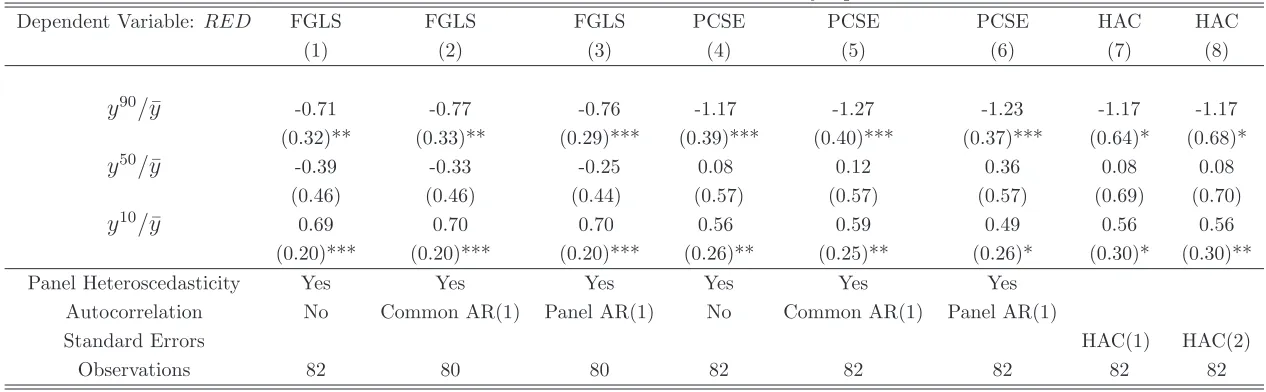
Structure of Panel Errors and Country Trends: Thus far I have followed an agnostic
strategy and considered errors that are robust to any type of correlation within country. Table
5 considers alternative correlation structures. Panel heteroscedasticity allows the variance of the error term to differ across panels. The contemporaneous correlation of the panel errors is
addressed by using time effects that capture common trends. I also consider common
cross-country autocorrelation of the error term and different autocorrelations across panels. Another
concern is that country-specific time trends to inequality and redistribution could drive the results.
I consider various estimation strategies to examine the sensitivity of the results to the assumed
behavior of the error term. In the first three columns of Table 5, I perform FGLS estimation. It
is well known that FGLS estimation has two disadvantages. First, it requires relatively strong
assumptions on the structure of the standard errors. Second, as Beck and Katz (1995) show, it may severely underestimate the variability of the estimates because each round of iteration
compounds the uncertainty over the coefficients. Therefore, in the next three columns I use Panel
Corrected Standard Errors which is a strategy more agnostic than FGLS. Finally, in the last two
columns I consider Newey/West standard errors which correct for arbitrary heteroscedasticity and
first and second order serial correlation. As Table 5 shows, the results for the coefficients of the
rich and the poor remain strong but the coefficient of the median to mean ratio loses significance.
Persistence of Redistribution and Endogeneity of Inequality: The effect of inequality on
redistribution has not taken into account, thus far, the persistent nature of redistribution. In
addition, the consistency of the fixed effects estimator assumes that factors which affect
redistri-bution in period t but are omitted in the error term εi,t, remain conditionally uncorrelated with
past, present and future inequality. For instance, this assumption is violated if current
redistri-bution affects the future distriredistri-bution of gross income through labor supply or factor price effects
as a result of a sluggish adjustment of the labor market to fiscal policy shocks.
To address these concerns I model the persistence of redistribution in a dynamic GMM frame-work. It is well known that when the lagged dependent variable is included into the model, the
Panel OLS estimator is upward biased (when the error term is positively autocorrelated) and
the fixed effects estimator is downward biased by construction (with the bias decreasing as the
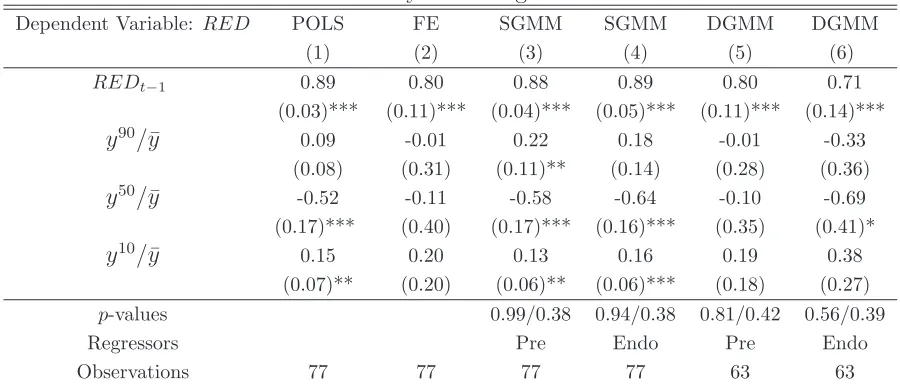
number of periods increases). In the first two columns of Table 6, the coefficient of the lagged
dependent variable is 0.88 for the Panel OLS technique and 0.80 for the fixed effects technique.
As a result, the true value of the coefficient lies between these two estimates or at least close to
these estimates when taking into account the uncertainty for the point estimates (Bond, 2002).
Table6 examines the performance of the model under two estimation procedures, namely the
System GMM method of Blundell and Bond (1998) in Columns 3-4 and the Difference GMM method of Arellano and Bond (1991) in Columns 5-6.19
The System estimator differs from the
Difference estimator because it stacks together the first differenced equation and the level equation
in a system of equations. In Columns 3 and 5, all regressors are treated as “predetermined” or
19
“sequentially exogenous” variables, that is the model is estimated under the assumption that ǫi,t
can be correlated with future regressors butǫi,t remains orthogonal to contemporaneous regressors.
Since I have already lagged the inequality ratios by one period, this implies that ǫi,t can be
correlated with inequality in period t and in other future periods but ǫi,t remains orthogonal to
inequality in period t −1 and in earlier periods. In this case, valid instruments are first and deeper lags of the instrumenting variable for the differenced equation and, for the System GMM,
the zero lag of the instrumenting variable in differences for the levels equation. In Columns 4 and
6, all regressors are treated as “endogenous” variables, that is the model is estimated under the
assumption thatǫi,t can be correlated with future and contemporaneous regressors butǫi,tremains
orthogonal to past regressors. Since I have already lagged the inequality ratios by one period,
this implies that ǫi,t can be correlated with inequality in period t−1 and in other future periods
but ǫi,t remains orthogonal to inequality in periodt−2 and in earlier periods. In this case, valid
instruments are second and deeper lags of the instrumenting variable for the differenced equation and, for the System GMM, the first lag of the instrumenting variable in differences for the levels
equation.
Table 6 shows that the estimated coefficient of the lagged dependent variable in the System
GMM method is close to the interval of true values (as implied by the FE and the POLS
tech-niques). The Difference GMM method, however, appears to deliver downward biased estimates.20
As the Table shows, the results remain robust for the poor and the median but not for the rich.
Specifically, the coefficients of the y10
/y¯and they50
/y¯variables have the correct signs under both
methods and they are always significant under the System GMM method. The coefficient of the
y90
/y¯ variable has the correct sign but it loses significance under the Difference GMM method and it has the wrong sign under the System GMM method.
4
Discussion
This Section discusses and interprets the results. First, I define the one dollar, one vote equilibrium
and explain why the empirical results are consistent with this definition. Then, I propose some
mechanisms that can explain the one dollar, one vote result, with a focus on the channel of
political participation. To conclude, I present the implications of my results for the US-Europe
“paradox of redistribution.”
20
4.1
One Dollar, One Vote
I define the one dollar, one vote equilibrium as a politico-economic equilibrium in which aggregate
outcomes tilt towards the preferences of a specific group of citizens as this group’s income increases
(relative to the mean income).
The empirical results in Section 3 are consistent with this definition. To see this, start with
the well known theoretical proposition that an individual’s most preferred size of redistribution
is inversely related to individual income (see e.g. Romer, 1975; Roberts, 1977). This proposition
finds strong empirical support. Alesina and La Ferrara (2005) show that richer individuals prefer
less redistributive policies for the case of the US. I extend their exercise for my panel of OECD countries using individual-level data from the World Values Survey Dataset and specifically from
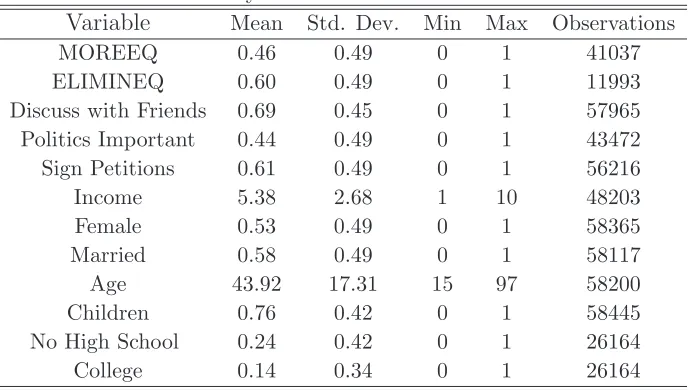
its Four-Wave Integrated Data File (2006) over 1981-2004. Table 7 presents summary statistics
and the Appendix contains more details for the variables.
Support for redistribution is measured with two variables. The first codes answers that range
from 1 if respondents think that “Incomes should be made more equal” to 10 if they believe that
“We need larger income differences as incentives.” The second ranges from 1 when the respondent
believes that it is “Very important to eliminate big income differences” to 5 if it is “Not at all
important.” To ease the interpretation, I recode the variables in binary form with 1 denoting
more support for redistribution and 0 denoting less support for redistribution. The results are not sensitive to the specific recoding procedure. The two variables are called MOREEQ and
ELIMINEQ.
The survey codes pre-tax income in ten scales which are standardized at the country level.
A higher value for the income variable means that the respondent belongs to a household of a
higher income scale. The regressions control for gender, age, the presence of children, marital
status and education. I assume that support for redistribution of individual i living in countryc
at time t is characterized by a latent variable:
R∗
ict =dc+τt+βYict+γXict+εict (2)
where dc and τt are country and year dummies, Yict is the income scale of the respondent,Xict is
the vector of controls and εict is the error term. The variableR∗ict is not observed but the variable
Rict, taking a value of 0 for low support and a value of 1 for high support for redistribution, is
observed. Assuming that the distribution of the error term is logistic, I estimate a logit model.
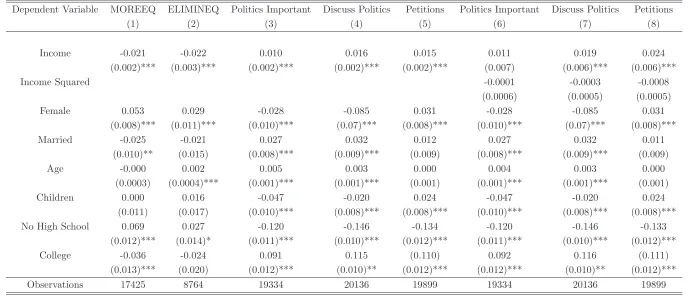
The first two columns of Table8show that support for redistribution decreases with income.
The point estimates suggest that the likelihood of finding someone who supports redistribution
regression for all countries separately. In all cases the point estimate for income is negative and
most of the times the coefficient is significant at the 1% level.21
Restricting the sample for specific
time periods or estimating an ordered logit model makes no difference for the results.
Since support for redistribution decreases as income increases, the poor prefer more redistribu-tion than the median and the median prefers more redistriburedistribu-tion than the rich. When the initial
equilibrium redistribution lies between the bliss points of the poor and the rich, the result in
Section3that redistribution increases in the income of the poor implies that as the poor become
richer, aggregate spending tilts closer to their most preferred outcome. When median income
increases relative to mean income, the median’s net benefit from redistribution decreases. The
one dollar, one vote definition holds in the Meltzer and Richard (1981) model since the median is
always the decisive voter. This system also holds in an extended framework in which the median
is not exclusively the decisive voter but in which the median’s decisiveness increases with its
relative income. In either framework, the median prefers less redistribution and also has the po-litical power to impose less redistribution as an equilibrium outcome. As a result, redistribution
decreases which is consistent with the results of Section 3.22
Finally, it is easy to see that the
one dollar, one vote definition is also satisfied for the high income group since the rich in general
prefer less redistribution.
4.2
Explanations
When the rich become richer, their most preferred size of redistribution decreases. As a result, the one dollar, one vote definition is satisfied if the rich’s political influence increases with income.
In this case the rich group will impose less redistribution as an equilibrium outcome shifting
the politico-economic outcome closer to its preferences. On theoretical grounds, the positive
association between income and pivotal role of the rich can be explained by the ideas developed
by Grossman and Helpman (1996). Because a richer rich class has more to lose from redistribution,
the incentive for the rich to contribute to political parties and tilt policy closer to their preferences
21
The two exceptions (across 28 specifications) are the coefficient in the MOREEQ regression for Germany and the coefficient in the ELIMINEQ regression for France.
22
is expected to increase with income. B´enabou (1996) uses this general insight to introduce a
non-monotonic relationship between inequality and redistribution. Campante (2008) lays out a model
that describes this behavior, with specific reference to campaign contributions. Bartels (2009)
analyzes the responsiveness of US senators to the preferences of their constituents and finds that the voting behavior of senators is considerably more responsive to the opinions of the wealthy.
When we contrast the individual-level evidence with the panel outcomes of Section 3, we
see a one-to-one correspondence between preferences for redistribution and aggregate policies for
the middle and the rich class: Both groups prefer less redistribution as they become richer and
aggregate spending decreases in the earnings of these two groups. On the other hand, using
individual-level data I find no evidence that the poor prefer more redistribution when they get
richer but in the country-level data a more affluent poor class is associated with a broader welfare
state. Because income is inversely related to the preference for redistribution it follows that: (i)
the poor in general prefer less redistribution when they get richer; (ii) the poor’s bliss point always involves more redistribution than that of the other groups. The evidence using country-level data
that redistribution increases in poor’s gross earnings implies that the second effect dominates
the first. In other words, in response to a richer low-income group policy moves closer to the
poor’s most preferred outcome which involves more redistribution than the redistribution mostly
preferred by the other groups. This is the essence of the one dollar, one vote definition.
The question then becomes why policy moves closer to the poor’s bliss point as their
in-come increases. One natural explanation is that political participation increases with inin-come.23
Rosenstone and Hansen (1993) and McCarty, Poole and Rosenthal (2006) find a strong positive
association between income and political participation in the US. To verify that these results are not special to the US, I present evidence from the World Values Survey Dataset.
Political participation is proxied by 14 different indicators (see Appendix for more details).24
Variables are in binary form such that 1 means higher political participation. I assume that
political participation of individual i, living in country c at time t is characterized by a latent
variable:
P∗
ict =dc+τt+βYict+γXict+εict (3)
where dc andτt are country and time dummies, Yict is the income scale of the respondent, Xict is
23
The political participation explanation is expected to become even more powerful when examining the rela-tionship between wealth inequality and redistribution. See Perotti (1996) for some discussion of wealth inequality and how it relates to redistribution and growth, and Deininger and Squire (1998) for empirical evidence on the relationship between land inequality and growth. See Ramcharan (forthcoming) for the relationship between land inequality and redistribution in the US counties over 1890-1930.
24
the vector of controls used in equation (2) and εict is the error term. I do not observe Pict∗ , but
instead I observe a variable Pict which equals 0 for low and 1 for high political participation.
Columns 3-5 in Table 8 present strong evidence that political participation increases with
income. The Table presents results for the three variables with the highest number of observations. The point estimates for income’s coefficient in all 14 specifications are positive and with one
exception all coefficients are significant at the 1% level. The estimates presented in the Table
indicate that the likelihood of participating politically each time we move up one income scale
increases by 1.0-1.6 percent. The absolute cost barrier to political participation implied by these
estimates is important, especially since I control for other proxies of income including education.25
Finally, in Columns 6-8 I introduce a quadratic specification for income to investigate how the
effect of income on political participation depends on income. As the negative coefficient of
squared income shows, the effect of income on political participation is stronger for the poor than
for the rich. The results presented in Columns 3-8 of Table 8 are robust when restricting the sample to specific countries or time periods.
To summarize, these findings indicate that income is positively associated with political
par-ticipation across the income spectrum. The poor do not contribute cash in campaigns, however
they do engage in other activities that influence policy and engage in these activities more as their
income increases. A richer poor class demonstrates more and participates in political parties,
vol-untary political clubs and labor unions. If the stronger political voice of the poor dominates their
decreased preference for redistribution, then redistribution increases in poor’s income. That is,
point (ii) above dominates (i).26
The political participation explanation assumes that policy is sufficiently elastic to rich’s and poor’s political demands, i.e. that the position of the decisive voter is not rigid. I also consider
some alternative explanations that can rationalize why redistribution tilts towards the preferences
of groups of citizens with higher income without assuming the reallocation of political power.
The theories of Becker (1983) and Becker and Mulligan (2003) offer an explanation for the
rich’s coefficient. With a progressive system of taxes, the distortionary effects of labor income
25
Consider, as an example, the case of US in 1999. A one percent increase in the probability to sign a petition is associated with approximately 4700 dollars. A respondent belonging to a household with yearly pre-tax income of 30000 dollars has approximately 10% lower probability to sign a petition than a respondent with similar demographic and educational characteristics who belongs to a household that earns 75000 dollars. The former is approximately 7% less likely to be affiliated with a political party than the latter.
26
taxation are higher at the right tail of the income distribution. Therefore, a richer high-income
class could be associated with less redistribution if the median voter internalizes these increasing
distortions when demanding redistribution.
The “social affinity theory” of Kristov, Lindert and McClelland (1992) can potentially ra-tionalize the effects at the left tail of the distribution. The authors develop a model in which
political agents organize into pressure groups and devote resources to affect redistribution, as in
Peltzman (1980). The equilibrium redistribution is determined in the following manner: one feels
closer to people that have a similar level of income. The theory predicts a positive sign for the
gap between the poor’s and the middle’s earnings coefficients in a regression of redistribution on
this income gap.27
I note that the authors allow for the interpretation that social affinity operates
through social mobility as in B´enabou and Ok (2001). Therefore, when the median income gets
closer to the income of the poor, redistribution increases.28
An alternative plausible explanation comes from relaxing the assumption of unidimensionality in the Meltzer and Richard (1981) model. In both sides of the Atlantic, modern welfare states
include means-tested redistributive programs. Examples of such programs are the Medicaid and
Food-Stamps in the US, family and solidarity allowances in many European countries and parts of
the medical insurance in France. The statutory nature of redistribution provides an explanation
for the results because when transfers are declining with income, a richer poor class becomes less
eligible for targeted transfers and a higher fraction of the tax revenues can be appropriated by
the middle class. If political power remains in the hands of the median class, then the median’s
increased benefit from receiving transfers will change the politico-economic trade-off in favor of
more redistribution.
4.3
The US-Europe Difference in Redistribution
In the Introduction I referred to the striking divergence of the data from the theory to motivate
the widely held belief that inequality does not matter for redistribution. In light of my results it is
worthwhile to revisit this issue. Consider the US versus a European aggregate of Finland, France,
Netherlands and Sweden (two Continental and two Nordic welfare states).29
The European
aggregate redistributed approximately 26.4% of its GDP in 2001, while 23.8% in 1980. US
27
The estimated coefficient of the y10
/y50
variable is of similar magnitude to the estimated coefficient of the y10
/¯y variable. As a result, the macro data is not sufficiently informative to distinguish between the political participation explanation and the social affinity theory. See also Lindert (1996) for careful tests of the social affinity theory over 1960-1981.
28
See also Gr¨uner and Schils (2007) who establish an unconventional voting behavior of the politically decisive middle class in a model of wealth redistribution. Specifically, the authors show how middle class voters form a coalition with the poor when redistribution gives access to entrepreneurial rents.
29
redistribution increased from 13.3% in 1980 to 14.4% in 2001. As a result, the European growth
of redistribution exceeded the US growth by approximately 2.7% (not percentage points) over
1980-2001.
Consider, as an illustrative example, the estimates of column 9 in Table 3 (which hold con-stant the minimum wage). Over 1977-1998, the growth of the y10
/y¯ ratio is approximately -2%
in Europe but almost -19% in the US. Multiplying the difference (16.8%) with the estimated
coefficient of the poor leads to an approximately 15.9% change in redistribution. The growth
of the y50
/y¯ ratio is more than -1% in Europe but less than -11% in the US. Multiplying the
difference (10.6%) with the estimated coefficient of the median leads to an approximately -15.4%
change in redistribution. According to these estimates, Europe increased redistribution relative
to the US in 2001 relative to 1980 because the European poor did not become as poor as the
American poor (both relative to their mean) and US increased redistribution relative to Europe
because the American median voter became poorer. These two opposing effects tend to cancel off. Finally, the growth of the y90
/y¯ ratio is -2.9% in Europe and 0.6% in the US. Multiplying
the difference (-3.5%) with the estimated coefficient of the rich leads to an approximately 3.4%
change in redistribution.
Assuming that the position of the pivotal voter is not rigid over this period of time, the
conclusion from these calculations is that the faster growth of rich’s income in the US allowed
the rich class to devote resources and tilt policy closer to their bliss point which involves less
progressive policies. As a result, the growth of redistribution in the US lagged the growth of
redistribution in Europe.30
5
Conclusion
The results of this paper challenge the conventional view that income inequality does not matter
for redistribution. Instead of focusing on a single summary inequality statistic, I show how looking
at different parts of the income distribution offers an explanation for the observed cross-country
differences in redistribution. In a panel of OECD countries over 1975-2001, I find that when
a group of voters becomes richer (relative to the mean), redistribution tilts closer to its bliss
point. This result is consistent with the argument that more money is associated with more
political power. The idea that political influence is not uniform across voters explains why the literature has found scant evidence in favor of the basic politico-economic model of inequality and
redistribution.
30
References
Alesina, Alberto, and George-Marios Angeletos. 2005. “Fairness and Redistribution.”
American Economic Review,95(4): 960–980.
Alesina, Alberto, and Edward L. Glaeser. 2004. Fighting Poverty in the US and Europe:
A World of Difference. Oxford, UK: Oxford University Press.
Alesina, Alberto, and Eliana La Ferrara. 2005. “Preferences for Redistribution in the Land of Opportunities.” Journal of Public Economics, 89(5-6): 897–931.
Allard, Gayle, and Peter H. Lindert. 2006. “Euro-Productivity and Euro-Job Since the 1960s: Which Institutions Really Mattered?” NBER Working Paper No. 12460.
Arellano, Manuel, and Stephen R. Bond. 1991. “Some Tests of Specification for Panel Data: Monte Carlo Evidence and an Application to Employment Equations.” Review of
Economic Studies,58(2): 277–297.
Atkinson, Anthony B., and Andrea Brandolini. 2001. “Promise and Pitfalls in the Use of “Secondary” Data-Sets: Income Inequality in OECD Countries As a Case Study.” Journal
of Economic Literature,39(3): 771–799.
Bartels, Larry M. 2009. “Economic Inequality and Political Representation.” In Lawrence Jacobs and Desmond King (eds.) The Unsustainable American State, New York: Oxford University Press.
Bassett, William F., John P. Burkett, and Louis Putterman. 2003. “Income Distribu-tion, Government Transfers, and the Problem of Unequal Influence.” European Journal of
Political Economy,15(2): 207–228.
Beck, Nathaniel, and Jonathan N. Katz. 1995. “What to Do (And Not to Do) With Time Series Cross Section Data.” American Political Science Review, 89(3): 634–647.
Becker, Gary S. 1983. “A Theory of Competition among Pressure Groups for Political Influ-ence.” Quarterly Journal of Economics, 98(3): 371–400.
Becker, Gary S., and Casey Mulligan. 2003. “Deadweight Costs and the Size of Govern-ment.” Journal of Law and Economics, 46(2): 293–340.
Bellettini, Giorgio, and Carlotta Berti Ceroni. 2007. “Income Distribution, Borrowing Constraints and Redistributive Policies.” European Economic Review, 51(3): 625–645.
B´enabou, Roland J.1996. “Inequality and Growth.” In Ben S. Bernanke and Julio J. Rotem-berg (eds.) NBER Macroeconomics Annual,11–74.
B´enabou, Roland J., and Efe A. Ok. 2001. “Social Mobility and the Demand for Redistri-bution: The POUM Hypothesis.” Quarterly Journal of Economics, 116(2): 447–487.
B´enabou, Roland J., and Jean Tirole. 2006. “Belief in a Just World and Redistributive Politics.” Quarterly Journal of Economics, 121(2): 699–746.
Bobba, Matteo, and Decio Coviello. 2007. “Weak Instrument and Weak Identification in Estimating the Effects of Education on Democracy.” Economic Letters, 96(3): 301–306.
Bond, Stephen R. 2002. “Dynamic Panel Data Models: A Guide to Micro Data Methods and Practice.” Portuguese Economic Journal, 1(2): 141–162.
Campante, Filipe R. 2008. “Redistribution in a Model of Voting and Campaign Contribu-tions.” Working Paper, Harvard University.
Casamatta, Georges, Helmuth Cremer, and Pierre Pestieau. 2000. “The Political Economy of Social Security.” Scandinavian Journal of Economics, 102(3): 503–522.
Deininger, Klaus, and Lyn Squire. 1998. “New Ways at Looking at Old Issues: Inequality and Growth.” Journal of Development Economics, 57(2): 259–287.
Easterly, William, and Ross Levine. 1997. “Africa’s Growth Tragedy: Policies and Ethnic Divisions.” Quarterly Journal of Economics, 112(4): 1203–1250.
Epple, Dennis, and Richard E. Romano. 1996. “Ends Against the Middle: Determining Public Service Provision When There Are Private Alternatives.” Journal of Public
Eco-nomics, 62(3): 297–325.
Feldstein, Martin, and Jeffrey B. Liebman. 2002. “Social Security.” In Allan J. Auerbach and Martin Feldstein (eds.) Handbook of Public Economics, 4: 2245–2324, Amsterdam: North-Holland.
Gal´ı, Jordi, and Roberto Perotti. 2003. “Fiscal Policy and Monetary Policy Integration in Europe.” Economic Policy, 18(37): 533–572.
Galor, Oded, and Joseph Zeira. 1993. “Income Distribution and Macroeconomics.” Review
of Economic Studies,60(1): 35–52.
Georgiadis, Andreas, and Alan Manning. 2007. “Spend it Like Beckham? Inequality and Redistribution in the UK, 1983–2004.” CEP Discussion Paper No. 816.
Gottschalk, Peter, and Mary Joyce. 1998. “Cross-National Differences in the Rise in Earnings Inequality: Market and Institutional Factors.” Review of Economics and Statistics,
80(4): 489–502.
Gouveia, Miguel, and Neal A. Masia. 1998. “Does the Median Voter Model Explain the Size of Government?: Evidence from the States.” Public Choice, 97(1-2): 159–177.
Gr¨uner, Hans Peter, and R¨udiger Schils. 2007. “The Political Economy of Wealth and Interest.” Economic Journal,117(553): 1403–1422.
Grossman, Gene, and Elhanan Helpman. 1996. “Electoral Competition and Special Inter-est Politics.” Review of Economic Studies, 63(2): 265–286.
Hellwig, Martin F. 1986. “The Optimal Linear Tax Revisited.” Journal of Public Economics,
Heston Alan, Robert Summers, and Bettina Aten. 2006. Penn World Table Version 6.2, Center for International Comparisons of Production, Income and Prices at the University of Pennsylvania, September 2006.
Huber Evelyne, Charles Ragin, John D. Stephens, David Brady, and Jason Beckfield.
2004. Comparative Welfare States Dataset, Northwestern University, University of North Carolina, Duke University and Indiana University.
Iversen, Torben, and David Soskice. 2006. “Electoral Institutions and the Politics of Coalitions: Why Some Democracies Redistribute More than Others.” American Political
Science Review, 100(2): 165–181.
Kenworthy, Lane. 2001. “Wage-Setting Measures: A Survey and Assessment.” World Politics,
54: 57–98.
Kristov, Lorenzo, Peter Lindert, and Robert McClelland. 1992. “Pressure Groups and Redistribution.” Journal of Public Economics,48(2): 135–163.
Lind, Jo T. 2005. “Why is There so Little Redistribution?” Nordic Journal of Political Econ-omy, 31: 111–125.
Lind, Jo T. 2007. “Fractionalization and the Size of Government.” Journal of Public
Eco-nomics, 91(1-2): 51–76.
Lindert, Peter. 1996. “What Limits Social Spending?” Explorations in Economic History,
33(1): 1–34.
McCarty, Nolan, Keith T. Poole, and Howard Rosenthal. 2006. Polarized America: The
Dance of Ideology and Unequal Riches. Cambridge, MA: MIT Press.
McDaniel, Cara. 2007. “Average Tax Rates on Consumption, Investment, Labor and Capital in the OECD 1950-2003.” Working Paper, Arizona State University.
Meltzer, Alan H., and Scott F. Richard. 1981. “A Rational Theory of the Size of the Government.” Journal of Political Economy, 89(5): 914–927.
Mendoza, Enrique G., Assaf Razin, and Linda L. Tesar. 1994. “Effective Tax Rates in Macroeconomics: Cross-Country Estimates of Tax Rates on Factor Incomes and Consump-tion.” Journal of Monetary Economics, 34(3): 297–323.
Milanovic, Branko. 2000. “The Median Voter Hypothesis, Income Inequality and Income Redistribution: An Empirical Test with the Required Data.” European Journal of Political
Economy,16(3): 367–410.
Mirrlees, James A. 1971. “An Exploration in the Theory of Optimum Income Taxation.”
Review of Economic Studies,38(114): 175–208.
Moene, Karl O., and Michael Wallerstein. 2001. “Inequality, Social Insurance and Redis-tribution.”American Political Science Review, 95(4): 859–874.