Munich Personal RePEc Archive
Second-degree price discrimination and
universal access under (weighted
average) price cap regulation
Li Ning, Jorge
OSITRAN
November 2009
Online at
https://mpra.ub.uni-muenchen.de/31321/
Second-degree price discrimination and universal access
under (weighted average) price cap regulation
Jorge Li Ning Chaman
November, 2009
Abstract
This paper analyzes the e¢ciency of the Price Cap regulatory scheme and its impact on universal access, when the monopolist is allowed to set a menu of alternative plans as part of a self-selection strategy (second-degree price discrimination) and the cap is calculated as the weighted average of the tari¤ plans he o¤ers.
In this context, we characterized the solution of the monopolist; who, besides o¤ering a menu of plans more distorted than the second-best outcome –even distorting the plan for high-valuation consumers– because the trade-o¤ between e¢ciency and rents extraction is exhibited in di¤erent way, can exclude consumers who are willing to pay for the service –shutdown policy– despite of universal access obligation have been imposed by the regulator. This happens regardless of the weighted average price cap (WAPC) set by the regulator.
Consequently, if the Price Cap regulatory scheme is going to be used by the regula-tor, this mechanism must be applied to a single regulated plan, leaving the monopolist some ‡exibility to o¤er alternative plans that will be incentive compatible with this single regulated plan (tari¤ ‡exibility).
Key Words: price cap; non-linear tari¤s; price discrimination; tari¤ ‡exibility;
uni-versal access.
Classification JEL: L51; D52; L96
1
Introduction
In several regulated industries –like telecommunications, electricity and gas–, regulators have opted to use the Price Cap regulatory scheme1 at the expense of other schemes (e.g. rate of
return) because of the incentives that this mechanism generates, mainly in terms of encour-aging productive e¢ciency without discourencour-aging investment2. However, industries regulated
by Price Caps also have other characteristics: most regulated …rms are multi-product, price-discriminating and, are also subjected to an universal access policy imposed by the regulator3.
The regulation by Price Caps of multi-product …rms, since the regulator has limited information about costs and/or demand for each one of the regulated services, is applied to a "basket" of services rather than to each of them; i.e. the regulator regulates a price index of the basket of services or a weighted average price. Note that the services of a basket can belong to perfectly separated markets (the monopolist could price discriminate in third-degree) or, to di¤erent market segments because the existence of di¤erent types of consumers (he could price discriminate in second-degree)4. On the other hand, the universal access
policy is intrinsically linked to the tari¤ policy that the regulator implements. That is, an inadequate pricing by the regulator or the …rm, with for example high …xed tari¤s, may lead to non-participation of low-income consumers who had accessed the service if the tari¤s had been properly set (i.e. they have willingness to pay for the service).
For purposes of this paper, we incorporate some of these characteristics (that have not been included in previous studies) in the e¢ciency analysis of the Price Cap regulatory scheme. In particular, we will assume a monopolist that can price discriminate in second-degree (this is the reason of de…ning a basket of services), but also faces an universal access obligation.5
1Also known as RPI - X regulation.
2Models studying this topic are conducted under the typical problem of asymmetric information about
costs and/or demand between the regulator and the regulated …rm (see Baron and Myerson, 1982). However, in this paper we will assume that no such asymmetric information exists.
3According to Li Ning and Willington (2009), universal access has 2 dimensions: (i) one related to
will-ingness to pay of low-income consumers in service’s coverage areas, and (ii) the other is the lack of coverage service in rural areas because of low demand and high costs.
In this paper, when referring to "universal access" we refer to (i). Inclusion of consumers related to (ii) will depend on how feasible is the implementation of a subsidy (permanently or temporarily) by the Government. Most countries have established funds, with contributions from the regulated …rms themselves, to …nance projects for low-income consumers.
4In this issue, Bertoletti and Poletti (1997) show that third-degree price discrimination generates Pareto
improves when two-part tari¤s are regulated, in comparison with the prohibition of any tari¤ di¤erentiation. On the other hand, Vogelsang (1990) and, Li Ning and Willington (2009) show the same, although when the …rm can price discriminate in second-degree.
It should be noted that, when a …rm is allowed to price discriminate in second-degree, the regulator sets the cap as the weighted average of all plans –each one corresponding to each consumer type– o¤ered by the monopolist, which will be adjusted over time according to the productivity factor (X-factor) and variations in the index of input prices (RPI). The monopolist has some ‡exibility to o¤er a menu of plans that ful…ll with the following char-acteristics: (i) allows di¤erent types of consumers self-select, and (ii) satis…es the cap set by the regulator. This cap setting and its application is de…ned as the Weighted Average Price Cap (WAPC) regulatory scheme.
In analyzing the e¢ciency of the WAPC regulatory scheme, we do not focus on incentives to productive e¢ciency, but in the existence of incentives to achieve allocative-e¢cient solu-tions. According to the economic literature, achieving allocative e¢ciency –when a basket of services is regulated by Price Cap– is possible under certain conditions. In relation to this issue, Bradley and Price (1988) and Vogelsang (1988) demonstrate that, when there are no changes in demand and costs, regulation by the WAPC leads to an iterative process that converges to a Ramsey pricing structure6, whose speed of adjustment will depend not only of the X-factor but also the weights used at the beginning of the regulatory process. On the other hand, Vogelsang (1990)7 shows that if the regulated …rm o¤ers two-part tari¤s as an
option, in addition to the initial tari¤ which should always o¤er (the constraint faced by the regulated …rm), Pareto optimal outcomes can be achieved; however to this happen, the initial price vector (which always has to o¤er the regulated …rm) must be properly regulated8. In
short, these authors consider that the initial tari¤ regulation is important for the regulator, not only to induce productive e¢ciency9 but also allocative e¢ciency or Pareto solutions10.
Although all models mentioned above reach e¢cient outcomes when the regulator grants the regulated …rm the possibility to set his own prices (also called price delegation), none of them shows the ine¢ciencies that could arise when the monopolist can price discriminate in second-degree and, simultaneously, is regulated by the WAPC regulatory scheme (a menu
6Note that Ramsey prices can be exclusionary, which contradicts our assumption that the regulator is
interested in the universal access problem.
7Following the Incremental Surplus Scheme (ISS) due to Sappington and Sibley (1988), and the Sibley’s
ISS-R scheme (1989).
8For the initial tari¤ setting, Vogelsang (1990) proposed the rate of return regulation. However,
…rm-e¢cient regulation can also be used.
9Bernstein et al. (2006) mentioned that if the initial regulated pricing makes pro…ts equal to zero –i.e. if
the regulator ensures that the initial regulation of prices are oriented at cost–, with the application of the RPI-X factor, the monopolist will continue make zero pro…ts.
10Note that for the case of Vogelsang (1990), the regulator should set tari¤s for each type of consumer on
of plans from which the regulator validates the ful…llment of the WAPC)11. Therefore, in
this context and assuming that there is no information asymmetry between the regulator and the regulated …rm about costs and/or demand for the service, as shown below, the WAPC regulatory scheme would encourage the monopolist to o¤er socially ine¢cient plans, even more distorted than the second-best solution (allocative ine¢ciency). This happens because the monopolist, considering the WAPC constraint on its problem, can not raise the tari¤ of the high-valuation consumer’s plan. The latter encourages the monopolist to extract informational rents from high-valuation consumers in another way: by reducing the number of minutes included in the high-valuation consumer’s plan and shutting-down the low-valuation consumers. It must be emphasized that these distortions occur despite the initial setting of the weighted average price is cost oriented and the imposition of an universal access obligation.
The peruvian experience
In Peru, since september 2001, the tari¤s for end users of …xed telephone service are regulated by Price Cap, speci…cally by the Tari¤ Regime of Weighted Average Price Cap. In partic-ular, the regulator (the Supervisory Agency for Private Investment in Telecommunications - OSIPTEL) is the only responsible for calculating the WAPC, which is reduced according to the RPI-X factor; while the regulated …rm sets the di¤erentiated tari¤ plans so that end users self-select and, simultaneously, ful…lls the WAPC set by the regulator.
The WAPC, according to the Concession Contract of Telefonica del Peru (TdP), is calcu-lated for each basket of services o¤ered by TdP. Calls from …xed-line subscribers are within the so-called "Basket D", whose tari¤ components are: the …xed monthly tari¤ (may include free minutes or not) and the per-minute tari¤ (for additional minute)12. Thus, each tari¤
component is considered as a service provided by the TdP, which weighted by the share of each service’s revenue of the previous period on the basket’s revenue, we obtain the WAPC13.
It should be noted that each di¤erent tari¤ plan o¤ered by TdP are also part of the basket
11There are only papers that studies the welfare e¤ects of the thrid-degree price discrimination of a
monopoly regulated by price cap (see Armstrong and Vickers, 1991; and Bertoletti and Poletti, 1997).
12The Concession Contract of TdP establishes two additional baskets of …xed-line services:
- Basket C: includes only the installation charge.
- Basket E: includes domestic and international long distance calls.
13In the TdP’s contract, the WAPC is calculated from the following formula:
T Tjn=PTijn 1 ijn 1
Tijn Tijn 1
D14.
As you can see, those di¤erentiated plans are three-part tari¤s: the consumer pays a …xed fee for the right to access the service plus a certain amount of minutes (free minutes), and additionally pay a tari¤ for additional minute or excess beyond the free minutes. In this regard, Bagh and Bhargava (2006) and Lambrecht et al. (2007) show that …rms will have incentives to o¤er plans with three-part tari¤s if there is uncertainty about the consumers’ future demand, which ultimately leads to a decrease in consumer surplus and an increase in …rm’s revenue. However, in this paper we will assume that no exist such information asymmetry and hence the monopolist only o¤ers two-part tari¤s or completely non-linear tari¤s15.
Furthermore, the application of the Price Cap regulatory scheme as mentioned in the Concession Contract of TdP, besides generates e¢ciency problems, also encourages the reg-ulated …rm to behave in some opportunistic way in the application of the RPI-X factor. By regulating a weighted average price the regulated …rm has some freedom to "re-adjust" any of the tari¤ components (or services) and thus ful…ll with the WAPC reductions resulting from the application of the RPI-X factor. This means that, reductions in the WAPC does not necessarily imply tari¤ reductions in all plans. For example, the regulated …rm could decide to ful…ll with the WAPC reductions, only reducing the per-minute tari¤ of some high-consumption plans16 and, no reductions in the monthly …xed tari¤ of high-consumption
plans and/or any of the tari¤s for low-consumption plans. This avoidance behavior by the
RTjn=P ijn 1
Tijn
Tijn 1 Fn
where,
T Tjn=Price Cap of basket “j” during the quarter “n”.
RTjn=Ratio Ceiling of basket “j” during the quarter “n”.
ijn 1=Weighting factor of service "i" that belongs to basket "j" during the previous quarter, given the
share the service’s revenue "i" on the basket’s revenue "j".
Tijn=Tari¤ of service “i” that belongs to basket “j” during the current quarter.
Tijn 1=Tari¤ of service “i” that belongs to basket “j” during the previous quarter.
Fn=Control Factor for quarter “n”
Fn= (1 X) IP Cn 1
IP Cn 2 IP Cn =Consumer Price Index of Metropolitan Lima for quarter “n”.
X =Quarterly Productivity Factor.
14For example, for a …rm o¤ering 2 tari¤ plans, the weighted average price is calculated from 4 tari¤
components or services (2 …xed monthly fees and 2 per-minute charges).
15A natural extension of this model is the incorporation of this information asymmetry.
16The weights of the per-minute tari¤ of high-consumption plans might be high enough to ful…ll the overall
regulated …rm could increase the universal access problem.
Therefore, this paper attempt to demonstrate that in a context of WAPC regulation and second-degree price discrimination, allocative ine¢ciencies and some kind of monopolist’s avoidance behavior arise. In the presence of these problems, it is recommended to design a regulatory scheme involving the regulation by Price Cap of a single plan (e.g. the "Classic Line" plan17), excepting that this regulated plan must always be o¤ered by the monopolist
as part of his menu of plans18. This will provide some ‡exibility to the monopolist to o¤er
alternative plans but with the caveat that be incentive compatible with the regulated plan19,
thereby avoiding losses in consumer welfare.
The rest of the paper is structured as follows. In the second part, the main assumptions are made and two models are developed. The …rst one characterizes the solution to be reached if there were a social planner, who, not having asymmetric information about costs and/or demand and only knows the distribution of consumers types, may set socially optimal prices with zero pro…ts for the monopolist. This model will be used as benchmark to compare e¢ciency gains. The second model presents the problem of the monopolist, who besides being able to price discriminate in second-degree, has to face the WAPC constraint. The inclusion of this restriction in the monopolist’s optimization problem generates plans more distorted than the second-best outcome, even distorting the high-valuation consumer’s plan. Finally, the third part presents some conclusions. The formal proofs are presented in the appendix.
2
The Models
Since we are interested in analyzing the e¢ciency level of the WAPC regulatory scheme, as mentioned above, it is assumed that the regulator has complete information about the monopoly’s operating costs and/or total demand, but imperfect with respect to the types of consumers (both the regulator and the regulated …rm only know the distribution of consumers types). In this regard, we will use the Li Ning and Willington (2009) basic model.
17In the case of TdP, the regulated plan would involve the regulation of one monthly …xed fee and one
additional per-minute tari¤, which also have to meet a minimum of quality requirements, among others.
18The restriction that the monopolist always has to o¤er the regulated plan jointly with other alternative
plans, is very similar to the restriction imposed by Vogelsang (1990), in the sense that the regulated …rm must always o¤er the initial tari¤.
19The regulation of a single plan and the ‡exibility the monopolist has to o¤er alternative plans is de…ned
Consumers
It is assumed that there are two types of consumers: one of high valuation (h) and another of low valuation (l). The utility of being connected isui and consumingm minutes isvi(m),
for i=h; l. The proportion of high-valuation consumers is and low-valuation is , where
+ = 1.
For simplicity, we assume that both types of consumers have no uncertainty about their future demand and, thus pay a total transfer Ti, fori=h; l, that include the right to access
the network and an amount of minutes20. Accordingly, the net utility of consumingmminutes
is ui+vi(mi) Ti(mi), fori=h; l:
Additionally, it is assumed thatvi is di¤erentiable, increasing and strictly concave. Also,
it is assumed that v0
h(m)> v0l(m); 8m >0 and mlim i!1
v0
i(mi) = 0, for i=h; l.
The Firm
The …rm’s revenues come from the consumers’ payments (Th, Tl). The cost function is:
C(m) = A+g(m)
where A is the network sunk …xed cost and g(m) is the variable cost that depends on the amount of minutes produced. It is assumed that g0(m)>0 and g00(m) = 0.
In this context, the e¢cient or …rst-best quantities are de…ned as: mh fmh :vh0 (mh) =
g0gand ml fml :vl0(ml) =g0g; while the second-best quantities when the monopolist can
price discriminate in second-degree is: mSB
l fml :vl0(ml) =g0(:) + [vh0(ml) g0(:)]g.
The Regulator
The regulator’s objective is to maximize the consumers’ surplus. To do it, he is responsible to: (i) determining the weighted average price cap (TR T
h+ (1 )Tl) that the regulated
…rm must ful…ll when o¤ers alternative plans, where 2 (0;1) is the weighting of the
high-20With the non-existence of such uncertainty, a plan with a three-part tari¤ (or an additional per-minute
valuation consumer’s plan21;22; and (ii) calculating and applying the RPI-X factor which
reduce the cap over time. Recall that in this paper we only analyze the (allocative) e¢ciency of using a WAPC scheme to regulate the monopolist’s market power.
Since it is assumed that the regulator has complete information about the costs and/or demand, he can determine the socially optimal tari¤s for the di¤erent types of consumers; i.e. the regulator can set a menu TR
l ; mRl ; ThR; mRh such that consumers self-select (only
knows the distribution of consumer types) and the monopoly does not make losses. From the socially optimal menu, the regulator could determine the socially optimal WAPC:
TR= ThR+ (1 )TR
l (PC)
such that the regulated …rm always makes zero pro…ts in each application of the RPI-X factor23.
Moreover, because the regulator promotes a universal access policy, with the regulated menu TR
l ; mRl ; ThR; mRh ensures the low-valuation consumer participation; i.e. we
as-sume that holds:
ul+vl(ml) Tl Ul (UA)
where Ul is the reservation utility of such consumer24.
Timing
1. Regulator sets the weighted average price cap(TR).
2. Monopolist o¤ers alternative plans: f(Th; mh); (Tl; ml)g such that ful…lls with the
weighted average price cap (TR) set by the regulator.
21It is noteworthy that in regulated industries, is de…ned as the share of the revenue that represents the
high-valuation consumer’s plan on the monopolist’s total revenue. However, for its calculation the regulator uses information from immediately preceding periods. This is why is considered as a parameter in this paper.
22 2(0;1) means we are assuming that, in previous periods, there were low-valuation consumers willing
to pay for the service. According to Rodríguez (2004), in periods prior to the privatization of TdP (and therefore before the application of the RPI-X factor), 22.3% of consumers who had no …xed-telephone at home in 2003, once had access to it; being the main cause of service cancellation the inability to pay a higher …xed monthly tari¤.
23This is consistent with the economic literature regarding the initial tari¤ setting, before the …rst
appli-cation of the RPI-X factor, must be regulated to costs (monopolist break-even) to ensure that the Price Cap regulation be allocative and productively e¢cient.
24For the plan TR
l ; mRl ; ThR; mRh ensures the low-valuation consumer participation, we assume that
3. Consumers choose a plan and consume.
2.1
Central Planner’s Model: The socially optimal solution
As mentioned above, on the assumption of complete information about the monopoly’s costs and/or demand for the service, the regulator can set a menu of socially optimal plans
TR
l ; mRl ; ThR; mRh such that consumers self-select and the monopolist makes zero
prof-its. This menu of regulated plans will serve as a benchmark, in terms of allocative e¢ciency achieved, when we will discuss the WAPC regulatory scheme.
The regulator’s problem is:
M ax
fTR h;T
R l ;m
R h;m
R lg
[uh+vh(mRh) ThR] + [ul+vl(mRl ) TlR] (PR)
subject to:
ThR+ TlR A g( mRh + mRl ) 0 (R1)
uh+vh(mRh) T R
h Uh (R2)
ul+vl(mRl ) TlR Ul (R3)
ul+vl(mRl ) T R
l ul+vl(mRh) T
R
h (R4)
uh+vh(mRh) T R
h uh+vh(mRl ) T
R
l (R5)
ThR; TlR; mRh; mRl 0
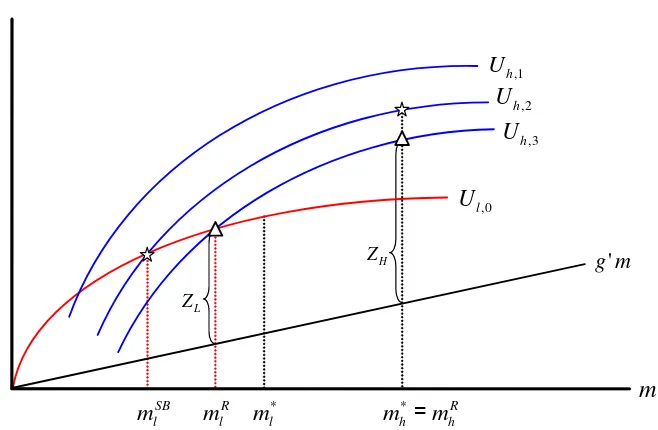
Note that (R2) is not binding and is always satis…ed (by assumption). The solution to the regulator’s problem is summarized in the following proposition.
Proposition 1 : If the regulator is interested in universal access, (R3) is active and the solution to (PR) is: mSBl < mRl < ml and mRh =mh. The payments (TR
l ; T
R
h ) are such that
(R1) and (R5) are binding.
Proof. See appendix.
m R l m SB l
m ml*
R h h m
m* =
[image:11.612.145.474.89.304.2]1 , h U 2 , h U 3 , h U 0 , l U m g' L Z H Z T
Figure 1: Socially optimal regulation
extranormal pro…ts in detriment of the surplus of high-valuation consumers (recall that low-valuation consumer always participates and reaches his reservation utility, Ul). Therefore,
if the regulator had the ability to set the monopolist’s menu of plans (because he knows the costs and/or demand), then he would set plans that could avoid any informational rents extraction (which are passed on to consumers) and the corresponding loses in e¢ciency. The gains in social welfare when the regulator sets the menu of plans (instead of the monopolist) are derived from Corollary 2.
Corollary 2 : The monopolist’s pro…ts in the second-best solution are greater than zero.
Proof. See appendix.
By concavity of the monopolist’s pro…t function, there is a unique plan to the right of
mSB
l such that the monopolist self-…nance ( = 0), the low-valuation consumer keeps his
reservation utility, Ul, and the high-valuation consumer reaches a lower indi¤erence curve
(higher utility level)25, providing unambiguous gains in social welfare with the regulated
plan. Figure 1 shows the results mentioned above, where ZH + ZL =A.
Consequently, considering the results above, the regulator has the task of establishing a regulatory scheme that not only encourages the monopolist to be productively e¢cient, but
25The redistribution of rents to consumers could also bene…t low-valuation consumers, reaching a lower
also to o¤er alternative plans that generates, at least, a similar level of allocative e¢ciency than the obtained in proposition 1. However, as will be shown in the next section, this will be impossible to achieve if the regulator uses the WAPC regulatory scheme.
2.2
Weighted Average Price Cap Model
The WAPC regulatory scheme is characterized because the regulator, rather than establish a menu of regulated plans, delegates the pricing to the monopolist (he has better information for it). However, the regulator is responsible for setting the cap as a weighted average price (TR), which will be reduced according to the RPI-X factor (also calculated by the regulator).
Additionally, the regulator maintains a universal access policy.
The monopolist will price discriminate in second-degree in order to maximize his pro…ts. This imply the design of a menu of alternative plansf(Tl; ml);(Th; mh)gsuch that encourages
consumers to reveal their type and, simultaneously, ful…ll with the weighted average price cap set by the regulator; i.e. carry out Th+ (1 )Tl TR.
The monopolist’s problem is de…ned as:
M ax
fTh;Tl;mh;mlg
Th+ Tl A g( mh+ ml) (PM)
subject to:
uh+vh(mh) Th Uh (R2’)
ul+vl(ml) Tl Ul (R3’)
ul+vl(ml) Tl ul+vl(mh) Th (R4’)
uh+vh(mh) Th uh+vh(ml) Tl (R5’)
Th+ (1 )Tl TR (R6)
ThR; TlR; mRh; mRl 0
Note that (R2’) is not binding and is always satis…ed (by assumption).
It is noteworthy that, if the WAPC constraint (R6) is not included, the monopolist’s problem above is reduced to the simple screening problem, in which the monopolist does not know the types of consumers and o¤ers a menu of plans such that consumers self-select. Obviously, the solution to this screening problem is the second best, which was introduced in the assumptions of the monopolist.
Proposition 3 : Under the WAPC regulatory scheme, if the regulator imposes an universal access policy and the monopolist’s …xed costs (A) are not as high, then (R3’), (R5’) and (R6) are actives and the solution of (PM) is: ml2 < mSBl and mh2 < mh. The payments(Tl2; Th2)
are such that (R3’) and (R6) are binding.
Proof. See appendix.
Proposition 3 tell us that, under the WAPC regulatory scheme, the monopolist still has incentives to extract informational rents from high-valuation consumers, inducing ine¢cient allocation results. By delegating the setting of the menu of plans to the monopolist, in the classical screening model he will maximize his pro…ts by setting plans equal to the second-best outcome f(TSB
l ; mSBl );(ThSB; mh)g; i.e. he will face the typical trade-o¤ between e¢ciency
(distorting ml and Tl) and rent extraction (increasing Th but with the samemh).
Now, when the WAPC constraint is imposed, the monopolist may continue extracting informational rents, although not by increasing Th over the second best –ThSB– but by
re-ducing mh; i.e. the trade-o¤ between e¢ciency and rent extraction is presented in di¤erent
way: the distortion of the low-valuation consumer’s plan (on his reservation utility –Ul–) is
accompanied by a distortion ofmh from the …rst best –mh–. If this distortion does not occur,
then the monopolist ful…lls with the WAPC constraint but would not be maximizing pro…ts; or otherwise.
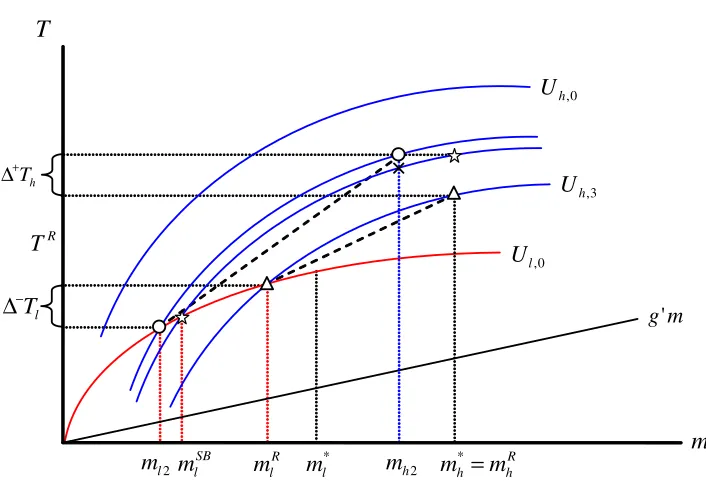
The Figure 2 shows the mechanism behind the menu of plans designed by the monopolist, as well the ine¢cient results generated by the application of the WAPC regulatory scheme. If the WAPC constraint does not exist, the monopolist has the ‡exibility to set a menu of plans and will maximize his pro…ts distorting the high-valuation consumer’s plan with the intention of extracting informational rents from the high-valuation consumers; i.e. he will set the menu f(TSB
l ; m
SB
l );(T
SB
h ; mh)g. However, o¤ering a second-best menu implies that
the WAPC constraint will not be ful…lled – TSB
h + (1 )T
SB l > T
R– (see the stars for both
types of consumers in Figure 2).
In this situation, the monopolist has two alternatives: (i) reduce TSB
h (distorting mh) so
that, together with TSB
l , the WAPC constraint is ful…lled26; or, (ii) reduce TlSB (distorting
mSB
l ) so that, together with ThSB, the WAPC constraint is ful…lled27. Choosing the …rst
alternative the monopolist’s pro…ts would be a¤ected in [v0
h(mh) g0(:)]; while with the
sec-26In the Figure 2, this involves moving from the second best –stars for both types of consumers– to a menu
of star –for low-valuation consumer– and cross –for high-valuation consumer–,f(mSB l ; T
SB
l );(mh; Th)g.
27That is, moving from the second best to a menu of circles for both types of consumers,
m R l m 2 l m * l
m mh2
R h h m
m*=
[image:14.612.128.481.78.319.2]0 , h U 3 , h U 0 , l U m g' T R T h T + ∆ l T − ∆ SB l m
Figure 2: Distortions in the WAPC model
ond alternative would be a¤ected in [v0
l(ml) g0(:)] g0(:)28. Since the monopolist’s pro…t
function is concave in m (see Corollary 2), [v0
l(ml) g0(:)] > vh0(mh) and the monopolist
will choose the alternative (ii). In words, the monopolist will distort the low-valuation con-sumer’s plan beyond the second best (ml < mSBl ) with the intention to continue extracting
informational rents from high-valuation consumers by o¤ering a plan with the same payment (TSB
h ) but a lower amount of minutes (mh < mh). In terms of Figure 2, the incorporation of
the WAPC constraint leads to the monopolist o¤ering a menu of plans equal to the circles for both types of consumers.
Thus, under the WAPC regulatory scheme, the monopolist o¤ers a menu of alternative plans more distorted than the second-best outcome and the socially optimal (allocative in-e¢ciency), generating losses in social welfare. The low-valuation consumer remains on his reservation utility –Ul– and the high-valuation consumer reaches a higher indi¤erence curve
(lower utility level) than the one reached in the second best; besides both types of consumers are consuming ine¢cient quantities.
Furthermore, it should be noted that this result still remains ine¢cient despite the weighted average price cap (TR) is calculated from the solution of the central planner of
28Note that by reducing the amount of minutes consumed –m–,g0(:)is the reduction in costs for producing
section 2.129. Note that the distortions in m do not explicitly depend on TR; that is,
re-gardless of the value ofTR, the monopolist will distort the menu of plans with the intention to continue extracting informational rents, which ultimately leads to the ine¢cient results shown in Proposition 3.
Despite the …ndings, the monopolist can still continue extracting rents under certain situations. Obviously, the monopolist’s pro…ts depend on the proportion of each type of consumer, being strictly increasing in . This means that the monopolist can implement a shutdown policy of low-valuation consumers –if there is a su¢ciently large – to extract all informational rents from high-valuation consumers, such as classical theory of contracts refers to (see La¤ont and Martimort, 2002).
According to La¤ont and Martimort (2002), the monopolist will implement a shutdown policy of low-valuation consumers if:
[vh(mSBl ) vl(mSBl )] (1 )[TlSB g0mSBl ] (SP)
that is, if the expected costs of leave informational rents to high-valuation consumers (for the low-valuation consumer participation) are at least as large as the expected bene…ts from transacting with the low-valuation consumer at the second-best outcome. From this, we de…ne SB as:
SB f : [v
h(mSBl ) vl(mSBl )] = (1 )[TlSB g0mSBl ]g (D1)
In this regard, to implement a shutdown policy under the WAPC regulatory scheme, the monopolist will not take in consideration the extra bene…ts generated by the shutdown policy at the second-best solution (i.e. from SB which induces the shutdown policy at the
second best), but those that will generate the shutdown policy from the solution presented in Proposition 3. The latter implies that, under the WAPC regulatory scheme, there also exist a P C –su¢ciently large but lower to SB– that generates the shutdown of low-valuation
consumer. Thus, considering that the monopolist would implement a optimal shutdown policy30, P C is de…ned as:
P C f : [v
h(ml2) vl(ml2)] = (1 )[Tl2 g0ml2]g (D2)
29TR set from TR h andT
R
l , which makes zero pro…ts. Recall that Bernstein et al. (2006) and Vogelsang
(1990), highlight the importance of the initial pricing before the application of the RPI-X mechanism.
Now we present the solution to the monopolist’s problem when he implements a shutdown policy of low-valuation consumer.
Proposition 4 : For any P C, the imposition of an universal access obligation in
a WAPC regulatory scheme is not restrictive, and the monopolist will only o¤er a plan to high-valuation consumers, such that: mh3 < mh and Th3 =
1
TR.31
Proof. See appendix.
The ‡exibility the monopolist has to set a menu of plans for both types of consumers (main characteristic of WAPC regulatory scheme), also implies that he has enough ‡exibility to decide not o¤er a plan for low-valuation consumer if it is not pro…table, as long as ful…lls with the WAPC constraint. That is, the shutdown of low-valuation consumer may occur regardless if the universal access obligation is imposed or not32.
In terms of Proposition 4, although the regulator imposes an universal access obligation to the monopolist, the latter may …nd some situation –when P C– in which it is not
pro…table to o¤er a plan to low-valuation consumers. In such situations, the monopolist will prefer to shutdown low-valuation consumers to focus only in the extraction of all informational rents from the high-valuation consumers by o¤ering a plan on his reservation utility –Uh–.
However, as shown in Proposition 3, the informational rents extraction are presented in a di¤erent way. According to the classical literature of contract theory, with the shutdown of the low-valuation consumer, the monopolist should be able to o¤er an e¢cient plan to high-valuation consumers(Th; mh). In contrast, this does not happen under the WAPC regulatory
scheme because, the increase inTh is limited by the presence of the WAPC constraint, which
ultimately encourages the monopolist to extract rents by distorting mh from the …rst best
–mh–. This distortion will be such that the high-valuation consumer reaches its reservation utility –Uh–.
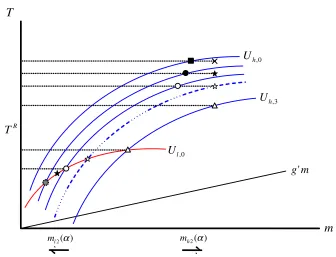
Figure 3 shows the results mentioned above. In it we can see how the solution to the monopolist’s problem, presented in Proposition 3, changes to an increases33. Then we
can say that there is an associated to a second-best solution (black stars for both types of consumers) from which the monopolist still might not have incentives to implement a shutdown policy of low-valuation consumers –i.e. [vh(mSBl ) vl(mSBl )] < (1 )[T
SB l
31We uses the subscript h3 to di¤erentiate the solution of monopolist’s problem in Proposition 4 and the
solution presented in Proposition 3.
32The universal service obligation ful…llment is not veri…able by the regulator, because he does not possess
complete information about the existence of low-valuation consumers who are willing to pay for the service and not access it by the lack of supply plans for these type of consumers.
m )
(
2α
l
m mh2(α)
0 ,
h
U
3 ,
h
U
0 ,
l
U
m g' T
R
[image:17.612.136.472.80.337.2]T
Figure 3: Distortions due to shutdown of low-valuation consumers
g0mSB
l ]–, but with the distortions presented in Proposition 3 may …nd it unpro…table to o¤er
a plan for the low-valuation consumer –i.e. [vh(ml2) vl(ml2)] > (1 )[Tl2 g0ml2]–.
Thus, for any P C, the monopolist decides to shutdown low-valuation consumer to
focus in the informational rents extraction from high-valuation consumers by increasing Th,
such that the WAPC constraint is ful…lled (the cross for high valuation consumer); however, the monopolist still has margin to continue extracting rents (note that cross is not on the reservation utility Uh;0), which are obtained by reducing mh (the monopolist o¤ers the black
square and extracts all surplus from the high-valuation consumer).
It is worth mentioning that, as consequence from the monopolist’s decision of doesn’t o¤er a plan to low-valuation consumer, the monopolist would be restricting access to consumers who could access to the market but they don’t do it just by lack of plans. In general, for any
P C, the low-valuation consumers are shutdown from the market, although the reasons
for this may be di¤erent34. However, if for SB the monopolist is able to cover his total costs
and [vh(mSBl ) vl(mSBl )] < (1 )[TlSB g0mSBl ], then for any 2 ( P C; SB) there is
clear that low-valuation consumers were shutdown from the market when they did have the
34Obviously, one cause for shutdown a certain types of consumers is the preference of the monopolist to
willingness to pay for the service and enter to the market; that is, if the universal access obligation would not been imposed, the monopolist would set a second-best menu of plans and both types of consumers would be participating in the market.
Therefore, despite the regulator imposes an universal access obligation, the use of the WAPC regulatory scheme allows that: (i) the monopolist can implement a shutdown policy of low-valuation consumers –ceasing to o¤er the service to consumers willing to pay for such service–, (ii) distortions on the menu of plans are maintained and, (iii) once implemented the shutdown policy, there is nothing to prevent the extraction of all surplus from high-valuation consumers.
The e¤ect of using the WAPC regulatory scheme on the monopolist’s menu of plans is summarized in the following Corollary.
Corollary 5 Under WAPC regulatory scheme, if (1 )v0
l(ml) < g0(:) then dmdmhl > 0, 8ml
and > SB:
Proof. See appendix.
That is, while the regulator decides to use the WAPC regulatory scheme, the monopolist, even with the incorporation of such constraint on his problem, will still have ‡exibility to set the menu of plans and will prefer to distort it with the intention to continue extracting informational rents.
A pro…t-maximizing monopolist, by distorting ml will also distort mh to cover losses
caused by the ful…llment of the WAPC constraint. The pro…ts will depend on the pro…ts size obtained due to changes in ml and mh, which could be even greater than those achieved in
the second-best solution.
3
Conclusions
We analyze the Price Cap regulatory scheme from the point of view of allocative e¢ciency and universal access, in particular when the RPI-X mechanism is applied to a weighted average price, which is calculated from the menu of plans o¤ered by the monopolist as part of a second-degree price discriminating strategy.
to social welfare losses. This happen despite that the initial prices were set to costs (tari¤s that make zero pro…ts), contradicting what until now the economic literature has proposed about it.
It has also been demonstrated that the WAPC constraint does not meet the primary objective of limiting the monopolist’s market power. On the one hand, the monopolist can implement a shutdown policy of low-valuation consumers (for P C, despite that the
regulator impose a universal access obligation), whose main consequence is the non-provision of service to consumers who are willing to pay for the service. On the other hand, this regulatory scheme does not prevent the monopolist extracts all high-valuation consumers’ surplus, if the shutdown policy is implemented. The use of this regulatory scheme seems to be the cause of what happened in the Peruvian telecommunications market, since there were consumers that had been in the …xed-telephone market before the WAPC was implemented, and subsequently left it.
In that sense, the policy recommendation is that when the regulator allows the monopolist to price discriminates in second-degree, the latter should not be regulated by Price Cap, calculated as the weighted average of the plans o¤ered. However, if the regulator wants to keep using the Price Cap scheme, the RPI-X factor should be applied to a single plan (e.g. the plan "Classic Line"), leaving some ‡exibility to the monopolist to o¤er alternative plans (see Li Ning and Willington, 2009).
References
[1] Armstrong, M., Cowan, S. and Vickers, J. (1997): Regulatory Reform: Economic Analy-sis and British Experience. The MIT Press, Cambridge.
[2] Armstrong, M. and D. Sappington (2004): "Toward a Synthesis of Models of Regulatory Policy Design with Limited Information". Journal of Regulatory Economics; 26:1, pp. 5-21.
[3] Armstrong, M. and J. Vickers (1991): "Welfare E¤ects of Price Discrimination by a Regulated Monopolist". The RAND Journal of Economics; 22:4, pp. 571-580.
[4] Bagh, A. and Bhargava, H. (2006): "Information Structures, Price Discrimination and Demand Uncertainty". Workshop on Information Systems and Economics; Kellog School of Management, Northwestern University.
[5] Baron, D. and R. Myerson (1982): "Regulating a Monopolist with Unknown Costs".
Econometrica; 50:4, pp. 911-930.
[6] Bernstein, J., Hernandez, J., Rodriguez, J., and Ros, A. (2006): " X-Factor updating and total factor productivity growth: the case of peruvian telecommunications, 1996-2003".
Journal of Regulatory Economics; 30, pp. 316-342.
[7] Bertoletti, P. and C. Polleti (1997): "Welfare E¤ects of Discriminatory Two-Part Tari¤s Constrained by Price Caps". Economics Letters; 56:3, pp. 293-298.
[8] Bradley, I. and Price, C. (1988): "The Economic Regulation of Private Industries by Price Constrains". The Journal of Industrial Economics; 37:1, pp. 99-106.
[9] La¤ont, J. and D. Martimort (2002): The Theory of Incentives. Princeton University Press.
[10] La¤ont, J. and J. Tirole (1993): A Theory of Incentives in Procurement and Regulation. The MIT Press, Cambridge.
[11] Lambrecht, A., Seim, K. and Skiera, B. (2007): "Does Uncertainty Matter? Consumer Behavior Under Three-Part Tari¤s". Marketing Science; 26:5, pp. 698-710.
[12] Li Ning, J. and Willington, M. (2009): "Regulating a Monopoly with Universal Service Obligation: The Role of Flexible Tari¤ Schemes". Documento de Investigación NoI-197.
[13] Rodríguez, A. (2004): "Per…l de uso y demanda potencial de telfonía en zonas urbano-marginales del Perú". Study made for OSIPTEL - Studies in Telecommunications N 18.
[14] Sappington, D. and D. Sibley (1988): "Regulating without Cost Information: The In-cremental Surplus Subsidy Scheme".International Economic Review; 29:2, pp. 297-306.
[15] Sharkey, W. and D. Sibley (1993): "Optimal Non-Linear Pricing with Regulatory Pref-erence over Customer Type". Journal of Public Economics; 50:2, pp. 197-229.
[16] Sibley, D. (1989): "Asymmetric Information, Incentives and Price-Cap Regulation".The RAND Journal of Economics; 20:3, pp. 392-404.
[17] Vogelsang, I. (1989): "Two-Part Tari¤s as Regulatory Constraints". Journal of Public Economics; 39:1, pp. 45-66.
A
Appendix
Proof. [Proposition 1] The Lagrangian of the regulator’s problem, when he is interested in the universal access problem (R3 active), is as follows:
L = [uh+vh(mRh) T R
h ] + [ul+vl(mRl ) T R
l ] + [ T R
h + T
R
l A g( m
R
h + m
R l )]
[ul+vl(mRl ) T R
l Ul] +'[vh(mRh) T
R
h vh(mRl ) +T
R l ]
The …rst order conditions:
ThR: + ' = 0 =) '= ( 1) ; >1
TlR : + +'= 0 =) = 1
mRh : vh0(mhR) g0(:) +'vh0(m R h) = 0
v0h(mR
h) = g
0(:)
mRl : vl0(mlR) g0(:) + vl0(m R
l ) 'vh0(m
R l ) = 0
vl0(mR
l ) =
(1 )
g0(:) + ( 1)v0h(mR l )
vl0(mRl ) =g0(:) +
1
vh0(mRl ) g0
By concavity of v(m) and since vh0(mR
h) =g0(:), we conclude thatv0l(mSBl )> vl0(mRl ).
There-fore, the plan for low-valuation consumer –set by the regulator– is less distorted than the second-best solution; that is, the low-valuation consumer will consume a greater amount of minutes than the second-best quantity (approaching to the e¢cient outcome).
Moreover, from the low-valuation consumer’s incentive compatible constraint (R5) as an equality:
uh+vh(mRh) ThR = uh+vh(mRl ) TlR
ThR = TlR+vh(mRh) vh(mRl )
pay-ments are:
TlR = A+g(:) vh(mRh) + vh(mRl )
ThR = A+g(:) + (1 )vh(mRh) (1 )vh(mRl )
Proof. [Corollary 2] This demonstration is taken from Li Ning and Willington (2009). Since the regulator sets plans such that the monopolist makes zero pro…ts, it is enough to show that the monopolist’s pro…t function is monotonically decreasing in ml as the socially
optimal plan moves along the low-valuation indi¤erence curveUl(i.e. TlR =ul+vl(mRl ) Ul).
The monopolist’s pro…t function can therefore be rewritten as:
= [ul+vl(ml) Ul+vh(mh) vh(ml) g0mh] + [ul+vl(ml) Ul g0ml] A
Di¤erentiating with respect to ml:
@ @ml
: vl0(ml) v0h(ml) + vl0(ml) g0
Note that from the latter equation, we get the second-best solution (the ml that maximizes
the pro…t function). Taking into account the Proposition 1 (i.e. evaluating at ml =mRl ), we
have:
v0l mRl vh0(mR
l ) g
0
v0l mRl
1 v
0
l(m R
l ) +
1 g
0 g0
vl0(mRl ) +g0 <0
By Proposition 1, it was shown that for mRl the pro…ts are zero and mRl > mSBl . The above shows that for quantities greater than mSB
l , the pro…t function is decreasing on ml and,
therefore, the monopolist’s pro…ts are greater than zero at mSB
l .
Proof. [Proposition 3] The Lagrangian of the monopolist’s problem is:
L = Th+ Tl A g( mh+ ml) + [ul+vl(ml) Tl Ul]
+ [vh(mh) Th vh(ml) +Tl] + 2[T
R T
The …rst order conditions are:
Th : 2 = 0 =) = 2 >0
Tl : + 2(1 ) = 0 =) = 1 2 >0 ; 2 <1 ; 2 >0
mh : g0(:) + vh0(mh) = 0
vh0(mh2) =
2
g0(:) ; > 2
ml: g0(:) + vl0(ml) v0h(ml) = 0
vl0(ml) =
1 1 2
g0(:) + 2
1 2
vh0(ml)
vl0(ml2) = g0(:) +
2
(1 2)
v0h(ml)
2
(1 2)
g0(:) ; 2 <1 ; > 2
The payments are:
Tl = ul+vl(ml) Ul
Th =
1
TR 1 [ul+vl(ml) Ul]
Therefore, since > 2 then v0h(mh2)> vh0(mh)and vl0(ml2)> vl0(mSBl ).
Proof. [Proposition 4] By Corollary 2 is shown that the pro…t function is strictly de-creasing on ml when the constraint (R3’) is binding (i.e. the low-valuation consumer gets his
reservation utilityUl;0). Consequently, by the Intermediate Value Theorem, we conclude that
for each , there is a unique solution (TSB
l ; mSBl ), and hence (Tl2; ml2) when applying the
WAPC regulatory scheme. The latter is true because the pro…t function is strictly increasing on (see Li Ning and Willington, 2009).
Therefore, for any P C, the monopolist will not o¤ers a plan for low valuation
consumer (the universal access is not guaranteed), and the monopolist’s problem is de…ned as follows:
M ax
fTh;mhg
subject to:
uh+vh(mh) Th Uh (R2’)
Th TR (R6’)
ThR; mRh 0
The Lagrangian is as follows:
L=Th A g(mh) + [uh+vh(mh) Th Uh] + 3[T
R T
h]
The …rst order conditions are:
Th : 1 3 = 0 =) = 1 3 >0
mh : g0(:) + v0h(mh) = 0
v0h(mh3) =
1 1 3
g0(:)
Considering that 1 3 > 0, we have that vh0(mh3) > vh0(mh) and thus mh3 < mh: The
payment Th is:
TR = Th+ (1 )Tl
Th3 =
1 TR
Proof. [Corollary 5] From Proposition 3 we have that the monopolist will distorts both
mSB
l (reducing TlSB) and mh (holding ThSB) to ful…ll with the WAPC constraint. In this
context, the distortions in plans of low and high-valuation consumers, respectively, will impact on the monopolist’s pro…ts in the following way:
= Th+ vl(ml) A g( mh+ ml)
@ @ml
= [v0
l(ml) g0(:)] (C1)
@ @mh
From condition (C1) and concavity ofvl(m), increases inmlcut down the monopolist’s pro…ts
in [v0
l(ml) g0(:)]; while from condition (C2), increases in mh raise his pro…ts in g0(:).
Thus, for any distortion of mSB
l as consequence of the ful…llment the WAPC constraint, the
monopolist will always distorts mh from the …rst-best outcome; typical reaction of a
pro…t-maximizing monopolist, who in this case is minimizing losses caused by the ful…llment the WAPC constraint. This applies for any g0(:)>0.
Therefore, if the gains of distorting mh o¤set the losses of distorting ml –i.e. (1
)v0
l(ml)< g0(:)–, the monopolist will make greater pro…ts than those achieved in the