CROSS SECTION AND BRANCHING RAI
11™
nmaw
«•ρ
lil
ë
liiii!
T h i s .
rlüw
of the European Communities. document was prepared under the sponsorship of the CommissionNeither the Commission of the European Communities, its contractors' . nor any person acting on their behalf:
Make any warranty or representation, express or implied, with respect to the accuracy, completeness, or usefulness of the information con tained in this document, or t h a t the use of any information, apparatus,
Assume any liability with respect to the use of, or for damages resulting the use of any information, apparatus, method or process disclosed in this document.
ÎS iti:
e at the
at the price of F F 5. F B 50.— DM 4, Lit. 620 Fl. 3.60
When ordering, please quote the E U R n u m b e r and the title, w h i c h are indicated on the cover of each report.
'.*ifiiÏirit*tii·. -Μ ι ii liti, brini! miniai s.iiili J, iJWaiHt'!iJw^Mul.!Pii»3ìtiH·!'- iBwKB{tiiff?'*4^:!tÌ!^J*''l^iiin'
A l
European Atomic Energy Community EURATOM Joint Nuclear Research Center
Geel Establishment Belgium
Central Bureau for Nuclear Measurements CBNM Brussels, June 1968 3(> Pages 5 Figures FB 50
Data available on the l nB (n, a) cross section and the branching ratio in the
range from thermal energy to 1 MeV arc compiled. After a critical evaluation a set of data is selected to compute recommended values and best curves of the (n, a) cross section and the branching ratio, for neutron energies up to
100 keV. The ση, a cross section is derived from this,
ι
At thermal energy σο = (3835 + 14)6 and R° = (Ì.30S + 0.012 are
n· a
recommended, the errors corresponding to confidence limits (95 % ) . From thermal energy to 100 keV best curves are recommended on the basis of least
EUR 3950 e ι
EVALUATION OF T H E 10B (η, a) CROSS SECTION ANU BRANCHING
RATIO by K. GUBERNATOR and H. MORET European Atomic Energy Community EURATOM Joint Nuclear Research Center
Geel Establishment Belgium
Central Bureau for Nuclear Measurements CBNM Brussels, June 1968 36 Pages 5 Figures FB 50
Data available on the 10B [η, a) cross section and the branching ratio in the
range from thermal energy to 1 MeV are compiled. After a critical evaluation a set of data is selected to compute recommended values and best curves of the (», a) cross section and the branching ratio, for neutron energies up to 100 keV. The ση, a cross section is derived from this.
ι
At thermal energy σο = (3835 + Ii)b and R° = 6.308 + 0.012 are
n· a.
squares fits to the experimental data. The formula for an, a = / (E) contains
terms to correct for non-l/v behaviour from the eV-range up to 100 keV. The confidence interval gradually decreases from + 146 (thermal) to + 0.06 6 (100 keV).
R = constant = 6.3 + 0.3 up to 30 keV. From 30 to 100 keV higher order terms are proposed to fit the data. All recommended values and curves are summarized in the last chapter of this report, together with a set of numerical values.
Ì
1 I I
Ί
squares fits to the experimental data. The formula for ση, « = / (E) contains ! terms to correct for non-l/v behaviour from the eV-range up to 100 keV. The ] confidence interval gradually decreases from + 146 (thermal) to + 0.06 6 |
(100 keV). I R = constant = G.3 ± 0.3 up to 30 keV. From 30 to 100 keV higher order
EUROPEAN ATOMIC ENERGY COMMUNITY - EURATOM
EVALUATION OF THE
1 0Β(η,α)
CROSS SECTION AND BRANCHING RATIO
by
K. GUBERNATOR and H. MORET
1968
Joint Nuclear Research Center Geel Establishment - Belgium
SUMMARY
Data available on the 10B («, a) cross section and the branching ratio in the
range from thermal energy to 1 MeV are compiled. After a critical evaluation a set of data is selected to compute recommended values and best curves of the (η, a) cross section and the branching ratio, for neutron energies up to 100 keV. The an, a cross section is derived from this.
At thermal energy σο = (3835 + 14)6 and R° = 6.308 + 0.012 are
n· a
recommended, the errors corresponding to confidence limits (95 % ) . From thermal energy to 100 keV best curves are recommended on the basis of least squares fits to the experimental data. The formula for an, a = / (E) contains terms to correct for non-l/v behaviour from the eV-range up to 100 keV. The confidence interval gradually decreases from + 146 (thermal) to + 0.06 6 (100 keV).
R = constant = 6.3 + 0.3 up to 30 keV. From 30 to 100 keV higher order terms are proposed to fit the data. All recommended values and curves are summarized in the last chapter of this report, together with a set of numerical values.
KEYWORDS
NUCLEAR REACTIONS BORON 10
NEUTRON BEAMS ALPHA PARTICLES LITHIUM 7
CROSS SECTIONS BRANCHING RATIO KEV RANGE
NUMERICALS
THERMAL NEUTRONS DIAGRAMS
EV RANGE
Index
Page Introduction
2. Isotopie Composition of Natural Boron 6
3. Νοη-(η,α) Reactions 8
3.1. (η,η) cross section 8
3·2. (η,γ) cross section 10 3·3· (η,ρ) cross section 10 3·4. (η,t) cross section 10 4. (η,α) Cross Section 11
4.1. Q-values 11 4.2. (η,α) cross section at thermal energy -LI
4.3· Recommended thermal cross section 13 4.4. (η,α) cross section from thermal energy to 1 MeV 13
4.5· Analysis of data and recommended best curve ly
5. Branching Ratio 19 5-1. Branching ratio at thermal energy 19
5.2. Recommended thermal branching ratio 22 5.3. Branching ratio from thermal energy to 1 MeV 22
5-4. Analysis of data and recommended best curve 24 6. Application of the recommended data as standards
for neutron measurements 25
INTRODUCTION
From the data available in literature have been derived : a. the best values of the B(n,cc) cross section and
branching ratio at thermal energy,
b. the energy dependence up to 100 keV of the (η,.ι) and (η,α ) cross sections and of the branching ratio.
To these ends a compilation of data from thermal energy to 1 MeV is contained in this report, together with a critical evaluation, ending with a selection of those data wich
enter into the calculations, required for the above-men tioned purposes. Of the energy range up to 1 MeV, the re commendations are limited to the interval between thermal energy and 100 keV as the latter is the most important
region for practical use at the present time. Nevertheless, curves and formulae are also given above 100 keV, but
the accuracy is much less in this energy interval.
Such an evaluation also required a discussion of ηοη-(η,α)-reactions. It was considered useful to incorporate a
chapter on isotopie composition as well. On several occasions published data had to be changed because of afterwards better known isotopie composition. Further
more, for convenience of the reader, it might be useful to know which differences in isotopie composition of so-called natural samples may be expected, and on the other hand -how accurate standard boron stocks have been defined and how and where standard samples may be obtained.
The Β cross sections have already been compiled and evaluated earlier (Hu 58, Bu 60, St 64, Sp 67, Ir 67).
However, until now the most recent data and comments which help to clarify the situation have not all been taken into
consideration.
ISOTOPIC COMPOSITION OF NATURAL BORON
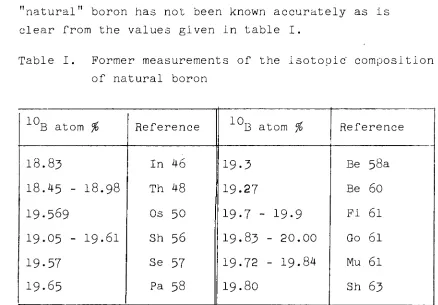
Until recent years the Β isotope concentration in "natural" boron has not been known accurately as is clear from the values given in table I.
Table I. Former measurements of the isotopie' composition of natural boron
1 0B atom $
18.83
18.45 I8.98 19.569
19.05 1961 19.57
19.65
Reference
In 46 Th 48 Os 50 Sh 56 Se 57 Pa 58
1 0B atom $
19.3 19.27
19.7 19.9 I9.83 20.00 19.72 1984 I9.8O
Reference
Be 58a Be 60 Fi 61 Go 61 Mu 61 Sh 63
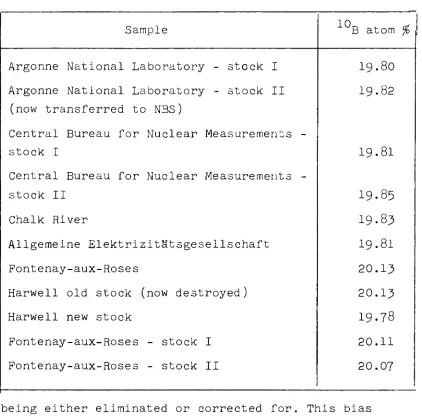
Variations in the isotopie composition of natural boron appear also from a series of intercomparisons carried out by the Central Bureau for Nuclear Measurements in 1962 on reference stock used for neutron measurements by different nuclear institutes (table II). The values given in table II (De 63) have a precision of + 0.5$ relative but were uncorrected at that time for possible systematic errors (such as mass discrimination).
Table I shows that Β concentrations vary from 18.4 to 20.0 atom $, while it appears from table II that even reference stocks are not identical.
To eliminate this uncertainty and consequently the error contribution to ö .( Β ) , a long term effort at the
Central Bureau for Nuclear Measurements has resulted in highly reproducible (< 0.1$) and accurate (0.1$) isotopie analysis of boron in boric acid. A small bias effect
[image:10.587.85.523.131.436.2]Table II. I962 Intercomparison of different natural boron stocks
Sample
Argonne National Laboratory stock I Argonne National Laboratory stock II
(now transferred to N3S)
Central Bureau for Nuclear Measurements stock I
Central Bureau for Nuclear Measurements stock II
Chalk River
Allgemeine Elektrizitätsgesellschaft FontenayauxRoses
Harwell old stock (now destroyed) Harwell new stock
FontenayauxRoses stock I FontenayauxRoses stock II
1 0B atom $
I9.8O 19.82
I9.8I
19.85 19.83 I9.8I 20.13 20.13 19.78 20.11 20.07
being either eliminated or corrected for. This bias factor was constant over the concentration range 10$ 90$ B and hence was reliable to correct any boron isotopie measurement. Thus the B concentration of the CBNM stock II of 200 kg boric acid (Η,ΒΟ,) was redeter mined, yielding an absolute value of (19.824 + 0.020) atom $ 1 0B (De 68).
This standard is available for distribution provided with a certificate for the isotopie composition, either
[image:11.587.70.492.130.547.2]the standard. The U.S. Atomic Energy Commission Nuclear Cross Section Advisory Group and the EuropeanAmerican Nuclear Data Committee emphasize the desirability of measuring boron neutron cross sections on CBNM standard boron or on boron from the identical NBS stock (De 54).
3. NON(η,α) REACTIONS
The total cross section σ _ and scattering cross section
nT to
σ q are not compiled in this report. However, some
results of absorption cross section σ . are obtained by subtracting σ q from o~ . In the energy range of interest
only elastic scattering is involved : σ n = σ
J ö nS η,η
10 7
In addition to the B(n,a)'Li reaction, the following processes are energetically possible and could
contribute to α , : nA
1 0B ( n ,v)nB , 10B(n,p)10Be and 10B(n, t )24He .
As appears from the following discussion of these competing absorption reactions, their contribution to σ . is too small to account for any significant deviation from the l/v dependence below 100 keV (within the given accuracy limits) or to influence σ at thermal energies.
J η,α to
3.1.(η,η) Cross Section 10o, >10„
Β(η,η) Β Hi 50, Argonne
Scattering cross section measurements on enriched Β and normal Β with epithermal Bfiltered neutrons in the scattering chamber give 2.43 for B.
Wl 55, Oak Ridge
Elastic scattering measurements with a proton recoil proportional counter on a cylindrical sample enriched in Β show angular distribution of scattered neutrons to be isotropic in the centreofmass system at
E = 550 keV and 1 MeV and yield by integration σ
η η , η
(corrected for neutron attenuation and multiple scat tering)# σ = 3·71 b an(ä 2.43 b, respectively.
Hu 58, Brookhaven
Quotes B thermal neutron scattering cross section for the bound atom, calculated by multiplying the free atom cross section, σ„ , by the recoil correction factor:
' free' J
V e e U x f = '
4·°
±
05)».
La 67, Argonne
Integration of differential scattering cross section, varying from 3 to 4 b in the region 80 < E < 5OO keV. Pi 67, Harwell
Least squares fit of measured σ yields a constant scattering cross section σ = (1.95 + 0.10)b for E < 10 keV.
η —
As 68, Harwell
Scattering measurements relative to carbon between 1 keV and 130 keV neutron energy by TOF method, 930$ enriched
Β samples, Liglass detectors. Corrections applied for sample impurities and sample holder, detector ef ficiency and size, multiple scattering; errors arising from counting statistics, background normalization, angular uncertainty, multiple scattering, σ appears
11 f XI
to be constant below 20 keV, the average over energy region 1 to 10 keV being σ = (2.20 + 0.06)b. At
B ö η,η v —
higher energies agreement with the La 67 data is good. By comparison of the quoted σ = 2.20 b with the
XI y LL
constant term of 1.95 b found by Di 67, authors conclude that the deviation from the l/v dependence of σ ( Β) according to Be 58b, Sh 58 and Be 61 is given by a
constant of (0.25 + 0.12)b (see further discussion in section 4.5).
Although the error on this small constant is 50$ a n^
further scattering measurements are needed, As 68 have led us to accept a deviation from the l/v law
(see 4.5) which below 100 keV remains within + 4$ from this law and which may need revision as
10
3.2. (n,y) Cross Section
1 0Β(η,γ)1 1Β Q = + 11.464 MeV
Ba 57, Cnalk- River
Measurement of the absolute intensity of the 4.47 MeV capture γ-line of B with a pair spectrometer.
The partial σ i'ar the production, of this g-line
by thermal neutrons was found to be σ ( Β) = (0.5 + 0.2)b.
Bi 65, Oak Ridge
Investigation of o in the neighbourhood of E = 230 keV,
η, γ η no j-rays observed, upper limit on σ estimated to be
η, s 10 mb.
3.3. (η,ρ) Cross Section
10B(n,p)10Be Q = + 0.227 MeV
Eg 48, Argonne
Be activity measured, produced by irradiating B in a fast-pile spectrum, estimated <σ >( Β) ^ 3m D averaged
η, ρ
over tne spectrum. Mo 66 (see page I5) conclude from this σ <30 mb as an average value over the interval η,ρ ^ 10 keV < E < 500 keV. — η — ^
Cr 56, Buenos Aires
Investigation of the formation of Be from Β by ther mal neutrons using radiochemical methods resulted in ση (10B) < 7 mb.
Co 66, Aldermaston/Argonne
Mentions (without reference, however) a measurement with thermal neutrons yielding σ < 0.2 b.
η,ρ
3.4. (η,t) Cross Section
10B(n,t)2^He Q = + O.328 MeV
Kl 66, Argonne
Investigation of the (n,t) reaction near E »230 keV, no tritium found in the irradiated B„0-, samples, estimated
,10, 2 3
4. (η,α) CROSS SECTION
10B(n,cxo)7Li Q0 = + (28ΟΟ.8 + 7.6) keV 10Β(η,αι)7Li* Q = + (2322.3 + 6.3) keV 7Li+- 7Li Ey = (478.5 + I.5) keV
4.1. Q-Values
The Q-values quoted above are taken from: De 67a, Geel/Mol
15 μg/cm Β layers together with a Pu - ' Am source of about 6OOO dpm in front of an Au-Si surface barrier detector in a thermal neutron beam allowed simultaneous
10 1
measurement of the Β(η,α) Li reaction products and the α-particles of the source. This is essentially the only direct high precision measurement, the quoted error being one standard deviation. (The actually recommended value from La 66 is Q«, = + (2.792 + 2) keV).
4.2. (η,α) Cross Section at Thermal Energy
The cross section at the thermal energy of 0.02526 eV is denoted by σ° throughout this report.
Sc 60, Oak Ridge o° = (3844 + 38)b Fast chopper time-of-flight spectrometer, transmission measurement in the range O.OI8 eV < E < 0.4 eV, B„0^.
n 10 ^
dissolved in D?0, samples enriched in Β to
(99.89 + 0.05)$ and (96.39 + 0.05)$, 6 BF, counters,
multichannel analyser. Corrections applied for background in the counters, differences in Do0 content between
dif-11
ferent samples, presence of 0 and B. Authors assume that σ* is equal to σ° = (3848 + 38)b. To arrive at the value quoted above, σ°_( B) « 4b (Hu 58) has been
no
subtracted here. The error given is one standard deviation. Authors stress that the uncertainty in the analysis of the samples is the main source of error.
Sa 60, Columbia/Brookhaven σ° = (3838 + 11)b ' η , 'χ — Crystal spectrometer, transmission measurement in the range O.OO29I eV < E < 0.1 eV, NaB0o dissolved in D_0, samples
12
enriched in 1 0B to (99.88 + 0.01) atom $ and (92.84 + 0.06)
atom $. Corrections applied: σ A(s) and σ o(S0^~~) from
the Na SO, reference sample, σ ( 1B ) , σ (BO ), dif
ference in D_0 content between different samples. By subtracting G° Q (1 0B ) = (4.0 + 0.5)b (Hu 58) from their
measured σ°_( Β ) , authors obtain abovementioned σ°. o°
nT nA η,o
as a weighted average of the results for the two samples of (3849 + 15)b and (3828 + 15)b, respectively. The quoted errors are standard deviations.
Me 61, Argonne σ" = (3843 + 17)b Neutron lifetime measurement in H.B0. solutions in Ho0,
3 3 2
sample enriched to (93.0 + 0.3)$ in B, BF counter. Corrections applied for dead time losses, background, changes in diffusion coefficient of the solution,
macroscopic scattering cross section of the moderator, contribution of other elements in the compound. The quoted error is mainly statistical.
Bl 62, Oak Ridge σ° = (3846 + 40)b
n*g ~
This is essentially a revised version of Sc 60.
Experimental data are fitted t o o " m o 0 = c + c0//E .
^ nT nS 1 2 η
Thus authors obtain °~°T(10B) = (385O + 4o)b, the error
being standard deviation. From this, σ0. = (3846 + 4o)b
is reevaluated here, taking σβ = 4b according to Hu 58.
Pr 63, Geel/Mol σ° = (3836 + 7)b Slow chopper timeofflight spectrometer, transmission measurement in the range of O.OO6 eV < E < O.O82 eV,
— η —
BQ0 dissolved in Do0, natural Β Γ(19·838 + 0.030)mol$ 1 0B ]
S ¿ IQ
and enriched [(96.525 + 0.006)mol$ B] samples (De 67b, new absolute determination of isotopie composition); bank of BF, counters. Corrected for background and epicadmium neutrons, assumed σ q(Bp0_) = (21 + 2)b, multiple scat
samples, the errors being standard deviations, with
restriction for a possible small systematic error due to mass discrimination. Value given in the first line is
the weighted mean of the two re-evaluated results (De 67b) with the standard deviation, i.e. σ°. (3835 + 11)b for the natural Β and σ° = (3836 + 9)b for tne enriched sample.
Al 64, Ris/ n , j . = (3827 + 12)b Crystal spectrometer, transmission measurement in the range O.OOI5 eV < E < 0.10 eV; the same natural Β sample used as in the Pr 63 measurements. Found σ to vary as l/v. Assumed σ ( B O ) = (21 + 2)b. The above-mentioned
/10 n
o'° ( B) has been deduced here (according to new absolute η,α determination of isotopie composition by De 67b) from the measured σ°. (Β) = (759.1 + 2.0)b. The quoted errors are standard deviations.
4.3· Recommended Thermal Cross Section
4.4
σ* (10B) = (3835 + I4)b
η,α v Ky ^ —
at η 0.02526 eV
Since all other neutron absorbing reactions at thermal energy are negligible (see chapt.3), the absorption cross section is practically identical with the (η,α) cross section. The recommended value is the (weighted) mean of the final results of Sa 60, Pr 63 and Al 64. The error
corresponds to confidence limits at 95$ confidence level (C.L. 95$= + l4b or + 0.37$). The results of all other
authors are in agreement with the recommended value; however, they have not been taken into consideration since their sample analysis is too poor and other short comings are evident.
(η,α) Cross Section from Thermal Energy to 1 MeV
14
Bi 57, Rice
Modified long counter as flux monitor. Nal crystal and multichannel analyser for detecting the 0.478 MeV γ radiation. Β shielded proportional counter with BF,, multichannel analyser, background effects taken into account. No details given on errors and corrections. Measured cross sections normalized at 20 keV (assuming c° = 4010b and validity of l/v law between thermal
η,α J '
energy and 20 keV). Authors conclude σ ~l/v up to
DJ η,α
100 keV and assign a + 25$ error to their absolute
values; their relative values presumably are more accura te. Data plotted in fig. 2 are renormalized to the new recommended thermal value (chapt. 4.3·)j for clarity of presentation, error bars are not indicated. Recently
(Bo 66, Sp 67) the assumed constant efficiency vs.
energy of the modified long counter assigned by Bi 57 has been called in question.
Bi 60, Duke
Long counter as neutron monitor. 122° neutron collimation detection system, 18 BF_ proportional counters connected in parallel. Background effects taken into account.
0 obtained by subtracting ootential scattering σ
η,α J ö * & η,η
2.43 b (Hi 50) from a measured with the 122° collimator by Ro 60. Authors conclude that σ = 624//E within
J η,α /v
statistical errors, corresponding to σ° . = 4036b, and that cross section curve indicates σ ~ l/v up to
η,α /
70 keV, ratio of BF, to longcounter counting rates (assuming constant efficiency) indicates σ ~ l/v up
η , χ.
to 250 keV. Recently (Ta 67) the assumed flat response of the Bi Ó0 long counter has been suspected to be a wrong assumption.
Da 6l, Rice
Long counter as flux monitor, calibrated with PuBe sour ces. Cdshielded gridtype ionization chamber with BF,
10 3
uncertainties of counting statistics, background corrections, geometry, amount of Β in the chamber, wall effects,
neutron energy determination. Authors estimate their cross sections to be in error by + 20$. Bogart comments in
Sp 67 that with the Da 6l data there are difficulties
in separating the (n,a0) and (η,α )groups because of large
epithermal background contribution, and that accuracy is poor as E is lowered to several hundred keV.
^ η
Mo 66, Argonne
Two collimated counting systems, each consisting of 34 BF, counters in a moderator medium, one system used as monitor, the other as counter. Natural Β samples and samples enriched to 93$ in Β. σ and 0 / 0 have been measured and σ . = σ m - σ 0 derived from this,
nA nT nS
taking σ ~ by integrating the differential scattering data of La 67. Authors conclude that σ . follows the l/v law from 10 - 500 keV except for a resonance at E =« 230 keV and a slight dip around 3^0 keV, and that σ - σ «
Xirv XI } CC
100 mb at any E in this interval. Error estimates assigned to the cross sections were obtained from a least squares fit to the measured quantities and vary for σ . from about + 2$ at 10 keV to + 4$ at 250 keV, 10 to 20$ between 300 and 400 keV, and + 5$ between 400 and 500 keV.
In fig. 2 error bars are only shown when the uncertainty exceeds the size of the circle.
Co 66, Aldermaston
Spherical shell transmission method, Β powder shell en riched in Β to 89.4$, either neutron source or detector in the centre of the shell, BF, counters. Corrections applied for variation of detector efficiency with neutron energy, finite counter size and source to detector
distance, anisotropic neutron emission, multiple scattering and neutron energy loss using Monte Carlo and Carlson
calculations. The values given are weighted means of dif ferent measurements with standard deviations. Author
- 16
σ follows quite well a l/v extrapolation from a η,α
thermal value of (3840 + 10)b up to 250 keV. Ma 67 comments that statistical and other errors of Co 66 are so large
(varying from about 5$ at 10 keV to 14$ at 250 keV), that the three points between 100 and I60 keV whose error bars fall above the l/v line are not considered a significant departure.
Pi 67, Harwell
Transmission measurement by T0F method, flight path 120 m and 300 m, neutron burst width 140 ns. Detectors: Al can containing Β powder mixed with vaseline moderator for efficiency improvement. Samples: three (93-0 + 0.2)$ Β samples of different thickness. No corrections for competing processes applied. Background effects, sample impurities and counting corrections are taken into consideration. Mean root square errors calculated.
The measured σ „ from 76 eV to 10 keV are least squares fitted by σ = (610.3 + 3.l)//E + (1.95 ± 0.10)b, corre sponding to an extrapolated σ° = (3839 + 20)b. The last term in the σ m formula is attributed to a constant
nT
potential scattering cross section σ = (1.95 + 0.10)b.
Ο η,η ^ —
By subtracting the σ data of Mo 66/La 67 from the measured σ m, σ . values are obtained up to 500 keV.
nT nA
Author concludes that the 1//E law is apparently followed up to about 300 keV to within the experimental errors which vary from + 1$ at a few hundred eV to + 3$ at about 100 keV and + 7$ at 500 keV.
In this report the σ values below 25 keV are re
evaluated by subtracting the very recent As 68 o data from the measured Di 67 o m .
nT
The σ . data thus obtained are plotted in figs. 1 and 2, tne errors being in the order of the triangles' size. Ma 68, Oak Ridge
Measurement of the inverse reaction using the graphite
Β(η,α) branching ratio. Thin metallic Li Van de Graaff targets placed in the centre of tne graphite spnere. Corrections applied for background effects,
energy spread and target tnickness. Normalization of the relative data by extrapolating σ ( Β) of Sc 6θ, Sa 6θ,
ΓΙ ¿ cx
Pr 63 and Al 64 (both uncorrected for new determination of isotopie composition) from thermal energy to 30 keV, and by the own branching ratio results. In this report the data are renormalized according to the recommended thermal value (chap. 4.3) and l/v law (chap. 4.5).
Author states that the Β(η,α) data are consistent with a departure of less than 3$ from 611//Έ behaviour below
166 keV, whereas the separate ground state and excited state cross section show significant departure from a
1//Έ dependence at and above 30 and 100 keV respectively. 4.5· Analysis of Data and Recommended Best Curve
All available data are represented in figs. 1 and 2. At first sight the l/v behaviour seems to be justified over a wide energy range, even up to 3OO keV. For a more
detailed analysis, however, four data sets were chosen from those reported in the preceding section. These four sets are Mo 66, Co 66, Di 67 and Ma 68, as these are the most accurate measurements in the energy range from ther mal to about 300 keV. Moreover, Co 66 used a completely
independent method.
The first step was to assume a
σ' = C E :1 / 2
η,α n
in which C was computed from the recommended thermal cross section value of section 4.3·, yielding
Ã72
(19.274 + O.O71) bkeV
The error in C corresponds simply to the error of the recommended thermal cross section (i.e. C.L. 95$ of + 0.37$).
The next step was to compute the differences between this "l/v cross section" σ' and the measured cross
' η,α
sections σ (observed). These differences were plotted as a
18
function of energy (fig. 3)·
As it is clear that the scatter of the points is not uni form around the zero line, a weighted least squares fit was computed according to :
n(En) A + Β·Ε^1 / 2 + DE η
yielding the values
(D
tö
>
II
II
D = Erre
-(o
+ (o
-(o
irs ;•32 + .079 . .0039 i r e s
0 . 0 5 ) b
f 0 . 0 1 2 ) b . k e V 1/2
+ 0 . 0 0 0 6 ) b keV oandard d e v i a t i o n s
The curve corresponding to this fit is traced in fig. 3 Formula (1) is in accordance with the model developed by Sh 58 and the shape of the curve seems to fit the experimental data fairly well. Even at 3OO keV the agree ment is still good. Earlier measurements below 30 keV by Be 58b and Be 6l based on the theoretical considerations of Sh 58 but neglecting the higher order coefficients Β and D yielded a term α (equivalent with our A) = 0.40b, whereas As 68 found a value of 0.25b.
Some recommended values σ =oì + 6fsee(l)}are tabulated
η,α η,α in Table III.
The errors r\0 in this table are confidence limits (P=95$), which were computed from three contributions: the uncertainty of the thermal value, which yields a
corresponding error in the coefficient C ( C L . = + 0.37$) the uncertainty in the scattering cross section
the errors in the constants and coefficients of the least squares fit.
the final error is mainly determined by the uncertainties in the σ correction and in the constants of the fit. η,η BRANCHING RATIO
By branching ratio is meant in this report the probability
10 1
of the Β(η,α) reaction going to the ground state of 'Li. For practical reasons this probability is multiplied by 100, hence the sum of ground state and excited state (η,α) reaction probability should be 100 :
R = 100 σ /σ with η,α· η,α σ = σ + σ
η,α η,α· η,α
The branching ratio at the thermal energy of 0.02526 eV is denoted here by R°.
In the literature this branching ratio is sometimes mixed up with the cross section ratio σ /σ , or even
η,α· η,α
with its reciprocal, which is at the origin of some con fusion.
5.1. Branching Ratio at Thermal Energy
Bo 45, Copenhagen R* = 6.3 Cloud chamber, about 400 tracks evaluated. Value given in the paper is σ /σ = 0.067·
η,α· η,α
Gi 48, Cambridge R* = 8.6 Cloud chamber with B(0CH,) gas, total ranges of Li- and α-particles measured, corrected for variations of stopping power.
Ha 50, Chalk River R* = 5-8 ± 0.1 Grid-type ionization chamber with BF_,, multichannel
20
Cu 51, Strasbourg R° = 4.08 ± 0.15 Borate charged nuclear emulsions, 30531 tracks measured. Value given in the paper is σ / o = 0.0427 + 0.0015,
η, α ο η,α
the uncertainty obviously representing only the statistical error.
Bi 52, Basel R° = 6.5 ± 07
Parallel plates ionization chamber with BF^, wall effects neglected, photographic pulseheight spectrograph and multichannel analyser. Only statistical error considered. Value given in the paper is σ„ / σ^ 0.070 + 0.007.
η,α· η,ο.^
Ha 52, Göttingen R° = 5.8 ± 0.1 B(CH^)z proportional counter in paraffin, RaBe neutron
source, l6channel analyser. No corrections applied. Rh52, Pennsylvania R° = 5.9 ± 0.9
Cylindrical ionization chamber with thin Β layer enriched to 96$ in °B, photographic pulseheignt spectrograph, wall effects and layer thickness taken into account.
Value given in the paper is σ / σ = 0.0o3 + 0.009· De 54, Washington R° = 6.52 ± 0.05 Two pulseionization chambers with thin Β films, three channel discriminator. Integral measurements. Exposure
in the NBS standard slowneutron flux, Cd difference method. Effects of geometry and film thickness taken into account. The error quoted is the statistical probable error.
Se 57, Aligarh R° = T.8 + 014
BF5 proportional counter. Measurement obviously erroneous by systematic errors. Value given in the paper is
0 / 0 = 0.040 + O.OOI5. η,αο η,α —
Bu 58, Debrecen R° = 7.9 ± 0.9 Bloaded nuclear emulsion, exposed to a RaBe source in
paraffin. 1230 tracks measured with a microscope. Geometrical corrections taken into account. Value given in the paper
is a / o = 0.086 + 0.009.
Br 60, Rossendorf R" = 6.51 ± °·°5
Proportional counter with BF.,, collimated beam from thermal 3
column of RFR reactor, Cd difference method, 70channel analyser, Vray effects on the counting plateau taken into account. Measurement errors due to radiation from Al and Cu counting tubes are negligible.
Ma 63, Studsvik R° = 6.08 ± 0.07 Proportional counter with BF^, multichannel analyser. Pulseheight resolution 2.6$, statistical accuracy <1$. Author quotes that the average value of 10 measurements give the ratio to + 0.0005 and that, with an estimate of
systematical errors to + 0.0005, ° / ° = 0.0647 + 0.0007.
— η,α· η,α^ —
Ma 65, Oak Ridge R° = 6.3 ± 0.2
Two facetoface Si surfacebarrier detectors with 10B_H¿,
2 o coincidence, multichannel analyser. Thermal neutron spectrum
(wax moderator). Value given in the paper is σ / σ = η,αβ η, α* 0.067 + 0.002 as an average of four measurements.
To 66, North Carolina R° = 6.43 ± 0.11 Semiconductor detector with thin Β converter film, 200channel analyser, thermal neutron beam, epicadmium cneck. Standard error assumed to be entirely statistical. De 67a, Mol/Geel R° = 6.3082 ± 0.006^ Thin Β layer on Aucoated quartz disk in front of an AuSi surface barrier detector, thermal neutron beam, Cddifference method, 400channel analyser. Due to the
geometry, backscattering and selfabsorption are eliminated. 20 runs evaluated taking into account all error contri
butions, corrected for epiCd data. The error indicated is one standard deviation of the mean.
22
wax moderator. Error quoted by the authors combines the
statistical standard deviation and the effect of uncertainty in identifying the 478 keV energy difference from the spectra. 5.2. Recommended Thermal Branching Ratio
Re = 6.3O8 + 0.012
at E = O.O2526 eV n
The De 67a result is recommended as thermal value, since its precision is about one order of magnitude or more better than that of all previous measurements. It is in agreement with the latest solid state detector data of
Ma 65, To 66 and Ma 68, but disagrees with the most precise previous results of De 5^, Br 60 and Ma 63. The above men tioned error gives confidence limits(P=95$), derived from the standard deviation quoted by De 67a.
5·3· Branching Ratio from Thermal Energy to 1 MeV
All available data are represented in figs. 4 and 5, to gether with the recommended best curve.
Pe 51, Wisconsin
Cd-shielded proportional counter with BF3, wall effect corrections, photographic recording. Considered are the uncertainties of concentration of °B in the counter, background corrections, counting statistics, neutron energy determination. In the paper are presented the
o / σ values, the total uncertainty of which is, η,αβ η,α according to the authors, somewhat greater than the statis tical uncertainty indicated in the graph.
Bi 52, Basel
B-shielded parallel plates ionization chamber with BF,, wall effects neglected, photographic pulse-height spec trograph. Considered are the uncertainties of evaluation of the pulse-height spectrum, statistics, neutron energy. It concerns a single value at 5OO keV which is quoted in the paper as σ / σ = 0.31 + 0.04, the total error
of 13 $ being composed of a 8$ statistical error and a 10$ uncertainty in evaluation.
Da 6l, Rice
Cdshielded gridtype ionization chamber with BF, enriched 10
to 96$ in B, wall effects and multichannel analyser dead time were corrected. Considered are the uncertainties of counting statistics, background corrections, geometry, amount of Β in the chamber, wall effects, neutron energy determination. Measured are both σ and σ with
η,α0 η,α
estimated errors of + 20$. Bogart comments in Sp 67 that with the Da 61 data there are difficulties in separating
the a0 and α groups because of large epithermal back
ground contributions and that accuracy is poor, as E is lowered to several hundred keV.
Ma 65, Oak Ridge
Two facetoface Si surfacebarrier detectors with BpH¿»
detection of 'Li and αparticles from the reaction in coincidence, multichannel analyser. No details given on corrections and errors. Energy uncertainties are only mentioned for 30, 110 and lóO keV. In the paper are pre sented σ / σ values. Authors comment that above
η,α0 η,α
ΐ6θ keV the pulse height resolution became progressively worse (most due to longer exposure of the detector to
BpH^.) and difficulty was experienced in determining the ratio.
So 66, Harwell
Proportional counter with BF-, enriched to 90$ in B, and end wall effects taken into consideration. Time-of-flight technique with 35 m (open circles o) and 52 tn
(open triangles A) flight paths, resp., two-dimensional multichannel analyser. Background neutrons proved to be negligible. Horizontal bars on measuring points indicate energy intervals (not errors in energy determination).
24
-may alter appreciably with energy. Mo 66, Argonne
a / o used in a detailed-balance calculation for a
η,α-ι η,α· 7 ,_
comparison of σ (XUB) of Mo 66 with tne 'Li(a,n) Β
cross section of Gi 59« No indication on errors. Ma 68, Oak Ridge
Considerable improvement of the Ma 65 measurements using
10 2 self-supporting Β foils of 80 - 100 μg/cm between the
two face-to-face surface barrier Si detectors. Calculated energy losses in the foils, small thermal neutron contri bution taken into account. In the paper σ / σ
η,α· ' η,α. values are quoted, the errors combining the statistical standard deviation and the effect of uncertainty in iden tifying the 478 keV energy difference from the spectra. Authors point to the difficulty of ratio measurements in the IOO-3OO keV range, as neutron source strength is low and thermalized neutron effects important and difficult to measure.
5.4. Analysis of Data and Recommended Curve
The curve of figs. 4 and 5 suggests a constant branching ratio from thermal energy up to about 30 keV.
The (unweighted) mean of all data out of the data sets Mo 66, So 66 and Ma 68 - which were chosen for the same reasons as indicated in section 4.5 - in the energy inter val 20 eV < E < 30 keV is R-6.3 with a standard deviation
η
of 0.13.
With a recommended thermal value of R° = 6.308 (confidence limit AR=0.012) it is recommended to assume the branching ratio
R = 6.3. ± 0.3 (C.L. 95$) above thermal to 30 keV
according to tne model :
1 0 0 σ
η , α /
ση , α "
C +A(E„-30)
η 2+ B(E
nη- 30)^ ,
(2)where Enis expressed in keV. C was fixed at 6.3·
A significance test showed that terms of an order higher than 3 gave no significant improvement (F-test, 5$ level) in the interval E <300 keV. So it is recommended to
accept for 30 keV <E < 100 keV formula (2) witn the following constants :
C = 6.3 ± 0.1
A = (2.1 + 0.1)10 keV-2
Β =-(3·6 + 0.6)10~7 keV"^
Errors are standard deviations
Some numerical values of R and the confidence limits AR bulated in Tab;
is computed by
are tabulated in Table III. From the quoted σ and R,
M η,α
η,α
i = o (1 - R/100)
η,α η,α (3) and the confidence limit AR is deduced from the propagation of error law, which can be applied here as far as Or
and R have been independently measured. η,α Some numerical values of both σ„
to be found in Table III. η,α
and Λ.σ
η,α are also 6.APPLICATION OF THE RECOMMENDED DATA AS STANDARDS FOR
NEUTRON MEASUREMENTS
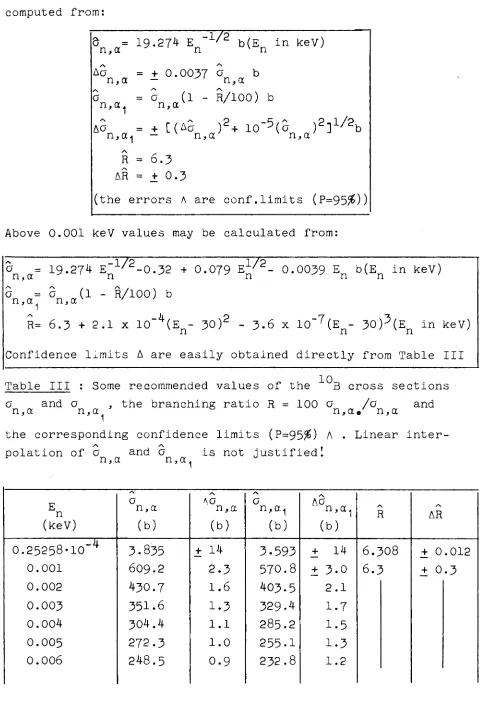
As a result of the present evaluation, some recommended values of the Β cross sections σ and σ together with the branching ratio R = 100 σ /σ
B η,α· η,α
are tabulated with the corresponding confidence limits Δ from thermal energy to 100 keV (see Table III).
Values at thermal energy with their confidence limits
- 26
Between thermal energy and 0.001 keV values may be computed from:
= 19.274 E "1//2 b(En in keV)
η,α
Δσ = + 0.0037 o" b η,α — η,α η,α = οη,α (1 - R/100) b
21 Ι Α Δσ = + [(Δσ Γ +η,α 10~^(ο Γ ]
1 - ν η,α7 ν η,α
R = 6.3 AR = + 0.3
(the errors Λ are conf.limits (P=95$)) Above 0.001 keV values may be calculated from:
£ = 19.274 E 1/2-0.32 + O.O79 E1//2η - 0.0039 E^ b(E^ in keV) η η
= £ ( 1 - R/100) b η,α η,α
R= 6.3 + 2.1 χ 10 (Ε - 30)2 - 3-6 χ 10"7(Εη- 3θ)5(Εη in keV)
[image:30.587.68.553.105.819.2]Confidence limits Δ are easily obtained directly from Table III Table III : Some recommended values of the Β cross sections σ and σ , the branching ratio R = 100 σ /o and
η,α η,α ° η,α·' η,α
the corresponding confidence limits (P=95$) Λ . Linear inter polation of σ and σ is not justified!
η,α η,α.,
E
η
(keV)
0 . 2 5 2 5 8 - 1 0 "4
0 . 0 0 1 0 . 0 0 2 Ο.ΟΟ3 0 . 0 0 4 Ο.ΟΟ5 0 . 0 0 6
/ Ν
G η , α
( b )
3 . 8 3 5 6 0 9 . 2 4 3 0 . 7 3 5 1 . 6 3 0 4 . 4 2 7 2 . 3 2 4 8 . 5
η , α ( b )
+ 14 2 . 3 1.6 1.3 1.1 1.0 0 . 9
SK
0
η , α . , ( b )
3 . 5 9 3 5 7 0 . 8 4 0 3 . 5 3 2 9 . 4 2 8 5 . 2 2 5 5 . I 2 3 2 . 8
x\ Λ.σ η , α
1
( b )
+ 14 + 3 . 0
2 . 1 1.7 1.5 1.3 1.2 /Ν. R
6 . 3 0 8 6 . 3
AR
n (keV)
0 . 0 0 7 0 . 0 0 8 0 . 0 0 9 0 . 0 1 0 . 0 2 0 . 0 3 0 . 0 4 0 . 0 5 0 . 0 6 0 . 0 7 0 . 0 8 0 . 0 9 0 . 1 0 . 2 0.3 0.4 0 . 5 0 . 6 0.7 0.8 0 . 9 1.0 2 . 0 3 . 0 4 . 0 5 . 0 6 . 0 7 . 0 8 . 0 9 . 0 1 0 . 0 2 0 . 0 3 0 . 0 4 0 . 0
η , α ( b )
2 3 0 . 0 2 1 5 . 2 2 0 2 . 8 1 9 2 . 4 1 3 6 . 0 1 1 1 . 0 9 6 . 1 8 5 . 9 7 8 . 4 7 2 . 6 6 7 . 8 6 4 . 0 6 0 . 6 4 2 . 8 3 4 . 9 3 0 . 2 2 6 . 9 9 2 4 . 6 2 2 2 . 7 8 2 1 . 3 c 2 0 . O 7 1 9 . 0 3 1 3 . 4 1 1 0 . 9 3 9 . 4 6 8 . 4 6 7-72 7 . 1 5 6 . 6 9 6 . 3 1 5-99 4 . 2 7 3-52 3 . 0 7
η , α ( b )
+ 0 . 9 0 . 8 0 . 8 0 . 8 0 . 5 0 . 5 0 . 4 0 . 4 0 . 3 0 . 3 0 . 3 0 . 3 0 . 3 0 . 2 0 . 2 0 . 2 0 . 2 0 . 2 0 . 2 0 . 2 0 . 2 Ο . Ι 5 0 . 1 2 0 . 1 2 0 . 1 2 0 . 1 0 Ο.Ο9 Ο.Ο8 Ο.Ο8 Ο.Ο7 Ο.Ο6 Ο.Ο6 Ο.Ο6 Ο.Ο6
η , αι
( b )
2 1 5 . 6 2 0 1 . 6 Ι 9 0 . Ι Ι 8 Ο . 3 1 2 7 . 4 1 0 4 . 0 9Ο.Ο 8 0 . 5 7 3 - 4 6 8 . 0 6 3 . 6
0 0 . 0
5 6 . 8 4 0 . 1 3 2 . 7 2 8 . 3 2 5 . 2 9 2 3 . 0 7 2 1 . 3 5 1 9 . 9 6 1 8 . 8 0 1 7 . 8 3 1 2 . 5 7 1 0 . 2 4 8 . 8 6 7 . 9 2 7 . 2 3 6 . 7 0 6 . 2 7 5 . 9 1 5 . 6 Ι 4 . 0 0 3 . 2 9 2 . 8 8
Λ θ
η , α ( b )
28
En
(keV)
5 0 . 0 6 0 . 0 7 0 . 0 8 0 . 0 9 0 . 0 1 0 0 . 0
ss.
0
η , α
( b )
2 . 7 7 2 . 5 5 2 . 3 7 2 . 2 3 2 . 1 1 2 . 0 1
AG
η , α
( b )
+0.06 0.06 0.06 0.06 0.06 0.06 o
η , α
1
( b )
2 . 5 9 2 . 3 8 2 . 2 2 2 . 0 8 1.96 1 . 8 7
AG
η , α
( b )
+ O . 0 6 O.O6 O.O6 O.O6 O . 0 6 O.O6
s\
R
6 . 4
6 . 5 6 . 6
6 . 8
7 . 0
7 . 2
s\
AR
+ O . 3
0 . 3
0 . 3 0 . 4
0 . 4
0 . 4
Acknowledgements
The authors wish to express their appreciation to Dr. J. Spaepen who has suggested and initiated the present evaluation, for
many valuable discussions and for his continuous interest in tnis work. Thanks are also due to Dr. P. De Bièvre for his contribution to chapt. 2 and to Dr. G. Nastri who took charge of tne computations.
7. REFERENCES Al 64 As 68 Ba 57 Be 58a Be 58b Be 60 Be 61 Bi 52 Bi 57 Bi 60 Bi 65
, 0. Dietrich, Phys. Rev. I33, B 925 Moxon, EANDC(UK)99 "AL"; J. Nucl. be publisned (I968)
Α., P.J. Campion, Can. J. Phys. 35, AlsNielsen, J
(1964)
Asami, Α., M.C, Energy Α/Β, to Bartholomew, G
1347 (1957)
Bentley, P.G., A.N. Hamer, Nature l82, II56 (I958) Bergman, A.A.,
Exp.Tneor. Phys , (USSR) 3_3_, 9; Sov. Phys. JETP 6, 6 (1958) A.I. Isakov, I.P. Popov, F.L. Shapiro, J. Bentley, P.G., J. Sci. Inst. 3_7_, 323 (i960)
Bergman, A.A., 40, I27O; Sov. Bichsel, H., W,
Phys. Acta 25, Bichsel, H., T, Bilpuch, E.G.,
10, 455 (i960) Biggerstaff, J,
(1965)
F.L. Shapiro, J. Exptl. Theor.Phys.(USSR) Phys. JETP 12, 895 (196I)
. Hälg, P. Huber, A. Stebler, Helv. 119 (1952)
Block, R., G. Slaughter, N. Pattenden, J. Harvey, Symp. Int. Conf. Pile Neutron Research, Vienna (I962) B/ggild, J.K., Mat. Fys. Medd. Dan. Vid. Selsk. 23, n* 4 (1945)
Bogart, D., Conf. 660303, Book 2, paper CC7; NASA TR R240 (I966)
Brinckmann, H.F., D. Gerber, Kernenergie 3_, 309 (i960) Bujdoso, E., Nucí. Phys. ó, 107 (1958)
Buckingham, B.R.S., Κ. Parker, E.D. Pendlebury, AWREO28/60 (i960)
Cox, S.A., WASH1064,4 (I966); Conf. 660303, Book 2, 701 (1966)
Crespi, M.B., Α.E. Cairo, J. Inorg. Nucl. Chemistry 3_, 248 (1956)
CUer, P., J. P. Longchamp, Compt. Rend. 2_3_2, 1824 (1951) Davis, E.A., F. Gabbard, T.W. Bonner, R. Bass, Nucl. Phys. 27, 448 (1961)
De Juren, J.Α., Η. Rosenwasser, Phys. Rev. £^, 831 (±954)
Deruytter, Α., G. Debus, K. Lauer, Η. Moret, Α. Prosdocimi, EUR 12.e (1962)
De Bièvre, P., G.H. Debus, J. Spaeoen, J. Nucl. Energy, A/B, Γ7_, 349 (1963)
Announcement in Nucl. Sci. Engin. If), 242 (1964); Nukleonik 6, 158 (1964); Ζ. Physik 179, 228 (1964) De 67a Deruytter, A.J., P. Pelfer, J. Nucl. Energy, A/B,
21, 833 (I967)
De 67b Debus, G.H., P.J. De Bièvre , J. Nucl. Energy 21, 373
(1967) ~~
Debus, G.H., P. De Bièvre, to be putii i shed (I968) Diment, K.M., UKAEAHL 67/762, E A N D C ( U K ) 8 5 "S" (I967)
Eggler, C , D.J. Hughes, C. Huddleston, Phys. Rev. 74, 1239 (1948)
Finley, H.O., E.E. Leuang jr., NBLI70 (I96I)
Gilbert, C.W.,Proc. Cambr. Phil. Soc. 44, 447 (1948) Gibbons, J.H., R.L. Macklin, Phys. Rev. 114, 571 (1959) Goris, P., T.D. Morgan, R.A. Nielsen, IDO14549 (196I) Hanna, G.C., Phys. Rev. 80, 53O (1950)
Hauser, U.H., Ζ. Naturforschg. 7_a, 78l (1952) Hibdon, C T . , ANL4552, 6 (1950)
Ir Kl La 67 66 66 30
Irving, D.C., ORNLTM1872 (1967)
Klein, P.D., F.P. Mooring cited in Mo 66 (I966)
Lauritzen, T., AjzenbergSelove, F., Nucl. Phys. 78, 1 (1966)
La 67 Lane, R.O., A. Elwyn, F.P. Mooring, A. Langsdorf, to be published (1967)
Malmskog, S., Physi ca 29, 987 (1963)
Macklin, R.L., J.H. Gibbons, Phys. Rev. 140, B 324 (1965)
Macklin, R.L., J.H. Gibbons, Phys. Rev., I65, 1147 (1968)
Meadows, J.W., J.F. Whalen, Nucl. Sci. Eng. Q, I32 (I96I)
Mooring, F.P., J.E. Monahan, C M . Huddieston, Nucl. Phys., 82, 16 (1966)
Mc Muilen, C C , C.B. Cragg, H.G. Thode, Geochim. Cosmichim. Acta £3_, 147 (I96I)
Prosdocimi, Α., A.J. Deruytter, J. Nucl. Energy A/B 17, 83 (1963)
Rhodes, J., W. Franzen, W.E. Stephens, Phys. Rev. 87, 141 (1952)
Roher, R.H., Unpublished, cited in Bi 60
Safford, G.J., T.I. Taylor, B.M. Rustad, W.W. Havens Jr. Phys. Rev. 112, 1291 (i960)
Schmitt, H.W., R.C. Block, R.L. Bailey, Nucl. Phys. 17_, 109 (I960)
Seghal, M.L., Indian J. Phys. 3_1, 329 (1957)
Shapiro, F.L., J. Exptl. Theoret. Phys. (USSR) ¿4, 1648; Sov. Phys. JETP J_, H 3 2 (1958)
Shima, M., Geochim. Cosmochim. Acta 2J_, 9II (I963) Sowerby, M.G., J. Nucl. Energy A/B 20, 135 (1966) Soaepen, J., in "Nuclear Data for Reactors, Vol. I", Vienna, CN23, p. 263 (I967)
St 64 Stehn, J.R., M.D. Goldberg, B.A. Magurno, R. Wiener Chasman, BNL 325, 2nd Ed., Suppl. No. 2 (1964)
Ta 67 Taschek, priv. commun, to J. Spaepen (1967)
To 66 Toney, W.M., A.W. Waltner, Nucl. Phys. 80, 237 (I966) Wi 55 Willard, H.B., J.K. Bair, J.D. Kington, Phys. Rev. %8,
669 (I955)
50
20
ö 10 c
τ Bi 60
A Di 67
^ ^ ^ A A ^ ^ ^
A \ ^ T
A ^ v - ^
♦ v ^ ▼
1
0.01 0.02 0.05 0.1
F i g l i . 1 0B ( n , a ) c r o s s s e c t i o n f r o m 0.07 te
0.2 , x 0.5
En( k e V )
20 50
£ „ ( k e V ) 100 500 1000
+ 1.5
+ 1.0
■0.5 'uf » r-CM cri
ï 0
> »
o " - - 0 5
1 . 0
- 1 . 5
- 2 . 0
A A A A A A A A A
Δ Co 66 O Mo66 A Di 67 D Μα68
A
A *
A
A
A
A
*
A * A
A
/ /
/ " '
A A A
, Ã"
A A A A
. A A
η 1 9 +
Δ
Δ
η m o . c 1 / 2 .
Δ
- U . J Z + υ.ν
A * — r —~ * ~ ~
* A A
A __
A
A " " ' U A O O
A O ■>
A *
>
A _ _ _ ^ -' ΟΔΑΤ5* ( OA A « . 1
Δ O
r ° * - ^ * o
o o
\P
CO ■ Y „ . » , 0
□
0
0.05 0.1 0.2 0.5 2 5 £n( k e V )
10 20 50 100 200 500
100
50
20 6C
o o II
Q:
10
£=6.3
° So66 Δ
I s—£+-r
= — a — i
-Y
— δ ! _
1 1
ï °—'
10 20
En(eV)
50 100 200 500 1000
10
50
20
c Ò
« 10
o o n CC
•
χ
ν τ ο
α
Pe 51 Bi 52 Da 61 Μ α 6 5 So 66 Μ ο 6 6 Μ α 6 8
1G ¿Û
Εη (KeV) 50 100 200 500 1000 10
specimen copies please write to :
Iandelsblatt GmbH
"Euratom Information'
Postfach 1102 " ffltiÉl
D-4 Düsseldorf (Germany)
li>rs:i!lí«
Office de vente des publications des Communautés européennes Place de Metz
Luxembourg
B
mm
:r·?-| To disseminate knowledge is to disseminate prosperi ¡||| general prosperity and not individual riches —
lililí disappears the greater part of the evil which
(iL
AU Euratom reports a r e on sale at the offices listed below, at the prices given on the back of the front cover (when ordering, specify clearly the EUR number and the title of the report, which are shown on the front cover).
löi ^tilisi
¡îilillfeiii
OFFICE CENTRAL DE VENTE DES PUBLICATIONS DES COMMUNAUTES EUROPEENNES
2, place de Metz, Luxembourg (Compte chèque postal N° 191-90) k!'f)
in