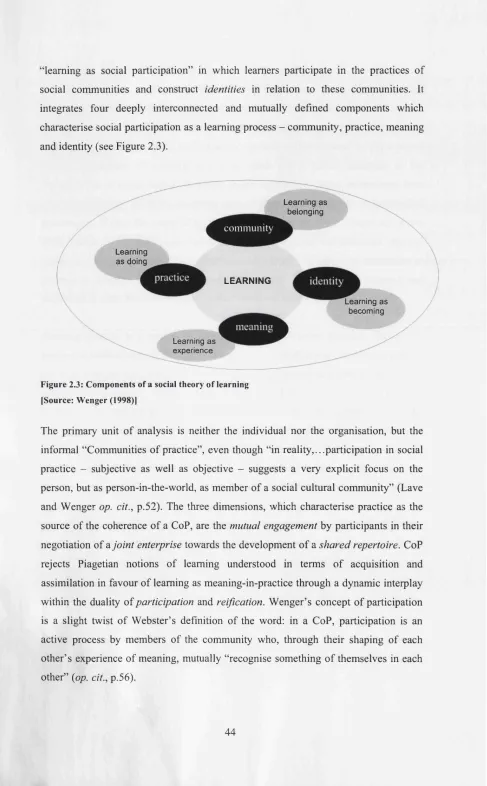
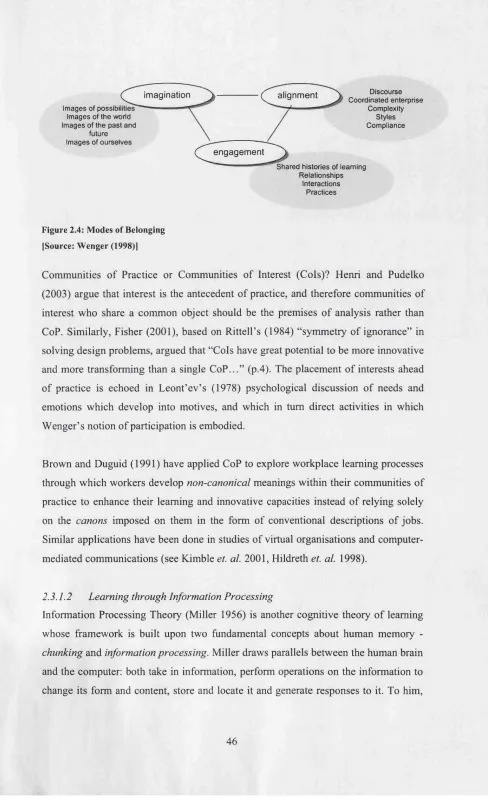
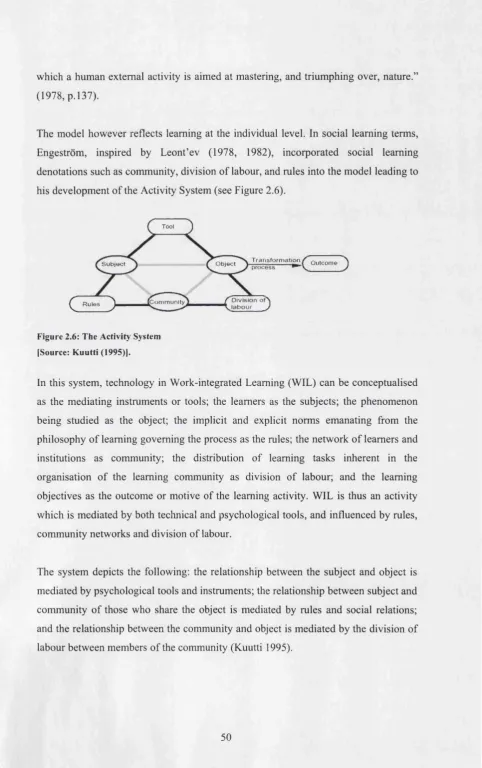
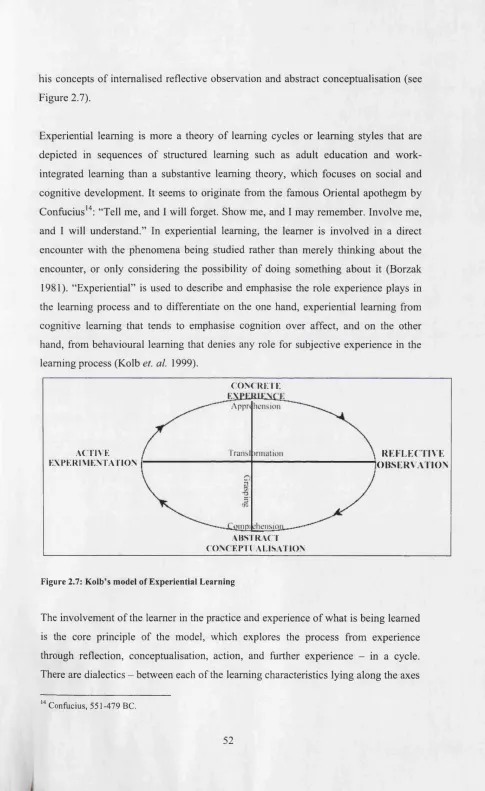
M obile Com puting in Work-Integrated Learning:
Problems of Rem otely-Distributed Activities and
T echnology U se.
Gamel Okoampa Wiredu
D epartm ent o f Information System s
T he London School o f E con om ics and Political Science University o f London, UK.
Dissertation submitted to the University of London in partial fulfilment of the requirements for the award of the Degree o f Doctor o f Philosophy in
Information Systems
UMI Number: U202450
All rights reserved
INFORMATION TO ALL USERS
The quality of this reproduction is dependent upon the quality of the copy submitted.
In the unlikely event that the author did not send a complete manuscript and there are missing pages, these will be noted. Also, if material had to be removed,
a note will indicate the deletion.
Dissertation Publishing
UMI U202450
Published by ProQuest LLC 2014. Copyright in the Dissertation held by the Author. Microform Edition © ProQuest LLC.
All rights reserved. This work is protected against unauthorized copying under Title 17, United States Code.
ProQuest LLC
789 East Eisenhower Parkway P.O. Box 1346
JL6stract
Recently, the continuing digitalisation of our social and analogue lives has assumed a new dimension. This dimension has resulted from of the introduction o f portable information and communication technologies (ICTs) - notably mobile phones, personal digital assistants (PDAs), laptop computers, smart phones and tablet computers - whose physical, instrumental and functional properties provide opportunities for mobility of interaction, information processing, learning and work. A parallel development along this dimension is the contemporary remote distribution of erstwhile-localised human activities, subsuming some dissolution of distance and time boundaries by portable ICTs.
This is a dissertation about the problems of remotely-distributed activities and technology use, in general; and specifically about the mutual shaping between remotely-distributed work-integrated learning and mobile computing. The study is underpinned by a developmental psychology perspective to purposeful human activities being seen as processes which are mediated by psychological and physical tools. It explores this mutual shaping by addressing related parameters such as motives, mobility, power, control, distribution and mobile computing. The aim is to unearth an understanding of how this mobilisation o f technology, humans and mobile computing shape each other within the framework of purposeful mobilised activities.
"Tager du mig for en laerd og belaest mand?" "Selvfolgeligt," svarede Zi-gong, "er du da ikke?"
"Ikke det mindste," svarede Confucius. "Jeg har blot greb om een trad der forbinder alle de andre"
"Do you think me a learned, well-read man?" "Certainly," replied Zi-gong, "Aren’t you?"
"Not at all," said Confucius. "I have simply grasped one thread which links up the rest"
[Recounted in Sima Qian (145-ca. 89 BC), "Confucius," in Hu Shi, The Development o f Logical
Methods in Ancient China, Shanghai: Oriental Book Company, 1922; quoted in Qian 1985:125, in
To
myfamiCy.
Acknowledgements
The production o f this thesis is the culmination o f a long excruciating period o f hard work inspired by my undying desire for scholarship and knowledge. This period of formal education has spanned from my early years of learning at UST Primary School in Ghana to these current times as a research student at the London School o f Economics. That I have come through this period of severe financial, social and emotional challenges is an accomplishment simply beyond my comprehension and a feat I never imagined my physical, financial and mental resources would enable me to tackle in this short period. It is in this context that I thank God for His abundant grace and unfailing compassions, and for endowing me with sufficient health, wealth and understanding which have sustained me throughout this period. It is also in this context that I find Psalm 30:1 appropriate:
“I will extol thee, O LORD; fo r thou hast lifted me up, and hast not made my foes to rejoice over me. ”
The Information Systems Department of the LSE has been a wonderful academic
environment since my days as a master’s student, and immediately afterwards as a PhD
student and Graduate Teaching Assistant. One outstanding personality o f this department is Dr. Carsten Sorensen: affable, supportive, diligent and honest are the few, among many, resounding epithets I will use to describe him. He has not only been always supportive as my research supervisor, but was always responsive to my requests even during master’s degree
studies. Dear Carsten, please be assured of my most profound appreciation for the
confidence you have had in my academic abilities that made you choose to supervise my research, and for the encouragement you offered me at the beginning when my ideas seemed to be heading nowhere.
I also thank my assessors, Dr Susan Scott and Antonio Cordelia, as well as Dr. Jannis Kallinikos, my tutor, whose suggestions on my early writings about this research have been invaluable.
I cannot leave out my Ghanaian teachers, masters and lecturers through whose lowly-paying efforts and sacrifices I acquired a sound academic foundation upon which my current level of knowledge has been built. Although it is often euphemistically said that their “rewards are in heaven”, they are worth every bit of my earthly glorification.
Dr. Roger Kneebone o f Imperial College London and his PSP project team, as well as the PSPs whose learning activities I studied, deserve a special mention because coming into contact with them was the most decisive encounter of my research. I thank Roger for allowing me to study the project throughout its duration, and even to study it as an action researcher which allowed me overwhelming access to data and was immensely beneficial. I thank his team members - Harry Brenton, Amanda Burgess, Jackie Younger, Michael Singh and Heather Fry - for their invaluable support. I also thank the 12 PSPs for their cooperation during my interviews and tutorials, and for all those times when I was in desperate need of data from them.
There are some brilliant people whose ideas I have drawn upon to develop my own in this thesis; some of them I have never met before and have passed away, some still alive today. I am greatly indebted to the departed Lev Vygotsky and Alexei Leont’ev, and the living Yijo Engestrom, whose expositions on Developmental Psychology, Learning and Activity helped me to clearly understand the research problem.
I am also grateful to all my friends who have kept me happy during my research. Mr Joe Appiah-Brantuo, Anthony Tuffour, Benjamin Acquaye, Clement Twumasi, Richmond Adjei, Regina Osafo-Adu, Collins Asare, Eugenia Sasu, Kofi Agyenim Boateng, Lawrence Dzakpa, Peter Fosu and James Owusu are a few o f an uncountable and valued number o f friends in this respect. Their patience, love and understanding over the period when I was a virtual social recluse are particularly appreciated.
To all my colleagues whom I encountered at the LSE, especially Daniel Osei-Joehene, Dr. Frederick Wamala, Jan Kietzmann and Daniel Pica, I thank you very much for the invaluable pieces of advice you have offered me.
Last but not least, I have enjoyed being a player of the LSE football team since my enrolment, and I thank all the players over the period for the wonderfully cherished times. My captains over the period, Dean Taylor, Gavin Peck, Jan Wojna, Tom Winston and Matt Davenport, deserve special mention for their organising efforts.
7
a6Ce o f Contents
ABSTRACT... 2
ACKNOWLEDGEMENTS... 5
TABLE OF CONTENTS... 7
LIST OF FIGURES... 11
LIST OF TABLES... 12
CHAPTER 1: RESEARCH ISSUES... 13
1.1 Pr e l u d e... 13
1.2 Pr e c u r s o r sa n d Ra t i o n a l e... 14
1.3 In s p i r a t i o n...15
1.4 Re s e a r c h Qu e s t i o na n d Sc o p e... 17
1.4.1 Empirical Study...19
1.4.2 Research Objectives...20
1.5 Or g a n is a t io no ft h e Th e s i s... 21
CHAPTER 2: PORTABLE ICTS, MOBILITY & TECHNOLOGY-MEDIATED LEARNING 23 2.1 In t r o d u c t i o n...23
2 .2 Po r t a b l e I C Tsa n d Mo b i l i t y... 2 4 2.2.1 Mobility o f Humans and Objects...27
2.2.1.1 M odalities o f Human M obility...27
2.2.2 Dimensions o f Mobility...30
2.2.2.1 Spatial D im ension... 30
2.2.2.2 Tem poral D im ension...31
2.2.2.3 Contextual D im ension... 33
2.2.3 Mobile Information Services...35
2.2.3.1 M obile Interaction S e rv ice s... 36
2.2.3.2 M obile Computing Services... 37
2 .3 Th e Pr o b l e mo f Le a r n i n g...3 9 2.3.1 Learning as Construction and Instruction...39
2.3.1.1 Learning in Communities o f P ractice...43
2.3.1.2 Learning through Information P rocessing...46
2.3.1.3 Learning as a Socially M ediated Phenom enon...48
2.3.2 Learning as Activity...49
2.3.3 Work-Integrated Learning...51
2.3.4 Technology-Mediated Learning...53
2.3.4.1 Technology-M ediated Distance L earn in g...56
2.3.4.2 Learning Technology and Inscriptions... 57
2.4 Ch a p t e r Su m m a r y...60
CHAPTER 3: RESEARCH METHODOLOGY... 62
3.1 In t r o d u c t i o n... 62
3 .2 Ph il o s o p h yo f Re s e a r c h Ap p r o a c h...62
3.2.1 Ontology and Epistemology o f Positivism...63
3.2.2 Ontology and Epistemology o f Interpretivism...64
3.2.3 Justification for Choice o f the Interpretive Philosophy...66
3 .3 Re s e a r c h De s i g n... 68
3.3.1 Action Research Strategy...68
3.3.2 Type o f Evidence...71
3.3.3 Data Sources...72
3.3.4 Data Interpretation Techniques...76
3 .4 Co n c l u s i o n...7 8 CHAPTER 4: LEARNING AS AN ACTIVITY... 79
4 .1 In t r o d u c t i o n...7 9 4 .2 Ov e r v ie wo f Cu l t u r a l-His t o r ic a l Ac t iv it y Th e o r y... 8 0 4 .3 Ge n e r a l St r u c t u r eo fa n Ac t i v i t y... 83
4 .4 Th e Ac t iv it y Sy s t e m... 8 7 4 .5 Pr in c ip l e so f Ac t i v i t y... 9 2 4.5.1 Object-orientation...92
4.5.2 Externalisation and Internalisation...94
4.5.3 Consciousness...96
4.5.4 Contradictions...99
4.5.5 Mediation and Prosthesis...102
4 .6 IC T To o l sin Le a r n in g Ac t iv it y... 104
4.6.1 ICT Affordances in Learning Activity...106
4 .7 Co n c l u s i o n... 109
CHAPTER 5: MOBILE COMPUTING IN THE TRAINING OF THE PSP... 110
5.1 In t r o d u c t i o n... 110
5 .2 Ba c k g r o u n d... I l l 5 .3 Pr o je c t Ou t l i n e...112
5.3.1 Team Structure...114
5.3.2 Pedagogic Framework...114
5.3.3 Implementation...115
5 .4 In f o r m a t io n Ma n a g e m e n t... 116
5.4.1 Architecture o f Mobile Computing Support....117
5.4.1.1 Access to Learning Resources...118
5.4.2.1 R a tio n a le ... 120
5.4.2.2 D ata C a p tu re ...121
5.4.2.3 D ata T ransm ission... 122
5.4.3 Implementation and Use...122
5.4.3.1 Stage O n e ... 123
5.4.3.2 Stage T w o ... 126
5.4.3.3 Stage T h re e ...130
5.5 Le a r n in g Ou t c o m e s...133
5 .6 Ke y Fi n d i n g s...134
5.6.1 Problematic Learning Conditions...135
5.6.2 Marginalisation o f Technology...136
5.7 Co n c l u s i o n...138
CHAPTER 6: MOBILITY OF COMPUTING AND WORK-INTEGRATED LEARNING... 140
6.1 In t r o d u c t i o n... 140
6 .2 Co n d i t i o n s, Mo d a l it ie sa n d Se n s e-Ma k in go f W I L ... 141
6.2.1 WIL as Contradiction...141
6.2.2 Sense-Making o f Distance, Distribution and Mobility...147
6.3 Po r t a b l e Co m p u t e r sa n d Pr o b l e m so f Mo b il e Co m p u t i n g... 151
6.3.1 Design Properties and Affordances o f PDAs...151
6.3.2 The Conflicts o f Needs and Motives...155
6.3.3 Control and the Politics o f Technology Use...159
6 .4 Mo b il it yo f Co m p u t in g Se r v i c e s...162
6.4.1 Ideality and Reconstruction o f the PDA...163
6 .5 Hu m a n Mo b il it ya n d Fl e x ib l e Co m p u t i n g: A Co n c e p t u a l Mo d e l... 168
6.5.1 Conclusion: A Paradox?...171
6 .6 Ch a p t e r Su m m a r y... 173
CHAPTER 7: PROBLEMS OF A REMOTELY-DISTRIBUTED ACTIVITY...175
7.1 Th e Pr o b l e m...175
7 .2 Th e Sig n if ic a n c eo f Dis t a n c ea n d Dis t r ib u t io nin Ac t i v i t y... 178
7.2.1 The Contradictory Nature o f a Localised Activity...180
7.2.2 The Metacontradictory Nature o f a Distributed Activity...184
7 .3 Co n t r a d ic t io n sa n dt h e Co n t r o lo f Dis t r ib u t e d Ac t i o n s... 190
7 .4 Co n t r o la n dt h ep r o b l e mo f Co m p u t in gina Di s t r i b u t e d Ac t i v i t y...195
7 .5 Fl e x ib il it yo f Mo b il e Co m p u t i n g... 2 0 0 7 .6 Ch a p t e r Su m m a r y... 203
CHAPTER 8: CONCLUSION...205
8.1 Th e s is Sy n o p s i s... 20 5
8.3 Lim it a t io n sa n d Fu t u r e Re s e a r c h...2 0 9
8.3.1 Future Research Challenges...211
8 .4 Co n c l u d in g Re m a r k s... 211
List o f ‘Figures
Fig u r e 2 .1 : Mo d a l i t i e so f Hu m a n Mo b i l i t y...28
Fig u r e 2 .2 : Fa c t o r sa f f e c t i n gp o r t a b l eICT u s e... 2 9 Fig u r e 2 .3 : Co m p o n e n t so fa s o c ia lt h e o r yo fl e a r n i n g... 4 4 Fig u r e 2 .4 : Mo d e so f Be l o n g i n g... 4 6 Fig u r e 2 .5 : Th e St r u c t u r eo f Pr o d u c t iv e Le a r n in gin Ev e r y d a y Si t u a t i o n s...4 9 Fig u r e 2 .6 : Th e Ac t i v i t y Sy s t e m...5 0 Fig u r e 2 .7 : Ko l b’sm o d e lo f Ex p e r ie n t ia l Le a r n i n g...52
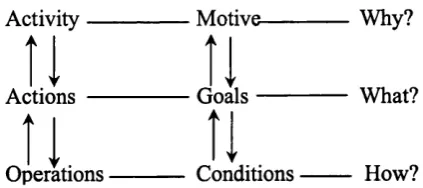
Fig u r e 4 .1 : Ge n e r a l St r u c t u r eo fa n Ac t i v i t y...84
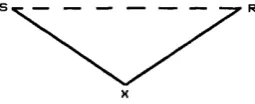
Fig u r e 4 .2 : Th es t r u c t u r eo ft h em e d ia t e da c t: ‘S ’ - St im u l u s, ‘R ’ - Re s p o n s e, a n d ‘X ’ -Me d i a t i n g Si g n...88
Fig u r e 4 .3 : Ba s i c St r u c t u r eo fa n Ac t iv it ya t In d iv id u a l Le v e l... 8 9 Fig u r e 4 .4 : An Ac t i v i t y Sy s t e m... 9 0 Fig u r e 4 .5 : Fo u rl e v e l so fc o n t r a d ic t io n sw it h int h eh u m a na c t i v i t ys y s t e m...101
Fig u r e 4 .6 : Se p a r a t i n ga f f o r d a n c e sf r o mt h ein f o r m a t io na v a i l a b l ea b o u tt h e m... 107
Fig u r e 5 .1 : Ar c h i t e c t u r eo ft h e Mo b il e Co m p u t in g Su p p o r t... 118
Fig u r e 5 .2 : Th e Co m p a q/H P iP A Q H 5 4 5 0 /H 3 9 7 0 Ha n d h e l d Co m p u t e ra n d Fo l d a b l e Ke y b o a r d. ... 119
Fig u r e 5 .3 : Se l e c t e d s c r e e nd u m p so ft h e Po c k e t Ex c e la n d Wo r da p p l i c a t i o n s... 124
Fig u r e 5 .4 : Se l e c t e ds c r e e nd u m p so ft h ea b cD B a p p l i c a t i o n...127
Fig u r e 5 .5 : Se l e c t e d Sc r e e n Du m p so ft h e Ha n dBa s ea p p l i c a t i o n... 131
Fig u r e 6 .1 : Th e Ce n t r a l/W IL Ac t iv it y Sy s t e mo fa P S P ... 142
Fig u r e 6 .2 : In t e r a c t i o nb e t w e e nt h ec e n t r a la c t iv it ya n dc u l t u r a l l ym o r ea d v a n c e d c e n t r a la c t i v i t yd e p ic t in gt h es h a r e do u t c o m e...143
Fig u r e 6 .3 : In n e rc o n t r a d ic t io n s w it h int h ee l e m e n t so ft h ec e n t r a la c t i v i t y... 145
Fig u r e 6 .4 : Th ec h a n g in gr o l eo ft h e P S P a saf a c t o ro fd i s t a n c e... 149
Fig u r e 6 .5 : Re l a t i o n s h i pb e t w e e n In s t r u m e n t-Pr o d u c in g Ac t iv it ie sa n dt h e Ce n t r a l Ac t i v i t y... 151
Fig u r e 6 .6 : Fl e x ib il it y o fc o m p u t in ga saf a c t o ro ft h eh u m a nm o b il it ya n dim m e d ia t e CONTROL OF ACTIONS... 162
Fig u r e 6 .7 : Re c o n s t r u c t i o no ft h e P D A ...165
Fig u r e 6 .8 : Co n c e p t u a l Fr a m e w o r kf o rt h ed e t e r m in a t io no f Fl e x i b l e Co m p u t in gf r o m Mo b il it yo f Hu m a n s Ac t iv it ie sa n d IC Ts...168
Fig u r e 7 .1 : Le a r n in g Ac t iv it yd e p ic t in gt h ed if f e r e n c e sinm o t iv e sa n dt h ed u a lid e n t it yo f t h el e a r n e r... 181
Fig u r e 7 .2 : Wo r k Ac t iv it yd e p ic t in gt h ed if f e r e n c e sinm o t iv e sa n dt h ed u a lid e n t it yo ft h e w o r k e r... 183
Fig u r e 7 .3 : St r u c t u r e so fc o n t r a d ic t io n sd e p ic t in gm e d ia t io nb yin t e r l o c a t io n a l CONTRADICTIONS IN DISTRIBUTED ACTIVITIES... 188
List ofLaSks
Chapter 1: Rgsearch Issues
1.1 Prelude
Recently, the continuing digitalisation of our social and analogue lives has assumed a
new dimension. This dimension is a corollary of the introduction of portable
information and communication technologies (ICTs) - notably mobile phones,
personal digital assistants (PDAs), laptop computers, smart phones and tablet
computers - whose physical, instrumental and functional properties provide
opportunities for mobility of interaction, information processing, learning and work.
A parallel development along this dimension is the contemporary remote distribution
of erstwhile-localised human activities, subsuming some dissolution o f distance and
time boundaries by portable ICTs.
‘Mobility’ is now a popular catchword not only in the realm o f information systems
(IS) research but a really pervasive and ubiquitous term in contemporary society.
‘Mobile’ is its concomitant or substitute term normally applied as an adjective to
describe traditional phenomena that have experienced some mobility due to the
stimulus of portable ICTs. Also closely related to ‘mobility’ and ‘mobile’ is
Kleinrock’s (1996) “anytime, anywhere”, which portrays the capacity of portable
ICTs to overcome spatial and temporal boundaries. In addition to these, Lyytinen and
Yoo (2002) have recently coined the phrase “nomadic information environment” to
illuminate the magnitude, pervasiveness and ubiquity of mobile computing that have
enabled the digitalisation, miniaturisation, and integration of information, as well as
the unprecedented possibilities to access, manipulate and share information on the
move (Ibid). Many others have used the terms 'pervasive' and 'ubiquitous' computing
to draw our attention to the fact that mobility is now an integral aspect o f our lives at
both personal aid institutional levels (e.g. Kopomaa 2000).
Portable ICTs have invaded us, and human activities are increasingly being mobilised
and distributed. Yet the present level of mobility and distribution is so seldom
problematised, so often taken for granted within IS research (Sorensen 1999).
Mobility presents a significant challenge for IS research which, in the past, has largely
instance, how professionals' work and learn in distributed environments with portable
ICTs, as well as the dynamics of the mutual shaping between those activities and their
mobile computing have seen little investigation and clarification. This study takes up
the challenge to explore how mobile computing and remotely distributed learning
activity shape each other.
This introductory chapter sets up the research agenda and provides a preview of the
entire organisation o f the whole dissertation. In Section 1.2, I present the precursors
and rationale that represent the grounds upon which the inspiration for this study was
derived. Section 1.3 discusses some of the socio-technical challenges inherent in these
precursors that inspire this research endeavour. Based on this, the research question,
the objectives that guided this study, a brief introduction of the empirical study are
presented under Section 1.4. Finally, the organisation of the rest of this dissertation is
previewed in Section 1.5.
1.2 Precursors and Rationale
Information revolution and information society are captions used to represent the
rapid development and diffusion of ICTs, notably the Internet and World Wide Web
(WWW) (Castells 2001). In their wake, we have seen the development of portable
ICTs to meet users’ demands for information processing and interaction anytime,
anywhere (Kleinrock 1996). It is not uncommon therefore to see almost everywhere
people communicating through mobile phones with colleagues who appear not to be
co-present. It does not take too long before one encounters people busily working
with laptop computers in the train. And we see others organising themselves and their
tasks assisted by the functionalities of PDAs in both social and organisational mobile
settings. Thus we witness pervasive and ubiquitous computing triggered by dramatic
developments in ICTs such as WAP1, Bluetooth™,2 and 3G3 mobile phones, and their
users’ nomadic behaviour (Lyytinen and Yoo op. cit.).
1 WAP means Wireless Application Protocol. It is an open global standard that specifies standards for mobile users information and service access. Visit www.wapforum.org for more information.
2 Bluetooth™ is a de facto standard for wireless communication among various devices in short to medium distance. For more information visit www.bluetooth.com.
The ubiquity and pervasiveness of portable ICTs uses facilitate human geographical
movement in urban life, work environments and other social milieus (Bergquist et. a l
1999, Dix and Beale 1996, Kristoffersen and Ljungberg 2000, Kopomaa 2000); they
also facilitate the speeding up o f transactions and time savings; that Barley (1988)
conceptualises under structural and interpretive temporality; and they influence
changes in the context or situatedness of mobile interaction (Kakihara and Sorensen
2002a). Moreover, the spatial, temporal and contextual aspects o f mobility have
resulted in the emergence of mobile professionals whose work practices are mobile in
the operational, locational and interactional senses (Kakihara and Sorensen 2002b).
These emerging issues are inducing new forms of organisations, organising, work and
learning. Compared with traditional organisations, mobility and distribution enables
work and learning to transcend organisational boundaries, and facilitates the
organisation o f these activities among interdependent professionals who are
geographically distributed and mobile. As mediating technologies, portable ICTs are
transforming activities through the restructuring of practices, o f institutional
arrangements and of the cognitivisation of work (Ciborra 1993).
However, in terms of communication, coordination and collaboration of mobile
activities, while portable ICTs are fulfilling Kleinrock's vision o f anytime, anywhere
interaction, the process presents new mobile information services challenges. These
challenges manifest in the complexities and uncertainties in information processing
and generation, and interaction (Mathiassen and Stage 1992, Sorensen et. al. 2002);
they are also reflected in the deficiencies of technology mediation, which are
explained in concepts such as Media Richness (Daft and Lengel 1986), Social
Presence (Short et. a l 1976), Cognitive Cues (McCarthy et. a l 1991, McCarthy et. a l
1993) and Remediation (Bolter and Grusin 2000). Furthermore, mobile computing
and interaction are also confronted with the socio-technical problems associated with
remotely distributed activities (Olson and Olson 2000).
1.3 Inspiration
In recent years, society in general and IS research in particular have been confronted
with the development, uptake and deployment of portable ICTs by individuals and
by this phenomenon. For example the problem of learning induced by portable ICTs
has received relatively inadequate attention in technology-mediated learning (TML)
research so far. Given the current rapid pace of technological advancement, it is
imperative that IS research efforts on learning match this pace before the whole
concept of mobile TML is hopelessly left unexplored and as a cumbersome legacy. At
a time when the mobility discourse itself lacks any rigorous analytical underpinning,
leaving mobile TML unexplored would be self-defeating.
From another angle, traditional localised activities are increasingly being remotely
mobilised and distributed. This new phenomenon results from the demands of modem
knowledge work which has given birth to concepts such as mobile work, mobile
learning, “postmordem nomads” (Bauman 1993, 2000), “postmodern professionals”
(Kakihara and Sorensen 2002b), and “social mobility” (Goldthorpe 1987, Hope
1972).
The pervasiveness and ubiquity of portable ICTs has placed mobility in a central
position within human-centred disciplines such as sociology, social psychology,
anthropology, economics, and urban geography - disciplines upon which IS research
largely draws. There has been some mobility research studying how portable ICTs
relate to phenomena such as Knowledge Management (e.g. Wiberg and Ljungberg
2001), work patterns (e.g. Kakihara and Sorensen 2002b), collaboration (e.g. Dix and
Beale 1996, Luff and Heath 1998) and CSCW4 (e.g. Wiberg 2001). There are also
emerging research efforts into the design and uptake of mobile and wireless ICTs (e.g.
Dix et. a l 2000). Furthermore, there has also been extensive research on technology- mediated learning (TML) which relates to desktop ICTs.
But there does not seem to be a proper understanding o f the relationship between
mobile computing and mobile and distributed learning from the individual, social and
organisational perspectives. We apparently lack the desired understanding of how
mobile computing shapes a fundamental aspect o f our physiological, sociological and
psychological abilities - our ability to leam. Moreover, as Kakihara (2003) has
indicated, the current discourse on mobility is very unstable and seems to lack any
rigorous analytical foundation- The diverse nature of mobility requires some
unification to bring a clarified understanding in this discourse. These unfilled gaps
represent significant theoretical challenges as well as an inspiration to make a
contribution in this direction. An attempt to fill these gaps is the main challenge of
this thesis.
1.4 Research Question and Scope
Against this background, this thesis aims to explore the mutual shaping between
mobile computing and mobile work-integrated learning (WIL), and to contribute new
ideas concerning the social and organisational impact of mobility and distribution of
activities on technology use. This challenge also incorporates the examination of the
impact o f portable ICTs on several key issues in mobile WIL. These issues, which
also define the scope of the study, are the essential matters of examination towards the
achievement of an enhanced understanding of portable ICT adoption and deployment
in distributed activities.
First, the problem of computing in WIL is situated within the problem o f mobility vs.
stability. Specifically, it is confronted with fluid mobile learning in remote locations versus stable social networks of those distant locations that challenge the purposes of
the WIL setup. Flexibility emerges because of the need to fit learning into the work
process as a means of ensuring leaming-in-practice; at the same time, it implies
instability as learning instructors are removed from the learning practice. On the other
hand, the community of professionals whose practice is being learnt present
challenges in terms of the learners’ continuous striving to become integral members
of those communities.
In relation to mobility and stability, monitoring and coordination o f the distance
learning actions of the learners is also critical in terms of the efforts o f learning
instructors’ tendency to control actions from remote locations. Very typical of
learning, monitoring and coordination are aimed at accreditation and accountability of
the learning process and contents. In this regard, the adoption and deployment of
portable computers as controlling measure takes place through instructors’ design of
However, the success o f these controlling inscriptions is engrossed in the politics o f technology use of those who are in immediate control o f the learning process. These
portable computers are meant to achieve their independence o f computing support for
the learners, and eliminate their dependence on existing ICT infrastructure of their
immediate learning environments. The challenge is in the degree o f remote control
achieved by these inscriptions towards this form of independence.
Based on the dynamics o f experience of using these technologies, another interesting
issue which cannot be overlooked is the reconstruction o f these portable artefacts by
the learners, given the conditions and circumstances within which the learning and
computing actions will occur. One significant challenge, therefore, will be an
examination o f the process of reconstruction o f the portable computers within the
learning conditions.
To achieve this aim, I seek to address the overarching question: How do the
phenomena o f mobile computing and the distribution o f work-integrated learning mutually shape each other?
This question translates into some decisive sub-questions:
• What is the role o f portable computers in distributed work-integrated learning?
• To what extent do the design properties o f portable computers affect their uses in mobile learning settings?
• How do the situational effects o f mobile work-integrated learning shape mobile computing?
• What is the role o f work-integrated learning in the reconstruction o f portable computers?
• How constraining, in terms o f computing, is the distribution o f an activity?
In order to address these questions, I have conducted a longitudinal empirical study of
the use o f portable computers in a natural, real-world archetype of distributed
work-integrated learning. Although the study is idiographic, it is undoubtedly an epitome of a distributed activity that is mediated by portable ICTs. Based on an action research
facilitator; and this immediacy offered me a deep insight into the complexities
inherent in the process. The central arguments of this thesis are derived from the
comprehensive and intensive analysis of the data collected in the empirical study
which is briefly sketched below.
1.4.1 Empirical Study
The Perioperative Specialist Practitioner (PSP) is a new medical professional role in
surgery created to take over some of the functions that were performed by Junior
Doctors in the National Health Service (NHS) of United Kingdom (UK) as of early
2003. Before August 2004, Junior Doctors in the NHS used to work for more than the
number o f hours per week allowed under the European Union Working Time
Directive (EUWTD). The working time directive stipulated, among others, that junior
doctors must not work for more than an average of 58 hours per week. This legislation
has since been in full force since August 2004. Since the production o f junior doctors
in UK was suffering at the time, and even training of many more o f them would take
more than a few years to complete, pressure was mounting on the NHS to fill the
impending vacancies with a new category o f health professionals. On Tuesday 15 July
2003, Wayne Versey reported the looming crisis in the London Evening Standard as
follows:
“Restrictions on junior doctors’ hours could force hospitals to close their casualty departments overnight, (...).
Employment rules will mean trainee doctors will be limited to a 58-hour week from August 2004 to protect them from exhaustion. The current maximum is 72 hours. But the royal college of physicians (RCP) argue that extending the EUWTD to trainee doctors will impose an added burden on the overstretched NHS.
A survey of emergency cover at 211 hospitals in England by the RCP found that if these restrictions were already in place, more than 40 of them would find it “very difficult” to cope.” (2003, p.2).
Thus, PSPs were to be trained to acquire and provide pre- and post-surgical clinical
care skills. The trainees were constituted by existing medical staff who served in
various capacities in other hospitals under the NHS. Their learning was work-
integrated because they trained in the same hospitals in which they worked in
different locations across UK, and their learning took place within the work practice.
Personal Digital Assistants (PDAs) were deployed to be used by the trainees as tools
and learning activities, for writing reflections right after every learning activity, for
sharing information, and for transfer of relevant data to the monitoring centre in
London. They were supposed to use the PDAs to process notes and other information
while roaming from one ward to another and in other locations o f their hospitals as
their training demanded. Their learning processes demanded that it was crucial to
record what was done when it was done, not at the end, and the PDAs were deployed
to fulfil immediate and easy capture and processing of information. The results of the
pilot would be fed into the institution of subsequent mass-scale training schemes for
PSPs in future.
1.4.2 Research Objectives
This thesis aims to establish an understanding of the relationship between portable
ICTs and distributed WIL. In other words, the study focuses on unearthing the
complexities inherent in the use of current portable ICTs such as PDAs for distributed
WIL. It is approached from a human development viewpoint grounded in the
principles o f Cultural-Historical Activity Theory (AT). As a psychological theory of
learning and development, AT lends itself for use as a framework for analysing this
relationship. While the theory offers a cogent set of postulates for the aims of this
study, it does not properly address the problems of the distribution o f activities which
are mediated by complex and portable ICTs. In order to address this deficiency, this
dissertation seeks to build upon AT by proposing a computing-based model of
distributed activities to guide the study of contemporary activities which are integrated with mobile computing.
We cannot expect to derive meaningful explanations of the dynamics involved in
modem mobile and distributed activities if we rely on theoretical frameworks built on
traditional localised or concentrated activities. The nature o f these activities makes the
role of portable ICTs in communication, collaboration and cooperation crucial. In this
respect, a computing-based model of distributed activities will serve as a
methodological foundation for future research endeavours on mobile and distributed
activities. It will lend itself as a useful framework to be drawn upon in subsequent
The influx o f portable ICTs in contemporary society and the concomitant marketing
gimmicks have ensured that, in most instances, they are erroneously adopted and
deployed in most learning activities of recent times. It is well known that most of
these artefacts and their inscribed software are pre-packaged products. And for pre
packaged products, since they are not tailored to suit peculiar learning activities, their
adoption and deployment can result in complete misplacement o f priorities.
Furthermore, the mediocrity of current understanding of the concepts of distribution
and mobility has left decision makers with virtually no source of theoretical
knowledge to draw upon when they are adopting and deploying portable ICTs for
learning purposes. Against this background, this dissertation will contribute practical
insights on the role of portable ICTs in mobile and distance learning activities.
1.5 Organisation of the Thesis
In Chapter 2, the literature on portable ICTs is reviewed in relation to emerging
conceptions o f mobility. It presents an analysis of the relationship between human
activities and portable ICTs in a review of the potential information services they
offer. This is followed by a review of the learning literature relevant for the aims of
this study. The learning review is centred on the notion o f learning as a socially
mediated phenomenon. This leads to a discussion o f how the mediation by
contemporary ICTs has reshaped contemporary learning processes and styles. Against
this background, the challenges presented by portable ICTs in technology-mediated
learning research are presented.
Chapter 3 presents the methodology that guided the theoretical and empirical aspects
of this study. It discusses the methodological decisions taken and their justifications -
from the philosophy of approach, strategy, type of data collected, methods of their
collection and analytical techniques.
Chapter 4 presents the theoretical framework that gives perspective to this study. An
overview of Activity Theory - discussion of its structure, system and principles - is
undertaken to depict its suitability for the aims of this study. Within this, mediation by
ICTs in learning activity is brought into focus and discussed in relation to the concept
Chapter 5 introduces the case study - the training of the Perioperative Specialist
Practitioner including the research findings. This comprises a detailed presentation of
the relevant data and information obtained from the empirical study of mobile
computing in WIL.
In Chapter 6, the data obtained from the case is thoroughly analysed and synthesised
to shed more light into the complexities involved in the use of portable computers in
distributed learning settings. Analysis breaks down the data and elucidates the
intricacies of the WIL from an activity theoretical perspective. There, I address the
key issues discussed in this chapter within the context of the empirical study. Further,
the problem o f mobile computing is treated from a combination o f technological
determinism and constructivism. Finally, synthesis siphons the emerging themes from
the analysis leading to a proposal of a flexible computing model.
Then in Chapter 7, a further step is taken to propose a computing-based model of
remotely-distributed activities in a discussion based on an integration o f Chapters 2 to
6. This is purely a theoretical discussions chapter that delves into abstract
deliberations and general propositions, and in which I draw from my understanding of
both the theoretical and empirical aspects of the study.
Chapter 8 concludes the dissertation, and presents the key contributions, limitations,
future challenges and leads to stimulate further research in the areas which this study
Chapter 2: <Porta6Ce ICTs, Mo6Uity
e£
LechnoCogy-9/lediated Learning
2.1 Introduction
In accordance with the objectives of this study, this chapter presents a review of the
literature on portable ICTs, and those of the phenomena o f mobility and learning.
Although the predominant problem of this dissertation is to address the question in
which all three phenomena show intrinsic interdependencies, the review process
undertaken in this chapter slightly separates the literature on mobility and learning.
Thus, the first part tackles the mutual relationship between contemporary portable
ICTs and mobility, while the second part takes up the problem o f learning and
technology-mediated learning, culminating in a review of mobile learning mediated
by portable ICTs.
In the first part, I attempt to improve the clarification of this relationship through a
review o f the literature on portable ICTs and mobility. Section 2.2 presents an
elucidation o f the significance of portable ICTs in contemporary society based on
their interaction and computing affordances, and the impetus it has given to mobility
research in the IS field. In Sub-section 2.2.1, the modalities o f human mobility are
presented within the context of factors that affect the use of portable ICTs. Next, Sub
section 2.2.2 places mobility of humans and ICTs within three fundamental
dimensions - space, time and context - with an aim to illustrate the potentialities of
portable ICTs for overcoming spatial, temporal and contextual constraints. Finally,
Section 2.2.3 presents an analysis of the relationship between human activities and the
use of portable ICTs in a review of the potential information services they offer.
In the second part, the problem of learning is placed within the dimension of objective
and subjective ontology and epistemology in Section 2.3: a review o f existing
learning literature and research on technology-mediated learning (TML) along these
subjective and objective dimensions. Sub-section 2.3.1 presents a discussion of
constructive and instructive learning leading to the placement o f learning within
psychological tool mediations of various forms. In Sub-section 2.3.2, literature on
technology-mediated learning is also reviewed; within this, the potential of physical
mediating tools such as current mobile and portable ICTs, which comprise the other
phenomena under study, are discussed in detail. I conclude this chapter, in Section
2.4, with a summary of my key arguments.
PARTI
2.2 Portable ICTs and Mobility
There is no doubt that portable ICTs have completely revolutionised contemporary
society; and the desire to elucidate their impact has preoccupied researchers from
several disciplines - urban sociology, geography, anthropology, town planning,
information systems and economics, to name the most dominant. In other realms,
attempts to improve the understanding of the relationship between portable ICTs and
mobility have been approached from technical and social perspectives (see Kakihara
2003). However, existing mobility literature portrays a murky understanding of this
relationship.
The term 'mobile' is usually applied as an adjective to describe entities that exhibit or
are capable o f moving; related and similar words are motile and nomadic. Mobility is
the noun representation of mobile and it signifies diverse abilities, states and qualities
of being mobile. In studies of mobility, there have been some attempts to define the
concept, but so far we have not seen any recognisable definition within existing
literature; and in organisation and information systems research in particular,
‘mobility’ has more been described and explained than defined. Among the several
mobility-related research publications, even the most frequently cited authors (e.g.
Bellotti and Bly 1996, Dahlbom and Ljungberg 1998, Dix et. al. 2000, Kleinrock
1996, Kopomaa 2000, Luff and Heath 1998, Sorensen et. al. 2002) have always
emerged with publications that fail to address our need for an appropriate definition:
"Mobility is one of the words that is virtually impossible to define in a meaningful
way. You either develop a definition that excludes obvious instances or the definition
is too vague..." (Kristoffersen and Ljungberg 2000, p. 140). Even though their claim
that it is "virtually impossible to define" is unacceptable, their concerns reflect the
its theorising. Kakihara was more explicit in illuminating the diversity of opinions
underlying the understanding o f what is ‘mobile’:
“In fact, the concept of mobility and the significance of ‘being mobile’ are used in strikingly diverse ways. In some cases, ‘mobile’ is simply interchangeable with ‘portable’ or ‘wireless’ such as portable technology or mobile operations. In other cases, ‘mobile’ is mostly synonymous with ‘remote’ such as mobile work and mobile office. Furthermore, ‘mobile’ sometimes refers to a ‘flexible’ or ‘opportunity- abundant’ situation, for instance, mobile society and mobile life” (Kakihara 2003, p.21).
There is no doubt that this particular stage of ‘mobility’, in its development and
theorising terms, can be described as rudimentary. Nevertheless, many of the recent
works on mobility together provide descriptions and explanations of generic notions
of the concept, which sufficiently represent foundations upon which an improved
clarification can be built.
Mobility is an intrinsic and fundamental characteristic o f all entities, be they physical
or non-physical, tangible or intangible, and is a phenomenon that emerged with the
beginning of time. For example people have always been mobile in their instinctive
desire to satisfy their biological, social, economic and emotional needs. Even non
living matter exhibit mobility - as we see in various forms o f rock weathering and
erosion, cloud movements, and wind migrations. Mobility is a human attribute as
fundamental as communication. The relationship between mobility and
communication can be described as mutually complementary: people's
communication needs motivate them to move while mobility brings people together to
create avenues and possibilities for communication. Yet, so generic is the existing
understanding o f ‘mobility’ that most often it is followed by the question that
demands a description of its particular form - ‘what form of mobility?’ In other
instances, the question of relevance in mobility has concerned the scale of human
mobility, which usually surrounds the distance covered by a mobile individual - on a
continuum from local to remote. For instance, in their discussion of the contemporary
mobile society, Kristofferson and Ljungberg (2002) classified human mobility under
three broad categories or modalities - travelling, visiting and wandering (see sub
section 2.3.1).
In IS research, new mobile and portable ICTs have generated a new wave o f research
notably, explanations o f the significance of portable ICTs in IS research are premised,
most luridly, on perceptual psychology. The concept of ,,affordance', (Gibson 1979,
Norman 1988, Gaver 1991, 1996, Zaff 1995), drawn from ideas in the psychology o f
perception, is the fundamental principle underlying current conceptualisations of
mobility that espouse the differences in portable technologies. Gibson {Ibid.) defined
affordances as the opportunities for action for the observer provided by an
environment. Gibson’s affordances mirror what Ortega y Gasset (1941) describes as
"facilities" and "frustrations" that are not properties of the world but properties that
lay solely in our "interaction with the world" - our interaction with reality. This sense
of affordance is reflected in physical objects of human design such as portable ICTs -
what they afford affects the fluidity or incoherence and clumsiness in our activities
(Cook and Brown 1999). Mobility of technologies and how that has impacted on our
lives is not a contemporary phenomenon. Simple portable technologies such as paper,
to complex ones such as the motor car and wrist watch were invented many years ago
and have lived with us for centuries, yet their emergence never generated as much
interest among IS researchers to pursue mobility studies as it is in contemporary
times. Recent enthusiasm in mobility research can be explained by the fact that
contemporary portable ICTs afford mobile interaction and information processing.
Complemented by the proliferation of wireless networks and internet
communications, portable ICTs have revolutionised modes of computing and
interaction in society.
Mobility of ICTs in IS research was energized in the mid 1990s by Leonard
Kleinrock’s popular thesis which espouses a vision of anytime anywhere access to
computing and interaction (see Kleinrock 1996). Consequently, nearly all publications
on mobility make reference to ‘anytime, anywhere.’ With reference to humans, he
revealed the lack o f systems support needed to assist various forms of ‘nomadicity’,
and discussed the intrinsic technical challenges and solutions. These challenges are
inherent in the possibility o f incoherence or frustration in the utilization o f objects
which often result in the ‘immobility’ of portable ICTs. This is the cornerstone of
Wiberg and Ljungberg’s (2001) claim that anytime anywhere access may not
necessarily imply everytime everywhere access. Portable ICTs, together with the
proliferation of mass digital communication and the convergence of ICTs (Lyytinen
understanding o f their impact, and as organisations and individuals in society pursue
the maximisation o f returns from their use in timely information processing and
interaction.
2.2.1 Mobility of Humans and Objects
The various descriptions which ‘mobility’ can assume are infinite due to the fact all
entities and phenomena can assume an ability, state or quality o f being mobile.
However, the different types of mobility do not always occur on the same level: some
mobility types are nested within or premised on other types. Fundamentally, humans
are mobile, and therefore human mobility assumes a basic type o f mobility upon
which other types develop. Recently, human mobility has been reconceptualised
based on how the affordances of modem ICTs have reshaped modem forms of human
migration and activities. This reconceptualisation is exemplified by phrases such as
‘postmordem nomads’ (Bauman 1993, 2000), ‘postmodern professionals’ (Kakihara
and Sorensen 2002b), and ‘social mobility’ (Goldthorpe 1987, Hope 1972).
2.2.1.1 Modalities o f Human Mobility
The modes o f mobility which humans beings exhibit are very diverse: they can be
conceptualised from the slightest movement o f the individual to very long distant
travels into space. In-between these two extremes, there is an uncountable number o f
variations o f human mobility that are possible, depending on the motives and needs of
the individual.
Perhaps the closest anyone has come to theorising human mobility can be seen in the
work o f Kistoffersen and Ljunberg (2000). While they clearly admitted their inability
and the virtual impossibility to define the concept, their in-depth elucidation o f the
modalities of human mobility has significantly improved the understanding of
mobility in IS research. Particularly, their application of ICTs in clarifying their three
modalities of human mobility makes their work analytically useful in this study.
Modality, according to their definition is the description of the “fundamental patterns
of motion” of humans as they move around - travelling, visiting and wandering (see
Figure 2.1). These fundamental patterns represent a modest and simple functional
characterisation of the complexly variegated nature of human mobility, and are often
many of the critics do not take the portable-technology-use context within which
Kristoffersen and Ljungberg placed these modalities. In the context o f the objectives
of this study, they are useful in the sense o f their intrinsic linkage with the portable
technology and the environments of use.
Travelling, as also conceptualised extensively in the work o f Urry (2000a, 2000b), is
the process o f movement from one point to another in which the distance between
those two points is such that a vehicle is required to convey the person in the process.
Visiting demands some form of travelling but its essential component is the prolonged
time a person spends at one location to perform some function before moving to
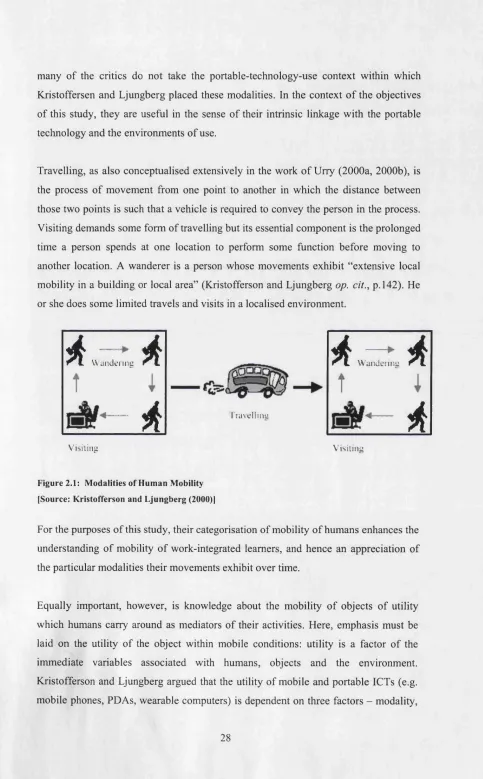
another location. A wanderer is a person whose movements exhibit “extensive local
mobility in a building or local area” (Kristofferson and Ljungberg op. cit., p. 142). He or she does some limited travels and visits in a localised environment.
A
A
W a n d e r in gA
W a n d e r in gA
A
r a v e n in gA
[image:31.595.29.512.30.809.2]V isiting V is it in g
Figure 2.1: Modalities of Human Mobility [Source: Kristofferson and Ljungberg (2000)1
For the purposes o f this study, their categorisation of mobility of humans enhances the
understanding of mobility o f work-integrated learners, and hence an appreciation of
the particular modalities their movements exhibit over time.
Equally important, however, is knowledge about the mobility of objects of utility
which humans carry around as mediators of their activities. Here, emphasis must be
laid on the utility of the object within mobile conditions: utility is a factor of the
immediate variables associated with humans, objects and the environment.
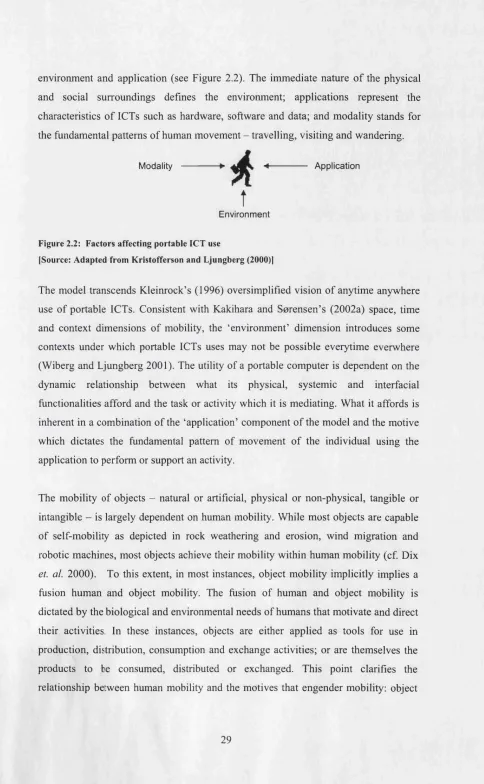
Kristofferson and Ljungberg argued that the utility of mobile and portable ICTs (e.g.
environment and application (see Figure 2.2). The immediate nature o f the physical
and social surroundings defines the environment; applications represent the
characteristics o f ICTs such as hardware, software and data; and modality stands for
[image:32.595.28.512.28.812.2]the fundamental patterns of human movement - travelling, visiting and wandering.
Figure 2.2: Factors affecting portable ICT use
[Source: Adapted from Kristofferson and Ljungberg (2000)1
The model transcends Kleinrock’s (1996) oversimplified vision o f anytime anywhere
use of portable ICTs. Consistent with Kakihara and Sorensen’s (2002a) space, time
and context dimensions of mobility, the ‘environment’ dimension introduces some
contexts under which portable ICTs uses may not be possible everytime everwhere
(Wiberg and Ljungberg 2001). The utility of a portable computer is dependent on the
dynamic relationship between what its physical, systemic and interfacial
functionalities afford and the task or activity which it is mediating. What it affords is
inherent in a combination o f the ‘application’ component of the model and the motive
which dictates the fundamental pattern of movement o f the individual using the
application to perform or support an activity.
The mobility of objects - natural or artificial, physical or non-physical, tangible or
intangible - is largely dependent on human mobility. While most objects are capable
of self-mobility as depicted in rock weathering and erosion, wind migration and
robotic machines, most objects achieve their mobility within human mobility (cf. Dix
et. al. 2000). To this extent, in most instances, object mobility implicitly implies a fusion human and object mobility. The fusion of human and object mobility is
dictated by the biological and environmental needs of humans that motivate and direct
their activities. In these instances, objects are either applied as tools for use in
production, distribution, consumption and exchange activities; or are themselves the
products to be consumed, distributed or exchanged. This point clarifies the
relationship between human mobility and the motives that engender mobility: object
Modality Application
mobility depends on human mobility and necessarily on human motives. Thus, the
need to operate objects, and for that matter portable ICTs, may themselves be the
motives that induce human mobility. The theorisation o f the significance of objects’
mediation o f human activities dates back to the seminal works o f Bacon (1620). Later
the idea o f objects’ mediation of activities became the premises of, most notably,
Marx’s (1976) Political Economics, Vygotsky’s (1962, 1978) Developmental
Psychology, Leont’ev’s (1978, 1982) Activity Theory and Engestrom’s (1987)
Expansive Learning.
Thus far, what is depicted by Kristofferson and Ljungberg is the mobility of humans
and the utility of portable ICT objects. As long as the artefacts are the portable
objects-in-use, their interaction and computing affordances imply that there is a
possibility o f the emergence of a countless variety of mobile human activities: for
example, the mobility o f location, interaction and occupation as corollaries of
mobility o f humans and objects is luridly conceptualised by Kakihara and Sorensen
(2002b). Nevertheless, the mobility of humans, objects and all other types are
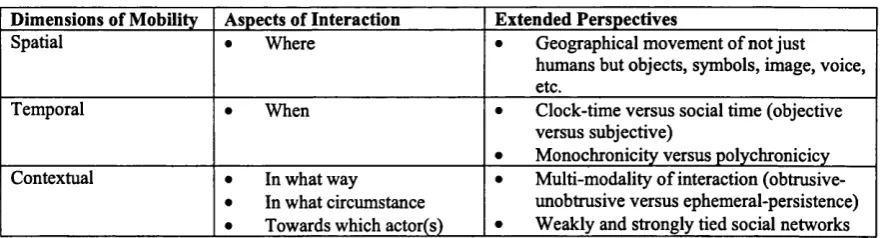
conceptualised within the dimensions of space, time and context: any analysis of
mobility has to deal with questions about where, when and under what circumstances
(Kakihara and Sorensen 2002a).
2.2.2 Dimensions of Mobility
2.2.2.1 Spatial Dimension
The definition of mobile inherently incorporates the notion o f space: one cannot
understand mobility without referring to location because it is the movement of an
entity from one location to another which defines mobility. The spatial mobility of
some modem ICTs have ensured the possibility of interactions between people who
are geographically independent: “the boundary between ‘here’ and ‘there’ dissolves”
(Kakihara and Sorensen op. cit.). People are expected to be geographically
independent nomads supported by the ‘wirelessness’ and portability o f ICTs including
their information services (Makimoto and Manners 1997). However, spatial mobility
does not only describe mobility of people; it also includes the mobility o f objects,
symbols and space itself (Castells 2001, Urry 2000a). Objects - including artificially
designed objects - exhibit mobility because they are carried by mobile humans to
objects possess symbols that are manipulated during their use; hence object mobility
implies mobility of symbols.
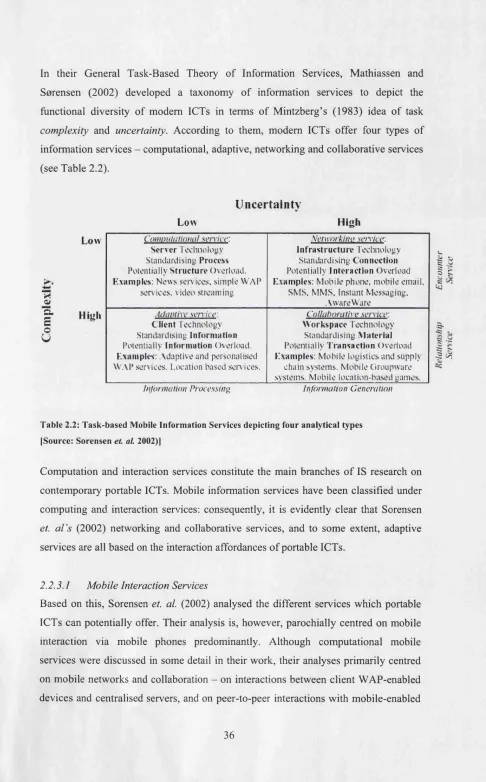
The essence of the spatial mobility of artefacts lies in the mobility o f information
services they afford. It is the mobile information service (Sorensen et. a l 2002) of a
mediating artefact in a particular activity that gives meaning to spatial mobility.
Without mobility of the service, we are left with the mobility o f the object, which, in
the context o f human activities, is non-essential or insignificant.
A point o f relevance is that, ultimately, the spatial mobility o f humans, objects and
symbols and services are interrelated and intertwined. For example, an individual who
carries a PDA, laptop computer or a mobile phone certainly does so with an intention
to use the service provided by the artefact to perform an activity aimed at satisfying a
motive. During this activity, he or she captures, processes or transmits information
using the artefact’s symbolic properties; and here, the mobility o f the individual, the
object and symbols occurs simultaneously. If he or she interacts with others using the
device, then spatial mobility o f the particular information service occurs. Therefore,
the interaction and computing information services provided by portable ICTs (ibid.),
together with the fundamental mobility of humans and objects, achieve spatial
mobility in terms of "humans independence of geographical constraints" (Kakihara
and Sorensen 2002a, see also Dahlbom and Ljungberg 1998, Deleuze and Guattari
1986, Fagrell et. al. 1999, Wiberg and Ljungberg 2001).
2.2.2.2 Temporal Dimension
Just as the concept of spatial mobility becomes meaningful and significant when the
phrase ‘of information services’ follows it, the conceptualisation of temporal mobility
is also only meaningful when it is linked to the information service supporting a
particular human activity. Technological development has always aimed at
automating human operations. To ‘automate’ (Zuboff 1988) is to adopt new time-
saving ways of doing work through technology. Zuboff s idea of automation was
largely related to static ICTs, yet it incorporated temporal efficiency. However,
temporal efficiency in static ICTs is only achieved when the user o f the technology is
attached to the technology and hence also static. Portable ICTs ensure that automation
automate human operations as they are carried around; in short, enhanced temporal
efficiency is achievable with portable ICTs.
In addition to time saving, portable ICTs also afford mobile interaction. Interaction
through fixed telephones and exchange of paper-based mails is asynchronous and
characterised by time delays. With the fixed telephone, interaction confines the user to
a specific location; otherwise he or she has to set voicemail up to allow callers to save
their messages for later reading. Reading of voicemail messages and paper-based mail
all constitute asynchronous interaction. Portable ICTs ensure synchronous interaction
because users can interact with others anytime anywhere. PDAs and laptop PCs are
wirelessly connectible to the internet for synchronous interaction via instant e-mail
exchange, or ICQ5 or MSN Messenger. In this sense, interaction and computing
information services provided by portable ICTs can be interpreted as temporally
mobile - the time it would take to interact or process information is mobilised.
The temporal efficiency established by the use of portable artefacts, and ICTs in
general, has seen much explication in organisation studies (see for e.g. Barley 1988,
Orlikowski and Yates 2002). Barley's work illuminated two strands o f temporality -
structural and interpretive. He applied objectified parameters such as sequence,
duration, temporal location and occurrence rates to measure structural temporality.
Interpretive temporality denotes how organisational actors interpret these objectified
parameters enabling them to "form opinions and make pronouncements about the
behaviour o f persons operating in alternate temporal systems" (p. 129). Arguments
surrounding temporality also point to considerations of whether time is symbolised as
monochronic or polychronic (Feldman and Homik 1981, Hall 1959, 1983, Kaufman
et. a l 1991a). Monochronicity refers to the treatment of time as linear and separable, and doing things "one thing at a time" (Cotte and Ratneshwar 1999), while treating
time polychronically means understanding time as naturally recurring and using it for
many purposes concurrently. Portable ICTs and their information services enable
people to deal with multiple tasks at the same time and therefore exhibit
polychronicity. Kakihara and Sorensen note: “the temporality o f human interaction
can no longer be explained from a linear clock-time perspective; it is now highly
mobilised into multiple temporal modes based on each actor's perspective and
interpretation of time itself’ (2002a, p.4).
Spatial and temporal mobility have together aroused interest in contemporary
Computer Supported Cooperative Work (CSCW) research. Before the introduction of
portable ICTs, CSCW researchers concerned themselves with communication,
collaboration and coordination issues of organisational actors and actions, and support
for these attributes through static computing. For example, they have concerned
themselves with the spatial and temporal dimensions of interaction among
interdependent workers in relation to technological innovations such as the Internet,
groupware and other information sharing systems. Recently, many CSCW researchers
are integrating mobility into their work (see Luff and Heath 1998, Dix and Beale
1996, Bergquist et. al. 1999, Bellotti and Bly 1996, Wiberg 2001). In their studies of
air traffic control, newsrooms, ship navigation and financial institutions for instance,
Luff and Heath illuminate how "the mobility of personnel and artefacts is critical to
communication and collaboration (p.306). This assertion is true. However, the crux of
our understanding of mobility also has to include expositions o f mobile computing
and interaction with contemporary portable ICTs.
2.2.2.3 Contextual Dimension
A third dimension o f mobility - contextual - has been propounded by Kakihara and
Sorensen {op. cit.) in their Extended Perspectives of mobility. They argue that the
contexts in which humans act, frame and are framed by their performance o f the act
recursively. Drawing parallels between context and Suchman's (1987) situated
actions, they bring to the fore the interactional aspects o f mobility referring to
questions such as "in what way", "in what particular circumstances" and "towards
which actors". These questions supplement the conventional spatial and temporal
dimensions of mobile interaction that respectively treated the questions o f "where"