Experimental Study on Nano Silica & Fly Ash as Partial Supplements of
Cement in Concrete
L. Ratna Kishore
1A. Priyadarshini
2P. Silus
31
PG Student
2Associate Professor
3Associate Professor & Head of Department
1,2,3
Department of Civil Engineering
1,2,3
Chebrolu Engineering College, Guntur, A.P, India
Abstract— The cement consumption is directly related to the country's infrastructure sector and thus its growth is paramount in determining the development of the country. With a current production capacity of around 366 million tonnes (MT), India is the second largest producer of cement in the world. An environmental standpoint cement has a negative impact, because manufacturing it emits about a ton of greenhouse gas (CO2) into the atmosphere for every ton of cement manufactured. Production of Portland cement not only releases 7% of the World's carbon dioxide, the cement industry also uses a lot of natural resources such as limestone, clay, petroleum, coal and other substances to preserve the natural resources and to reduce the pollution due to the production of cement is by limiting the cement content in the concrete without compromising the strength. There were efforts before to partially replace cement in concrete with new compounds and industry by-products. The aim of the present experimental investigation is to find the influence of combined application of Nano-Silica (NS) and Fly Ash (FA) on the strength properties of concrete. Fly Ash and Nano-Silica are used as partial replacement of cement. In the present experimental investigation the cement is partially replaced by 20% and 30% of Fly Ash and Nano-Silica 1.5%, 3% and 4.5% by weight. The effect of combined application of Fly Ash and Nano-Silica on compressive strength, split tensile strength, flexural strength and modulus of elasticity of M25 grade of concrete is investigated. The test results of concrete prepared using the combination of different proportions of Fly Ash and Nano-Silica are compared with that of controlled concrete. The variation of different test results of concrete prepared with various proportions of Fly Ash and Nano-Silica indicates the same trend. Based on the test results, it can be observed that concrete prepared with20% Fly Ash and 3% Nano-Silica combination possesses improved strength properties compared to the controlled concrete. The increase in the various strength characteristics of concrete prepared using Fly Ash and Nano-Silica can be attributed to the effective particle packing and the also the availability of additional binder in the presence of Fly-Ash and Nano-Silica.
Key words: Fly-Ash, Nano-Silica, Partial Replacement, Particle Packing & Strength of Concrete
I. INTRODUCTION
Concrete can be considered as the most widely used material in the construction industry. In the present day construction practice, along with the strength equal importance is given to the durability of concrete. The Indian Standard Code of practice for plain and reinforced concrete recommends the minimum cement content to satisfy the strength and durability requirements. Hence, the utilization of cement is increased. But, the cement production sconsumes large
amount of energy and emits carbon dioxide results in environmental pollution. Hence, one of the solutions to these problems is to reduce the consumption of cement and utilise Pozzolana materials for the preparation of concrete. Previous studies indicates that the use of Fly-Ash(FA), Micro Silica(MS), Metakaoline (MK) and Ground Granulated Blast Furnace Slag(GGBS) as partial replacement of cement reduces the cement consumption and also increases the strength and durability of concrete. To improve the performance of concrete further, Nano materials are also now being introduced as supplementary materials.
Recent developments in Nano-technology and the availability of nano-silica made the use of such materials in concrete. Nano-Silica (NS) is a nano-sized, highly reactive amorphous silica. Due to the smaller particles size and high surface areas compared to the other pozzolanic materials, the use of nano-silica possibly enhances the performance of concrete more effectively. As the nano-silica particles are very fine and they tend to agglomerate due to high surface interaction, uniform dispersion of nano-silica is an important issue to get its beneficial effects. The influence of combined application of fly ash and nano-silica is to be investigated.
It is the action of human beings that determines the worth of any material. Materials having potential for gainful utilization remain in the category of waste until its potential is understood and put to right use. Fly ash is one such example, which has been treated as a waste material in India, till a decade back, and has now emerged not only as a resource material, but also as an environment saviour. The Indian market is extremely receptive to clean development mechanism (CDM), with a fair amount of appreciation both by the government and the industry. Developed countries like US account for 30 % of global emissions, while India contributes about 3 % of the global Green House Gases (GHS) against the global average of 5.2 %. Use of fly ash in various products and partly substituting cement at current annual levels in India reduces the generation of CO2 by 25
million tons, good quality lime by 35 million tons and coal by 15 million tons a year. The potential that is yet to be tapped is multi-fold of the current levels.
Supplementary Cementing Materials (SCM) are widely used in India to partly replace cement in concrete. The SCM’s most commonly used include fly ash, ground granulated blast furnace slag and silica fume. Selection of fly ash as SCM for the cement is due to its availability and to protect environment from pollution.
II. LITERATURE REVIEW
Bjorn strom et al. explained about the hydration process of tricalcium silicate (C3S) cement and established the
accelerate dissolution of C3S phase, thereby renders the rapid
formation of C-S-H phase. If the nano particles are integrated with cement based materials, the new materials might posses some outstanding properties. NS can react with Calcium Hydroxide (CH) crystals, which are arranged in the interfacial transition zone (ITZ) between hardened cement paste and aggregates and produce C-S-H gel. Thus, the size and amount of CH crystals are significantly decreased and the early age strength of hardened cement paste in increased.
Ye Qing et al. found that the setting times and consistency for silica fume (SF) and NS incorporated concrete were different, but NS makes the cement paste thicker and accelerated cement hydration. Compare to SF concrete, NS showed improved compressive and bond strength.
Jo et al. studied the properties of cement mortar with NS particles and reported on the importance of NS addition towards strength characteristics, hydration progress and calorimetric investigations. Observations were also made from the heat of hydration values, which depicted the amount of CH formed by the addition of NS that could increase the amount of heat evolved during setting and hardening of the cement.
Gaitero et al. have explained about the reduced calcium leaching behaviour of cement paste by the addition of NS and revealed that the calcium leaching was a degradation process that consisted in the progressive dissolution of the cement paste as a consequence of the migration of Ca2+ ions to the aggressive solution. The results
obtained showed that NS increases the strength of the cement paste by about 30%.
Sololev et al. reported the roles of nano particles of silica act as fillers in the voids or empty spaces. The well dispersed NS act as a nucleation or crystallization centers of the hydrated products, thereby increasing the hydration rate, that is NS assisted towards the formation of smaller size CH crystals and homogeneous clusters of C-S-H composition. Moreover, they found that NS improved the structure of the transition zone between aggregates and the paste. The drawback in using NS in concrete is self - desiccation due to increased surface area and it will lead to shrinkage at high concentration and thereby produces cracks in concrete.
Khanzadi et al. reported the influence of NS particles on the mechanical properties and durability of concrete through measurement of compressive and tensile strengths, water absorption and the depth of chloride penetration. It was observed that the compressive and tensile strengths increased in presence of nano SiO2, which indicates
the pozzolanic activity of NS improvement in ITZ. Also water absorption, capillary absorption and distribution of chloride ion test results indicate that the nano-silica concrete has better permeability resistance than the normal concrete. With advent of supplementary cementitious materials and other siliceous and aluminous materials, today's concrete technology has achieved enormous potential applications, by the way of reduction in cement consumption, enhanced properties and reduced carbon foot print. In concrete, for example, the micro silica fume works in the form of chemical reaction with CH form more C-S-H gel at final stage and also fill the voids and pores in the fresh and hardened cement paste, thereby increasing the concrete's density. Some
researchers found that the addition of 1 kg of SF permits a reduction of 4 kg of cement, and this can be more if NS is used.
Lin et al. observed the effect of NS addition on permeability and compressive strength of fly ash (FA) cement mortar with NS. From the pore analysis study, it was reported that the relative permeability and pore sizes of concrete were decreased, whereas the compressive strength increased by adding 3% NS.
III. MATERIALS
A. Cement
53 grade (OPC – Ultratech Cement) was used for the investigation. It was tested for its physical properties in accordance with Indian Standard specifications. The properties of cement shown in Table 1.
PROPERTY VALUES
Specific Gravity 3.15 Normal Consistency 33 %
Setting Time Initial Setting time
Final setting time
40 mins 460 mins
Table 1: Properties of Cement
B. Coarse Aggregate
The coarse aggregate is defined as that retained on 4.75 mm IS sieve. To increase the density of the resulting concrete mix, the coarse aggregate is frequently used in two or more sizes. The coarse aggregate used were washed and kept in water for 24hr to remove dust and dirt and were dried to surface dry condition having a specific gravity of 2.61, water absorption of 0.4%, Finess modulus of 7.2.
C. Fine Aggregate
IS: 383-1970 defines the fine aggregate, as the one passing 4.75mm IS sieve. The fine aggregate is often termed as a sand size aggregate. Locally available riverbed sand was used in the present study. The per cent passing 600 micron sieve = 62.35. The sand conforms to grading Zone – III as per IS: 383 – 1970 respectively having specific gravity of 2.6, water absorption of 1.04%, Finess modulus of 2.8
D. Fly Ash
Due to its unique mineralogical and granulometric characteristics, fly ash generally does not need any processing before use as a mineral admixture. Bottom ash is much coarser, less reactive and therefore requires fine grinding to develop a pozzolanic property. Average worldwide utilization of fly ash is about 15%, whereas in India, its utilization is form 2 to 5% only. In the present study Fly ash is collected from VTPS. It is conformed to grade1 of IS: 3812-1981 having Specific Gravity of 2.2.
E. Nano Silica
F. Water
Water Available in our lab is used in this investigation.
IV. RESULTS & DISCUSSIONS
A. Compressive Strength
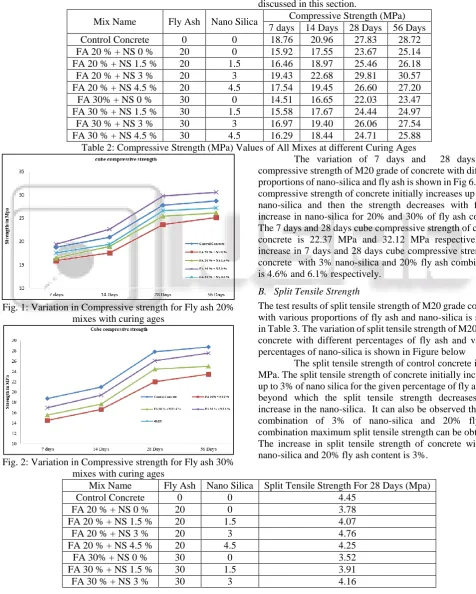
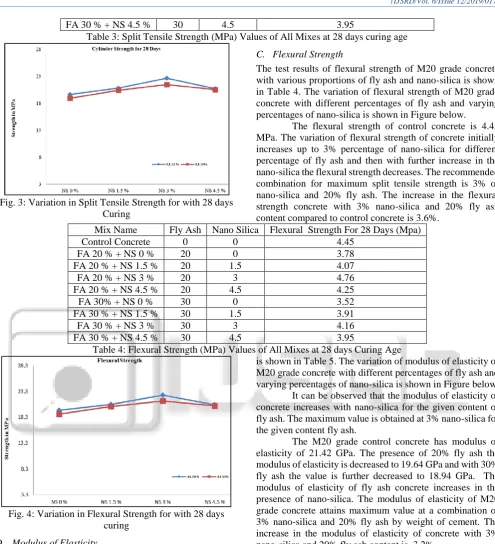
A compression test determines behaviour of materials under crushing loads. The cube compressive strength indicates the average of three test results. It can be observed that the
compressive strength of concrete prepared using fly ash and nano-silica exhibits more strength than the control concrete up to 3% of nano-silica if the percentage of fly ash is 20% and with further increase in nano-silica the compressive strength decreases. But, if the percentage of fly ash is increased to 30% irrespective of the content of nano-silica the compressive strength is less than the control concrete. The results of the strength tests conducted on concrete specimens of different mixes cured at different ages are presented and discussed in this section.
Mix Name Fly Ash Nano Silica Compressive Strength (MPa)
7 days 14 Days 28 Days 56 Days
Control Concrete 0 0 18.76 20.96 27.83 28.72
FA 20 % + NS 0 % 20 0 15.92 17.55 23.67 25.14
FA 20 % + NS 1.5 % 20 1.5 16.46 18.97 25.46 26.18
FA 20 % + NS 3 % 20 3 19.43 22.68 29.81 30.57
FA 20 % + NS 4.5 % 20 4.5 17.54 19.45 26.60 27.20
FA 30% + NS 0 % 30 0 14.51 16.65 22.03 23.47
FA 30 % + NS 1.5 % 30 1.5 15.58 17.67 24.44 24.97
FA 30 % + NS 3 % 30 3 16.97 19.40 26.06 27.54
[image:3.595.48.525.173.768.2]FA 30 % + NS 4.5 % 30 4.5 16.29 18.44 24.71 25.88
Table 2: Compressive Strength (MPa) Values of All Mixes at different Curing Ages
Fig. 1: Variation in Compressive strength for Fly ash 20% mixes with curing ages
Fig. 2: Variation in Compressive strength for Fly ash 30% mixes with curing ages
The variation of 7 days and 28 days cube compressive strength of M20 grade of concrete with different proportions of nano-silica and fly ash is shown in Fig 6.2. The compressive strength of concrete initially increases up to 3% nano-silica and then the strength decreases with further increase in nano-silica for 20% and 30% of fly ash content. The 7 days and 28 days cube compressive strength of control concrete is 22.37 MPa and 32.12 MPa respectively.The increase in 7 days and 28 days cube compressive strengthof concrete with 3% nano-silica and 20% fly ash combination is 4.6% and 6.1% respectively.
B. Split Tensile Strength
The test results of split tensile strength of M20 grade concrete with various proportions of fly ash and nano-silica is shown in Table 3. The variation of split tensile strength of M20 grade concrete with different percentages of fly ash and varying percentages of nano-silica is shown in Figure below
The split tensile strength of control concrete is 3.30 MPa. The split tensile strength of concrete initially increased up to 3% of nano silica for the given percentage of fly ash and beyond which the split tensile strength decreases with increase in the nano-silica. It can also be observed that at a combination of 3% of nano-silica and 20% fly ash combination maximum split tensile strength can be obtained. The increase in split tensile strength of concrete with 3% nano-silica and 20% fly ash content is 3%.
Mix Name Fly Ash Nano Silica Split Tensile Strength For 28 Days (Mpa)
Control Concrete 0 0 4.45
FA 20 % + NS 0 % 20 0 3.78
FA 20 % + NS 1.5 % 20 1.5 4.07
FA 20 % + NS 3 % 20 3 4.76
FA 20 % + NS 4.5 % 20 4.5 4.25
FA 30% + NS 0 % 30 0 3.52
FA 30 % + NS 1.5 % 30 1.5 3.91
FA 30 % + NS 4.5 % 30 4.5 3.95
[image:4.595.50.546.49.594.2]Table 3: Split Tensile Strength (MPa) Values of All Mixes at 28 days curing age
Fig. 3: Variation in Split Tensile Strength for with 28 days Curing
C. Flexural Strength
The test results of flexural strength of M20 grade concrete with various proportions of fly ash and nano-silica is shown in Table 4. The variation of flexural strength of M20 grade concrete with different percentages of fly ash and varying percentages of nano-silica is shown in Figure below.
The flexural strength of control concrete is 4.45 MPa. The variation of flexural strength of concrete initially increases up to 3% percentage of nano-silica for different percentage of fly ash and then with further increase in the nano-silica the flexural strength decreases. The recommended combination for maximum split tensile strength is 3% of nano-silica and 20% fly ash. The increase in the flexural strength concrete with 3% nano-silica and 20% fly ash content compared to control concrete is 3.6%.
Mix Name Fly Ash Nano Silica Flexural Strength For 28 Days (Mpa)
Control Concrete 0 0 4.45
FA 20 % + NS 0 % 20 0 3.78
FA 20 % + NS 1.5 % 20 1.5 4.07
FA 20 % + NS 3 % 20 3 4.76
FA 20 % + NS 4.5 % 20 4.5 4.25
FA 30% + NS 0 % 30 0 3.52
FA 30 % + NS 1.5 % 30 1.5 3.91
FA 30 % + NS 3 % 30 3 4.16
FA 30 % + NS 4.5 % 30 4.5 3.95
Table 4: Flexural Strength (MPa) Values of All Mixes at 28 days Curing Age
Fig. 4: Variation in Flexural Strength for with 28 days curing
D. Modulus of Elasticity
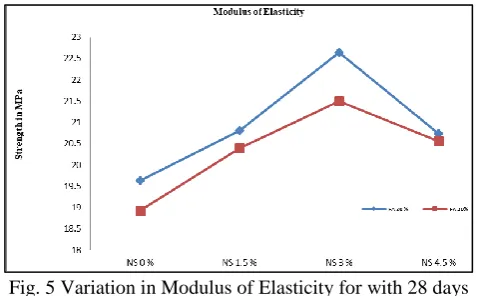
The test results of modulus of elasticity of M20 grade concrete with various proportions of fly ash and nano-silica
is shown in Table 5. The variation of modulus of elasticity of M20 grade concrete with different percentages of fly ash and varying percentages of nano-silica is shown in Figure below. It can be observed that the modulus of elasticity of concrete increases with nano-silica for the given content of fly ash. The maximum value is obtained at 3% nano-silica for the given content fly ash.
The M20 grade control concrete has modulus of elasticity of 21.42 GPa. The presence of 20% fly ash the modulus of elasticity is decreased to 19.64 GPa and with 30% fly ash the value is further decreased to 18.94 GPa. The modulus of elasticity of fly ash concrete increases in the presence of nano-silica. The modulus of elasticity of M20 grade concrete attains maximum value at a combination of 3% nano-silica and 20% fly ash by weight of cement. The increase in the modulus of elasticity of concrete with 3% nano-silica and 20% fly ash content is 3.2%.
Mix Name Fly Ash Nano Silica MOE For 28 Days (Mpa)
Control Concrete 0 0 21.42
FA 20 % + NS 0 % 20 0 19.64
FA 20 % + NS 1.5 % 20 1.5 20.81
FA 20 % + NS 3 % 20 3 22.65
FA 20 % + NS 4.5 % 20 4.5 20.74
FA 30% + NS 0 % 30 0 18.94
FA 30 % + NS 1.5 % 30 1.5 20.4
FA 30 % + NS 3 % 30 3 21.5
FA 30 % + NS 4.5 % 30 4.5 20.56
Fig. 5 Variation in Modulus of Elasticity for with 28 days Curing
V. CONCLUSION
The results of the experimental investigation indicate that the combination of fly ash and nano-silica can be used as Ordinary Portland cement replacement for concrete preparation.
1) Using the test results, it can be concluded that with the increase in the percentage of nano-silica for different percentages of fly ash, the various strength properties of concrete are increased up to 3% of nano silica and with further increase in the nano-silica the properties of concrete are decreased.
2) It is very interesting to note that the variation of compressive strength, split tensile strength, flexural strength and modulus of elasticity of M20 grade fly ash concrete with various percentages of nano-silica indicates the similar trend.
3) The increase in various strength properties of concrete containing fly ash with increase in the nano-silica content can be due to the availability of additional binder in the presence of nano-silica. The nano silica and fly ash reacts with the calcium hydroxide to form additional binder material. The availability of additional binder leads to increase in the paste-aggregate bond, results in improved strength properties of the concrete prepared with nano-silica and fly ash combination.
4) The decrease in the strength characteristics of concrete with increase in the nano-silica content beyond 3% is due to the poor quality of binder formed in the presence of high content of nano-silica and fly ash.
5) The various strength characteristics of concrete can be improved by the combined application of 3% nano-silica and 20% fly ash content. It can also be concluded that the cement content can be reduced without compromising the strength of concrete by the use of fly ash and nano-silica combination.
REFERENCES
[1] Thomas et al.,(1999), “Reported that fly ash reduced concrete strength at early ages, but significantly enhanced strength at later ages”. Cement and Concrete Research, Vol 29(4), pp.487-495.
[2] Gengying Li.,(2004). “Properties of High-Volume Fly Ash Concrete incorporating Nano-SiO2”, Cement and Concrete Research, pp. 1043-1049.
[3] Jagadesh.Sunku (2006),“had studied the advantages of use of fly ash as Supplementary Cementing Materials in Fibre cement sheets. International Inorganic Bonded Fibre Composites Conference, pp.25-32.
[4] Belkowitz,J. and Armentrout, D. L. (2009). The Investigation of Nano Silica in the Cement Hydration Process. ACI Special Publication 267(8): 87-100. [5] Sanchez,F., and Sobolev, K. (2010). “Nano-Technology
in Concrete – A Review”, Construction and Building Materials. 24, 2060-2071.
[6] G.Quercia and H.I.H. Browwers, (2010). ‘Applications of Nano Silica in Concrete Mixtures’, 8th Ph.D. Symposium in Kgs Lyngby, Denmark, June 20-23, [7] C Freeda Christy and D Tensing., (2010). “Effect of
Class F Fly Ash as Partial Replacement with cement” IJEMS, Vol 17 pp 140 – 144
[8] Surenra P. Shah, et al. (2010). “Controlling Properties of Concrete through Nano Technology” Proc. of the International Conference on Advances in Concrete, ICI-ACECON 2010, 5-9 Dec., IIT, Madras, India, PP 1-8. [9] D.P. Bentz et al.,(2010),“studied the evaluation of
sustainable high volume fly ash concretes,Cement and Concrete Composites, Vol 33, pp 39-45.
[10]Vanitha Aggarwal et .al.,(2010),“studied the concrete
durability through high volume Fly Ash
concrete.International Journal of Engineering Science and Technology, Vol 2(9), pp.4473-4477
[11]G.Carette et.al.(2010),“ studied on the early age strength development of concrete incorporating fly ash”.Materials, Vol 90(6),pp.535-544.
[12]Kazim Turk et.al.(2012),“ studied the effect of fly ash and silica fume on Compressive Strength”. Construction and Building Materials, Vol 37,pp.326-334.
[13]IS: 10262-2009. Concrete Mix Proportioning – Guidelines (First Revision). Bureau of Indian Standards, New Delhi.
[14]IS 516:1959. “Methods of Tests for Strength of Concrete”. Bureau of Indian Standards, New Delhi, India.