Comparative Study of Various Parameters for Pre-Engineered Building
& Conventional Truss Building Taking Effect of Soil Structure
Interaction
Pooja H. Jagtap
K J College of Engineering and Management Research, India
Abstract— There are many circumstances in civil engineering for which interaction between structure and ground has to be considered prominently. Hence the behavior of soil strata under the structure plays an important role during the earth quake excitation forces and other lateral forces on the structure. The phenomena may be defined as “The process in which the response of soil influences the motion of structure and motion of structure influence the response of the soil is termed as SSI”. In order to study structural behaviour of any structure, it is prominent to study the effects of soil structure interaction (SSI). In present study, attempt have been made to study the influence of soil structure interaction on Pre Engineered Building (P.E.B) and conventional truss shed building(C.S.B).Usually the structural behaviour is analysed assuming the fixed support conditions at the base of structure. In conventional method the foundation flexibility of soil mass is ignored which is likely to affect the structural response of building. The soil flexibility is integrated in the analysis of structure using Winkler’s spring model approach. For analysis P.E.B and C.S.B with 15m, 21m, 24m, 30m spans are considered with equal bay spacing. Three different soil strata’s i.e. hard, medium and soft are used for SSI study. The analysis is carried out in STAAD Pro.V8i software using response spectra of IS 1893-2002. The effect of SSI on various parameters like base shear, lateral displacement, etc. are studied and discussed. To get real behaviour of superstructure the subgrade must be modelled adequately well. The study reveals that the SSI significantly affects the performance of the structure.
Key words: Soil Structure Interaction (SSI), Pre-Engineered Building (P.E.B), Conventional Truss Building
I. INTRODUCTION
Steel is extensively used in the construction of industrial building of larger spans where concrete construction is not feasible or when construction time is critical. Any building structure used by industry to store raw materials or for manufacturing products of industry is known as an Industrial Building. In India steel constructions are most popular because of their ease in construction, low cost, availability of manpower for erection & fabrication. Now a day’s three types of steel structures are used as industrial shed for various purposes. Such as warehouse, workshops and various industrial units. These industrial structures are as follows: a) Conventional truss shed building.(CSB)
b) Pre-Engineered building.(PEB) c) Truss less roof sheds (shell structure).
In case of industrial building, the economy of the structure plays an important role. For longer spans the design is optimized in order to minimize the use of materials, costs, and installation efforts. Manufacturer adopt Pre-Engineering Building concept to reduce the costs. Pre-engineering Buildings is a metal building that consist of light gauge metal
standing seam roof and steel purlins spanning between rigid frames with light gauge metal wall cladding. If we go for conventional truss steel structures, time frame will be more, and also cost will be more, and both together i.e. time and cost, makes it uneconomical. Thus in pre-engineered buildings, the total design is done in the factory, and as per the design, members are pre-fabricated and then transported to the site where they are erected in a time less than 6 to 8 weeks. In such competitive decade problems associated with the practical application of SSI for building structures are rooted in a poor understanding of fundamental SSI principles. Soil- structure interaction topics are generally not taught in graduate earthquake engineering courses, so most engineers attempting SSI in practice must learn the subject on their own. Unfortunately, practice is hindered Buildings STAAD pro is one of the best software for Structural Analysis and Design Software Supporting Indian and major International codes.by a literature that is often difficult to understand, and codes and standards that contain limited guidance. Most articles rely heavily on the use of wave equations in several dimensions and complex arithmetic to formulate solutions and express results. Moreover, nomenclature is often inconsistent, and practical examples of SSI applications are sparse. This gives rise to the present situation in which soil-structure interaction is seldom applied
There are many circumstances in civil engineering for which interaction between structure and ground has to be considered prominently. Hence the behavior of soil strata under the structure plays an important role during the earth quake excitation forces and other lateral forces on the structure. The phenomena may be defined as “The process in which the response of soil influences the motion of structure and motion of structure influence the response of the soil is termed as SSI”.
In 2009, the National Institute of Standards and Technology (NIST) initiated the Task Order 69221 Project entitled “Improved Procedures for Characterizing and Modeling Soil-Structure Interaction for Performance-Based Seismic Engineering.” The purpose of this project was to develop consensus guidance for implementing soil structure interaction in response history analyses, such that input ground motions accurately reflect the input at the base of structures, and that structural models include elements that account for the geotechnical and foundation conditions associated with the building under consideration. Work also included an extensive review of available research on soil-structure interaction, evaluation of existing SSI guidelines for static-type analyses, and development of recommendations for improvement where necessary.
neither P.E.B provider researcher suggested the effect of “Soil-Structure Interaction” on performance of P.E.B and C.S.B. We know that soil below foundation affects structures subjected to lateral forces. So, it is important to check the effect of “Soil-Structure Interaction” on performance of both P.E.B and C.S.B. The power tool for Computerized Structural engineering STAAD.Pro is the most popular structural engineering software product for 3D model generation, analysis and multi-material design. For static or dynamic analysis of Pre Engineered Buildings, STAAD.Pro has been the choice of design professionals around the world for their specific analysis needs.
A. Soil Structure Interaction
Most of the civil engineering structure involve some type of structural element having direct contact with ground. There are many circumstances in civil engineering for which interaction between structure and ground has to be considered prominently. This encourages the interaction between structural engineers & geotechnical engineers. During to external lateral forces such as earthquake the structural displacement & ground displacement both are interdependent on each other. It is impossible to depart the correlation between structures & ground motion. It can be easily understand that the interaction between soil and structure can indeed affect the performance of the structure during earthquake particularly structure founded on relatively flexible soils.
Soil structure interaction is the general phenomena involved in the behaviour of structure which interacting with soil medium in response to the lateral loading imposed on the structure. The phenomena may be defined as “The process in which the response of soil influences the motion of respect to structure influence the response of the soil is termed as SSI”. This phenomena deals with interaction between structure & sub soil
B. Need of Soil Structure Interaction
In India from last few decades there is significance increase in the infrastructural development of country. Since the structure are huge and heavy the effect like SSI are to be considered during the design procedure of such structures. The effect of SSI on structure is not considered in early stage of construction practices. But since last 3-4 decades it has achieved prominent importance to consider the SSI while designing the structure. The effect of SSI for light structure can be neglected but its effect on heavy structure like high rise buildings, bridges, tall chimneys, nuclear power plants (NPP), elevated highways becomes prominent for better performance of structure during earthquake.
Many researchers have suggested different methods to study the effect of soil structure interaction during last few decades. Winkler’s spring model (1867) represents the soil medium as of identical but mutually independent, closely spaced, discrete, linearly elastic springs. George G Gazetas (1991) has presented complete set of algebraic formulas and dimensionless charts for readily computing the dynamic stiffness of springs which represents the soil medium.[8]
II. OBJECTIVE OF STUDY
To study various parameters like Base shear, lateral displacement, column moment for P.E.B and C.S.B with different spans. To validate results obtained by software with manual results. To investigate the effect of soil structure interaction considering three dissimilar soil strata’s like soft, medium and hard soil. To suggest suitable structure behaving better performance.
III. STRUCTURAL MODELLING
For the analysis of work a Pre-engineered and conventional Struss building with 15m, 21m, 24m and 30m spans are considered. The behaviour of these buildings are studied during earthquake excitation forces considering the soil structure interaction. The building is 11m high and length is 30m, height of crane girder is 8m. Building is symmetrical along both the X and Z-axis each bay of 6m. Isolated footings are considered to be resting on three types of soil strata’s namely, hard soil, medium soil, and soft soil.
Soil type
Modulus of Elasticity
(kN/m2)
Unit Wt. (γ)
Poisson ratio (μ)
Hard 65000 16 0.3
Medium 35000 16 0.4
Soft 15000 16 0.3
Table 1: Soil Elastic Constants
A. Models of P.E.B & C.S.B
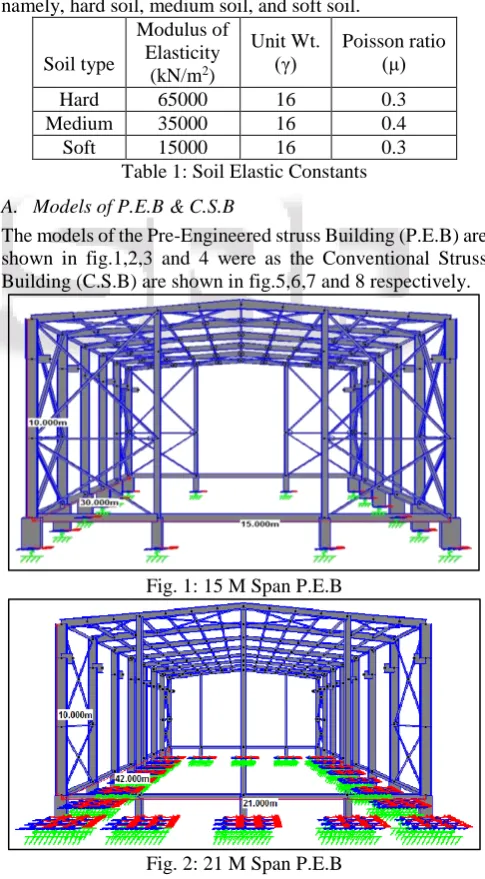
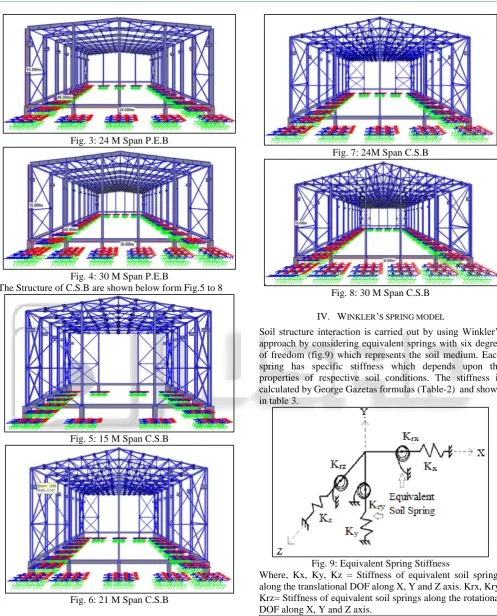
The models of the Pre-Engineered struss Building (P.E.B) are shown in fig.1,2,3 and 4 were as the Conventional Struss Building (C.S.B) are shown in fig.5,6,7 and 8 respectively.
[image:2.595.306.549.286.726.2]Fig. 1: 15 M Span P.E.B
Fig. 3: 24 M Span P.E.B
Fig. 4: 30 M Span P.E.B
The Structure of C.S.B are shown below form Fig.5 to 8
[image:3.595.47.545.54.671.2]Fig. 5: 15 M Span C.S.B
Fig. 6: 21 M Span C.S.B
Fig. 7: 24M Span C.S.B
Fig. 8: 30 M Span C.S.B
IV. WINKLER’S SPRING MODEL
Soil structure interaction is carried out by using Winkler’s approach by considering equivalent springs with six degree of freedom (fig.9) which represents the soil medium. Each spring has specific stiffness which depends upon the properties of respective soil conditions. The stiffness is calculated by George Gazetas formulas (Table-2) and shown in table 3.
Fig. 9: Equivalent Spring Stiffness
Where, Kx, Ky, Kz = Stiffness of equivalent soil springs along the translational DOF along X, Y and Z axis. Krx, Kry, Krz= Stiffness of equivalent soil springs along the rotational DOF along X, Y and Z axis.
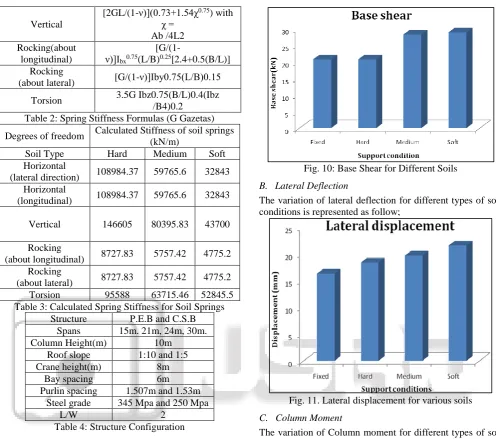
Degrees of freedom Stiffness of equivalent soil spring
Horizontal (lateral)
[2GL/(2-ν)](2+2.50χ0.85) with χ = Ab
/4L2
Horizontal (longitudinal)
Vertical
[2GL/(1-ν)](0.73+1.54χ0.75) with χ =
Ab /4L2 Rocking(about
longitudinal)
[G/(1-
ν)]Ibx0.75(L/B)0.25[2.4+0.5(B/L)] Rocking
(about lateral) [G/(1-ν)]Iby0.75(L/B)0.15
Torsion 3.5G Ibz0.75(B/L)0.4(Ibz
[image:4.595.47.544.61.500.2]/B4)0.2 Table 2: Spring Stiffness Formulas (G Gazetas)
Degrees of freedom Calculated Stiffness of soil springs (kN/m)
Soil Type Hard Medium Soft
Horizontal
(lateral direction) 108984.37 59765.6 32843 Horizontal
(longitudinal) 108984.37 59765.6 32843
Vertical 146605 80395.83 43700
Rocking
(about longitudinal) 8727.83 5757.42 4775.2 Rocking
(about lateral) 8727.83 5757.42 4775.2
Torsion 95588 63715.46 52845.5
Table 3: Calculated Spring Stiffness for Soil Springs
Structure P.E.B and C.S.B
Spans 15m. 21m, 24m, 30m.
Column Height(m) 10m
Roof slope 1:10 and 1:5
Crane height(m) 8m
Bay spacing 6m
Purlin spacing 1.507m and 1.53m Steel grade 345 Mpa and 250 Mpa
L/W 2
Table 4: Structure Configuration
V. PARAMETRIC STUDY
The effect of different base condition on performance of P.E.B is studied considering soil structure interaction (SSI). Effect of SSI on P.E.B is carried out considering the following parametric study.
A. Base Shear
[image:4.595.311.544.68.231.2]The variation of base shear for different soil conditions is represented as follow;
Fig. 10: Base Shear for Different Soils
B. Lateral Deflection
The variation of lateral deflection for different types of soil conditions is represented as follow;
Fig. 11. Lateral displacement for various soils
C. Column Moment
[image:4.595.311.545.511.662.2]The variation of Column moment for different types of soil conditions is represented as follow
Fig. 12: Column Moment for Different Soil
VI. CONCLUSIONS
PEB, hence for these spans CSB gives good performance compared to PEB in effect of SSI.
2) For 21m to 24m span it is observed that for CSB increment in B ase shear, Lateral deflection and Column moment is 87%, 83% and 73% which is more compared to PEB, hence for these spans PEB is better performing building in SSI.
3) For 24m to 30m span it is observed that for CSB increment in Base shear, Lateral deflection 77.5%, 86% which is more compared to PEB, but there is 637% less increment in column moment of PEB compared to CSB, hence for these spans PEB is better performing building in SSI.
ACKNOWLEDGMENT
I am thankful to my guide, Dr. Prof, S. K. Patil HOD Civil Department and Mr. Nitin Lale. Department of KJ’s College of Engineering and Management Research.
REFERENCES
[1] Mr.Nitish Kumar, Mr.Praveen J, “Study of Soil Structure Interaction Effect on Multi-Storey RC Frame Structures Resting Over Raft Foundation under Earthquake Caused Agitation”. Vol. 4, Issue 1, pp: (95-102), September 2016, IJCSER.
[2] Nirav M. Katarmal, Hemal J. Shah, “Seismic Response of RC Irregular Frame with Soil-Structure Interaction”. Volume 1, Issue 4, April 2016, IJSDR.
[3] Mamathashree K.S, Sanjay S.J, “Seismic Evaluation of RC Framed Irregular Buildings with Soil Structure Interaction”. ISSN: 2319-7064, IJSR.
[4] Halkude S.A., Kalyanshetti M.G. and Barelikar S.M, “Seismic Response of R.C. Frames with Raft Footing Considering Soil Structure Interaction”.Vol.4, No.3 (June 2014), IJCET.
[5] R. M. Jenifer Priyanka, N. Anan, Dr. S. Justin, “Studies on Soil Structure Interaction of Multi Storeyed Buildings with Rigid and Flexible Foundation” Volume 2, Issue 12, December 2012, IJETAE.
[6] M.E.Boostani Darmian, M.Azhdary Moghaddam, and H.R.Naseri (2011) “Soil structure interaction in steel braced structure with foundation uplifts”,, Vol.7, Issue 2, IJRRAS
[7] George Mylonakisa, Sissy Nikolaoub, George Gazetas (2006) “Footings under seismic loading: Analysis and design issues with emphasis on bridge foundations.” Soil Dynamics and Earthquake Engineering 26 (2006) 824– 853 ELSEVIER.
[8] George Gazetas, “Formulas and charts for impedance of surface and embedded foundations” Vol. 117, No. 9, September, 1991, ASCE.
[9] “Soil structure interacton for building structures”, NIST GCR12-917-21, NEHRP consultents.
[10]IS 1893(part I):2002-criteria for earth quake resistant design of structures.