Optical Wireless Communication System using VLC Technology
Michelle Araujo e Viegas
1Mr. Kevin Keith Monteiro
2Mr. Ninad Sanzgiri
3Mr. Tushar Revankar
4Mr. Mathias Pascoal Rodrigues
51
Assistant Professor - Head of Department
2,3,4,5UG Student
1,2,3,4,5
Department of Electronics & Telecommunication Engineering
1,2,3,4,5Don Bosco College of Engineering, Fatorda, Goa, India
Abstract— The last few decades have seen rapid advances in information and communication technology. We commonly use broadband technology with high-speed Internet connectivity at our homes, offices, and in our mobile devices. The bandwidth and high-capacity requirements due to the increased use of Internet and broadband services have exceeded our expectations in twenty-first century. Optical Wireless communication (OWC) uses optical carrier in the near-infrared (IR) and visible light bands (VLC) and is considered a viable solution for realizing very high-speed and large-capacity communication links. It is a line-of-sight communication using a laser/LED to transmit the information signal between two transceivers over an unguided channel which may be either the atmosphere or free space. The technology that is used to achieve Optical Wireless Communication discussed in this paper is VLC technology (Li-Fi).
Key words: Optical Wireless Communication, VLC Technology
I. INTRODUCTION
Nowadays using technology for communication has become an important part of our day-to-day life. But current wireless technology has been providing low data rate for data communication when multiple user tries to connect the network. As it provides a limited bandwidth frequency. There are around 1.4 million cellular mast radio waves base stations deployed, with over 5 billion mobile phones. Mobile phones transmit over 600TB of data. Presently wireless communication uses radio waves. Spectrum is the one of the most essential requirement for wireless communication. With the advancement in technology and the number of users, the existing radio wave spectrum fails to cater to this need. To resolve the issues of scalability, availability and security, we have come up with the concept of transmitting data wirelessly through light using LEDs, which is called as Li-Fi is a latest technology that makes use of LED light which helps in the transmission of data much faster and flexible than data that can be transmitted through Wi-Fi. LED lights are becoming widely used for homes and offices for their luminous efficacy improvement.
Visible light communication (VLC) is a new way of wireless communication using visible light. Typical transmitters used for visible light communication are visible light LEDs and receivers are photodiodes and image sensors. We present new applications which will be made possible by visible light communication technology. Location-based services are considered to be especially suitable for visible light communication applications. An indoor visible data transmission system utilizing LEDs is proposed. In this system, these devices are used not only for illuminating rooms, but also for an optical wireless communication system.
II. WHAT IS THE PROBLEM?
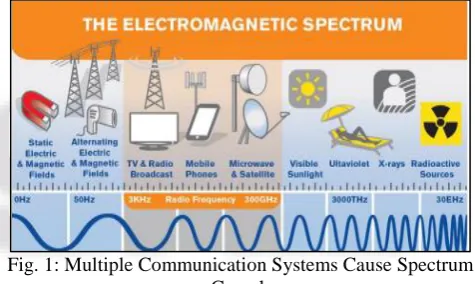
Despite continuous improvements in wireless communication systems, e.g. 3G, 4G, etc.., a coming crisis is expected due to the lack of sufficient Radio Frequency (RF) resources, this limitation in bandwidth can’t support the growth in demand for high data rates and the large numbers of communication systems, as shown in Figure 1, within the bandwidths between 300 kHz and 4 GHz. That’s known as “Spectrum Crunch”. [1]
[image:1.595.308.546.332.474.2]Although, spectrum congestion decreases when we use high frequencies to transfer data, but this not a practice solution, because this part of spectrum requires complex equipment and causes high cost systems. [2]
Fig. 1: Multiple Communication Systems Cause Spectrum Crunch
A. So How Can We Solve This Problem?
Actually, there are numbers of technologies that provide realistic and applicable solutions to this issue. One of them is the “Cognitive Radio”. [3] It is a new sort of wireless communication with a transceiver architecture that can intelligently detect which communication channels are in use and which are not, and instantly move into empty channels to use them to transmit data. Another solution is the transmission of data using visible light illumination which use very high frequency. In general, this technology known as Visible Light Communication (VLC). [2]
There are also many brilliant and efficient solutions, in this seminar we will focus on Light Fidelity (Li-Fi) technology, which is based on VLC.
III. VISIBLE LIGHT COMMUNICATION
within IEEE wireless personal area networks working group (802.15). [6]
[image:2.595.52.282.151.240.2]One of VLC‟s features is providing wide bandwidth as illustrated in Figure 2. We can obviously see that usage the optical portion of spectrum guarantees about 10,000 times greater bandwidth compares to the usage of the RF frequencies. [7]
Fig. 2: Location of Visible Light & RF Frequencies at Electromagnetic Spectrum.
A. Components
As we see in the previous paragraph, VLC is a communication system which consists of a transmitter, a receiver and a communication channel. The main components of VLC systems are:
1) High brightness Light-Emitting Diodes (LEDs) or any light sources, which acts as transmitter.
2) A silicon photodiode has the roll of a detector and it shows a good response to visible wavelength.
3) Communication channel is air or fiber optics.
[image:2.595.312.545.214.365.2]Usually, we add to these components some necessary circuits like a driving circuit and a receiving circuit. The driving circuit consists of a control circuit and output stage to modify the data and make it ready to be sent and the receiving circuit consists of a filter to select the required band, amplification stage to provide the required Signal to Noise ratio in order to demodulate the signal. We show a block diagram of VLC system in Figure 3. [8]
Fig. 3: Block Diagram of the VLC System
IV. WHAT IS LI-FI?
Li-Fi is a new technology for short range wireless communication system; which is suitable for data transmission via LEDs by illumination. It uses the visible light, a part of the electromagnetic spectrum that is still not greatly utilized, instead of RF part. [9]
Professor Harald Haas, the original founder of Li-Fi technology, in his Technology Entertainment Design (TED) global talk on Li-Fi says: “At the heart of this technology is a new generation of high brightness LEDs”, he also explains “Very simply, if the LED is on, you transmit a digital 1, if it’s off you transmit a 0, they can be switched on and off very quickly, which gives nice opportunities for transmitted data.”
It is possible to encode data in the light by varying the rate at which the LEDs flicker on and off to give different strings of 1s and 0s. Figure 4 illustrates the idea of data transmission using light. The LED intensity is modulated so rapidly that the human eye cannot notice, so the output appears constant; also more sophisticated techniques could dramatically increase Li-Fi data rates such as using array of LEDs, where each LED transmits a different data stream, to provide parallel data transmission. Other ideas are using mixtures of red, green and blue LEDs to alter the light frequency encoding a different data channel. In the next paragraphs, we will talk about the history of the technology, its working principle and its various advantages. [4]
Fig. 4: Data Transmission via LEDs
A. Working Principle
Li-Fi technology is implemented using white LED light bulbs used for illumination by applying a constant current. However, by fast variations of the current, the light output can be made to vary at extremely high speeds. If the LED is on, it transmits a digital 1otherwise it transmits a digital 0. The LEDs can be switched on and off quickly to transmit data that can’t be detected by a human eye. [2]
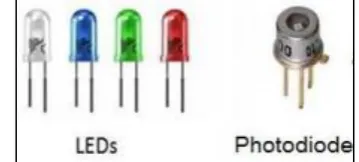
[image:2.595.52.284.482.590.2]So what we need at all for sending data are some LEDs and a controller that cods data into those LEDs and for receiving data, we need a Photodiode which is used as a detector, these components are shown in Figure 5.
Fig. 5: The Main Component of Li-Fi System: LEDs, Photodiode
[image:2.595.336.516.514.595.2]Fig. 6: The Working Principle of the Li-Fi.
V. PROPOSED DESIGN
[image:3.595.329.521.92.252.2]A. Transmitter
Fig. 7: LED Driver Circuit in Transmitter
Figure 7 shows the LED driver circuit for transmission of data. ULN2803 is used as the driver IC in LED driver circuit. This IC is connected to eight NPN Darlington transistors which are directly compatible to TTL families. The maximum output voltage is about to be 50V and it can handle 500mA of output current. The input data is directly given to ULN2803 through function generator. The positive power supply is directly connected to the anode terminal. The output of ULN2803 is connected to the cathode terminal of LED.
B. Receiver
Fig. 8: Photo Detector Receiver Circuit
The photo detector receiver circuit is shown in Figure 8. The receiver circuit consists of LM358 which acts as a comparator and also calibrates the sensitivity of the photo detector (solar panel). It has wide bandwidth and high gain. LM358 is an open collector comparator in which logic levels like TTL, DTL, ECL, and CMOS Logic are compatible. The current of solar panel changes according to the variation in the illumination of light. There are two stages in receiver circuit. In first stage the photo detector current is converted into voltage. The second stage is inversion of voltage level to get
[image:3.595.46.284.169.365.2]the original information by the Hex Schmitt trigger IC 74LS14.
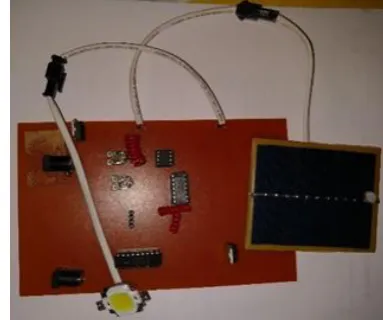
Fig. 9: Hardware Model of the Transceiver Circuit Figure 9 shows the hardware model of the transceiver circuit.
VI. RESULTS & DISCUSSIONS
A. Simulation Output for Data Transmitter
In ULN2803 IC, the 18 pin is located using a CRO probe. The voltage level of this IC is around 24V. The information sent is a square wave sent through a function generator. Figure 10 shows the simulation result of data transmitter.
Fig. 10: Simulation Result of Data Receiver
B. Simulation Output for Data Receiver
[image:3.595.306.542.365.545.2] [image:3.595.46.284.488.638.2]Fig. 11: Simulation Result of Data Receiver
VII. ADVANTAGES
Li-Fi is ideal for high density wireless data coverage in confined area and for reducing radio interference issues. Its features include benefits to the capacity, energy efficiency, safety and security of a wireless system; now, we will talk briefly about each one of these advantages. [4] [12]
A. Efficiency
The efficiency of each radio station is just 5%due to the fact that most of the energy is used for the cooling system in base of the radio station. Li-Fi is highly efficient because LED consumes less energy. [16] It is effective in terms of low cost, low required energy and for various Environments. In this topic there are some main and important points:
1) Low cost
Requires fewer components than radio technology, due to the cheap price of the LEDs and Digital components compared with the microwave equipment.
2) Energy
LED illumination is already efficient and the data transmission does not requires, additional power because most energy dissipation in LEDs requires little amount of energy.
3) Environment
RF transmission and propagation in water is extremely difficult but Li-Fi works well in this environment. [15]
B. Capacity
Any lighting devices like car lights, ceiling lights, street lamps, etc. are used as a hotspot. It means that any light spread internet using VLC which helps us to lower cost architecture for a hotspot. [12] the most important issues here are Bandwidth, Data density and speed.
1) Bandwidth
The visible light spectrum more abundant 10,000 times compared with the RF spectrum.
2) Data density
Li-Fi can achieve about 1000 times the data density of Wi-Fi because visible light can be well contained in a tight illumination area, whereas RF tends to spread out and cause interference.
High speed, Very high data rates can be achieved as high as 500mbps or 30GB per minute due to the low interference, high device bandwidths and high intensity optical output. [4]
C. Safety
Light is all around us – it is a natural part of life – and as such there are no health concerns associated with its use as a communications medium. It never gives any side effects on any living thing like radio waves and other communication waves which can dangerously interfere with electronic circuits and have effects on birds and humans. [10]
D. Security
“If you can’t see the light, you can’t access the data!” Because of the signal will not travel through walls, it is difficult to eavesdrop on Li-Fi signals. You can also see where the data is going, so there is no need for additional security such as pairing for RF interconnections like Bluetooth. [15]
VIII. LI-FI VERSUS WI-FI
Wi-Fi is the popular name for the wireless Ethernet 802.11b standard for Wire line local area networks (WLANs). It is the name of a popular wireless networking technology that uses radio waves to provide wireless high-speed Internet and network connections. This technology works with no physical wired connection between sender and receiver by using RF, a frequency within the electromagnetic spectrum associated with radio wave propagation. When an RF current is supplied to an antenna, an electromagnetic field is created that then is able to propagate through space. [20]
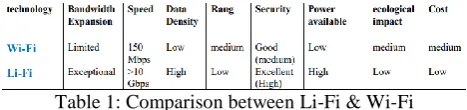
Li-Fi is a term of one used to describe visible light communication technology applied to high speed wireless communication. It acquired this name due to the similarity to Wi-Fi, only using light instead of radio. Wi-Fi is great for general wireless coverage within buildings, and li-fi is ideal for high density wireless data coverage in confined area and for relieving radio interference issues, so the two technologies can be considered complimentary. Li-Fi provides better bandwidth, efficiency, availability and security than Wi-Fi and has already achieved blisteringly high speed compare with Wi-Fi. It is low-cost technology because of nature of LEDs and lighting units and there are many opportunities to exploit this medium. Table 1 shows a comparison between Li-Fi and Wi-Fi. [4] [12]
Table 1: Comparison between Li-Fi & Wi-Fi
IX. CHALLENGES FOR LI-FI
Apart from many advantages over Li-Fi, this technology is facing some problems such as Li-Fi requires line of sight (LOS) and receiving device would not be shift in indoors. A major challenge is how the receiving device.
[image:4.595.311.545.543.598.2]somebody simply walking in front of the LED source. [16] [21]
X. CONCLUSION
The possibilities are numerous and can be explored further because the concept of Li-Fi is currently attracting a lot of eye-balls because it offers a genuine and very efficient alternative to radio based wireless. It has a good chance to replace the traditional Wi-Fi because as an ever increasing population is using wireless internet, the airwaves are becoming increasingly clogged, making it more and more difficult to get a reliable, high-speed signal. In the future, data for laptops, smart phones and tablets can be transmitted through light in the room by using Li- Fi. Researchers are developing micron sized LED which are able to flicker on and off around 1000 times quicker than larger LED. If this technology can be put into practical use, every bulb can be used as a Wi-Fi hotspot to transmit wireless data and we will proceed toward the cleaner, greener, safer and brighter future. This concept promises to solve issues such as the shortage of radio-frequency bandwidth and boot out the disadvantages of Wi-Fi. Li-Fi is the upcoming and on growing technology acting as competent for various other developing and already invented technologies. Hence the future applications of the Li-Fi can be predicted and extended to different platforms and various walks of human life.
REFERENCE
[1] (2015, jan) Enhanced data transmission protocol for visible light communications. [Online].
http://www.research- innovation.ed.ac.uk/Opportunities/enhanced-data-transmission-for-Li-Ficommunications.aspx
[2] (2011, Jul) TED. [Online].
http://www.ted.com/talks/harald_haas_wireless_data_fr om_every_light_bulb
[3] (2010) Techtarget search networking. [Online]. http://searchnetworking.techtarget.com/definition/cogni tive-radio
[4] Prerna Chauhan, Ritika Tripathi Jyoti Rani, "Li-Fi (Light Fidelity)-The future technology In Wireless communication," International Journal of Applied Engineering Research, Nov 2012.
[5] M. Mutthamma, "A survey on Transmission of data through illumination - Li-Fi," International Journal of Research in Computer and, Dec 2013.
[6] (2015) wikipedia. [Online].
http://en.wikipedia.org/wiki/Visible_light_communicati on
[7] Kajal, Ashish Saini Kanchan Gupta, "Lifi- Light Fidelity Technology- A Review," International Journal of Emerging Research in Management &Technology, vol. 3, no. 10, Oct 2014.
[8] Sylvester C.S. Lo, "Visible Light Communications," The Hong King University of Science and Technology, 2014.
[9] Teleinfo. (2012, Jan) [Online].
http://teleinfobd.blogspot.in/2012/01/what-is-lifi [10](2013, Feb) Seminar projects. [Online].
http://seminarprojects.com/Thread-li-fi-light-fidelity-the-futuretechnology-in-wireless-communication
[11](2011) digplanet. [Online].
http://www.digplanet.com/wiki/Li-Fi
[12]Dharmrajsinh N. Parmar, Khushbu V. Mehta Jay H. Bhut, "LI-FI Technology – A Visible Light Communication," INTERNATIONAL JOURNAL OF ENGINEERING DEVELOPMENT AND RESEARCH, Jan 2014.
[13]Richard Gilliard, "THE LiFi® Lamp High Efficiency High Brightness Light Emitting Plasma With Long Life And Excellent Color Quality," IEEE, Sunnyvale, USA, 2010.
[14](2011) Good. [Online].
http://magazine.good.is/articles/forget-wifi-it-s-lifi-internet-through-lightbulbs
[15](2014) pureLiFi. [Online]. http://purelifi.com/ Seminar Li-Fi Technology 28
[16]Raunak, Akshay Sanganal Rahul R. Sharma, "Li-Fi Technology Transmission of data through light," al, Int.J.Computer Technology & Applications, Navi Mumbai, India, 2014.
[17](2014) TOP IEEE Visible Light communication (LiFi)
Projects. [Online].
goaltechnologies.in/new/wpcontent/uploads/2012/01/to p-embedded-projects-2014-15.docx
[18](2012) (UP-VLC) project. [Online]. http://up-vlc.photonics.ac.uk
[19](2014, Nov) Fujitsu. [Online].
http://www.fujitsu.com/global/about/resources/news/pre ssreleases/2014/1117-01.html
[20](2011) webopedia. [Online].
http://www.webopedia.com/TERM/W/Wi_Fi.html [21]Prof. (Dr.) Y.P.Singh, "A Comparative and Critical