University of East London Institutional Repository:
This paper is made available online in accordance with publisher policies. Please scroll down to view the document itself. Please refer to the repository record for this item and our policy information available from the repository home page for further information.
Author(s):Tobe, Renée
Title:Not Thinking but Questioning Year of publication:2007
Citation:Tobe, R. (2007) 'Not Thinking but Questioning' The Role of the Humanities in Design Creativity, East Midlands Media and Technology Centre University of Lincoln, 15-16November. University of Lincoln: UK.
Link to published version:
TOBE Not Thinking but Questioning
Copyright reverts to the author
The Role of the Humanities in Design Creativity International Conference 2007
1
The Role of the Humanities in Design Creativity
Conference at the University of Lincoln (15-16th November, 2007)
Title: Not Thinking but Questioning Contributor’s name: Renée Tobe
Academic/Professional affiliation: Sheffield Hallam University Email Address: [email protected]
Biography
Introduction
In this paper I examine two films of Terrence Malick, Badlands (1973), and Days of
Heaven (1978) as vehicles to look at how depth of thought can influence creative
image making.1 Badlands follows two young people aged 25 and 15, on a journey through the American mid-West in the 1950s, as they try to escape their destiny killing people along the way. Days of Heaven is set earlier, just before the First World War and tells the story of a love triangle between migrant workers and a farmer.
Place of the Image
I also question the relation of architecture and film. Visual culture enables us to look at how the place of the image, the image of architecture, and the filmic image help us to understand how films transfer meaning. Visual culture provides a framework into intellectual possibilities so that we may look at film, philosophy, and architecture together.2 The image of architecture is only part of the whole culture it embodies.3 In both Badlands and Days of Heaven Malick shows a close visual correspondence to films of the silent era such as F. W. Murnau’s Sunrise (1927), in the same way he ‘quotes’ the photographs of Dorothea Lange or the classic paintings by Andrew Wyeth and Edward Hopper, who capture the look and silence of the Mid-Western American landscape. Hopper’s painting House by the Railroad (1925) provided a model for the house in Days of Heaven, not just in architectural form, but also in lighting, framing, and an honest and authentic way of setting itself in the landscape. This ‘quoting’ affords the film a cultural authority. While putting the paintings and the film stills side by side may create a visual game of likenesses and similarities, it also emphasises the artists’ visually expressed and shared concern for the effects of modernity on the relationship between humans and the environment.4
Fig. 1 Edward Hopper House by the Railroad (1925) Fig. 2 Richard Gere and Brooke Adams in front of Farmer’s House.
Days of Heaven (Terrence Malick, 1978)
Malick employs what Laura Mulvey describes as the formal characteristics of style, where words, text, or dialogue are less appropriate, or even inadequate to the emotional burden of the subject matter. Fate rather than heroic transcendence offers a resolution to the drama.5 Characters in the film (and the actors who play those characters) represent forces rather than people as they respond to rather than control or attempt to understand their circumstances.
Silent film initiated the notion of a universal language in instrumentalised form.6 Film as a medium began silent and the mute role is expressive. In silent films gesture, dramatic action, and visual expression replace spoken dialogue. In the two years Malick took to edit Days of Heaven he cut out a great deal of talking between
TOBE Not Thinking but Questioning
Copyright reverts to the author
The Role of the Humanities in Design Creativity International Conference 2007
TOBE Not Thinking but Questioning
Copyright reverts to the author
The Role of the Humanities in Design Creativity International Conference 2007
3 characters but the narrative required clarification so Linda’s (street wise) voice over was added in post-production. This editing out of scenes of heavy dialogue re-emphasised the visuals, and image.
Although, as Karsten Harries demonstrates, we can describe in words what we have never seen or experienced, and a non-sighted person may be taught to name the correct colours to objects not actually viewed, these words do not reveal the situation.7 In Heideggerian terms the things around us reveal themselves to us. Although words help us to understand the world, language doesn’t belong to us, we share it as culture.
Image of Architecture
Architecture and film and the relation to visual culture as a discipline helps us to look at a painting and a film still and compare them and discuss them as well as the architecture depicted in the image. For both films, but more obviously in Days of
Heaven,Malick draws on the paintings by Wyeth and Hopper. For example, Wyeth’s
paintings look out to minimal landscapes; roads lead out to the distances, their destination unclear. Similarly Hopper’s painting, American Landscape (1920) resembles Wyeth, in both the handling of light and the empty landscapes. Hopper’s barren hills, angular houses, unsmiling figures, and empty roads offer isolation everywhere.8 Malick’s films as well make explicit this theme of isolation, and alienation combined with destination (and destiny).
The cinematic language of look, gesture, cut, and frame extends possibilities for reading and interpretation of expression through colour, language, and mise en scène. The mute gestures, extreme visuals, and saturated colours of Malick’s films give visibility to material that evades conscious articulation. What can’t be expressed or described may be presented on screen. In an example from Badlands, in a scene in the rich man’s house, dust covers cover the furniture in a room where the owner and the deaf maid are kept prisoner, muting both scene and colour. This contrasts with the rich sensuality of materials and furnishings, as well as the piano and record player (machines that produce not only sound but music) in the interior of the farmer’s house
of Days of Heaven.
The Filmic Image
The actors transcend the characters. Included in the discussion of the filmic image must be the youthful beauty of the male characters played by Martin Sheen, Richard Gere, and Sam Shepherd. Like Adonis, the men in the films are beautiful and killed while still young.
The workers in the fields of Days of Heaven, resemble Winslow Homer’s The Cotton
Pickers (1876) with the underlying tension of subject and objects that is never
completely resolved. The wheat fields were in Alberta, in Hutterite country. The Hutterites reject all modern developments including recent hybrid wheats. They use an older, unadulterated, wheat that grows taller. As a result, the actors appeared smaller in the fields.
TOBE Not Thinking but Questioning
Copyright reverts to the author
The Role of the Humanities in Design Creativity International Conference 2007
4 philosophical thinking as well as become the object of it. As with any other form of art, film contains some speculative motifs. Cavell suggests that any film responds to questions it raises with its own position and proceedings such that this self reflective nature of film justifies philosophical discourse.9 Cinema provides a moment of experience, either when we go to see it, or for what it shows us. Malick states that ‘you can’t film philosophy’ but hopes the film will give the person looking at it a sense of things.10
Architecture in film may be examined from the point of view of architectural history. However, philosophical as well as architectural, cultural, and anthropological theories help open up and explain how we view filmic architecture and provide a frame of reference to discuss Badlands and Days of Heaven. These films offer a means to investigate Heidegger’s notions of 'ground' and 'world'. Film may present images of architecture and landscape in a manner both neutral and powerful, a ‘given’ world into which we (and the characters of the film) are ‘thrown’.
World
Malick taught philosophy at MIT and when Hubert Dreyfus went to France, Malick took over his philosophy lectures at Harvard. In 1969 Malick translated into English Heidegger’s The Essence of Reasons.11 Malick’s translator’s introduction quotes a letter Heidegger wrote to Edmund Husserl: ‘What is the nature of being in which ‘world’ is constituted? This is the central problem of Being and Time’.12 In The
Essence of Reasons Heidegger traces and establishes the lineage of the concept of
‘world’. ‘World’ is not the totality of things, but the terms in which we understand them and give measure and purpose to our human actions. ‘World’ describes how and why we share certain notions about the measure of things, their validity and purpose. ‘Entering the world’ is not an event that takes place within (or outside) the realm of being but something that ‘happens with’ being. Malick enters the world through filmmaking.
‘Being’ suggests not that the sky is blue, in an object/subject relationship but that these subjects ‘are’, and must ‘be’. In Heidegger’s description the world brings itself before itself.13 The sky, the horizon, the wheat, the fire, even the locusts, ‘are’. The sounds of nature, wind, water, insects, fire, and the images of nature are everywhere in Malick’s work.14 There is a sense of things being looked at in Malick’s films; just being what they are, tree, bird, bat, locust, whatever it is, yet, the seemingly neutral camera, the objective observer, is not so. The title of the first film suggests an evil inherent in the ground itself. Badlands are dry and arid lands, described by Lakota and the early French settlers who first saw them as Bad Lands, impossible to cultivate and difficult to cross. Natural cruelty in Days of Heaven arrives in the form of the locusts, as if from a biblical plague, who consume the wheat (planted by humans) that is in turn consumed by fire in which one of the characters is shot while the other dies in water.
it as a ‘thing in itself’. Things simply 'are' in Malick's films and we, the viewer, are as well. Malick’s films are not interested in ‘how the world is’ or what happens to be true, but ‘that it is’.
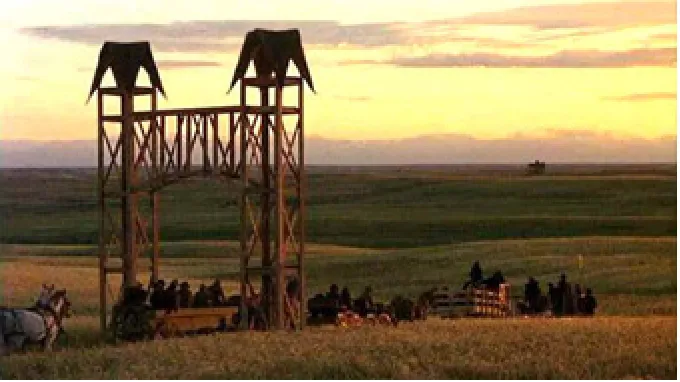
Fig. 5 Symbolic silhouettes against the sky. Days of Heaven (Terrence Malick, 1978)
We must have things in common in order to have a basis to discuss what we disagree about.15 Things we share help us to discover why we can disagree, for the point of view with which we bring to the things in the world gives us a common basis to discuss the disagreement. There is a tension, as a repeated motif, between the narrative and the voice over, between day and night, white and black, angel and devil, growth and harvest, life and death. Rather than drawing us in, this tension distances us; the film just is, we watch it, and just ‘are’. This then becomes the basis to look at how to express Heidegger’s notion of ‘world’ in Malick’s films.16
Malick famously wished to do a DPhil at Oxford in Philosophy on the notion of ‘world’ in Wittgenstein, Kierkegaard, and Heidegger. Wittgenstein suggests the unsayable limit of the world; Kierkegaard that our primary access to reality is through our involved action. Malick describes Wittgenstein’s ‘world’ as a ‘form of life’ and Kierkegaard’s notion of world as the ‘sphere of existence’. In Malick’s films, the Wittgensteinian world may be interpreted through the voice-over that names things, or feelings that are not expressed visually. The character’s unquestioning expression of feeling by which they act because they must, rather than working things out objectively, evokes Kierkegaard’s suggestion that a detached thinker deforms things and sees them as fragmented and warped, as when the secret couple in Days of
Heaven scheme to accept the farmer’s marriage proposal so they can inherit the farm
after his death. The committed individual sees the whole, complete and undistorted, represented here by the ‘innocent’ view of the prepubescent narrator, whose ‘streetwise’ accent lends authenticity to her statements.
Malick’s films present stability of the world in the very ephemerality of representations of family and home he conjures.17 These include makeshift homes such as haystacks, trains, cars, a treehouse, and barns. He rarely shows four walls that enclose a family. For example, the ‘rich mans’ house in Badlands is more a Victorian museum, (complete with objects covered in dustsheets), than a home, with its owner
TOBE Not Thinking but Questioning
Copyright reverts to the author
The Role of the Humanities in Design Creativity International Conference 2007
and his deaf maid, (muted language and communication), and we only see the inside of the farmer’s house in Days of Heaven, when Gere invades, when the owner and his new wife (in reality Gere’s lover) are on their honeymoon, and Gere pokes and prods through the house, like both an interloper and thief. In an example from Badlands
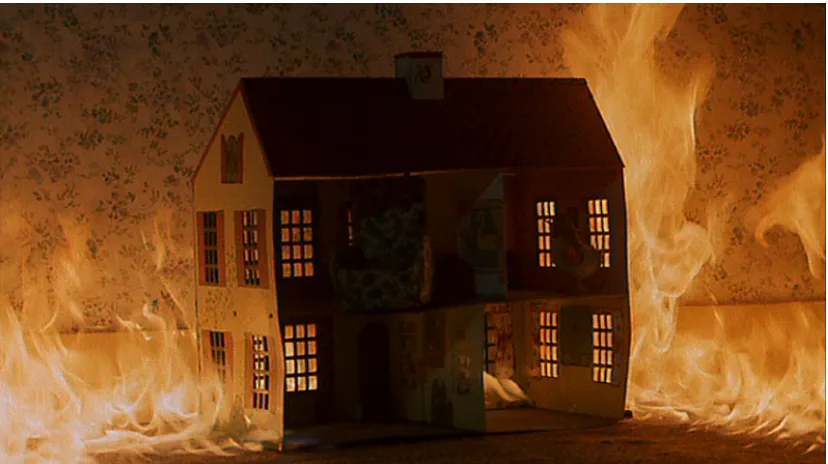
[image:7.595.92.506.181.413.2]Holly’s home appears most completely when it is burning, and the close up of the burning dolls house, (the destruction of home and childhood innocence) sums up as a miniature of what is happening around it.
Fig. 4 Burning doll’s house. Badlands (Terrence Malick, 1973)
Days of Heaven offers a discussion of Heidegger’s fourfold that opens up the nature
of dwelling. The places of dwelling in both films disclose how earth sky divinities and mortals enter into a simple oneness into things ordered by the house.18 This is shown in an earlier scene where the farmer sits with his accountant outside the house, in period furniture, of a high quality, brought out side, disconnected from its connection to dwelling. This encampment resembles the tree house of Holly and Kit in Badlands
with its Maxfield Parrish painting.
Fig. 3 Days of Heaven (Terrence Malick, 1978)
TOBE Not Thinking but Questioning
Copyright reverts to the author
The Role of the Humanities in Design Creativity International Conference 2007
[image:7.595.90.381.547.718.2]TOBE Not Thinking but Questioning
Copyright reverts to the author
The Role of the Humanities in Design Creativity International Conference 2007
7 The power of images with which cinema engages its audiences, also forces us to listen carefully to the sounds the world produces including the poignant human voices. In
Badlands, the female voiceover lends depth to the visuals as much through the broad
and flat Texan accent of the narration as through what the character says. Badlands
has a matter of fact beauty complimented by and contrasted to the beautiful but colourless pallor of Sissy Spacek’s voice.19 When Holly describes her growing discomfort of being with Kit (the character played by Martin Sheen) as like ‘feeling that you are sitting in a bath after the water has all run out’, we know what she means and suddenly the rich painted landscape through which they drive, seems less inviting. There is a dialectic of text and visuals, of sound and image. In Badlands we frequently hear something that differs from what we see as we follow Holly’s distorted view of her own world and that of Kit. This offers not insight into the film, but another world, one of feeling and emotion, of imagination, or of adolescent fantasy. Holly describes the enormity of the cosmos and the world she inhabits when viewing picture postcards through a viewing apparatus. She wonders where she would be at that moment if she had never met Kit. Holly says:
While taking a look at some vistas in Dad’s Stereopticon it hit me, that I was just this little girl born in Texas, whose father was a sign painter, who had only just so many years to live.20
Spacek’s dialogue talks about the paradox of existence whereby we can be at one and the same time at the centre of the universe and also at the periphery of it.21 She is both present and absent from the events taking place around her. She has a profound indifference to Kit’s gun, or as Malick refers to it, his ‘magic wand that takes away things that bother him’.22
Badlands
The story of Badlands is loosely based on two real life people, Charles Starkweather and his girl friend Caril Ann Fugate. Badlands is narrated from the perspective of Holly, whose faux innocent statements, full of phrases and notions gleaned from popular romance magazines, create a tension with the violent, dispassionate killing of Kit.23 The moral intensity of Malick’s film presents both nature and culture with a cinematic richness of texture. We take it in through our senses, rather than watch and analyse. The film’s lack of judgment of the character’s actions does not reveal them as inhuman, but reveals the fragility of our own values (against the forces of nature). Even the Medieval defence Kit erects, show primitive, basic ingenuity, brute force, and violence, as defence systems and barricades.
After killing Holly’s father and burning down her family home, Kit and Holly are on the run, and hide in the woods. Their tree house existence with its Maxfield Parrish painting, and Holly’s cosmetics experiments, exhibit this ‘play house’ aspect rather than a thorough ‘being in the world’ of nature.24 Although this does seem the most ‘authentic’ being in the film, and the happiest time for both Holly and Kit, this inhabited wilderness sums up the suburban nature of their dwelling.
Days of Heaven
TOBE Not Thinking but Questioning
Copyright reverts to the author
The Role of the Humanities in Design Creativity International Conference 2007
8 Gere as the migrant worker, and Sam Shepard, the farmer while the women (the female lead and a younger sister of the male, played by Brooke Adams and Linda Manz) strike out for parts unknown.
The advertising banner for Days of Heaven read: “Your eyes … your ears …. your senses … will be overwhelmed”. On the hour long drive from the hotel where the crew and director stayed and the wheat fields where the shoot was, cinematographer, Nestor Almendros, art director Jack Fisk, and filmmaker Malick talked and discussed the film, and often determined what they might shoot that day and how. Interesting ideas developed as they went along, and the shooting schedule changed with the weather, as well as their frame of mind. The ‘old guard’ Hollywood crew were often distressed by this divergence from the call sheet, as they were by the main characters being filmed in shadow. Almendros saw his job as to simplify and purify all effects. Malick traditionally eschews all ‘special effects’ rather than adding them in post-production. In Days of Heaven he often uses a single source of light as in the early days of film. Daytime interiors show sideways light as in Vermeer paintings and exteriors invoke Wyeth or Hopper, or even photo-montage (in the opening sequence
of Days of Heaven). Editing is like musical rhythm or building up a symphony.
The ‘magic hour’, the mythic after glow in the sky after the sun has disappeared from the horizon, famous in Days of Heaven was actually about 20 minutes. It is quite hard to film against this as figures are silhouetted and appear black. To expose for the shadow means over exposing for the sky, and losing the colour, so Almendros opened the lens a stop half way between luminosity of the sky and of the actor’s faces. The faces were a bit underexposed and the sky a bit over exposed.
The guidelines Malick laid down for all to follow were to stick as close to reality as possible. Fisk built a real mansion with exterior and interior from painted plywood, not just a façade as was usual.26 For authenticity the white curtains were washed in tea for the look of unbleached cotton. To film the swarming locusts, helicopters dropped seeds and peanut shells that swirled around in the wind from the helicopter blades. Actors walked backwards and tractors drove in reverse. That way, when the film was reversed everyone moved forwards and the ‘locusts’ looked as though they were swarming up from the wheat fields.
Conclusion
TOBE Not Thinking but Questioning
Copyright reverts to the author
The Role of the Humanities in Design Creativity International Conference 2007
9
The two films together represent a journey from hell (the badlands) to heaven. Where one is a journey, the negative aspects of alienation, the other is engaged full of passion and vitality. Badlands is a road trip, across the plane of the earth while the later film, seems like a single day in the forever of existence; one flash and then it’s gone. There is also a tension between the two films, from dark to light, bad to good, hell to heaven. It is as if the journey of ‘the bad lands’ of the earlier film, that ends with the male protagonist dying in the electric chair, ‘on a warm Spring night’, leads to the days of heaven, in the wheat fields of Texas, in reality a Hutterite farm in Alberta in Canada. While there is death in the later film as well, it ends on a positive note, with Linda, the narrator, setting off on a journey of her own, following rail road tracks (suggestive of direction and destination if an unknown one) in the spirit of another American hero, Huckleberry Finn, who ‘lights out for the territory.’27
1
Badlands, dir. Terrence Malick, 1973. Days of Heaven, dir. Terrence Malick, 1978.
2
‘Questionnaire on Visual Culture’ in October 77, (Summer 1996) pp. 25 - 70. 3
Sylvia Lavin, ‘Questionnaire on Visual Culture’. p. 51. 4
John Berger, Ways of Seeing, (London: Penguin Books, 1974). p. 135. 5
Laura Mulvey, Visual and Other Pleasures, (London: Palgrave Macmillan, 1989). 6
Mulvey 17. 7
Karsten Harries, The Meaning of Modern Art (Evanston: Northwestern University, 1968). p. 139.
8
Rolf G. Renner, Hopper, (Germany: Taschen, 2006), p. 146. 9
Stanley Cavell, The World Viewed. (Cambridge: Harvard UP, 1979). 10
David Barison and Daniel Ross’s film, The Ister (2004) shows a means of
expressing philosophical thought through an expression of a poem by Holderlin. The
Ister illustrates phenomenological thought through interviews with Jean-Luc Nancy
and Bernard Stiegler. 11
Martin Heidegger, The Essence of Reasons. Trans. by Terrence Malick, (Evanston, Northwestern University Press, 1969).
12
Malick, The Essence of Reasons. translator’s introduction. 13
Essence of Reasons 89
14
The Films of Terrence Malick, Wallflower Press p. 107
15
Malick, translator’s introduction. 16
Martin Heidegger, Being and Time, (Oxford: Blackwell, 1962), §63 ¶ 14. 17
Adrian Martin, ‘Things to Look Into: The Cinema of Terence Malick’ in Rouge, no. 10, http://www.rouge.com.au/10/malick.html. <accessed August 14 2007>
18
Karsten Harries, ‘Lessons of a Dream’ in Chora vol 2. (1996). pp. 91 – 108. 19
Adrian Danks, ‘Death Comes as an End: Temporality, Domesticity and Photography in Terrence Malick’s Badlands’ in Senses of Cinema,
http://www.sensesofcinema.com/contents/00/8/badlands.html <accessed July 6 2007> 20
Terence Malick, Badlands. 21
Michael Filippidis, ‘On Malick’s Subjects’ in Senses of Cinema,
http://www.sensesofcinema.com/contents/00/8/malick.html <accessed July 6 2007> 22
Martin 23
TOBE Not Thinking but Questioning
Copyright reverts to the author
The Role of the Humanities in Design Creativity International Conference 2007
10 24
Andrew Wyeth was taught by his father, N C Wyeth who was taught by Howard Pyle who also taught Maxfield Parrish. Parrish’s print ‘Daybreak’ from 1922 features significantly in Badlands. This painting is first seen hanging in the house, then Holly sneaks it out the back door when Kit sets the house alight, and then we really see it as the suburban décor to the inhabited wilderness of their treehouse refuge.
25
“That your days be multiplied, and the days of your children, in the land which the Lord swore unto your fathers to give them, as the days of heaven upon the earth.” Deuteronomy 11: 21.
26
Jack Fisk art directs and production designs all of Malick’s films. He also art directs (and production designs) for David Lynch.
27