BIROn - Birkbeck Institutional Research Online
Kikot,
Stanislav
and
Kontchakov,
Roman
and
Podolskii,
V.
and
Zakharyaschev, Michael (2012) Exponential lower bounds and separation
for query rewriting.
In: Czumaj, A. and Mehlhorn, K. and Pitts, A. and
Wattenhofer, R. (eds.) Automata, Languages, and Programming. Lecture
Notes in Computer Science 7392 7392. Berlin, Germany: Springer, pp.
263-274. ISBN 9783642315848.
Downloaded from:
Usage Guidelines:
Please refer to usage guidelines at
or alternatively
Exponential Lower Bounds and Separation for
Query Rewriting
?S. Kikot1, R. Kontchakov1, V. Podolskii2, and M. Zakharyaschev1
1
Department of Computer Science and Information Systems Birkbeck, University of London, U.K.
{kikot,roman,michael}@dcs.bbk.ac.uk 2
Steklov Mathematical Institute, Moscow, [email protected]
Abstract. We establish connections between the size of circuits and formulas computing monotone Boolean functions and the size of first-order and nonrecursive Datalog rewritings for conjunctive queries over
OWL 2 QLontologies. We use known lower bounds and separation results from circuit complexity to prove similar results for the size of rewritings that do not use non-signature constants. For example, we show that, in the worst case, positive existential and nonrecursive Datalog rewritings are exponentially longer than the original queries; nonrecursive Datalog rewritings are in general exponentially more succinct than positive exis-tential rewritings; while first-order rewritings can be superpolynomially more succinct than positive existential rewritings.
1
Introduction
First-order (FO) rewritability is the key concept of ontology-based data access (OBDA), which is believed to lie at the foundations of the next generation of information systems. A language L enjoys FO-rewritability if any conjunctive queryq over an ontologyT, formulated in L, can be transformed into an FO-formulaq0 such that, for any dataA, the certain answers toq over the knowl-edge base (T,A) can be found by querying q0 over A using a standard rela-tional database management system (RDBMS). Ontology languages with this property include theOWL 2 QLprofile of the Web Ontology Language OWL 2, which is based on the DL-Lite family of description logics [11, 4], and frag-ments of Datalog±such as linear or sticky sets of TGDs [9, 10]. Various rewriting techniques have been implemented in the systems QuOnto [1], REQUIEM [19], Presto [26], Nyaya [12] and Quest [25].
OBDA via FO-rewritability relies on the empirical fact that RDBMSs are usually very efficient in practice. However, this does not mean that they can ef-ficiently evaluate any given query: after all, for expression complexity, database query answering is PSpace-complete for FO-queries andNP-complete for con-junctive queries (CQs). Indeed, the first ‘na¨ıve’ rewritings of CQs overOWL 2 QL
ontologies turned out to be too lengthy even for modern RDBMSs [11, 19]. The
?
next step was to develop various rewriting optimisation techniques [26, 12, 23, 24]; however, they still produced exponential-size —O((|T | · |q|)|q|) — rewrit-ings in the worst case. An alternative two-step combined approach to OBDA with OWL 2 EL [18] and OWL 2 QL [17] first expands the data by applying the ontology axioms and introducing new individuals required by the ontology, and only then rewrites the query over the expanded data. Yet, even with these extra resources a simple polynomial rewriting was constructed only for the frag-ment of OWL 2 QL without role inclusions; the rewriting for the full language remained exponential. A breakthrough seemed to come in [13], which showed that one can construct, in polynomial time, a nonrecursive Datalog rewriting for some fragments of Datalog± containingOWL 2 QL. However, this rewriting uses the built-in predicate 6= and numerical constants that are not present in the original query and ontology. Without additional constants, no FO-rewriting forOWL 2 QLcan beconstructed in polynomial time [15] (it remained unclear, however, whether such an FO-rewriting of polynomial sizeexists).
These developments bring forward a spectrum of theoretical and practical questions that could influence the future of OBDA. What is the worst-case size of FO- and nonrecursive Datalog rewritings for CQs overOWL 2 QLontologies? What is the type/shape/size of rewritings we should aim at to make OBDA with
OWL 2 QLefficient? What extra means (e.g., built-in predicates and constants) can be used in the rewritings? In this paper, we investigate the worst-case size of FO- and nonrecursive Datalog rewritings for CQs overOWL 2 QLontologies depending on the available means. We distinguish between ‘pure’ rewritings, which cannot use constants that do not occur in the original query, and ‘impure’ ones, where such constants are allowed. Our results can be summarised as follows:
– An exponential blow-up is unavoidable for pure positive existential rewritings and pure nonrecursive Datalog rewritings. Even pure FO-rewritings with = can blow-up superpolynomially unlessNP⊆P/poly.
– Pure nonrecursive Datalog rewritings are in general exponentially more suc-cinct than pure positive existential rewritings.
– Pure FO-rewritings can be superpolynomially more succinct than pure pos-itive existential rewritings.
– Impure positive existential rewritings can always be made polynomial, and so they are exponentially more succinct than pure rewritings.
We obtain these results by first establishing connections between pure rewritings for CQs overOWL 2 QLontologies and circuits for monotone Boolean functions, and then using known lower bounds and separation results for the circuit com-plexity of such functions asCliquen,k‘a graph withnnodes contains ak-clique’
and Matching2n ‘a bipartite graph with n vertices in each part has a perfect
matching.’
2
Queries over
OWL 2 QL
Ontologies
does not contain any predicates with fixed semantics, such as = or 6=. In the description logic (orOWL 2 QL) setting, constant symbols are called individual names, ai, while unary and binary predicate symbols are calledconcept names,
Ai, androle names,Pi, respectively, wherei≥1. The language ofOWL 2 QLis
built using these names in the following way. Theroles R,basic concepts B and concepts C ofOWL 2 QLare defined by the grammar:
R ::= Pi | Pi−, (Pi(x, y) | Pi(y, x))
B ::= ⊥ | Ai | ∃R, (⊥ | Ai(x) | ∃y R(x, y))
C ::= B | ∃R.B, (B(x) | ∃y(R(x, y)∧B(y)))
where the formulas on the right give a first-order translation of the OWL 2 QL
constructs. AnOWL 2 QL TBox, T, is a finite set ofinclusionsof the form
BvC, (∀x(B(x)→C(x)))
R1vR2, (∀x, y(R1(x, y)→R2(x, y)))
B1uB2v ⊥, (∀x(B1(x)∧B2(x)→ ⊥))
R1uR2v ⊥. (∀x, y(R1(x, y)∧R2(x, y)→ ⊥))
Note that concepts of the form ∃R.B can only occur in the right-hand side of concept inclusions in OWL 2 QL. An ABox, A, is a finite set of assertions of the formAk(ai) andPk(ai, aj).T andAtogether form theknowledge base(KB) K= (T,A). The semantics forOWL 2 QLis defined in the usual way [6], based on interpretationsI= (∆I,·I) with domain∆Iand interpretation function·I. The set of individuals inAis denoted byind(A). For concepts or rolesE1,E2, we write
E1vT E2 ifT |=E1vE2; and we set [E] ={E0 |EvT E0 andE0 vT E}. A conjunctive query (CQ) q(x) is an FO-formula ∃yϕ(x,y), where ϕis a conjunction of atoms of the formAk(t1) andPk(t1, t2), and eachtiis aterm (an
individual or a variable fromxory). A tuplea⊆ind(A) is acertain answer to
q(x) overK= (T,A) ifI |=q(a) for allI |=K; in this case we writeK |=q(a). Query answering over OWL 2 QL KBs is based on the fact that, for any consistent KB K= (T,A), there is an interpretation CK such that, for all CQs
q(x) and a ⊆ ind(A), we have K |= q(a) iff CK |= q(a). The interpretation
CK, called the canonical model of K, can be constructed as follows. For each pair [R],[B] with ∃R.B in T (we assume ∃R is just a shorthand for ∃R.>), we introduce a fresh symbol w[RB] and call it the witness for ∃R.B. We write K |=C(w[RB]) if∃R−vT CorBvT C. Define agenerating relation,;, on the set of these witnesses together withind(A) by taking:
– a;w[RB] ifa∈ind(A), [R] and [B] arevT-minimal withK |=∃R.B(a) and there is nob∈ind(A) withK |=R(a, b)∧B(b);
– w[R0B0] ; w[RB] if, for some u, u; w[R0B0], [R], [B] are vT-minimal with
K |=∃R.B(w[R0B0]) and it is not the case that R0vT R− andK |=B0(u).
bytail(π) the last element inπ∈pathK(a). ThenCK is defined by taking:
∆CK = [
a∈ind(A)
pathK(a), aCK = a, fora∈ind(A),
ACK = {π∈∆CK | K |=A(tail(π))},
PCK = {(a, b)∈ind(A)×ind(A)| K |=P(a, b)} ∪
{(π, π·w[RB])|tail(π);w[RB], RvT P} ∪
{(π·w[RB], π)|tail(π);w[RB], RvT P−}.
Theorem 1 ([11, 17]). For every OWL 2 QL KB K= (T,A), every CQ q(x) and every a⊆ind(A),K |=q(a)iffCK|=q(a).
LetΣbe a signature that can be used to formulate queries and ABoxes (re-member thatΣdoes not contain any built-in predicates). Given an ABoxAover Σ, define IA to be the interpretation whose domain consists of all individuals in Σ(even if they do not occur inind(A)) andIA|=E(a) iffE(a)∈ A, for all predicatesE(x).
Given a CQq(x) and a TBoxT, a first-order formulaq0(x) overΣis called an FO-rewriting for q(x) and T over Σ if, for any ABox A over Σ and any
a ⊆ind(A), we have (T,A)|=q(a) iffIA |=q0(a). If q0 is an FO-rewriting of the form∃yϕ(x,y), whereϕis built from atoms using only∧and∨, then we call
q0(x) apositive existential rewriting forq(x)andT overΣ (or aPE-rewriting, for short). Thesize |q0|ofq0 is the number of symbols inq0.
All known FO-rewritings for CQs andOWL 2 QLontologies are of exponen-tial size in the worst case. More precisely, for any CQqandOWL 2 QLTBoxT, there exists a PE-rewriting of sizeO((|T |·|q|)|q|) [11, 19, 12, 17]. One of the main results of this paper is that this bound cannot be substantially improved in gen-eral, even for FO-rewritings. On the other hand, we also show that FO-rewritings can be superpolynomially more succinct than PE-rewritings.
We also consider rewritings in the form of nonrecursive Datalog queries. We remind the reader that a Datalog program, Π, is a finite set of Horn clauses
∀x(A1∧ · · · ∧Am → A0), where each Ai is an atom of the form P(t1, . . . , tl)
and eachtj is either a variable fromxor a constant.A0is called thehead of the
clause, and A1, . . . , Am its body; all variables occurring in the head must also
occur in the body. A predicateP depends on a predicateQinΠ ifΠ contains a clause whose head isP and whose body containsQ.Π is callednonrecursive if this dependence relation forΠ is acyclic. Anonrecursive Datalog query consists of a nonrecursive Datalog program Π and a goal G, which is just a predicate. Given an ABox A, a tuple a⊆ind(A) is a certain answer to (Π, G) over Aif Π,A |=G(a). Thesize |Π|of Π is the number of symbols inΠ.
Given a CQq(x) and a TBoxT, a pure nonrecursive Datalog query (Π, G) is called anonrecursive Datalog rewriting for q(x) andT overΣ (or an NDL-rewriting, for short) if, for any ABox A over Σ and any a ⊆ ind(A), we have (T,A) |= q(a) iff Π,A |= G(a) (note that Π may define predicates that are not inΣ, but may not use non-signature constants). Similarly to FO-rewritings, known NDL-rewritings for OWL 2 QL are of exponential size [26, 12]. Here we show that, in general, one cannot make NDL-rewritings shorter. On the other hand, they can be exponentially more succinct than PE-rewritings.
The rewritings can be much shorter if non-signature predicates and constants become available. As follows from [13], every CQ over an OWL 2 QL ontology can be rewritten as a polynomial-size nonrecursive Datalog query if we can use the inequality predicate and at least two distinct constants (cf. also [5], which shows how two constants and = can be used to eliminate definitions from first-order theories without an exponential blow-up). In fact, we observe that, using equality and two distinct constants, any CQ over anOWL 2 QLontology can be rewritten into a PE-query of polynomial size.
3
Boolean Circuits, CNFs and OBDA
To establish the lower and upper bounds for the size of rewritings mentioned above, we show first how the problem of constructing formulas and circuits that compute monotone Boolean functions can be reduced to the problem of finding FO- and NDL-rewritings for CQs overOWL 2 QLontologies.
By ann-ary Boolean function, forn≥1, we mean a function from{0,1}n to {0,1}. A Boolean functionf ismonotoneiff(α)≤f(α0), for allα≤α0, where
≤is the component-wise relation≤on vectors of{0,1}.
We remind the reader (for more details see, e.g., [3, 14]) that an n-input Boolean circuit, C, is a directed acyclic graph with nsources, inputs, and one sink, output. Every non-source node of C is called a gate and is labelled with either∧or∨, in which case it has two incoming edges, or with¬, in which case it has one incoming edge. A circuit ismonotoneif it contains only∧and∨gates. Boolean formulas can be thought of as circuits in which every gate has at most one outgoing edge. For an inputα∈ {0,1}n, theoutput ofConαis denoted by C(α), andC is said tocompute an n-ary Boolean functionf ifC(α) = f(α), for everyα∈ {0,1}n. The number of nodes inCis thesizeofC, denoted|C|.
Afamily of Boolean functions is a sequencef1, f2, . . ., where each fn is an n-ary Boolean function. We say that a familyf1, f2, . . . is in the complexity class
NPif there exist polynomialspandT and, for eachn≥1, a Boolean circuitCn
withn+p(n) inputs such that|Cn| ≤T(n) and, for eachα∈ {0,1}n, we have
fn(α) = 1 iff Cn(α,β) = 1, for someβ∈ {0,1}p(n).
The additionalp(n) inputs forβin the Cn are calledadvice inputs. Given a familyf1, f2, . . . of monotone Boolean functions in
NP, we construct
well as ABoxesAα,α∈ {0,1}n, with asingle individual such that
(Tfn,Aα)|=qfn iff fn(α) = 1, for allα∈ {0,1}n.
Then we show that rewritings for qfn and Tfn correspond to Boolean circuits computingfn. The construction proceeds in two steps: first, we represent thefn
by polynomial-size CNFs (in a way similar to the Tseitin transformation [27]), and then encode those CNFs in terms ofOWL 2 QL query answering.
Let f1, f2, . . . be a family of Boolean functions in
NP and C1,C2, . . . be
a family of circuits computing the fn (according to the definition above). We
consider the inputsxand the advice inputsy ofCn as Boolean variables; each
of the gates g1, . . . , g|Cn| of Cn is also thought of as a Boolean variable whose value coincides with the output of the gate on a given input. We assume that
Cn only contains¬- and ∧-gates, and so can be regarded as a set of equations of the form
gi=¬hi or gi=hi∧h0i,
where hi andh0i are the inputs of the gategi, that is, either input variables x,
advice variables y or other gates g = (g1, . . . , g|Cn|). We assume g|Cn| to be the output ofCn. Now, with eachfn and eachα = (α
1, . . . , αn)∈ {0,1}n, we
associate the following formula in CNF:
ϕαfn(x,y,g) = ^
αj=0
¬xj ∧g|Cn| ∧ ^
gi=¬hiinCn
(hi∨ ¬gi)∧(¬hi∨gi)
∧
^
gi=hi∧h0iinCn
(hi∨ ¬gi)∧(h0i∨ ¬gi)∧(¬hi∨ ¬h0i∨gi)
.
The clauses of the last two conjuncts encode the correct computation of the circuit: they are equivalent togi↔ ¬hi andgi↔hi∧h0i, respectively.
Lemma 1. If fn is a monotone Boolean function then fn(α) = 1 iff ϕα
fn is satisfiable, for each α∈ {0,1}n.
The second step of the reduction is to encode satisfiability ofϕα
fn by means of the CQ answering problem in OWL 2 QL. Denoteϕα
fn forα = (0, . . . ,0) by ϕfn. It is immediate from the definitions that, for eachα ∈ {0,1}n, the CNF
ϕα
fn can be obtained from ϕfn by removing the clauses ¬xj for which αj = 1,
1≤j≤n. The CNFϕfn containsd≤3|Cn|clausesC1, . . . , Cd withN =|Cn|
Boolean variables, which will be denoted byp1, . . . , pN.
LetPbe a role name and letAi,Xi0,Xi1andZi,jbe concept names. Consider
the TBoxTfn containing the following inclusions, for 1≤i≤N, 1≤j≤d:
Ai−1v ∃P−.Xi`, X `
i vAi, for`= 0,1,
Xi0vZi,j if ¬pi∈Cj,
Xi1vZi,j if pi∈Cj,
Zi,jv ∃P.Zi−1,j,
A0uAiv ⊥, A0u ∃P v ⊥,
It is not hard to check that|Tfn|=O(|Cn|2). Consider also the CQ
qfn=∃y∃z
A0(y0)∧ N
^
i=1
P(yi, yi−1)∧
d
^
j=1
P(yN, zN−1,j)∧ N−1
^
i=1
P(zi,j, zi−1,j)∧Z0,j(z0,j)
,
where y= (y0, . . . , yN) and z= (z0,1, . . . , zN−1,1, . . . , z0,d, . . . , zN−1,d). Clearly, |qfn| =O(|Cn|2). Note that Tfn is acyclic and qfn is tree-shaped and has no answer variables. For eachα= (α1, . . . , αn)∈ {0,1}n, we set
Aα =
A0(a) ∪
Z0,j(a)|1≤j≤nandαj= 1 .
C(Tf n,Aα)
a A0, Z0,1
X1 1,Z1,3
X10, Z1,1
X1 2 X0 2 X1 2 X0 2
X31
X30, Z3,3
X31
X30, Z3,3
X31
X30, Z3,3
X31
X30, Z3,3 Z0,1
Z0,3
Z2,3 Z1,3
Z0,3
Z2,3 Z1,3
Z0,3
Z2,3 Z1,3
Z0,3
Z2,3 Z1,3
Z0,3
qfn
y0 A0
y1 y2 y3
z2,1 z1,1
[image:8.612.179.444.318.528.2]z0,1 Z0,1 Z0,2 Z0,3 Z0,4 Z0,5
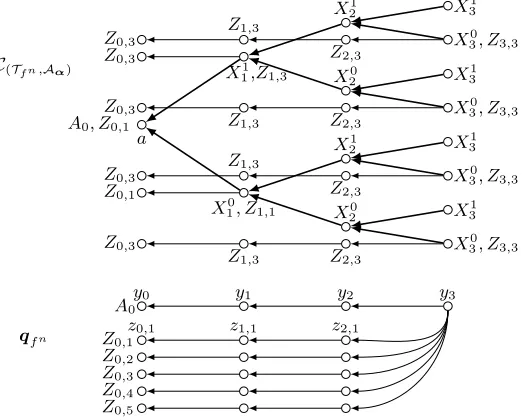
Fig. 1.Canonical modelC(Tf n,Aα) and queryqfn for the Boolean functionfn,n= 1, computed by the circuit with one input x, one advice input y and a single ∧-gate. Thus,N = 3,d= 5 andϕfn(x, y, g) =¬x∧g∧(x∨ ¬g)∧(y∨ ¬g)∧(¬x∨ ¬y∨g). Points in Xi`are also inAi, for all 1≤i≤N; the arrows denote roleP and theZi,j branches in the canonical model are shown only forj= 1,3, i.e., for¬xand (x∨ ¬g).
We explain the intuition behind the Tfn, qfn and Aα using the example
of Fig. 1, where the query qfn and the canonical model of (Tfn,Aα), with
in the canonical model, we have to check whetherqfn can be homomorphically mapped into it. The variablesyiare clearly mapped to one of the branches of the
canonical model fromato a point inA3, say the lowest one, which corresponds
to the valuation for the variables inϕα
fnmaking all of them false. Now, there are two possible ways to map variablesz2,1, z1,1, z0,1 that correspond to the clause
C1 = ¬x1 in ϕfn. If they are sent to the same branch so that z0,1 7→ a then
Z0,1(a) ∈ Aα, whence the clause C1 cannot be in ϕαfn. Otherwise, they are
mapped to the points in a side-branch so thatz0,167→a, in which case¬x1 must
be true under our valuation. Thus, we arrive at the following:
Lemma 2. (Tfn,Aα)|=qfn iffϕαfn is satisfiable, for allα∈ {0,1}n.
We now use this result to reveal a close correspondence between PE-rewritings and monotone Boolean formulas, FO-rewritings and Boolean formulas, and be-tween NDL-rewritings and monotone Boolean circuits.
Lemma 3. Let f1, f2, . . . be a family of monotone Boolean functions in NP, and letf =fn, for somen.
(i)If q0f is a PE-rewriting for qf andTf then there is a monotone Boolean
formula ψf computingf with|ψf| ≤ |q0f|.
(ii) If q0
f is an FO-rewriting for qf and Tf over a signature with a single
constant then there is a Boolean formulaχf computingf with|χf| ≤ |q0f|.
(iii)If(Πf, G)is an NDL-rewriting forqf andTf then there is a monotone
Boolean circuitCf computing f with|Cf| ≤ |Πf|.
The proof proceeds by eliminating quantifiers from the given rewriting and replacing its predicates with propositional variables using the fact that, in the ABoxes Aα, these predicates can only be true on the individual a. Lemmas 1
and 2 ensure that the resulting Boolean formula or circuit computes f.
The next lemma shows that, conversely, circuits computingf can be turned into rewritings forqf andTf over ABoxes with a single individual.
Lemma 4. Let f1, f2, . . . be a family of monotone Boolean functions in
NP,
and let f =fn, for some n. The following holds for signaturesΣ with a single
constant:
(i)Supposeq0 is an FO-sentence such that (Tf,Aα)|=qf iffIAα |=q
0, for
all α. Then
q00 = ∃xhA0(x)∧ q0∨
_
A0uBvTf⊥ B(x)i
is an FO-rewriting forqf andTf with|q00|=|q0|+O(|Cn|2).
(ii)Suppose(Π, G)is a pure NDL query with a propositional goalGsuch that (Tf,Aα)|=qf iffΠ,Aα|=G, for all α. Then(Π0, G0)is an NDL-rewriting for
Tf andqf with|Π0|=|Π|+O(|Cn|2), whereG0 is a fresh propositional variable
andΠ0 is obtained by extending Π with the following rules:
– ∀x(A0(x)∧G→G0),
– ∀x(A0(x)∧B(x)→G0), for all conceptsB such that A0uB vTf ⊥.
We are in a position now to formulate our main theorem that connects the size of circuits computing monotone Boolean functions with the size of rewritings for the corresponding queries and ontologies. It follows from Lemmas 1–4.
Theorem 2. For any family f1, f2, . . . of monotone Boolean functions in NP, there exist polynomial-size CQs qn and OWL 2 QL TBoxes Tn such that the
following holds:
(1) Let L(n)be a lower bound for the size of monotone Boolean formulas com-putingfn. Then|q0
n| ≥L(n), for any PE-rewriting q0n forqn andTn.
(2) LetL(n)andU(n)be a lower and an upper bound for the size of monotone Boolean circuits computingfn. Then
– |Πn| ≥L(n), for any NDL-rewriting(Πn, G)forqn andTn;
– there exist a polynomialpand an NDL-rewriting(Πn, G)forqn andTn
over a signature with a single constant such that|Πn| ≤U(n) +p(n).
(3) Let L(n) and U(n)be a lower and an upper bound for the size of Boolean formulas computingfn. Then
– |q0n| ≥L(n), for any FO-rewritingq0n forqn andTn over any signature with a single constant;
– there exist a polynomialpand an FO-rewritingq0n forqn andTn over a signature with a single constant such that|q0n| ≤U(n) +p(n).
4
Rewritings Long and Short
We apply Theorem 2 to three concrete families of Boolean functions and show that some queries and ontologies may only have very long rewritings, and some rewritings can be exponentially or superpolynomially more succinct than others. First we prove that one cannot avoid an exponential blow-up for PE- and NDL-rewritings; moreover, even FO-rewritings can blow-up superpolynomially for signatures with a single constant under the assumption that NP6⊆P/poly (i.e., that NP-complete problems cannot be solved by polynomial-size circuits, which is an open problem; see, e.g., [3]). This can be done using the func-tion Cliquen,k of n(n−1)/2 variables eij, 1 ≤ i < j ≤ n, which returns 1
iff the graph with vertices {1, . . . , n} and edges {{i, j} | eij = 1} contains a
k-clique. A series of papers, started by Razborov’s [22], gave an exponential lower bound for the size of monotone circuits computingCliquen,k: 2Ω(
√
k)for
k ≤ 1
4(n/logn)
2/3 [2]. For monotone formulas, an even better lower bound is
known: 2Ω(k) for k = 2n/3 [21]. One can show that there is a
nondeterminis-tic circuit with nadvice inputs andO(n2) gates that computes
Cliquen,k. As
Cliquen,k is NP-complete, the question whetherCliquen,k can be computed
by a polynomial-size deterministic circuit is equivalent toNP⊆P/poly.
Theorem 3. There is a sequence of CQsqnof sizeO(n)andOWL 2 QLTBoxes
Tn of sizeO(n)such that:
– any NDL-rewriting forqn andTn is of size ≥2Ω((n/logn)1/12);
– there does not exist a polynomial-size F O-rewriting for qn and Tn over a signature with a single constant unlessNP⊆P/poly.
By the Karp-Lipton theorem (see, e.g., [3]),NP⊆P/poly impliesPH=Σ2p. So we can replace the assumptionNP6⊆P/poly with PH6=Σp2.
The next result shows that NDL-rewritings can be exponentially more suc-cinct than PE-rewritings. Here we use the function Genn3 ofn3 variablesxijk, 1≤i, j, k≤n, defined as follows. We say that 1generates k≤nif eitherk= 1 or xijk = 1 and 1 generates both i and j. Genn3(x111, . . . , xnnn) returns 1 iff 1 generates n. Genn3 is clearly a monotone Boolean function computable by polynomial-size monotone circuits. On the other hand, any monotone formula computingGenn3 is of size 2n
ε
, for someε >0 [20].
Theorem 4. There is a sequence of CQsqnof sizeO(n)andOWL 2 QLTBoxes
Tn of size O(n) for which there exists a polynomial-size NDL-rewriting over a signature with a single constant, but any PE-rewriting over this signature is of size≥2nε, for someε >0.
Finally, we show that FO-rewritings can be superpolynomially more succinct than PE-rewritings. We use the function Matching2n with n2 variables eij,
1 ≤ i, j ≤ n, which returns 1 iff there is a perfect matching in the bipartite graphGwith vertices{v1
1, . . . , vn1, v12, . . . , v2n}and edges{{v1i, v2j} |eij= 1}, i.e.,
a subset E of edges in Gsuch that every node in Goccurs exactly once in E. An exponential lower bound 2Ω(n)for the size of monotone formulas computing
Matching2n was obtained in [21]. However, there are non-monotone formulas
of size nO(logn) computing this function [8]. On the other hand, it can also be
computed by a nondeterministic circuit withn2 advice inputs andO(n2) gates.
Theorem 5. There is a sequence of CQsqnof sizeO(n)andOWL 2 QLTBoxes
Tn of sizeO(n)which has a polynomial-size FO-rewriting over a signature with a
single constant, but any PE-rewriting over this signature is of size≥2Ω(2log1/2n).
In the proof of Theorem 3, we used the CQs qn = qClique
m,k containing no constant symbols. It follows that the theorem will still hold if we allow the built-in predicates = and6= in the rewritings, but disallow the use of constants that do not occur in the original query. The situation changes drastically if =,
6
= and two additional constants, say 0 and 1, are allowed in the rewritings. As shown by Gottlob and Schwentick [13], in this case there is a polynomial-size NDL-rewriting for any CQ andOWL 2 QLTBox. Roughly, the rewriting uses the extra resources to encode in a succinct way the part of the canonical model that is relevant to answering the given query. We call rewritings of this kindimpure (indicating thereby that they use predicates and constants that do not occur in the original query and ontology). In fact, using the ideas of [5] and [13], one can construct an impure polynomial-size PE-rewriting for any CQ and OWL 2 QL
Theorem 6. Impure PE- and NDL-rewritings for CQs and OWL 2 QL ontolo-gies are exponentially more succinct than pure PE- and NDL-rewritings.
The difference between short impure and long pure rewritings appears to be of the same kind as the difference between deterministic and nondeterministic Boolean circuits: the impure rewritings can guess (using =, 0 and 1) what the pure ones must specify explicitly. It is not clear, however, how the RDBMSs are going to cope with such guesses in practice.
5
Conclusion
The exponential lower bounds for the size of ‘pure’ rewritings above may look discouraging in the OBDA context. It is to be noted, however, that the ontolo-gies and queries used in their proofs are extremely ‘artificial’ and never occur in practice (see the analysis in [16]). As demonstrated by the existing description logic reasoners (such as FaCT++, HermiT, Pellet, Racer),real-world ontologies can be classified efficiently despite the high worst-case complexity of the clas-sification problem. We believe that practical query answering over OWL 2 QL
ontologies can be feasible if supported by suitable optimisation and indexing techniques. It also remains to be seen whether polynomial impure rewritings can be used in practice. We conclude the paper by mentioning two open problems. Our exponential lower bounds were proved for a sequence of pairs (qn,Tn). It is unclear whether these bounds hold uniformly for allqn over the sameT:
Question 1. Do there exist an OWL 2 QL TBox T and CQs qn such that any pure PE- or NDL-rewritings for qn andT are of exponential size?
As we saw, both FO- and NDL-rewritings are more succinct than PE-rewritings.
Question 2. What is the relation between the size of FO- and NDL-rewritings?
Acknowledgments. We thank the anonymous referees for their constructive feedback and suggestions. This paper was supported by the U.K. EPSRC grant EP/H05099X.
References
1. Acciarri, A., Calvanese, D., De Giacomo, G., Lembo, D., Lenzerini, M., Palmieri, M., Rosati, R.:QuOnto:Queryingontologies. In: Proc. of the 20th Nat. Conf. on Artificial Intelligence (AAAI 2005). pp. 1670–1671 (2005)
2. Alon, N., Boppana, R.: The monotone circuit complexity of Boolean functions. Combinatorica 7(1), 1–22 (1987)
3. Arora, S., Barak, B.: Computational Complexity: A Modern Approach. Cambridge University Press, New York, NY, USA, 1st edn. (2009)
5. Avigad, J.: Eliminating definitions and Skolem functions in first-order logic. In: Proc. of LICS. pp. 139–146 (2001)
6. Baader, F., Calvanese, D., McGuinness, D., Nardi, D., Patel-Schneider, P. (eds.): The Description Logic Handbook: Theory, Implementation and Applications. Cam-bridge University Press (2003)
7. Benedikt, M., Gottlob, G.: The impact of virtual views on containment. PVLDB 3(1), 297–308 (2010)
8. Borodin, A., von zur Gathen, J., Hopcroft, J.E.: Fast parallel matrix and gcd computations. In: Proc. of FOCS. pp. 65–71 (1982)
9. Cal`ı, A., Gottlob, G., Lukasiewicz, T.: A general Datalog-based framework for tractable query answering over ontologies. In: Proc. of PODS. pp. 77–86 (2009) 10. Cal`ı, A., Gottlob, G., Pieris, A.: Advanced processing for ontological queries.
PVLDB 3(1), 554–565 (2010)
11. Calvanese, D., De Giacomo, G., Lembo, D., Lenzerini, M., Rosati, R.: Tractable reasoning and efficient query answering in description logics: The DL-Lite family. J. of Automated Reasoning 39(3), 385–429 (2007)
12. Gottlob, G., Orsi, G., Pieris, A.: Ontological queries: Rewriting and optimization. In: Proc. of the IEEE Int. Conf. on Data Engineering, ICDE (2011)
13. Gottlob, G., Schwentick, T.: Rewriting ontological queries into small nonrecursive Datalog programs. In: Proc. of DL 2011. vol. 745. CEUR-WS.org (2011)
14. Jukna, S.: Boolean Function Complexity: Advances and Frontiers. Springer (2012) 15. Kikot, S., Kontchakov, R., Zakharyaschev, M.: On (in)tractability of OBDA with
OWL 2 QL. In: Proc. of DL 2011. vol. 745. CEUR-WS.org (2011)
16. Kikot, S., Kontchakov, R., Zakharyaschev, M.: Conjunctive query answering with OWL 2 QL. In: Proc. of the 13th Int. Conf. KR 2012. AAAI Press (2012) 17. Kontchakov, R., Lutz, C., Toman, D., Wolter, F., Zakharyaschev, M.: The
com-bined approach to query answering in DL-Lite. In: Proc. of the 12th Int. Conf. KR 2010. AAAI Press (2010)
18. Lutz, C., Toman, D., Wolter, F.: Conjunctive query answering in the description logic EL using a relational database system. In: Proc. of the 21st Int. Joint Conf. on Artificial Intelligence, IJCAI 2009. pp. 2070–2075 (2009)
19. P´erez-Urbina, H., Motik, B., Horrocks, I.: A comparison of query rewriting tech-niques for DL-Lite. In: Proc. of DL 2009. vol. 477. CEUR-WS.org (2009)
20. Raz, R., McKenzie, P.: Separation of the monotone NC hierarchy. In: Proc. of FOCS. pp. 234–243 (1997)
21. Raz, R., Wigderson, A.: Monotone circuits for matching require linear depth. J. ACM 39(3), 736–744 (1992)
22. Razborov, A.: Lower bounds for the monotone complexity of some Boolean func-tions. Dokl. Akad. Nauk SSSR 281(4), 798–801 (1985)
23. Rodr´ıguez-Muro, M., Calvanese, D.: Dependencies to optimize ontology based data access. In: Proc. of DL 2011. vol. 745. CEUR-WS.org (2011)
24. Rodr´ıguez-Muro, M., Calvanese, D.: Semantic index: Scalable query answering without forward chaining or exponential rewritings. In: Proc. of the 10th Int. Se-mantic Web Conf., ISWC (2011)
25. Rodr´ıguez-Muro, M., Calvanese, D.: High performance query answering over DL-Lite ontologies. In: Proc. of the 13th Int. Conf. KR 2012. AAAI Press (2012) 26. Rosati, R., Almatelli, A.: Improving query answering over DL-Lite ontologies. In:
Proc. of the 12th Int. Conf. KR 2010. AAAI Press (2010)