CONSUMER ACCEPTANCE OF A PRODUCT FROM PACU CARCASSES SUBMITTED TO DIFFERENT
PROCESSING TECHNIQUES: AN APPROACH TO TRANSFORM WASTE INTO WEALTH
Glaucia Vasques de Farias, Camilla Paranzini Alves Ferreira, Rebeca Maria Sousa, Sandriele
Goes de Campos Deboleto, Leonardo de Oliveira Seno, Alexandre Rodrigo Mendes Fernandes,
and Claucia Aparecida Honorato*
Faculty of Agronomic Sciences, Federal University of Grande Dourados, Rod. Dourados-Itahum - Km. 12 – Unity
II, Mailbox 364, CEP 790804-970. MS. Brazil
ARTICLE INFO ABSTRACT
The objective is to elaborate a food product developed from Pacu carcass subjected to different processing techniques that may contain healthy components and that is environmentally correct. Fish stocks were developed from three different products, here named as in natura carcass, smoked carcass, and carcass residual biomass. The chemical composition, colorimetric and microbiological profiles, and sensory analysis were evaluated in these stocks. The sensory analysis was based on the evaluation of 66 trained tasters concerning sensory attributes and consumers’ acceptance. The results were submitted to analysis of variance and compared by the Tukey’s test when averages were significantly different (p<0.05). The principal component analysis was applied to assess consumer acceptance. A significant difference between the evaluated stocks was in the contents of protein and cholesterol. The principal component analysis highlights that the sensory quality and characteristics of the consumer’s, influence on the process of choosing a product. Stocks were deemed microbiologically suitable for consumption. We conclude that the in natura carcass is the most favorable product for the production of fish stock, based on its highest acceptance rates and chemical characteristics; the multivariate analysis showed that flavor is the sensory attribute of greatest importance in fish stocks.
Copyright © 2019, Glaucia Vasques de Farias et al. This is an open access article distributed under the Creative Commons Attribution License, which permits unrestricted use, distribution, and reproduction in any medium, provided the original work is properly cited.
INTRODUCTION
The use of fish carcasses can be divided into two groups. The first one, based on the use of viscera, scales, fins, skin, skeleton, and head, is intended for animal production, feed based on flours used inchain production, oils, silages, and composting (Vidotti, 2011). The second one, based on human consumption, includes carcasses containing adhered meat and fillet residues and is intended for the elaboration of processed food products such as battered and breaded patties, fish meat, and restructured fish products (Pires et al. 2014). The use of in
natura carcass or its processing may be an alternative to
increasing the profitability of the aquaculture sector (Justen et al. 2017). The use of some processing techniques, such as carcass smoking, can add value to the product, providing increased economic viability.
Smokingpromotes improvement in the quality of the fish product by inducing changes in sensory attributes such as aroma, flavor, color, and texture, because the process presents preservative, bacteriostatic, bactericidal, and flavoring activities (Sigurgislotottir et al. 2009). Phenols and aldehydes are responsible for the specific aroma of smoked products and prevent the oxidation of lipids. Organic acids are responsible for increased product shelf life because they inhibit the development of microorganisms (Feiden et al. 2009). The use of residual fish biomass that can be obtained from discarded fishing by-products such as dorsal skeletons, fins, heads, gills, and skin is a very common alternative to the use of fish waste. These residues have been used as raw material for the production of processed products such as ground meat for hamburgers and patés (MPA, 2011). These uses promote the usage of several species of fish to produce a wide range of value-added products and the reduction of residues generated
ISSN: 2230-9926
International Journal of Development Research
Vol. 09, Issue, 11, pp. 31391-31396, November, 2019
Article History:
Received xxxxxx, 2019 Received in revised form xxxxxxxx, 2019
Accepted xxxxxxxxx, 2019 Published online xxxxx, 2019
Article History:
Received 17th August, 2019 Received in revised form 14th September, 2019 Accepted 26th October, 2019 Published online 30th November, 2019
Key Words:
Fish, Food processing, Principal components analysis, Residual biomass.
*Corresponding author:
Claucia Aparecida Honorato
RESEARCH ARTICLE
OPEN ACCESS
Citation: Glaucia Vasques de Farias, Camilla Paranzini Alves Ferreira, Rebeca Maria Sousa et al. 2019. “Consumer acceptance of a product from
in the industrialization process (Feltes et al. 2010). There is a great expectation of using neotropical fish in professional kitchens because of their organoleptic characteristics (Sousa and Kato, 2017). The use of carcasses for culinary purposes fits mainly in the preparation of stocks, as in the French fonds
de cuisine. These can be defined as translucent and flavored
liquids prepared with the gentle boiling of bones with some meat and/or vegetables in flavored water, until their taste, aroma, color, body, and nutritive value are afterward extracted through filtration processes (Wright & Treuille, 2010; Bottini, 2009). The ability to prepare good stocks is very important in classic cooking because it is the basis of the preparation of various dishes such as soups, sauces, roasts, and stews (Rangel, 2004). The use of residual fish material brings economic advantages to the industry because its utilization adds value to commercialized products besides remedying the significant problem of eliminating organic waste (Aguiar & Limberger, 2014). Thus, the elaboration of fish stocks using fisheries can represent a viable technological alternative by taking advantage of transforming nutrients and flavors into new market products. Among the fish that have been outstanding in the aquaculture scene are the species of round fish represented by pacu (Piaractus mesopotamicus), tambaqui
(Colossoma macropomum), and their hybrids. Because of their
organoleptic characteristics, these fish have been in demand in the consumer market (Honorato et al. 2014). Considering the growth potential of the commercial exploitation of round fish, the performance of tests evaluating sensory quality is necessary. The characteristics that involve the choice of a product include sensory attributes based on color, flavor, aroma, overall index, and other factors such as the taster’s food preferences, which can influence the choosing process (Oliveira et al. 2014). Therefore, the use of products to be tested by sensory analyses show some gaps that can be studied further. The multivariate analysis is a tool for collecting information and recognizing patterns, reducing the size of the data and organizing it into separate groups (Moon et al. 2017). Multivariate techniques are widely used in the treatment of sensory data such as product characterization, identification of consumer segments, and selection of sensory attributes. It is possible to reduce the number of independent principal components through the principal components analysis (PCA), and thus, identify the best subset of attributes to be considered in sensory evaluations (Rossini et al. 2012). The main objective is to elaborate a food product developed from Pacu carcass subjected to different processing techniques that may contain healthy components and that is environmentally correct.
MATERIALS AND METHODS
The experiments in this study followed a completely randomized design (CRD) and included three treatments (in
natura, residual biomass, and smoked) with seven replications.
Carcasses and the biomass were purchased from a fish supplier in the city of Dourados - MS. The production of fish stocks was carried out at the Gastronomy Laboratory of the Grande Dourados University Center (UNIGRAN). The analyses of physical and chemical composition were performed at the Meat Quality Laboratory at the Federal University of Grande Dourados (UFGD). The following stocks were elaborated: In
natura (F1) – Using in natura carcasses; Residual biomass
(F2) – Using mass obtained from successively milled carcasses; Smoked (F3) –Using smoked carcasses.
Carcass smoking: The production of smoked carcasses used 10 kg of the skeleton after filleting, obtained from a supplier in the region. These carcasses were washed and drained, individually weighed, identified with metal plates, and immersed in a brine solution (20%) for 15 minutes, which contained aromatic herbs (50 g of a mixture of dried rosemary, basil, sage, oregano, chives, and parsley) (Wright & Treuille, 2010). They were subsequently hung for 1 hour to drain at room temperature and placed into the smoking chamber at 65 °C for partial drying for 60 minutes. The smoking process began after this period by using a homemade stainless-steel smoker, which generated smoke outside of the smoking chamber. Pink eucalyptus sawdust (Eucalyptus globulus Labill) was the fuel used to produce the smoke (Assis et al. 2009). The smoking temperature started at 60 °C until reaching 80 °C in the last hour of the process, with 10 °C increases every hour in a total of 3 hours of smoke exposure. The smoked product was packed in commercial plastic packaging and stored under refrigeration (5 °C) for further use.
Development of fish stocks: Fish stocks were prepared from
in natura, biomass, and smoked carcasses (F1, F2, and F3) in a
final volume of 0.5L. The other ingredients used (celery, carrots, and onion) were previously cleaned by individual wash in tap water and immersion in chlorinated water (Sumaveg®) for 10 minutes; these were subsequently rinsed with tap water in stainless steel screens to eliminate the excess of chlorine. Each stock was prepared and evaluated through seven replications, each using an aluminum pan where seasonings (85 g of celery, 150 g of onion, 80 g of carrot, two leaves of bayleaves, and four cloves), 2 liters of filtered water, and 1 kg of carcasswere added. All ingredients were initially placedin the pan with cold filtered water, to start cooking on low heat (85 to 95 °C) untilboiling (100 °C), then cooked for another 30 minutes. Subsequently, they were filtered in chinois
(stainless steel strainer) and filter paper with medium porosity (10-6 μm) and stored for further analysis.
Physicochemical analysis: The analysis of product color was performed as described by Houben et al. (2000) using a colorimeter (Konica Minolta®) and evaluating luminosity (L*) (0 = black, 100 = white), the intensity of the red color (a*), and intensity of the yellow color (b*). The lipid profile was performed using the colorimetric method and a commercial kit (GoldAnalisa, Brazil), and analysis in the semi-automatic spectrophotometer Bioplus S-200 (Allain et al. 1974). The total protein content was measured by the method described in Bradford et al. (1976).
Microbiological analysis: Themicrobiological analyses were carried out to determine the most probable number (MPN) of coliforms at 35ºC/g and 45ºC/g of product, and the CFU/g of product for Staphylococcus aureus and Salmonella ssp (American Public Health Association [APHA], 1992).
evaluation considering color, aroma, flavor, and overall indexes of the evaluated product. The scores ranged between the minimum and maximum: 1 – I extremely disliked it and 9 -I liked it a lot (Dutcosky, 1996). The samples were also submitted to the attitude test with a hedonic scale of 5 scoring points between 1 - I certainly would not buy it and 5 – I would certainly buy it (Dutcosky, 2007).
Statistical analysis: The results were submitted to analysis of variance (ANOVA) and compared by the Tukey’s test when averages were significantly different (p < 0.05). A multivariate statistical technique was applied in the sensory analysis to define the main components and correlate linear functions that did not show any type of correlation.
RESULTS AND DISCUSSION
[image:3.595.312.552.339.381.2]The pre-processing used in the fish carcasses produced fish stocks with different chemical composition characteristics (p<0.05) (Table 1). The fish stocks showed different levels of protein, triglycerides, and cholesterol (p<0.05). The stocks prepared from residual biomass presented the lowest protein value. Sarcoplasmic proteins represent 18–20% of fish muscle proteins that are soluble in water and do not contribute to gel formation because they adhere to myofibrillar proteins, preventing the gelatinization process (Simões et al. 1998; Fennema, 1996). Myofibrillar proteins influence the water retention capacity and emulsifying property of a product (Kuhn & Soares, 2002). Proteins naturally denature and renature forming a structural network (Ahmad et al. 2004); however, because the stocks were prepared ata high temperature, this may explain why protein denaturation and low content was observed in the final product produced from the residual biomass. The low values of protein present in the smoked fish stock (Table 1) are related to the non-enzymatic browning called Maillard reaction, which involves reactions between carbonyl and amine groups; this reaction is responsible for the reduction of protein digestibility and inhibition of digestive enzymes, which explains the protein values found (Araújo, 1999). The levels of triglycerides and cholesterol did not differ between the three types of studied stocks. The smoking process produced the fish stock with the lowest levels of cholesterol and triglycerides (Table 1) as the result of the oxidation of unsaturated lipids, contributing to a significant reduction in cholesterol and triglycerides content (Xavier et al. 2017).
Table 1. Centesimal composition of fish stocks prepared from pacu carcasses submitted to different processing techniques
Centesimal composition: In natura Biomass Smoked Protein(mg.dl-1) 1.72±0.06a 14.6±2.13a 4.83±0.37a Triglyceride (mg.dl-1) 1.05±0.15c 11.3±0.94b 2.66±0.74b Cholesterol (mg.dl-1) 1.22±0.05b 7.66±1.75c 2.83±0.37b Means followed by distinct letters indicate statistical difference by the Tuckey’s test (p> 0.05). Mean values (n = 6) ± standard deviation.
The stocks produced from in natura carcass showed the highest values of protein, cholesterol, and triglycerides (Table 1). The use of this carcass without processing reflected its natural constitution in the ventral parts of the fish’s body, which contains a large deposit of fat (Vidal et al. 2011). It should be noted that the high levels of lipids present in fish, particularly in Brazilian fish species such as pacu, are important to give organoleptic identity to the product
(Honorato et al. 2014). The high levels of lipids in fish meat represent benefits of sensory characteristics influencing flavor, besides being an excellent source of energy and essential nutrients (Maia & Ogawa, 1999). The analysis of product color showed the greatest yellow (b*) chromaticity in the stock produced from the smoked carcass. These results are a consequence of the concocting process (Maillard reaction) during smoking. The color produced, its intensity, and the properties of the reaction’s product are strongly dependent on the nature of reagents and reaction conditions, especially the pH and temperature. Darkening is one of the consequences of the Maillard reaction (Nunes & Batista., 2001). The main function of smoking using heat is to provide characteristic aroma, flavor, and color with improved sensory qualities and extended shelf life in the final product (Souza et al. 2004). The tested stocks showed low counts of coliforms (at 35 and 45 °C), low counts of Staphylococcus aureus, and absence of
Salmonella ssp (Table 3), indicating that they are suitable for
[image:3.595.305.561.456.509.2]human consumption based on the microbiological standards required by law and according to the Brazilian Health Surveillance Agency (BRASIL, 2001).
Table 2. Color variation in fish stocks prepared from pacu carcasses submitted to different processing techniques
Color parameters In natura Biomass Smoked
L* 36.17±5.4 37.12±5.79 37.53±4.18
a* 0.44±0.67 0.38±0.64 0.13±0.74
[image:3.595.318.549.558.620.2]b* -0.61±0.54b 0.11±1.21b 2.74±1.18a Means followed by distinct letters indicate statistical difference by the Tuckey’s test (p<0.05). Mean values (n = 7) ± standard deviation. (L*) Luminosity, (a*) Intensity of the red color, and (b*) Intensity of the yellow color.
Table 3. Microbiological analysis of fish stocks prepared from pacu carcasses submitted to different processing techniques
Microbiological parameter: In natura Biomass Smoked MLN/g of coliforms at 35 ºC < 3 < 3 < 1x10² MLN/g of coliformsat 45 ºC(MLN/g) < 3 < 3 < 1x10²
Staphycoccus aureus count (UFC/g) < 3 < 3 < 1x10²
Salmonella ssp. count in 25 g Absent Absent Absent MLN: Most likely number
Table 4. Sensory analysis of fish stocks prepared from pacu carcasses submitted to different processing techniques
Sensory analysis In natura Biomass Smoked Color 7.22±1.65a 6.01±2.02b 6.55±2.41ab Aroma 7.07±1.88 6.25±2.19 6.46±2.38 Flavor 7.26±1.86ª 5.19±2.33c 5.80±2.59bc Global index 7.18 ±1.55a 5.54 ±2.26b 6.18±2.51ab Purchase intent 3.98±0.98ª 2.87±1.57c 3.34±1.36b Averages followed by distinct letters indicate statistical differences by the Tuckey’s test (p> 0.05). Mean values (n = 6) ± standard deviation. The Hedonic scale scores ranged from 1 to 9.The purchase intention scores in the hedonic scale ranged from 1 to 5.
The sensory analyses showed favorable results in all parameters (Table 4). The aroma was the only parameter that did not differ between stocks. The stock produced from in
natura carcass showed the best results of flavor, overall index,
[image:3.595.42.282.631.673.2]Figure 1. Contribution of the product’s attributes toward the individual characteristics of consumers (tasters)
A B
C D
E F
[image:4.595.40.552.57.209.2] [image:4.595.61.539.250.741.2]
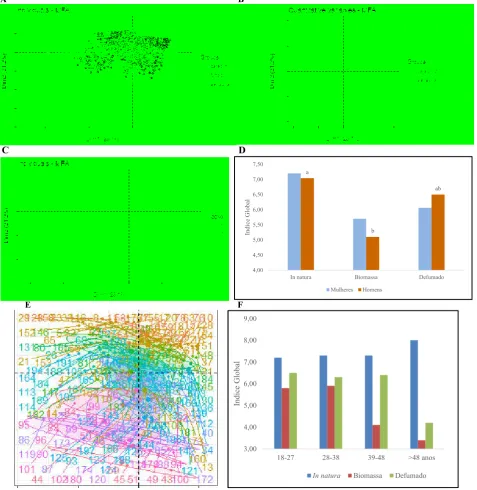
Figure 2. Grouping of characteristics in relation to pacu stocks submitted to different processing techniques (A); quantitative variables in relation to dimensions (B); contribution of the product in relation to the taster gender (C);the aroma attribute evaluated according to gender
(D); stratification of the age of tasters in relation to their preference of stocks (E); and stratification of the global index by age (F)
a
b
ab
4,00 4,50 5,00 5,50 6,00 6,50 7,00 7,50
In natura Biomassa Defumado
Ind
ice
G
lo
b
al
Mulheres Homens
3,00 4,00 5,00 6,00 7,00 8,00 9,00
18-27 28-38 39-48 >48 anos
Indic
e Gl
o
b
al
The relevance of the sensory attributes in dimension 1 (CP1) and the relevance of the attributes of tasters in dimension 2 (CP2) is shown in Figures 1A and 1B. The flavor was the sensory attribute with the greatest contribution, followed by the global index (GI) and purchase intention. The aroma was not an attribute of relevance in the evaluated fish stocks (Figure 1A). The importance of the tasters’ age is noteworthy because the subdivision into age ranges may reveal that the choice of a product is influenced by these ranges (Figure 1B). The intrinsic characteristics of the stocks and the sensory evaluation reveal homogeneity in the analyses because they show the same distribution sites in the PCA. The contribution of tasters takes the vectors to two extremes, which reveals that individuals contribute distinctly to the choosing of a product when tasting them (Figure 2A). The loading values for CP1 and CP2 indicated different contributions from the age and gender of tasters. Figure 2B shows the graphs between CP1 × CP2 loads, which allows visualizing the position of variables in the two-dimensional space and their corresponding correlation. The correlation between two variables is defined as the cosine of the angle between their respective vectors in the plot (Kaiser, 1970). It is noteworthy that the sensory characteristics were less correlated with CP2 than with CP1 because their correlation was approaching zero. Aroma presented the highest load on the CP1 axis, denoting its significant contribution to the variance explained in CP1. These results reveal that aroma offers a significant contribution to the choosing of the evaluated stocks. And that different genders make different aroma choices (Figure 2C). The aroma attribute in males was not significant among the evaluated stocks, while females showed a preference for stocks produced from in natura and smoked carcasses (Figure 2D). The stratification of the tasters’ age (Figure 2E) shows that the increase in age (above 39 years) leads to a preference for the stock produced from in natura carcass (Figure 2F).
The analysis of the overall index shows that the tasters regularly liked (score 7) the stock produced from in natura
carcass but were indifferent (score 5) toward the stock produced from biomass carcass (Table 4). The PCA revealed a correlation between age and gender in the applied sensory analysis. This preference can be explained through the PCA, which revealed a greater relevance of the tasters’ preference of sensory attributes; age and gender influenced the choice of a product. The PCA has been used as a data collection tool that contributes to pattern recognition, reducing the data dimension for decision making. Hence, some studies have been developed in the area of food science using this tool. Petenuci et al. (2018) used the PCA as a chemometric tool to evaluate the incorporation of omega-3 in diets supplemented with chia and canola oil (replacing soybean oil)in the compositionof muscle tissuein Nile tilapia; the study showed the separation of groups by types of treatment, suggesting a positive influence of the fatty acid in the composition of muscular tissue, and indicating that it contributed to an increase in nutritional value. Nishiyama et al. (2018) applied the PCA to evaluate minerals, fatty acid composition, and sensory attributes in a mixture developed with a by-product of Nile tilapia fed diets containing flaxseed. Those authors observed that the added tilapia sub-product was the component factor that most contributed to the choice for this flour mix, which in turn presented significant values regarding the contents of calcium and ω 3 and 6 fatty acids, and could be used in the preparation of food products such as soups, creams, nuggets, and pasta. The multivariate analyses were of fundamental importance for
the evaluation of sensory data because it indicated the possibility of using other stocks tested in this study, produced through other processing techniques, as long as age and gender of the consuming public are adjusted. The flavor results in the F2 and F3 stocks showed smaller values than those in F1, coinciding with the lipid levels that affect the taste of food. In general, consumers associate the parameter "color" with product appearance; in this study, it can be inferred that this parameter was associated with the purchase intention in the results of the F1 and F2 stocks.
Conclusion
By the increase of this species of fish slaughtered in Brazil, it is necessary to allocate its carcass in a socially and environmentally correct manner. Associated with this demand, the destination of the co-products in a food product is a possibility of adding value to the fish chain. In this context, this paper concludes that among the processes applied to the carcass for fish background production, there was a predilection of one of the prepared products. The in natura
carcass is the most favorable product for the production of fishstock due to its great acceptance scores and chemical characteristics. The use of multivariate analysis allowed us to verify that the most important sensory attribute for fish stocks is flavor. The marketing of fish stocks should consider age groups to improve the acceptance of consumers.
Acknowledgements
We are indebted to the Laboratory of fIsiology of Aquatic Organisms for facilities and technical support that allowed us to carry on the present investigation. We also thank CAPES for financial suppor.
REFERENCES
Aguiar, G. P. S., Limberger, G. M., & Silveira, E. L. 2014. Alternativas tecnológicas para o aproveitamento de resíduos provenientes da industrialização de pescados. R. eletr interdisc, 1(11).
Ahmad, M. U.; Tashiro, Y.; Matsukawa, S.; Ogawa, H. 2004. Comparison of gelation mechanism of surimi between heat and pressure teratment by using rheological and NMR relaxation measurements. Journ. Food. Scien, v. 69, n.9, p. 497-502.
Allain, C.C.; Poon, L.S.; Chan, C.S.; Richmond, W.; FU, O.C. 1974. Enzimatic determination of total sérum cholesterol.
Clin. Chem., v. 20, n.4, p. 470-475.
American Public Health Association. 1992. America's public health report card: A state-by-state report on the health of the public. Am. J. Public Health.
Araújo, J. M. 1999. Química de alimentos–Teoria e Prática. 2a edição. Editora da Universidade Federal de Viçosa (UFV), Viçosa.
Assis, M. F., Franco, M. L. R. S., Stéfani, M. V., Franco, N. P., Godoy, L. C., Oliveira, A. C. & Hoch, A. L. V. 2009. Efeito do alecrim na defumação da carne de rã (Rana
catesbeiana): .2.
Bottini, R. L. 2009. Chef profissional. Instituto americano de Culinária, v 4., Brasil.
Bradford, M. M.; Anal. Biochem. 1976, 72, 248
Brasil. Acessado em 15 de março de 2018. http://portal.anvisa.gov.br/documents/33880/2568070/RD C_12_2001.pdf/15ffddf6-3767-4527-bfac-740a0400829b Dutcosky, S. D. 1996. Análise Sensorial de Alimentos.
Curitiba, Brazil: Champagnat. flour obtained from the carcasses of Nile tilapia: physicochemical, sensory, and microbiological analysis. J. Aquat. Food. Prod. Tech, 26(3), 258-266.
Dutcosky, S. D. Análise Sensorial de Alimentos. Curitiba: Champagnat, 2007. 210 p.
Feiden, A.; Massago, T.; Boscolo, W.R.; Signor, A.A.; Zorzo, A.L.; Weirich, C. E. 2009 Rendimento e análise bromatológica do lambari do rabo vermelho Astyanax sp F (Pisces: characidae) submetido ao processo de defumação. Semina: Ciências Agrárias, v. 30, n. 4, p. 859-866.
Feltes, M. M. C.; Correia, J. F. G.; Beirão, L. H.; Block, J. M.; Ninow, J. L.; Spiller, V. R. 2010. Alternativas para a Agregação de Valor aos Resíduos da Industrialização de Peixe; Rev. Bras. Eng. Agrícola e Ambient, 14, 669–67723 Fennema, OR, & Tannenbaum, SR (1996). Introdução à química alimentar. CIÊNCIA ALIMENTAR E TECNOLOGIA-NOVA YORK-MARCEL DEKKER-, 1-16.
Honorato, C. A., Caneppele, A., Matoso, J. C., Prado, M. R., Siqueira, M. S., & Souza, L. R. O. 2014. Caracterização física de filés de Surubim (Pseudoplatystoma sp.), Pacu
(Piaractus mesopotamicus) e Pirarucu (Arapaimas gigas).
Arq. ciênc. vet. Zool. da UNIPAR, 17(4), 237-6242. Houben, J.H.; Van Dijk, A.; Eikelenboom, G. et al. 2000.
Effect of dietary vitamin E supplementation, fat level and packaging on color stability and lipid oxidation in minced meat. Meat Science, v.55, n.3, p.331-336.
Justen, A. P., Souza, M. L. R. D., Monteiro, A. R., Mikcha, J. M., Gasparino, E., Delbem, Á. B, & Del Vesco, A. P. 2017. Preparation of extruded snacks with flavored flour obtained from the carcasses of Nile tilapia: physicochemical, sensory, and microbiological analysis. J. Aquat. Food. Prod. Tech. 26(3), 258-266.
Kaiser, H.F. 1970. A second generation little jiffy. Psychometrika 35: 401–415
Kuhn, C. R.; Soares, G. J. D. 2002. Proteases e inibidores no processamento de surimi. Revista Brasileira de Agrociência, v.8, n.1, p.5-11.
Maia, E., & Ogawa, M. 1999. Química do pescado: lipídeos. Manual de pesca: ciênc. Tecn. pesc. São Paulo: Livraria Varela, 1, 49-55.
Ministério da Pesca e Aquicultura (MPA); Boletim Estatístico da Pesca e Aquicultura 2011; Brasília, 2011, 60.
Moon, J. H., Chung, D. H., Pan, C. H., & Yoon, W. B. 2017. Determination of Principal Components for Characterizing the Drying of Sea Cucumbers (Stichopus
japonicus Selenka) Using Far Infrared Radiation Drying
and Hot Air Drying. J. Aquat. Food. Prod. Tech. 26(10), 1221-1232.
Nishiyama, S., Sch¨odel, R., Yoshikawa, T., Nagata,T., Minowa, Y., Tamura, M. 2018. Spectroscopically Identified Intermediate Age Stars at 0.5 - 3 pc Distance from Sgr A*. Astronomy & Astrophysics manuscript. Doi: 10.1051/0004-6361/201322392
Nunes, C. S., & Baptista, A. O. 2001. Implicações da reacção de Maillard nos alimentos e nos sistemas biológicos. Revista Portuguesa de Ciências Veterinárias, 96 (536) 53-59.
Oliveira, P. R., de Jesus, R. S., Batista, G. M., & Lessi, E. 2014. Avaliação sensorial, físico-química e microbiológica do pirarucu (Arapaima gigas, Schinz 1822) durante estocagem em gelo/. Braz. J. Food Tech. 17(1), 67.
Petenuci, M.E., Schneider, V.V.A., Lopes, A.P., Gonçalves, R.M., Santos, V.J., Matsushita, M., Visentainer, J.V. 2018. Effect of Alpha-Linolenic Acid Sources in Diets for Nile Tilapia on Fatty Acid Composition of Fish Fillet Using Principal Component Analysis. Journal of Aquatic Food Product Technology, 27,4.
Pires, D. R., de Morais, A. C. N., da Costa, J. F., de Araújo, L. C. D. S., & de Oliveira, G. M. 2015. Aproveitamento do resíduo comestível do pescado: Aplicação e viabilidade. Revista Verde de Agroecologia e Desenvolvimento Sustentável, 9(5), 34-46.
Rangel, P. N. 2004. Fundos e molhos: artesanais ou industriais?44 f. Monografia (Especialização em Gastronomia e Segurança Alimentar) Universidade de Brasília, Brasília.
Rossini, K., Anzanello, M. J., & Fogliatto, F. S. 2012. Seleção de atributos em avaliações sensoriais descritivas. Produção. Porto Alegre, RS. Vol. 22, n. 3 (maio/ago. 2012), p. 380-390.
Sigurgisladottir, S.; Sigurgisladottir, M.S.; Torrissen, O.; Vallet, J.L.; Hafsteinsson, H. 2009. Effects of different salting and smoking processes on the microstructure, the texture and yield of Atlantic salmon (Salmo salar) fillets. Food Research International, v.33, p.847-855,
Simões, D. R. S., Pedroso, M. A., Ruiz, A., & Almeida, T. L. 1998. Hambúrgueres formulados com base protéica de pescado. Food.Scien.Tech. 18(4), 410-413.
Sousa, D. N., & de Almeida Kato, H. C. 2017. Novos produtos e cortes diferenciados: o potencial dos peixes nativos nos mercados da gastronomia. Ext. Rural, 24(4), 86-101. Souza, M. L. R. D., Baccarin, A. E., Viegas, E. M. M., &
Kronka, S. D. N. 2004. Defumação da tilápia do Nilo
(Oreochromis niloticus) inteira eviscerada e filé: aspectos
referentes às características organolépticas, composição centesimal e perdas ocorridas no processamento. R. Bras. Zoot. 27-36.
Vidal, J. M. A, Passos Rodrigues, M. D. C., Fuentes Zapata, J. F., & Martins Vieira, J. M. 2011. Concentrado proteico de resíduos da filetagem de tilápia-do-nilo (Oreochromis
niloticus): caracterização físico-química e aceitação
sensorial. Revis. Ciên. Agron. 42(1).
Vidotti, R. M. 2011. Tecnologias para o aproveitamento integral de peixes. Curso Técnica de Manejo em Piscicultura Intensiva, (01), 01-22.
Wright, J., & Treuille, E. 2010. Le cordon bleu: todas as técnicas culinárias. Marco Zero.
Xavier, A. C. R. 2017. avaliação do shelf-life do salmão defumado submetido à estocagem refrigerada. In Congresso Internacional de Atividade Física, Nutrição e Saúde (Vol. 1, No. 1).