1225
RESOURCE OPTIMIZED KERNEL SUPPORT VECTOR FOR
SCALABLE AND RELIABLE MULTIPATH MULTICAST
ROUTING IN MANET
1M.SASEEKALA, 2DR.P.KAMALAKANNAN
1Research Scholar, Bharathiar University, Department of Computer Science, Coimbatore, Tamilnadu, India
2Head. Department of Computer Science, A.A. Govt. Arts College, Namakkal, Tamilnadu, India
E-mail: 1[email protected], 2[email protected]
ABSTRACT
Mobile ad hoc network (MANET) is a wireless ad hoc network where the mobile nodes are moved randomly. Due to the random movement of nodes, optimal resource utilization plays a vital role in multipath multicast routing. Each node itself acts as a router however it takes limited battery capacity, memory and processing power, varying channel conditions, less stability, bandwidth and scalability. Therefore, the lack of bandwidth and energy of the mobile nodes makes it more difficult to find the optimal route path. In order to attain optimal routing in MANET, Resource Optimized Kernel Support Vector (ROKSV) technique is introduced. The ROKSV technique improves multipath multicast routing by utilizing the optimal resources. Initially, the resources namely energy and bandwidth of the node is measured to attain scalable routing. After that, Optimized kernel support vector is applied to classify the node with optimal resource utilization for routing. Then the multipath is discovered between source and destination with the selected mobile nodes. The data packets are transmitted through the discovered route path. Finally, route path maintenance is carried out to achieve more reliability. The simulation is carried out to analyze the performance of proposed ROKSV technique with the parameters such as energy consumption, bandwidth, packet delivery ratio and delay.
Keywords: Resource optimization, Multipath multicast routing, Optimized kernel support vector, Scalability, Reliability.
1. INTRODUCTION
MANET is a wireless infrastructure less network, where nodes are free to travel separately in any direction with no any fixed access points. Initially, MANET has been introduced for communicating in disaster areas, rescue sites, military applications and battlefields, etc., the places where infrastructure based networks are not possible. Later, it has been used for group communications like conferences, business meets, online services, etc [2]. The nodes in the network have limited battery power and bandwidth and it failed to optimize network performance. Since QoS aware routing is a major issue in ad-hoc networks for saving network life time with limited battery power. Several techniques are developed for multicast multipath routing in MANET.
2. REVIEW OF LITERATURE
A scheduled-links multicast routing protocol (SLMRP) was introduced in [1] to obtain reliability and quality of service requirements.
However, it failed to predict the routes and network scalability was not achieved effectively. In [2], a Better Multicast Routing Protocol was introduced in which only the infallible neighbors involved in routing. But it concentrated more on improving scalability. In [3], A Reliable Minimum Energy Routing (RMER) was designed to reduce the total energy consumption in end-to-end packet transmission. However, it failed to analysis the different resource parameters.
1226 responsive data transmission in MANET. However, it failed to perform route maintenance.
Multipath Multicast Routing using reliable Neighbor Selection (MMRNS) approach was introduced in [7]. But, it failed to perform mathematical analysis with simulation results. In [8], Minimal Energy Consumption with Optimized Routing (MECOR) framework was introduced for successful communication in MANET. But multicast and multi path routing was not performed. Scalable multi-hop routing protocol was designed in [9] using kernel-based link quality estimator. However, the resource efficient multicast routing was not achieved. An energy-aware multipath routing based on particle swarm optimization (EMPSO) was introduced in [10] using continuous time recurrent neural network and guarantee the reliability in MANET. But, energy efficiency during multipath routing was not improved. An efficient and stable multipath routing techniques was introduced in [11]. But the best route path was not chosen for routing. A different multicast routing protocol in ad-hoc networks was designed in [12] to offer more robustness against node mobility. However, a single protocol failed to satisfy a multicast routing. ROKSV technique improves the multicast routing in MANET. In [13], On-Demand Multicast Routing Protocol (ODMRP) was designed for mobile ad hoc networks MANETs. But, it failed to adjust a route dynamically for improving the transmission rate and reduce interflow interference in mobile ad hoc networks. ROKSV technique alternate the route path if any path failure along the route path. Multiconstrained and Multipath QoS Aware Routing Protocol was developed in [14] for reliable and energy efficient data transmission. However, other resource parameters were not addressed. ROKSV technique effectively addressed the other resource parameters bandwidth utilization to improve the multipath multicast routing.
Residual Energy based Reliable Multicast Routing Protocol (RERMR) was designed in [15] to enhance network lifetime and improved packet delivery and forwarding rate. However, the optimized resource efficient routing was not achieved. The ROKSV technique improved the optimized resource efficient routing through kernel support vector machine. In [16], Long Lifetime Multicast Routing Protocol (LLMRP) based on on-Demand Multicast Routing Protocol (ODMRP) was developed. However, the link stability was not evaluated to improve the packet delivery ratio. In order to over this issue, the ROKSV technique
improves the link stability through the route maintenance approach. An Improved Ant colony-based Multi-constrained QoS Energy-saving Routing algorithm (IAMQER) was introduced in [17] to establish a route and improve the network throughput with minimum energy consumption. However, other aspects were not considered to improve routing performance. Hence, ROKSV technique utilizes the aspects of resource optimization in order to obtain multipath multicast routing in MANET.
A new multipath routing approach called as simulated annealing was developed in [18] for improving the network reliability and energy efficiency in MANET. But, it was not supported for delay sensitive data services. Therefore, ROKSV technique effectively reduces the delay to improve the data packet transmission. Energy efficient routing protocol was designed in [19] using the residual energy and transmission power of nodes for selecting the energy efficient path. But, it failed to analyze the simulation performance of delay and throughput. The ROKSV technique overcomes the issues by means of applying resource optimized routing. Fuzzy decision-based resource admission control method (FAST) was designed in [20] for achieving better scalability and flexibility. But it failed to use optimal methods for calculating the bandwidth more accurately. The proposed ROKSV technique effectively used the optimized kernel support vector to measure the bandwidth and their availability. The source-based multicast routing using a genetic algorithm was introduced in [21] for identifying the delay-constrained multicast tree and minimizes total energy consumption of the tree. But, more QoS parameters were not analyzed. The proposed ROKSV technique measures both energy and bandwidth utilization to achieve QoS aware routing. ROKSV technique also improves the multicast routing in MANET.
The certain issues are identified from above said reviews such as lack of scalability, and resource efficient routing, failed to solve multipath and multicast routing, difficult to construct multipath in MANER for efficient routing. In order to overcome above said issues, Resource Optimized Kernel Support Vector (ROKSV) technique is developed.
2.1 Contribution of the paper
1227 optimized routing in MANET. At first, transmitting and receiving energy and residual energy of the node is measured. After that, bandwidth is calculated using the amount of data packet to be transmitted in a specific time.
Optimized kernel support vector is applied to classify the mobile node based on similarities between the mobile nodes. The similarity between the nodes is identified through the node which has minimum energy consumption and bandwidth utilization for improve QoS aware routing. Finally, a kernelized binary classifier measures a weighted sum of similarities to classify the node by defining a marginal hyperplane. This in turn, lessens the energy consumption and improves the bandwidth. Route path discovery is performed based on RREQ and RREP transmission between the mobile nodes for data packet transmission. If any link failure is occurred in the route path, then the source node selects another resource optimized route for efficient transmission. This helps to attain higher packet delivery ratio with minimum delay.
The remaining section of the paper is ordered as follows: In Section 2, Resource Optimized Kernel Support Vector (ROKSV) technique is described with neat diagram. In Section 3, Simulation settings are presented and the result discussion is explained in Section 4. Section 5 introduces the background and reviews the related works. Section 6 provides the conclusion of the paper.
3. RESOURCE OPTIMIZED KERNEL SUPPORT VECTOR TECHNIQUE
In MANET, ROKSV technique performs multipath multicast routing for QoS aware routing. Let us consider the design of MANET is organized in a graph G(V,E) where ‘V’ represents a number of
mobile nodes MNi MN1,MN2,....MNn and ‘E’
denotes a connections between the mobile nodes in network. In multicasting routing, a source node (SN) transmits a data packet to multiple destinations through the neighboring node (NN). The link between two mobile nodes is represented as . During the frequent transmission, the intermediate node collects the data packets from SN to send a multiple DN simultaneously. Through the multipath multicast routing in MANET, the resource efficient routing is a demanding issue than for wired networks hence it degrades the scalability and reliability of the network performance. In order to overcome such kind of issues, Resource
Optimized Kernel Support Vector (ROKSV) technique is introduced.
Figure1: Processing diagram of Resource Optimized Kernel Support Vector Technique
As shown in Figure 1, processing diagram of ROKSV technique is described to attain resource optimized routing in MANET. Resource optimization is the processes to use the available resources (energy, bandwidth) for achieving multipath multicast QoS routing. Initially, energy and bandwidth availability is measured for classifying the node with minimum resource utilization. After that, optimized Kernel Support Vector is applied for classification by finding the hyperplane. The nodes with lesser resource utilization are selected for route path discovery. Then the data packet transmission is performed through selected route path. Finally, the route maintenance is performed to achieve the network reliability. The brief explanation about ROKSV Technique is described in following sections.
3.1 Energy and Bandwidth Estimation
In MANET, the mobile nodes perform efficient multicast routing in a multiple available paths between source and destination. For attaining the efficient routing, the mobile nodes utilize the
MANET Energy and Bandwidth Estimation
Optimized Kernel support vector
Improves resource optimized routing
Classify the mobile node based on resource utilization
Discover route path for data packet transmission
1228 available resources in MANET. In order to optimize the resource consumption in MANETs, the ROKSV technique introduced for optimizing the energy and bandwidth utilization. In MANET, the node energy is calculated based on Power and Time. Therefore the energy of the node is measured as follows,
Time
*
Power(P)
E
(1)From (1), energy (E) is measured based on product of the power (P) and time (T). The energy is measured in terms of joule (J), the unit of power is the watt (W), and the time is measured in second (S). Therefore, the higher energy nodes are selected for multicast routing. Then the energy consumption by the mobile node for transmitting nth-bit of data packet is measured as,
D)
*
(n
E
n)
*
(E
E
TX
U
PA (2)From (2), ETX denotes a data packet transmitting energy, EU denotes total energy utilization, D represents a distance between the mobile nodes and EPA represents power amplifier energy which dissipated per bit to transmit the data packets. After receiving the nth bit of data packet, the node energy is calculated as,
n
*
E
E
RX
U (3)From (3) ERX denotes a data packet receiving energy of node. Therefore, the total energy (ET) is calculated as,
]
E
D
*
E
[E
*
n
E
T
TX
PA
RX (4)After transmission, the node which has remaining energy i.e. residual energy of the node is measured as follows,
C I
R
=
E
-
E
E
(5)From (5), EI denotes an Initial energy and EC represents a consumed energy after transmission. Therefore, the mobile node which has higher residual energy is selected for transmitting the data packets for avoiding the link failure.
For transmitting the data packets where multiple routes are available from source to destination, the maximum available bandwidth of
the routes are calculated. Bandwidth is defined as the amount of data packet transmitted in a specified period of time. Therefore, the bandwidth is measured as follows,
Time sent packet data of Amount
B (6)
From (6), B represents a bandwidth and the amount of data packet sent is measured in bits, kilo bytes, mega bytes and so on and Time measured in seconds. Each node calculates its consumed bandwidth by tracking the data packets and it transmits into the network. This value is stored in the bandwidth consumption register at the mobile node and it revised periodically. Therefore, each node transmits a data packet frequently, and updates the entire neighboring node bandwidth.
The format of data packet and their bandwidth consumption is shown in figure 2.
< SN_ID, , time stamp> <NN_ID, , time stamp>
Figure 2:Data packet format
From the figure 2, the SN_ID denotes a source node ID,BC represents the consumed bandwidth and timestamp used to record the time. Once a node identifies the bandwidth consumption of its one-hop neighbors and its two-hop neighboring nodes, available bandwidth is measured as follows,
C R
A
B
B
B
(7)From (7), BA denotes a bandwidth availability of the mobile node, BR raw channel bandwidth and BC denotes an overall consumed bandwidth. Therefore, the energy and bandwidth of the node is effectively measured in ROKSV Technique to improve the scalability.
3.2 Optimized Kernel Support Vector
1229 The kernel function defines the distribution of
similarities between the mobile nodes around a network. The similarity between the nodes is identified by the means of energy and bandwidth utilization. Therefore, the kernel support vector is applied to classify the node for multipath multicast routing in MANET. Let us consider the
number of mobile nodes
MNn MN
MN
MNi 1, 2,.... deployed in
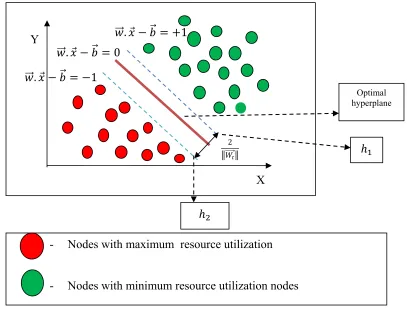
MANET and the classification using support vector machine is shown in figure 3. Figure 3 illustrates the support vector machine to classify the nodes accurately by using the optimal separating hyper plane which maximizes the margin of training data (i.e. node). Among the mobile nodes in network, the node which has efficient resource utilization (i.e. energy and bandwidth) is classified. The region surrounded by the hyper planes is termed as marginal hyperplane. The support vectors belonging to the margin that affects the direction of the discriminate hyperplane. At each occurrence, the nodes are classified on either side of the hyperplane. In other words, the nodes are separated from both upper and lower side of the margin.
The Kernel support vector comprises , , , , … , set of training samples i.e. group of mobile nodes in MANET, where indicates mobile nodes and represents the target output. The output of the kernalized binary classifier is described as ∈ 1, 1. Therefore, the predicted classification output 1 is an efficient node for routing, and the output provides the negative results (i.e. 1) then the mobile nodes are not selected for routing. As a result, the different training samples sets are generated for attaining higher improvement of the aggregation result.
The optimal hyperplane is described as the set of points,
w. x b 0 (8)
[image:5.612.117.524.402.713.2]From (8), represents the weight vector and set of samples and denotes a bias. The region surrounded by hyperplanes is known as margin.
Figure 3: Support vector machine
X
Y
Optimal hyperplane
2
.
1
.
1
.
0
-
Nodes with maximum resource utilization
1230 Therefore, the margins which is above and below the hyperplane is described as follows,
h → w. x b 1 (9)
h → w. x b 1 (10)
The distance among the two marginal hyperplane is illustrated as,
d h , h ‖ ‖ (11)
From (11), , represents a distance between two marginal hyperplane. Efficient nodes are classified by applying a similarity function is called as kernel. The similarity between the any pair of the mobile nodes is
calculated through the kernel. A kernelized binary classifier normally measures a weighted sum of similarities,
Y sgn ∑ w y k x , x′ (12)
[image:6.612.94.525.308.497.2]From (12), Y ∈ 1, ‐1 represents a kernalized binary classifier. , ′ denotes a kernel function that measures similarity between any pair of nodes in MANET.” sgn” determines whether the predicted classification output as positive or negative. Then the positive output results provide the higher similarity between the nodes. Therefore, ROKSV Technique uses kernalized binary classifier for classifying the node either maximum resource utilization or minimum resource utilization.
Figure 4: Resource optimized kernel support vector algorithm
Figure 4: Resource optimized kernel support vector algorithm
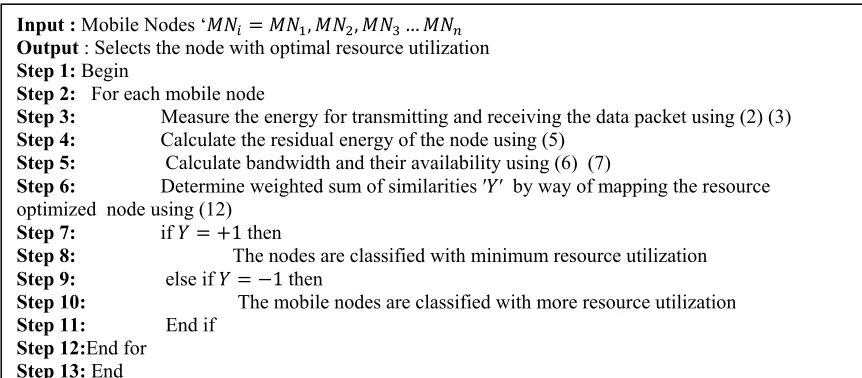
Figure 4 clearly describes the Resource optimized kernel support vector algorithm to separate the resource optimized node for efficient routing. Initially, transmitting and receiving energy of the node is computed. Followed by, the residual energy of the node is measured. Besides, the bandwidth of the each node and their availability also measured. Based on the energy and bandwidth estimation of the mobile node, the node which has minimum resource utilization is classified through kernel support vector. Finally, kernel support vector computes weighted sum of similarities between the any pair of nodes to provide optimal results.
3.3 Route Discovery for Data Transmission
After classifying the nodes, the route discovery is performed between the nodes. Generally, the route path discovery is performed based on control packets i.e. RREQ and RREP packet transmission. The SN transmits RREQ data packet to their neighboring nodes (NN). After receiving the RREQ data packet to destination, the RREP message sent to the source node. In addition, the node with minimum distance is selected for efficient routing.
Let us consider number of resource optimized mobile nodes in MANETs i.e. ‘
, , … ’and the distance
between the mobile nodes and within the transmission range . Let the current
Input : Mobile Nodes ‘ , , …
Output : Selects the node with optimal resource utilization
Step 1: Begin
Step 2: For each mobile node
Step 3: Measure the energy for transmitting and receiving the data packet using (2) (3)
Step 4: Calculate the residual energy of the node using (5)
Step 5: Calculate bandwidth and their availability using (6) (7)
Step 6: Determine weighted sum of similarities ′ ′ by way of mapping the resource optimized node using (12)
Step 7: if 1 then
Step 8: The nodes are classified with minimum resource utilization
Step 9: else if 1 then
Step 10: The mobile nodes are classified with more resource utilization
Step 11: End if
Step 12:End for
1231 coordinate for is ( , ) and for is ( , ). The distance between the mobile node and is measured for finding an optimal path. The distance is measured as follows,
D MN , MN p q p q (13)
From (13), , denotes a distance between the mobile nodes and . Therefore the nodes with minimum distance are selected to construct the multiple route paths with minimum resource (i.e. energy and bandwidth) utilization for multicast routing. After discovering the route paths, source node sends the data packet to destination. This helps to improve the data packet delivery with minimum delay.
3.4 Route Maintenance
Generally, the MANET has a dynamic topology where the mobile node moves randomly. Due to nature of dynamic topology, the link breakages in these networks may possibly occur. In addition, some of the mobile nodes may be malicious and selfish. This problem causes high data packet loss and delay.
Therefore, the route maintenance is necessary for improving the network lifetime. Route maintenance is a method that is used by a source node for discovering a link breakage in an available route path to a destination node. When a source node identified broken link in the route path, it uses another alternate route path for transmission. This helps to improve the reliability of the network. As a result, Route maintenance is performed only with active routes to improve the network performance.
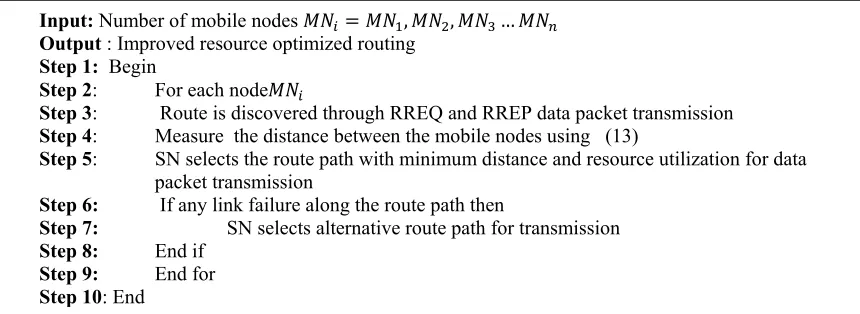
Figure 5 shows Multipath multicast route routing algorithm to improve the reliability. Initially, SN sends the route request to neighbor node and it receives the reply message to their neighboring node for discovering the multipath between source and destination. Followed by, the distance between the nodes is compute.
[image:7.612.94.524.423.580.2]The node has minimum distance is selected for routing. If any link failure is occurred in the route path, SN chooses alternative path for improving the resource optimized routing.As a result, ROKSV technique improves multipath multicast routing with minimum resource utilization.
Figure 5: Multi path-multicast routing algorithm
4. SIMULATION SETTINGS
A ROKSV technique uses NS2 simulator for obtaining the scalable and reliable multipath multicast routing in MANET. Totally 600 mobile nodes are considered for simulation in a square area of 1500 m * 1500 m). The Random Waypoint mobility model is employed for carry out the simulation. The number of data packets
are used in simulation is varied from 10 to 100. The simulation time is set as 300 sec.
Table 1: Simulation parameters
Parameters Values
Simulator NS2.34
Network area 1500 m * 1500 m
Number of nodes 60,120,180,240,300,360, 420,480,540,600
Input: Number of mobile nodes , , …
Output : Improved resource optimized routing
Step 1: Begin
Step 2: For each node
Step 3: Route is discovered through RREQ and RREP data packet transmission
Step 4: Measure the distance between the mobile nodes using (13)
Step 5: SN selects the route path with minimum distance and resource utilization for data packet transmission
Step 6: If any link failure along the route path then
Step 7: SN selects alternative route path for transmission
Step 8: End if
Step 9: End for
1232 Mobility model Random Way point model
Speed 2m/s – 20m/sec
Number of data packets
10,20,30,40,50,60,70,80,90, 100
Speed of node 0 – 20 m/s Simulation time 300s
Protocol DSDV
Number of runs 10
The lists of input parameters are shown in the above table1.
5. RESULTS AND DISCUSSION
The result analysis of ROKSV technique is performed and discussed with existing Scheduled-Links Multicast Routing Protocol (SLMRP) [1] and Reliable minimum energy routing (RMER) [2]. In order to evaluate the performance of ROKSV technique, a network comprises 600 mobile nodes within the transmission range. The various simulation parameters such as energy consumption, bandwidth, packet delivery ratio and delay are explained with the help of tables and graphs.
5.1 Impact of Energy Consumption
Energy consumption is defined as an amount of energy utilized by a particular mobile node with respect to the number of mobile nodes in MANET. Energy consumption is measured in terms of joule (J). The formula for energy consumption is expressed as,
EC E ∗ n (14)
[image:8.612.85.294.75.208.2]From (14), is the energy of the one node and ‘n’ denotes a number of mobile nodes in MANET.
Table 2: Energy Consumption
Number of nodes
Energy consumption (joules)
ROKSV SLMRP RMER
60 30.8 52.3 42.3
120 34.2 55.9 46.5
180 40.7 58.6 50.2
240 45.3 63.2 53.7
300 48.9 67.5 55.9
360 51.2 70.1 58.6
420 53.4 75.8 62.3
480 55.7 78.6 65.8
540 58.6 80.2 70.1
600 62.3 84.5 73.9
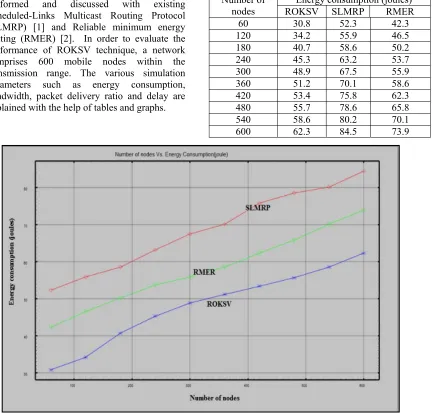
[image:8.612.103.536.289.702.2]1233 Table 2 shows the impact of energy consumption with respect to number of nodes in MANET. The mobile nodes are varied from 60 to 600. As shown in table, the proposed ROKSV technique reduces energy consumption than the existing SLMRP [1] and RMER [2] respectively.
Figure 6 illustrates the simulation of energy consumption with respect to number of nodes in MANET. The result in figure 8 confirms that the proposed ROKSV technique significantly outperforms than the existing methods. This significant improvement is attained based on energy of the node. The energy consumption of the mobile node during the transmission is minimized in ROKSV technique by applying kernel support vector. In MANET, energy of each mobile node is measured based on the data packet transmitting and receiving capacity of the nodes. Followed by, the residual energy of the node is measured after the transmission. Besides, kernel support vector classifies the nodes based on the minimal resource utilization through the optimal hyperplane to improve the routing. Then ROKSV technique selects the path with minimum energy utilization for efficient routing. Therefore, the energy consumption is reduced by 31% and 18% compared to existing SLMRP [1] and RMER [2] respect
5.2 Impact of bandwidth
Bandwidth is defined as the amount of data packet is sent in a fixed amount of time and it is measured in terms of kilo bits per second (Kbps). The bandwidth is measured using (6).
Table 3: Tabulation for bandwidth
Data packet size (MB)
Bandwidth (Kbps)
ROKSV SLMRP RMER
15 6 3.1 4.3
30 8.4 4.5 5.7
45 10.7 5.4 6.9
60 15.5 9.4 12.5
75 20.2 10.7 14.8
90 25.5 13.5 20.5
105 28.7 15.4 22.4
120 33.5 20.6 28.9
135 39.6 24.9 31.2
150 48.5 29.1 35.8
[image:9.612.307.539.186.347.2]Table 3 describes the analysis of bandwidth with respect to data packet size which is varied from 15MB to 150MB. From the table value, the ROKSV technique improves the bandwidth than the existing SLMRP [1] and RMER [2].
[image:9.612.107.520.432.707.2]1234 Figure 7 depicts the simulation analysis of the bandwidth with respect to data packet size. The bandwidth is significantly improved using ROKSV technique than the existing methods. This is because, ROKSV technique calculates the bandwidth for each mobile node by sending the amount of data packets in a particular time. This value is stored in the bandwidth consumption register at each mobile node in network. The bandwidth of the each node is measured for improving the scalability. Besides, the source node identifies the bandwidth consumption of its one-hop and two-hop neighboring nodes. Bandwidth availability is also measured as the difference between raw channel bandwidth and consumed bandwidth. Therefore, the bandwidth of ROKSV technique significantly improved by 80% and 33% compared to existing SLMRP [1] and RMER [2] respectively.
5.3 Impact of packet delivery ratio
Packet Delivery Ratio is defined as the ratio of num ber of data packets correctly received at destination node to the total number of data packets transmitted by the source nodes. The formula for Packet delivery ratio is measured as follows,
100 * DPS DPR
PDR (15)
[image:10.612.321.528.217.360.2]From (15), ‘ ’ denotes a Packet Delivery Ratio measured based on number of data packets received at destination node ‘ ’ to the number of data packet sent from the source node ‘ ’ respectively. Let us consider, the node consists number of data packets is 10. Among the 10 data packets, correctly received data packet at the destination is measured.
Table 4: Tabulation for Packet delivery ratio
Number of
nodes ROKSV Packet delivery ratio (%) SLMRP RMER
60 92.32 80.12 72.35
120 93.15 82.57 75.12
180 94.43 83.13 77.34
240 95.57 84.75 79.56
300 96.44 85.46 80.10
360 97.47 87.65 81.32
420 98.11 88.10 82.31
480 98.95 89.36 83.45
540 99.21 90.12 84.12
600 99.89 92.36 86.36
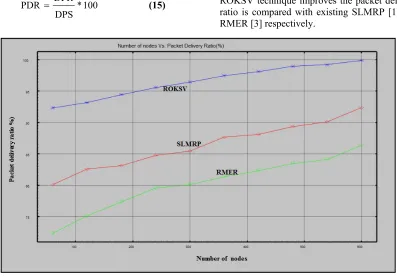
Table 4 shows that the simulation performance analysis of packet delivery ratio is performed based on the number of nodes in network. The node contains the number of data packets to transmit and receive. The proposed ROKSV technique improves the packet delivery ratio is compared with existing SLMRP [1] and RMER [3] respectively.
[image:10.612.104.501.433.710.2]1235 Figure 8 shows the simulation analysis of packet delivery ratio based on number of nodes in network. The number of nodes taken for experimental is varied from 60 to 600. From the figure, it is clearly evident that the packet delivery ratio gets increased in ROKSV technique than the existing methods [1] [3]. In ROKSV technique, energy and memory optimized nodes are classified from the large number of nodes in network.
The support vector machine maximizes the margin around the separating hyperplane that classifies the nodes with minimum resource utilization (i.e. energy and bandwidth) through the output of kernel binary classifier. With the optimized nodes, the SN discovers the route path with minimum resource utilization. If any link failure is occurred in the route path, SN selects another route path for efficient packet transmission. Therefore, the packet delivery ratio is increased by 12% and 21% compared to existing SLMRP [1] and RMER [3] respectively.
5.4 Impact of delay
Delay is defined as the amount of time required to transmit the number of data packets from source to multiple destinations. It is measured in terms of milliseconds (ms).
The delay is measured as follows,
∗ (16)
Time-Time to transmit one data packet
From (16), denotes a delay and represents a number of data packets.
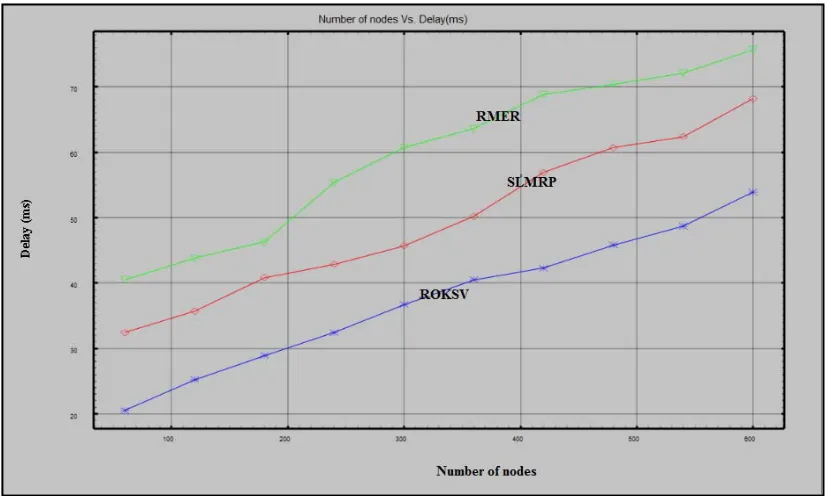
[image:11.612.327.529.254.434.2]Table 5 shows the performance analysis of delay with respect to number of nodes. The table values are clearly evident that the delay is considerably reduced in proposed ROKSV technique than the existing SLMRP [1] and RMER [3] respectively.
[image:11.612.104.518.461.709.2]Table 4: Tabulation for Delay
Figure 9: Measure of delay
Number of nodes
Delay (ms)
ROKSV SLMRP RMER
60 20.5 32.4 40.5
120 25.2 35.7 43.8
180 28.9 40.8 46.3
240 32.4 42.9 55.4
300 36.7 45.7 60.7
360 40.5 50.2 63.6
420 42.3 56.9 68.9
480 45.8 60.7 70.4
540 48.7 62.4 72.1
1236 The simulation results of the proposed and existing protocols are shown in figure 9. As shown in figure 9, the simulation result of delay with respect to number of nodes is described. From the figure delay gets reduced in ROKSV technique than the existing methods. This is because, the distance between the nodes are calculated for construct the multipath between source and destination.
Therefore, the nodes with minimum distance are selected to reduce the delay. In addition, Route maintenance is performed if any link failure along the route path. The source node identified the broken link across the route path and it selects another energy efficient route path for data packet transmission in MANET. This helps to obtain higher reliability of the network. Therefore, the delay during the packet transmission is significantly reduced by 25% and 38% compared to existing SLMRP [1] and RMER [3] respectively.
6. CONCLUSION
An efficient Resource Optimized Kernel Support Vector (ROKSV) technique is developed to improve reliable and scalable multipath multicast routing in MANET. Initially, the resources energy and bandwidth of the node is measured for improving the scalable routing. Secondly, the nodes are classified based on the minimal resource utilization through the optimized kernel support vector. It uses the separating hyperplane to classify the mobile node with the help of kernel binary classifier for routing. With the classified nodes, the route path between the mobile nodes is discovered. Then the data transmission is performed in a discovered route path. Finally, the route maintenance is performed to overcome the route failure issue and improve the packet transmission with minimum delay. The simulation is performed for different parameters such as energy consumption, bandwidth, packet delivery ratio and delay. The performance results show that the ROKSV technique improves the higher Packet delivery ratio, bandwidth with minimal energy consumption and delay compared to state-of-art methods. In future, more parameters can be analyzed to improve the performance of Manets.
REFERENCES:
[1] Hasan Abdulwahid, Bin Dai, Benxiong
Huang, Zijing Chen, “Scheduled-Links Multicast Routing Protocol in MANETs”,
Journal of Network and Computer Applications
,Elsevier,Vol.63,Mar.,Pp.56-67, 2016,https://doi.org/10.1016/j.jnca.20 15.12.013
[2] M.Saseekala, Dr.P.Kamalakannan,” A Comprehensive Model for Better Multicast Routing Protocol(BMRP-QoS) to Improve QoS in Manets”, International Journal of Applied Engineering Research, Vol.12, No. 14, Pp. 4049-4055, 2017
[3] Javad Vazifehdan, R. Venkatesha Prasad, and Ignas Niemegeers, “ Energy-Efficient Reliable Routing Considering Residual Energy in Wireless Ad Hoc Networks”,
IEEE Transactions on Mobile Computing,
Vol. 13, No. 2, Pp. 434 – 447, 2014 , DOI: 10.1109/TMC.2013.7
[4] Zhiwei Y, Jong HL, Sean S & Chunming Q, “Novel Branching-Router-Based Multicast Routing Protocol with Mobility Support”, IEEE Transactions on Parallel and Distribu -ted Systems, Vol.24,
no.10,Pp.2060-2068, 2013 , DOI: 10.1109/TPDS.2012.305
[5] Dingde J, Zhengzheng X , Wenpan L & Zhenhua C, “Network Coding-Based EnergyEfficient Multicast Routing Algori -thm for Multi-hop Wireless Networks”,
Journal of Systems and Soft ware , Elsevier,
Vol. 104, Pp. 152-165, 2015, https://doi.org/ 10.1016/j.jss.2015.03.006
[6] Sunil Kumar, Siddharth Khimsara, Kashyap Kambhatla, Kalyani Girivanesh, John D.Matyjas, and Michael Medley, “Robust On-Demand Multipath Routing with Dynamic Path Upgrade for Delay-Sensitive Data over Ad Hoc Networks”, Hindawi Publishing Corporation, Journal of Computer Networks and Communications,
Vol. 2013, Feb, Pp.1-13, 2013
http://dx.doi.org/ 10.1155/2013/791097
[7] Rajashekhar C.Biradar, Sunilkumar S.Manvi, “Neighbor supported reliable multipath multicast routing in MANETs”,
Journal of Network and Computer Applications,Elsevier,Vol.35,Pp.1074–
1085,
2012,https://doi.org/10.1016/j.jnca.2011.12.008
1237 Springer,Vol.88,no.4,June.,Pp.963–983,
2016 , https:// doi.org /10.1007 /s1127
[9] David Palma and Marilia Curado, “Scalable multi-hop routing in wireless networks”, EURASIP Journal on Wireless Comm.tions and Networking, Vol.86, Pp. 1-21, 2013
https://doi.org/10.1186/1687-1499-2013-86
[10] Y. Harold Robinson and M. Rajaram, “Energy-Aware Multipath Routing Scheme Based on Particle Swarm Optimization in Mobile Ad Hoc Networks”, The scientific World Journal, Hindawi Publishing
Corporation, Vol. 2015, Nov., Pp 1-9,2015,
http://dx.doi.org/10.1155/2015/284276
[11] A. Pratapa Reddy and N. Satyanarayana, “Energy-efficient stable multipath routing in MANET” Springer ,Wireless Networks,
Vol. 23, no. 7, Oct., pp.2083–2091,2017
doi>10.1007/s11276-016-1220-4
[12] Tanu Preet Singh, Neha, Vikrant Das, “Multicast Routing Protocols In MANETs”, International Journal of Advanced Research in Computer Science and Software Engineering, Volume 2, Issue No.1, January 2012, Pages 1-6.
[13] Jeong-Soo Kim and Sang-Hwa Chung, “Adaptive On-Demand Multicast Routing Protocol for Mobile Ad Hoc Networks”, Hindawi Publishing Corporation,
International Journal of Distributed Sensor Networks, Vol. 2015, Oct., Pp. 1-11, 2015
http://dx.doi.org/10.1155/2015/652572
[14] Mamatha Balachandra , K. V. Prema , Krishnamoorthy Makkithaya, “Multi constr -ained and multipath QoS aware routing protocol for MANETs, Wireless Networks, Springer, Vol. 20, Issue 8, Nov. 2014, Pp. 2395–408,http://doi.org/10.1007/s1127601407546
[15] S. Gopinatha, and N. Nagarajan, “Energy based reliable multicast routing protocol for packet Forwarding in MANET”, Journal of Applied Research and Technology, Elsevier, Volume 13, 2015, Pages 374-381 [16] Abdulmalek Al-Hemyari, Mahamod Ismail,
Rosilah Hassan and Sabri Saeed. “Improving Link Stability of Multicasting Routing Protocol in MANETs” Journal of Theoretical and Applied Information Technology, September 2013, Volume 55, Issue No. 1,
[17] Wang Ya-li, Song Mei, Wei Yi-fei, Wang Ying-he, Wang Xiao-jun, “Improved ant colony-based multi-constrained QoS energy-saving routing and throughput optimization in wireless Ad-hoc networks”, The Journal of China Universities of Posts
and Telecommunications, Elsevier, Volume 21, Issue 1, February 2014, Pages 43-53 htt://doi.org/10.1016/S1005-8885(14)60267-3
[18] Sungwook Kim, “Adaptive MANET Multipath Routing Algorithm Based on the Simulated Annealing Approach”, Hindawi Publishing Corporation, the Scientific World Journal, Volume 2014, June 2014, Pages 1-8
http://dx.doi.org/10.1155/2014/872526
[19] May Cho Aye and Aye Moe Aung, “Energy Efficient Routing for MANETs using On-demand Multipath Routing Protocol”, International Journal of Advanced Research in Computer Eng.&Tech.(IJARCET), Vol.3, Issue5,May2014, Pp. 1872-1875 [20] Yue-Bin Bai, Xuan Zhu, Xu Shao, Wen-Tao
Yang, “FAST: Fuzzy Decision-Based Resource Admission Control Mechanism for MANETs”, Mobile Networks and Applications, Springer, Volume 17, Issue 6, 2012, pp 758–770, https://doi.org/10.1007/ s11036-012-0384-0