1334
A STUDY ON CLOUD-BASED PROJECT MANAGEMENT
SYSTEM MODEL: FOCUS ON NEW-ICT PROJECT
1OK-SU YANG, 2*KOO-RACK PARK, 3DONG-HYUN KIM
1Dep. of Computer Engineering, Kongju National University, 31080, Rep. of Korea
2*Dep. of Computer Science & Engineering, Kongju National University, 31080, Rep. of Korea
3Dep. of Computer Engineering, Kongju National University, 31080, Rep. of Korea
E-mail: 1[email protected], 2*[email protected], 3[email protected]
ABSTRACT
Modern society is undergoing various changes in all industries. Especially, the requirements, scale, and interfaces to carry out SW projects are complex and large, due to development of IT technology. So project management is becoming more important. This requires new structured form of project management system to manage the project. Many SW development companies have difficulties in management since they are dispersed. In this situation, the cloud system is emerging as an alternative. Also, project management is not properly managed because they apply New-ICT to traditional management process. The thesis proposes integrated management system of easy access to anyone that integrates the tasks of various projects by implementing the necessary management models and system to manage New-ICT services in Cloud Computing environment. It is expected that project management will improve management efficiency when it applying to New-ICT service projects because this system is managed information and data from disparate projects into a single to manage them as SaaS Cloud Computing based approach.
Keywords: Cloud Computing, Project Management, Agile Methods, Scrum, ICT
1. INTRODUCTION
Modern society has many changes throughout industry. Rapid advances in IT technology mean that requirements, scale and interfaces of the system are complex and large. As a result, management of development projects is becoming more important issue. Under these circumstances, most SW development company are attempting to shift rapidly from revolving around SI(System Integration) and package SW project to revolving The Third Platform Area. Under these circumstances, when carry out a new project there are lags in the development period because of lack of project management services tailored to developers and managers, data dispersion, and difficulty in collaboration. This requires new structured form of project management system to manage the project because of diversification of the company. As a result Cloud computing systems are becoming an alternative The Cloud computing system is a next-generation computing environment that provides wide variety services to enable users and distribute IT resources efficiently. Cloud system enable high capacity processing and rapid processing. If network is connected, you can always
1335 effectiveness in the field of development projects. The development process and tools were applied to seven projects for the verification of the system. As a result, it gained more than 20 % of the overall through process and productivity.
2. RELATED RESEARCH
2.1 Cloud System
[image:2.612.327.511.101.210.2]Understanding Cloud computing is essential to knowing Cloud. Cloud have various definitions depending on the views of the researchers, designers, engineers, developers, manager, customers and etc. These can be summarized as keywords for on-demand, utility, virtualization resource pool, web services, and professional vision[9],[10],[11],[12]. The following [Figure 1] is Cloud Service Type.
Figure 1: Cloud Services
A Cloud is a system that uses Internet technology to borrow and service IT resources as needed. Cloud systems can be categorized according to service delivery and utilization purposes. Service delivery means the way Cloud provider supports a user. There are Infrastructure as a Service(IaaS), Platform as a Service(PaaS), Software as a Service(SaaS). Cloud service types are classified as users and suppliers according to the system configuration[13],[14],[15],[16].
IaaS is service that lets users build high-level structure with providing to user subsequence like virtualization, server, storage, network. Paas is a service that provides the platform for users to develop software through the platform. SaaS provides users with services across all software domains through a single platform, such as application.
[image:2.612.93.301.317.497.2]The following [Figure 2] is Cloud systems, and classified according to the purpose of use.
Figure 2: Cloud systems
Depending on the arrangement of the system, the shape is determined such as Private, Public, Hybrid. Hybrid Cloud System is a new system form that combines both characteristics of Private and public cloud with a connection and choice. Private Cloud Systems is a service that enables companies to directly build up cloud systems to share and manage internal data. Public Cloud systems are paid only as much as they used to because IT resources are dependent on external companies that Many users use a system built by a cloud service provider.
2.2 Traditional Project Management
Environment and Process
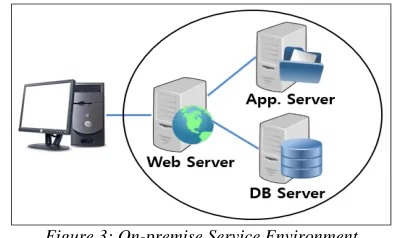
The following [Figure 3] is On-Premise Service Environment.
Figure 3: On-premise Service Environment
Traditional development of project were carried out in Traditional (Waterfall) Process in On-Premise environment using an IT infrastructure. The following [Figure 4] is Traditional Management Model.
[image:2.612.317.515.422.541.2] [image:2.612.313.522.622.714.2]1336 There is difficulty in conducting a successful project due to problems with the review and testing, because after all development is completed based on the requirements, the source integrate/ test/ inspection is performed at the end of the project.
2.3 New-ICT Project Management
Environment and Process
[image:3.612.311.528.188.632.2]The following [Figure 5] is Off-premise Service Environment.
Figure 5:Off-premise Service Environment
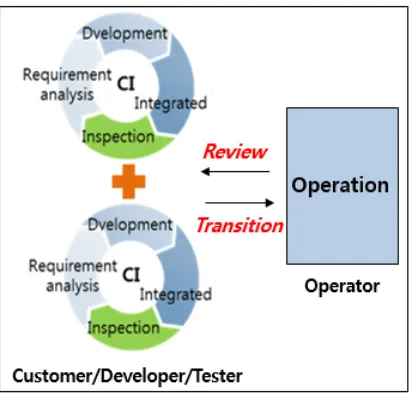
Recent IT environments are different from traditional development project management system. Using SaaS or Cloud Computing to connect data-centers, hosting or cloud to the network. The trend is proceeding the Agile Process in the off-premise of running the software remotely.
[image:3.612.91.302.233.336.2]The following [Figure 6] is New-ICT management model.
Figure 6:New-ICT management model
Develop and test the project for a short period based on the priority of Task. And periodically, customers, developers, tester, QA work together and share. There is the advantage of minimizing the problems caused by the Waterfall process and saving the project Life Cycle Time.
2.4 Difference between the New-ICT process
and the Traditional process
The following [Table 1] is difference between the New-ICT process and the traditional process management model.
Table 1: Difference between the New-ICT process and the traditional process
Division Traditional process New-ICT process
Plan Fixed range Fluid range
Development and Test
Stepwise execution
Iteration unit operation
Process
Defined processes
Standardize, Objectification
Heuristic process
Flexibility, Simplified, Cyclical
Work flow
Command and control led by the manager
Work execution with personal responsibility
Self-organizing Team-management
Work execution with team share responsibility
Organization
Function oriented
Specialization and Role limitation
Functional mixing
Multi role
Team management
Indication, Surveillance, Competition
Coaching and Facilitation, Cooperation
Evaluation
Higher administrator assessment
Relative evaluation
Multiple evaluation
Absolute evaluation
Success measure
Planning compliance
Delivering customer value
[image:3.612.93.300.451.648.2]1337
3. CLOUD BASED NEW-ICT PROJECT
MANAGEMENT
3.1 New-ICT Management Triangle
The following [Figure 7] is New-ICT management Triangle. The traditional project management, the left triangle, consists of ‘Scope’, ‘Schedule’, and ‘Cost’. The left triangle fix ‘Scope’ and plan ‘Cost’, ‘Schedule’. But if requirements are changed, fix ‘Schedule’ and readjust priority of ‘Scope’.
Figure 7: New-ICT Management Triangle
New-ICT Project Management is fixed ‘Schedule’, and allow changes in ‘Scope’. This means Time is fixed constraint. The measured value are Value(to the Customer), Quality(Required to deliver continuous value to the customer), Constraints(Scope, Schedule, and Cost). Although constraints are still important factor in the project, but it is not the goal. Value is goal, and constraints can be adjusted for customer value[17].
[image:4.612.313.521.217.384.2]The following [Table 2] is New-ICT Triangle
Table 2: New-ICT Triangle
Goal Descriptions
Value goal Build a releasable product
Quality goal Build a reliable, adaptable product
Constraint goal Achieve value and quality goals within acceptable constraints
3.2 New-ICT Management Life Cycle
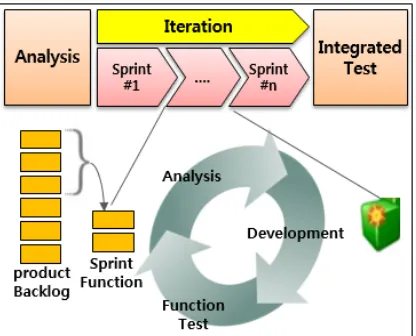
The management of New-ICT project proposed by this report aims to select the lifecycle model for the project to facilitate project management. For example, utilizes ‘Sprint’ as a unit of activity related to task management and ‘Milestone’ as a unit of constant management. The proposed project management Life Cycle Model consists of Pure Repeat Life Cycle Model which are appropriate for developing a small new solution, Hybrid Repeat Life Cycle Model which
are appropriate for developing a medium and Waterfall Repeat Life Cycle Model which are appropriate for developing a Large Next Generation Project. AS a result, Decisions for managing project management are made up of SW Life Cycle, Milestone(Sprint) and Task Management.
3.2.1 Pure Repeat Life Cycle
[image:4.612.92.301.229.337.2]The following [Figure 8] is a pure repeat life cycle.
Figure 8: Pure Repeat Life Cycle
Pure Repeat Life Cycle Model is a suitable for developing new solutions that are low safety and highly functional change
3.2.2 Hybrid Repeat Life Cycle
Hybrid Repeat Life Cycle [Figure 9]
Model is a suitable for developing of operational systems that are confirmed More than 50 % of the requirements in advance and ordinary functional change
[image:4.612.315.523.520.688.2]1338
3.2.3 Waterfall Repeat Life Cycle
Waterfall Repeat Life Cycle [Figure 10] Model is suitable for developing next-generation systems that require high levels of scale, period, management, and inspection of the outputs.
Figure 10: Waterfall Repeat Life Cycle
3.3 New-ICT Management Methodology
It is very difficult to apply agile methodologies, if there is no major reform to prevailing idea in traditional development project[18][19][20]. This Methodology is organized for various factors, such as management, organization maturity, development speed, technical level, management capabilities and services that aims to effectively combine the traditional development process and the agile development Process(Representative XP, Scrum) to better align with New-ICT[21],[22].
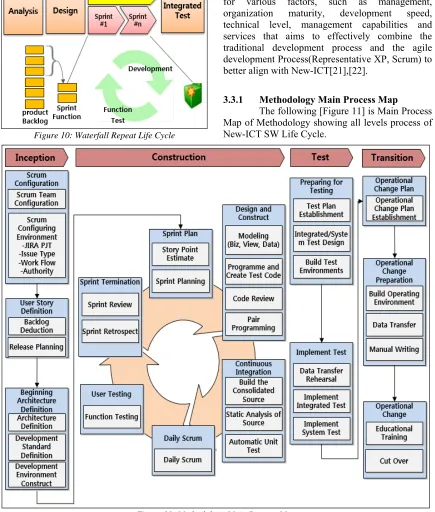
3.3.1 Methodology Main Process Map
[image:5.612.90.525.167.679.2]The following [Figure 11] is Main Process Map of Methodology showing all levels process of New-ICT SW Life Cycle.
Figure 11: Methodology Main Process Map
The key of methodology proposed by thesis
1339 The traditional development organizational model and Scrum Process reflected Software Development Life Cycle optimized for the New-ICT development environment.
3.3.2 Preparation and Inception Phase
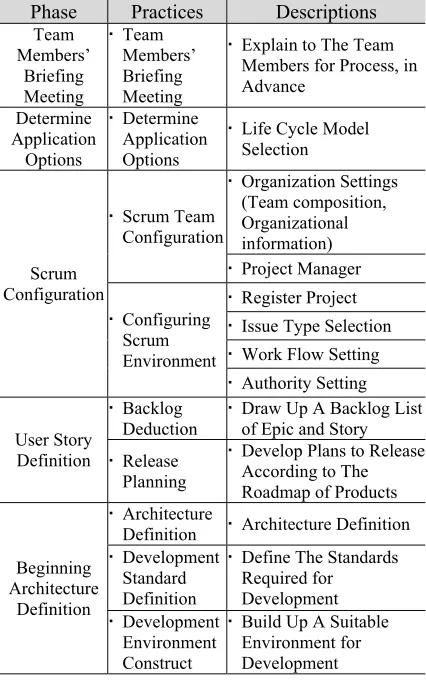
The following [Table 3] lists the start-up 5 steps to perform the project. And it defines Team
Members’ Briefing Meeting, Determine
[image:6.612.313.525.104.721.2]Application Options, Scrum Configuration, User Story Definition and Beginning Architecture Definition.
Table 3:Inception Phase
Phase Practices Descriptions
Team Members’
Briefing Meeting
Team Members’ Briefing Meeting
Explain to The Team Members for Process, in Advance
Determine Application
Options
Determine Application Options
Life Cycle Model Selection
Scrum Configuration
Scrum Team Configuration
Organization Settings (Team composition, Organizational information)
Project Manager
Configuring Scrum Environment
Register Project
Issue Type Selection
Work Flow Setting
Authority Setting
User Story Definition
Backlog
Deduction Draw Up A Backlog List of Epic and Story
Release Planning
Develop Plans to Release According to The Roadmap of Products
Beginning Architecture
Definition
Architecture
Definition Architecture Definition
Development Standard Definition
Define The Standards Required for Development
Development Environment Construct
Build Up A Suitable Environment for Development
3.3.3 Construction Phase
[image:6.612.90.303.259.604.2]The following [Table 4] is Construction Phase. It should establish a sprint schedule and decide work plan in the sprint, in consideration of the product roadmap, priority, personnel and team velocity.
Table 4: Construction Phase
Phase Practices Descriptions
Sprint Plan
Story Point Estimate
It tells volumes of the Story(Issue, Task), and possible the checking velocity of progress during the sprint
Sprint Planning
Establish project plan within each sprint period by measuring priorities and volumes of backlogs
Design and Construct
Modeling (Biz, View, Data)
Modeling data and process about function
Programming and Create Test Code
Implement coding and unit test about function
Code Review
Improve the quality of work with colleague review
Pair Program
Two or more
programmers use coding together
Continuous Integration
Build the Consolidated Source
Implement tool-setting and automation-work to provide configuration, build, and release management for continuous integration
Static Analysis of Source
Eliminate potential defects and induced to improvement of source quality through automation of unit test and visualization of development quality
Automatic Unit Testing
Implement regression test automatically through the unit test
Daily
Scrum Daily Scrum
It is standup meeting to share the progress of the current project and identify the fault elements every day
User
Testing Function Testing
It is an activity to test whether or not to complete DoD of story or task within a sprint
Sprint Terminatio
n
Sprint Review
It is a meeting that verifies the progress and outcome of the sprint goal.
Sprint Retrospect
1340
3.3.4 Test Phase
[image:7.612.90.302.155.336.2]The following [Table 5] is Test Phase. This Phase is the stage for test preparation and conducting test after the construction phase.
Table 5: Test Phase
Phase Practices Descriptions
Preparing for Testing
Test Plan
Establishment Establish test plan
Integrated/Syst em Test Design
Definition of integrated test, system test, scenario and case
Build Test Environments
Build up environment for Test
Implement test
Data Transfer
Rehearsal Data transfer for Test
Implement Integrated Test
Implement Integrated Test
Implement
System Test Implement System Test
3.3.5 Transition Phase
The following [Table 6] is Transition Phase. As a step toward switching the development system into operation, it is phase to hand over the system, documentation and training to operators.
Table 6: Transition Phase
Phase Practices Descriptions
Operational Change Plan
Operational Change Plan Establishment
Prepare all details in the form of checklist for operational change
Operational Change Preparation
Build Operating Environment
Build operating environment
Data Transfer Data transfer
Manual Writing
User manual, operator manual, system manual preparation
Operational Change
Educational Training
Training for actual users
Cut Over Close a project
3.4 New-ICT Management Model and SW
Development Project
3.4.1 New-ICT Management Model
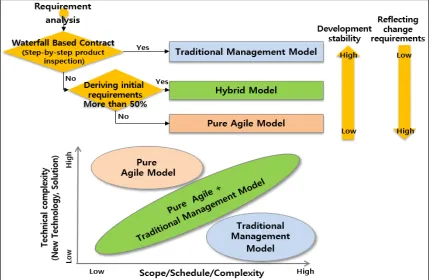
The following [Figure 12] is New-ICT
[image:7.612.91.522.433.713.2]Management Model. This model is defined as the hybrid form mixed traditional SI development process and agile development process. This is based on contract with client and the way you work depends on the agile process.
1341
3.4.2 The Relation between New-ICT Life
Cycle and SW Development Project
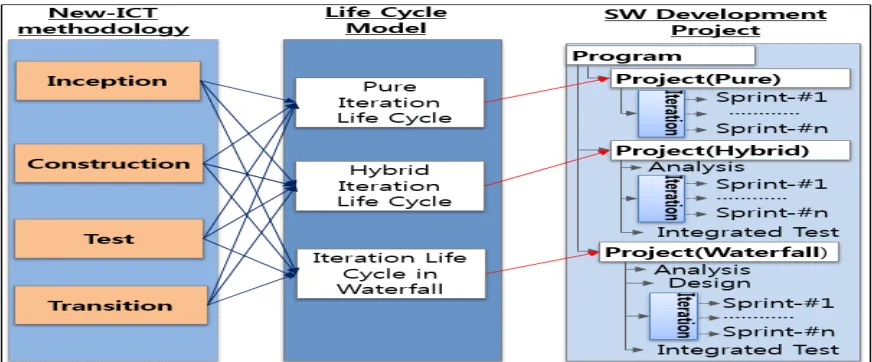
Project Management Model proposed by the thesis defines the relationship between program and project through the linking New-ICT methodology and Life Cycle Model. Project refers to management aspects. To create Top Down
project through the correlation between project and phase as model for sprint management and task management. And it can generate multiple projects and sprint.
[image:8.612.91.527.184.365.2]The following[Figure 13] shows relationship between New-Life Cycle and SW development project.
Figure 13: Relationship between New-ICT Life Cycle and SW development project
One program has multiple projects, and one project can generate multiple sprint. One sprint has multiple task, and there are many processes in one task. Users share the progress of the project and quickly register, receive, and resolve problems arising from project implementation. And it support the process and make rapid decisions on changing the variety of requirements.
4. MODELDESIGN AND DEVELOPMENT
This stage describes implementation of New-ICT methodology, Life Cycle Model and Linked Project Management Model previously defined. This is developed in the Cloud Based Web Environment, which can be used anywhere and anytime, so accommodates PMBOK and basic process of agile development with thorough analysis of new environments and requirements, etc.
4.1 Scope and Process of Design
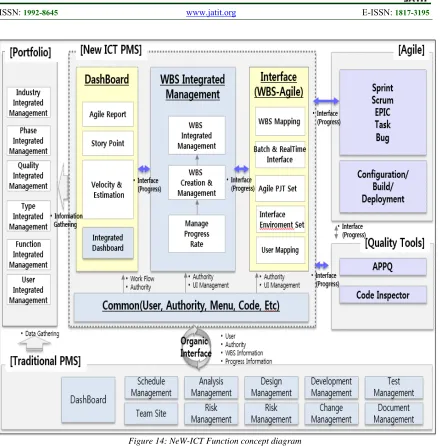
The following [Table 6] are divided into four sections as the scope of design. This is separated areas that Requirements Management, Schedule Management that integrates task management, DashBoard that manages project status in real time and provide basic information for communication.
Table 6: Basic Functions of Management Tools
Function Descriptions
Requirements Management
Easy to change the need for sustained requirements
Manage requirements by task type
(Feature, Epic, Task, Bug)
Flexibly respond to requirements
Schedule Management
WBS management in project development Life cycle units
Progress management by project Phase units, Feature units, Sprint units.
Progress status and delay management by user.
Quick decision management using Burn Down/Up charts.
DashBoard
Real-time information on processes and risks status
Monitor workload fluctuation
Milestone Performance Management
Quality Control
Manage productivity based on story point estimation in the Sprint Unit
Estimate the performance of individual units by managing velocity trends and estimates
Link
Traditional management process with organic connections
Link to portfolio management, link to quality management
[image:8.612.314.527.408.704.2]1342
Figure 14: NeW-ICT Function concept diagram
4.2 Describe the Basic Functions of
Management
The key function of implementing seamless communication system is in the management of projects integrated into the project. Systematic project management is essential to
standardization of data based on the standard process considering the characteristics of the task.
4.2.1 Requirements Management Systems
and Functions
The following [Figure 15] is requirements management systems and functions screen.
This screen collects and summarizes the task to share the effective requirements among project stakeholders. In addition, it can be managed from various perspectives and monitored for registration and progress. Each function has an
1343
Figure 15: requirement registration and managing
4.2.2 Schedule Management System and
Functions
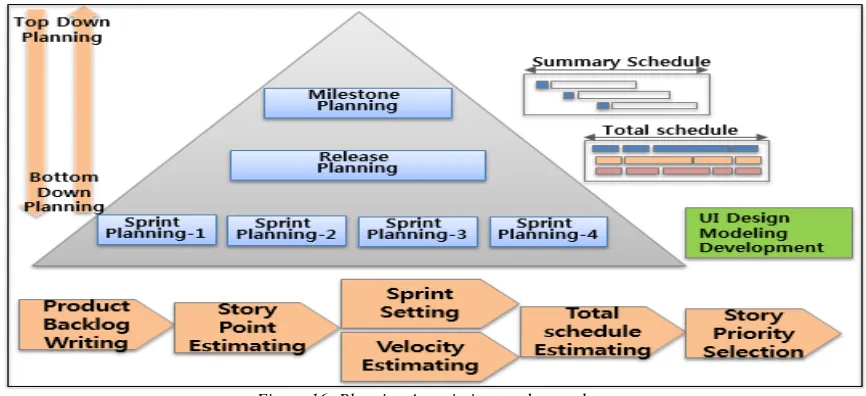
Once the scale estimates and the story point are established, assign and manage the task, considering the priority of the task after setting
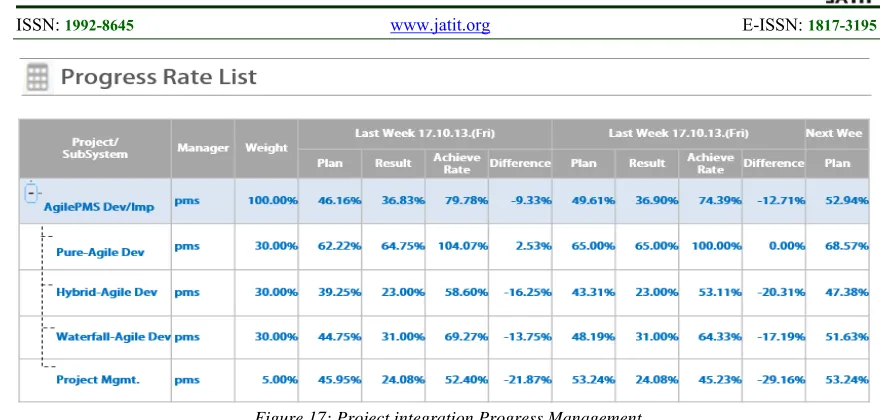
WBS(Sprint Planning) to link the Release Pan(major milestone) and the Product Back Log(Business classification) with the scope of the Project Life Cycle. The following [Figure 16] is project integration progress management process.
Figure 16: Planning Associations and procedures
[image:10.612.88.521.389.587.2]1344
Figure 17: Project integration Progress Management
4.2.3 Real Time Integration Management
Using DashBoard
The following [Figure 18] is Project integration dashboard. Managing risks and managing progress using DashBoard is a function of providing real-time information and integrated management.
Figure 18: Project integration DashBoard
The following [Figure 19] is Velocity & Estimating DashBoard. Story point is the number used to calculate the magnitude of the requirement (Story) considering complexity, risk, and size.
[image:11.612.312.524.293.484.2]The sum of the backlog story points performed during the duration of the sprint period means the workload that was treated during the project period.
Figure 19: Velocity & Estimating DashBoard
5. NEW-ICT PROJECT MANAGEMENT
SYSTEM EVALUATION
Based on the design of the proposed management tools, build up system and apply to a project in progress. Then analyze differences by comparing them with existing management methods. In particular, the validity of management tool is verified through performance of management, identification and measurement of changes in the way.
5.1 Performance of Integrated Management
[image:11.612.90.300.384.543.2]1345
Table 7: Project Management Object
Subject Category Subject
Manager Developer
All
Transparency in schedule/ quality management
Communication
↑ ↑
Schedule Management Aspect
Progressive management transparency
↑ ↑
Project Forecast ↑ ↑
Project Over
Time ↑
Collaboratio n Aspect
Communication
efficiency ↑ ↑
Document
preparation time ↑
Self-level
co-operation ↑
Quality Aspect
Implement
Customer Value ↑ ↑
Early Detection
of Defects ↑ ↑
Defect
Processing Rate ↑ ↑
The proposed management tools provide a clear view of the progress of the work. The defects in the release phase have decreased by 30 % and the efficiency and productivity of the development process has increased by more than 20 %.
5.2 Change in The Way of Working
The following [Table 8] is a way of thinking of losing. Rather than simply attempts to implement a tool or process, a paradigm shift in people's mindset is needed. Wisdom is needed to choose the right method depending on the nature of the project and the nature of the organization.
Table 8:The way of thinking
Item Description
Self-directed execution culture
Team member-led results review and retrospective
Prioritize performance based on repeated cycles.
Communication and Collaboration
culture
Sharing and actively solving
problems
Real-time information sharing and tracking management
Efficiency culture
Progress automation in connected with agile
Minimize reporting by using real-time dashboards
Continuous improvement
culture
Priority-oriented small execution
Systems that continue to grow and improve
6. CONCLUSION AND FUTURE
DIRECTIONS
By integrating the advantages of the traditional SW development process and the advantages of the NEW-ICT SW development process, we have implemented the Hybrid SW development process to solve the existing problems. Although the process is important in real application to the project, the development culture must also change before the Hybrid SW development process can be settled.
Currently, the majority of the development projects are managed and operated with traditional service environments and processes. Owing to the unstructured models and tools, interoperability between the systems is degraded within the organization.
Hence, I Offers cloud-based integrated management system to enable heterogeneous data exchange with the management model and processes appropriate for the period of time for the upcoming New-ICT implementation. These proposed models has not only the effect of using many development platforms and external services but also, Testing and Staging Server can be infinitely provided and synchronize development work at the same time. In terms of security and usability, research needs to be continued continuously in the future. The integrated management model is needed that is considered to be operational and developmental without limitation on development projects within the organization.
REFRENCES:
[1] Kenny, J., “Effective project management for strategic innovation and change in an organizational context”. Project Management Journal, vol. 34, No. 1, 2003, pp. 43–53.
[2] Besner, C., Hobbs, B., “The perceived value and potential contribution of project management practices to project success.”,
Project Management Journal, Vol. 37, No. 3,
[image:12.612.88.295.109.439.2]1346 [3] Thomas, J., Mullaly, M., “Understanding the
value of project management: first steps on an international investigation in search of value”,
Project Management Journal, Vol. 38, No. 3,
2007. pp. 74–89.
[4] O. S. Yang, K. R. Park, J. W. Kim, Y. Y. Lee, D. H. Kim, “Cloud Based New-ICT Project Management Model and Implementation Study”, The 2nd International Conference on
Computing Convergence and Applications,
August 17-20, 2017, pp.17-20
[5] O. Salo, P. Abrahamsson, “Agile methods in European embedded software development organisations: a survey on the actual use and usefulness of Extreme Programming and Scrum”, IET Software, Vol, 2, No. 1, 2008, pp.
58-64.
[6] T. Dybå. T. Dingsøyr, “Empirical studies of agile software development: A systematic review”, Information and Software Technology,
Vol. 50, No. 9, 2008, pp. 833-859.
[7] C. Schwaber, “Enterprise Agile Adoption In 2007,” Forrester Research, Feb., 2008.
[8] A Begel, N. Nagappan, “Usage and perceptions of agile software development in an industrial context: An exploratory study”, First International Symposium on Empirical Software Engineering and Metrics, 2007, pp.
255-264
[9] Sean Carlin, Kevin Curran, “Cloud Computing Security", IGI Publishing, International Journal of Ambient computing and Intelligence,
Vol. 3, No. 1, 2011, pp. 38-46.
[10] Wayne A. Jansen, “Cloud Hooks: Security and Privacy Issues in Cloud Computing",
Proceedings of the 44th Hawaii International
Conference on System Sciences, 2011, pp. 1-10.
[11] Wang, L., Jie Tao, Kunze, M., Castellanos, A.C., Kramer, D., Karl, W., “Scientific Cloud Computing: Early Definition and Experience",
High Performance Computing and Communications, 2008: HPCC '08, HPCC'08.
10th IEEE International Conference on 2008, pp. 825-830.
[12] Weiss A, "Computing in the clouds', net Worker, Vol. 11, No. 4, 2007, pp. 16–25.
[13] Cloud Computing Use Case Discussion Group, "Cloud Computing Use Case White Paper Version 4.0", July, 2010.
[14] D. Zissis, and D. Lekkas, "Addressing cloud computing security issues", Future Generation Computer Systems, Vol. 28, No. 3, 2012, pp.
583-592.
[15] Brunette, G., Mogull, R., "Security Guidance for Critical Areas of Focus in Cloud Computing V2.1", Cloud Security Alliance,
2009, pp. 1-76.
[16] W. Jansen, and T. Grance, "Guidelines on Security and Privacy in Public Cloud Computing", January 2011.
[17] http://www.360pmo.com/evolution-agile-triang le/(12/10/2017)
[18] M. Cohn., “Succeeding with Agile: Software Development Using Scrum”, Pearson Education, 2010.
[19] A. Shalloway, J. R. Trott, and G. Beaver, “Lean-Agile Software Development: Achieving Enterprise Agility”, Pearson Education, 2009
[20] Kanban, David J Anderson, 2010 D.J. Anderson, Kanban “Successful Evolutionary Change for Your Technology Business”, Blue Hole Press, 2010.
[21] J. Sutherland, K. Schwaber, “The scrum papers: nuts, bolts, and origins of an agile method”,
Scrum Inc., 2007.
[22] B. Fitzgerald, G. Hartnett, K Conboy, “Customizing agile methods to software practices at intel Shannon”, European Journal of information System, Vol. 15, No. 2, 2006,
pp. 200-213.
[23] Project Management Institute, “Guide to the Project Management Body of Knowledge(3th Edition)”, 2004, pp. 37-38.
[24] Roger S Pressman, “Software Engineering: A Practitioner’s Approach(6th edition),”