ORIGINAL RESEARCH ARTICLE
SECURITY OBJECTIVES BASED KEY MANAGEMENT
ALGORITHM FOR DEVICE-TO-DEVICE APPLICATIONS
*
Feras Masoud, Mohammad Alchaita, and Mohammad Assora
Computer Science Department, Syria Higher Institutes for Applied Sciences and Technology,
Damascus, Syria
ARTICLE INFO ABSTRACT
D2D communications is the promising technology that is essential in the next generation of the mobile network. One of the basic restrictions of deploying this technique is the lack of security objectives which depends on user entities reliability and network capabilities; this issue imposes more expensive choices adopted by the network especially when user entities are out of coverage. Our work concentrated on designing the transmissions between the network and the out of coverage user entities to achieve a set of desired security requirements based on network policy applied by the SDN. The Key materials of MIKEY-SAKKE protocol are used to exchange the shared secure key, along with elliptic curve based Tate-Lichtenbaum pairing are used to achieve the security requirements. A bundle of security objectives is achieved represented by fundamental security objectives such as confidentiality, integrity and availability. The other security objectives such as the source/receiver non-repudiation, the avoidance of free riding attack and the privacy are also achieved.
*Corresponding author
Copyright ©2017,Feras Masoud et al. This is an open access article distributed under the Creative Commons Attribution License, which permits unrestricted use,
distribution, and reproduction in any medium, provided the original work is properly cited.
INTRODUCTION
The new directions of the next generation of mobile communications have many challenges, such as voluminous data, high data rate, large number of mobile stations in service, and unlimited demands with limited recourses. Another challenge is making mobile stations connected anywhere, anytime, and under any circumstances, with the new emerging applications that are used in both commercial and disaster situations (Rysavy Research, 2012). These challenges drive us to reconsider the network architecture and the new emerging technologies. The Software-defined network (SDN) architecture can help to make the network functionalities programmable. By decoupling control and data planes, we can apply the network policies in an elegant way. In addition, the network actions could be driven by events. On the other hand, the new technologies such as Device to Device D2D communications provide an effective infrastructure to enable new applications using direct communication between nearby user entities UEs.
This technique is proposed in response to 5G mobile communications requirements as illustrated in (Li, 2014) to increase the network capacity in two basic directions; the first one is by improving the network infrastructure to face the increasing demands of the consumers by adopting new technologies such as M2M Communications, IOT, and proximity services or D2D communications; the other direction is by expanding the spectrum utilization not restricted by unlicensed spectrum. It can also be used as one of the multi-tier solutions to increase the coverage area by utilizing much more frequency bands like millimeter waves due to increased path-loss associated with these suggested bands. But, the major problem that faces D2D communications is the lack of security objectives (Wang, 2015), which make user entities (UEs) vulnerable to many kinds of attacks, especially when eNodeB (eNB) becomes out of service. Security requirements such as data origin authentication, entity authentication, privacy, and other malicious behavior mitigation must be achieved to prevent the deviation from the objectives gained by these new
ISSN: 2230-9926
International Journal of Development Research
Vol. 07, Issue, 08, pp.14260-14274, August,2017Article History: Received 19th May, 2017
Received in revised form 25th June, 2017
Accepted 20th July, 2017
Published online 30th August, 2017
Citation: Feras Masoud, Mohammad Alchaita, and Mohammad Assora. 2017. “Security objectives based key management algorithm for
device-to-device applications.”, International Journal of Development Research, 7, (08), 14260-14274.
ORIGINAL RESEARCH ARTICLE Open Access
Keywords:
technologies. Furthermore, the optimization of performance could not be achieved without mitigating the possible threats, and taking positive procedures toward malicious UEs during the normal and abnormal operations. The core concept of our work can be demonstrated in many directions, the first one is to demonstrate the powerful of the idea of pre-distributing key materials to the UEs, which gives a great versatility in the process of deriving new functions to achieve many security objectives. Since the UE is a standalone entity, the D2D communications adoption may be discouraged by the unpredictability of UEs behavior, so that, the second direction of our work, is to push the devices to make the right decisions, and to make its utmost effort, in order to achieve the objectives of the network policy. Finally, since the elliptic curve and pairings calculations can be done under heavy processes, the calculations processes are simplified as much as possible. The key materials are distributed using pre-defined secure channel, which is guaranteed in LTE-A by using generic bootstrapping architecture (GBA) (3GPP, 2016) between the key management server (KMS) and UE. This will form the basic infrastructure to derive the functions and the transmissions to achieve such new security objectives. MIKEY-SAKKE algorithm (Groves, 2012) shares a secret key between two entities participating proximity services and signs the secure message. This algorithm guarantees the confidentiality of sharing these keys, message authentication, message integrity, and sender non-repudiation. Further steps can be taken by integrating SDN architecture to accommodate the security objectives. This architecture is provided with hierarchical building and many capabilities to get more flexibility, and impose the best method to achieve the security policy objectives.
This paper is organized as follows: section 2 discusses the related works, while section 3 gives mathematical preliminaries used in different parts of the paper. Section 4 presents our proposed system model while section 5 presents the proposed protocol. In Section 6 discusses the practical results achieved by the simulation, while Section 7 analyses the security objectives achieved by our protocol, in section 8 we conclude the paper and propose some future works.
Related Works
Many security aspects are addressed in (Zhang, 2015) when two user entities reside within network coverage. Privacy is handled in conditional states. More security steps are needed to prevent advanced threats such as: the selected entity may fall as a victim to malicious behavior of requesting UE by sending a beacon report to eNB while receiving a true message. The authors in (Shen, 2014) propose a secure key establishment using Diffie-Hilman key exchange with commitment scheme. They have addressed the case when the active adversary makes independent connections with victims, making them believe that they are talking to each other directly. The security management scheme for Out of Coverage UEs (OoC UEs) is proposed in (Goratti, 2014) to enable authentication of UEs, confidentiality and integrity of the messages. The pre-distributed keys with indexes are proposed to establish D2D communications by intersecting the owned index of the UE with the received index. Trade off between connectivity and overhead as a function of network related parameter is
addressed. In (Sun, 2014; Xi, 2014), physical layer based relay-assisted key generation approach is proposed. The main idea is to explore some relay nodes in the vicinity of two target nodes and use the random channels associated with these relay nodes as additional random sources for secret key generation between the two target nodes. In (Sun, 2014), the mobile nodes are partitioned into disjoint coalitions. Game theory is introduced to motivate the nodes within the same coalition at the vicinity to play a rule as relays, in which every node assists other nodes to establish a secure connection and gets help from the others in return. While in (Xi, 2014), the adversary is an eavesdropper, which assumed to be passive. The channel is proposed to change slowly; the cooperative scheme proposes to keep the generated key secure from both the adversary and relay. The multiplexing gain in the key rate grows linearly with the number of relays. The authors in (Panaousis, 2014) propose a Secure Message Delivery Game (SMDG) protocol. The primary objective is to choose the most secure path to deliver a message from a sender to a destination. Energy consumption and QoS are considered by giving certain weights to the involved parameters (security, energy, QoS, etc.).
Preliminaries
Definition1: Suppose that three Abelian subgroups, the following mapis: e ∶ × admissible pairing if the following properties satisfied:
Bilinear:
( + , ) = ( , ). ( , ) (1.a)
( , + ) = ( , ). ( , ) (1.b)
Non-degeneracy:
[image:2.595.324.549.334.606.2]Symmetric:
e( , ) = ( , ) (2)
Efficiency computable:
Where.
P, P ∈ , Q, Q′ ∈
From Eq(1), we can infer that:
e( , ) = ( , ) = ( , ) = ( , )
= ( , ); , ∈ (3)
The modified Tate-Lichtenbaum pairing along with the notions used in (Silverman, 2008) is defined as in (Barker, 2015):
∶ [ ] × : ( , )
= ( )( )⁄
Where
= = ∶ ∈ ,and =
= ∶ ∈ and = ∈ = 1}.
This pairing is considered admissible.
The practical algorithm used to compute Eq (3GPP, 2016) is Miller algorithm, with many improvements suggested by Baretto paper (Barreto, 2002) to accelerate calculations, these improvements include:
The points are directly inserted in calculations without using of divisors.
Projective coordinates used to accelerate group law calculations.
Denominator irrelevant.
Speeding up the final power.
A special case in super-singular curves where the distortion map can be used; the distortion map used in our work is:
The extension field with embedded degree is used. A distortion map contributes a further facilitation by using a single point in calculation pairing where:
Definition2: MIKEY-SAKKE protocol (Groves, 2012) is a method of key exchange that uses Identity-based Public Key Cryptography (IDPKC) to establish a shared secret value the algorithm used to make secure connections between two or more parties by sharing the secure key, validating its correctness and signing it. The primary motivation for MIKEY-SAKKE protocol is the idea of pre-distributing key materials to achieve many security objectives, especially when the stations are out of coverage; another motivation is the low latency of real-time communication; and finally the KMS which is a trusted party of all stations within domain is used to form broad categories of security materials to face even more advanced attacks.
System Model
Systemoverview
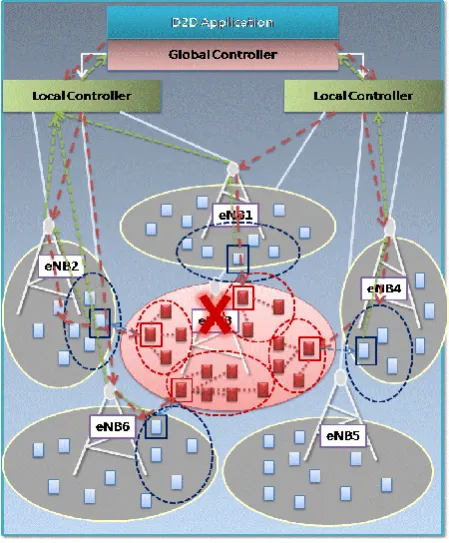
[image:3.595.52.266.414.572.2]Suppose that we have a system as illustrated in Fig 1. In this system, the global controller (GC) has an overall overview about the network activities, and provides programmable connectivity between core network entities at the northbound interface and user plane connectivity, with QoS needed at the southbound interface. GC applies the specified policy. The local controller (LC) drives many eNBs, and combines radio access network functionalities; thus, the access network is not restricted to LTE-A network. Therefore, the transmissions to achieve certain security objectives can be applied, such as Wi MAX, Wi Fi, and W-CDMA. In addition, LC provides a hierarchical architecture of eNBs which simplifies transitions between frequency bands and resource allocations. Suppose that one of the eNBs has dropped for some reason; the GC decides to use relays at the edge of the affected area to make secure connections between LC and OoC UEs, and use MIKEY-SAKKE protocol (Groves, 2012) to share the secret keys and sign it. The key materials that allow MIKKE-SAKKE protocol () are previously provided to the UEs in the affected area by the key management server (KMS) (Groves, 2012; Groves, 2015), which is a trusted party to all stations reside within the domain. Where IDi is a short, unambiguous identifier assigned to each user. Ki is the received secret key provisioned by KMS to share a secure message of a certain length with other parties using a SAKKE algorithm (Groves, 2012). (SSKi, PVTi) pair is used to sign the secure message by the signer and validate the signed message by the verifier using Elliptic Curve-Based Certificateless Signatures for Identity-Based Encryption algorithm (ECCSI). Where SSKi is the secret part of the algorithm and PVTi is the public part (3GPP, 2016).
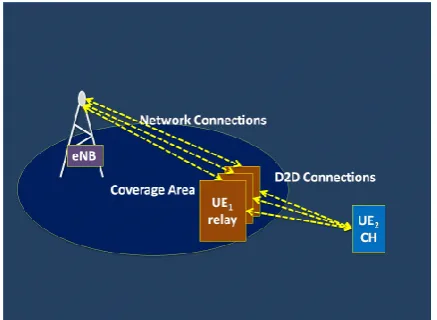
Fig 2. D2D Communications: UE-to-network relay
[image:3.595.50.269.600.760.2]On the other hand, the LC is assumed to participate within KMS domain with key materials (IDeNB, KeNB, SSKeNB, PVTeNB). The secure connection between LC and OoC UE is established over a relay using D2D communication between the relay and cluster head (CH). To reduce collisions due to announces in the affected area, OoC UEs elect CHs and join to it. CHs plan the resources temporarily between the stations, and the CH is the only part that announces its presence inside the affected area as illustrated in Fig 2. UE1 is called UE-to-Network relay as the name suggested by (3GPP, 2016).
Cluster Head election and out of coverage group formation
When a node that is out of coverage needs to announce itself, it will be vulnerable to collisions with other nodes due to collisions. On the other hand, if a node is using previously dedicated band, it will not guarantee that someone on the same band listens to it. To overcome this problem and reduce the bands dedicated to such announcements, we need to control the percentage of stations that are announcing themselves and serving the other parties in the affected area by electing CHs. If a CH does not serve the other stations; the stations may elect another CH. In our proposed framework, the LEACH protocol (Mahapatra, 2015), which is used in Wireless Sensor Networks (WSN), is used to elect CHs.
Choosing CHs is done by using the following steps:
Each node chooses a random number between 0 and
1.
The node is chosen as CH if the chosen number is
less than the threshold:
(4)
Where:
p is the desired percentage of CHs.
r is the current round.
G The set of the nodes that have not been CH for the last round.
By this formula, we can control the desired percentage of CHs. The other nodes join the nearest CH and regulate the resources inside the affected area temporarily, by using the LEACH protocol access method. If one of the CHs does not serve the stations in its area, they can do another round to choose another CH.
Relays
In the following discussion, we want to rejoin the CH securely to the mobile network over relay. The bottleneck in the process is the relay, since it has no motivations to participate in the process due to frequency resource sharing, hardware storage, and computation loads. Moreover, it may act malicious behaviors such as:
It may ignore the CH transmissions.
It may impersonate other stations like eNB, if it has enough information.
It may pretend that it cannot access the CH, and make it out of reach permanently.
It may pretend that CH has performed wrong transmissions, so the network will apply a certain policy toward CH.
Besides that, the relay that helps CH may impose radio resource and hardware sharing, which has negative effects on the relay performance. Three steps can be taken to help relays:
To avoid the frequency sharing, eliminate the performance degradation of the relay, and allow it to use its own band. The dropped eNB radio resources may be reused again, or dedicated D2D radio resources are allocated to establish a D2D radio bearer between LC and relay. By this way, the D2D radio bearer is used to provide OoC UE connectivity over relay.
The required computation processes and data storage volume of D2D communications must be reduced as possible as we can.
Distribution of the dedicated D2D communication load to the minimum limits is achieved by invoking more than one relay that is located nearby CH as illustrated in Fig 3 (this involves another task as we will see later).
By using these steps, we can make D2D communications between the relay and the CH as transparent as possible from the relay viewpoint. Choosing possible relays can be done by using evolved serving mobile location center (E-SMLC) that is located in the core network. The CHs search process by relays is not effective, since it involves many transmissions, which may cause redundant transmissions. At the same time, the CH announcement may be vulnerable to ignorance by relays. We will call the relay as UE1, and CH as UE2 for simplicity, and we will differentiate between them as needed. LC can be replaced by eNB to make sense that the radio connection is between eNB and UEs. At the beginning, we suppose some principles that allow secure connection between eNB and UE2 to achieve some security objectives:
UE1 must not ignore UE2 messages; the massages
must not be modified or forged by UE1.
UE1 cannot pretend UE2 error transmissions without
evidence.
Since UE2 is isolated from the outside world, so any
connection with it must be certified by KMS to ensure source authenticity.
When UE1 malicious behavior passes beyond a
certain level, the network has the right to apply a certain policy to prevent such behaviors.
If some of relays admit that the transmission by the CH is false, but at least one of the relays admits that the transmission is true with evidence, then the decision is that all the relays that admit false transmission will get false transmission in their records in the statistical table, and the relays with true transmission will get true transmission.
If the network detects that one of the relays has forged
the message by CH, then it will get a false transmission in its record.
If all relays admit false transmission by CH, then the
CH is a malicious station.
If the relays admit that no reply from a CH, then the
[image:5.595.127.495.143.418.2]CH is considered inaccessible.
Fig 4. Transmission between eNB and Relay to establish Secure D2D Radio Bearer
[image:5.595.97.520.453.769.2] If the wrong transmission rate of relays passes beyond a certain level, the network will apply a certain policy toward it.
Table 1 is a convenient tool as it can be used to evaluate the performance of each node, which is the authentication degree of each relay. Another benefit is to distribute the load equally between relays. More complicated decisions with invoking the game theory could be used to increase the performance of the relays, especially for nodes with low authentication degree levels; and make the relay exploits its best effort to find the CH or any UE inside the injured area.
D2D radio bearer between eNB and UE1
In this section, we demonstrate how to establish a secure D2D radio bearer between eNB and UE1 (relay), which is
different from Radio Resource Control (RRC) bearer. Non-Access-Stratum (NAS) protocol (3GPP, 2009) is still used in here, since we need the same objectives to achieve D2D radio, and the key lengths are the same.
Mutual authentication is achieved previously when UE has attached the network. In D2D radio bearer establishment, we need to deliver the secret key KD2D in a secure manner.
Hence, send the token message to UE1, and confirm that
KD2D and the token are delivered correctly. The procedure is
illustrated by Fig 4, and explained in the following:
Find the secret key between eNB and UE1 which
called KD2D.
A token message must be delivered correctly to the relay.
UE1 encrypts the token message with KD2D and
returns the result to the eNB.
The eNB verifies that the message and the key are delivered correctly.
Mutual authentication is not needed, since it is previously preserved. The establishment is done by using RRC radio bearer.
Searching Stage
As UE1 receives the token message, it will begin to search
the UE2 announcement. The UE2 is prevented from
announcing its ID directly, but it uses another format such
as hashing its ID; PID2 = hash (ID2). When UE1 captures
the announcement message that contains PID2, it will
redirect the message to the eNB, which enquiries KMS to
get more information about CH of UE2. If this step is not
completed properly, the eNB will inform relays to drop any
announcement that contains PID2. But, if it is completed
properly, then the statistical table is updated with true
transmissions for relays that found PID2; as illustrated in
Fig 5.
Joining Cluster Head to mobile network
The CH is vulnerable to many kinds of threats, since it does not have any way to identify the stations that are trying to connect with it. Furthermore, it does not guarantee that these stations are ready to provide the requirements. The CH needs to communicate securely with trusted stations that are authorized by the mobile network as relays; and communicate securely with the nearest eNB over relays.
To join the CH securely, we need:
Secure connections with relays.
A secure connection with the nearest eNB over
relays.
Joining OoC UEs to mobile network
After the CH joins the mobile network over relays; we need to rejoin the other stations inside the affected area. Since the CH has the same token message, the same imposition
and the same procedure are applied by the network. UE1 is
the station that possesses the token message. We want to
deliver the token message to UE2.
When a station is rejoined the mobile network, it will participate in the joining process to distribute the processing load. The joining message to an OoC UE, which is originated from the eNB, can be delivered either by the CH or another recently joined station.
The Proposed Protocol
In some cases like the state illustrated in the previous section; we can see that the potential threats impose more security objectives such as, entity authentication, free-riding attack prevention, and receiver non-repudiation, to deal with such threats. We introduce the concept of certificate,
which allows the CH of UE2 to validate that the eNB or the
relay of UE1 is authorized by the KMS (the trusted party to
all stations within a domain) to perform this connection. On the other hand, the eNB, by getting sub-authority from the KMS to perform entity authentication, can identify the CH. Another security requirement at this stage is to get the
confirm messages from UE1 with evidences, when a correct
message is sent by a CH. An additional security requirement, the eNB needs to prevent the attack, when the CH sends a true confirm message to a relay and a wrong evidence message to the eNB. This may be considered as a malicious behavior by the relay, while the CH is the malicious station.
The eNB is responsible to prevent malicious behaviors of relays, by providing them with a certificate from the KMS, and to apply network policy when a malicious behavior is detected. If we achieve this task, then we get a secure connection between the eNB and the CH over a set of unsafe stations from the CH viewpoint. Finally, the privacy requires that IDs must be preserved, so, the announcements must not involve sending IDs in clear. Two different functions of a real ID are used; one for transmission and the other for computational processes. Where, a random number from the KMS is sent each time D2D communications is needed. The traffic analysis is one of the privacy issues that can be mitigated by eliminating the reliance on one relay and making the traffic between relays and OoC UEs as transparent as possible. Before we start our proposed protocol, there are some modifications in MIKEY-SAKKE protocol to conceal the real IDs of the participating stations, these modifications as follows:
SAKKE algorithm:
Receiver
Compute Note that by bilinearity, w: =
;
[image:7.595.137.470.51.300.2]Fig 6. The message token exchanged between UE1 and UE2
Fig 7. The message M exchanged between eNB and UE2
Relay Relay 1 Relay 2 …. Relay n
Public Keys PID1, PVT1 PID2, PVT2 PIDn, PVTn
KMS
KMS1, KPAK1, Z1 KMS2, KPAK2, Z2 KMSn, KPAKn, Zn True Transmissions (T)
Fault Transmissions (F) Totla Transmissions (N = T + F) Percentage F / N
If does not equal R, then B MUST NOT use the SSV to derive key material;
Output SSV for use to derive a key material for the application to be keyed.
ECCSI algorithm
Signer
Verify that otherwise go to step 2.
.
.
Verifier:
Thus, the real IDs of the sender and receiver is concealed from each other. Suppose that, the eNB wants to send a shared secret key (M) to the CH, to secure the messages between the eNB and the CH (the key is derived as in NAS
protocol). MIKEY-SAKKE algorithm (Groves, 2012) is
invoked to share the secret message and sign it. The message of the form: mikey-sakke(eNB, M) means that the eNB sends a message M to the CH with a secure message:
(Xi, 2014); and a signature:
(Groves, 2012).
[image:8.595.199.394.74.137.2]Sending a message from the eNB to the CH of UE2 means
Table 2. The messages used in Section 5.
eNB
Query message eNB KMS Response message KMS eNB
[image:8.595.187.404.159.351.2]Confirm message
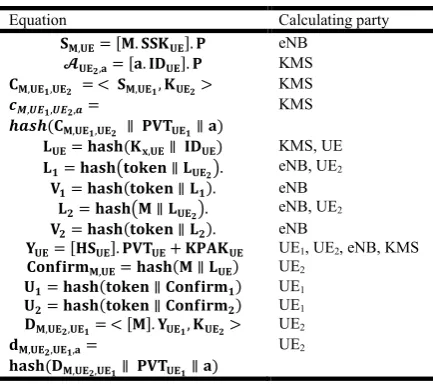
Table 3. The equations used in Section 5.
Equation Calculating party
, = [ . ]. eNB
, = [ . ]. KMS
, , = < , , > KMS
, , , =
( , , ∥ ∥ )
KMS
= ( , ∥ ) KMS, UE
= ∥ . eNB, UE2
= ( ∥ ). eNB
= ∥ . eNB, UE2
= ( ∥ ). eNB
= [ ]. + UE1, UE2, eNB, KMS
, = ( ∥ ) UE2
= ( ∥ ) UE1
= ( ∥ ) UE1
, , = < [ ]. , > UE2
, , , =
( , , ∥ ∥ )
UE2
Table 4. The bit lengths of different parameters
Key Exchange Method MIKEY-SAKKE
HashToIntegerRange As illustrated in RFC6508[6] 128 bits Hashfn(str, ‘SHA-256’) SHA-256 As in [15] 256 bits
∶
128 bits
= ( , ) (1538 bits, 1537 bits)
258 bits
= + . (1536 bits, 1538 bits)
Table 5. Message lengths between different parties
that the KMS authorizes the eNB to send the message M,
and UE2 can validate that, so the message is considered
secure. As a result, it is connected securely with mobile
network via the relay of UE1. We notice that the procedure
involves exchanging two secret messages with UE2.
The first one for exchanging a token message, which
confirms that UE2 is accessible and the eNB guarantees that
relays work properly. The importance of exchanging the token message is that when the relay is moving away from the affected area, while another station is moving close to this area, the eNB immediately establishes D2D bearer with the new station, by exchanging token message with it, and
sending a message to UE2. This will make the access to UE2
as transparent as possible. Even if the token message is vulnerable to disclosure, this is worthless without authorization from the eNB and the KMS. The second
message is exchanging the message between the eNB
and UE2. This message involves the basic key materials to
extract further keys just like NAS protocol; it is designed to be of the same length (128 bits). The proposed protocol has the following steps:
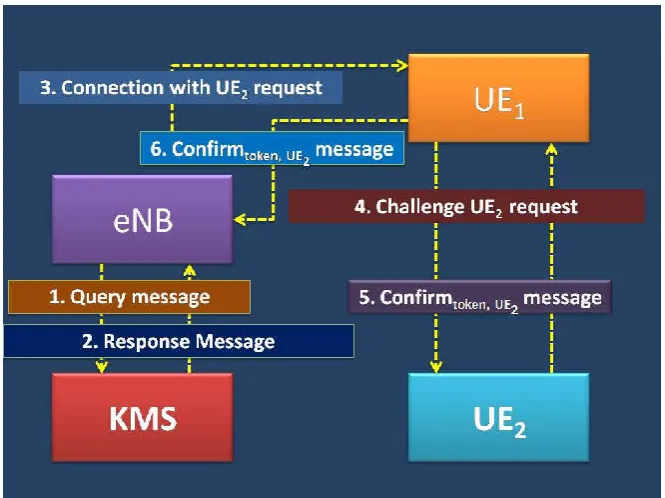
eNB sends a query message to the KMS to authorize its secure message (M) sent by eNB and (token) message sent by relay as illustrated in Fig 6; therefore
it needs to send ; the table of equations used is illustrated in TABLE 3.
KMS receives the query, chooses randomly; and
calculates the certificates
and . The random number is used in combination with real ID; therefore the real ID is concealed during calculations, whereas PID is used to announce the presence of the station. KMS returns the
certificates along with back to eNB as a response
to the query message. Note that is used as an entity authentication material that is only calculated by
KMS and ; thus represents a sub-authorization for eNB by KMS to ensure the entity authentication of
eNB calculates derived from ; and
sends message to ;
this message includes which is used as a hint for the relay to verify the correctness of the Confirm message sent by ; Note that contain a part known by which is message and the other parts are obtained from the Confirm message sent by ; by this way can verify the correctness of the Confirm message without falling as a victim to the malicious behavior of ; on the other hand, when the relay reveals the values of this is considered as an evidence to the eNB that the relay is really connected with . The message forms are illustrated in TABLE 2.
sends ; that contains and certified by KMS; the importance of this step is to achieve the benefits of
MIKEY-SAKKE protocol illustrated in the previous section, another benefit is by exchanging message with with completion of the whole procedure, the same network policy is applied on since it is considered securely connected.
extracts the secure message; verifies its correctness, validates the signature and the certificate,
and then calculates message then sends it back to . Note that calculated
message must
be exactly the same as message to continue the procedure.
verifies the correctness of and sends it back to eNB. This is considered as evidence that is accessible if this message is correctly
received by eNB. Fig.6 shows the procedure to
exchange message between and .
delivers to ,
the same steps 5, 6 followed to extract the secure message , verify its correctness, validate the
signature and rhe certificate, and send
The secured shared message is further used to derive further key materials to secure message exchanged between eNB and . The procedure is illustrated in Fig 7.
RESULTS ANALYSIS
To make the protocol compatible with the NAS protocol used in LTE-A network; in such case, the shared secure message length in the simulation is 128 bits, to make the security level compatible with AES-128 as demonstrated in (18). The lengths of different parameters are illustrated in TABLE 4; while TABLE 5 illustrates the lengths of the different messages used. The elliptic curve used is supersingular which has the formula given by:
(5)
The elliptic curve is defined over finite field where
. The extension field with such that . In such case, the pairing calculation represented by two dimensional vector space, although the bit length in each dimension is slightly bigger, but the gain is more simplification in operations execution.
To achieve the desired security level compatible secure shared key of length 128 bits, we choose the cyclic subgroup order of the point P greater than 256 bits (Groves, 2012) (258 bits in our case). By this way, we have taken all security requirements to achieve the security level compatible with AES-128.
Security Analysis
Table 1. Key Materials of Relay station
Station Relay
PID E / 0 LK ]o
?W : 8'
K 19753071594220456633238536851806811510229606273876106371640622276633728183783970935052665591076770751361451126659
53352338138062900034171112142717134374968155016931281887292900381441901878562563804126518093072476113648709856184 32776812083771630808659096851032565982428028748767333143543647649064661159733532649217500993257976086464822465436 79942617136807230362587464203282399438602747048806651477117322090743187741556139158064740265582068669981966294806 42224956930
69963739161686921245409071206733169248660739262739498752590352423093897214571418182525348743224376191181509747336 87209107085202306514413234908192159134006598246723086537838698033397477826161996839081954197688250544225505776727 90837615725698605912623467534054851521691867817639891956056805514635365988963175560636445478289883846332661657755 13847786931729005422660451506420697024669600783724084772576305915547303341292540783114602648159012754922777999255 56928161295
PVT 69243132936426841498145189297678961079779929269980267309601824021644482298123855777349046369548497475754746198023
88822494073840556796275473307321916650832238808993126846461372622842506509854270466186225409080716343232287659411 54278989251364548131570716875174449207253743522410563846264555323448855166100423106881937512362416052977065678379 43203178187111338094394248790334188555829388478730114304784991032776636890594041313815348568553555664639311133205 96662635488
57963269217112434191959430134098238547936716789021704326379645926021198286979143965016148332476393269599881837230 36416041211816468041522512396182604211304551850364294931011625385330821263238252813472152830847263896513837327695 19240272876482953000073104547173566050171465188095218980657640798654948164163603322901228182087966959947988063240 73672732821741479094580955389795694708773862714963875700464752040203549456320183197248630900462797967284343594039 01570657852
SSK 305791494886113919890358627111723765339671862581438185646179391981810994538022
Table 2. Key Materials of eNB
Station eNB
PID ~I 4. %I& q Y
K 219661106972165451964768744762701079610419140045874567653385133974272846540308836421594100534906271199411996354194371
343411543866239911006926704915263102596387643018663144739532013073097772006870298974869830852685407782803243068687969 054011039628662999930890444390485931389917672422370920722896438664311944409771449252254024845286556398074174191177508 9682567884265301148287769028202515363716631502809796543362919087627269257467764040614451756543899055276999279730 809894071482231212804132052514389122310025461446557709023924661089853295213250066690077378328825460231604763082360231 069524667663053955292609805961494112196339114757917131930756244936483926739752267466140558775551646429158703193734315 027570996293394426053059279129212452315054851659620795356672364745244319325037749581326878124742589260060846976396525 550604390429726280886132877062697889970220727879890423753910810342041618626468764895266064019143555900815406530
PVT 794270488531062954841663108372753168668884290001399584393055427209588530284092974105393302548049410927672072115358396
081420949145556115377386964267199260404945009042942835712460081860259121127170742456780183985658017008879555752057844 376640926914233643549683165605052931123979651010871161500611747531659360994245500383206727079635303278512896311081757 4537605552596588342198543987719698298178081737577919801042725994832613006260969850605994242081791062497581737853 171161889345353170380432439488696896962513791983583535758894018412138839649206223338700599216881600187234353113850608 766370818125127741719245013755730529790326270761437091579947042418866819896633786831031343975412064666036949083045505 294986718112379651052311121682322238219641928581075542953960613717242507046333271059446953564112270337909840522208159 0851548216358846467463231087343202775727713725444222540342305804884811476126916841597947068432674590456926721379
[image:10.595.43.546.564.771.2]SSK 346548429201617318090981036606695943103613190864225110438580876673558419278344
Table 3. Key Materials of CH
Station Cluster Head
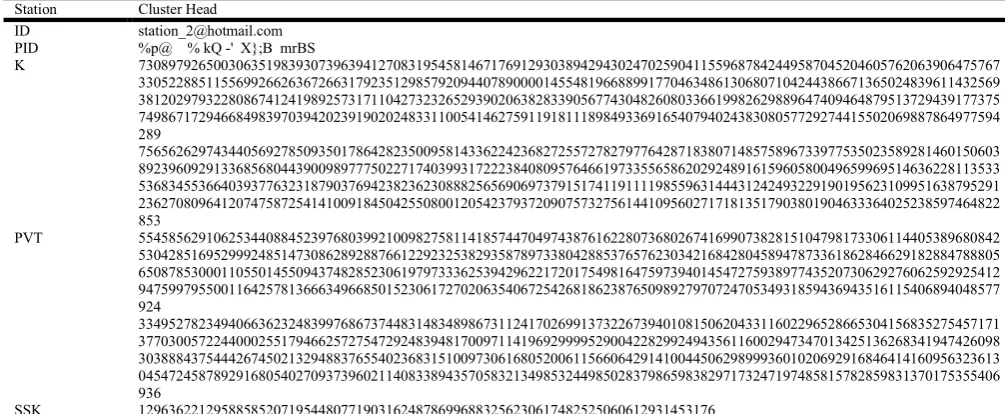
PID %p@ % kQ -' X};B mrBS
K 7308979265003063519839307396394127083195458146717691293038942943024702590411559687842449587045204605762063906475767
3305228851155699266263672663179235129857920944078900001455481966889917704634861306807104244386671365024839611432569 3812029793228086741241989257317110427323265293902063828339056774304826080336619982629889647409464879513729439177375 7498671729466849839703942023919020248331100541462759119181118984933691654079402438308057729274415502069887864977594 289
7565626297434405692785093501786428235009581433622423682725572782797764287183807148575896733977535023589281460150603 8923960929133685680443900989777502271740399317222384080957646619733556586202924891615960580049659969514636228113533 5368345536640393776323187903769423823623088825656906973791517411911119855963144431242493229190195623109951638795291 2362708096412074758725414100918450425508001205423793720907573275614410956027171813517903801904633364025238597464822 853
PVT 5545856291062534408845239768039921009827581141857447049743876162280736802674169907382815104798173306114405389680842
5304285169529992485147308628928876612292325382935878973380428853765762303421684280458947873361862846629182884788805 6508785300011055014550943748285230619797333625394296221720175498164759739401454727593897743520730629276062592925412 9475997955001164257813666349668501523061727020635406725426818623876509892797072470534931859436943516115406894048577 924
3349527823494066362324839976867374483148348986731124170269913732267394010815062043311602296528665304156835275457171 3770300572244000255179466257275472924839481700971141969299995290042282992494356116002947347013425136268341947426098 3038884375444267450213294883765540236831510097306168052006115660642914100445062989993601020692916846414160956323613 0454724587892916805402709373960211408338943570583213498532449850283798659838297173247197485815782859831370175355406 936
Table 4. Public and Private key of KMS
KMS Domain Public
2974501557329772378027364523251174782290894306909249843745009211583004146565158720682364449222352638803 1247205106162714181093016662651771409076375252758902259976583036324878114684224214284641217857577085882 3125944904926291015416734100944652247414856251120365686766708490605820393515939373387652176375346670486 6002545734419941074027655260989766417983066954132601227593790325536601180975712298662862547583928342253 888830203058005595766072528278220213749007106386397
6380311045481649875434638346469156432284226894758571878184077944610519334031810149568006247960761754194 0866822950645816853782800267365044805250993256814333909437756116220121072566224733261818836420059487716 8261572963423266101373154641084971439690837242823871198315594904082680385839083878762887408506239938965 6300430238120990972542189064423898027829602608412926439915717945629428348769817360907186597453814738336 897074949403651445653336934430367478597266596061853
1909590278297591554367659672198943389139229546763902003331490850090425491692647565775712597458268043713 0544679993045076131429645407062175676211982350561908497948963184025246234676879032532313482055203178351 6075336659137112984866614223181374830305496412115555127942903003855370750860313385456438698627437394473 6593055958575800555422548616895180224325578528560900164715033322700323815121758235823805949346065641315 039115811519808182315443377338153005036078928793751
2834778331215234038121274869227918232506197549534981221928506015485149381175152797295077379534309971161 3685010255813507009107444928126196279342614511465312301740383338431397890324401506180481505283411061911 2909753021802086224333190200492936533621468383497076270190762539488833929540739826490821739499231890507 0382923548265989318896250783611645534511904923760817131813351381802628105886534911242664068926857724839 614277128054180103648021637835044368842170210279957
Private
73789113580430203886455766621737131813230484162656720356702124276197
[image:11.595.58.536.359.660.2]249142422180907352900964535551047639915047461166942395005609737726425814020683
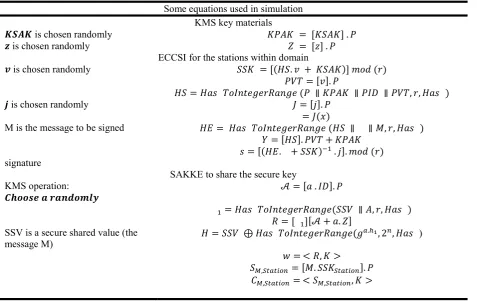
Table 5. Set of equations used in Simulation
Some equations used in simulation KMS key materials
is chosen randomly = [ ] .
is chosen randomly = [ ] .
ECCSI for the stations within domain
is chosen randomly = [( . + )] ( ) = [ ].
= ( ∥ ∥ ∥ , , )
is chosen randomly = [ ].
= ( )
M is the message to be signed = ( ∥ ∥ , , )
= [ ]. +
= [( . + ) . ]. ( )
signature
SAKKE to share the secure key KMS operation:
= [ . ].
= ( ∥ , , )
= [ ][ + . ]
SSV is a secure shared value (the message M)
= ⊕ ( . , 2 ,
)
= < , >
, = [ . ].
[image:11.595.116.467.707.788.2], = < , , >
Table 6. Security Sestem Parameters in Simulation
Security parameters used (Comparable with AES-128) Key Exchange Method MIKEY-SAKKE
HashToIntegerRange As illustrated in RFC6508[6] 128 bits Hashfn(str, ‘SHA-256’) SHA-256 As in [15] 256 bits
∶ 128 bits
= ( , ) (1538 bits, 1537 bits)
258 bits
Confidentiality
Integrity
Source authentication for achieving D2D communications and residing within the accepted KMS domain.
Entity authentication is achieved by using the certificate that allows the OoC UE to validate the relay and the eNB
by ensuring that the received messages ( ) are
[image:12.595.184.398.73.145.2]authorized by a KMS which is a trusted party within the domain. The confirmed message guarantees that the intended receiver has extracted the message correctly; therefore, the secure connection has been made by the authorized entity and mutual authentication achieved. Receiver non-repudiation: When the relay obtains a true Confirm message, it is considered an evidence that the OoC UE has received the message correctly.
Table 7. Messages lengths used in Simulation
Message lengths between different parties Connection with request 15762 bits Challenge request 11918 bits Query message ( From eNB to KMS) 6915 bits Response message (From KMS to eNB) 4864 bits Confirm messages ( to KMS) 512 bits Mikey-sakke(M, UE) 7944 bits
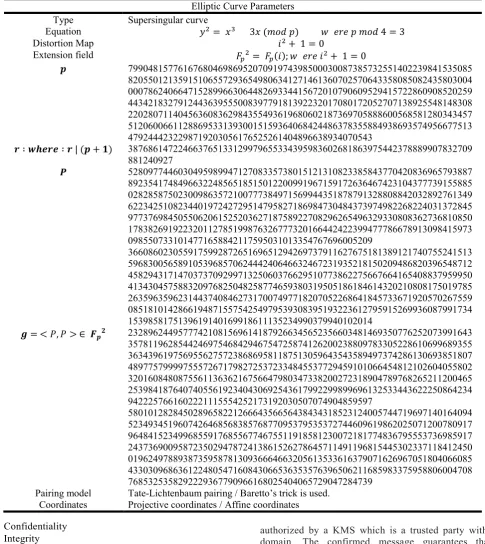
Table 8. Elliptic Curve Identity Card
Elliptic Curve Parameters Type Supersingular curve
Equation = 3 ( ) 4 = 3
Distortion Map + 1 = 0
Extension field = ( ); + 1 = 0
799048157761676804698695207091974398500030087385732551402239841535085 820550121359151065572936549806341271461360702570643358085082435803004 000786240664715289966306448269334415672010790609529415722860908520259 443421832791244363955500839779181392232017080172052707138925548148308 220280711404563608362984355493619680602187369705888600568581280343457 512060066112886953313930015159364068424486378355884938693574956677513 4792444232298719203056176525261404896638934070543
∶ ∶ | ( + ) 387686147224663765133129979655334395983602681863975442378889907832709 881240927
528097744603049598994712708335738015121310823385843770420836965793887 892354174849663224856518515012200991967159172636467423104377739155885 028285875023009863572100777384971569944351878791328808842032892761349 622342510823440197242729514795827186984730484373974982268224031372845 977376984505506206152520362718758922708296265496329330808362736810850 178382691922320112785199876326777320166442422399477786678913098415973 0985507331014771658842117595031013354767696005209
366086023055917599287265169651294269737911627675181389121740755241513 596830056589105396857062444240646632467231935218150209486820396548712 458294317147037370929971325060376629510773862275667664165408837959950 413430457588320976825048258774659380319505186184614320210808175019785 263596359623144374084627317007497718207052268641845733671920570267559 085181014286619487155754254979539308395193223612795915269936087991734 1539858175139619140169918611135234990379940102014
= < , > ∈ 232896244957774210815696141879266345652356603481469350776252073991643 357811962854424697546842946754725874126200238809783305228610699689355 363439619756955627572386869581187513059643543589497374286130693851807 489775799997555726717982725372334845537729459101066454812102604055802 320160848087556113636216756647980347338200272318904789768265211200465 253984187640740556192340430692543617992299899696132533443622250864234 9422257661602221115554252173192030507074904859597
580101282845028965822126664356656438434318523124005744719697140164094 523493451960742646856838576877095379535372744609619862025071200780917 964841523499685591768556774675511918581230072181774836795553736985917 243736900958723502947872413861526278645711491196815445302337118412450 019624978893873595878130936664663205613533616379071626967051804066085 433030968636122480547160843066536353576396506211685983375958806004708 7685325358292229367790966168025404065729047284739
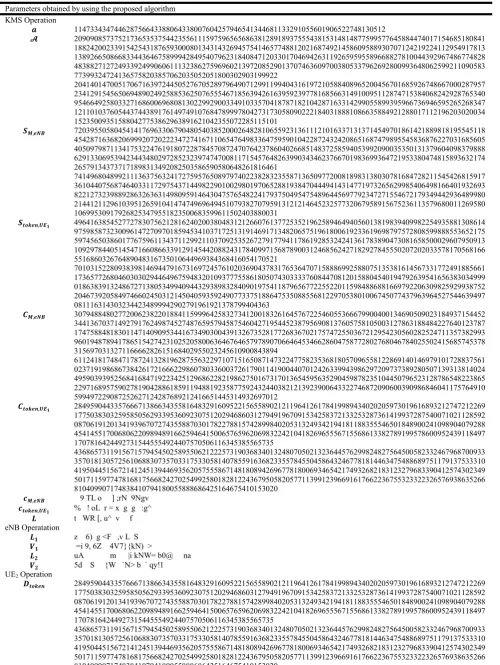
[image:12.595.46.532.184.729.2]Table 9. The results of Proposed Transmission by using the Simulation
Parameters obtained by using the proposed algorithm KMS Operation
114733434744628756643388064338007604257946541344681133291055601906522748130512
2090908573752173653537544235561115975965656863812891893755543815314814877599577645884474017154685180841 1882420023391542543187659300080134314326945754146577488120216874921458609588930707124219224112954917813 1389266508668334436467589994284954079623184084712033017046942631192659595589668827810044392967486774828 4838827127249339249906061113238627596960213972085290137074636097003805337962692800993648062599211090583 773993247241365758203857062035052051800302903199922
2041401470051706716397244505276705289796490712991199404316197210588408965200456701685926748667000287957 2341291545650694890249258853625076555467185639426163959239778168566314910095112874715384068242928765340 9546649258033271686006968081302299290033491033570418787182104287163314299055899395966736946595265268347 1211010376054437443891761497491076847899978042731730580902221840318881086635884921288017112196203020034 152350093515880427753862963891621042355072285115101
, 7203955058045414176963306790480540385200026482810655923136111210163371313714549701861421889818195545118 4542871636820699920720222347274167110654764983364759590104228724324208651687479895545836876227031685605 4050979871134175322476191807228784570872470764237860402668514837258594053992090035350131379604098379888 6291330695394234434802972852323974747008117154576482639903434623766701983699364721953380474815893632174 265791343737171898313492082503586590580648261816461
7414968048992111363756324172759576508979740223828323558713650977200818983138030781684728211545426815917 3610440756874640331172975437144982290100298019706528819384704449414314771973265629985406498166401932693 8221273239889286326363149809591464304757654822417937504954754896445697792347271554672179349442936489980 2144121129610395126591041474749696494510793827079591312121464523257732067958915675236113579680011269580 106995309179268253479551823500683599611502403880031
, 4964163854527727830756212816240200380483121266076137725352196258946494056013819839409982254935881308614 9759858732300961472709701859453410371725131914691713482065751961800619233619698797572808599888553652175 5974565038601776759611343711299211037092535267279177941178619285324241361783890473081658500029607950913 1092978440514547166086633912914544208824317840997156878900312468562427182927845550207202033578170568166 551686032676489048316735010644969384368416054170521
7010315228093839814694479167316972457610203690437831765364707158886992588075135381614567331772491885661 1736577268046030302944649675948320109377755861805074303333760844708120158804540194792639541656383034999 0186383913248672713805349940944329389832840901975411879656772255220115984886881669792206309825929938752 2046739205849746602450312145040593592490773375188647535088556812297053801006745077437963964527544639497 0811163143032344234899942902791961921378799404363
, 3079488480277200623822018841159996425832734120018326164576722546055366679900400134690509023184937154452 3441367037149279176249874527487659579458754604271954452387956908137605758105003127863188484227640123787 1747588481830114714090953441673490300439132673528177268367021757472550367212954230560282524711357382993 9601948789417865154274231025205800636467646579789070664645346628604758772802768046784025502415685745378 315697031327116666282615168402955023245610900843894
6112418174847178724132819628755632297107151650871473224775823536818057096558122869140146979101728837561 0237191986867384261721666229860780336003726179011419004407012426339943986297209737389280507139313814024 4959039395256841684719223425129686228219862750167317013654595635290459878235104450796523128786548223865 2297168957590278190428861859119488192358775924324403821213923900643322746872090600390986846041175764910 599497229087252627124287689212416651445314932697012
, 2849590443357666713866343558164832916095221565589021211964126178419989434020205973019616893212747212269 1775038303259585056293395360923075120294686031279491967091534258372133253287361419937287540071021128592 0870619120134193967072743558870301782278815742899840205313249342194181188355546501848900241098904079288 4541455170068062209894891662594641500657659620698322421041826965556715568613382789199578600952439118497 17078164244927315445554924407570506116345385565735
4368657311915671579454502589550621222573190368340132480705021323644576299824827564500582332467968700933 3570181305725610688307357033175330581407855916368233557845504586432467781814463475488689751179137533310 4195044515672141245139446935620575558671481808942696778180069346542174932682183123279683390412574302349 5017115977478168175668242702549925801828122436795058205771139912396691617662236755323322326576938635266 810409907174838410794180055888686425164675410153020
, 9 TL o ] ;rN 9Ngv , % ! oL r = x g g :g^
t WR [, u^ v f eNB Operatation
z 6) g <F ,v L S =i 9, 6Z 4V7}{kN) >
uA m |i kNW= b0@ na 5d S {W `N> b ` qy!1 UE2 Operation
2849590443357666713866343558164832916095221565589021211964126178419989434020205973019616893212747212269 1775038303259585056293395360923075120294686031279491967091534258372133253287361419937287540071021128592 0870619120134193967072743558870301782278815742899840205313249342194181188355546501848900241098904079288 4541455170068062209894891662594641500657659620698322421041826965556715568613382789199578600952439118497 17078164244927315445554924407570506116345385565735
4368657311915671579454502589550621222573190368340132480705021323644576299824827564500582332467968700933 3570181305725610688307357033175330581407855916368233557845504586432467781814463475488689751179137533310 4195044515672141245139446935620575558671481808942696778180069346542174932682183123279683390412574302349 5017115977478168175668242702549925801828122436795058205771139912396691617662236755323322326576938635266 810409907174838410794180055888686425164675410153020
The sent message by the relay or the received Confirm message cannot be forged or impersonated by the relay since it is subjected to the game theory applied by the network; hence, the risk of losing service should a malicious behavior pass beyond a certain level. On the other hand, a malicious behavior of the OoC UEs can be
avoided by sending the hint messages ( ) to the relays.
Avoidance of free riding attack: The steps that are taken by the network to mitigate the malicious behavior of relays along with the game theory, based on decision making, will prompt the relays to make the right decision by responding to the announcements issued by the OoC relays. Privacy: The real IDs of the stations participating in the procedure are concealed from each other.
The process of decoupling the real IDs used in calculations, from the transmitted IDs used in announcements, will
achieve several objectives: The network and the stations
deal with real entities and not impersonations. Any party trying to use the announcement ID without the ability to produce true Confirm messages will be considered a malicious behavior and will be captured by the network which applies the policy concerning malicious stations. Furthermore, traffic analysis is impossible since traffic to the receiver is delivered over multiple relays. The assumption that the relays do not collude with each other is important and reasonable since this is one of the game theory requirements. Should the two relays try to make s D2D connection, they need authorization from the network and the connection will be temporarily aborted by the network until the joining OoC UEs is completed.
Availability: By using mini-cloud of relays isolated from each other at the periphery of the affected area, the availability requirements can be achieved and the bands used by the affected eNB can be redistributed over these mini-clouds to achieve the required SLA. A potential performance degradation does exist due to the relays' degree of reliability. The transmissions between the relays and the OoC UEs are as transparent as possible due to the possibility of moving one of the relays away from the affected area. Should another in-coverage station move close to this area, the network can immediately send a token message and an authorization to this station to work as a relay. The availability and connectivity have been discussed
in (Zhang, 2015) and (Goratti, 2014); however, this study
needs further consideration and scrutiny to explore the issues related to the authentication degree of the relays, as inferred by the statistical table and from the viewpoint of traffic engineering in order to achieve the required SLA at extreme states.
Conclusion and Future Works
D2D radio bearer has been introduced to reduce radio sharing and performance degradation with relays, this bearer may be the downlink connection of dropped eNB, unlicensed bands, or any other expanded spectrum utilities available by the network, this process has the mean of re-identification of radio resources allocated for each OoC UEs, The QoS is guaranteed by the minimum SLA in abnormal circumstances dedicated by the network policy. This framework employs more than one relay to distribute the hardware load, storage capacity, and heavy processing.
, 9 TL o ] ;rN 9Ngv
, % ! oL r = x g g :g^
t WR [, u^ v f eNB Operatation
z 6) g <F ,v L S =i 9, 6Z 4V7}{kN) > uA m |i kNW= b0@ na
5d S {W `N> b ` qy!1 UE2 Operation
284959044335766671386634355816483291609522156558902121196412617841998943402020597301961689321274721 226917750383032595850562933953609230751202946860312794919670915342583721332532873614199372875400710 211285920870619120134193967072743558870301782278815742899840205313249342194181188355546501848900241 098904079288454145517006806220989489166259464150065765962069832242104182696555671556861338278919957
860095243911849717078164244927315445554924407570506116345385565735
436865731191567157945450258955062122257319036834013248070502132364457629982482756450058233246796870 093335701813057256106883073570331753305814078559163682335578455045864324677818144634754886897511791 375333104195044515672141245139446935620575558671481808942696778180069346542174932682183123279683390 412574302349501711597747816817566824270254992580182812243679505820577113991239669161766223675532332
2326576938635266810409907174838410794180055888686425164675410153020
307948848027720062382201884115999642583273412001832616457672254605536667990040013469050902318493715 445234413670371492791762498745274876595794587546042719544523879569081376057581050031278631884842276 401237871747588481830114714090953441673490300439132673528177268367021757472550367212954230560282524 711357382993960194878941786515427423102520580063646764657978907066464534662860475877280276804678402
5502415685745378315697031327116666282615168402955023245610900843894
611241817484717872413281962875563229710715165087147322477582353681805709655812286914014697910172883 756102371919868673842617216662298607803360037261790114190044070124263399439862972097373892805071393 138140244959039395256841684719223425129686228219862750167317013654595635290459878235104450796523128 786548223865229716895759027819042886185911948819235877592432440382121392390064332274687209060039098
6846041175764910599497229087252627124287689212416651445314932697012
, 9 TL o ] ;rN 9Ngv
, % ! oL r = x g g :g^
z 6) g <F ,v L S uA m |i kNW= b0@ na
UE1 Operation
=i 9, 6Z 4V7}{kN) > 5d S {W `N> b ` qy!1
Moreover, it conceals the relays’ IDs and does not depend on one party. The statistical table is introduced for tracing relays behaviors. The decision that is taken by the LC is important to improve relays reliability. The game theory can be used in relays to build the decision rules that are based on relays reliabilities. By using certificates with MIKEY-SAKKE protocol to help CH communicating with trusted stations, we can share keys securely, provide message origin authentication, message integrity, and source non-repudiation. Moreover, the framework provides entity authentication for OoC UEs, in addition to receiver non-repudiation. The sub-authority technique allows the KMS, which has a full authorization capability, to authorize the eNB or a trusted station to perform a number of security services such as entity authentication. Further steps can be taken to authorize the eNB to certificate its message without communicating with the KMS. The framework conceals the IDs of participating stations to maintain the stations privacy, since we do not have any idea about the attackers’ capabilities. Therefore, this will mitigate unpredictable malicious behaviors of some parties. As we have seen; the functions and parameters that are used for sending and computing are different, which means that the only entity that can send and compute the transmissions properly is the station that has the real identity. Through our work; we have introduced a realistic scenario that may 5G mobile network encounter. This scenario can be generalized with the same technique, and the same security objectives to be a framework for D2D communications, when user entities are out of coverage.
REFERENCES
Rysavy Research, 2015. “Beyond LTE: Enabling the Mobile Broadband Explosion”, 4G Americas, White Paper, Aug.
Li, Q. et al. 2014. “5G Network Capacity/ Key Elements and Technologies”, IEEE Vechular Technology Magazine, vol. 9, no. 1, Jan. pp. 71-78.
Wang, M. and Yan, Z. 2015. “Security in D2D Communications: A Review”, IEEE Trustcom/BigDataSE/ISPA, vol. 1, Aug. 2015, pp. 1199-1204.
3GPP, 2016. “Study on Security issues to support Proximity Services (ProSe)”, 3rd Generation Partnership Project (3GPP), TR. 33.833, Release 13, Feb, pp. 1-231. Groves, M. 2012. “MIKEY-SAKKE: Sakai-Kasahara Key
Encryption in Multimedia Internet KEYing (MIKEY),” RFC Editor, California, RFC 6509, Feb. pp. 1-21. Zhang, A. et al. 2015. “SeDS: Secure Data Sharing Strategy
for D2D Communication in LTE-Advanced Networks,” IEEE Transactions on Vehicular Technology, vol. 65, no. 4, Mar., pp. 2659-2672.
Shen, W. et al. 2014. “Secure Key Establishment for Device-to-Device Communications”, IEEE Global Communications Conference (GLOBECOM), Austin, TX, USA, Dec. 8-12, pp. 336-340.
Goratti, L. et al. 2014. “Connectivity and Security in a Device to Device Communication Protocol for Public Safety Applications”, Wireless Communications Systems (ISWCS), Barcelona, Spain, Aug. 26-29, , pp. 548-552.
Sun, J. et al. 2014. “SYNERGY; A Game-Theoretical Approach for Cooperative Key Generation in Wireless Networks”, IEEE INFOCOM- IEEE Conference on Computer Communications, Toronto, ON, Canada, Apr. 27-May. 2, , pp. 997-1005.
Xi, et al. 2014. “KEEP: Fast Secret Key Extraction Protocol for D2D Communication”, IEEE International Symposium of Quality of Service (IWQoS), Hong Kong, China, May. 26-27, pp. 350-259.
Panaousis, E. et al. 2014. “Secure Message Delivery Games for Device-to-Device Communications”, Springer International Publishing. 5th International Conference, GameSec, Los Angeles, CA, USA, US, Nov.6-7, 2014, Springer, Nov.6-7, 2014, pp. 997-1005.
Washington, L. C. 2008. Elliptic Curves Number Theory and Cryptography, 2nd ed, Boka Raton: Chapman & Hall/CRC.
Barreto, P.S.L.M. el at. 2002. “Efficient Algorithms for Pairing-Based Cryptosystems”, Springer Berlin Heidelberg. 22nd Annual International Cryptology Conference on Advances in Cryptology, Aug. 18-22, 2002, pp. 354-368.
Groves, M.2012. “Ellipltic Curve-Based Certificateless Signatures for Identity-Based Encryption (ECCSI),” RFC Editor, California, RFC 6507, Feb.pp. 1-17. Groves, M. 2012. “Sakai-Kasahara Key Encryption
(SAKKE),” RFC Editor, California, RFC 6508, Feb., pp. 1-21.
Mahapatra, R. P., Yaday, R.K. 2015. “Descendant of LEACH Based Routing Protocols in Wireless Sensor Networks”, Procedia Computer Science, vol. 57, Aug., pp. 195-215.
3GPP, 2009. “Non-Access-Stratum (NAS) protocol for Evolved Packet System (EPS),” 3rd Generation Partnership Project (3GPP), TS. 24.301, Release 8. Mar, pp. 1-250.
Barker, E. B., Dang, Q. H. 2015. “Application-Specific Key Management Guidance”, NIST SP, 800-57, Pt. 3, Rev. 1 , Jan.
Cohen, H., Frey, G., Avanzi, R. M. 2006. Handbook of Elliptic and Hyperelliptic Curve Cryptography, Boka Raton: Chapman & Hall/CRC.
Silverman, J. H. 2008. The Arithmetic of Elliptic Curves, 2nd ed, New York: Springer.
Joux, A. 2002.“The weil and Tate pairings as building blocks for public key cryptosystems”, Springer Berlin Heidelberg. International Symposium, ANTS-V Sydney, Australia, June. 7-12, pp. 20-32.