7491
DEVELOPMENT OF EDUCATIONAL MATERIALS USING
PREZI AS DIGITAL STORYTELLING TOOL
1HYERYEONG SHIM, 2SUNJOONG LEE
1Paichai University, Department of Korean Language & Literature, Korea
2Paichai University, Department of Teaching Korean as a foreign language, Graduate School, Korea
E-mail: 1[email protected], 2[email protected]
ABSTRACT
This study seeks new methods for developing educational materials using web-based multimedia tools in Korean language education. For this purpose, this study focuses on ‘Prezi’, a presentation tool which enables storytelling approaches. ‘Prezi’ is a cloud-based presentation tool, which features the interface that shifts pages using zoom-in effect. It breaks from the usual two-dimensional presentation to a more effective presentation with dynamic screen composition using space movement. Moreover, ‘Prezi’ enables a more comfortable visualization of digital storytelling. Digital storytelling allows nonlinear writing using the flexibility of the media, and anyone can become a director with the development of various multimedia technology. Moreover, the barrier between creators and audiences collapses and everyone can become participants of the contents due to the same digital media they share that allows networking. ‘Prezi’ presents the aforementioned advantages of digital storytelling and the advantages can be integrated in education by using ‘Prezi’ to develop educational materials. Even more, ‘Prezi’ can be utilized anywhere connected through the internet, and various people can access the educational materials by sharing URLs. This study will show the process and system of developing web/computer-based educational materials using ‘Prezi’ and will also present its actuality as e-learning material.
Keywords: Teaching Materials, Prezi, Online, Multimedia, Digital Storytelling, Korean Language Education
1. INTRODUCTION
1.1 The purpose and necessity of the research Improvement in science technology has resulted in developments not only in the realm of everyday life, but also in the various fields of society. The development in multimedia tools and computer technology had a big influence on the field of education, and it especially diversified educational media and opened up the era of diversification. As a result, educational materials which were limited to paper and clips, are now advancing into other various forms such as websites or mobile applications.
Based on these changes, this study looks into methods using multimedia tools for making educational materials, and especially focuses on ‘Prezi’, which is one of the recently developed presentation tool receiving the most attention, to suggest ways in approaching language education when making educational materials. Accordingly, this study will try to differentiate ‘Prezi’ with other media based on its functional features and verify the diverse possibilities and value of such functions as
educational media, and thereafter analyse how these specific functions can be related to techniques of general language teaching methods.
The research will state specific principles and methods that are required for educational and language education theories combining with ‘Prezi’ and being presented as educational materials and sum up by presenting the actuality of making educational materials utilizing ‘Prezi’.
1.2 Previous studies
There have been various discussions regarding using multimedia in developing and making Korean language education materials, and this research specifically looks into the studies done by Kwak Ji-young and Lee Hyun-joo, Cho Tae-rin.
7492 subjects and contents of the main textbooks were arranged, current utilization of multimedia resources was inquired and the necessary types and sizes of multimedia were set. In the development stage, the principles in educational and technological aspects were set and the actual materials were made to be tested and go through the stages of revision. The developed materials were divided into three categories of picture material, audio material and video material, and the role of the auxiliary textbook was to arouse intest in courses, enhance the motive of learning, effectively deliver the meanings of vocabulary or grammar and concept of certain cultural terms and thereby enhance the efficiency in teaching. This study also claimed that the role of multimedia as auxiliary material is very important in the field of Korean education and therefore researching and developing multimedia materials is extremely meaningful. Kwak’s discussion was highly relevant to this research, especially since the analyzing and dividing the process of developing multimedia materials had the thread of connection to its purpose and therefore it would be meaningful in the further discussions.[1]
In the study of Lee Hyun-joo and Cho Tae-rin, there were discussions regarding the types of multimedia materials in Korean education and the building methods. Especially the specified details regarding the required method of data collection for selecting multimedia materials as the preparation for making ‘Korean education digital resource archives’ of Nuri-Sejong Institute was meaningful to this research. The discussion not only presented the example of building multimedia material, but also presented ways of selecting the type of materials and setting the building methods as to enhance the significance of its usage.[7]
Researches on ‘Prezi’ are mostly done recently, featuring researches of Kim Ah-young, Ryu Sung-hyun, Jang Chan-Mi, Song Ga-young and We Sun-young. However, none of these researches are focusing on Korean education or language education, and mostly discusses on utilization and practicality in artistic subjects (art, music) or subjects related to calculations such as math or computer science to suggest directions in education. One of the implications of these researches to this study is that they suggest direction of the storytelling approach that is currently a key topic in the spot of general education. It is verified through the researches that the main functions of ‘Prezi’ are appropriate to the storytelling approach to the educational contents.
Moreover, the functional feature of Prezi, which allows complicated thinking processes to be done in one big frame, is highlighted in its application in calculation-related subjects such as math and computer science. Likewise, these features are considered to be also meaningful in language
education, especially vocabulary
education.[2][3][4][5][8]
2. THEORETICAL BACKGROUNDS 2.1 Sections and Subsections
‘Multi-media’ refers to an integrated collection of different media (Preece, 1993) or system of educational technology using graphic images, animation, sound and video through computers.[1] As we can see in this term, multimedia teaching tool is a complex bundle of various media connected together with relevance, and it is a reassembled form that can be processed and utilized instantly according to the educational goal. However, as it is stated through the definition, the form of the tool would be program or bit-based material since in has developed based on computer science.
7493 learning, since multimedia can arouse interest and motivation among learners and enhance their will to learn due to it being the interesting and effective comprehensive visual media.[1]
As indicated abover, the value of multimedia teaching tool in the language education field is immeasurable. There would be no room for disputes regarding the fact that multimedia teaching tools can be used as auxiliary materials to resolve the problems resulted by textbook-centered management of classrooms.
2.2 Prezi
‘Prezi’ is a tool that shows how individual ideas can be connected together in one space and be communicated to the audience.
The developer of ‘Prezi’ is the architect Adam Somlai-Fisher, and he actually prepared himself all the detailed pictures, microphotographs, little arrows and backgrounds for every presentation in order to show the interactive designing and dynamic groupings to effectively deliver his work to the audience. After several attempts, he started using the ZUI (Zoomable User Interface) for presentations since 2001 and eventually developed the current ‘Prezi’ after supplementing the difficulties in manufacturing.[6]
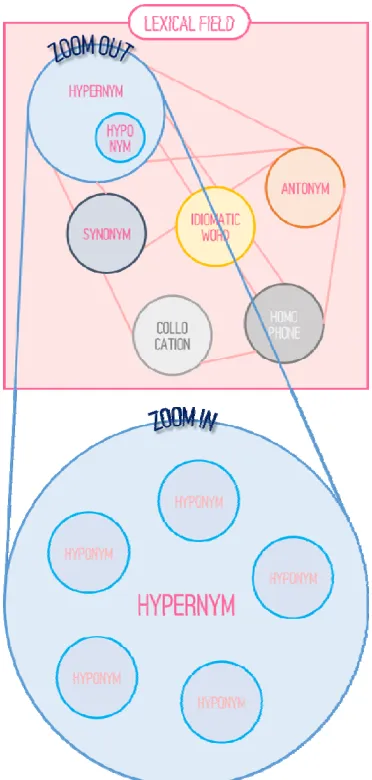
[image:3.612.313.515.91.452.2]As shown above, Prezi was invented for successful presentations, and delivers messages in a more multilateral aspect, from the general to specific elements, and again from the specifics to general visualization. So, ‘zooming-in’ and ‘zooming-out’ the information intended to be delivered is the typical function of ‘Prezi’.
Figure 1: ‘Process of zoom in/out of Prezi.
‘Prezi’ is related to the reorganization of ideas, making it the multimedia tool that has a ‘story-telling’ function. In other words, storytelling ability can be acquired through ‘Prezi’ and this function can be helpful to language learners in that they can contextually reorganize what they have learned. Also, ‘Prezi’ can be used as the tool that helps the learners themselves to use the language or improve understanding. Moreover, not only does language education through ‘Prezi’ enables a meaningful approach to the educational contents rather than a simple delivery of information, it is also useful in intriguing interest for learning through visual stimulation. This approach is possible due to the stereoscopic display of ‘Prezi’ and this dynamic screen composition easily leads to study with the learners’ attention and interest.
7494 receive help in overall arrangement, and get their motivations stimulated continuously.
2.3 Storytelling and Digital Storytelling
Storytelling is a combination of 'Story' and 'Telling', which means to convey meaningful stories for the purpose of changing the thoughts and behavior of the audience. Recently, the concept of digital storytelling has been introduced, which incorporates storytelling into digital technology. Joe Lambert, co-founder of UC Berkeley's Digital Storytelling Center, defines digital storytelling as "bringing old storytelling technology to new media and aligning it with valuable stories that are changing with the present life." [11]
Meanwhile, Tosi, U. presents the following three characteristics of digital storytelling. The first is flexibility, meaning that it enables nonlinear writing using the flexibility of the media, and allows readers to express roles of various characters. This means that on the Internet, you do not have to write or read in order and you can jump through the article with just a click. In addition, readers can express various roles. The second is universality, which means that the development of various multimedia technology makes it easy for anyone to make their own work, so anyone has the potential to become a producer or director. Third, interactivity, unlike movies, dramas, TV programs, and radio, digital storytelling is on a networkable digital medium such as the Web, so the boundaries between creators and audiences are eliminated and everyone becomes content participants. Finally, the digital storytelling plays a role of forming a community. Through digital storytelling, people who share common interests can exchange stories with each other and recreate stories and form a community.[11]
By incorporating such storytelling into education, quality of education can be improved in various areas. It is especially effective in implementing learner - centered education. As the learners are given the ability to manipulate the contents of education to improve their learning outcomes, the center of education moves naturally to the learner. Also, since the learner's own story becomes the content of education, they can easily be motivated and form positive attitude towards learning. The immersion into the contents of education becomes easier than any other contents of education. Therefore, the application of the storytelling technique is inevitable to bring out active learning among learners.
2.4 Lexical field theory and meaning association
When a word is stored in human memory, each word is organized and stored in a highly organic semantic network rather than being stored individually or in a disordered state. The organic semantic network at this state is called the lexical field. Therefore, during vocabulary education, it is important to present words that are semantically related.[9]
In vocabulary education, the lexical field is a valuable material in that it broadly gathers all the relevant vocabulary such as upper and lower words, synonyms, antonyms, plural words, homonyms, compound words, collocations, idioms and so on. Also, since the lexical field is formed based on the culture and history of the country, the education using the lexical field in the language education can also be combined with culture education. In vocabulary education, by utilizing the lexical field, the vocabulary within the same semantic field and situational vocabulary can be studied together, and it is also possible to effectively use the vocabulary to learn synonyms and antonyms. The following is a classification of the lexical field that can be used in Korean language education.[10]
Table 1: Lexical field classification in Korean language education
1) Basic semantic field
(1) Physical semantic field (2) Space-based semantic field (3) Time-based semantic field (4) Numeral semantic field
(1) Place-related semantic field
① Public place - ⒜ Post office ⒝ Bank
② Semipublic place - ⒜ School ⒝ Hospital (including diseases and sicknesses)
③ Private place - ⒜ Home (included in ‘Living’) (2) Beings, relations, and actions
① Beings - ⒜ Human ⒝ Animals and plants ② Relations (Relatives/appellation)
③ Activity - ⒜ Occupation ⒝ Majors ⒞ Hobbies ⒟
Physical activities ⒠ Travel
(Transportation/Destinations etc.) ⒡ Shopping (Expenditure/Shopping destinations etc.)
7495 Season/weather/climate ② Colors ③ Taste
3) Cultural Semantic field (1) Clothing
(2) Diet - ① Food ② Cooking (3) Living
(4) family events
(marriage/house-warming/parties(first birthday/birthdays/60th birthday)/hospital visits/condolences)
(5) National holidays (including traditional plays/spiritual culture) - ① Holidays ② Traditional
games ③ Spiritual culture (6) Countries
In this way, the vocabulary combined under the semantic field according to the lexical field theory naturally improves the efficiency of the vocabulary learning because they act as a mechanism for semantically associating each other. Association is connection of various concepts and indications in a certain concept and refers to deriving other related things through a single vocabulary. Semantic association means semantically related words being mutually evoked in human psychology.[9] Therefore, if the vocabulary is presented by using the semantic field, it definitely helps learners to improve the vocabulary skills by learning semantically related vocabularies at the same time. In this research, we propose an effective method for presenting lexical field and the implementation in vocabulary education.
3. MAKING KOREAN LANGUAGE EDUCATION MATERIALS USING PREZI 3.1 Educational application of Prezi
As stated in the theoretical backgrounds, the potential in educational utilization of Prezi is verified in that it was developed under the main goal of delivering contents, in other words, the messages. Especially since it facilitates the storytelling approach, the effectiveness is confirmed not only language education, but also education of narrative contents.
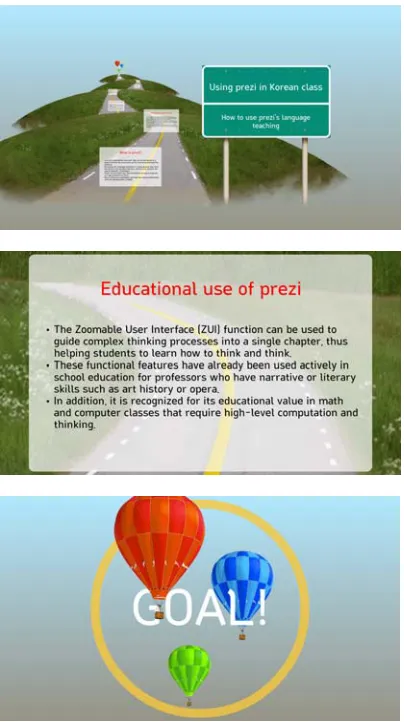
Moreover, the function of ZUI(Zoomable User Interface) allows free utilization of ‘zoom in’ and ‘zoom out’ functions and therefore help education of other subjects that require complicated thinking since it can convey the complex thinking process on one screen. In effective, due to this functional advantage, it is utilized in school education for art history and opera classes with narrativity and also
math and computer classes that require high-level calculation and reasoning.
Of course, there were conventional multimedia materials valued for educational utilization. A typical example would be the ‘Powerpoint’ of Microsoft, but it induced boredom among teachers and also lacked improvement in credibility for its educational effectiveness and efficiency due to the repetitive pattern, monotonous format and flat structure. Thus, the educational value of ‘Prezi’ is enhanced in that it tops the flatness of conventional multimedia materials and provides new stimulation to teaching and learning.
However, it is important not to ignore the fact that ‘Prezi’ is not all-powerful for conveying all the educational contents. In other words, if teaching content can be presented simply, or has too much information that it can not be included in a single stream of thinking, the educational approach using ‘Prezi’ shoulde be reserved.
3.2 Use of Prezi as a medium for Korean language education
Previous contents have verified many advantages of ‘Prezi’ as a pan-educational medium. Unlike other multimedia materials, ‘Prezi’ has the function of ‘zooming in’ and ‘zooming out’ that opens the educational possibility of its own. Through this ‘Prezi’ shows two directions in the perspective of language education. First is the ‘storytelling approach’ to contents of teaching and learning and second would be the ‘vocabulary education’ based on the lexical field theory. These approaches are possible due to the following reasons.
(1) ‘Storytelling approach’ to contents of teaching and learning
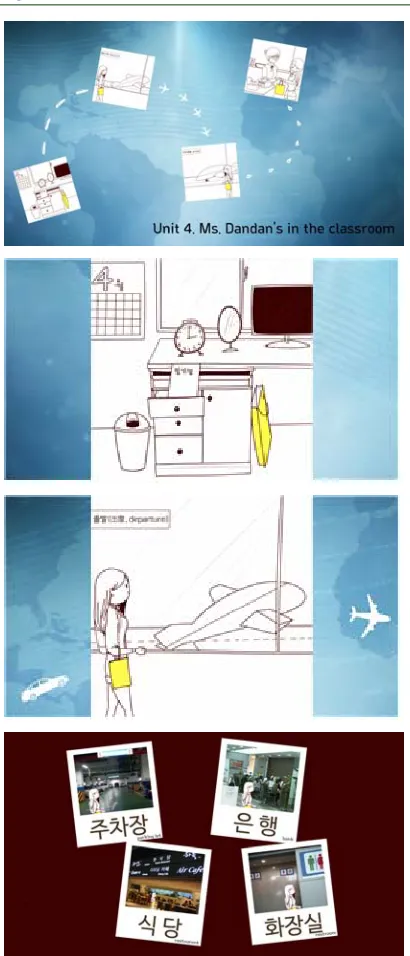
The ‘zoom in’ and ‘zoom out’ functions of ‘Prezi’ provide narrative in the educational contents and it is useful for the so-called ‘storytelling approach’ in that it enables checking the process of progress at one sight. It can be even more effective especially if the content itself contains narrativity. Since the ‘storytelling approach’ have been utilized mainly for contents with stong narrativity, it can be utilized effectively in the introduction or finishing stage of listening or reading practice in language education.
7496 practice, leading to a more practical conversation context in speaking curriculum and a diversified and phased approach for process-based instruction of writing.
Figure 2: ‘Storytelling approach’ to contents of teaching and learning
(2) ‘Vocabulary education’ based on lexical field theory
The ‘zoom in’ and ‘zoom out’ functions of ‘Prezi” can also be helpful in visualizing the relationship between certain subjects. For example,
hypernym can be placed in the front of the screen using the ‘zoom out’ function, and in the case of narrower terms, they can be enlarged using the ‘zoom in’ function and be placed within the screen boundary of their hypernym. As for synonyms and antonyms, they can be placed horizontally and the relationships can be explicitly expressed through colors and arrows.
Especially in the elementary levels of Korean language, structurizing the vocabulary contents using various illustrations and pictures can be even more effective. Due to the nature of elementary level within the educational curriculum, it can be easier to prevent excessive amount of words being arranged and to present vocabulary information at once with utilizing the previously studied words.
[image:6.612.325.511.305.695.2]7497 3.3 Actuality of using Prezi for educational
material production
Previously in 3.2, the methodological principles of language teaching that can be applied in Korean education have been stated with the practical examples of actual classes. And this section will present the actuality of using ‘Prezi’ for making educational materials based on the previous discussions of this article.
(1) The actuality of ‘storytelling approach’ to teaching and learning
[image:7.612.316.521.83.561.2]This article set the following hypothesis of class situation to present the actual implementation of the ‘storytelling approach’ in teaching and learning.
Table 2: Hypothesis of class situation for ‘storytelling approach’
Level Class contents
Level 1
Speaking class
Function: expressing place and location
Aims of the lesson
① Understanding and presenting expressions regaring place
② Understanding and presenting expressions regarding location Utilization of Prezi: Introduction and
finishing stage
In order to include all the expressions of place and location in the educational contents, ‘Ms. Dan Dan’s day’ is given as the subject and the situation of Ms. DanDan leaving his country and coming to Korea is set up. The educational material is made with scenes that fit the course of events and various objects of each scene are placed in diverse locations. The following <Fig.4> is the brief summary of the educational material made with this plot.
[image:7.612.93.304.351.505.2]http://prezi.com/if7os9xjjhu4/?utm_campaign=share&utm_medi um=copy&rc=ex0share
Figure 4: Example of ‘storytelling approach’ using ‘Prezi’
(2) The actuality of ‘vocabulary education’ based on lexical field theory
7498 Table 3: assumed situation of a class regarding
‘vocabulary education based on the lexical field theory’
Level Class contents
Level 2
Listening class
Function: Describing appearances Aim of the lesson
① Understanding someone’s
appearance after listening to a description
② Describing the information (looks, appearances) that he/she heard Utilizaition of Prezi: Step after listening
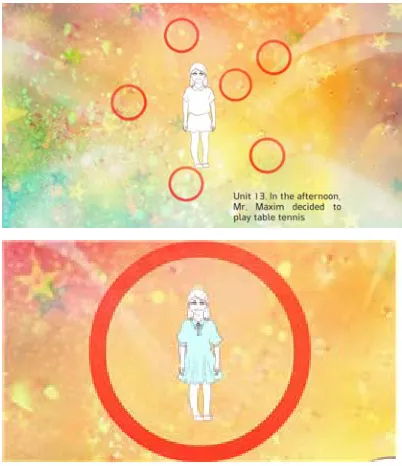
For the study of various new vocabulary for describing appearances and rearrangement with the previously acquired vocabulary, hypernym such as ‘type of clothes’, ‘color’, ‘hairstyle’, ‘vocabulary related to wearing’, ‘description’ are set and the existing narrower terms of each hypernyms are presented through the ‘zoom in’ function. The following <Fig.5> is summarizing the educational material made based on this structure.
[image:8.612.94.295.396.629.2]http://prezi.com/qksu3unqbtf-/?utm_campaign=share&utm_medium=copy&rc=ex0share
Figure 5: Example of ‘vocabulary education’ based on lexical field theory using ‘Prezi’
4. CONCLUSION
This study attempted to verify the educational value and usefulness of developing educational materials utilizing multimedia and devise principles and methods of making educational materials utilizing the newest medium based on the technological development in multimedia.
For this purpose, this study has presented the ways of producing educational materials using ‘Prezi’, which is stated as ‘storytelling-presentation’, and the following principles in teaching. Specifically, the methods and actualities of the ‘storytelling approach’ in teaching and learning based on the original storytelling features of the programs and ‘vocabulary education’ based on lexical field theory utilizing ‘zoom in’ and ‘zoom out’ function were presented.
7499 Acknowledgments: This work was supported by the research grant of Pai Chai University in 2018.
REFRENCES:
[1] Kwak, Ji Young, "A Case Study on the Development of Multimedia-assisted Materials: Focused on an auxiliary textbook for advanced Korean Learners with the general purpose",
Teaching Korean as a Foreign Language, Vol.
36, 2011, pp.37-67.
[2] Kim Ah Young, "Development of Teaching Materials Using Prezi for Music Class of Multicultural Music: With Turkish Folk Song in the 7th Grade Textbook", The Graduate School of Education Ewha Womans University, Master's thesis, 2012.
[3] Ryu Sung-Hyun, The Effects of the Learning to Use ZUI of Prezi on Learner's Interestsand Academic Achievement, The Graduate School of Education Daegu National University of Education, Master’s thesis, 2012.
[4] Song Ga Young, A Development of Teaching and Learning Material for Opera Appreciation Class Using ‘Prezi’, The Graduate School of Education Sangmyung University, Master’s thesis, 2014.
[5] Sunyoung We, (The) use of digital storytelling based on Prezi: Highschool art history with a focus on contextualism, The Graduate School of Education Kookmin University, Master's thesis, 2014.
[6] Dowon Lee, Junoh Oh and Jongseo Cha, STORYTELLING PRESENTATION Prezi, mentor, Seoul, 2013.
[7] Lee Hyun Ju and Cho Tae-Rin, "Types and Construction Method of Multimedia Materials for the Korean Language Education: For the Construction of Digital Library on Nuri-Sejonghakdang", Journal of Korean Language Education, Vol. 23, No. 1, 2012, pp.25-45. [8] Jang Chan Mi, Math Educaitonal Method Using
Prezi: For high school sequence units, The Graduate School of Education Seongkyunkwan University, Master’s thesis, 2013.
[9] Lee Sunjoong, "A Study on Teaching Sino-Korean Vocabulary using Etymological Approach", Korean Education, Vol. 112, 2017, pp.211-243.
[10] Moon, Keum-Hyun, "A Study fo Korean Vocabulary Education using Lexical field",
Field Studies in Korea Language Education,
Vol. 5, No. 2, 2011, pp.7-47.