STUDY OF THE EFFECTS OF EXCESSIVE CEMENT OR LIME IN MECHANICAL PROPERTIES AND
DURABILITY OF THE MORTAR COATING
*Santos, W.J., Carrasco, E.V.M., Mantilla, J.N.R., Piancastelli, E.M., Magalhães, A.G.,
Silva, F.J. and Rezende, M.A.P.
Federal University of Minas Gerais, School of Engineering
ARTICLE INFO ABSTRACT
The mortars produced currently have adhesion and mechanical resistance and physical properties often unsatisfactory to cater for projects with large loads and environmental conditions more severe. This work aims to study the mechanical properties and durability of coating mortars produced with excessive lime or cement. Tests were carried out air incorporated content; resistance to compression, flexion traction and pull off; elasticity modulus; water absorption; porosity, fissurability e digital microscope images. It was CP-II-E-32 cement, CH-I lime and quartz natural sand. The results showed that the addition of excessive binder maximizes some mechanical properties such as compression, tensile and elasticity modulus, yet reduces the adhesion and durability properties analyzed. It is concluded that it is necessary to get the proper content of cement and lime for mortar mixed with a focus primarily on adherence and durability indicators, being these more sensitive to variation properties of materials.
Copyright © 2019, Santos, et al. This is an open access article distributed under the Creative Commons Attribution License, which permits unrestricted use, distribution, and reproduction in any medium, provided the original work is properly cited.
INTRODUCTION
The mortars are extensively consumed in the world, as coating walls, ceilings and floors, or settlements in masonry and structural sealing Barbosa et al. (2013). It is noted that a significant portion has mechanical resistance and adhesion and chemical and physical properties often unsatisfactory to meet fully the projects with large loads and environmental conditions more severe (Ribeiro et al. 2003, Kadri and Duval 2002). According to Costa (2005) the mortar may present problems in production quality, being the main factors responsible: flaws in mix design, wrong choice of materials, and shortcomings in the mix at construction sites. Segat (2005) comments that there is also the presence of pathological manifestations in external coatings of mortar of buildings as: cracks spread (65.32%) (9.56%) mapped cracks, moisture stains (2.13%), vesicles (22.82%), retinal detachment (3.08%) and other types of cracks (1.57%). Most of the diseases, according to the quoted work, was from problems in the same proportion of materials (definition of cement content and/or lime) and mixture of materials on construction sites.
*Corresponding author: Santos, W.J.,
Federal University of Minas Gerais, School of Engineering
The choice of a trait is conditioned to the expected performance of grout over time, i.e. its durability. However, in practice it is observed the use of poorer traits than necessary, this compromises the quality of the coating (Carasek 2010). The performance of mortar is conditioned to the roughness, determined on the basis of mineralogical nature and particle size of aggregate (Meng et al. 2012, Sahmaran et al. 2009); final finish (Faria et al. 2015; mechanical resistance from the materials used (Hwang and Soo Ko 2008), the same proportion efficiently (Allwood et al. 2011) and amount of water in the mix (Larrard 2009). In this context, this paper aims to study coating mortars whereas an excess of lime or cement and evaluate some mechanical properties and durability indicators in order to identify their behavior and define possible advantages, disadvantages, indications and contraindications.
MATERIALS AND METHODS
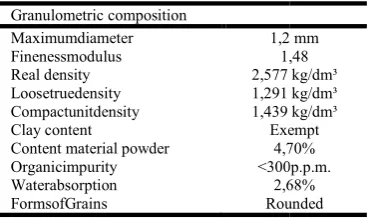
The experimental program of this work was to characterize the materials (Table 1) and perform necessary tests to evaluate the characteristics of mortar: incorporated air content (NBR 12278 2005), flexural strength, compressive strength (NBR 13279, 2005), elasticity modulus (NBR 15630, 2008), pull off (NBR13528, 2010, water absorption, Porosity (NBR 9778,
ISSN: 2230-9926
International Journal of Development Research
Vol. 09, Issue, 09, pp. 29923-29927, September, 2019
Article History: Received xxxxxx, 2019 Received in revised form xxxxxxxx, 2019
Accepted xxxxxxxxx, 2019 Published online xxxxx, 2019
Article History:
Received 16th June, 2019
Received in revised form 04th July, 2019
Accepted 20th August, 2019
Published online 30th September, 2019 Key Words:
Coating mortar, Excess cement, Excess Lime, Coating Durability.
RESEARCH ARTICLE
OPEN ACCESS
Citation: Santos, W.J., Carrasco, E.V.M., Mantilla, J.N.R., Piancastelli, E.M., Magalhães, A.G., Silva, F.J. and Rezende, M.A.P. 2019. “Study of the
2009), capillary water absorption (NBR 15259,
digital microscope images. The mortars were dosed in order to obtain a conventional mixture (Mixture 3) use in works of facades, a mixture rich in concrete (Mixture 1) and rich mixture in lime (Mixture 2), according to Table 2.
[image:2.595.70.256.170.279.2]used CP II-E-32; lime was CH I and fine aggregate in less useable area – quartz natural sand (Table 1).
Table 1. Physical characteristics of fine aggregates
Granulometric composition
Maximumdiameter 1,2 mm
Finenessmodulus 1,48
Real density 2,577 kg/dm³
Loosetruedensity 1,291 kg/dm³ Compactunitdensity 1,439 kg/dm³
Clay content Exempt
Content material powder 4,70% Organicimpurity <300p.p.m.
Waterabsorption 2,68%
[image:2.595.58.265.315.358.2]FormsofGrains Rounded
Table 2. Characteristics of samples tested
Mixture Ciment Lime Sand
1 1.000 0.125 0.125
2 1.000 8.000 1.000
3 1.000 1.000 8.000
Highlights that the water content was adjusted for consistency of 260 ± 10 mm in flow table. Analysis of results by means of statistical test of normality, ANOVA and t
results expressed as mean ± standard error (Se) to 28 days old.
RESULTS ND DISCUSSION
fc results (Table 3) identified that the strokes are different from each other (t-test), and the influence of the presence of lime can be observed in dash more rich in this binder (Mixture 2) which realizes the last resistance already at 14 days, without significant variations. It is noticed that the excess lime generated many pores and weakened the the composite structure (equal to 41.6% of fc Mixture 3) and isolated distribution of these pores allow the carbonation of lime (Carasek 2010).
Mixture fc (MPa) Mean Mixture 1 56.29 Mixture 2 3.41 Mixture 3 8.19
(a)
Figure 1. (a) Cracking hydraulic retraction, (b) Peeling the coating
29924 Santos, W.J., Carrasco et al. Study of the effects of excessive cement or lime in mechanical properties
2009), capillary water absorption (NBR 15259, 2005) and digital microscope images. The mortars were dosed in order to obtain a conventional mixture (Mixture 3) use in works of facades, a mixture rich in concrete (Mixture 1) and rich mixture in lime (Mixture 2), according to Table 2. Cement was 32; lime was CH I and fine aggregate in less
Table 1. Physical characteristics of fine aggregates
1,2 mm 1,48 2,577 kg/dm³ 1,291 kg/dm³ 1,439 kg/dm³ Exempt 4,70% <300p.p.m. 2,68% Rounded
Table 2. Characteristics of samples tested
Water 0.382 6.750 1.734
Highlights that the water content was adjusted for consistency Analysis of results by means of statistical test of normality, ANOVA and t-test, being the results expressed as mean ± standard error (Se) to 28 days old.
results (Table 3) identified that the strokes are different from test), and the influence of the presence of lime can be observed in dash more rich in this binder (Mixture 2) which realizes the last resistance already at 14 days, without nificant variations. It is noticed that the excess lime generated many pores and weakened the the composite structure (equal to 41.6% of fc Mixture 3) and isolated distribution of these pores allow the carbonation of lime
The effect of cement can be observed in dash more rich in this material (Mixture 1), in which the high value maximized cement compressive strength (fc equal to 687.5% of Mixture 3), Sahmaran et al. (2009). These values are interesting for mortar however, for coatings, are i
mortars with difficulty to accommodate the deformation of the substrate. By analyzing the resistance to traction, it is seen that the Mixture 2 is to 17,7% and the Mixture 1 to 199,6% of the value of the Mixture 3 (reference).
of the lime was more relevant as this property than the cement content. This happens due to the developer additive of air present in this type of lime, that maximized the porosity and reduced the capacity of adherence of the m
aggregates (Carasek 2010). As for the elasticity module, the values allow to classify the mortar of the Mixture 3 as middle inclination to fissurability (
inclination to Mixture 2 (Em smaller than 7GPa) and high to Mixture 1(Em bigger than 12GPa) (Sahmaran
Malhotra and sivasundaram 2004). It is seen that the excess of lime produced a very deformable mortar and with low resistance capacity. By contrast the cement produced a mortar extremely rigid and inappropriate to the use in coatings due to the high packaging of grains (Peng
adherence is primordial for mortar of wall and roof coating (Carasek 2010). It is seen by the Figure 1 that the mixture rich in cement or lime aren’t approp
excess of cement produced a mortar with high adherence when the points peeling are not analysed. The peeling happens due to the retraction of the cement, which produced several cracks (Figure1-a) and the displacement of the sub
b).
In spite of the high value, there were identified several portions of the coating not joined during the test. The excess of lime produced retraction and cracks too, nevertheless it was saw powderiness of the coating when touched. Because of this it wasn’t possible to fix the tablets to check the values of this property, being assigned the value zero. It is shown that the ideal content of binders (Mixture 3) converges to an adequate mortar to an external coating (f
[image:2.595.77.518.444.637.2]The Figures. 2, 3 and 4 show the results of the incorporated air content, superficial porosity, water absorption for immersion and for capillarity and digital microscope Figures.
Table 1. Characteristics of samples tested
c (MPa) ft (MPa) Po (MPa) Em (GPa)
Se Mean Se Mean Se Mean S
2.02 4.63 0.02 0.85 0.02 18.22 0.36 0.02 0.24 0.02 0.00 0.00 1.94 0.05 0.15 1.37 0.10 0.35 0.01 9.13 0.23
(a) (b)
Figure 1. (a) Cracking hydraulic retraction, (b) Peeling the coating
of the effects of excessive cement or lime in mechanical properties and durability of the mortar
nt can be observed in dash more rich in this material (Mixture 1), in which the high value maximized cement compressive strength (fc equal to 687.5% of Mixture . (2009). These values are interesting for mortar however, for coatings, are indicative of very strict and mortars with difficulty to accommodate the deformation of the By analyzing the resistance to traction, it is seen that the Mixture 2 is to 17,7% and the Mixture 1 to 199,6% of the value of the Mixture 3 (reference). It is noticed that the excess of the lime was more relevant as this property than the cement content. This happens due to the developer additive of air present in this type of lime, that maximized the porosity and reduced the capacity of adherence of the matrix to the As for the elasticity module, the values allow to classify the mortar of the Mixture 3 as middle inclination to fissurability (Em bigger than 7GPa), low smaller than 7GPa) and high to bigger than 12GPa) (Sahmaran et al. 2009 and Malhotra and sivasundaram 2004). It is seen that the excess of lime produced a very deformable mortar and with low resistance capacity. By contrast the cement produced a mortar propriate to the use in coatings due to the high packaging of grains (Peng et al 2009). The test of adherence is primordial for mortar of wall and roof coating (Carasek 2010). It is seen by the Figure 1 that the mixture rich in cement or lime aren’t appropriate for this property. The excess of cement produced a mortar with high adherence when the points peeling are not analysed. The peeling happens due to the retraction of the cement, which produced several cracks a) and the displacement of the substratum
(Figure1-In spite of the high value, there were identified several portions of the coating not joined during the test. The excess of lime produced retraction and cracks too, nevertheless it was ing when touched. Because of this it wasn’t possible to fix the tablets to check the values of this property, being assigned the value zero. It is shown that the ideal content of binders (Mixture 3) converges to an adequate mortar to an external coating (front - bigger than 0,3 MPa). The Figures. 2, 3 and 4 show the results of the incorporated air content, superficial porosity, water absorption for immersion and for capillarity and digital microscope Figures.
Se
0.36 0.05 0.23
As for the incorporated air content, it is seen an increase of 43,9% between Mixture 1 and 3 and 58,9% between Mixture 2 and 3. Hence, it can be inferred that the excess of lime amplified the incorporated air content as a function of the air entraining additive, as shown in Figure 4-b, which presents more spherical and small pores. In the Mixture 1, it is seen the increase of the content of air due to the grain arrangement (particle packing), which allowed the formation of pores with a more irregular shape (Figure 4-a) and the presence of microcracks due to the hydraulic retraction of the cement. When the porosity was evaluated (Figure 2) it is seen that the trace with lime presented a higher value (352,9% of Mixture 3), demonstrating that the excess of this binder doesn’t contribute to the durability of this composite, as
[image:3.595.113.497.56.176.2]some bibliographies (Carasek 2010 and Nokken and Hooton 2008). In addition to this, it was observed that the trace rich in cement was also not adequate due to the high occurrence of microcracks (Figure 4-a) and small interconnected pores that increased the porosity in 139,8% in relation to Mixture 3. Already as for the water absorption, it is possible to note a similar behavior to the porosity, in which the value to Mixture 1 was 125,3% and Mixture 2 was 449,5% of the value of Mixture 3 (Nokken and Hooton 2008), demonstrating that this mortar, even with a lot of cement presents high porosity and
[image:3.595.110.489.203.321.2]Figure 2. Results of porosity,
Figure 3. Results of capillary water absorption test to 28 days old
(a) (b)
Figure 4. Digital microscope images
As for the incorporated air content, it is seen an increase of % between Mixture 1 and 3 and 58,9% between Mixture 2 and 3. Hence, it can be inferred that the excess of lime amplified the incorporated air content as a function of the
air-b, which presents all pores. In the Mixture 1, it is seen the increase of the content of air due to the grain arrangement (particle packing), which allowed the formation of pores with a a) and the presence of etraction of the cement. When the porosity was evaluated (Figure 2) it is seen that the trace with lime presented a higher value (352,9% of Mixture 3), demonstrating that the excess of this binder doesn’t contribute to the durability of this composite, as indicated in some bibliographies (Carasek 2010 and Nokken and Hooton 2008). In addition to this, it was observed that the trace rich in cement was also not adequate due to the high occurrence of a) and small interconnected pores that increased the porosity in 139,8% in relation to Mixture 3. Already as for the water absorption, it is possible to note a similar behavior to the porosity, in which the value to Mixture 1 was 125,3% and Mixture 2 was 449,5% of the value of and Hooton 2008), demonstrating that this mortar, even with a lot of cement presents high porosity and
water absorption, which obstructs the use like armed mortar, even having elevated mechanical resistance.
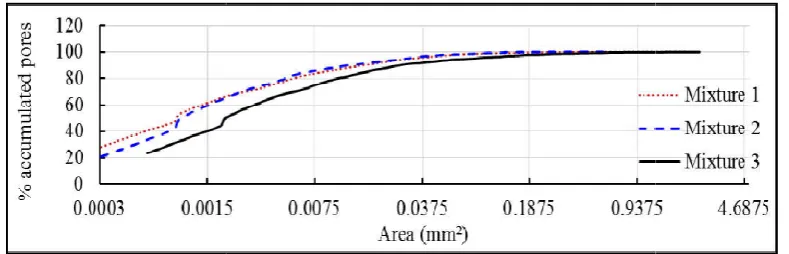
demonstrates that the excess of lime produced a poorly water resistant mortar, being that the specimen was discarded in approximately 24 hours of water exposure. Besides this, the high value of this property for rich traces in this binder can highlighted, demonstrating the low resistance of these composites when in contact with the aggressive agents. The traces rich in cement have more pores open on the surface, which are generated by the output of the unhydrated water. In the case of lime, it is reported that the excessive use of this binder promoted the generation of pores due to the air incorporating additive, but the excess made pores that should be isolated to join and form paths for the entry of the water for capillarity. It is apparent from Figure 4 that the pores of the traits rich in cement and lime are much smaller than those of the reference trace. Based on the images of Figure 4 (a, b and c) was confectioned the Figure 5 with the distribution of the pores in each mortar. It can be
images that the Mixture 3 has a larger quantity of big pores (195µm) that generate high porosity. However, this pore size prevented the percolation of the water by capillarity and kept the values of porosity and air incorporated
traces.
Results of porosity, incorporated air content and water absorption tests to 28 days old
Figure 3. Results of capillary water absorption test to 28 days old
(a) (b) (c)
Figure 4. Digital microscope images - 1000x of (a) Mixture 1, (b) Mixture 2 and (c) Mixture 3
water absorption, which obstructs the use like armed mortar, even having elevated mechanical resistance. The Figure 3 demonstrates that the excess of lime produced a poorly water-resistant mortar, being that the specimen was discarded in approximately 24 hours of water exposure. Besides this, the high value of this property for rich traces in this binder can be highlighted, demonstrating the low resistance of these composites when in contact with the aggressive agents. The traces rich in cement have more pores open on the surface, which are generated by the output of the unhydrated water. In it is reported that the excessive use of this binder promoted the generation of pores due to the air incorporating additive, but the excess made pores that should be isolated to join and form paths for the entry of the water for from Figure 4 that the pores of the traits rich in cement and lime are much smaller than those of the reference trace. Based on the images of Figure 4 (a, b and c) was confectioned the Figure 5 with the distribution of the pores in each mortar. It can be seen from the data and the images that the Mixture 3 has a larger quantity of big pores (195µm) that generate high porosity. However, this pore size prevented the percolation of the water by capillarity and kept the values of porosity and air incorporated below the other
incorporated air content and water absorption tests to 28 days old
[image:3.595.68.530.352.495.2]The values of D50 of each trace are emphasized, 50µm (Mixture 3), 36 µm (Mixture 1 and 2), being more evident the difference of pore sizes between the mixtures. It can affirmed that the excess of binder reduced the pore size and maximized the intercommunication between them, increasing the porosity, the water absorption, the incorporated air content and the capillarity, soon, reducing the durability of the mortars (Nokken and Hooton 2008). It is evidenced the need to identify the binder content adequate to each condition of use of coating mortars, optimizing its mechanical properties and, especially their behavior throughout the useful life of the building. Excess binder reduces working life by compromising the durability of coating mortars, even with higher mechanical properties values.
Conclusion
The mortars with excess of binders can presents high values of the mechanical properties, for the cement, nevertheless, seen big incidence of fissures for hydraulic retraction that promotes the substrate detachment and high rigidity, converging to a composite that is inappropriate for use as a coating mortar. If the lime be the binder, the same cracks are observed, however with low rigidity and high powderiness, having low values in the mechanical properties and being also inappropriate for use. When evaluating the durability indicators, the data of mechanical properties are verified, in which many percolable pores are identified in the richer mortars, generating mortars that are not durable. The preparation of armed mortars, which require more mechanical resistance, must be guaranteed with the use of water reducing additives and efficient cure, to guarantee durability. evidenced the need to identify the content of adequate binder to each condition of use of coating mortars, optimizing their mechanical properties and, above all, their behavior through the useful life of the building. The excess of binder reduces th useful life when the durability of the coating mortars is compromising, even with higher values of mechanical properties.
Acknowledgements
[image:4.595.102.497.58.185.2]The authors would like to thank CNPq (National Council for Scientific and Technological Research and Development) funding this research and UFMG (Federal University of Minas Gerais) for the infrastructure provided for the realization of the project.
Figure 5. Analysis of porosity image program
29926 Santos, W.J., Carrasco et al. Study of the effects of excessive cement or lime in mechanical properties
The values of D50 of each trace are emphasized, 50µm (Mixture 3), 36 µm (Mixture 1 and 2), being more evident the difference of pore sizes between the mixtures. It can be affirmed that the excess of binder reduced the pore size and maximized the intercommunication between them, increasing the porosity, the water absorption, the incorporated air content and the capillarity, soon, reducing the durability of the mortars It is evidenced the need to identify the binder content adequate to each condition of use of coating mortars, optimizing its mechanical properties and, especially their behavior throughout the useful life of the der reduces working life by compromising the durability of coating mortars, even with higher mechanical
The mortars with excess of binders can presents high values of the mechanical properties, for the cement, nevertheless, it is seen big incidence of fissures for hydraulic retraction that promotes the substrate detachment and high rigidity, converging to a composite that is inappropriate for use as a coating mortar. If the lime be the binder, the same cracks are wever with low rigidity and high powderiness, having low values in the mechanical properties and being also When evaluating the durability indicators, the data of mechanical properties are verified, in identified in the richer mortars, generating mortars that are not durable. The preparation of armed mortars, which require more mechanical resistance, must be guaranteed with the use of water reducing additives and efficient cure, to guarantee durability. It is evidenced the need to identify the content of adequate binder to each condition of use of coating mortars, optimizing their mechanical properties and, above all, their behavior through the useful life of the building. The excess of binder reduces the useful life when the durability of the coating mortars is compromising, even with higher values of mechanical
The authors would like to thank CNPq (National Council for Scientific and Technological Research and Development), for funding this research and UFMG (Federal University of Minas Gerais) for the infrastructure provided for the realization of the
REFERENCES
Allwood, J.M., Ashby, M.F., Gutowski, T.G., Worrell, E. 2011. Material efficiency: a white paper. In
Conservation and Recycling. 55, pp 362 Barbosa, M.T.G., Santos, W.J.
performance mortar. Portugal SB13. In Contribution of Sustetainable Building to Meet. 5, pp 387
Carasek, H. 2010. Materiais de Construção Civil e Princípios de Ciência e Engenharia de Materiais, Vol.I, IBRACON Publication, São Paulo, Brazil.
Costa, F.N. 2005. Process mortar facade coating performance: problems and improvement opportunities. Dissertation Master of Engineering, Civil engineering College, University of Rio Grande do Sul.
Faria, P., Santos, T., Aubert, J. 2015 characterization of an earth eco
mortar. In J. of Materials in Civil Engineering, 28, pp 1 Hwang, E.H., Soo Ko, Y. 2008
and physical properties of SBR using recycled waste materials and Engineering Chemistry. Kadri, H., Duval, R.R. 2002. E
heat of hydration of cement mortars. In 99, p 138-142.
Larrard,F.De. 2009. Concrete optimization with regard to packing density and rheology. Proceedings of 3rd International RILEM Symposium on Rheology of Cement Suspensions such as Fresh Concrete. Aug 2009, France. 1, pp 1-8.
Malhotra, V.M., Sivasundaram, V. 2004
In: Handbook on Nondestructive Testing of Concrete, Boston, USA.
Meng, L., Lu, P., Li, S., Zhao, J.,
effects on the packing density of binary spherocylinders. In J. Powder Technology. 228, pp 284
NBR 12278. 2005. Argamassa para assentamento de paredes e revestimento de paredes e tetos
densidade de massa e do teor de ar incorporado. In Associação brasileira de normas técnicas. Rio de Janeiro, Brazil.
NBR 13279. 2005. Argamassa para assentamento e revestimento de paredes e tetos
resistência à tração na flexão e à compressão. In Associação brasileira de normas técnicas. Rio de Janeir Brazil,
NBR 13528. 2010. Revestimento de paredes e tetos de argamassas inorgânicas
-potencial de aderência à tração. In Associação brasileira de normas técnicas. Rio de Janeiro, Brazil.
Figure 5. Analysis of porosity image program
of the effects of excessive cement or lime in mechanical properties and durability of the mortar
M.F., Gutowski, T.G., Worrell, E. Material efficiency: a white paper. In Resources, Conservation and Recycling. 55, pp 362–81.
Santos, W.J. 2013. ARGAD: High performance mortar. Portugal SB13. In Contribution of Sustetainable Building to Meet. 5, pp 387-394.
Materiais de Construção Civil e Princípios de Ciência e Engenharia de Materiais, Vol.I, IBRACON Publication, São Paulo, Brazil.
Process mortar facade coating performance: problems and improvement opportunities. Dissertation Engineering, Civil engineering College, University of Rio Grande do Sul.
Faria, P., Santos, T., Aubert, J. 2015. Experimental characterization of an earth eco-efficient plastering mortar. In J. of Materials in Civil Engineering, 28, pp 1-9.
Y. 2008. Comparison of mechanical and physical properties of SBR-polymer modified mortars using recycled waste materials. In Journal of Industrial and Engineering Chemistry. 14(5), pp 644-650.
Duval, R.R. 2002. Effect of ultrafine particles on heat of hydration of cement mortars. In ACI Materials J.
Concrete optimization with regard to packing density and rheology. Proceedings of 3rd International RILEM Symposium on Rheology of Cement such as Fresh Concrete. Aug 2009, France. 1,
Malhotra, V.M., Sivasundaram, V. 2004. Ultrasonicmethods. In: Handbook on Nondestructive Testing of Concrete,
Meng, L., Lu, P., Li, S., Zhao, J., LI,T. 2012. Shape and size packing density of binary spherocylinders. In J. Powder Technology. 228, pp 284-294.
Argamassa para assentamento de paredes e revestimento de paredes e tetos - Determinação da densidade de massa e do teor de ar incorporado. In rasileira de normas técnicas. Rio de Janeiro,
Argamassa para assentamento e revestimento de paredes e tetos – determinação da resistência à tração na flexão e à compressão. In Associação brasileira de normas técnicas. Rio de Janeiro,
Revestimento de paredes e tetos de - determinação da resistência potencial de aderência à tração. In Associação brasileira de normas técnicas. Rio de Janeiro, Brazil.
NBR 15259. 2005. Argamassa para assentamento e revestimento de paredes e tetos - Determinação da absorção de água por capilaridade e do coeficiente de capilaridade. In Associação brasileira de normas técnicas. Rio de Janeiro, Brazil.
NBR 15630. 2008. Argamassa para assentamento e revestimento de paredes e tetos - Determinação do módulo de elasticidade dinâmico através da propagação de onda ultrassônica. In Associação brasileira de normas técnicas. Rio de Janeiro, Brazil.
NBR 9778:2009. 2009. Associação brasileira de normas técnicas. Argamassa e concreto endurecidos - Determinação da absorção de água, índice de vazios e massa específica. In Associação brasileira de normas técnicas.Rio de Janeiro, Brazil.
Nokken, M.R., Hooton, R.D. 2008. Using pore parameters to estimate permeability or conductivity of concrete. In Materials and Structures, 41(1). pp 1-10.
Peng, Y., Hu, S., Ding, Q. 2009. Dense packing properties of mineral admixtures in cementitious material. In Particuology. 7, pp 399-402.
Ribeiro, B.V.V., Jagadish, K.S. 2003. Embodied energy of common and alternative building materials and Technologies. In J. Energia e Edifícios. 35, pp 129-137. Sahmaran, M., Lachemi, M., Hossain, K.M.A., Ranade Li,R.,
V.C. 2009. Influence of Aggregates Type and Sinze on Ductility and Mechanical Properties of Engineered Cementitious Composites. In ACI Materials J. 106, pp 308-316.
Segat, G.T. 2005. Pathological manifestations observed in mortar coating: a case study in población in Caxias do Sul city. Dissertation Master of Engineering), Civil engineering College, University of Rio Grande do Sul.