IJPSR (2014), Volume 5, Issue 9 (Research Article)
Received on 03 March 2014; received in revised form, 02 May 2014; accepted, 18 June 2014; published 01 September 2014 SIMPLE ISOCRATIC RP-HPLC METHOD DEVELOPMENT AND VALIDATION FOR ESTIMATION OF GATIFLOXACIN IN TABLET DOSAGE FORM
Ashok Kumar Bera 1, Amit Kumar De 2 and Biswajit Pal *3
Shri Ritam Vidyapith 1, 293/1 Raja Rammohan Roy Road, Kolkata - 700041, West Bengal, India.
R & D Division, Dey’s Medical Stores (Mfg) Ltd. 2, 62 Bondel Road, Kolkata - 700019, West Bengal, India.
Department of Chemistry 3, St. Paul’s C. M. College, 33/1 Raja Rammohan Roy Sarani, Kolkata - 700009, West Bengal, India.
ABSTRACT: The objective of the present study is to develop and validate a method for the estimation of gatifloxacin (GTX) in the tablet dosage form. An isocratic reversed-phase high-performance liquid chromatographic (HPLC) method was developed to estimate gatifloxacin using X terra C18 column (4.6 mm 150 mm I.D., 5µm particle size) and the mobile phase containing phosphate buffer (pH adjusted to 3.5 with dilute phosphoric acid) and acetonitrile (60:40 v/v) at the flow rate of 0.5 ml/min. The UV detection was carried out at 298 nm. The retention time of gatifloxacin was found to be 2.340 min. The developed method was validated concerning accuracy, precession, linearity, selectivity, ruggedness, and robustness. Linearity for gatifloxacin was observed in the concentration range 0.01 to 0.50 µg/ml. Percent recovery was found to be 99.67. The results confirmed that the proposed method is specific, rapid, reproducible, and suitable for the routine determination of gatifloxacin.
INTRODUCTION: Gatifloxacin is an antibiotic of the fourth-generation fluoroquinolone family drug 1. The antibacterial action of gatifloxacin results from inhibition of the enzymes topoisomerase II (DNA gyrase) and topoisomerase IV like other members of the fluoroquinolone drug 2-4
. Gatifloxacin is a broad-spectrum antibiotic that is active against Gram-positive, Gram-negative bacteria and other isolated organisms, both microbiologically and clinically 5.
QUICK RESPONSE CODE
DOI:
10.13040/IJPSR.0975-8232.5(9).3741-45
This article can be accessed online on
www.ijpsr.com
DOI link: http://dx.doi.org/10.13040/IJPSR.0975-8232.5(9).3741-45
It has been used for the treatment of respiratory tract infections, sinusitis, community-acquired pneumonia, and skin infections. This quinolone antibiotic is used as tablets and in various aqueous solutions for intravenous therapy 6. Gatifloxacin ophthalmic solution is a typical fluoroquinolone anti-infective used for the treatment of bacterial conjunctivitis.
FIG. 1: CHEMICAL STRUCTURE OF GATIFLOXACIN
Keywords:
RP-HPLC, Gatifloxacin, Estimation, Validation Correspondence to Author: Biswajit Pal
Department of Chemistry,
[image:1.612.356.526.624.729.2]Gatifloxacin is an 8-methoxyfluoroquinolone with a 3-methylpiperazinyl substituent at C7 position, and the chemical name is 1-cyclopropyl-6-fluoro-8-methoxy-7-(3-methylpiperazin-1-yl)- 4- oxo quino-line-3-carboxylic acid 7Fig. 1.
The bactericidal action of Gatifloxacin depends on blocking of bacterial DNA replication by binding with DNA gyrase that allows the untwisting required replicating one DNA double helix into two 3
. Since the mechanism of action of gatifloxacin is different from that of aminoglycoside, macrolide, tetracycline, etc. antibiotics, thus, gatifloxacin may play an active role against pathogens that are resistant to these antibiotics2. Literature survey reveals spectrophotometric 8, HPLC 9-12, HPTLC 13, and LC/electrospray tandem mass spectrometry 14 methods for determination of gatifloxacin in pharmaceutical dosage forms. In the present investigation, an attempt has been made to develop reverse phase- high performance liquid chromatographic method using simple mobile phase which was sensitive and rapid for estimation of gatifloxacin in tablet dosage form and subsequent validation of the developed method as per ICH guidelines 15, 16.
EXPERIMENTAL:
Chemicals and Reagents: All solvents were of HPLC grade, and reagents were analytical grade. Potassium di-hydrogen phosphate and dipotassium hydrogen phosphate of AR grade and acetonitrile of HPLC grade were purchased from Merck Ltd., Mumbai. HPLC grade water was prepared from Aurium 611 UV water purification system of Sartorius, Germany. Standard gatifloxacin (99.6%) was kindly donated by local pharmaceutical industry and were used as a reference standard without further purification. Gatifloxacin tablets were purchased from the local pharmacy.
Instrumentation and Chromatographic
Condition: Chromatographic separation was
performed on a Waters Alliance e2695 separation module and Waters 2489 dual lambda absorbance detector. The method was carried out on a C18 (150 mm × 4.6 mm, 5 µm) X terra column. The mobile phase used was a mixture of 60 volumes of 5.3 mM phosphate buffer solution adjusted to pH 3.5 ± 0.1 with orthophosphoric acid and 40 volumes of acetonitrile and was delivered at a flow rate of 0.5
ml/min. All solutions, including mobile phase, were sonicated for 15 min and filtered through a 0.45 µm membrane filter (Millipore) before use. A rheodyne injector with a 10 µl loop was used for the injection of standard and sample solutions of gatifloxacin. The UV detection was made at 290 nm at ambient temperature (24 ± 2 °C), and all data were analyzed by using Empower 3 software.
Preparation of Standard Stock Solution:A stock solution containing 0.5 mg/ml of gatifloxacin was prepared in 10 ml HPLC grade water by addition of one drop of conc. HCl followed by sonication for 15 minutes, and the final volume was made by the mobile phase. The resulting solution was diluted with mobile phase to obtain a solution with a final concentration of 0.02 mg/ml and was prepared by appropriate dilution with mobile phase from the stock solution. The contents of the standard solution were filtered through a 0.45 µm syringe filter.
Preparation of Sample Solution: Twenty tablets of gatifloxacin were individually weighed, mean weight was determined and triturated to obtain a homogeneous mixture. An amount of powder mass equivalent to 12.5 mg of gatifloxacin was weighed accurately and transferred to a 25 ml volumetric flask. About 10 ml of HPLC grade water and 1 drop of conc. HCl was added to the volumetric flask and sonicated for 15 minutes to facilitate proper solubilization. The final volume was made up to the mark by the mobile phase. The resulting solution was filtered through Whatman filter paper no. 1. Aliquots of filtered solution were diluted with mobile phase to obtain a solution with a final concentration of 0.02 mg/ml of gatifloxacin (theoretical value). The contents of the sample solution were filtered through a 0.45 µm syringe filter.
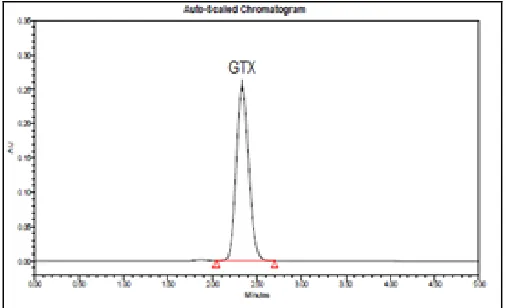
FIG. 2: REPRESENTATIVE CHROMATOGRAM FOR GTX (RETENTION TIME = 2.340)
The retention time was 2.34 min. The concentration of gatifloxacin in the marketed tablet was calculated by comparing the area of the sample solution with that of the standard solution. The percentage assay of gatifloxacin was presented in Table 3.
Method Validation: To validate a simple and efficient method for the analysis of the drug in pharmaceutical formulations, preliminary tests were performed to select adequate and optimum conditions. Parameters like linearity, accuracy, precession, ruggedness, and robustness were studied according to USP and ICH guidelines 15, 16.
Linearity: Linearity was studied to determine the range over which analyte response is a linear function of concentration. The linearity of the proposed method was evaluated by using calibration curves obtained from the analysis of different concentrations of the standard solutions, to calculate coefficient of correlation and intercept values.
Accuracy: The accuracy of an analytical method is the closeness of results obtained by that method to the true value for the sample. To evaluate the accuracy of the proposed method, recovery tests were carried out. Pre-analyzed samples were spiked with 90%, 110%, and 120% of the standard solution and analyzed. The experiment was performed in triplicate. Recovery (%) and RSD (%) were calculated for each concentration.
Precession: The precession of an analytical method is the closeness of replicate results obtained from the analysis of the same homogeneous sample. Precession of the method was established by
mixing six replicate injections of a standard solution of the drug. The percentage RSD concerning the peak area, peak retention time and amount were calculated.
Ruggedness and Robustness: Ruggedness is the degree of reproducibility of the results obtained under a variety of conditions like different analysts, instruments, reagents, days, etc. The ruggedness of the proposed method was determined by experimenting with different instruments like Merck Hitachi HPLC La Chrome pump L-7100 with Merck Hitachi UV La Chrome detector L-7400, Waters HPLC 600 pumps by different operators using different columns of similar typein different days.
Robustness is the capacity of a method to remain unaffected by small, deliberate variations in method parameters such as mobile phase, pH, temperature, etc. The robustness of the proposed method was evaluated by making a slight variation in the mobile phase as well as its pH and temperature.
Limit of Detection and Limit of Quantification: The limit of detection (LOD) is the lowest analyte concentration at which detection is feasible, and limit of quantification (LOQ) is the lowest concentration at which the analyte cannot only be reliably detected but at which some predefined goals for bias and imprecision are met. The LOD and LOQ of the developed method were determined by injecting progressively low concentrations of the standard solution with the optimized chromatographic conditions.
RESULTS AND DISCUSSION: The developed
HPLC method provides a convenient and efficient method for estimation of gatifloxacin in the tablet dosage form. The proposed method is simple and does not involve laborious time-consuming sample preparation. The simple mobile phase gave a well resolved, sharp peak for gatifloxacin with a retention time of 2.34 min Fig. 2.
[image:3.612.47.300.54.208.2]TABLE 1: SAMPLE SUITABILITY PARAMETER Parameters Gatifloxacin The wavelength of the max
absorbance (nm)
290.0
Retention time (min) 2.34
Tailing factor 0.5123
Theoretical plate 10012
LOD (µg/ml) 0.09
LOQ (µg/ml) 0.27
The calibration curves showed linearity over a concentration range from 0.01 μg/ml to 0.50 μg/ml, and the regression coefficient (R2) was found to be 0.98 Table 2.
TABLE 2: LINEARITY PARAMETERS
Parameters Gatifloxacin
Linearity range (µg/ml) 0.01 to 0.50
Regression coefficient 0.98
Slope 1739
Intercept 1349
[image:4.612.47.571.244.335.2]The method was statistically validated for accuracy and precision. The mean recovery observed was 99.67%, and the percent RSD concerning the accuracy of recovery test was 0.46 Table 3 which showed that the method was free from the interference of the excipients used in the formulation.
TABLE 3: ACCURACY PARAMETERS (RECOVERY STUDIES)
Tablet Formulation
Drug Labeled Amount of Drug (mg/tab) Amount mg/tab found % label claim (n =6) % RSD
Recovery Studies (n = 3) Total Amt. after spiking (mg) Amt recovered (mg) Mean ±
SD % Recovery % Mean Recovery % RSD Gatiflox Tab (Sun Pharma)
GTX 400 398.99 99.74 0.96 360
440 480
357.99 ± 2.73 439.32 ± 3.01 478.76 ± 3.88
99.44 99.84 99.74
99.67 0.46
The lower values of % RSD concerning the peak area, peak retention time, and amount Table 4 indicate that the method was precise.
TABLE 4: % RSD OF PRECISION PARAMETERS
Parameters GTX
Peak Area 0.50
Peak RT 0.07
Amount 0.10
The method was satisfactory concerning ruggedness and robustness. The limit of detection (LOD) and the limit of quantification (LOQ) were found to be 0.09 and 0.27 μg/ml Table 1, respectively.
CONCLUSION: The proposed HPLC method was
found to be simple, precise, accurate, linear, rugged, robust and rapid and can be used in routine analysis of gatifloxacin as raw materials as well as in tablet dosage form in quality control laboratories.
ACKNOWLEDGEMENT: The authors gratefully
acknowledge Dey’s Medical, Kolkata for providing necessary facilities for carrying out this study.
CONFLICT OF INTEREST: Nil
REFERENCES:
1. Burka JM, Bower KS, Vanroekel RC, Stutzman RD, Kuzmowych CP and Howard RS: The effect of
fourth-generation fluoroquinolones gatifloxacin and moxifloxacin on epithelial healing following photorefractive keratectomy. American Journal of Ophthalmology 2005; 140: 83-7.
2. Budawari S: In; The Merck Index, 13th Edn., Merck & Co., Inc., Whitehouse Station, NJ, 2003; 777: 1229.
3. Parfitt K, Blake PS and Parsons AV: Martindale, In; The Complete Drug Reference, 32nd Edn., Pharmaceutical Press, London 1999; 589.
4. Bera AK, De AK and Pal B: Development and validation of a rapid RP-HPLC method for estimation of sparfloxacin in the tablet dosage form. International Journal of Pharmaceutical Sciences and Research 2014; 5: 563-67. 5. Indian Pharmacopeia 2007; 1158-59.
6. Gerald LM: In; Goodman and Gilman, The
Pharmacological Basis of Therapeutics, 9th Edn., McGraw-Hill, New York, 1998, 1065.
7. Rang HP and Moore PK: In pharmacology: Antibacterial Drugs. 5th Ed. Elsevier Science Ltd., New Delhi 2003: 635.
8. Paramane S, Kothapalli L, Thomas A and Deshpande AD:
Simultaneous spectrophotometric estimation of
gatifloxacin and ornidazole in the tablet dosage form. Indian Journal of Pharmaceutical Sciences 2006; 68: 819-21.
9. Saxena V and Singh A: Development and validation of HPLC method for the simultaneous estimation of loteprednol and gatifloxacin. International Journal of Science and Research 2013; 2: 252-55.
10. Liang H, Kays MB and Sowinski KM: Separation of levofloxacin, ciprofloxacin, gatifloxacin, moxifloxacin, trovafloxacin and cinoxacin by high-performance liquid chromatography: application to levofloxacin determination in human plasma. Journal of Chromatography B 2002; 772: 53-63.
12. Patel AB, Shah NJ and Patel NM: Development and validation of HPLC method for the simultaneous estimation of stranidazole and gatifloxacin in the tablet dosage form. International Journal of Chem Tech Research 2009; 1: 587-90.
13. Suhagia BN, Shah SA, Rathod IS, Patel HM, Shah DR and Marolia BP: Determination of gatifloxacin and ornidazole in tablet dosage forms by high-performance thin-layer chromatography. Analytical Sciences 2006; 22: 743-45.
14. Vishwanathan K, Bartlett MG and Stewart JT:
Determination of gatifloxacin in human plasma by liquid chromatography/electrospray tandem mass spectrometry. Mass Spectrometry 2001; 15: 915-19.
15. United States Pharmacopeia. USP Convention, Rockville, MD, 2008; 1225.
16. ICH (Q2, R1).Note for guidance on validation of analytical methods: Definitions and terminology. International conference on harmonisation 1994: 9-13.
All © 2013 are reserved by International Journal of Pharmaceutical Sciences and Research. This Journal licensed under a Creative Commons Attribution-NonCommercial-ShareAlike 3.0 Unported License.
This article can be downloaded to ANDROID OS based mobile. Scan QR Code using Code/Bar Scanner from your mobile. (Scanners are available on Google Playstore)
How to cite this article: