Early Childhood and Elementary Education Dissertations
Early Childhood and Elementary Education Department
Fall 10-18-2010
Student Participation in Mathematics Discourse in
a Standards-based Middle Grades Classroom
Brian S. Lack
Georgia State University
Follow this and additional works at:https://scholarworks.gsu.edu/ece_diss
This Dissertation is brought to you for free and open access by the Early Childhood and Elementary Education Department at ScholarWorks @ Georgia State University. It has been accepted for inclusion in Early Childhood and Elementary Education Dissertations by an authorized administrator of ScholarWorks @ Georgia State University. For more information, please [email protected].
Recommended Citation
Lack, Brian S., "Student Participation in Mathematics Discourse in a Standards-based Middle Grades Classroom." Dissertation, Georgia State University, 2010.
This dissertation, STUDENT PARTICIPATION IN MATHEMATICS DISCOURSE IN A STANDARDS-BASED MIDDLE GRADES CLASSROOM, by BRIAN LACK, was prepared under the direction of the candidate’s Dissertation Advisory Committee. It is accepted by the committee members in partial fulfillment of the requirements for the degree Doctor of Philosophy in the College of Education, Georgia State University.
The Dissertation Advisory Committee and the student’s Department Chair, as representatives of the faculty, certify that this dissertation has met all standards of excellence and scholarship as determined by the faculty. The Dean of the College of Education concurs.
Barbara Meyers, Ed. D. Joel Meyers, Ph. D.
Committee Chair Committee Member
Lynn Hart, Ph. D. Susan Swars, Ph. D.
Committee Member Committee Member
Date
Barbara Meyers, Ed. D.
Chair, Department of Early Childhood Education
R. W. Kamphaus, Ph. D.
By presenting this dissertation as a partial fulfillment of the requirements for the
advanced degree from Georgia State University, I agree that the library of Georgia State University shall make it available for inspection and circulation in accordance with its regulations governing materials of this type. I agree that permission to quote, to copy from, or to publish this dissertation may be granted by the professor under whose direction it was written, by the College of Education's director of graduate studies and research, or by me. Such quoting, copying, or publishing must be solely for scholarly purposes and will not involve potential financial gain. It is understood that any copying from or publication of this dissertation which involves potential financial gain will not be allowed without my written permission.
All dissertations deposited in the Georgia State University library must be used in
accordance with the stipulations prescribed by the author in the preceding statement. The author of this dissertation is:
Brian Lack 4250 Brumby Lane Cumming, GA 30041
The director of this dissertation is:
Dr. Barbara Meyers
Department of Early Childhood Education College of Education
Brian Lack
ADDRESS: 4250 Brumby Lane
Cumming, GA 30041
EDUCATION:
Ph.D. 2010 Georgia State University Early Childhood Education M.Ed. 2000 University of Georgia
Early Childhood Education
B.S. 1999 University of Georgia
Early Childhood Education
PROFESSIONAL EXPERIENCE:
2008-Present Middle School Math Teacher
Forsyth County Schools, Cumming, GA
2007-2008 Elementary School Teacher
Atlanta Public Schools, Atlanta, GA
2004-2007 Doctoral Teaching and Research Fellow
Georgia State University, Atlanta, GA
2000-2004 Elementary School Teacher
Clarke County and Gwinnett County, GA
PUBLICATIONS:
Lack, B. (2011). Anti-democratic militaristic education: An overview and critical analysis of KIPP Schools. In R. Ahlquist, T. Montano, and P. Gorski (Eds.), Assault on working-class kids: Hyper-accountability, corporatization, Ruby Payne, and deficit theories. New York: Peter Lang.
Lack, B. (2010). Education funding. In C. Clauss-Ehlers (Ed.), Encyclopedia of cross-cultural school psychology (pp. 414-415). New York: Springer.
Lack, B. (2009). No excuses: A critique of the Knowledge is Power Program (KIPP) within charter schools in the USA. Journal for Critical Education Policy Studies, 7(2), 126-153.
Breault, R. A., & Lack, B. (2009). Equity and empowerment in PDS work: A review of literature (1999 to 2006). Equity and Excellence in Education, 42(2), 152-168. Swars, S. L., Meyers, B., Mays, L. C., & Lack, B. (2009). A two-dimensional model of
PDS: A review of literature. Paper presented at the annual meeting of the American Educational Research Association, New York.
Lack, B. (2007, April). No excuses: A democratic critique of the Knowledge is Power Program. Paper presented at the annual meeting of the American Educational Research Association, Chicago.
Lack, B., Mays, L. C., Swars, S. L., & Meyers, B. (2007, April). Examining teacher retention and mobility in a Professional Development School through
collaborative inquiry. Paper presented at the annual meeting of the American Educational Research Association, Chicago.
Lack, B., and Meyers, B. (2006, November). The many faces of mobility: A school-university partnership study of school climate and culture. Presented at the annual meeting of the Southeastern Regional Association of Teacher Educators, Towson, MD.
Lack, B., & Meyers, L. (2006, October). Integrating social studies, technology, and children’s literature to teach about the American Civil Rights movement. Presented at the annual meeting of the Georgia Council for the Social Studies, Athens, GA.
Truscott, D., Dangel, J. R., Meyers, B., Lack, B., Swars, S. L., Jordan, L., et al. (2006, February). Partnership work in high-needs schools: Reflection on practice. Presented at the annual meeting of the Association of Teacher Educators, Atlanta, GA.
PROFESSIONAL SOCIETIES AND ORGANIZATIONS: 2006-Present American Educational Research Association 2008-Present National Council for Teachers of Mathematics
PROFESSIONAL SERVICE:
2010 Mentor, Forsyth County Schools Mentoring Program
2009 Assisted peer review for Journal for Research in Mathematics Education
2007 McNair Program research mentor to Julie Owens, ECE undergraduate
student, Georgia State University
2006-2007 Guest speaker for Ed.S. course on teacher development
2006 Teaching apprentice to Dr. Laura Meyers, social studies methods
undergraduate course in ECE
2005-2007 Interviewer for admissions to undergraduate program in ECE
2005-2006 Volunteer, academic tutoring and percussion instructor, KIPPWAYS,
Atlanta, GA
2004-2006 ECE student representative for the Student Activities Fees
STUDENT PARTICIPATION IN MATHEMATICS DISCOURSE IN A STANDARDS-BASED MIDDLE GRADES CLASSROOM
by Brian Lack
The vision of K-12 standards-based mathematics reform embraces a greater
emphasis on students’ ability to communicate their understandings of mathematics by
utilizing adaptive reasoning (i.e., reflection, explanation, and justification of thinking)
through mathematics discourse. However, recent studies suggest that many students lack
the socio-cognitive capacity needed to succeed in learner-centered, discussion-intensive
mathematics classrooms. A multiple case study design was used to examine the nature of
participation in mathematics discourse among two low- and two high-performing sixth
grade female students while solving rational number tasks in a standards-based
classroom. Data collected through classroom observations, student interviews, and
student work samples were analyzed via a multiple-cycle coding process that yielded
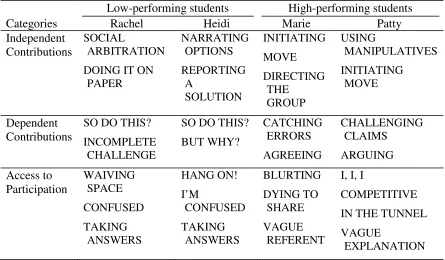
several important within-case and cross-case findings. Within-case analyses revealed that
(a) students’ access to participation was mediated by the degree of space they were
afforded and how they attempted to utilize that space, as well as the meaning they were
able to construct through providing and listening to explanations; and (b) participation
was greatly influenced by peer interactional tendencies that either promoted or impeded
productive contributions, as well as teacher interactions that helped to offset some of the
orientations as well as the degree of social risk perceived with providing incorrect
solutions before their peers; and (b) differences between the kinds of peer and teacher
interactions that low- and high-performers engaged in were directly related to the types of
challenges they faced during discussion of these tasks. An important implication of this
study’s findings is that the provision of space and meaning for students to participate
equitably in rich mathematics discourse depends greatly on teacher interaction, especially
in small-group instructional settings where unequal peer status often leads to unequal
peer interactions. Research and practice should continue to focus on addressing ways in
which students can learn how to help provide adequate space and meaning in small-group
mathematics discussion contexts so that all students involved are allowed access to an
by Brian Lack
A Dissertation
Presented in Partial Fulfillment of Requirements for the Degree of
Doctor of Philosophy in
Early Childhood Education in
the Department of Early Childhood Education in
the College of Education Georgia State University
Copyright by Brian Lack
ii
I am humbly grateful to several individuals for the hands you’ve lent toward making this project a reality. Without your help, either I would not have pursued a doctorate in education, or at best I would be forever trapped in A.B.D. purgatory.
I am so thankful to my loving mom and dad, as well as my nana and papa, for instilling in me the passion to follow my heart, and for imparting the resources to do so. I hope I make you proud. Thank you also to Edith Jonathan for your encouragement and willingness to help see to it that I completed this research.
To my beautiful wife, Sonia, and my precious son, Holden, I can’t wait to give you back the time you gave me as I isolated myself in order to complete this study. And to our beloved four-legged companions, Bella and Gabby, who suffered through many summer days without a trip to the park or even a stroll around the block while I slaved over this dissertation, you too will be compensated with walks, milk bones, and rawhides galore.
To Dr. Barbara Meyers, my advisor and the most wonderful writer I’ve ever known, thank you for all of the wisdom, constructive criticism, and affirmation you provided along the way. Whenever I felt lost or even remotely discouraged, you knew exactly what to say and do to lift me up. You are such a special person.
To Dr. Swars, Dr. Hart, and Dr. Joel Meyers, your feedback on the various iterations of this draft were invaluable. Thank you for always taking such great care, time and effort in responding to my work. I could not have picked a better group of intellectuals to collaborate with on this study.
To Jon Thomason, the greatest teacher I’ve ever known, the influence you have had on my life is truly boundless and I am so lucky to call you my friend.
Thank you Kara Kavanagh, fellow doc student, for all of the helpful email and telephone conversations we shared as we both lumbered through the dissertation process together.
iii
Page
List of Tables ...v
List of Figures ... vi
Abbreviations ... vii
Chapter 1 INTRODUCTION ...1
Study Rationale ...4
Study Significance ...10
Research Question ...12
2 REVIEW OF THE LITERATURE ...13
Theoretical Framework ...14
Conducting the Literature Review ...23
The Complexity of Rational Number Learning ...24
A Brief Overview of Classroom Discourse ...27
Mathematics Discourse Communities ...28
Student Participation in Discourse ...44
Summary of Empirical Research ...53
3 METHODOLOGY ...55
Context ...56
Participants ...65
Data Collection ...70
Data Analysis ...82
The Role of the Researcher ...96
4 FINDINGS ...98
The Nature of Participation in Discourse: An Overview ...98
Cross-case Frequencies ...101
Within-case Findings ...107
Cross-case Findings ...156
5 DISCUSSION ...167
Summary of Findings ...167
Conclusions ...168
Implications...181
iv
v
Table Page
1 Characteristics of Mathematical Proficiency ...5
2 Norms and Corresponding Classroom Interventions ...59
3 Codes and Categories Generated from First Cycle Coding ...86
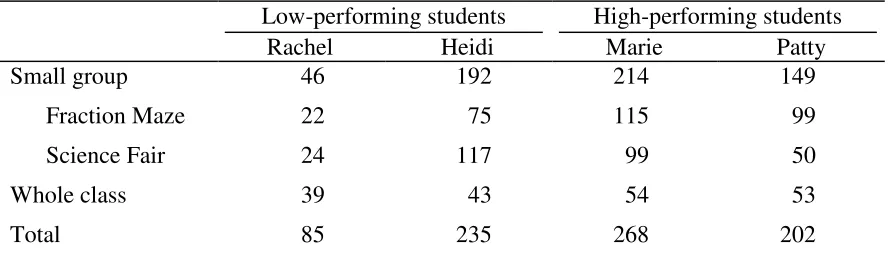
4 Total Number of Student Utterances during the Study ...102
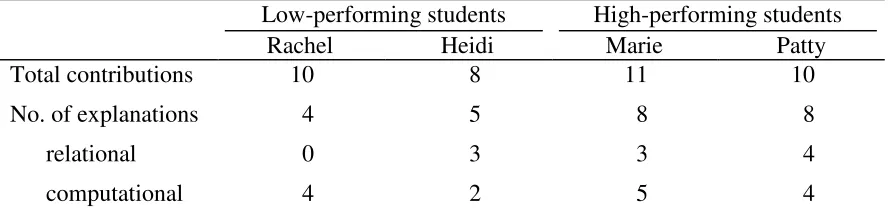
5 Frequency and Types of Student Contributions: Whole Class ...103
6 Quality of Explanation Rubric ...104
7 Frequency and Quality of Explanations: Whole Class ...104
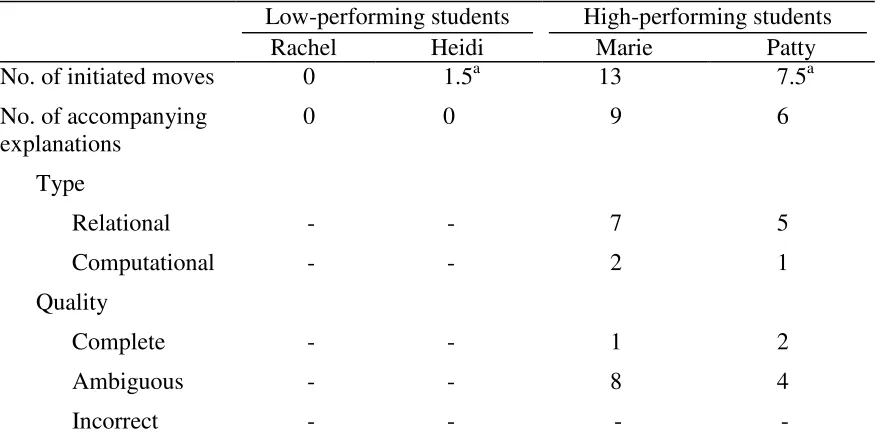
8 Frequency of Initiated Moves and Type and Quality of Explanations: Fraction Maze Task...105
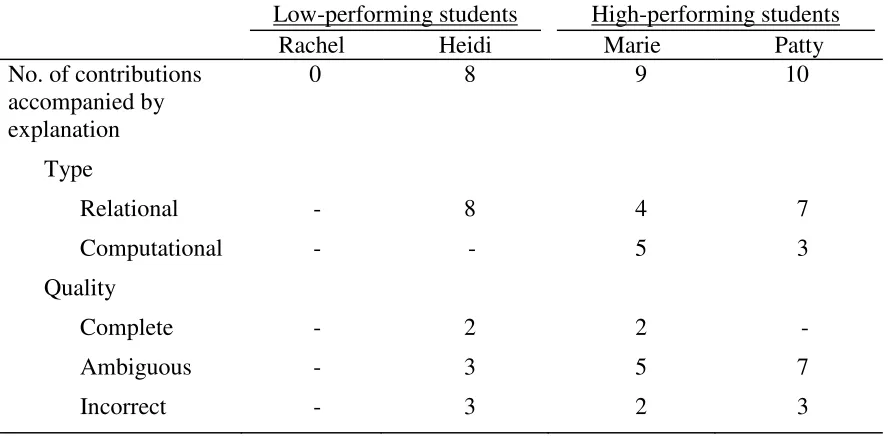
9 Frequency and Quality of Explanations: Science Fair Task ...106
10 Primary Goal Orientation and Perception of Risk Associated with “Being Wrong” ...164
vi
Figure Page
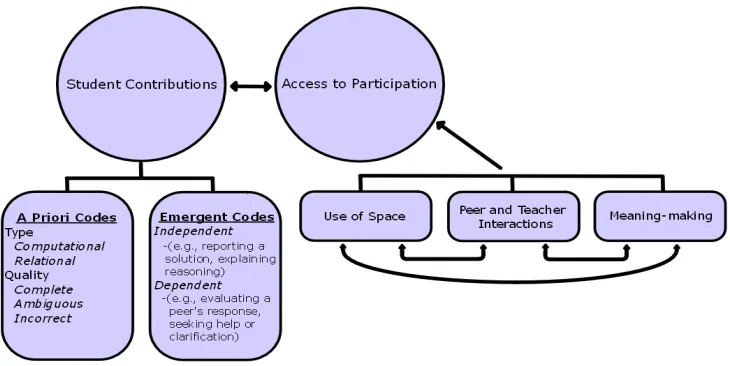
1 A Model of Salient Themes Related to the Nature of Students’
vii
NRC National Research Council
NCLB No Child Left Behind
NCTM National Council of Teachers of Mathematics
NMAP National Mathematics Advisory Panel
1 CHAPTER 1
INTRODUCTION
Just over twenty years ago, in response to widely publicized indictments of
American education including A Nation at Risk (1983) and A Nation Prepared: Teachers
for the 21st Century (1986), the National Council of Teachers of Mathematics (NCTM)
issued its radical reconceptualization of mathematics education in its Curriculum and
Evaluation Standards for School Mathematics (1989). Developers of the Standards
envisaged reformed mathematics classrooms as “discourse communities where
conjectures are made, arguments presented, strategies discussed,” (Romberg, 1993, p.37)
or, in short, classrooms that promote genuine understanding of mathematics. As a result,
current K-12 standards-based reform embraces a greater emphasis on child-centered
instructional practices that prioritize mathematical processes in addition to the traditional
focus on mathematical content alone (NCTM, 2000). This generally means that students
of today are expected to take a more active and meaningful role in the learning process,
which often translates to classroom behaviors such as verbal or written reasoning,
discussion, debate, and inquiry. Instead of responding succinctly to questions that have
predetermined answers, students in today’s standards-based classrooms are expected to
address richer, more complex questions that draw on their ability to monitor, reflect on,
and communicate their thinking processes. Put differently, questions such as “What is
the answer?” have been supplemented (if not supplanted) by questions of the following
contrast with what someone else said? Why do you agree or disagree? Will that always
be the case? Can you think of a counterexample? Can you explain your reasoning to
another student? How can you be certain?
Because the vision of mathematics education reform has placed greater emphasis
on students’ ability to effectively communicate their mathematical understandings, the
nature of classroom discourse (i.e., student-to-student, student-to-teacher) has become an
important instructional element of standards-based elementary and middle school
mathematics classrooms (Silver & Smith, 1996; Walshaw & Anthony, 2008). Discourse,
however, is an ambiguous term that has been defined and studied in very different ways,
all the while masquerading under one generic label (Gee, Michaels, & O’Connor, 1992).
NCTM (1991) has operationalized its conception of discourse as such:
Discourse refers to the ways of representing, thinking, talking, and agreeing and disagreeing that teachers and students use to engage in . . . tasks. The discourse embeds fundamental values about knowledge and authority. Its nature is reflected in what makes an answer right and what counts as legitimate mathematical activity . . . Teachers, through the ways in which they orchestrate discourse, convey messages about whose knowledge and ways of thinking and knowing are valued, who is considered able to contribute and who has status in the group. (¶ 4)
Mathematics classrooms that espouse rich discourse are widely viewed as a remedy to the
traditional forms of instruction that have rendered students as passive learners and often
left them with only superficial understanding of mathematics (Cobb, Wood, & Yackel,
1990). However, endorsement of discourse-rich mathematics instruction for the mere
sake of increasing the ratio of student-initiated talk to teacher-talk underestimates the
complexity of discourse as an effective instructional intervention for all students (Nathan
& Knuth, 2003; Truxaw & DeFranco, 2008). While a stable body of research on
of researchers have looked specifically at low-achieving children and their participation
in discussion-oriented classrooms (Baxter, Woodward, & Olson, 2001; Empson, 2003;
Lubienski, 2000a; 2000b) and of these studies, only Empson’s (2003) focuses on
children’s understanding of fractions and other rational number constructs. A perusal of
the relevant literature has led me to reflect on my own experiences as a middle grades
mathematics teacher (one who embraces discourse as a potentially useful instructional
tool), resulting in several complex and discomforting questions. For instance, who
benefits from mathematical discourse communities, and to what extent? What factors
might impede the efficacy of classroom discourse as an effective intervention for all
students? How can all students profit from participation in discourse communities? In
today’s milieu of standards-based reform, these questions bear a critical degree of import,
especially for advocates of discussion-intensive mathematics instruction.
Proponents of discourse-based mathematics instruction call for the development
of classroom communities that empower students to engage in the processes of “doing
mathematics” (NCTM, 1989, p. 7), which entails “conjecturing, scrutinizing, and
defending one’s ideas, as well as learning about it” (Nathan & Knuth, 2003, p. 176). The
teacher, no longer the sole arbiter of truth in the classroom, plays a less dominant but
nevertheless critical role in facilitating students’ knowledge construction. Cazden (2001)
argues that teaching and learning roles within such communities are necessarily
distributed more fluidly and democratically among all participants and suggests that the
quality of discourse communities depends not only on teacher expertise but also on
traditional and non-traditional mathematics classrooms is thorough, yet succinct, and
therefore worth quoting at length:
In more traditional classrooms, social relationships are extracurricular, potential noise in the instructional system and “interference” with real school work. What counts are relationships between the teacher and each student as an individual, both in whole-class lessons and in individual seatwork assignments. In non-traditional classrooms, the situation has fundamentally changed. Now each student becomes a significant part of the official learning environment for all the others, and teachers depend on students’ contributions to other students’ learning, both in discussions and for the diffusion of individual expertise through the class. (p. 131)
Given the increasing emphasis on non-traditional, discussion-oriented approaches to
mathematics pedagogy, coupled with the well-documented history of difficulties in
understanding fractions and other rational number concepts, empirical attention to
children’s engagement in classroom discourse about rational number learning is of
critical value.
Study Rationale
Lack of Emphasis on Mathematical Processes
Since the late 1990s, international studies of mathematics achievement have
consistently revealed somewhat disappointing comparisons of American students’
performance relative to students of other industrialized nations. A look at the Trends in
International Mathematics and Science Study (TIMSS) of 2007 shows that U.S.
fourth-graders ranked 11th in overall mathematics achievement and only 13th when compared to
other nations in the domain of cognitive reasoning (Gonzales, Williams, Jocelyn, Roey,
Kastberg, & Brenwald, 2008), which assesses the ability to draw inferences, make
generalizations and justifications, and solve novel tasks—the very actions that discourse
communities aim to enculturate in students. In light of these data, further investigation of
communicative processes that best enable genuine mathematical learning of such
concepts is in great demand.
In 2001, members of the National Research Council (NRC) promulgated perhaps
the most balanced and comprehensive notion of mathematical knowledge to date,
identifying five distinct but related attributes that contribute to the development of
individual students’ overall “mathematical proficiency” (Kilpatrick, Swafford, & Findell,
2001, p. 116). The five elements of mathematical proficiency are listed in Table 1, along
with a corresponding definition of each element. Although each of these notions are
interconnected in complex ways, this study placed particular emphasis on children’s use
of adaptive reasoning, which currently is in need of empirical attention in the discourse
literature on rational number learning.
Table 1
Characteristics of Mathematical Proficiency
Element Definition
Conceptual understanding Comprehension of mathematical concepts, operations,
and relations
Procedural fluency Skill in carrying out procedures flexibly, accurately,
efficiently, and appropriately
Strategic competence Ability to formulate, represent and solve mathematical
problems
Adaptive reasoning Capacity for logical thought, reflection, explanation, and
justification
Productive disposition Habitual inclination to see mathematics as sensible,
Classrooms in the United States have given only superficial attention to the
development of adaptive reasoning as evidenced by a lack of instructional emphasis on
student reasoning and justification of mathematical concepts and procedures (Hiebert,
Stigler, Jacobs, Givvin, Garnier, Smith, et al., 2005). However, recent research has
proven that encouraging the use of rich forms of discourse, like explaining one’s
reasoning and comparing multiple problem-solving strategies, leads to deeper levels of
understanding (Chi, De Leeuw, Chiu, & LaVancher, 1994; Rittle-Johnson, Siegler, &
Alibali, 2001; Star, 2005).
Like the NRC, NCTM (2000) has also called for greater efforts on the part of
teachers to integrate explicit mathematical processes, like reflection, reasoning, and
explanation, into daily classroom instruction. In 2006, the state in which the current
study was conducted responded to NCTM’s call for greater emphasis on these processes
by publishing a revised edition of the state’s K-12 public education standards, which
currently includes a set of process standards. In two years of teaching middle grades
mathematics, the author has observed a disproportionate amount of emphasis placed on
content standards and only superficial attention dedicated to process standards. While
deemphasizing these critical process standards, students and teachers remain limited to
traditional forms of teacher-centered instruction buttressed by a pedagogical culture that
promotes passivity, isolation, and complicity on the part of students, along with the
prioritization of procedures over concepts in determining what type of knowledge is of
optimal value (NCTM, 2000). Research and practice devoted to students’ learning of
but can not be divorced from research and practice pertaining to the processes by which
such content is made accessible to students.
Equitable Opportunities to Learn
Scholarly analyses of student learning and participation that claim to address
issues of equity often identify one or more particular underrepresented cultural groups,
such as African-Americans, females, or students from low-income families, as a focal
population. Generally, the intended aim of such work is to generate raised consciousness
about unequal distribution of benefits or resources among such cultural groups (Breault &
Lack, 2009). This study does not address a particular cultural group, but rather, students
based on their measured performance in mathematics, which includes both high- and
low-performing students. This study design was constructed from the primary interest of
creating equitable opportunities to learn mathematics (Esmonde, 2009). In short, this
study examines who has access to opportunities to learn mathematics and also aims to
explore how and perhaps why.
Notwithstanding contention, a fundamental assumption of standards-based
reform, and specifically inscribed into the language of the equity principles, is that all
children can learn mathematics to a degree of functional proficiency (usually measured
by performance on standardized assessments). As one might reasonably expect, much
attention has been devoted to tailoring mathematical content to students of varying ability
in order to effectively reach diverse students, but nuanced mathematical processes have
been overlooked. For instance, textbook companies have responded to public demands
related to equity concerns by providing differentiated tasks, such as supplemental
varying proficiency levels. But minimal emphasis has been placed on differentiation of
process standards, like students’ communication of, reasoning about, and representations
of mathematics. The present study embraces Cazden’s (2001) assertion that “educational
purpose and equitable opportunities to learn remain the most important (instructional)
design principles. Both teachers and researchers need to monitor who participates and
how, and who doesn't and why” (p. 81). The implications of this study’s findings may
help elevate awareness of the need to place a greater priority on mathematical processes
that facilitate the learning of mathematical content. In sum, by focusing on both low and
high-performing students’ access to participation in discourse, this study addresses issues
of equity and access to learning opportunities.
Rational Number Learning
The introduction of rational number concepts represents a critical developmental
shift in children’s mathematical thinking (Lamon, 1996; 2006). Fraction or part-whole
concepts are typically the first form of rational number a child encounters in his or her
formal education experience (Booker, 1996; Pothier & Sawada, 1983) and often in
making this developmental transition, children experience substantial interference from
their crystallized knowledge of whole number properties (Behr, Wachsmuth, & Post,
1985; Behr, Wachsmuth, Post, & Lesh, 1984; Johanning, 2008). Between grades 4 and 8,
rational number concepts are featured in national and state mathematics standards
because they help build the necessary developmental skills one needs to master more
advanced forms of mathematics (Lamon, 2006). Recently, a body of research has
revealed that student mastery of fraction skills and concepts is among the strongest
2007; National Mathematics Advisory Panel, 2008; Wu, 2001). However, researchers
have also long articulated the struggle that American students have endured in attempts to
understand fractions (Kieren, 1976; Mack, 1990; Moss & Case, 1999). Further
compounding this phenomenon is the well-documented fact that many adults, including a
significant amount of teachers, hold misconceptions regarding fractions and fraction
operations (Ball, 1993a; Hanson & Hogan, 2000; Newton, 2008; Post, Harel, Behr, &
Lesh, 1991).
Fraction and rational number proficiency is strongly associated with success in
later mathematics learning, and particularly algebra. Brown and Quinn (2007b) noted a
significant correlation between students who performed poorly in a first-year high school
algebra course and their performance on a fraction test. Wu (2001) contended that the
“proper study of fractions provides a ramp that leads students gently from arithmetic up
to algebra” (p. 1) and underscored the critical role that fraction proficiency plays in the
ability to manipulate linear functions in advanced algebra. Just recently, the National
Mathematics Advisory Panel (NMAP) issued a call for increased scholarly focus and
greater instructional emphasis on children’s learning about fractions. The authors of the
report clearly asserted that future success in algebra hinges on substantive learning about
fractions, decimals, and percents in the K-8 curriculum and reported that a nationally
representative sample of high school algebra teachers described their incoming students
as having very poor preparation in rational number concepts, particularly those associated
with operations involving fractions and decimals (NMAP, 2008). Although critics
lamented the NMAP’s narrow selection of “scientifically-rigorous” studies from which it
the belief that early learning of fractions and other rational numbers leads to subsequent
success in mathematics. Moreover, few question the fact that early rational number
learning continues to be problematic for many students.
Study Significance
The majority of mathematics discourse studies have focused on very young
children’s experiences with whole-number arithmetic. Given the observation that the
introduction of rational number concepts poses a critical developmental shift in
mathematical thinking, in addition to the assertion by some researchers that equitable
participation in classroom discourse among older students is more difficult to achieve
(Cazden, 2001; NCTM, 2000), discourse studies of middle school students engaged in
learning about rational numbers is of considerable import. It is also worth pointing out
that much of the work on mathematics classroom discourse has been at the primary-age
level (kindergarten through grade 5), where the ramifications of social and emotional
development may play a distinct role in the nature of children’s participation in discourse.
NCTM (2000), for example, acknowledges the reality that, during adolescence, “students
are often reluctant to do anything that causes them to stand out from the group, and many
middle-grades students are self-conscious and hesitant to expose their thinking to others.
Peer pressure is powerful, and a desire to fit in is paramount” (p. 268). By examining the
nature of older students’ participation in mathematical talk about rational number
concepts, particularly those who have failed to master basic fraction concepts like
equivalence and order, this study makes a contribution to the extant literature on rational
While much of the literature on mathematics discourse focuses on the role of the
teacher in facilitating students’ participation in making contributions, few studies of
mathematics classroom discourse have examined peer interactions in small-group
instructional settings. Notwithstanding the critical role a teacher plays in orchestrating
rich discussion of mathematical content, small-group peer interactions without the
assistance of the teacher represent a fundamental characteristic of standards-based
mathematics classrooms. In short, students assume the critical role of facilitating
discourse when the teacher is not present to do so. No studies that addressed small-group
peer-led discussions among the body of work dedicated to mathematics discourse
communities were found. This study therefore aims to help fill this critical gap.
This study also aims to address a methodological gap in the recent classroom
discourse literature by employing video-recording as a method of eliciting student
awareness and reflection on the nature of participation in mathematics discourse. Few
classroom discourse studies have sought to address students’ own perspectives regarding
their roles in classroom participation, which ignores the possibility that students may
actually have complex reasons for assuming various roles or for choosing to overtly
participate or not participate in classroom discourse. For example, Baxter et al. (2001)
characterized low-performing students as passive, quiet, and disengaged in the context of
whole-group discussion, but failed to address why these students appeared to behave in
such ways. Instead, the researchers relied on deficit assumptions to explain students’
lack of capacity for participating in whole-class mathematics discussion. To the contrary,
researchers who have used video monitoring of students’ interactions during
of their behavior in a group discussion setting and, specifically, how their behavior
relates to the shared norms and expectations of the group itself. For example, Nastasi and
Young (1994) found that after viewing and discussing audiovisual recordings of
collaborative group work with students who were struggling to work effectively together,
students reported greater degrees of consciousness about their collaborative interactions.
Allen (1992) also shared video-recordings of classroom discussions with her students to
illuminate inequitable participation trends and subsequently involved students in offering
ideas for improvement. Hatch (2002) contends that the use of video playback is a
powerful stimulus for getting students to share their perspectives or interpret their own
behavior during classroom events. Therefore, this study may reveal important insights
about students’ perspectives of their roles in mathematics discourse communities.
Finally, this study addresses Empson’s (2003) call for research to examine
differences between the interactions and participation of low- and high-performing
students while talking about mathematics. In fact, like Empson’s research, this study
applied participant frameworks as a lens to help analyze students’ interactions and
contributions made during discussion of mathematics tasks.
Research Question
This study was guided by the following research question:
What is the nature of low- and high-achieving students' participation in
classroom discourse about rational number tasks in a standards-based sixth
13 CHAPTER 2
REVIEW OF THE LITERATURE
In order to investigate the nature of low- and high-achieving students'
participation in classroom discourse about rational number tasks in a standards-based
sixth grade classroom, a broad review of the existing literature is provided that addresses
some of the most salient concepts germane to the research question, including
mathematics discourse communities, cooperative learning, and social and emotional
dimensions of participating in group task discussions. Before examining the empirical
research related to these topics, it is important to lay out the theoretical assumptions that
guided this study from its inception.
The first part of this chapter is therefore devoted to describing how the major
theoretical assumptions related to this study. Since sociocultural learning theory and
pedagogical constructivism were the major lenses through which the research design was
filtered, these theories of learning are identified and described first. This is followed by
an explanation of participant frameworks, which is a tool used for analyzing students’
interactions, specifically focusing on how individuals animate one another into certain
intellectual roles by their interactions. The final part of this chapter is dedicated to
Theoretical Framework
Sociocultural Theory
According to Cobb (2007), theoretical contributions in the field of mathematics
education have come primarily from four traditions: experimental psychology, cognitive
psychology, distributed cognition, and sociocultural theory. This study draws primarily
on sociocultural theories of learning because of its explicit emphasis on theoretical
assumptions regarding social and cognitive development that hinges on participation in
cultural practices (e.g., language socialization through participation in classroom
discourse, or understanding of mathematics from informal, out-of-classroom experiences,
etc.). Moreover, data collection and analysis focused on the processes by which students
became participants in various roles and to various extents in mathematics discourse
related to rational number tasks.
Sociocultural theories of mathematics learning are generally associated with the
seminal work of Vygotsky (1978) and prioritize the socially and culturally situated nature
of mathematical activity over individual sensory-motor functions (Cobb, 1994).
Vygotsky (1978) identified three general themes fundamental to his theory of
development: (a) Higher mental human processes can be best understood by focusing on
how and when they occur; (b) higher mental processes, such as memory, concepts, and
reasoning, originate between people on the social plane before appearing in the individual
on the psychological plane; and (c) higher mental processes are mediated by cultural
tools and signs such as language, writing, and symbols. Vygotsky claimed that all higher
mental activity originates through a process of internalization, or what some scholars
individuals engage in cultural practices on the intermental plane (i.e., through social
interaction) before gradually performing these practices independently on the intramental
plane (i.e., through internalization). The transformation between the social and
psychological planes occurs within a zone of proximal development – the space between
an individual’s independent capabilities and his or her immediate mental potential. In
other words, the zone of proximal development is determined by both the child’s level of
development and the quality of instruction provided to the child (Wertsch, 1985). It is in
this space that social interaction between a novice and more knowledgeable others can
lead to internalization of higher mental functions. Vygotskian learning theory, and in
particular, his contributions regarding the zone of proximal development, essentially
paved the foundation for cooperative learning as a viable instructional approach in
modern classroom settings (Schunk, 1996).
Other researchers have extrapolated Vygotsky’s work into theories that rely on an
apprenticeship metaphor (e.g., Lave & Wenger, 1991; Rogoff, 1990), specifically stating
that learning occurs in social interaction between novices and more-skilled others through
increasingly greater degrees of legitimate participation (Lave & Wenger, 1991). In other
words, learning is defined, in part, as a positive change in participation in a set of cultural
practices. For example, while co-participating in mathematics discourse communities,
teachers or more-able peers initially take a major role in sharing their reasoning aloud.
Over time, novice students evolve from relatively marginal or peripheral roles to more
autonomous roles through successively greater degrees of participation in the community
of practice. Wertsch (1985) draws an important distinction between apprenticeship and
settings, intentionally organizes interaction so that the expert assumes a majority of the
responsibility for executing tasks in the earliest of interactions. Therefore, initial
interactions of this type might be informed by the assumption that efficient error-free
execution is of the highest priority, rendering the novice capable of only executing the
easiest steps involved in successfully mastering a task. On the other hand, school-like
learning, which derives from instructional activity settings, might intentionally structure
interaction so that novices can learn for the sake of understanding by participating freely
in all aspects of the task. The important distinction between apprenticeship and
school-like settings is that since learning is prioritized in the school-school-like setting, errors and
mistakes are viewed as necessary steps toward true mastery of a task.
Philosophical and Pedagogical Constructivism
Around 600 B.C.E., a Western philosopher named Xenophanes boldly asserted
that the state of knowing “truth” (i.e., reality) is impossible because, in order to do so,
"we would need access to such a world that does not involve our experiencing it" (von
Glasersfeld, 1990, p. 20). More than two centuries later, 17th century Italian philosopher
Giambattista Vico famously noted “verum esse ipsum factum” (“truth itself is made”).
Put differently, Vico argued that the human mind can only know what the human mind
has constructed, thereby delivering one of the earliest references to the epistemology of
constructivism (von Glasersfeld, 1990). As a theory of knowledge, constructivism is
consonant with the Vygotskian principle that “knowing” is constructed primarily through
an individual’s adaptive cognition of the experiential world, and rejects many of the
tenets of classical behaviorism (e.g., mental processes insulated from social context;
(Noddings, 1990; von Glasersfeld, 1990). Advocates of constructivism can crudely be
distinguished by the degree of emphasis they place on individual psychological (i.e.,
radical constructivists) and social processes (i.e., social constructivists) (Cobb, 1994).
From an individual or psychological perspective, the teacher's primary goal is to
provide situations and objects that build on existing constructions of knowledge by either
partially restructuring children’s thinking (Booker, 1996) or triggering cognitive conflict,
known as disequilibrium (Piaget, 1969). Through a process of equilibration, which
presupposes the conditions of engagement and comprehension, children assimilate new
knowledge into previously existing knowledge or accommodate new knowledge by
reorganizing cognitive structures (Ginsburg & Opper, 1988). Constructivism is typically
reified in classrooms by the use of inquiry- or discussion-based learning (Cobb et al.,
1990; Ernest, 1996; Silver & Smith, 1996), and the instructional focus is on development
of both mathematical concepts and procedures (Goldin & Shteingold, 2001) through the
use of challenging tasks (Silver & Smith, 1996) and manipulatives (i.e., hands-on
learning objects) (Noddings, 1990). Social constructivists place additional pedagogical
emphasis on collaborative group work and peer interactions (Ernest, 1996).
As a theory of learning, constructivism stresses the role that prior knowledge
plays in development of new knowledge. This prior knowledge can be either formal (i.e.,
that which is taught in schools) or informal (i.e., intuitive or experiential knowledge)
(Baroody & Ginsburg, 1990). Informal knowledge is particularly useful in a child’s
formal educative experiences because it tends to be more meaningful, practical, and
interesting than formal knowledge alone (Mack, 1990). Constructivists therefore
component of effective mathematics instruction. One way to accomplish this, as
constructivists assert, is to pay careful attention to and productively respond to children’s
thinking (Jacobs, Lamb, & Phillip, 2010). Careful consideration of the strategies that
students report while doing mathematics allows teachers and researchers to embrace
diverse or idiosyncratic forms of reasoning, which sometimes lead students down
"unexpected paths to correct answers" (Callingham & Watson, 2004, p. 83). The author
asserts that such consideration forms the sine qua non of constructivist-guided,
student-centered pedagogy.
Many theorists have cautioned that constructivism, as an epistemological and
ontological orientation, cannot generate a set of prescriptive teaching practices
(Noddings, 1990; von Glasersfeld, 1990; Ernest, 1996). It does, however, inform a
pedagogical approach that rejects student passivity and transmission as dominant modes
of instruction. This approach is best known as pedagogical constructivism (Richardson,
2003). In mathematics classrooms that adopt constructivist pedagogy, teachers
encourage students to become more engaged in reasoning and thinking that leads to
solutions rather than solutions as ends in themselves (Yackel & Cobb, 1996). Said
differently, as Lampert (1990) contends, in mathematics discourse communities, “the
problem is not the question and the answer is not the solution” (p.40). There are some
researchers who firmly believe that mathematics, by its essence, lends itself to (if not
necessitates) a constructivist pedagogical approach. For instance, Carpenter, Franke, and
Levi (2003) argue that the nature of mathematics presupposes that one cannot truly learn
mathematics without actively engaging in meaningful discussion and argumentation. In
different from those of the past which were founded primarily upon principles of
behaviorism.
Students’ Goal Orientations
Given the assumption of situated cognition, constructivist learning theories
support the idea that motivation depends on cognitive processes that interact with social
and cultural dimensions. According to Schunk (1996), beliefs about one’s own ability to
learn are also constructed within a social context, and have a strong influence on one’s
goal-setting schema in school. Put differently, constructivists posit that motivation,
which is an indisputably fundamental aspect of the learning process, is highly sensitive to
environmental influences and plays a significant role in one’s implicit theories of factors
that contribute to understanding of content as well as performance in school. Goal
orientations, or the degree to which individuals and institutions place emphasis on
intrinsic and extrinsic indicators of success, are believed to be play a significant role in
influencing students’ academic behaviors in classrooms (Dweck, 1986).
According to this theory, classrooms typically emphasize learning goals (also
known as task-involved goals or mastery goals) and performance goals (also known as
ability- or ego-involved goals). Learning goals stress the seeking of challenges, true
understanding of content, and mastery of tasks. Performance goals, on the other hand,
emphasize the demonstration of high ability and avoidance of displays of incompetence
(Ames & Archer, 1988; Dweck, 2000). Students with learning goals are governed by
intrinsic interest and natural curiosity in solving tasks, as well as developing competence
in a specific content area. Students with performance goals instead tend to depend
assignments, and are more concerned with grades than developing conceptual
understanding (Newman, 1998). Across an array of classrooms (i.e., elementary, middle
grades, high school), research has also shown that students with performance-orientations
tend to seek shallow or imitative forms of learning, such as rote learning, and often
prioritize mere answers over explanations as their primary goal is speedy completion of
tasks, not necessarily gaining deep understanding (Elliot & Dweck, 1988; Meece,
Blumenfield, & Hoyle, 1988; Meyer, Turner, & Spencer, 1997; Nelson-LeGall & Jones,
1990).
Goal theorists contend that instructional tasks that are optimal for learning
typically involve a high degree of challenge and beg if not necessitate risk-taking acts
such as conjecturing and a willingness to expose and capitalize on one’s errors. On the
other hand, performance-oriented instructional tasks are best for avoiding challenge or
the embarrassment that may come with failing to solve them successfully, and are
generally tasks that students are well-rehearsed at and are marked by a high degree of
predictability, but devoid of ripe opportunities to learn something new (Ames, 1992).
Given this conception of these competing orientations, one could reasonably argue that
learning-oriented tasks are aimed at understanding while performance-oriented tasks are
mostly successful at only imitating understanding.
Participant Frameworks
According to Empson (2003), understanding classroom discourse and how it
“structures students’ participation requires a fine-grained analysis of teachers’ and
students’ interactive talk” (p. 306). Participant frameworks (Goffman, 1974, 1981) can
and teacher talk animates individuals into certain intellectual roles or identities, such as
answer-supplier, evaluators, claim-makers, listeners, solution-reporters, questioners, etc.
According to O’Connor and Michaels (1996), the teacher in a mathematics discourse
community facilitates language socialization and role-taking by orchestrating interaction
among the group, which aims to get students to “identify themselves as people who solve
problems, construct arguments, justify claims, generate conjectures, and communicate
with others formally and informally about their mathematical thoughts” (Empson, 2003).
All members within a learning community position themselves and others as participants
in myriad ways, but primarily through markers such as verbal and non-verbal language.
For example, when a student asks a peer, “But why did you divide by one-half when
there were two people sharing the cake?” the student is positioning his or her peer as a
defender of and clarifier of a mathematical claim. In other words, the specific language
used by one participant prompts another participant to assume a special role in discourse,
in this case a justifier and clarifier. In short, a participation framework at any particular
moment in classroom discourse is “the amalgam of all members’ participation statuses
relative to the current utterance” (O’Connor & Michaels, 1996).
According to Goffman (1974), the traditional dyadic categorization of speaker
and hearer grossly misconstrues “the range of ways that humans use talk to create
alliances and oppositions and to connect utterance acts with various participants”
(O’Connor & Michaels, 1996, p. 69). Rather than thinking of a single speaker, Goffman
contends that most utterances involve a principal (the person who is the source of the
original content whose position has been established), author (the person scripting the
that rather than thinking of a single listener in each case to instead view the audience as a
group of both addressed and unaddressed recipients (Forman & Ansell, 2002; O’Connor
& Michaels, 1996). This is not to suggest that each of these entities represent mutually
exclusive social roles for separate individuals – of course, at times during conversation, it
is possible for a single speaker to assume each of these three roles simultaneously
(Goffman, 1981).
Empson (2003) argues that lower-performing students’ success in discourse
communities depends on the teacher’s ability to provide space and meaning for students’
contributions. Many researchers explain the struggles of lower-performing students’
ability to participate in discussion-intensive instructional settings as a function of
sociocognitive traits, such as a child’s limited capacity for listening and responding to
others’ high-level explanations (e.g., Baxter et al., 2001; Lubienski, 2000a, 2000b;
Mulryan, 1995). However, Cohen and Lotan (1995) suggest that even low-performing or
low-status students’ degree and quality of participation in discourse can increase when
teachers orchestrate their interactions skillfully, (e.g., praising a student’s contributions
during task work, using effective scaffolding practices, etc.). Thus, the teacher’s role in
facilitating discourse is paramount, but that is not to say that students themselves play a
marginal role in producing quality verbal interactions. The few studies to date that have
employed participant frameworks as a method of analyzing discourse have focused
almost exclusively on teacher-to-student interactions, giving priority to the teacher’s role
in facilitating discussion among students; this study used participant frameworks as a lens
to analyze discourse that emerged not only between the teacher and students, but
instructional contexts. Studies that have moved beyond pigeonholing low-performing
students as incapable of engaging in productive discourse with teachers and peers
underscore the usefulness of adopting analytical lenses like participation frameworks
within the context of mathematics discourse communities.
Conducting the Literature Review
A majority of the research related to this study was reviewed before collecting
and analyzing data. To find this literature, the researcher used keywords identified in
several of the most relevant previous studies related to mathematics discourse
communities (e.g., Baxter et al., 2001; Empson, 2003; Nathan and Knuth, 2003) and also
obtained relevant primary sources that were cited in these flagship studies.
Additional literature was reviewed as findings emerged from data analysis. As
codes and categories emerged, the Thesaurus of ERIC Descriptors was used to generate
relevant descriptors, which were then applied in a variety of combinations using Boolean
operators to refine and narrow the search according to the contextual features of this
study. Examples of ERIC descriptors used were: adolescents, classroom communication,
competition, cooperative learning, discourse analysis, discussion (teaching technique),
elementary education, fractions, group discussion, group dynamics, grouping
(instructional purposes), mathematics education, rational numbers, student participation,
and small group instruction.
I also obtained recently-published secondary source documents from Review of
Educational Research; one addressed the teacher’s role in classroom discourse (Walshaw
& Anthony, 2008) while the other provided a review of the scholarship on equitable
These two reviews provided relevant and up-to-date references related to the significant
themes that emerged from this study’s findings.
The remainder of this chapter is dedicated to critically reviewing and synthesizing
the extant empirical literature related to the research question, beginning with a review of
empirical studies that capture the complexity of learning about rational numbers. Next,
an overview of classroom discourse communities is provided by comparing traditional
forms of discourse to a reform-based model, followed by an analysis of the literature
related to challenges to building and maintaining successful discourse communities. The
next section addresses student participation in discourse communities, with an emphasis
on the nature of students’ explanations. Finally, research on peer interactions in
small-group settings is reviewed, as well as important social and emotional developmental
processes that mediate such interactions.
The Complexity of Rational Number Learning
Several theories have been advanced to explain why student understanding of
fractions and related rational number concepts has been so elusive. Cognitive
psychologists and mathematics educators have identified several interdependent
theoretical subconstructs of rational numbers (Kieren, 1976), each playing a critical role
in the development of overall understanding. However, upper-elementary mathematics
instructors have traditionally spent little time developing students’ substantive
understanding of the meaning of fractions beyond the narrow focus on part-whole
shading tasks (Cramer, Post, & delMas, 2002), thus addressing only one of several
critical rational number subconstructs (Lamon, 2007). Other researchers ascribe blame to
knowledge development. In a review of studies, Moss and Case (1999) posited that
student deficiencies associated with fraction learning stem primarily from a traditional
instructional emphasis on syntactic knowledge over semantic knowledge. Put differently,
teachers have long prioritized memorization of rules and procedures (or computation)
over construction of meaning and concepts (or relationships) (Hiebert & Wearne, 1985;
Klein, 2003; Schoenfeld, 1988).
Empirical studies have highlighted specific characteristics of fractions that
contribute to students’ difficulty in understanding them. Many scholars cite the complex
notational system (Ball, 1993a; Leinhardt, 1988; Mack, 1990; Moss & Case, 1999; Post
et al., 1985; Streefland, 1993) that differs greatly from children's intuitive and formal
understandings of the whole number notational system. Other researchers underscore the
significance of rudimentary fraction concepts, like order and equivalence, which often
elude student understanding and account for later developmental obstacles (Behr et al.,
1984; Cramer et al., 2002; Post et al., 1985; Smith, 1995). Studies on understanding of
fraction order and equivalence point to the necessity of two prerequisite abilities:
partitioning (Pothier & Sawada, 1983) and concept of units (Lamon, 1996). The ability
to perform partitions on geometric figures through strategies such as fair sharing and
splitting are critical concepts to grasp in the early stages of fraction learning (Pothier &
Sawada, 1990; Streefland, 1993). Equivalence has traditionally been taught as a
mechanical procedure disconnected from semantic representation (Cramer et al., 2002),
and the role of unit has often been implicitly taught, if not overlooked altogether
(Yoshida & Sawano, 2002). This body of literature clearly suggests that in order to attain
magnitude of rational numbers: As Cramer et al. (2002) contend, “without this
conceptual foundation, they cannot operate on fractions in a meaningful way" (p. 129).
Many students tend to confound whole number properties with rational number
properties, which typically “involves the comparison and construction of ratios based on
absolute rather than on relative difference” (Streefland, 1993). Rather than applying
multiplicative or proportional reasoning, students often incorrectly apply additive
thinking to rational numbers. Several researchers have analyzed these misconceptions,
which can manifest in various forms, such as: treating fractions as whole numbers;
referring to fractional parts as whole number quantities; and using additive rather than
multiplicative or proportional reasoning when operating on fractions (Behr et al., 1984;
Lamon, 2006; Mack, 1990; Mix, Levine, & Huttenlocher, 1999; Moss & Case, 1999;
Post et al., 1985). An experimental curriculum carried out by Moss and Case (1999)
demonstrated the resounding observation that although many students learn to manipulate
rational numbers successfully through traditional instructional methods, they lack a deep
conceptual understanding of these numbers and tend to struggle in novel instructional
contexts where some degree of flexible or adaptive knowledge application is necessary.
Similarly, Behr et al. (1984) found that even when students were successfully taught to
overcome their tendencies to confuse fraction properties with the properties of whole
numbers, they still struggled when asked to apply their fraction knowledge to problem
solving contexts. These studies collectively infer that children’s firmly rooted arithmetic
conceptions of whole numbers often pose a great challenge to their learning of fractions
and other rational numbers, especially when instructional focus is on syntactic
A Brief Overview of Classroom Discourse
Traditional classroom dialogue, which generally consists of teacher initiation,
student response, and teacher evaluation (i.e., IRE sequence), limits students’
participation statuses to mere responders to “display questions” to which the teacher
already knows the answer (Cazden, 2001, p.41). In discourse communities, on the other
hand, all participants animate each other into specific roles and identities by responding
to each other’s utterances in diverse ways. One might argue that traditional patterns of
classroom discourse, such as IRE, allow students to participate in discourse, however one
of the most salient distinctions between IRE and inquiry-and-discussion-intensive
discourse is that IRE tends to follow a linear, predictable direction of verbal exchange
(i.e., teacher to student), whereas richer forms of discourse often assume a multilateral
trajectory (i.e., student 1 to teacher to student 2). Truxaw and DeFranco (2008) classify
the latter as dialogic discourse because it is better characterized by a give-and-take flow
of information that uses dialogue as opposed to lecture or transmission as a central
process for thinking.
According to Hatano and Inagaki (1991), information flow can also be described
by the relative hierarchical status of the participants involved in an exchange. Horizontal
interaction occurs among peers at a comparable level of ability, while vertical interaction
occurs between a novice and an expert. While vertical interaction seems consonant with
the idea of apprenticeship learning, Hatano and Inagaki assert that productive classroom
discourse generally involves a balance of the two. Because of the complex nature of
interactions that can occur in mathematics discourse communities, students can be called
etc.) while co-constructing mathematical knowledge. Rich and diverse verbal
interactions between members of discourse community are typically characterized by an
amalgam of horizontal and vertical interactions along with dialogic discourse trajectories.
Mathematics Discourse Communities
Norm Setting
Mathematics discourse, particularly the practice of students reasoning aloud or
explaining their thinking, is often a new experience for students who enter
learner-centered classrooms that emphasize communication of mathematical thinking;
socialization into this type of learning environment often takes considerable time for
some students as they adjust to revised classroom norms (Hufferd-Ackles, Fuson, &
Sherin, 2004; Yackel & Cobb, 1996). Yackel and Cobb underscore the importance of
establishing norms that are amenable to rich discourse; in doing so, they distinguish
between social and sociomathematical norms: “The understanding that students are
expected to explain their solutions and their ways of thinking is a social norm, whereas
the understanding of what counts as an acceptable mathematical explanation is a
sociomathematical norm” (1996, p. 461). For example, Yackel and Cobb describe
situations in mathematics classrooms where students acquiesce to social cues when asked
a question instead of assertively supporting their answers with mathematical explanations
or justifications. During one classroom episode, a child supplied an answer before
hearing other students begin to dissent. The child subsequently wavered between two
different answers without providing an explanation of her reasoning. The teacher then
only by mathematical logic. Yackel and Cobb pointed out examples like this to argue
that sociomathematical norms should be emphasized in addition to social norms.
Classroom culture, which has significant ramifications on the nature of discourse,
is not something that a teacher necessarily creates alone, but rather is co-constructed and
negotiated by the teacher’s interactions with all of the students in a particular classroom
(Empson, 2003; O’Connor & Michaels, 1996; Sliver & Smith, 1996). Therefore,
teachers in mathematics discourse communities must remain sensitive to the unique
abilities, interests, and social and emotional characteristics of the students in the class.
Much of the literature on mathematics discourse communities emphasizes what teachers
can do to alter the instructional environment so that it is conducive to productive
discursive practices between students and teachers.
Finally, the significance of an individual child’s biographical experiences with
learning and doing mathematics cannot be exaggerated. By the time most students reach
middle school, they have been exposed to thousands of hours of classroom socialization.
Lampert (1990) argues that children’s early exposure to traditional mathematics
instruction often results in the formation of rigid cultural assumptions about the act of
doing and knowing mathematics:
Commonly, mathematics is associated with certainty: knowing it, with being able to get the right answer, quickly. These cultural assumptions are shaped by school experience, in which doing mathematics means
following the rules laid down by the teacher; knowing mathematics means remembering and applying the correct rule when the teacher asks a
Lampert’s words have continued to resonate in scores of empirical studies that have since
analyzed the development of classroom discourse. This body of work has conveyed
several distinct challenges involved in facilitating a discursive community of learners.
Challenges to Building and Sustaining Discourse Communities
Upon entering a reform-based discourse community, many students struggle to
identify with new and often unfamiliar roles of engagement in learning because of their
learning histories in traditional settings. Hufferd-Ackles et al. (2004) found that even
when third-grade students felt confident that they knew the correct answers to problems
presented in whole-class discussions, many were nervous about sharing thinking because
they lacked experience with doing so in front of peers. Several studies of mathematics
discourse communities have shown that because of inexperience, students often do not
know how to explain their mathematical reasoning (Lampert, 1990; Nathan & Knuth,
2003; Pape, Bell, & Yetkin, 2003). Lampert’s (1990) reflection on her work with
fifth-grade students is illustrative of many of the problems demonstrated when teachers
attempt to build discourse communities among a group of students with limited prior
experience in discussion-intensive classrooms. Her study revealed that students’
uncertainty about discourse expectations impeded their participation in classroom
dialogue about mathematics. For example, when the teacher questioned a child’s
thinking (i.e., asked the student to explain), Lampert observed that other students
automatically inferred that the child’s proposed solution was incorrect. Lampert
explained this tendency as the product of a social norm—similar to Yackel’s and Cobb’s
(1996) example of acquiescing to social cues rather than relying on mathematical