Biology Theses Department of Biology
8-11-2015
Early Life Cold Exposure Decreases Global
Methylation Levels in Juveniles and Attenuates the
Corticosterone Response after Restraint in Adult
Zebra Finches (Taeniopygia guttata)
Anne Kristel Yu Tiamco Bayani
Follow this and additional works at:https://scholarworks.gsu.edu/biology_theses
This Thesis is brought to you for free and open access by the Department of Biology at ScholarWorks @ Georgia State University. It has been accepted for inclusion in Biology Theses by an authorized administrator of ScholarWorks @ Georgia State University. For more information, please contact [email protected].
Recommended Citation
JUVENILES AND ATTENUATES THE CORTICOSTERONE RESPONSE AFTER
RESTRAINT IN ADULT ZEBRA FINCHES (TAENIOPYGIA GUTTATA)
by
ANNE KRISTEL YU TIAMCO BAYANI
Under the Direction of Laura Carruth, Ph.D.
ABSTRACT
Cold exposure, especially early in life, can be stressful. We examined if cold exposure
affects HPA axis sensitivity and global DNA methylation in the brain in Australian zebra finches
(Taenopygia gutta). We hypothesized that cold exposure during the first two weeks post-hatch
alters HPA sensitivity and global brain DNA methylation levels in juveniles and adults. Control
birds showed the predicted elevation in plasma corticosterone (Cort) after restraint stress in
adulthood, however cold exposed birds exhibited a blunted Cort response. There was no
significant difference in global methylation levels between treatments. Juveniles showed no
hypomethylation on a global scale and hypermethylation in specific gene sequences can occur
after adverse early life events. The attenuated Cort response could protect against the noxious
effects of prolonged glucocorticoid secretion.
JUVENILES AND ATTENUATES THE CORTICOSTERONE RESPONSE AFTER
RESTRAINT IN ADULT ZEBRA FINCHES (TAENIOPYGIA GUTTATA)
by
ANNE KRISTEL YU TIAMCO BAYANI
A Thesis Submitted in Partial Fulfillment of the Requirements for the Degree of
Master of Science
in the College of Arts and Sciences
Georgia State University
Copyright by
JUVENILES AND ATTENUATES THE CORTICOSTERONE RESPONSE AFTER
RESTRAINT IN ADULT ZEBRA FINCHES (TAENIOPYGIA GUTTATA)
by
ANNE KRISTEL YU TIAMCO BAYANI
Committee Chair: Laura Carruth
Committee: Aaron Roseberry
William Walthall
Electronic Version Approved:
Office of Graduate Studies
College of Arts and Sciences
Georgia State University
DEDICATION
I dedicate my thesis to my Lolo, Dr. Pedro Yu Tiamco. You’ve spoiled us for every
holiday with your unfaltering and unconditional love. I thank you for believing in all of us and
for teaching us the importance of hard work, dedication and practice in all that we do from our
academic careers to our tennis swing. Most importantly, thank you for being so present in all
phases of my development and through all of life’s major milestones. I will always carry your
ACKNOWLEDGEMENTS
First and foremost, I would like to thank Dr. Laura Carruth, my advisor and professor
throughout my graduate career. You have been so patient, upbeat and supportive. It was through
your expertise and your excellent mentorship that this thesis was possible. I would like to thank
my committee members, Dr. Aaron Roseberry and Dr. Walter William Walthall, for contributing
your thoughts and support in my project. Furthermore, I would like to thank Michael Donahue
for helping me throughout the entire process. To Shauna Cheeseman, I thank you for sharing
your techniques and expertise in blood and brain collection. I would like to extend my love and
appreciation to my pets, Lana and Wilbur. Thank you for your welcoming me with enthusiasm
after a long day of lab work and teaching. I would like to thank my Mom, Dad, Ben, and Nina
for their constant support throughout this entire process. I would finally like to thank my fiancé,
Carson Topping, for reminding me of my capabilities when I lost confidence and for celebrating
TABLE OF CONTENTSACKNOWLEDGEMENTS ... v
LIST OF FIGURES ... ix
1 INTRODUCTION ... 1
1.1 The Australian Zebra Finch ... 1
1.2 Zebra Finch Song ... 2
1.2.1 Song Development ... 2
1.2.2 Adult Song Qualities and Partner Preference ... 3
1.2.3 Song Nuclei and Neural Circuit for Song ... 3
1.3 Stress ... 4
1.3.1 The Hypothalamic-Pituitary Adrenal Axis ... 4
1.3.2 Cort and Glucocorticoid Receptor’s Role in Negative Feedback ... 5
1.4 Early Life Stress ... 6
1.4.1 Stress Exposure in Zebra Finch ... 6
1.4.2 Song Alterations with Early Life Stress ... 8
1.4.3 Physiological and Molecular Alterations with Early Life Stress ... 8
1.5 Epigenetics ... 10
1.6 Goal of Thesis ... 10
1.6.2 Does early life cold exposure affect glucocorticoid receptor abundance in
the brain? 11
1.6.3 Does early life stress alter epigenetics in a global manner? ... 12
2 METHODS ... 12
2.1 Zebra Finch Care and Breeding ... 12
2.2 Sex Determination for P30 Fledglings ... 13
2.2.1 Blood Collection and DNA Isolation ... 13
2.2.2 Polymerase Chain Reaction (PCR) ... 14
2.2.3 Gel Electrophoresis ... 14
2.3 Cold Stress ... 15
2.3.1 Cold Stress Treatment ... 15
2.3.2 Cold Stress Chamber ... 15
2.4 Blood Collection for Radioimmunoassay ... 16
2.4.1 Baseline Blood Collection ... 16
2.4.2 Restraint Stress ... 17
2.5 Radioimmunoassay for Cort ... 17
2.6 Brain Collection ... 18
2.7 DNA and Protein Extraction ... 18
2.7.1 Homogenization and Phase Separation ... 18
2.7.3 Protein Precipitation, Wash, and Resuspension ... 19
2.8 MethylFlash Colormetric Methylation Quantification ... 19
2.9 Statistics ... 20
3 RESULTS ... 21
3.1 Sexing PCR ... 21
3.2 Cort Response after 15-minutes of Acute Restraint Stress ... 21
3.3 Global methylation quantification in control and cold exposed birds ... 23
4 DISCUSSION ... 26
4.1 Conclusions and Future Studies ... 31
LIST OF FIGURES
Figure 1 Illustration of HPA axis ... 5
1 INTRODUCTION 1.1 The Australian Zebra Finch
The zebra finch, Taeniopygia guttata, is a passerine songbird endemic to central Australia
and 18 of the Lesser Sudas islands (Zann, 1996). Categorized in the order Passeriformes and
family estrildidae, zebra finches are one of the most abundant and widespread species in this
family (Zann, 1996). In the late 1800s it was recognized that they were easy to breed and
maintain in captivity and have been used in behavioral research on learning, plasticity, and
memory since the 1960s (Zann, 1996; Murray et al., 2013). Socially, they are a highly gregarious
species that form life-long pair bonds and family units in the wild and in domesticated
populations (Zann, 1996). One of the most apparent characteristics of a zebra finch is their
unique and vibrant coloration. Males, the homogametic sex (ZZ), sport bright orange cheek
patches and a brilliant red beak (Eraud et al., 2007; Griffiths et al., 1998; Zann, 1996). Unlike
their male counterparts, females (heterogametic sex, ZW) lack the robust, facial coloration but
have a black, vertical line on their cheeks (Zann, 1996). As a songbird species, both sexes
vocalize, but only males learn and create a stereotypical song (Zann, 1996).
Among adults, males and females create life-long pair bonds that are inseparable throughout
life unless death or disappearance separates them (Perfito et al., 2007; Smiley et al., 2012; Svec
et al., 2009; Zann, 1996). They are opportunistic breeders and both males and females
participate in nest building, brooding and incubation behaviors (Zann, 1996). Typically, eggs
will hatch within 14 days given that the parents diligently attend to their nest (Zann, 1996;
Murphy et al., 2013). Once parents start incubating, the egg matures and characteristics of
developing embryos can be staged developmentally.
On the day of hatching, hatchlings were aged and denoted as P0 (P: post-hatch, 0: days old).
without parental care and have an altricial life history strategy (Zann, 1996), the opposite of
precocial birds, which can thermoregulate at hatching. Zebra finch hatchlings continue to stay in
the nest until they are forced to fledge between P17-P18 (Zann, 1996). By P30, offspring are
considered juveniles and are easily identifiable by their black beak and dense gray feathers
(Zann, 1996). Sexually dimorphic characteristics that separate males from females start to form
at P40 and are considered nutritionally independent from their parents (Zann, 1994). Adulthood
is defined as P90, an age when facial and beak coloration are completely mature along with the
male’s final song.
1.2 Zebra Finch Song
1.2.1 Song Development
Zebra finch males are closed ended learners with their final, crystalized song not
undergoing any change (Woodgate et al., 2012). Vocal learning, much like human speech
development, starts with the “sensory phase”, which is characterized by the acquisition of
auditory input from their surroundings (Glaze & Troyer, 2013; Bertram et al., 2014; Hara et al.,
2012; Derégnaucourt et al., 2013; Woodgate et al., 2012; Zann, 1996). During this period,
offspring are sensitive to auditory cues their father or male tutor. Overlapping with the early
sensory phase, the “sensory-motor” phase not only requires auditory input but also is
characterized by auditory feedback (Bertram et al., 2014; Zann, 1996). The young tutee hears its
own vocalizations and corrects its sound based off of what their tutor sings. Between P28 – P35
(juveniles), birds create a “subsong”, which is synonymous to babbling in human infants
(Bertram et al., 2014; Zann, 1996). By P50, the emergence of semi-developed notes with less
variability transforms and results in a plastic song, which is characterized by syllables
P90-P120, the crystalized song is developed and will be the final, stereotyped song (Bertram et al.,
2014; Zann, 1996).
1.2.2 Adult Song Qualities and Partner Preference
Zebra finch song can be divided into motifs, containing song patterns lasting between 0.5
– 1.0 second. A motif contains approximately 3-14 syllables made up of subsyllables (Woodgate
et al., 2012; Zann, 1996). A single syllable can be repeated within a particular motif; however, a
bird can sing a variety syllables in a single motif (Woodgate et al., 2012; Vyas et al., 2009).
Songs start off with introductory notes followed by a song bout, which is a sequence of
approximately 5.4 motifs (Vyas et al., 2009; Zann, 1996). Females prefer males who sing songs
at higher rate and higher song complexity, which refers to the number of song types or unique
syllables within a bird’s repertoire (Buchanan et al., 2004; Woodgate et al., 2012; Vyas et al.,
2009). Females exposed to high quality songs exhibit more courtship behaviors, such as
orienting, long calls and shakes (Vyas et al., 2009). In the wild, males who sang more complex
songs, characterized by long length and high peak frequency, had more offspring surviving to
P12 and hatchling success than those with simpler songs (Woodgate et al., 2012).
1.2.3 Song Nuclei and Neural Circuit for Song
Avian song learning and production is controlled by a set of interconnected, bilateral
forebrain telencephalic nuclei (Simpson & Vicaro, 1990). Vocalizations are the outcome of two
pathways termed the vocal motor pathway (VMP; also known as the posterior vocal pathway)
and the anterior forebrain pathway (AFP) (Bertram et al., 2014; Wada et al., 2013; Hara et al.,
2012). The VMP is primarily responsible for the motor production of song and contains the HVC
(acronym is a proper noun) and the robust nucleus of the acropallium (RA) that send motor input
Simpson & Vicario, 1990, Zann, 1996; Hara et al., 2012). The AFP is responsible for learning
and real-time production of song and includes the lateral magnocellular nucleus of the anterior
nidopallium (LMAN) and Area X (a nucleus of the basal ganglia nucleus Area X) (Wada et al.,
2013).
Studies have shown that during the vocal learning phase, there are more synaptic inputs
from RA to LMAN while adults show more inputs between RA and HVC, suggesting that RA
and HVC are essential for subsong creation (Bertram et al., 2014; Zann, 1996). Singing involves
excitatory input from the HVC innervating portions of the RA, which fine-tunes song timing in
the developing finch (Poole et al., 2012; Bertram et al., 2014). Males with transected HVC
exhibited slower songs, increased acoustic variability, and unstructured song (Poole et al., 2012;
Bertram et al., 2014). The proper development of these song nuclei is essential for the production
of a song exhibiting both complexity and structure.
1.3 Stress
1.3.1 The Hypothalamic-Pituitary Adrenal Axis
The hypothalamic-pituitary-adrenal (HPA) axis is the responsible for the regulation of
stress responses and operates via negative feedback (Figure 1). Corticotrophin-releasing
hormone (CRH), synthesized and released by the paraventricular nucleus of the hypothalamus, is
released into the hypophyseal portal system and acts in the anterior pituitary to stimulate the
secretions of adrenocorticotropic hormone (ACTH) into circulation (Banerjee et al., 2012;
Wright & Perrot, 2013). ACTH acts in the adrenal zona fasiculata to stimulate the synthesis and
secretion of glucocortiosids, such as corticosterone (Cort), into circulation (Banerjee et al., 2012;
available by preventing Cort interaction with their target tissues thereby buffering the negative
[image:17.612.242.412.141.332.2]consequences of glucocorticoids (Crino et al., 2014).
Figure 1 Illustration of HPA axis
1.3.2 Cort and Glucocorticoid Receptor’s Role in Negative Feedback
Glucocorticoids, including Cort, bind to glucocorticoid receptors (GR) or
mineralocorticoid receptors (MR) and distribution of these receptors includes the hippocampus,
cerebellum, and hypothalamus (Wada & Breuner, 2010; Banerjee et al., 2012; Wright & Perrot,
2013). The relative affinity with glucocorticoids greatly differs between MR and GR. MR
typically has a high affinity for glucocorticoids and is primarily responsible for maintaining basal
glucocorticoid levels (Wada & Breuner, 2010; Banerjee et al., 2012; Wright & Perrot, 2013),
while, GR has relatively low affinity for glucocorticoids (Wada & Breuner, 2010; Banerjee et al.,
2012; Wright & Perrot, 2013). Both MR and GR binding are essential for the stress response
(Wada et al., 2010), however higher concentrations of glucocorticoids are required to initiate
(Wright & Perrot, 2013). Therefore, receptor densities play a massive role in the sensitivity of
the HPA axis. High receptor densities suggest a fast, efficient negative feedback response while
low receptor levels suggest a low and hyposensitive response (Wada & Breuner, 2010; Banerjee
et al., 2012).
1.4 Early Life Stress
It is evident that song is essential for male reproductive fitness and the quality of song
depends on the development of the forebrain song nuclei (Woodgate et al., 2012; Vyas et al.,
2009). The early life period in zebra finches is a period of massive neuronal proliferation and
song nuclei development along with sensory learning, memorization, and production
(Derégnaucourt et al., 2013; Woodgate et al., 2012; Zann, 1996). Environmental conditions early
in life, such as stress, that disrupts this period have the capacity to ultimately alter the final song.
1.4.1 Stress Exposure in Zebra Finch
Direct administration of Cort through oral feeding or subcutaneous implants has been used
by many researchers and has yielded robust results (Spencer & Verhulst, 2006; Spencer et al.,
2003; Zimmer et al., 2013; Buchanan et al., 2013; Shahbazi et al., 2014). Cort dissolved in
peanut oil is the least invasive method to increase Cort concentrations in hatchlings. In addition
to Cort administration, many studies have mimicked food scarcity by altering the food to husk
ratio or by decreasing the amount of food given in a particular day (Buchanan et al., 2013;
Spencer et al., 2003; Zimmer et al., 2013). As a result, parents attending to altricial zebra finch
hatchlings have to increase their foraging efforts in order to provide food (Spencer et al., 2003).
Across all of these manipulation, food restriction (or nutritional deprivation) and Cort
administration have both been shown to affect song nuclei size, song quality, basal Cort
Buchannan et al., 2004; Spencer & Verhulst, 2006). However, food deprivation does not directly
increase Cort levels as demonstrated in 18-day old hatchlings (Spencer et al., 2003).
Furthermore, the water content of standard seed mixture ranges between 7-10%, which suggests
that food deprivation may be disrupting water balance rather than energy balance (Zann, 1996).
Food deprivation may be a more relevant stressor for precocial offspring, such as Japanese quail
(Coturnix japonica) and chickens (Gallus gallus), because removal of food did show significant
increases in Cort due to the need for increase foraging efforts (Zimmer et al., 2013). Cort
administration serves as a physiological stressor by raising circulating Cort above baseline for a
period of hours to days. Food deprivation, on the other hand, has been considered an ecologically
relevant issue, but has not been shown to directly increase Cort levels in altricial offspring.
1.4.1.1 Cold Stress
Cold stress is not as commonly used as a potential stressor in many avian studies, however
this is a very potent and relevant ecological stressor. While cold exposure does not alter Cort
levels in adult birds (Johnson & Rashotte, 2002), cold exposure decreases the concentration
carotenoid pigments in adult zebra finches resulting in males with duller beaks that are less
attractive to females (Eraud et al., 2007). Lynn and Kern (2014) assessed the effect of cold on
hatchling Cort levels in eastern bluebird chicks, which are altricial and require significant
amount of parental aid for sustenance and thermoregulation. Hatchlings were placed in four
temperature controlled conditions; cold (1.8 ± 0.08°C), cool (9.08 ± 0.04°C), ambient (22.0 ±
0.04°C), and brooding (23.3 ± 0.06°C) from P5 to P7. The cold and cool treatment showed
1.4.2 Song Alterations with Early Life Stress
Studies using various stressors, primarily Cort administration and food deprivation, have
shown drastic changes in song quality with corresponding changes in the forebrain song nuclei
size (Buchanan et al., 2013; Spencer et al., 2003; Zimmer et al., 2013; Spencer & Verhulst, 2007;
Shahbazi et al., 2014). Consistent across many studies, both Cort treatment and food-deprived
hatchlings sang with fewer unique syllables, fewer song types, lower song accuracy scores and
lower peak frequencies (Spencer et al., 2003; Schmidt et al., 2013). Furthermore, these
alterations were accompanied by changes in song nuclei size. Cort fed or food deprived song
sparrows (P18) showed a decrease in RA size in addition to decrease song accuracy scores, song
types and syllables (Schmidt et al., 2013). Adult and juvenile zebra finches showed a decrease in
HVC size in both Cort and food deprived treatment groups (Buchanan et al., 2004; Shabhazi et
al., 2014). Elevated Cort could potentially act in the brain as an oxidative stressor thereby
decreasing the number of neurons within the HVC (Shabhazi et al., 2014). Glucocorticoids have
been shown to damage free-radical scavenging enzymes (e.g. superoxide dismutase) thereby
decreasing antioxidant capabilities in the brain (Shahbazi et al., 2014; Zafir & Banu, 2009; von
Schmidt et al., 1990). During normal development, HVC undergoes the most change from birth
to adulthood with projection neurons primarily extending towards LMAN during development
and RA during adulthood (Buchanan et al., 2014; Shabhazi et al., 2014; Bertram et al., 2014;
Zann, 1996).
1.4.3 Physiological and Molecular Alterations with Early Life Stress
Focusing within the early life period, it has been hypothesized that hatchlings undergo a
period of hyporesponsiveness similar to what is seen in neonatal rat pups. This has been termed
altricial young from the harmful effects of Cort release (Wada & Breuner, 2010). MR receptor
binding capacity was highest in the youngest pups (P1-P3) and then binding capacity decreased
as hatchlings reached P7 suggesting high receptor densities to sustain and maintain the negative
feedback response at P1-P3 (Wada & Breuner, 2010). A parallel study that assessed Cort
response from P5-P7 supporting the previous claim and demonstrated that Cort levels were at
their lowest during P5 and started to increase until P7 (Lynn & Kern, 2014). A steady rise in Cort
during development among cold exposed birds with Cort levels higher at P7 compared to P5 was
also observed (Lynn & Kern, 2014). These studies suggest a hyposensitive period for Cort
release and feedback and that early life stress can exert a potential “organizational power” on the
outcome of the brain (Wada & Brenuer, 2010).
The responsiveness of the HPA axis has been connected with multiple cognitive,
neurological, and psychology issues ranging from PTSD and cognitive decline (reviewed by:
Harris & Seckl, 2011). While these previous studies assess the bird during development, the
organizational landscape of the bird is unknown until they are tested as juveniles and adults. Cort
exposure and food deprivation early in life showed significantly higher increases in Cort
response compared to control among juvenile finches (Crino et al., 2014; Spencer et al., 2003).
While it is evident that CORT response early in life is responsible for the MR and GR
concentrations in the brain in hatchlings (Wada & Breuner, 2010), hatchlings exposed to
maternal deprivation during the first days life, exhibited higher Cort levels after 30 minutes of
isolation compared to control when tested as adults (Banerjee et al., 2012). This effect was
accompanied by an overall decrease in MR mRNA in the hypothalamus, hippocampus, and
cerebellum of maternally deprived offspring and a significant decrease in GR mRNA in the
1.5 Epigenetics
The role nature versus nurture or genes versus environment has been under scrutiny for
decades. The genome functions as the “blueprint” for the organism that is unchanged and
permanent. However, recent studies have indicated that environment can affect the expression of
the genome. CpG islands, located upstream of the gene’s coding region, are the sites “on and
off” switch to that particular gene. The addition of a methyl group (CH3) to cytosine’s
pyrimidine ring on the 5th carbon results in a 5-methylcytosine structure, which serves as a
transcription barrier and prevents the transcription of that particular gene (Wright & Perrot,
2013; Murphy, 2012; Gryzinska, 2013). Conversely, the removal of methyl groups along the
CpG islands allows transcription factors to bind to the promoter region and promote
transcription. Based on these findings, genetic mechanisms, particularly these epigenetic
mechanisms, maybe the key connecting the relationship between early developmental stress and
variations in song parameters and their corresponding nuclei.
1.6 Goal of Thesis
Many studies in zebra finches have utilized early life Cort administration, nutrient
deprivation, and even maternal deprivation as a stressor. Very few studies have assessed the
effect of cold on the zebra finch and this research mainly focused on adult finches and did not
delve into the realm of developmental stress. Lynn & Kern’s studies (2014) confirmed cold as a
stress response with temperatures between 1.8°C – 9.0°C (Lynn & Kern, 2014; Zann, 1996). As
native birds to Australia, these birds are accustomed to dry and warm temperatures but still
continue to breed at 12°C with some regions breeding at 4°C during the winter months (Zann,
1996). As an underused yet ecologically relevant stressor, zebra finch hatchlings can withstand
1.6.1 Does early life cold exposure affect the sensitivity of the HPA axis in male and
female zebra finches?
Zebra finches exposed to Cort, maternal or nutritional deprivation early in life
demonstrated high Cort levels and a weakened negative feedback response compared to controls
(Crino et al., 2014; Spencer et al., 2003). In this study, we hope to determine if cold exposure, an
ecologically relevant stressor, has the capacity to alter the HPA axis at baseline and after restraint
stress. Lynn & Kern’s study (2014) suggest that altricial hatchlings do exhibit increases in CORT
from P5-P7, but this study did not involve zebra finch hatchlings nor did it address the hormonal
landscape of the resulting juvenile and adult bird. Therefore, this study hopes to determine if
there are any major differences between male and female zebra finches along with differences in
juvenile and adult response.
1.6.2 Does early life cold exposure affect glucocorticoid receptor abundance in the
brain?
Studies examining maternal deprivation have shown an elevated Cort response after
isolation stress in zebra finches and also demonstrated a corresponding decrease in MR mRNA
distribution in the hippocampus, hypothalamus, and cerebelleum (Banerjee et al., 2012).
However, GR distribution was only significantly decreased in the hypothalamus but not in other
brain regions (Banerjee et al., 2012). Early life stress acts through changing in GR and MR
distribution and abundance and thus affecting the relative impact of the negative feedback
mechanisms in place. In addition to determining the Cort response before and after stress, this
1.6.3 Does early life stress alter epigenetics in a global manner?
Given all these physiological and molecular changes, this study hopes to determine if early
life cold exposure alters epigenetics by assessing global methylation levels among male and
female zebra finches in two different age groups: juveniles (P25-30) and adults (over P90).
Methylation levels can be transferred across generations; data from similar studies could
potentially show how perturbation of the environment may dictate the behavioral and
physiological changes across an individual’s life history as well as across generations (Morgan &
Bale, 2011).
2 METHODS
2.1 Zebra Finch Care and Breeding
Male and female zebra finches were housed in communal flight cages or individual
breeding cages in Georgia State University’s animal facility. The Georgia State University
Institutional Use and Animal Care Committee granted approval for all animal procedures. Aviary
temperature was maintained at 23°C and the birds were kept on a 12-hour light: 12-hour dark
photoperiod. Flight cages contained 12 nesting boxes attached along the periphery. Individual
breeding cages contained a single nesting box situated near the entrance. All birds had ad libitum
access to seed (standard Kaytee finch seed), water, shell grit, and cuttlefish bone. Birds were
given hardboiled egg and spinach supplement once a week to promote and accelerate egg laying
and breeding behaviors and were misted with water from a spray bottle to stimulate breeding
conditions.
Established pair bonds were determined by observing adults in their home cages. The
primary characteristics of zebra finch pairing are the frequency of allopreening and clumping
consistently preen themselves, mated pairs allopreen, in which a male and female pair grooms
one another (Smiley et al., 2012). In addition, mated pairs also maintain close physical contact
for long periods of time, known as clumping behavior (Smiley et al., 2012). All birds had unique
colored leg bands, which were used to identify pair bonds during capture. Further observations
and indicators of well-established pair bonds are the existence of nest building, incubating and
brooding behavior in their respective nests.
Four mated pairs were transferred from the one of the communal flight cages and into
four separate individual breeding cages (IBCs). These pairs were allowed four weeks to mate.
One pair failed to yield fertilized eggs and exhibited abnormal breeding behaviors and was
replaced by the end of the 4-week period with a new breeding pair. All eggs were candeled
(shining a bright light behind the egg to visualize blood vessels) approximately one week after
laying to determine if the egg was fertilized. Zebra finch eggs have an approximated 14-day
incubation period. In the flight cage, pair bonded zebra finches freely used 12 breeding boxes.
The number of eggs laid and offspring hatched were recorded Monday through Friday.
2.2 Sex Determination for P30 Fledglings
2.2.1 Blood Collection and DNA Isolation
Sexing polymerase chain reaction (Sexing PCR), a well-established protocol in the
Carruth Lab, was only conducted to determine the sex of juvenile finches. Sexually dimorphic
traits, such as the orange cheek patches and red beaks in males, are not fully developed by this
age (P30). Therefore, it is difficult to sex the individual bird based on appearance itself. One
drop of blood was collected into a 3mm x 3mm square of Whatman filter paper and then placed
in a microcentrifuge tube and stored at -20°C. To extract DNA, the blood soaked filter paper
15,000 x g in an Eppendorf microcentrifuge at RT (room temperature, 21°C). The supernatant
was discarded and then 200 μL of 5% w/v Chelex® resin was added to each sample. An
additional 30 min incubation in a 56°C dry incubator was performed before samples were further
boiled in a hot water beaker for 8 mins. Samples were centrifuged at 15,000 x g for 8 mins, and
the supernatant was transferred into a new 1.5 mL Fisherbrand® microcentrifuge tube. Samples
were stored at -20°C for PCR.
2.2.2 Polymerase Chain Reaction (PCR)
A standard master mix for sexing PCR was created by combining (10X PCR buffer, 25
mM MgCl2, dNTP), W1 primer GGGTTTTGACTGACTAACTGATT-3’), W2 primer
(5’-GTTCAAAGCTACATGAATAAACA-3’), Z1 primer (5’-GTGTAGTCCGCTGCTTTTGG-3’),
Z2 primer (5’-GTTCGTGGTCTTCCACGTTT-3’), and nuclease free water. These PCR primers
anneal to the sex chromosome’s coding regions and also amplify along the non-coding regions
(Griffith et al., 1998). Due to the differences in intron size, sex chromosomes are easily
distinguishable after PCR products are ran through gel electrophoresis (Griffith et al., 1988).
Standard master mix, genomic DNA and Platinum Taq DNA polymerase were placed into an
Applied Biosystems GeneAmp® PCR system 9700 at 94°C for 30 seconds, 56°C for 45 seconds,
and 72°C for 45 seconds for a total of 30 cycles. Samples were stored in 4°C for 24 hours.
2.2.3 Gel Electrophoresis
PCR products were dyed with 6X loading dye, separated by gel electrophoresis in 1.5%
agarose gel, and stained with approximately 8 μL of 1% ethidium bromide. The gel apparatus
was at 120 V for 45 mins. Sex was determined based on size and number of bands. Unlike
humans, female zebra finches are a heterogametic sex and consist of a Z and W chromosome
bands at 242 bp and 179 bp indicate a female specimen, and a single band at 242 bp indicates a
male specimen.
2.3 Cold Stress
2.3.1 Cold Stress Treatment
New hatchlings and eggs were checked 5 days a week. Any Monday hatchlings were
aged ±2 days. The day of birth or discovery of new hatchling was denoted P0. Hatchlings were
exposed to cold stress treatments at post-hatch day 5, or P5 (±2 days) until post-hatch day 19, or
P19 (±2 days). Birds were exposed to cold for 15 mins a day for 14 days (P5-P19). The cold
chamber temperature was maintained between 9°C-11°C. Hatchlings were transported from their
nest boxes to the behavioral suite. Once the hatchlings were placed onto the plastic weigh boat,
the chamber was covered for 15 mins, and the temperature was recorded every 3 mins. Due to
their inability to thermoregulate, each hatchling was stimulated by a single touch ensure that they
were responsive. Exaggerated movements from the wing, leg, and neck characterized significant
amount of movement for each three-minute period. If the hatchling failed to respond to touch,
then the hatchling was immediately removed from the chamber and placed into their home nest.
Early removal typically occurred during the first day of cold stress. These birds still received 14
days of cold stress and were kept in the study.
2.3.2 Cold Stress Chamber
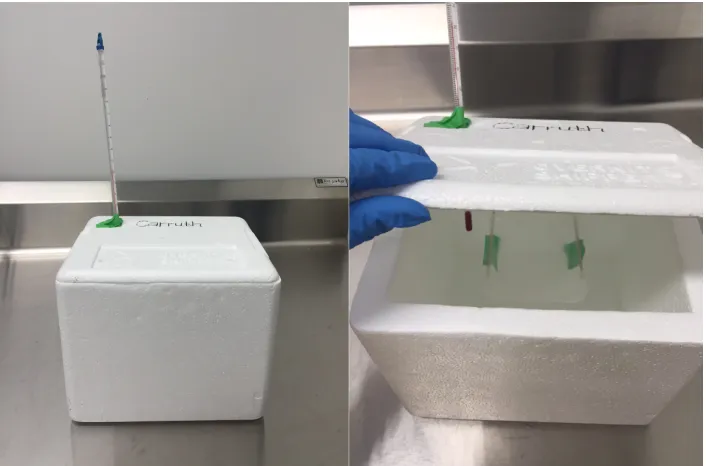
Three styrofoam coolers were used as cold chambers with five, equally spaced holes
punched in the lid (Figure 2). A thermometer was inserted into one hole with the other four
serving as air-ports. Inside the cold chamber, two holes were punctured along one side of the
weigh-boat. Ice was added to the floor of the chamber so that the ice was 1 inch below the inner
holes of the cold chamber. The hatchling was placed on top of the plastic weigh-boat to prevent
[image:28.612.116.469.188.421.2]direct contact with ice.
Figure 2 Styrofoam cold exposure chamber
2.4 Blood Collection for Radioimmunoassay
2.4.1 Baseline Blood Collection
Birds from IBCs and communal flight cages were captured in 5 minutes or less and kept
in a separate holding cage until blood collection. Baseline blood was collected from the right alar
wing vein. A sterile needle (BD PrecisionGlide™ 26G x 5/8 (0.45mm x 16mm) was used to
gently puncture the vein. Approximately 150-μl of blood was collected into multiple
and stored on wet ice for transport to lab. Gelfoam® Dental powder was applied to the wound to
stop the bleeding.
Each bird’s blood sample was transferred into a 0.6 ml Fisherbrand® microcentrifuge
tube. The samples were centrifuged in an Eppendorf miniSpin plus centrifuge at RT for 4 mins at
8.0 rpm. A minimum of 15 μl of plasma was pipetted out and transferred to a new 0.6 ml
Fisherbrand® microcentrifuge tube for Cort RIA. The remaining blood was saved for further
DNA analysis. Plasma and blood was stored at -20°C.
2.4.2 Restraint Stress
Adult and juvenile birds housed in either IBCs or flight cages were captured in less than 5
minutes and transferred into a separate holding cage. Birds were placed in an opaque cloth bag
for 15 mins and held gently. Restraint stress and collection was staggered by 8 mins to ensure
adequate time for blood collection and complete healing of the injury site. Blood collection
followed the protocol described above, however, blood was drawn from the left alar wing vein.
All IBC birds were returned to their respective cages and allowed 1.5 to 2 hrs of recovery before
brain collection. Flight cage birds were not returned to their home cages but remained in the
holding cage within the aviary and were also allowed 1.5 to 2 hrs of recovery before brain
collection.
2.5 Radioimmunoassay for Cort
Total plasma Cort concentrations were measured in adult birds using a Corticosterone
RIA kit (Corticosterone 125
I RIA kit, catalog # 07 – 120102; MP Biomedicals LLC, Solon, OH,
for rat plasma). We validated the use of this kit for measuring plasma Cort concentration in zebra
finches, and this kit has been used in previous studies in song sparrows as well (Newman et al.,
pooled plasma. The standard curve was matched to the zebra finch Cort concentrations range (by
adding 6.25 ng and 12.5 ng through serial dilution of 25 ng standard to increase sensitivity).
Once this was established, we ran a dilution series (1:2 98 %, 1:4 102 %, and 1:6 115 %) of
zebra finch plasma to get linearity and obtained the overall recovery. In addition to the two (low
and high concentrations of Cort) controls that were provided by the kit, pools of zebra finch, rat
(control for assay), and hamster (in house control) plasma were used as extra controls for each
assay run. Recovery rate was 99 % and detection limit was 6.25-1000 ng / mL. Intra-assay &
inter-assay coefficient variations were 5.3 % and 9.4 %, respectively.
2.6 Brain Collection
Brains were collected from experimental and control birds. Prior to sacrifice, all surgical
supplies were washed with soap, water, and 70% ethanol in order to prevent DNA
contamination. Birds were given an overdose of Isoflurane until the heart stopped beating and
then were rapidly decapitated using sharp scissors. The scalp was removed from the base of the
neck and pulled towards the beak to expose the skull. An incision was made around the
periphery of the skull, which was carefully lifted to expose the brain. The entire brain (cerebrum,
olfactory bulb and cerebellum), was quickly removed and placed into a 10 mL tube and flash
frozen on dry ice and then stored at -80°C.
2.7 DNA and Protein Extraction
2.7.1 Homogenization and Phase Separation
TRIzol® Reagent was used to extract DNA and protein from the collected brains
following a standard protocol. For every 100 mg of brain tissue, 1 mL of TRIzol® Reagent was
milli-Q water, 1 M NaOH, and milli-Q water. The resulting homogenate was shaken and
incubated at room temperature before chloroform was added. Once the samples were centrifuged
(Allegra™ 21R Centrifuge) at 5,500 x g for 25 minutes at 4°C, the top, aqueous layer containing
RNA was pipetted out of the solution and immediately discarded. The interphase and organic
layer containing the genomic DNA and protein, respectively, were saved for extraction.
2.7.2 DNA Precipitation, Wash, and Resuspension
For DNA precipitation, the organic layer was treated with 100% ethanol (0.3 mL 100%
ethanol: 1 mL TRIzol® Reagent) and centrifuged 4°C. The protein supernatant was saved for
further protein precipitation, wash and resuspension. The remaining DNA pellet was washed
with 0.1 M sodium citrate in 10% ethanol (1 mL sodium citrate: 1 mL TRIzol® Reagent) and
75% ethanol (2 mL 75% ethanol: 1 mL TRIzol® Reagent). After the removal of supernatant, the
DNA pellet was dried and resuspended in 8 mM NaOH (0.3 mL 8 mM NaOH: 70 mg brain).
2.7.3 Protein Precipitation, Wash, and Resuspension
To the supernatant from the DNA precipitation phase, isopropanol (1.5 mL isopropanol:
1 mL TRIzol® Reagent) was added for protein precipitation. The pellet was washed three times
with 0.3 M guanidine hydrochloride (2 mL 0.3 M guanidine hydrochloride: 1 mL of TRIzol®
Reagent) and 100% ethanol (2 mL 100% ethanol: 1 mL TRIzol® Reagent). Protein pellets were
resuspended in 200 μL 1% SDS. In cases of poor protein solubility, samples were incubated in
50°C. The protein supernatant was transferred and stored at -20°C.
2.8 MethylFlash Colormetric Methylation Quantification
To measure global methylation DNA in whole brain we used the MethylFlash™
was bound to high affinity strip wells before capture and detection antibodies specifically bind to
methylated portions of DNA (5-mC). Quantification was determined colormetrically through a
microplate spectrophotometer with OD intensity directly proportional to the amount of
methylated DNA. To determine the percent and amount of methylation, a standard curve was
produced based on various positive control concentrations. The slope of the standard curve was
used to determine the absolute amount of methylated DNA in the sample based on the formula
below:
2.9 Statistics
All data were analyzed using IBM SPSS Statistics for Windows, version 19.0 (SPSS Inc,
Chicago, IL). First, data were examined for assumptions of parametric statistical test. No
assumptions were violated, and therefore a non-parametric alternative was not needed.
Independent samples t-test was used to compare plasma Cort concentration between baseline and
restraint stress in P30 and P90 birds from the control and experimental groups. The same test
was used to compare the percentage of cytosine methylation in P30 and P90 birds from the
control and experimental groups. One-Way ANOVA was used to compare plasma Cort
concentrations between groups (control baseline, control restraint, cold baseline, and cold
restraint).
3 RESULTS 3.1 Sexing PCR
Juvenile birds do not have sexually dimorphic features and therefore sexing PCR was
performed to sex all birds in this study as described previously in the methods (Figure 3). Lanes
4, 5, 6, 7, 8, 9 and 10 represent male birds (ZZ) with a single Z band at 242 bp. Lanes 1, 2, 3, 11
and 12 represent female birds that contain both Z and W chromosomes at 242 bp and 179 bp.
Additional bands can be attributed to primer competition resulting in differential amplification of
avian sex chromosomes (Griffiths et al., 1998).
3.2 Cort Response after 15-minutes of Acute Restraint Stress
There was no significant difference between baseline and restraint Cort levels in juvenile
control birds (n = 4; p = 0.1298; Figure 5). A similar effect was found in juvenile cold exposed
finches between baseline and restraint (n = 4; p = 0.5093; Figure 5). There was a significant
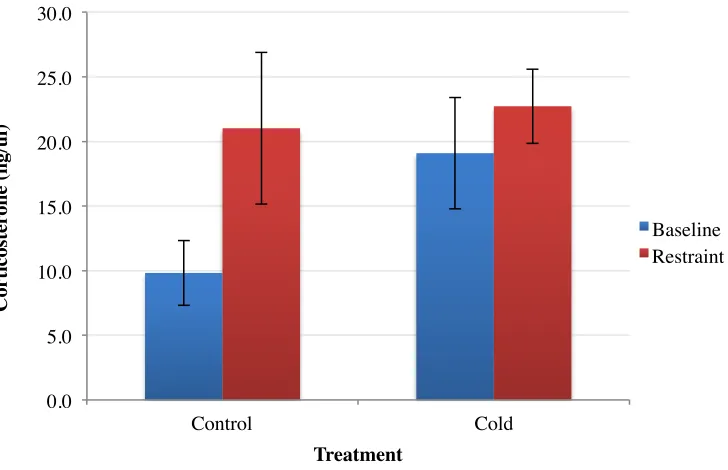
difference between restraint and baseline for adult control birds after restraint stress. These birds
exhibited an elevated Cort response after restraint stress compared to baseline (n = 6; p = 0.0053;
[image:33.612.72.532.363.471.2]Figure 4). The baseline Cort values are consistent with previous studies in the Carruth lab. There 1 2 3 4 5 6 7 8 9 10 11 12
was no difference in Cort concentrations in cold exposed adult birds with the trend towards
having slightly decreased Cort secretion after restraint (n = 10; p = 0.387; Figure 4). However,
cold exposed birds had increased baseline Cort levels and also had little variability in their
restraint Cort response (SEM = 3.4) compared to controls (SEM = 11.1). Independent sample
T-test revealed a significant difference between baseline and restraint Cort levels in control birds
with Cort levels after restraint being significantly elevated. Cold baseline and restraint plasma
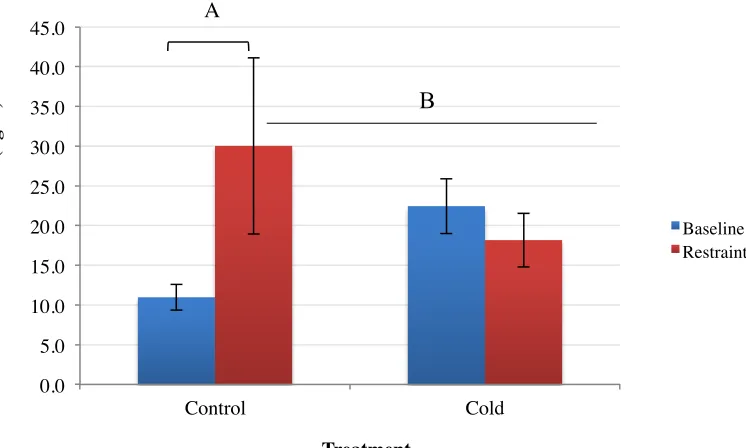
Cort levels were not significantly different from each other. One-way ANOVA revealed that
baseline control Cort levels were significantly lower than cold restraint, cold baseline, and cold
restraint (F (3, 24) = 9.025, P = 0.01; Figure 5). Both cold exposed juvenile and adult birds had
elevated baseline Cort compared to controls. There was no difference in males and females at
either age and for either treatment so sexes were analyzed together.
[image:34.612.100.464.416.651.2]0.0 5.0 10.0 15.0 20.0 25.0 30.0 Control Cold C or ti cos te ron e (n g/ u l) Treatment Baseline Restraint
3.3 Global methylation quantification in control and cold exposed birds
Overall, there were no significant differences in global methylation levels between sexes
so males and females were analyzed together. OD values for juveniles were low compared to
internal control samples, which lead to negative 5-mC percentages. In order to conduct the
appropriate analyses, these values were corrected for based on the 2ng positive control readings
in order to determine the percentage of methylated cytosines. Cold exposed juvenile had
significantly lower global methylation levels as compared to control juveniles (n = 7; p = 0.001;
Figure 7). Adult cold exposed birds (n = 8) had slightly higher percentages of global
[image:35.612.98.471.96.320.2]methylation, but these methylation percentages did not significantly differ from control-treated 0.0 5.0 10.0 15.0 20.0 25.0 30.0 35.0 40.0 45.0 Control Cold C or ti cos te ron e (n g/ u l) Treatment Baseline Restraint A B
birds (n = 6; p = 0.4839, Figure 6). The OD values for P30 had to be corrected against the 2ng
control values but not the values for adult birds and, therefore, analyses, such as ANOVA,
0.0 1.0 2.0 3.0 4.0 5.0 6.0 Control Cold M ean % 5-mC me th yl ati on Treatment 0.0 0.5 1.0 1.5 2.0 2.5 3.0 3.5 4.0 4.5 Control Cold M ean % 5-mC me th yl ati on Treatment *
Figure 6 Percent global methylation in adult (P90) control (n = 6) and cold (n = 8) birds (mean +/- SEM)
[image:37.612.122.454.341.546.2]4 DISCUSSION
The aim of this study was to determine if early life cold exposure affects the sensitivity of
the HPA axis in zebra finches (Taeniopygia guttata) and if this ecologically relevant
manipulation alters global brain DNA methylation. Cold exposure is not as commonly used as
nutritional deprivation as an early life stressor, but it is a natural/ecologically relevant stressor
because it is a type of stress that developing hatchlings can be exposed to in early life under
natural conditions in the wild. Even among these studies, the effect of cold exposure was only
determined within one specific age group and not across developmental stages. For our
experimental design, birds were exposed to acute bouts of cold (15 mins. a day) for the first two
weeks of life and then exposed to an acute stressor as juveniles or adults. While laboratory
manipulation may not completely mirror environmental patterns, experimentally induced cold
conditions and cold conditions in the wild have both been shown to increase Cort levels. Altricial
(such as zebra finches) and precocial nestlings (such as Japanese quail) exhibit significant
increases in Cort not only in laboratory manipulations but also immediately after deteriorating
weather conditions characterized by cold temperatures, heavy wind and torrential downpours
(Bize et al., 2010; Lyn & Kern, 2014). Not only does Cort release promote offspring adaptation
to deteriorating and life threatening situations, studies have shown that CRF also is necessary to
maintain body temperature in offspring (Mujahid, 2010).
In our study, cold exposure in adult birds displayed altered HPA responsiveness. First, we
observed an elevated baseline plasma Cort levels as compared to control baseline levels,
suggesting that cold may re-program birds to maintain higher homeostatic Cort levels. In
addition, there was no significant change in plasma Cort levels after restraint in cold-exposed as
compared to baseline. The lack of a response to restraint may suggest that these birds are
As expected, Cort concentrations in control adult birds were significantly higher after restraint
stress compared to baseline and are consistent with previous studies (Banerjee et al., 2011).
Juvenile birds showed no significant Cort changes in control or cold treatments, however cold
exposed birds also exhibited an elevated Cort baseline, which may also suggests that juvenile
birds maintain higher homeostatic baseline levels compared to control birds.
Many studies support the idea that early life stress programs a hyper-responsive and
prolonged HPA axis response, which has been attributed to low MR and GR binding leading to a
reduced negative feedback response (Banerjee et al., 2011). Interestingly, adult cold-exposed
birds did not show this significant spike in Cort after restraint stress but showed a non-significant
decrease in Cort after restraint. Similarly, studies conducted on white crowned sparrow (altricial)
and Japanese quail (precocial) exhibited a hyporesponsive response among pre-hatch Cort and
post-hatch Cort fed birds with a corresponding increase in GR:MR ratios and receptor abundance
(Wada & Breuner, 2010; Zimmer et al., 2013; Zimmer & Spencer, 2014). High GR binding
capacity accelerates the negative feedback response resulting in a blunted Cort response after
stress.
Furthermore, similar findings were observed in precocial chicken hatchlings (Gallus gallus), which were placed in a small, mesh box for 22 days as a form of early life stress. These birds experienced handling, social isolation, food and water deprivation, and a 10 degree drop in
ambient temperature for up to 3 hours a day (Goerlich et al., 2012). Interestingly, the resulting
adult offspring and the offspring of early life stressed specimens also exhibited the same blunted
Cort response, which suggests that this programmed response has the capacity to cross one, and
possibly multiple generations. Mice exposed to early life stress during adolescence also exhibited
juveniles’ baseline and restraint Cort response did not significantly differ between treatments;
however, there was a non-significant increase in Cort after restraint. Juveniles exposed to Cort
have been shown to have significantly higher baseline and restraint plasma Cort concentrations
while P60 and adult birds showed no such difference (Crino et al., 2014).
Excess prenatal and postnatal glucocorticoid secretion during development has been
associated with increased cardiovascular, metabolic, and neuroendocrine risks in adulthood
(Harris & Seckl, 2011). These effects could be detrimental in the developing brain and have also
been connected to psychological disorders from anxiety to autism. Excess glucocorticoid
exposure in brain tissue and other cells has been shown to increase oxidative stress through an
increase in reactive oxygen species (ROS) (Zafir & Banu, 2009; von Schantz et al., 1999; Tissier
et al., 2014). Adult female zebra finches and chickens injected with Cort exhibited higher levels
of telomere loss, which predisposes cells to apoptosis (Tissier et al., 2014). Furthermore, Cort
has been shown to reduce the actions of free-radical scavenging enzymes (e.g. superoxide
dismutase and glutathione reductase) (Zafir & Banu, 2009). Cort administration early in life has
been implicated to decrease neuron numbers in areas like the HVC and it could be through the
damaging properties of ROS and the telomere loss in DNA that this occurs (Shahbazi et al.,
2014; Tissier et al., 2014). A dampened Cort response to stress could possibly be a way to
protect the developing offspring from the noxious effects of glucocorticoids in order to adapt to a
harsh and changing environment and prevent systemic tissue damage (Goerlich et al., 2012;
Wada & Breuner, 2010). This early developmental profile may program and organize the brain
in a way that allows the offspring to survive and thrive in hazardous conditions.
Environment-matching studies have shown that the combination of prenatal and postnatal stressors attenuates
2013). For example, Merill & Grindstaff treated female zebra finches prior to the shelling of
their first clutch and/or newly born offspring with an antigen that activates helper-T cells, which
synthesizes ACTH thereby promoting Cort release from the adrenal glands. There was a
significant effect on Cort response with the antigen, and the effect was more potent when the
antigen was given both prenatally through the pregnant mother and also postnatally to the
offspring (Merrill & Grindstaff, 2014). Our study focused on postnatal stress exposure rather
than prenatal stress. Additional studies need to be conducted to determine how prenatal and
postnatal stressors affect the developing HPA axis.
In both juveniles and adults, the Cort levels of cold-exposed birds were elevated
suggesting that these birds operate at higher homeostatic limits than control birds. MR, the
receptor responsible for maintaining baseline Cort levels, undergoes the most change during
development with higher binding affinities at P1-P3 and lower binding affinities as hatchlings
age (Wada & Breuner, 2009). After a significant weather evident (i.e. wind, cold and rain),
altricial alpine swifts exhibited higher levels of baseline Cort (Bize et al., 2010). Furthermore,
MR abundance was shown to significantly decline in the hypothalamus, cerebellum, and
hippocampus of maternally deprived zebra finches (Banerjee et al., 2011). It is possible that the
elevated baseline levels may be attributed to changes in MR abundance in the brain, which has
been shown to change during development and be the most affected receptor later in life.
The differences between early life stress vs. control offspring suggest a strong
organizational power at the genomic level that allows an organism to adapt to their environment.
One way early life stress can act to promote adaptation is through DNA methylation. Few studies
have assessed the effect of early life stress on global DNA methylation in birds, particularly
changes in the individual through epigenetic mechanisms and across generations (Goerlich et al.,
2012; Morgan & Bale, 2011). Adult birds in our study did not show any differences in global
methylation levels between control-treated and cold-exposed birds. However, juveniles exposed
to cold demonstrated significant hypomethylation in DNA. Our results contradict previous
research, many of which observed hypomethylation in adulthood rather than in juveniles.
The juvenile period is a critical period for song learning and production. During this time,
juveniles are in the middle of the sensory phase and are hearing their father’s or another male
tutor’s song. In addition, these birds are also beginning their sensory motor phase when birds
learn and practice their song (Zann, 1996). It is not until adulthood (P90) that these birds form
their final crystalized song that is resistant to change or the addition of syllabus (Zann, 1996). In
between juvenile and adulthood, neural circuits are being remodeled. The connection from
LMAN to RA, which is a dominant connection among juveniles, is rewired to a stronger
connection between RA and HVC in adulthood (Bertram et al., 2014, Zann, 1996). Global DNA
hypomethylation may be one way in which these changes can occur, by allowing transcription
factors to access promoter regions in genes required for axon and neuron growth. On the other
hand, adults in our studies showed global hypermethylation. By adulthood, the critical period for
learning is closed and the song is fully crystallized, which means all unnecessary neurons are
pruned away.
Early life maternal deprivation in rats results in significant decreases in global
methylation levels in adulthood (Anier et al., 2014). Our results are similar but only in juvenile
bird with adults showing no significant differences between controls. Global hypomethylation, as
seen in the work by Anier and colleagues (et al., 2014), could be attributed to specific
hypomethylation occurs in the CRH promoter and the Avp enhancer in rats that were stressed early in life (Chen et al., 2012; Murgatroyd et al., 2009). Hypomethylation of the CRH promoter
was shown to increases Cort levels in maternally deprived rats. Furthurmore, Avp prolongs and sustains the activity of the HPA axis by promoting CRH expression. Avp hypomethylation can be another avenue to sustain a potent stress response. On the other hand, Anier and colleagues (et
al., 2014) found upregulation of DNMT3a, a protein responsible for de novo DNA methylation, as well as identifying a trend towards DNA hypermethylation in the PP1C and A2AR promoter
regions in the nucleus accumbens. PP1C and A2AR, the genes for neuroplasticity, were found to
be significantly hypermethylated particularly in adulthood. Upregulation of DNMT3 suggests
these proteins are necessary in early stressed birds to maintain methylation levels in a constantly
changing environment. Taken together, hypermethylation of DNMT and genes for
neuroplasticity could possibly be the dominating epigenetic change in adulthood.
4.1 Conclusions and Future Studies
In conclusion, the present study demonstrates that early life cold exposure alters stress
responsiveness differently across an animal’s life history. Both ages showed an elevated
baseline plasma Cort response accompanied by a blunted response to restraint stress in
exposed birds. Juveniles demonstrated the most significant difference in methylation with
cold-exposed birds exhibiting global hypomethylation. Changes in methylation levels could have
occurred as the bird developed its final song and unnecessary neurons were pruned away.
However, global DNA methylation cannot predict the stress response because our methylation
studies did not focus on genes associated with the HPA axis. However, hypomethylation of the
possible way that stress and methylation could be connected and could be attributed to elevated
baseline levels in our birds.
Additional studies are needed to determine the cumulative effects of prenatal and
postnatal stressors, which have been shown to also greatly affect HPA axis response. A next step
can be to look at methylation pattern differences in GR, MR or other HPA axis related receptors.
We have started this process by performing a bisulfite conversion on genomic DNA from brains
of cold-exposed and control juvenile and adults. This procedure converts cytostines to uracils,
without affecting 5-methylcytosine. This results in changes in a DNA sequence that reflects the
methylation status of that sequence and we are currently designing the appropriate GR and MR
primers to use. These studies may yield information on the DNA methylation on the GR and MR
promoters. By specifically examining these receptors, we can directly determine if there is an
epigenetic role in early life stress specifically in the HPA axis negative feedback response.
Following a targeted, gene specific approach, future studies, such as Western blot analysis, are
needed to determine GR and MR abundance in the brain, which may address how these proteins
are altered during development and in adulthood.
Furthermore, early life stress has both physiological and behavioral consequences
particularly in the forebrain song nuclei. Future studies need to address both global methylation
and gene specific methylation in areas particularly sensitive to development such as the HVC
(Buchanan et al., 2004; Shahbazi et al., 2014). Furthermore, synaptic connections between the
song control system undergoes significant change during development with connections between
LMAN and RA in the juvenile stage and connection between HVC and RA during adulthood
(Bertram et al., 2014; Zann, 1996). Song is considered as an honest signal for male quality, and
shown that breeding conditions can affect song learning with Cort exposed birds reared in small
clutches in individual breeding cages having the highest song learning scores compared to birds
reared in crowed housing conditions (Shahbazi et al., 2014). Cort exposure or any form of early
life stress could possibly shift life history timing in these birds resulting in poor learning and
copying of song. Housing conditions should be an additional factor to consider when comparing
Cort response and global DNA methylation levels. Aberrant DNA methylation could be source
of abnormal physiological, psychological and behavioral phenotypes. In all, these studies
contribute to our understanding of the sensitivity of the brain and nervous system to early life
REFERENCES
Anier, K., Malinovskaja, K., Pruus, K., Aonurm-Helm, A., Zharkovsky, A., Kalda, A., 2014.
Maternal separation is associated with DNA methylation and behavioural changes in
adult rats. European Neuropsychopharmacology. 24, 459-468.
Banerjee, S.B., Aterbery, A.S., Fergus, D.J., Adkins-Regan, E., 2012. Deprivation of maternal
care has long-lasting consequences for the hypothalamic-pituitary-adrenal axis of zebra
finches. Proceedings of The Royal Society. 279, 759-766.
Bertram, R., Daou, A., Hyson, R. L., Johnson, F., Wu, W., 2014. Two neural streams, one voice:
Pathways for theme and variation in the songbird brain. Neuroscience Forefront Review.
277, 806-817.
Bize P., Stocker, A., Jenni-Eiermann, S.J., Gasparini, J., Roulin, A., 2010. Sudden weather
deterioration but not brood size affects baseline corticosterone levels in nestling Apline
Swifts. Hormones and Behavior. 58, 591-598.
Buchanan, K.L., Leitner, S., Spencer, K.A., Goldsmith, A.R., Catchpole, C.K., 2004.
Developmental stress selectively affects the song control nucleus HVC in the zebra finch.
Proceedings of The Royal Society. 271, 2381-2386.
Chen, J., Evans, A. N., Liu, Y., Honda, M., Saavedra, J.M., Aguilera, G., 2012. Maternal
deprivation in Rats is Associated with Corticotrophin-Releasing Hormone (CRH)
Promoter Hypomethyation and Enhances CRH Transcriptional Responses to Stress in
Adulthood. Journal of Neuroendocrinology. 24, 1055-1064.
Crino, O.L., Driscoll, S. C., Breuner, C.W., 2014. Corticosterone exposure during development
has sustained by not lifelong effects on body size and total and free corticosterone
responses in the zebra finch. General and Comparative Endocrinology. 196, 123-129.
different methods to train a young zebra finch (Taeniopygia guttata) to learn a song.
Journal or Physiology – Paris. 107, 210-218.
Eraud, S., Devvey G., Gaillard M., Prost, J., Sorci, G., Faivre, B., 2007. Envrionmental stress
affects the expression of a carotenoid-based sexual trait in male zebra finches. The
Journal of Experimental Biology. 210, 3571-3578.
Gil, D., Naguib M., Riebel K., Rutstein, A., Gahr M., 2006. Early Condition, Song Learning, and
the Volume of Song Brain Nuclei in the Zebra Finch (Taeniopygia guttata). Journal of
Neurobiology. 1602-1612.
Glaze, C. M., Troyer, T. W., 2013. Development of temporal structure in zebra finch song.
Journal of Neurophysiology. 109, 1025-1035.
Goerlich, V.C., Natt, D., Elfwing, M., Macdonald B., Jensen, P., 2012. Transgenerational effects
of early experience on behavioral, hormonal and gene expression response to acute stress
in the precocial chicken. 61, 711-718.
Gryzinska, M., Blaszczak, E., Strachecha A., Jezewska-Witkowska, G., 2013. Analysis of Age-
Related Global DNA Methylation in Chicken. Biochem Genet. 51, 554-563.
Harris, A., Seckl, J., 2011. Glucocorticoids, prenatal stress and the programming of
disease. Hormones and Behavior. 59, 279-289.
Hodgson, Z.G., Meddle S.L., Roberts, M.L., Buchanan K.L., Evans, M.R., Metzdorf, R., Gahr,
M., Healy, S.D., 2007. Spatial ability is impaired and hippocampal mineralocorticoid
receptor mRNA expression reduced in zebra finch (Taeniopygia guttata) selected for
acute high corticosterone response to stress. Proceedings of The Royal Society. 274, 239-
245.
undirected singing in adult male zebra finches. Physiology & Behavior. 76, 9-20.
Marasco, V., Robinson, J., Herzk, P., Spencer, K.A., 2012. Pre- and post-natal stress in context:
effects on the stress physiology in a precocial bird. The Journal of Experimental Biology.
215, 3955-3964.
Merrill, L., Grindstaff, J. L., 2015. Pre and post-natal antigen exposure can program the stress
axis of adult zebra finches: Evidence for environmental matching. Brain, Behavior, and
Immunity. 45, 71-79.
Morgan, C.P., Bale, T.L., 2011. Early Prenatal Stress Epigenetically Programs
Dysmasculinization of Second-Generation Offspring via the Paternal Lineage. The
Journal of Neuroscience. 31, 11748-11755.
Leonardo, A., Fee, M. S., 2005. Ensemble Coding of Vocal Control in Birdsong. The Journal of
Neuroscience. 25, 652-661.
Murgatroyd, C., Patchev, A. V., Wu, Y., Micale, V., Bockmuhl, Y., Fischer, D., Holsboer, F.,
Wotjack, C.T., Almeida, F.X., Spengler, D., 2009. Dynamic DNA methylation programs
persistent adverse effects of early-life stress. 12, 1559 – 1568.
Mujahid, A., 2010. Acute cold-induced thermogenesis in neonatal chicks (Gallus gallus).
Comparative Biochemistry and Physiology, Part A. 156, 34-41.
Murphy, T.M., Millins, N., Ryan, M., Foster, T., Kelly, C., McClelland R., O’Grady, J.,
Corcoran, E., Brady, J., Reily, M., Jeffers, A., Brown, K., Maher, A., Bannan, N.,
Casement, A., Lynch, D., Bolger, S., Buckley, A., Quinlivan, .L., Daly, L., Kelleher, C.,
and Malone, K.M., 2013. Genetic variation in DNMT3B and increase global DNA
methylation is associated with suicide attempts in psychiatric patients. Genes, Brain, and
Murray, J.R., Varian-Ramos, C.W., Welch, Z.S., Saha, M.S., 2013. Embryological Staging of the
Zebra Finch Taeniopygia guttata. Journal of Morphology. 274, 1090-1110.
Perfito, N., Zann, R.A., Bentley, G. E., Hau, M., 2007. Opportunism at work: habitat
predictability affects reproductive readiness in free-living zebra finches. Functional
Ecology. 21, 291-301.
Poole, B., Markowitz, J. E., Gardner, T. J., 2012. The Song Must Go On: Resilence of Songbird
Vocal Motor Pathway. Plos One. 7, 1-10.
Schmidt, K.L., Moore, S.D., MacDougall-Shackleton, E.A., MacDougall-Shakleton, S. A., 2013.
Early-life stress affects song complexity, song learning, and volume of the brain nucleus
RA in the adult male song sparrows. Animal Behaviour. 86, 25-35.
Simpson, H. B., Vicario, D.S., 1990. Brain Pathways for Learned and Unlearned Vocalizations
Differ in Zebra Finches. The Journal of Neuroscience. 10, 1541-1556.
Shahbazi, M., Jimenez, P., Martinez, L. A., Carruth, L. L., 2014. Effects of housing condition
and early corticosterone treatment on learned features of song in adult male zebra finches.
Hormones and Behavior. 65, 226 – 237.
Smiley K. O., Vahaba, D. M., Tomaszycki, M. L., 2012. Behavioral effects of progesterone on
pair bonding and partner preference in the female zebra finch (Taeniopygia guttata).
Behavioural Processes. 90, 210-216.
Spencer, K.A., Buchanan, K.L., Goldsmith, A.R., Catchpole, C.K., 2003. Song as an honest
signal of developmental stress in the zebra finch (Taeniopygia guttata). Hormones and
Behavior. 44, 132-139.
Spencer & Verhulst, 2007. Delayed behavioral effects of postnatal exposure to corticosterone in