Art and Design Theses Ernest G. Welch School of Art and Design
5-9-2015
A Case for Performance Art: An Artist/Educator
Exploring Identity
Zully A. Conde
Follow this and additional works at:https://scholarworks.gsu.edu/art_design_theses
This Thesis is brought to you for free and open access by the Ernest G. Welch School of Art and Design at ScholarWorks @ Georgia State University. It has been accepted for inclusion in Art and Design Theses by an authorized administrator of ScholarWorks @ Georgia State University. For more information, please [email protected].
Recommended Citation
by
ZULLY ANDREA CONDE
Under the Direction of Melanie Davenport, PhD
ABSTRACT
How can vulnerability and censorship culminate into a teaching philosophy in art
education? In the following thesis, a studio exploration from photography into a performance
piece documents how presence and vulnerability play roles in performing and defining identity.
INDEX WORDS: Art education, identity, vulnerability, censorship, pussy, gendered
by
ZULLY ANDREA CONDE
A Thesis Submitted in Partial Fulfillment of the Requirements for the Degree of
Masters of Art Education
in the College of Arts and Sciences
Georgia State University
Copyright by Zully Andrea Conde
AN ARTIST/EDUCATOR EXPLORING IDENTITY
by
ZULLY ANDREA CONDE
Committee Chair: Melanie Davenport
Committee: Kevin Hsieh
Melody Milbrandt
Electronic Version Approved:
Office of Graduate Studies
College of Arts and Sciences
Georgia State University
DEDICATION
ACKNOWLEDGEMENTS
The source for an idea doesn’t spring from one place. Inspiration, to me, is the most
precious of all gifts that I have received from those around me. I believe an idea is like an ice
cream sundae- a multi-faceted concoction that eventually melts into a swirly reality. Inspiration
has been gifted to me from various artists, images and experiences. These factors are like the
creamy ice-cream that sits at the bottom. The support that I have received from family and
friend has been unconditional and I shall never forget it. At work and at home, the people
around me have been there to catch me when I have fallen and they have been willing to lift me
up when I have needed them to. The late night chats, encouraging texts, and patience through an
unforeseen change of course in events have been the color in my life-in my existence. They are
like the sprinkles that bring joy to my world. During this adventure, I have also discovered my
faith and God’s desire for me to lead a fearless life. Through all the doubt and fear, I knew that I
had to do this performance and I knew that it would take me to places of professional and
personal vulnerability. I learned to hear His call and to follow through. Much like the chocolate
syrup on my sundae, God has poured into my life and I have been renewed by it.
The sources of my inspiration don’t exist in a hierarchy. When one takes a bite from an
ice cream sundae the enjoyment is the mixture of all the delicious parts in unison.
TABLE OF CONTENTS
ACKNOWLEDGEMENTS ... v
LIST OF FIGURES ... 4
1 Chapter One: Introduction ... 7
1.1 Purpose of the Study ... 10
1.2 Operational definitions ... 12
2 Chapter Two: Literature Review ... 15
2.1 Why performance as an artist? ... 15
2.2 Why performance as a researcher? ... 26
2.3 Why performance as an art educator? ... 29
2.4 Using metaphor to create sexual identity ... 33
2.5 Censorship in the Art Classroom and beyond ... 38
3 Chapter Three: Methodology and Process ... 45
3.1 Method of Study ... 51
3.2 Limitations of Study ... 52
4 Chapter Four: Performance ... 69
5 Chapter Five: Reflections and Implications ... 89
REFERENCES ... 98
APPENDICES ... 105
Appendix B: Song Lyrics of songs used in performance ... 106
LIST OF FIGURES
Figure 2.1: Sample of M. Barney’s work ... 18
Figure 2.2: Sample of M. Barney’s work ... 18
Figure 2.3: Sample of cat-like creatures from M. Barney's work ... 19
Figure 2.4: Infinite Kisses II by Carolee Schneeman ... 21
Figure 2.5: Sample from Meat Joy by Carolee Schneeman ... 21
Figure 2.6: Sample from Cunt Play by Judy Chicago ... 22
Figure 2.7: Photo of me standing in front of my photograph, after it was found in a closet ... 43
Figure 2.8: Photo of me explaining and validating my work to someone at the show ... 43
Figure 3.1: Sample collage from sketch book ... 58
Figure 3.2: Sketch of cat from memory ... 58
Figure 3.3: Sketch of cat from live observation ... 59
Figure 3.4: Sketch of cat from ive observation ... 59
Figure 3.5: Sketch of body positioning for photograph ... 60
Figure 3.6: Sketch of costume idea ... 60
Figure 3.7: Photo of 'Normal' cat face ... 61
Figure 3.8: Photo of 'Happy' cat face ... 62
Figure 3.9: Photo of 'Sexy' cat face... 62
Figure 3.10: Photo of 'Aggressive' cat face... 63
Figure 3.11: Photo studio set-up ... 63
Figure 3.12: Editing process in Photoshop ... 64
Figure 3.13: Editing process with emphasis on food and expression ... 64
Figure 3.15: "Two Pussies Are Better Then One” ... 66
Figure 3.16: "It's Okay to Eat Pussy"... 66
Figure 3.17: Action shot from photo shoot ... 67
Figure 3.18: Action shoot from photo shoot ... 68
Figure 4.1: Performer at the beginning ... 70
Figure 4.2: Video clip at the beginning ... 70
Figure 4.3: Lionesses grooming ... 71
Figure 4.4: First body position on stage... 71
Figure 4.5: First layered images from projector ... 72
Figure 4.6: First moving image from projector ... 73
Figure 4.7: Rest position ... 73
Figure 4.8: Back bend position ... 74
Figure 4.9: Beginning of 2nd song ... 75
Figure 4.10: More explicit images of cat-like creature ... 75
Figure 4.11: Explicit image of cat-like creature ... 76
Figure 4.12: Cat-like creature with leg up ... 76
Figure 4.13: Close-up of cat-like creature ... 77
Figure 4.14: Close-up of raw chicken ... 77
Figure 4.15: Close-up of raw chicken ... 78
Figure 4.16: Human face layout... 78
Figure 4.17: Image during last song ... 79
Figure 4.18: Layered image near end of Performance ... 79
Figure 4.20: Backbend on tiptoes ... 80
Figure 4.21: 2nd Resting position ... 81
Figure 4.22: Working towards elbows ... 81
Figure 4.23: Moving into the deepest part of the backbend ... 82
Figure 4.24: Last rest position ... 82
Figure 4.25: Video Clip from P.O.P. ... 83
Figure 4.26: A woman being interviewed about being a stripper ... 83
Figure 4.27: Performer has moved into the audience ... 85
Figure 4.28: Removing chicken from under skirt ... 85
Figure 4.29: A video clip with five zoomed mouths chewing and moaning ... 86
Figure 4.30: Placing raw chicken on plates ... 86
Figure 4.31: Preparing chicken and plates ... 87
Figure 4.32: Cutting raw chicken... 87
1 Chapter One: Introduction
“All of the world is a stage.
And all the men and women merely players;”
-William Shakespeare, As You Like It, 1623
Performance is a part of my daily existence. Throughout any given day, I am a daughter,
a sister, an aunt, a student, an employee, a resident in an urban city, and much more. Each role
comes with a different personae and different characteristics, yet they all come together to create
my identity. For example, I am a responsible older sister, but also a free-spirited, inquisitive
student. Baker (2008) defines identity in terms of construction:
So individuals could be said to hold a sex identity, a gender identity, and a sexual
identity, as well as an ethnic identity, a national identity, a social class identity, an age
identity, a religious identity, a work identity, a physical appearance or body identity etc.
It is the sum of these identities that make us who we are. (p. 11)
Yet, where is the line between authenticity and inauthenticity? Who is the true person? What is
the actual or ‘real’ identity? It is my belief that the exploration of identity is the constant
performance of trial and error with different personas. Identity is constantly challenged as it is
questioned, constructed, deconstructed, and reconstructed.
At times, questioning identity is confusing and highly emotional work. I have chosen to
focus on sexual identity and how it can be constructed. “As well as being able to characterize
people according to sex and gender, a third aspect of identity, sexuality, is related to both sex and
gender” (Baker, 2008, p.6). I will address how the construction of my sexual identity is affected
by external factors and is ‘acted out’ and taken as identity. Throughout my research, I have
become increasingly aware of my sexual identity and how openly questioning and sharing
assume things about me. Eventually, how I perform my identity, all aspects of my identity, helps
communicate my identity to others.
Exploring sexual identity remains taboo and is commonly referred to as a private, not
public, venture. As such, sexual identity is played out, ‘acted out,’ rather than openly
questioned. “This social constructionist approach to gender and sexual identities sees these and
other identities as not a matter of who or what people are but a matter of what people do: rather
than have identities, people perform them” (McConnell-Ginet, 2011, p. 8). Both youth and
adults require enough opportunity to question the many constructs that form all aspects of their
identity through performance, or by acting them out. Carlson (2011), in his discussion of the
video, Teenage Sexuality in a Culture of Confusion, quotes one of the featured interviewers as
saying “adolescents' sexuality ‘expresses’ itself in virtually every physical way-in the way you
walk, in the way you talk, in how you dress, in what you do, and how you act” (p. 20).
Questioning gender roles and sexual identity can be important and beneficial work on one’s self.
Adolescent youth may not have the personal insight that adults may have and may, therefore, not
be readily able to discuss sexual attitudes and desires. This is especially true of younger
students. There may, however, be other taboo issue that teachers want to address with students
ranging from elementary to high school. Within my research, I reflect on how my studio process
feeds into my teaching practices and philosophy and how my reflections can be applied by other
art educators. However, encouraging youth to ask questions about assumed gender roles can also
have a lasting positive impression. Sexual identity plays a profound role in person’s identity.
According to Levine (2002):
Gendered sexuality goes far deeper than social attitudes or behavior. It shapes our
but also what, in our heart and groins, we do want: the silent, menacing male stranger; the
reserved but sexually yielding, then voracious, girl next door. Without alternative to
these ingrained fantasies (and again, particularly in the hyper-conformist adolescent
years) these caricatured desires can impede the process of discovering and accepting the
idiosyncrasies of what a person might really want in sex and of finding emotional
fulfillment in relationships. (p. 158)
While it’s imperative that youth actively partake in forming their identity, the idea of combining
‘youth culture’ and ‘sexuality’ also conjures questions of maturity and censorship, especially
when being combined in a classroom setting. Within my research, I have leaned into the
question of how exploring my own identity has expanded my understanding of how students and
teachers may process questions of identity within the classroom setting.
Risk and vulnerability are themes that repeatedly arise in both my performance and
teaching reflections. A part of the performance art experience has been an increased awareness
of risk and vulnerability between myself and the audience. The relationship between intimacy
and risk in performance art is described by Dominic Johnson (2012) in the following:
In its most pressing formulation, live art redefines our understanding of intimacy and
risk. It invites new ways of thinking about how these seemingly opposed logics are tied
to each other, in our experiences of art, performance and the everyday. Live art also
stages the ways intimacy and risk have been historically tied to social, cultural and legal
crises concerning the body, ownership, pleasure and desire. (p. 121)
In this studio-based thesis, I have been able to expand my understanding of risk and vulnerability
through performance art, specifically about a taboo issue such as sexual identity. From this
others and how risk and vulnerability are constantly in flux throughout the process of creating
identity.
1.1 Purpose of the Study
The focus of the following study is two-fold. The first purpose for my study was
addressed through my studio practice, as I seek to explore the process of using the visual
platform of performance art to hold a socially relevant conversation, specifically in regards to the
construction of female sexual identity. Eisler (1995) describes the social construction of
sexuality in the following:
In short, sex does not, as a once-popular song had it, ‘just come naturally.” Rather, as
illustrated by the jarring differences in the prehistoric and contemporary sexual symbols
and images we have been comparing, sex is to a very large degree socially constructed.
(p. 22)
I used metaphor and the use of meaning through language to explore the creation of sexual
identity both internally and in community. Specifically, I relied heavily on the feedback of my
cohort, professors, and studio instructors, with ranging experiences in art education and art
making, as context for my reflections and insights. My studio research questions are:
How can I challenge the socially and historically constructed meaning of the word
‘pussy’ by reconstructing metaphors through the use of songs, images,
advertisements, and my personal reflections?
How can performance art enable me to explore my identity, specifically sexual
identity and help me reframe and reclaim the word ‘pussy’?
Then, I took my insights and processed reflections to address the implications of performance art
my lens as an art educator and I contemplated if and under what circumstances controversial
issues should be introduced to students in the art classroom. Within my practice as an art
educator, my research question is:
How creating a performance piece and documenting an extensive creative process has
benefitted or hindered my teaching philosophy?
The focus of my research is in the realm of taboo issues, as I have found it difficult to introduce
issues deemed as taboo into a classroom. Similarly to sex and sexual identity, other taboo issues
also rely heavily in social metaphors to create, maintain and share their meaning. Ultimately, I
hope to engage students in themes centered on social justice art education; students making
relevant and meaningful comments on social issues even if the issue may seem taboo.
In my curriculum, I hope to include different experiences in art education that require
students to develop empathy. Exploring an otherwise private identity, sexuality, in public can
help create empathy. Barrett (2013) noted, “Self-disclosure can aid in garnering empathy. The
more we reveal about ourselves the more others can think about and feel our experiences” (p.
32). My hope in employing a philosophy based on empathy is to foster students’ empathy for
themselves, as well as each other. It takes courage to explore identity, but, even more so, to
question identity in the presence of others. Similar to my exploration of a taboo and censored
topic--sexual identity and the word ‘pussy’--adolescents and teenagers may also find it relevant
and meaningful to explore their sexual identity or other taboo issues in their community within
the art classroom. By deconstructing my creative process, I am better able to understand, and
empathize with, the obstacles that others may encounter when creating artwork. Empathy is an
art education into my teaching practice. As such, I have reflected on my understanding of
empathy in both my performance piece and my teaching philosophy.
1.2 Operational definitions
Several key terms for this study are briefly defined below. The relevance of these terms
and concepts is discussed in greater detail within the review of literature. The following
definitions explain how I have decided to use these concepts throughout my research.
Sexual Identity- Weeks (2010) states:
The strong emotions it (sex) undoubtedly arouses dives to the world of sexuality a
seismic sensitivity, making it a transmission belt for a wide variety of needs and desires;
for love and anger, tenderness and aggression, intimacy and adventure, romance and
predatoriness, pleasure and pain, empathy and power. We experience the erotic very
subjectively, and in a host of often contradictory ways. At the same time, the very
mobility of sexuality, its chameleon-like ability to take many guises and forms, so that
what for one moment can be a source of warmth and attraction, for another might be a
cauldron of fear and hate, make it a peculiarly sensitive conductor of cultural influences,
and hence of social, cultural and political divisions. Through their sexualities,
individuals are expected to find themselves and their place in the world. (pp. 2-3)
Performance Art- Gomez-Pena (2011) suggested that:
Performance as an artistic “genre” is in a constant state of crisis, and is therefore an ideal
medium for articulating a time of permanent crisis such as ours. Performance is a
dis-narrative and a symbolic chronicle of the instant which focuses mainly on the “now” and
In doing this, performance artists engage in the practice of critical citizenship and radical
forms of democracy that have significant implications for teaching in schools
(Garoian, 1999, p.2).
Censorship- Atkins and Mintcheva (2006) asserted that censorship is:
Sometimes disguised as a moral imperative, at other times presented as an
inevitable result of the impartial logic of the free market. No matter how it may be
camouflaged, however, the result is the same: the range of what we can say, see, hear,
think, and even imagine is narrowed. (p. xv)
Taboo- Rosewarne (2013) explains the following about taboo topics:
While sex, politics and religion might be conversation topics that make first dates
awkward, dinner parties uncomfortable, and classroom, staffroom, and locker-room
discussions fiery, the very fact that they summon such strong — such visceral —
reactions highlights that these are also the very topics that we have the most passion for
and certainly harbor the most curiosity about. (p. vii)
Time and time again, these topics have been shown to titillate, offend, arouse, and create
angst — if not outrage. Likewise, each has a history of controversy and scandal, be it
related to censorship, restricted classification, protest, or just accusation of poor taste.
(p. viii)
Metaphor- As a literary term, metaphor is “a word or phrase for one thing that is used to refer to
another thing in order to show or suggest that they are similar; an object, activity, or idea that is
used as a symbol of something else.” (Merriam-Webster dictionary)
According to Lakoff and Johnson (1980) metaphors, as it relates to self-understanding, can be
We seek out personal metaphors to highlight and make coherent our own pasts, our
present activities and our dreams, hopes and goals as well. A large part of
self-understanding is the search for appropriate personal metaphors that make sense of our
lives. Self-understanding requires unending negotiation and renegotiation of the meaning
of your experience to yourself. It involves the constant construction of new coherences
in your life, coherences that give new meaning to old experiences. The process of
self-understanding is the continual development of new life stories for yourself. (p.232-233)
A/R/Tography- This term describes the relationship between artist, researcher and teacher and
how each role can interfere and complement each other. The roles are present all the time and
are not limited to conducting research. According to Pinar (2004) a/r/tography can be described
as the following:
A/r/tographical work is a specific category of arts-based research practices with education
research. A/r/t is a metaphor for artist-research-teacher. In a/r/tography these three roles are
integrated creating a third space. These practitioners occupy ‘in-between” space.
A/r/tography merges knowing, doing and making…A/r/tography is a form of representation
that privileges both text and image as they meet within moments of metissage. But most of
all, a/r/tography is about each of us living a life of deep meaning through perceptual
practices that reveal what was once hidden, create what has been known, and imagine what
2 Chapter Two: Literature Review
In this chapter, I will discuss in more depth the themes I explored in my performance
piece and thesis, such as my choice to use performance art practices in my studio and for
reflections in the art classroom; the relationship between language, metaphor, and the
construction of sexual identity; and how censorship can play out in the art classroom and beyond.
2.1 Why performance as an artist?
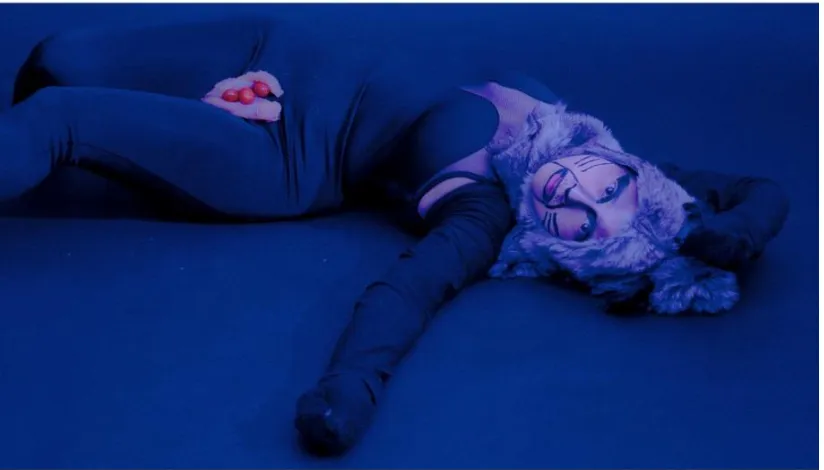
In the spring of 2013, I decided to take a photography class, ‘The Animal’. The premise
behind the class was to research the many relationships between human beings and animals. By
the end of the semester, we identified a small location that was willing to host an exhibition of
the work made by all the artists in the class. Prior to opening night, I was informed that my
photo had been removed from the exhibition space. My speculation is that the title of my photo,
“It’s Okay to Eat Pussy” was the determining factor for it getting taken down, rather than the
image itself. Initially, I felt offended and surprised. While the audience was engaged and
curious in knowing the reasons why it was removed, the audience was also dismissive of the
complex image of sexuality and desire that is constructed in the photograph (See Figure 3.16).
This hit a nerve. By including the word ‘pussy’ in the title and therefore making a reference to
explicit female sexuality, I addressed the taboo, and otherwise private, issue of female sexuality
and desire.
Performance art has a history of addressing controversial issues. “In more recent times, it
[performance art] has been the genre of choice for artists of marginalized cultures who have
found the strategy of radical critique necessary to aestheticism issues surrounding ethnicity,
sexual orientation, gender, race, and class distinctions” (Garoian, 1999, p. 18-19). The history of
trajectory of my studio work. In the book Live Art and Performance, Heathfield (2004)
describes the use of the body as “stepping away from the representation of the human subject
found in portraiture and the depiction of the artist found in the self-portrait, twentieth-century
artists increasingly stepped inside the frame, using their own bodies as sites of experimentation
and expression” (p.11). With the use of performance art, I have addressed the body, specifically
the female body. Heddon (2012) asserts that:
Live art brings the artist body into view in new ways, engaging questions of ownership,
property, self-determination, legitimating, repression and control. Bodies themselves
need to be read as a result of various discursive practices, practices located historically
and culturally. The body is never experienced-lived or witnessed- as an unmediated,
unmarked canvas. Mediation, though, marks bodies differently. Live art practices,
where the body is engaged as material, often take that already culturally marked body and
remark it- revealing the operations and impacts of cultural inscriptions and/or rewriting
such inscriptions in an attempt to figure other possible bodies and lives lived through
them. (p. 184)
My decision to use the female body in a performance piece was an invitation to dialogue about
female sexuality, particularly as represented by the word ‘pussy’.
My artistic pursuits towards a performance piece started with extensive research of
contemporary performance artists, specifically how artists investigate the construction of desire
in performance art. I wanted to understand how the consumption of the female body changed
when the body was placed in the same space as the audience. There were numerous artists that
influenced my work. The artists that made the greatest contributions to my work are Matthew
paths for addressing the female body in performance and I gathered the greatest insight on how
to address female sexuality. I started with an interest in Matthew Barney’s work. While Barney
is not considered a feminist artist, his work does address gender and identity. As Margo
Crutchfield, the director of the Fast/Forward series notes, "fact and fiction are blurred. Barney
presents an outrageous and baffling arena in which issues of gender, the body and the
construction of identity do battle (“Matthew Barney’s enigmatic art”, 2000).
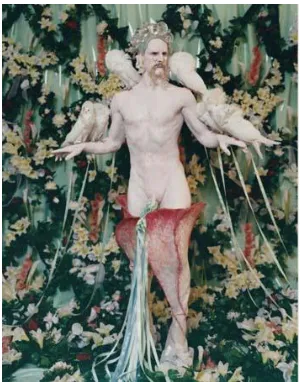
I was astonished by his complete metamorphosis into characters, both human and
creature, and his commitment to staying within that character for the duration of the performance
(see Figure 2.1, 2.2). Aesthetically, Barney sexualizes flesh, but the result is not a sexy image
but grotesque, even horrifying images. I was inspired by Barney’s use of flesh as it resembled,
in my mind, meat. More specifically, I was drawn to a cat-like character in his film Cremaster 3
(see Figure 2.3). The image is of a half-human, half-cat creature that is naked. I found the
image to relate to an alter-ego associated with female sexuality and the persona that female
desire should resemble. The creature fashions sharp nails and bare breasts, a mixture of predator
and nurturing care-taker. The image is a contradiction of sorts and I believe it resembles an
internal conflict that women may experience when working out their desires and sexual
Figure 2.1: Sample of M. Barney’s work
[image:25.612.107.257.331.522.2]Figure 2.3: Sample of cat-like creatures from M. Barney's work
The second artist I researched was Carolee Schneemann. Schneemann is considered a
feminist artist and her work uses cats and meat as well. Amongst Schneemann’s extensive work,
I focused on Meat Joy and Infinity Kisses II (1990-1998). The work, Infinity Kisses II, is a series
of 124 self-shoot 35mm color slide photo sequence (see Figure 2.4). Benzan (2010) states, “In
Infinity Kisses, the boundaries that distinguish feline and female beings are physically probed
through the exchange of saliva and the ambiguous touches of two tongues” (p. 9). “However,
the particular presence of Infinity Kisses speaks to the intimate connectivity between
Schneeman's feminist practice, sexual politics and ongoing attention to (and thinking with) feline
companions in her art and life” (p.7). From Schneeman’s Infinity Kisses II, I was inspired by
the rawness and imperfections in the images that she shares.
Meat Joy is a performance piece in which a group of 8 partially nude people were asked
to dance, run, and embrace each other in the center of a room. While the participants interacted
with each other, Schneemann would periodically lay paint, raw fish, and raw chicken on the
participants and the participants would include the new material in their interactions. For
example, a couple lays on top of each other while a whole raw chicken is smashed between them
the construction of the erotic. Within Schneeman’s work, I traced back questions of the
construction of intimacy and the erotic. Johnson (2012) describes the role of intimacy in the
following:
When viewed as a continuum, intimacy unsettles and outstrips binary oppositions:
love/hate, monogamy/infidelity, pleasure/pain, security/danger, and, perhaps,
intimacy/risk. Sliding uncomfortably between supposedly distinct terrains, intimacy is
therefore seemingly bounded by abuse, solitude, infidelity, and other risks, such that too
little to too much intimacy augurs a dereliction of sorts. (p.122)
Intimacy is filled with contradiction and experienced duality. Intimacy is not only associated
with tenderness but also with violence. According to Benzan (2010) violence has been
associated with ‘Infinite Kisses II’ in the following way:
Viewers have asked whether this is bestiality or whether the cat was biting Schneeman,
but what Schneeman captures on film is not the sexual intercourse of bestiality. It is
gentler exploration of and by the sensual organs of speech that are not speaking. (p.10)
Figure 2.4: Infinite Kisses II by Carolee Schneeman
[image:28.612.109.287.412.626.2]Another artist whom influenced me is Judy Chicago. During a practice exercise with her
students at Cal State, Chicago would ask students to wear enlarged replica genitals. The students
would use the word cunt and cock to describe different gender roles, such as “You have a cunt.
A cunt washes dishes. And I have a cock and I cock does not wash dishes” (Dancoff, 2012). As
performed by Wilding and Lester, two of Chicago’s students, The Cock and Cunt Play inspired
me by the overt use of the genitialia to reconstruct sexual identity as an experience. The
enlarged genitalia became the focus of idenity and the reason for behavior. In this way, the
genitalia symbolized both sex and gender roles. Also, the nude female body, which is common
in performance art, is not present. I believe that even though the bodies are covered with black
leotards, the flesh colored genitals and their positioning remain erotic.
Figure 2.6: Image of Cock-Cunt Play by Judy Chicago
Within the emerging trajectory of my studio work, performance art was the next step. I
wanted to challenge the notion of ‘being’ and performance art is able to question both presence
and time. Having started my research in photography, I heavily relied upon my ability to capture
a moment in time and then remove myself from that moment. After taking a photograph, I am
advantage of, and took comfort in, the nature of photography in allowing for this removal. I am
able to simultaneously experience my photographs as artist and as viewer with ease. However,
through performance art I am present as woman artist and not as viewer. Instead, I surrendered
my ability to be the viewer so that the audience becomes the only present viewer in a specific
time and space. What does it mean to ‘be present’ or to ‘be there’? According to Josette Feral
(2012):
The first step is to define presence in comparison with absence. Presence would be what
is here, what is not absent. This is to say, present within the subject’s space and time.
This relationship with respect to space and time is fundamental. (p. 31)
More so, Feral (2012) defines the ‘presence effect’ as ‘the feeling of a body’s (or an object’s)
presence- that these bodies or objects create the impression of really being there, even if the
audience rationally knows that they are not” (p. 29). I chose to consider some of the
characteristics of ‘presence effect’ when planning for my performance. The audience is required
as spectator to participate by watching the performance. An awareness of the ‘observer gaze’ is a
part of all performance. More specifically, my performance addresses female sexuality -female
body and desire- on public display and, therefore, the male gaze becomes more voyeuristic. The
audience is viewing something that is private and as they become aware of their voyeurism; they
also become aware that they are a part of a group watching a female body in sexual exploration.
As a performer, my awareness of the audience’s gaze becomes a part of the performance.
According to Carlson (2004), the male gaze can be challenged during performance art. The
author states that ‘live art...can expose the (male) spectator to the fearful proximity of the
performer and the dangerous consequences of his own desires” (p. 185). More so, ‘his (the
within the work” (p.185). As a performance artist, I must determine how to address the audience
and the role the audience will play in the performance. Even in choosing to ignore the audience
or to operate as if the audience isn’t there, would be a role that the artist chooses for the
audience. As such, by acknowledging the ‘observer's gaze’ I meant to invite the audience to
watch an otherwise private exploration of female sexuality through my performance. In the
operations of my performance, I acknowledge the audience by my choice in body position,
talking to the audience, and ultimately moving into the audience’s space. However, beyond
watching the performance, presence can also include reflection or what the audience thinks
during the performance. While the physical presence of the spectator is necessary, the artist can
thereafter determine if a ‘presence’ beyond that is required from the spectator. In How to Define
Presence Effects, Feral (2012) defines presence effect in as ‘the point between the self and the
world outside, in a place where the sense of place and time are fictionalized” (p. 43).
According to Feral (2012), other characteristics of ‘presence effect’ are that:
It puts man, at the very core of his own representation, into play. Through him, the
subject experiences, his existence in the world.…Evokes the feeling that there is a
genuine sharing of a common space and time. It takes place in the present…. It is this
primary relation to perception that gives the spectator the feeling that there is a real
sharing of a common space and time. (p. 44)
During the performance, the audience is invited into an aesthetic experience as well as an
evoking an imaginative experience. As such, Feral (2012) explains:
Allows the senses to be awake, to be ‘on call’. Among the sensory organs involved, the
most important are the eyes, whether vision is ‘effective’ and serves a caution to the
of a gap, an absence, a play of illusion…with the presence effect, there is an escalating
process of automation of the image by showing it as an escalating process of automation
of the image by showing it as the focus, not the product. This is the visibility of the
imaginative process in its truest sense; the image’s revelation creates the presence effect
because it makes the focus of perception palpable. (p. 45)
Lastly, performance can also conjure up memories and therefore effect presence as the audience
remembers previous experiences and association with what they are viewing. Feral (2012)
elaborates in the following:
Reality is absorbed, rendered, in a hyper-personalized space that intensifies
self-consciousness to an even greater degree than the awareness of outward reality. It
becomes equally clear that presence effects call upon memory and are connected to the
different modalities of representation that authorize the operation of ‘recognition’ in the
absence of the object. (p.43)
To clarify, the aim of my performance is not to coax the audience into believing that female
sexuality is defined by my behavior. Rather, I invite the audience to be present in my
questioning of private thoughts and desires. Beyond being present, the audience can reflect on
their desires and exploration of the word ‘pussy’. The audience does inevitably become aware of
their presence, though it may not always occur during the performance. Feral (2012) comments
about presence effect in the following:
Allows spectator to find themselves at the heart of a ‘performative’ experiment where,
first and foremost, they understand that there is a gap between their perception and the
Using performance as an artist to explore identity, specifically sexual identity, I am able to
engage the audience in a different type of experience by altering the time of their presence. It
was my goal to bring the audience into the performance and include them in an actively present
role, but to also include moments in which the audience may be reflective and analytical of the
performance.
2.2 Why performance as a researcher?
Traditionally, research is based on the reliability and predictability of the scientific
method. In this way, the results or findings from research are tested and considered valid. “An
assumption embedded in the scientific method is that knowledge is gained through the
speculation, accumulation, analysis, and confirmation of facts, and the utility of empirical
approaches remain the cornerstone of scientific inquiry” (Sullivan, 2005, p. 41). Art, however, is
different. It does not depend upon its predictability or reliability for its success. Instead, art can
arguably be said to stray in the opposite direction by being most effective when it is unexpected
and uncommon. Arts-based research may then sound like a contradiction and unlikely to yield
‘quality’ research findings. Yet, when the process of art-making is looked at closely, it
resembles the inquiry and problem-solving that are also a part of other forms of research. “Art
and science bear intrinsic similarities in their attempts to illuminate aspects of the human
condition” (Leavy, 2009, p.2). Within my process of theorizing and problem solving, methods
of research are found. “Constructive theorizing helps to construct explanation about what, why
and how problems arise, and how discrepancies between what is believed and what is
encountered are resolved” (Sullivan, 2005, p.76). Within my research questions, I investigate the
socially constructed meanings and applications of the word ‘pussy’. “Research of art
and issues” (Sullivan, 2005, p. 80). As such, my research includes not only my personal
reflections but how I have found that the word ‘pussy’ is socially defined through the use of
music and its association to accepted behavior.
More specific to my research, my pursuits as a researcher are supplemented by my
endeavors as an artist and teacher. Using the relationship between artist, researcher and teacher,
also referred to as a/r/tography, I allow and heavily rely on my studio practice and interest to
communicate and translate into research questions. Irwin (2004) defined the a/r/tography
experience as:
A/r/tographers are living their practices, representing their understandings, and
questioning their positions as they integrate knowing, doing, and making through
aesthetic experiences that convey meaning rather than facts. Theory as a/r/tography
creates an imaginative turn by theorizing or explaining phenomena through aesthetic
experiences that integrate knowing, doing, and making: experiences that simultaneously
value technique and content through acts of inquiry; experiences that value complexity
and difference within a third space. (p. 31)
As such, I have used arts-based research in my exploration of the constructed meanings of the
word ‘pussy’.
In many examples of research, art and writing complement each other and, by being
coupled together, provide a clearer, deeper understanding. As explained by Irwin (2004):
Art and writing unite the visual and textual by complementing, refuting, or enhancing one
another. Image and text do not duplicate one another but rather teach something different
The characteristics of presence and time are also relevant to using performance art in my
research. The role of performance in research is described by Kershaw (2012) as:
Performance is always already boundless. Yet also performance (and performativity) in
both organic/inorganic “worlds” is never other than perfused with space and time. Every
example is incorrigibly particular. Hence boundless specificity is a constitutive paradox
of performance and performativity, creating multiple ontologies and epistemologies,
ways of being and knowing. That paradox ensures that performance practice as research-
defined as the use of practical creativity as reflexive enquiry into significant research
concerns (usually conducted by “artist/scholar” in universities) –will present both highly
specific and very broadly applicable results. (p.4)
However, there are also challenges to basing research on performance art practices. One of the
challenges has been to putting the lid on the social connections and implications that can be
found in my performance. Embedded with questions of feminism, violence against women,
gender studies, technology and art, and much more, numerous disciplines can be found within
my performance. As further defined by Kershaw (2012), a characteristic of performance art as
research is as follows:
Its concerns may be defined by languages of particular disciplines, but the paradox also
ensures this type of research will always resist becoming a single discipline as its projects
proliferate insights, understandings, knowledge that overall, will be part of many
disciplines. Similar tendencies propose performance as an antidiscipline. A similar
move for performance practice as research would claim it as a transdiscipline. Implying
that, most typically, it will generate procedures and protocols relevant to research in
itself as method and methodology in search of results across disciplines: a collection of
transdisciplinary research “tools”. (p. 5)
Opting to use performance art as the medium to show my research has allowed me not only to
address personal reflections but also to include and relay social and philosophical insights.
2.3 Why performance as an art educator?
One of the original inspirations for my research comes from an experienced intersection
between my identity as teacher and as a researcher and using this experience for reflection in my
studio practice. As a Pre-kindergarten teacher, I observed how my students used performance to
create their identities and test experiences. Without much prompting, a number of my students
created artwork, mostly collages and role-play, addressing not only events they saw at school
that day but also dialogue and behavior they had witnessed at home. A majority of the narratives
that they created or acted-out were strongly driven by gender roles. For example, roles such as
‘mother and father’ or ‘caretaker and worker’, were commonly divided between girls and boys
according to traditional gender roles. Even though I did not have formal conversations about
identity with my students, my students did find it necessary to perform their identities in
solo-play and during interactions with other students. My students might not have been aware of how,
through play, they were in fact creating their identities through performance. As such, my
teacher observations were my first impressions of how gender roles can be explored in
performance art and the risk and vulnerability that are a part of the process.
The work of creating identity is a constant ambition. Regardless of age, all students will
go through various experiences of constructing, questioning, and reconstructing identity. As
Our age identity is constantly changing throughout our lives, and there is very little we
can do to stop changing it. We have no choice in becoming a teenager, adult or old
person (although we do have more control over the way we orient to and outwardly
express those identities, for example, by attempting to hide our increasing years by
wearing clothes normally worn by younger people). So we have varying amounts of
control over, and consciousness of, the different types of identities that we possess.
(p. 11)
As such, my work as an art educator is to be aware of how identity is constructed and to be alert
to the fact that my students will inevitably deal with the construction of their identity. Baker
(2008) explains the following about the construction of identity for students, specific to sexual
identity, “Ideologies of gender and sexuality are interdependent. How students believe, value,
and practice gender in their talk directly connects to how they believe, value, and practice
sexuality” (p. 8). While younger students may not be deciphering their sexual identity or sexual
desires, my pre-kindergarten students did explore their identity by role-playing gender roles.
Charles R. Garoian is both a performance artist and an art educator. In his book,
Performing Pedagogy, Garoian (1999) describes the connection between performance art and art
education:
Performance artists use memory and cultural history to critique dominant assumptions, to
construct identity, and to attain political agency. In doing so, performance artists engage
in the practice of critical citizenship and radical forms of democracy that have significant
implications for teaching in schools. (p. 2)
In a traditional classroom, the teacher is the performer and the students engage as audience. By
speaker, the performer. According to Garoian (1999), the use of performance art pedagogy is a
three-layered process:
First, as a process of objectification, the critique of performance art enables student to see
the culture that they embody and to expose and problematize its hidden circumstances.
Second, as a process of subjectification, it enables students them to see themselves within
culture by critiquing it from the perspective of personal memory and cultural history.
Third, it provides them as opportunity to see their performances within culture as they
critique the positionality of their performances within the expanded field of cultural
history. (p. 9)
However, I believe that introducing performance art and performance pedagogy can help change
the dynamics of who is teaching. In other words, performance pedagogy can empower students
into becoming the source of information, i.e. the teacher.
I have also chosen to consider performance pedagogy, because performance art is a
contemporary practice that has helped to redefine art by constantly challenging the norms. “It is
this critical-thinking dimension of performance art-the desire to experience, question, and
respond to contemporary culture and to create culture anew from interdisciplinary and
intercultural perspectives-that is significant to a pedagogy of postmodern art education”
(Garoian, 1999, p. 19).
During my classroom observations, I noted that some of my students created distance
between their identity and their experiences by employing fictional characters in their artwork
and in their skits. An awareness of risk and intimacy, and ultimately vulnerability becomes a
part of the performance art experience for both artist and audience. The relationship between
In its most pressing formulation, live art redefines our understanding of intimacy and
risk. It invites new ways of thinking about how these seemingly opposed logics are tied
to each other, in our experiences of art, performance and the everyday. Live art also
stages the ways intimacy and risk have been historically tied to social, cultural and legal
crises concerning the body, ownership, pleasure and desire. (p. 121)
If risk and vulnerability are a part of performance art, one of my concerns, as an art educator, is
creating a safe space for the exploration of taboo issues. An example of using performance art to
dialogue about a taboo issue with high school students is The Roof Is on Fire, a project pioneered
by Suzanna Lacy. Garoian (1999) offered that:
In June 1994, two hundred Oakland, California, teenagers, mainly African Americans
and Latinos, gathered on the rooftop of the new downtown federal building parking lot to
discuss a number of issues concerning their lives in the inner city: sex, violence, values,
family, school, the future, and the mass media’s stereotyping of youth as criminals. As
they spoke out about these and other issues that affected their lives, they sat in new,
rented, and loaned automobiles that filled the parking lot, private spaces of their choosing
within the public context of the city. They sat and talked in parked cars with their
windows rolled down and, in the case of convertibles, their tops open. As the students
began their conversations, the audience walked up the ramps of the garage and
approached the “sound installation” of parked cars in order to “listen in”. (p. 125)
Even though Lacy uses performance art as the medium, community values and issues become
the topic of the performance and, therefore, they are most important to Lacy’s approach to
community and engages them in dialogue with their community. Garoian (1999) describes her
curriculum’s role in the community in the following:
Her art work is performative curriculum because it opens a liminal space, within which a
community can engage a critical discourse, a space wherein decisions are contingent
upon the collective desires of its citizens, as well as an ephemeral space because it is
applicable to the particular time and place for which it has been designed. Thus, for
Lacy, communities are contested sites, and performance art is a function of community
development. (p.128)
As an educator it is essential to remember that what is considered taboo will vary and that a keen
awareness of what would be considered deviant in any community is important to know before
attempting to address taboo issues in an art classroom. Maintaining an awareness of community
values can help create a safe space. Students may feel less at risk and vulnerable and begin to
feel valued and supported by their community. According to Maslow’s hierarchy of human
needs, “students need to feel emotionally and physically safe and accepted within classroom to
progress and reach their full potential” (McLeod, 2007) As part of my teaching philosophy, I
hope to encourage students to ask questions and decipher through their opinions on taboo issues
relevant to themselves and their community.
2.4 Using metaphor to create sexual identity
“One is not born a woman, but rather becomes one”
-Judith Butler, (1990)
Language is a part of everyday life; it helps us communicate who we are and gives us
information about the world around us. As such, language is powerful. According to
coordinating actions with others, to sharing ideas, to reminding others and ourselves of plans and
commitments, to amusing ourselves and others, to making sense of ourselves and our world” (p.
5). More so, the use of language defines identity and culture. The influence of language on
culture was described by Kyratzis and Sauntsson (2007) thus:
A language’s vocabulary and grammar, according to Spair (1949: 90-1), is not a mere
collection of meaning and structures, but a ‘complex inventory’ of whatever is culturally
significant to a community. Therefore, in order to understand a culture we should look at
language first. (p. 7)
Language is therefore manifested in all realms of society, including creating sexual identity and
desire. Language is able to create meaning by defining acceptable and deviant behavior. As
described by McConnell-Ginet (2011):
Language plays a key role in creating and sustaining (and sometimes challenging and
changing) all of the varied kinds of beliefs and practices that inform gender and sexual
identities, relations, practices, and ideologies. This is because language is meaningful:
we use it to do things with one another, to ‘do’ gender and sexuality as well as much
more. (p. 15)
To construct meaning through language is a process. The process of creating meaning involves
both power (a consensus of meaning) and practice (using language with specific meaning). As
described in Campbell-Kibler, Roberts, and Wong (2002):
Those with meaning making power (e.g., the media) attempt to naturalize their own
ideologies about the social category that a given label denotes. Naturalization works by
creating what Stuart Hall (1982) calls “the reality effect.” Dominant ideologies that are
naturalized become the literal meaning of the label. (p. 9)
Therefore, meaning is constructed through language by a common acceptance of meaning.
Secondly, the accepted meaning of words must be performed to communicate and further
establish meaning. However, meaning is not stagnant and can be changed through power and
practice. For example, Campbell-Kibler, Roberts, and Wong (2002) describe the change in
meaning of the word ‘hussy’:
According to McConnell-Ginet, it is plausible that a certain ideology of the speech
community was that sexual wantonness was a characteristic of the housewife. Those who
embraced this ideology would say hussy and rely on their addresses to invoke that
characteristic when interpreting the utterance. When enough uses of hussy to insult
succeeded, subsequent language users would be able to interpret the insult without
relying on any extralinguistic attitudes. (p.9)
Currently, the use of the word ‘hussy’ continues to have a negative connotation. However, the
degree to which the word ‘hussy’ is offensive may vary in different communities. Hence, the
construction of meaning through language is also directly influenced by the culture in which it is
used. As explained by Kyratzis and Sauntson (2007),
In an Austinian definition of a speech act, to say something is to do something, so that we
literally perform actions by producing utterances. This notion has informed much current
theorizing of language, gender and sexuality- we speak our gender and sexuality into
existence….So, gender and sexuality are not simply brought into being by speaking or
doing, but via a process of interaction between the speech act and the grounded
As such, the actual meaning associated with a word, such as ‘hussy’, can vary depending on the
community or culture in which it is used.
Within the realm of language, I will be focusing on the use of metaphor to connect both
language and meaning. As described by Kyratzis (2007),
Metaphors are ‘filters’ that help us structure abstract concepts so that we can understand
them; in this sense, our conceptual system is to a large extent metaphorical and,
consequently, the way we live is largely based on metaphors. Metaphorical processes
involve the bringing together of two concepts; hence, metaphor can be defined as
understanding one thing in terms of another. (p.96)
In my use of metaphor, I will compare the word ‘pussy’ tot the images it is associated with
(aggression, animal-like, cat-like, sensual). I am completing the metaphor ‘Pussy is like…’. In
this way, I will use metaphor to help define ‘pussy’ based on language found in popular culture.
More so, specific to sexuality, metaphors have helped to create and maintain negative aspects of
sexuality. Kyratzis (2007) explains the finding of a previous study that sought to survey
conventional metaphors of desire in the English language (drawing data from the British
National Corpus); the study found the following:
We fear desire, possibly for its potential to disrupt the established patterns of our
lives;
desire is talked of metaphorically as a wild animal and as the dangerous elements
of water, fire and electricity;
we project [desire] linguistically onto objects or forces outside ourselves. Thus,
reflects our physical perception of desire and allows us to disclaim responsibility
for 'sinful' desire. (p. 114)
The meanings implied in the metaphors that construct female sexuality and desire are most
relevant to my research.
Female sexuality has a range of metaphors associated with it. Specifically, I am focusing
on the metaphors constructed for the word ‘pussy’. In my research, I have challenged the
meaning and the use of the word ‘pussy’ by questioning the metaphors associated with it and
how men and women create desire (behavior) based on the accepted meaning. The word ‘pussy’
is closely associated to a cat or feline. As described by Blackledge (2003),
Cats are, curiously, still irretrievably associated with female genitalia and all things
female. In Britain, ‘pusse’ first surfaced in 1662 as a vaginal descriptor; now the term
has become ‘pussy’. In Italy, the words for a female cat, chatte and gatta, both signify
the vagina. Cats in many cultures also have associations with sex, female sexuality and,
sometimes, prostitution. Women are feline, men never. Various cultures recognize and
respect cats as having mystical powers, as a witch’s companion or familiar, for instance,
while some, in particular in Japan, believe cats bring good fortune. Japanese brothels
also use the cat as sign to indicate the nature of the establishment- a place where the
vagina can be viewed and more. Despite the intervening centuries, cats and vaginas are
still linked, just as vulval display was with Egypt’s feline pleasure goddess, Bast. (p. 13)
In other words, by using the word ‘pussy,’ one is linking female sexuality to an animal, a cat.
Through this connection, meaning is constructed through the metaphor of ‘women are like cats’.
The accepted metaphor of female sexuality resembling a cat, leads to female sexuality
2.5 Censorship in the Art Classroom and beyond
Now imagine the following: a teacher decides she wants to introduce her students to
meaningful, socially relevant art. She wants to talk about racism, sexism, and social justice. She
wants to familiarize herself with what her students have to say about these issues and how the
issues come into view in their community. Our teacher, in this scenario, is a firm believer that
her students can be agents of change, and she wants them to ask questions and deal with difficult
answers. We all know what happens next: parents react, principals respond, and teachers are
reprimanded. This story may seem bleak and scary. However, while the narrative may seem
exaggerated and oversimplified, it illustrates how values can be created within a community and
how censorship can occur when divergence from established behavior ensue.
During my research and into my studio practice, I was censored and edited by three
sources: the art education cohort, the artist community from a photography class, and myself.
They edited and censored for different reasons and their reasons were a reflection of the values
they were upholding.
To begin with, the process of censoring is clearly not an isolated self-indulgence. Rather,
self-censorship responds to community values and perspectives from those that may be interested
in my work. Therefore, the questioning and censoring of my work was not limited to one group
of people. After showing my photographs to my cohort, I was asked, “Will you show this work
during a job interview?” and “What will you tell a principal who wants to know details about
your thesis work and its implications in your classroom?” Prior to sharing my photos with my
cohort, these questions had crossed my mind, not once or twice, but at every decision I made in
my creative process. Will I be naked in the photographs? Should I change the title of my
work? Will I include the titles in my resume? How will I describe my work so that I am not
perceived as either an angry, bitter woman or a crazed pervert? The questions that I asked
myself, or my self-censoring, were shared concerns amongst my cohort. Our concerns were not
a reflection of our own collective values, instead what we were voicing were perceived values of
people in power (principal, administrator, and parents) and what people in power might think of
my work. Collective values can be hard to define and maintain as they usually include
disagreement, frustration and compromise. During my studio practice, I was not teaching in the
classroom and therefore, I was not a part of a specific school community. In most situations of
self-censoring, a school community plays a large role for an art educator.
The art education cohort that I was a part of supplied most of the teacher lens and voiced
the majority of the concerns about my research, thesis, and subject matter in a classroom. The
question then becomes how an art educator can decipher whether students are a mature audience
and if the information will be in the best interest of the students. In this process of censorship in
the classroom, teachers can become the police, and communal values can limit a teacher’s
choices of the content students are exposed to. When this practice is used in radical ways, a
teacher loses all autonomy and content is stripped of all controversial content. Henley (1997)
expands the description of this process:
Considering whether to censor depends upon assessing the quality of the artist’s
intentions and the artistic venue or audience to which the art will be exhibited. Assessing
artistic intention requires that the art educator astutely observe each student’s art process
and, in doing so, discern the pay-offs of the art experience; meaning, intention and
If censorship is to be guided by what is considered in the ‘students’ best interest’, then extreme
censorship can be as detrimental and as irresponsible, such as engaging students in topics that
they are not mature enough to dialogue through. Emery (2002) suggests in her article
‘Censorship in Contemporary Art Education’, that choosing to leave out contentious art works or
images is denying students of all ages the chance to debate and form personal opinions in a safe
and structured environment (p. 27). Kirlew (2011) also comments on censorship by stating,
“however, by censoring education, it can be seen that educators are missing vital opportunities to
confront the relevant personal, social, political, and cultural issues that shape young peoples’
lives in our postmodern contemporary society” (p.379). In this argument, the criteria by which
to censor or not to censor changes to include the relevance of contemporary issues in students’
lives and art’s ability to question norms and that lead to change. In contemporary times, with
images becoming more and more a part of our everyday culture, considering this argument and
its questions is no longer optional for art educators. In reference to art education and social
engagement Desai and Chalmers (2007) claim the following:
Socially engaged works of art require us to ask critical questions about our current
political, social, economic and cultural situation. And, through this questioning, we
arrive at different ways of looking at our situation and, hopefully, creating some change.
(p. 9)
My teaching philosophy is aligned with the belief that art should solicit questions and lead to
social change, hopefully in the form of social justice. However, censorship in art education is
not only relevant, it is essential. Students’ maturity and the benefit to students should be
Beyond being a part of my art education cohort, I was also a member of a photography
class and made many of my photographs within the context of my identity consisting mostly as
artist. The nature of the class was to engage in an in-depth critical exploration of the
relationships between people and animals. As such, I was never discouraged from pursuing all
possibilities. Reasons for images produced, even controversial images, were more readily
supported by the community of artists in the class. When I created my photos and planned my
performance, I made the majority of my decisions as an artist, operating in a community of artist.
Within this community, I felt safe and encouraged to push ideas and boundaries to better
understand my vision. However, the value of self-expression decisions in the community of the
photography class did not necessarily reflect the same values within the art education program at
Georgia State University, or within the community around the exhibition space. Outside of the
photography class, the accessible, safe environment that we had created during the class was no
longer available to me in the gallery space or its surrounding community. Henley (1997)
describes the relationship between freedom of expression and censorship for artists as:
Artist often confuse the right to create with the right to show. While art educators must
embrace an artist’s freedom of expression, this freedom extends only to the work’s right
to exist. Should art leave the studio and enter the public domain, it would then be
governed by the community values rater individual freedom. (p.40)
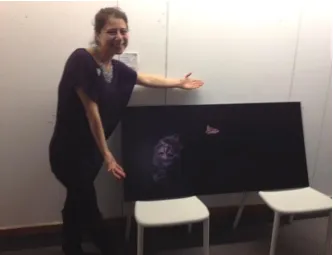
As a collective, the artists in the photography class decided to exhibit work at a local gallery
space and the artwork was to be displayed facing the street. My work, mostly due to its
controversial title, was removed from the show by the management from the gallery space (See
figure 2.7). I was informed that the management of the space feared that the children and
the space and hidden in a closet, while the name of my piece was still printed in the show’s
pamphlet.
Members of the Georgia State University community who viewed at the show seemed
intrigued by the censorship, but their responses varied. Some tossed in the explanation that ‘we
are in the South’ and that Atlanta isn’t as progressive as we would like to think. While others
simply stated that ‘if you (the artist) make artwork with the word ‘pussy’ in the title, you pretty
much know that this is going to happen.’ You should change the title to ‘cat’ or ‘kitten’.’
After this experience, I was frustrated and didn’t really understand why my piece
couldn’t be shown, even if it was offensive. I had to realize that the classroom was not a smaller
version of the outside community. I decided to take a risk and create a performance piece that
focused on the cat-like creature, which seemed to have enlarged genitals, from the photograph
that was removed from the gallery space wall and placed in the closet. I decided to continue to
venture forward, into a performance piece that addressed the word ‘pussy’. Operating between
both the censorship of art education and the freedom of contemporary art practices has
exaggerated my disconnected identity between the two worlds. This exploration and reflection
on censorship helps me better understand the nature of art education and how my teaching
Figure 2.7: Photo of me standing in front of my photograph, after it was found in a closet
[image:50.612.72.340.408.644.2]