ScholarWorks @ Georgia State University
ScholarWorks @ Georgia State University
Applied Linguistics and English as a Second
Language Dissertations Department of Applied Linguistics and English as a Second Language
12-18-2014
Language, literacy, and funds of knowledge: Somali refugee
Language, literacy, and funds of knowledge: Somali refugee
women in Clarkston, Georgia
women in Clarkston, Georgia
Cassie Leymarie
Follow this and additional works at: https://scholarworks.gsu.edu/alesl_diss
Recommended Citation Recommended Citation
Leymarie, Cassie, "Language, literacy, and funds of knowledge: Somali refugee women in Clarkston, Georgia." Dissertation, Georgia State University, 2014.
https://scholarworks.gsu.edu/alesl_diss/32
IN CLARKSTON, GEORGIA
by
CASSIE D. LEYMARIE
Under the Direction of Gayle Nelson & Eric Friginal
ABSTRACT
The purpose of this study is to investigate how Somali refugee women experience
language and literacy in their community of Clarkston, Georgia, and to identify their funds of
knowledge (Gonzales, Moll, & Amanti, 2005), or unseen practices. The aim of this investigation
is to strengthen and challenge their current modes of language socialization and to combat
negative discourses that represent them as ‘vulnerable victims and cunning crooks’ (Horst,
2006). Clarkston, Georgia was chosen by private resettlement agencies as a refugee resettlement
site in the early 1990s. In Clarkston, although there are several refugee serving agencies that
focus on refugee education and integration, many Somali refugee women are still facing
included five Somali refugee women who were affiliated with one specific community of
practice, a Somali-ethnic based community organization for refugees. Data collection involved
my participant observation and field notes, interviews with the participants, and photographic
documentation of the linguistic landscape (Landry & Bourhis, 1997) in Clarkston. Findings
reveal the diverse language and literacy practices and language socialization pathways among
participants, and shed light on some of the barriers to language socialization, including
gender-based ideologies and textually-mediated social interactions, as well as some of the successful
strategies they have used. In addition, the case of one exceptional Somali refugee woman, Mama
Rita, presents funds of knowledge that may help enhance the language socialization of Somali
refugee women and help to understand citizenship as practice rather than status.
INDEX WORDS: Literacy, Somali Refugees, Funds of Knowledge, Language Socialization,
IN CLARKSTON
by
CASSIE D. LEYMARIE
A Dissertation Submitted in Partial Fulfillment of the Requirements for the Degree of
Doctor of Philosophy
in the College of Arts and Sciences
Georgia State University
Copyright by Cassie D. Leymarie
IN CLARKSTON, GEORGIA
by
CASSIE D. LEYMARIE
Committee Chairs: Gayle Nelson PhD
Eric Friginal PhD
Committee: Diane Belcher PhD
Sinfree Makoni PhD
Electronic Version Approved:
Office of Graduate Studies
College of Arts and Sciences
Georgia State University
DEDICATION
ACKNOWLEDGEMENTS
The Ph.D. process has been a life-changing journey that has helped me to understand that
we, as people, above all, need each other. It has been a privilege to be able to pursue my
curiosities and be able to spend time among so many different people in order to complete this
dissertation, though I know that the work has only just begun. I have had many people, in many
ways, help me throughout the Ph.D. process, and although I would like to acknowledge each and
every one, I undoubtedly will forget some.
I would first like to acknowledge my committee members. I have deep gratitude for my
advisors Dr. Gayle Nelson and Dr. Eric Friginal. Thanks for all of the encouragement, support,
and advice. You have been integral to my success and terrific mentors. My professional and
academic development has been bolstered by your time and efforts. I appreciate your patience
and understanding throughout the process, and that you have been able to understand my process.
Thanks for being sensitive to the time and effort it took for me to be a scholar engaged in both
the academic and refugee serving communities. Mentorship is a complex and dynamic
relationship and I feel lucky to have had not one but two fabulous scholars on my side. Thanks
for all of the time that you have spent working with me, for believing in me, and for helping me
learn how to tell my research story.
I would also like to thank the members of my dissertation committee, Dr. Diane Belcher
and Dr. Sinfree Makoni. Dr. Belcher, your courses were the springboard for my ideas and
curiosities and your input and support have helped shape my passion for qualitative research.
Dr. Makoni, thank you for being an encouraging and supportive mentor throughout my academic
career. You’ve taught me how to think holistically. During the times when I need a fresh
thoughts, you were always there for me. Thanks for always telling me that you were proud of
me, those kind words and moments- they have fueled me more than you could know.
I cannot go any further without thanking my family, my parents and sister. Your support
has been indescribable. Dad, your many levels of support throughout my life and academic
career is unspeakable. Thanks for being so generous and for teaching me how to be
compassionate and humble in the pursuit of my education and my life, and for always telling me
to put my head down and sprint to the finish. Mom, thanks for always asking how things were
going throughout the process. Sometimes when people asked about my dissertation I would want
to turn the other way. When you asked me I always knew it was because you cared for my
wellbeing. Thanks for giving me roots, and wings, Mom and Dad. Lottie, thank you for being
my sister and taking genuine interest in my work. Your hardworking pursuits to reach your
dreams inspire me- you’re next.
I would like to thank all of the professors, current and former graduate students, faculty,
staff, and affiliates of the department of Applied Linguistics and ESL. Support comes in so many
different forms, from conversations at the Xerox machine or water cooler, to Friday night
dinners, to volunteering at my various community programs, each of you have held me up and
kept me going. Special thanks to Luciana, Ashley, Brittany, Jack, Audrey, Meg, Joe, Caro, Pam,
Cindy, Jennifer, and Ben. Also, Amanda, Alison, Debra, Sarah, Sharon, Margareta, John,
Marcel, and Diana.
I would like to say thank you to T.J. Rhine. I am beyond grateful for your partnership.
You were there to witness of all of my pits and peaks throughout this rollercoaster of a process.
To the participants in my study, Hannah, Faith, Mouna, Caaliyah, and Rita- we did this
together and I am forever indebted to you for your help.
I would also like to acknowledge Emily Feuerherm and Vai Ramanathan for helping me
to enter the academic conversation regarding refugees, language, and policy. Your early
comments on my work helped me to propel my dissertation forward.
Also, I would like to extend a thank you to all of my colleagues at Penn State for your
ongoing support and friendship.
To Omar, you were my first friend in the community, and now you are my mother, father,
brother, and a best friend. Thanks for everything and for your support and understanding
throughout the process. From the first days I came to the community you saw and trusted in my
ideas and vision. I cannot thank you enough for the opportunities you have given me.
A special thanks to High Country Rugby Football Club and the Brewhouse Café family.
I didn’t know that family could be found in such spaces and places. Your levity and conviviality
have carried me through the good times and the bad. Many of you have supported me in so
TABLE OF CONTENTS
ACKNOWLEDGEMENTS ... v
LIST OF TABLES ... xiv
LIST OF FIGURES ... xv
1 INTRODUCTION ... 1
1.1 Background of the Problem ... 1
1.2 Somalian History and Context ... 3
1.2.1 The Somali People ... 3
1.2.2 The Somali Nation ... 3
1.2.3 Somali Culture ... 4
1.2.4 Somalia’s Sociopolitical History ... 7
1.2.5 Somali Refugees ... 13
1.3 Statement of the Problem ... 14
1.3.1 Clarkston as a site for refugee language socialization ... 14
1.3.2 Public perception of refugees and Somalis ... 16
1.4 Purpose of the Study ... 19
1.5 Scope of the Study and Terms ... 20
1.5.1 Examination of Linguistic Landscape ... 20
1.5.2 A Social view of Literac(ies) ... 21
1.5.4 Funds of Knowledge ... 28
1.5.5 CoP and FoK ... 29
1.6 Organization of the Study ... 32
2 REFUGEE CONTEXT AND RESEARCH: A FOCUSED LITERATURE REVIEW 32 2.1 Refugees and the Resettlement Scenario ... 33
2.2 The Refugee and Somali experience ... 35
2.3 Research Questions ... 39
3 METHODOLOGY ... 40
3.1 The Qualitative Research Paradigm ... 40
3.2 Qualitative Approaches ... 41
3.2.1 Participant Action Research ... 41
3.2.2 Case Study Approach ... 42
3.3 The Case of a Researcher ... 43
3.3.1 Positionality ... 43
3.3.2 Trajectory ... 44
3.4 Site identification, Selection, and Access ... 45
3.4.1 Deciding to conduct research outside of the classroom ... 46
3.4.2 Site identification and access ... 47
3.6 Research Context... 50
3.6.1 The CoP ... 51
3.6.2 The Somali Plaza ... 53
3.6.3 Clarkston Village Shopping Center ... 55
3.6.4 Market Street ... 56
3.7 Data Collection ... 57
3.7.1 Interviews ... 58
3.7.2 Life stories ... 59
3.7.3 Participant observation ... 60
3.7.4 Artifacts ... 62
3.7.5 Linguistic landscape ... 62
3.8 Data Management, Coding and Analysis ... 64
3.8.1 Management of the Data ... 64
3.8.2 Analysis and Coding for RQ1 ... 64
3.8.3 Analysis, and Coding for RQ2 ... 66
3.8.4 Analysis, and Coding for RQ3 ... 68
3.9 Ethical Considerations ... 69
3.10 Issues of Trustworthiness ... 70
4 PARTICIPANTS ... 72
4.2 Mama Mouna... 75
4.3 Faith ... 76
4.4 Caaliyah... 77
4.5 Mama Rita ... 78
5 THE LINGUISTIC LANDSCAPE OF CLARKSTON, GEORGIA ... 80
5.1 Characteristics of the LL of Clarkston ... 81
5.2 LL, Language Socialization ... 88
5.3 Chapter Findings ... 92
6 LANGUAGE AND LITERACY: ILLUMINATING CASES OF SOMALI REFUGEE WOMEN ... 93
6.1 Hannah ... 94
6.1.1 Hannah’s language and literacy practices ... 95
6.1.2 Strategies for successful language socialization... 98
6.1.3 Experiences in the CoP ... 102
6.2 Faith ... 107
6.2.1 Faith’s language and literacy practices ... 107
6.2.2 Education, Independence, and Family attitudes ... 110
6.2.3 Experiences in the CoP ... 113
6.3 Mama Mouna... 114
6.3.2 Absence of literacy practices for everyday needs ... 116
6.3.3 Experiences in with ESL classes ... 119
6.3.4 Perceptions of language and literacy ... 120
6.3.5 Refugee education ... 121
6.4 Caaliyah... 122
6.4.1 Absence of literacy practices ... 122
6.4.2 Textual Mediation as a barrier to language socialization ... 123
6.4.3 Experiences in the CoP ... 125
6.5 Mama Rita ... 126
6.5.1 Mama Rita’s language and literacy practices ... 126
6.5.2 Experiences in the CoP ... 127
6.6 Cross Case Discussion ... 129
6.6.1 Barriers to language socialization ... 129
6.6.2 Successful Language socialization practices ... 132
6.6.3 Competing goals and ideologies in the CoP ... 133
6.6.4 Language as an FoK ... 135
6.7 Summary of Findings ... 136
7 FoK: THE CASE OF MAMA RITA ... 137
7.1 Mama Rita as a Purveyor of Information ... 137
7.3 Mama Rita as a Participant of Multiple Religions ... 142
7.4 Summary of Findings ... 144
8 CONCLUSIONS AND IMPLICATIONS ... 144
8.1 Discussion of Major Findings ... 146
8.1.1 RQ1 ... 146
8.1.2 RQ2 ... 147
8.1.3 RQ3 ... 148
8.2 Outcomes of Participant Action Research ... 149
8.3 Implications for Research ... 150
8.4 Implications for Pedagogy ... 153
8.5 Implications for Refugee Education and Policies (The CoP) ... 155
8.6 Limitations of the Study ... 158
8.7 Contributions and Future Research ... 159
REFERENCES ... 161
APPENDICES ... 171
Appendix A ... 171
Appendix B ... 173
Appendix C ... 179
Appendix D ... 181
Appendix F ... 188
LIST OF TABLES
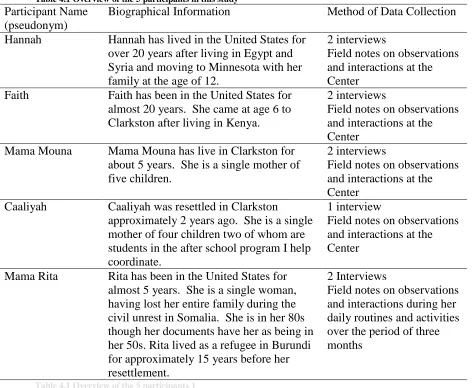
Table 4.1 Overview of the 5 participants in this study ... 73
Table 5.1.1 Top Down and Bottom Up LL items by area (% and number) ... 81
Table 5.1.5.2 Bottom Up LL items by Location and Language Usage (% and number) . 83
Table 5.1.5.3 LL items by language and locality ... 86
LIST OF FIGURES
Figure 1.3.2.1 Somali Pirate Cartoon (Breen, 2008) ... 17
1 INTRODUCTION
In this dissertation, I investigate the language and literacy practices of Somali refugee women
in Clarkston, Georgia in order to better understand how to strengthen or challenge the existing
ways they are socialized to and through the use of language or their language socialization
(Shiefflin & Ochs, 1986). I utilize existing theories of language, literacy, discourse, and funds of
knowledge, in order to understand the dynamics of language socialization in a particular
community of practice. Specifically, I investigate the language environment in Clarkston, Georgia;
this part of the study was based upon the investigation of the linguistic landscape (Landry &
Bourhis, 1997) of Clarkston and the case of Somali refugee women in a community of practice that
I participate in. I employ a qualitative methodology combining longitudinal field notes, interviews,
and visual documentation of language in order investigate language, literacy, and funds of
knowledge among Somali refugee women.
The study was carried out during my time volunteering with a Somali ethnic based
organization whose mission is to help refugees with social and cultural adjustment services. This
first chapter of the dissertation presents the background and problem that serves as the motivation
for the study, states its purposes, and important terms that inform and orient the study. I conclude
the chapter with a brief overview of the content of the dissertation.
1.1 Background of the Problem
Somali refugees began resettling in Clarkston in the early 1990s and despite a prominent
community of refugees and refugee service providers they, along with other refugee groups,
continue to face obstacles in integrating into and participating in their new community. Obstacles
need for culturally sensitive pedagogies (Watkins et al., 2012) as well as program policies that take
into account the diverse needs of refugees (Cranitch, 2010) rather than a one size fits all approach
to refugee education. In addition to linguistic and educational needs, refugees face negative
perceptions based on popular national and local discourses that affect their daily life (Van Dijk,
2005).
Clarkston, Georgia’s population is approximately 7,500, and it is located about ten miles
northeast of Atlanta. The city was founded in the 1830s after it became a connection point for the
Georgia Railroad rail line for merchants between Athens and Augusta, Georgia as well as various
locations in South Carolina (City of Clarkston, 2013). In the 1980s Clarkston consisted of a 90
percent white-only population and that number dropped to less than 14 percent by 2010
(Rossenwasser, 2012). This demographic shift was spurred by private relief and resettlement
agencies’ decision in the early 1990s to render Clarkston a refugee resettlement site. Clarkston was
chosen as a resettlement site by agencies based on factors such as the metro-Atlanta job market,
highways, access to public transportation, and affordable housing. Since resettlement has occurred,
the population has dramatically shifted from a small community consisting of mostly native born
American citizens to a community in which half of the current residents are foreign-born. Somalis
are not the only group that has resettled in Clarkston; others include Burmese, Bhutanese, Iraqi,
Eritrean, and Sudanese populations. Today Clarkston is home to refugees from more than 40
nations (Rosenwasser, 2012). Clarkston can be characterized by what Vertovec (2007, 2010) has
described as ‘superdiverse’. Superdiversity is characterized by population complexity or the
“dynamic interplay of variables among an increased number of new, small and scattered,
multiple-origin, transnationally connected, socio-economically differentiated and legally stratified
new, small, multiple-origin, transnationally connected, and socio-economically differentiated
refugees.
1.2 Somalian History and Context
1.2.1 The Somali People
Putnam and Noor note that “while Somalis have traditionally fought among themselves,
their greater identity as Somalis takes hold in front of strangers” (1993, p.2). In my experience
working in the Somali immigrant and refugee communities, this statement holds true. A large
portion of my curiosity toward Somali refugees lies in the paradox that exists in the Clarkston,
among the Somali people. The existence of a tightly knit Somali community, one that seemingly is
trying to unite its members, is even evident to outsiders. With the belief that it is best to understand
community needs on a case by case basis through a very holistic and ecological look at a situation,
this section aims to introduce a historical background of the Somali people. A description of
Somalia, its culture and language, will be shared in the following sections to foreground the social
and political occurrences that have led to the displacement and forced migration of the Somali
people.
1.2.2 The Somali Nation
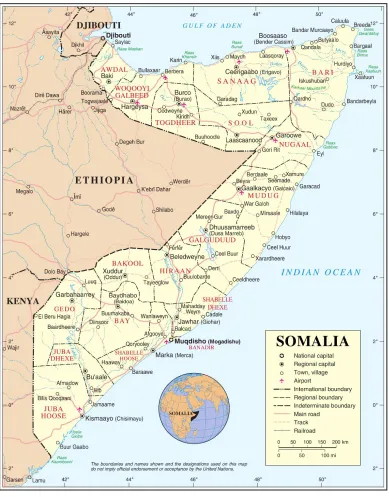
Somalia is located in East Africa, east of Ethiopia and bordering the Gulf of Aden and the
Indian Ocean. Somalia’s population in 2011 is estimated to be 9,925, 640, though it is difficult to
report exact figures due to the large amount of nomads, and displaced people, and refugees (1.1
million total, are estimated (CIA, 2011). The capital of Somalia, which is just slightly smaller than
the state of Texas, is Mogadishu. Despite its lack of federal governance, Somalia has kept a
healthy informal economy based on livestock, remittance companies, and telecommunications
Figure 1.1, Map of Somalia (Source: wikimedia.org)
1.2.3 Somali Culture
Somalis are traditionally pastoralists and agropastoralists (80%), with remainder relying on
Males are generally the center of the family and community, at least in public. Women have a very
important and productive economic role, normally farming or conducting business. Increasingly
due to the civil war, droughts, and other harsh factors, women are becoming heads of the
households (Putnam & Noor, 1993). Also, since the socialist revolution of the 1960s in Somalia,
many more women are educated, though traditions such as female circumcision and waiting to
have sex until marriage are widely practiced and valued (Putnam & Noor, 1993).
Somalis are organized ethnically by clans. Most Somalis belong to one of six clans: the
Darod, Dir, Hawiye, Isaaq, Digil and Rahanweyn (Hesse, 2010). The first four, together are known
as “Samalee” clans, and have similar culture and language. They make up about seventy five
percent of ethnic Somalis and are historically known as nomads (Hesse, 2010). The Digil and
Rahanweyn from Southern Somalia together comprise about twenty percent of ethnic Somalis.
These two clans are known as farmers and pastoralists. They are known for assimilating members
of other clans and even former slaves, unlike the Samalee clans whom are “borderline xenophobic”
(Hesse, 2010, p.249).
Somalis will further divide themselves into subclans and beyond. Hesse illustrates the clan system
this way:
Classification can even extend right down to the household level: if a man has more than
one wife, for example, some in the household might stress the clans, subclans or
sub-subclans associated with one maternal line over another. What is more, not all Somalis
agree to which lineage lines other Somalis belong. Somali genealogy presents individuals
with a seemingly infinite number of ways to affiliate with, or disassociate from, fellow
Somalis- which may be the point. Whether one is looking at those in a day-to-day nomadic
existence in a semi-desert, day existence in an urban area of a failed state, or
malleable ways to negotiate limited opportunities and limited resources. The Somali lineage
system accomplishes this. Whereas outsiders usually see an impractically complex, shifting
system of genealogy, many Somalis see a practically complex, shifting one. (2010, p. 249)
It is important to note that Somalis historically divided themselves into diya, or ‘blood wealth’,
groups which would deal with other diya-groups collectively whether they were indebted or owed a
debt. Hesse describes these groups’ dynamics, in the scenario of a murder:
[…] in the case of murder, a killer is expected to have his diya-group deliver just
compensation to the victim’s diya-group. Should compensation not be received, then the
victim’s kin are expected to exact blood revenge not only on the perpetrator, but also on any
member of the perpetrator’s lineage- which often touches off even more claims and
counter-claims for diya payments or revenge. (2010, p. 251)
1.2.3.1 Somali language (and literacy)
The main language in Somalia is Somali, which belongs to the lowland eastern Cushitic
group of languages (Putnam & Noor, 1993). There are two major Somali dialects and they are
mutually intelligible. Many Somalis also speak Arabic, Italian, and English, and near the Kenyan
borders some speak Swahili. Italian and English were primary languages of education during the
colonial era. In 1972, the first ever Somali script was created using the Roman alphabet, leading to
the spread of its use in the Somali government (Putnam & Noor, 1993). Many educated Somalis
still do not have a strong grasp of the Somali orthographic system as they were educated in one of
the colonial languages. The CIA World Factbook (2011) states that only 37.8% of Somalis over the
age of 15 can read and write. The Somali oral culture is highly valued, as is one’s ways with
words, no matter a person’s occupation. The prominence of the spoken word is evidenced by the
Somali people are primarily Sunni Muslim, though some religious traditions are evident
from folk rituals as well as Sufism, a thread of Islamic mysticism. A rise in fundamentalist Islamic
beliefs is apparent among Somalis due to the many tragedies that have struck the Somali nation,
and hence the visibility and pull of such groups as Al Shabaab, a clan-based insurgent and militant
group (Putnam & Noor, 1993).
1.2.4 Somalia’s Sociopolitical History
Some claim Somalis are descended from Arabians who settled on the Somali coast a
thousand years ago. Somali origins are still contentious, though it is agreed upon that Somalis
were in the region now known as Somalia some seven hundred years before their names were first
recorded in the 15th century (Putnam & Noor, 1993). Somalia was known as the land of Punt by
the ancient Egyptians and the presence of the Somali people has been fairly well documented.
According to Putnam and Noor, documentation of the northern inhabitants’ presence can be found
in:
[…] The Periplus of the Erythrean Sea, an A.D. 60 Greek guide to sailors, and in Ptolemy's
Geography, compiled between the 2nd and 5th centuries; contact with Egyptian, Phoenician,
Persian, Greek, and Roman traders dates to this time. (2010, p.5)
By the 10th century Arab and Persian merchants had settled on the Somali coast and Chinese
merchants were visiting and buying goods for the empire (Putnam & Noor, 1993). Somali people’s
conversion to Islam probably happened soon after in the 11th and 12th centuries with regional wars
occurring among Muslims and Christians between the 13th and 16th centuries. Establishment of
present day clans occurred by the 12th century though the southward movement of other clans
continued until the 19th century (Putnam & Noor, 1993). The region that constitutes present day
1969 (Putnam & Noor, 1993). The British occupied north central Somalia and the Italians
occupied Southern Somalia.
The occupation of Somalia was more strategic that economic (Putnam & Noor, 1993).
Only the Italians introduced western economic principles; they started banana and sugarcane
plantations in the south which led to commercial agriculture. The British used their territories to
supply meat to Aden (Putnam & Noor, 1993). One effect of colonialism was the emergence of
working class or salaried Somalis, that is, Somalis that attended colonial schools and worked in the
colonial government (Putnam & Noor, 1993). The conflicts between European Allied and Axis
powers were apparent in Somalia when in 1940 Italy invaded British Somaliland and forced the
British out. The British retaliated a year later and retook their former territory as well as the Italian
portions of Somalia. Putnam and Noor assert that it was during this decade that Somalis awareness
of the effects of colonialism became heightened, calling colonial powers into question while
questioning the need for political and national unity. In November 1949 former Italian Somalia
was lost by the British when it became a United Nations (U.N.) trust territory. With British
Somaliland in the North and the U.N. Italian Somalia in the South, Somali nationalists worked until
July 1st, 1960 when independence was granted and the two territories merged to form the Somali
Republic. Putnam and Noor note that the next nine years were characterized by unity and
democracy. Many Somalis participated in politics, none were excluded by background, and clan
and regional differences were set aside for frequent multi-party elections. Hesse’s characterization
of the 1960s is slightly different and paints a picture of a Somalia whose clan differences were
heightened by independence. Hesse maintains that
In what was to be a unified Somalia, northern clansmen from former British Somaliland
(the Isaaq mostly, but also some Dir) came to fill most technical posts. Clansmen from
Rahanweyn and Digil) came to fill many political ones. Why this happened is sometimes
attributed to the educational preparedness the British and Italians meted out before
independence. (2010, p. 250)
In other words, educational differences were significant; in the north the British made education an
elite privilege, while the Italians in the south introduced mass education. Hesse notes that “certain
Somalis were better positioned to seize political and economic spoils, but almost always in the
company of clansmen” (p.250). He asserts that if the government had not been so segregated, a
united Somali nation may have succeeded.
The 1960s foreign relations in Somalia were characterized by military and economic aid
from the Soviet Union, developmental assistance from China, and some developmental aid from
the U.S. (Putnam & Noor, 1993). Ethiopia was the U.S.’s primary ally in the region at that time.
Government powers were generally associated with clans and not the state. In October 1969
president Abdirashid Ali Shermaake (a Darod) was assassinated, the military took control and
evolved into the well-known dictatorship of president Major-General Mohammed Siyaad Barre
(also a Darod) (Hesse, 2010).
Barre attempted to eliminate clannism through ‘scientific socialism’ which was a mixture of
ideas from Lenin, Marx, Mao, Mussolini, and the Qur’an. Under this ideology, which associated
political parties as having specific clan affiliations, Barre’s Somali Revolutionary Socialist Party
was the only party allowed in the nation (Hesse, 2010). In the same vein, Somalis were made to
live in communes constituted of many different clans where they were not allowed to inquire under
any circumstances into their fellow Somali’s lineage and were told to call each other ‘jaalle’
meaning comrade (Hesse, 2010). This is especially powerful because Somalis family and lineage
the common Somali question, tol maa tahay? (What is your lineage?)” (1993). This question is
asked in place of “where are you from?”
In a change of sentiment meant to strengthen his failing power, Barre completely changed
his ways and began to emphasize clan differences. During this time, the diya-groups were still
outlawed, even though Barre was trying to use a similar system to his favor. In 1991, the Barre
regime collapsed when overthrown by opposition clans, which lead to more clan fighting and a
civil war; though none of the clan warlords were able to centralize their powers (Kimenyi, Maku,
& Moyo, 2010). In May of the same year, Northern clans declared the region the independent
Republic of Somaliland, which is a territory not recognized by any other government, but one
working toward constitutional democracy (CIA World Factbook, 2010). The year after the regime
collapse 45% of the Somali people were either displaced internally or fled the country, and the
death of several hundred thousand Somalis due to conflict, disease, and famine occurred (Putnam
& Noor, 1993). Also, it is estimated that one quarter of the population or 1.5 million people were
subject to famine at that time (Putnam & Noor, 1993). This is the reality that led the first wave of
Somali refugees to their eventual resettlement in Georgia, among other places.
The United States, under two UN Security Council Resolutions, led Operation Restore
Hope on December 4th, 1992 near Mogadishu, the capital. This operation is well known as it
resulted in the shooting down of two U.S. helicopters, the death of 18 U.S. soldiers, and a few
dozen Pakistani Peacekeepers (Grünewald, 2012).
After the failure of Restore Hope, the country, including Mogadishu, was led by various
opposing warlords, still none gained supreme power. Puntland, another semi-autonomous state not
recognized by other governments despite its progress, declared independence from Somalia
In 2000, with the help of the international community and the Djibouti Arta Peace Conference, the
Transitional National Government (TNG) was created, though its presence did not go beyond a few
Mogadishu neighborhoods (Kimenyi et al, 2010). TNG failed due to various problems, and in
2004, the Transitional Federal Government (TFG) replaced it. According to Hesse (2010) the
TFG’s composition,
Reflecting the influence of clans, the TFG adopted […] a ‘4.5 Formula’. Representation in
the parliament is evenly divided amongst four main clan groups- the Darod, Hawiye, Dir
and Digle-Mirifle- plus five minority constituencies. The minority constituencies include
‘minor clans’, non-ethnic Somali groups, members of the Somali diaspora, citizens’ groups,
and various Islamist organizations. In total the TFG’s parliament has 550 representatives,
having grown from an original 275 members (p. 252)
In 2006 the Islamic Courts Union (ICU), a “coalition of local Islamic leaders and business
executives, promoting the primacy of Sharia law over clan laws” took control over the majority of
the south and central regions and opened the Mogadishu port once again (Grunewald, 2012,
p.S111). According to Grunewald, thereafter
Heavily-armed Ethiopian troops started to operate in the south and central regions in 2006.
These were soon followed (in spring 2007) by troops sent by the African Union (AU) to
confront the Muqawama (Resistance), composed of the ICU, nationalists, militias, and other
movements opposed to the TFG. (2012, p. S111)
The Ethiopian leaders who sent the troops were in opposition to ICU as they claimed the Union had
ties to Al Qaeda. ICU maintained control over much of the country until 2010, when Al Shabaab
became a major ruling force (Putnam & Noor, 1993.). According to Hesse, at this time although it
were really maintaining loyalty to members of their clans and subclans whom were operating
within Al Shabaab (2010).
The year 2012 marked the transition into yet another governmental system, yet little has
been written about its exact composition and procedures. Hassan Sheikh Mohamud has taken the
head of the new parliament, with a six pillar plan that he promoted during his campaign and that he
recently handed over to the UN as his strategy for changing and developing Somalia. According to
Somali news network, Garowe Online, the policy is vague with little potential for solutions (2012).
Today, U.S.’s involvement in Somalia is controversial. According to Scahill (2011) “US policy on
Somalia has been marked by neglect, miscalculation and failed attempts to use warlords to build
indigenous counterterrorism capacity, many of which have backfired dramatically.” (2011, p.14).
For example, there is uncertainty related to an alleged secret prison buried in the basement of
Somalia's National Security Agency (NSA). It is the said headquarters for suspected Shabaab
members caught in Kenya and internally, led by the United States Central Intelligence Agency
(CIA) (Scahill, 2011). According to Scahill (2011), the US is reluctant to interact with Somali
political leaders, and instead they are hiring former warlords and Al Shabaab members to work for
them at their secret prison site at Somalia NSA. This meager assistance and contentious interaction
of the US government is often criticized by Somalis and other commentators.
If the sociopolitical realities of Somalia aren’t enough to cause forced migration, Somalia
has recently experience drought and famine. In 2011, Somalia had a severe drought causing what
UN officials called ‘the worst humanitarian disaster in the world’ (Muhumed & Van Kemenade,
2011). In the July report from Dadaab, Kenya, reporters noted yet another wave of Somalis were
traveling into Dadaab refugee camps, now home to close to half a million refugees. The report told
stories of families walking for weeks in order to find food and shelter. At the time of the report,
amount. The drought in East Africa in the past year has forced migration yet again amongst the
Somali people. It will take several years for these refugees just arriving in Dadaab to be resettled,
though there is a great chance that many of these Somalis will also eventually be resettled in
Clarkston, justifying the need for resettlement reform even more.
1.2.5 Somali Refugees
In the 2012 report on the state of the world’s refugees, United Nations High Commissioner
for Refugees characterizes Somalia as a microcosm of the state of the world’s refugees (United
Nations High Commission for Refugees [UNHCR], 2012). They assert that the crisis in Somalia
and among Somali people represents the entire range of issues plaguing refugees and that the
unpredictable nature of Somali conflict coupled with drought has severely strained host countries
and resulted in few durable solutions for Somali refugees. Somalis fled their native lands in
response to a civil war which broke out after the collapse of General Mohammed Siyaad Barre’s
regime in 1991. In 1992, the year after the regime collapsed, 45% of the Somali people were
displaced and many others died due to the conflict, disease, and famine that occurred (Putnam &
Noor, 1993). The region has since been characterized by clan warfare, military activity, and
political conflict, and dozens of failed peace initiatives and external interventions (UNHCR, 2012).
In 2011, a drought once again displaced a large number of Somalis, creating yet another wave of
migration (Muhumed & Van Kemenade, 2011).
At the end of 2011 there were approximately one million Somali refugees registered in
countries in the Horn of Africa: 520,000 in Kenya, 202,000 in Yemen, 186,000 in Ethiopia, 18,700
in Djibouti and within Somalia itself and estimated 1.4 million internally displaced peoples
(UNCHR, 2012). In 2011, the Census Bureau’s American Fact Finder estimated that there are over
Statistics from UNHCR show that 90,000 Somalis were resettled as refugees during the
period of 1991-2010 principally to the Unites States of America, Canada, and a few Nordic
countries (2012). UNHCR sought resettlement sites for 35,000 Somalis in 2011 in spite of the
reluctance of the resettlement countries. Resettlement countries cite integration challenges and
security issues as reasons for their disinclination to settle Somalis although it is duly noted that the
Somali diaspora is very strong in North America and Europe. Given that Somali refugees represent
a large portion of refugees in the United States and given recent crises, it is important to expand
knowledge of this community and its people
1.3 Statement of the Problem
1.3.1 Clarkston as a site for refugee language socialization
Clarkston, its residents, and the various agencies that aim to serve the needs of newcomer
refugees are struggling to accommodate the newcomer refugee population. The city was
highlighted as a case study in a report given to the members of the Committee on Foreign Relations
in the United States Senate, entitled “Abandoned Upon Arrival: Implications for Refugees and
Local Communities Burdened by a U.S. Resettlement System that is not Working” (S. Rep. No.
111-52, 2010). Clarkston was characterized as a place of tumult laden with stories of prejudice
against refugees from residents and city police (S. Rep. No. 111-52, 2010). According to the
report, the actions and discourse of the general Clarkston population do not convey a welcoming,
understanding community.
The attitudes among the Clarkston community are in part due to the reality of resettlement
and the time period in which refugees are allotted to integrate into the community. After three
months resettlement agencies no longer serve their refugee clients. Many of these new residents
refugee residents experience problems with housing and often cause apartment fires, one time
leading to the tragic death of four refugee youth in 2008 (S. Rep. No. 111-52, 2010). Navigating
housing is not the only problem; refugees also have difficulties accessing and understanding legal
and educational systems and programming (S. Rep. No. 111-52, 2010). In order to resolve such
issues the community is left to create and implement educational programming that promotes social
and cultural adjustment including English language learning and socialization. These circumstances
produce national and local discourses that lead residents to believe refugees "burden" local
governments, schools, police, hospitals, and social services (S. Rep. No. 111-52, 2010).
Especially relevant to the present study is that in Clarkston "resources for language
instruction are inadequate. Unlike migrants in search of economic opportunities, who can access
extensive friend and family networks to navigate language or other cultural barriers, new refugee
populations lack this type of community resource upon arrival.” (S. Rep. No. 111-52, 2010, p.2)
and "efforts to address the special needs of refugee students are ad hoc, adding strain on local
education funding" (S. Rep. No. 111-52, 2010, p.2). A primary factor contributing to unfit
resources is that "each refugee is initially afforded one-size-fits-all assistance" (S. Rep. No. 111-52,
2010, p.3). The community was not ready for a vulnerable population of refugees, without a
network of social, cultural, and linguistic support, and had to create a few programs without any
resources to rely on.
In order to lessen the burden on communities like Clarkston there is a call to work with
state and local leaders to deepen understanding about backgrounds and quantities of refugees to be
resettled using both qualitative and quantitative input from local communities (S. Rep. No. 111-52,
2010). This understanding would help implement programs that increase access to English as a
Second Language (ESL) courses and eliminate the one-size-fits-all approach to refugee
accountability and promote community engagement (S. Rep. No. 111-52, 2010, p.4). This study
offers insight into context specific knowledge that can challenge existing methods of language
socialization and strengthen program models.
1.3.2 Public perception of refugees and Somalis
Another major motive of this research project is to contest the negative and subtractive
discourses about refugees, and Somalis, in particular, which are spread by local and national media.
Assuming discourse is a social practice, media portrayals as discursive practices have ideological
effects based on the representation and positioning of people (Fairclough, 2003) These negative
ideas that persist throughout society have an effect on the daily lives of refugees (Horst, 2006).
Language socialization is a complex process in part affected by the way the community perceives
those to be socialized (Schiefflin & Ochs, 1986). In Clarkston, refugees face misperceptions held
by the local community and are also subject to the media discourses that are propagated about
refugees and more specifically Somalis. Often times Somali refugees are presented as cunning
crooks or vulnerable victims (Horst, 2006) and portrayed in the media as warlords and pirates.
Such portrayals reproduce discourses and contribute to social realities (Van Dijk, 2005). In the
small community of Clarkston, Somali refugees are subject to mass mediated and local discourses.
In addition to the media and discourses surrounding Somalis, local residents are influenced by
discourses that are anti-refugee or that portray refugees as draining local resources. Such discourses
inhibit the language socialization and integration into the local community.
Looking to movie, television, print, and musical discourses surrounding Somalis, then, is
useful because they represent technologically and institutionally based mass produced and
distributed discourses (Gerbner, 1972). Take the critically acclaimed movie, Blackhawk Down
(Bruckheimer; Scott, 2001)as an example. This film misrepresents Somalis and has been
In "Black Hawk Down," the lack of characterization converts the Somalis into a pack of
snarling dark-skinned beasts, gleefully pulling the Americans from their downed aircraft
and stripping them. Intended or not, it reeks of glumly staged racism. (p. 1)
Ethnographically speaking, whenever I meet people unfamiliar with the large refugee populations
near to Atlanta and tell them about the community I work with, I am often met with “Oh, you work
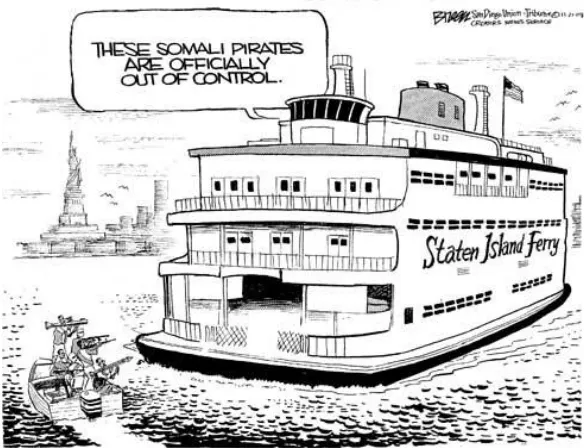
with pirates?” This is not surprising though, as the Somali pirate is a commonly reoccurring
character in media discourse. Figure 1.3.2.1 shows an image of the Staten Island Ferry, with New
York City’s Statue of Liberty in the background, encountering Somali pirates with a comment from
[image:35.612.102.394.309.533.2]someone on board stating the “Somali pirates are officially out of control”.
Figure 1.1.3.2.1 Somali Pirate Cartoon (Breen, 2008)
I found another example of the mainstream association of Somalis to pirates in a newspaper
crossword puzzle. Figure 1.3.2.2 shows crossword item 63 which asks the reader for a word that
describes many modern day pirates. Figure 1.3 shows that the appropriate answer was ‘Somali’.
Figure 1.3.2.2. Crossword puzzle item, '63', Creative Loafing, Atlanta, 2013
Figure 1.2.2.3. Crossword puzzle answer 'Somali', Creative Loafing, Atlanta, 2013
The animated series South Park provides yet another example of the discursive
representation of Somalis as pirates. In the episode “Fatbeard”, one of the characters Eric decides
he is destined to be a pirate, and promises his friends if they join him in his travels to Somalia they
will reap the benefits. Eric and his entourage go to Somalia to meet Somali pirates (Parker &
[image:36.612.66.358.327.523.2]K’naan, a Toronto-based Somali musician, uses music to discuss the plight and reality of
the Somali people and such discourses. K’naan’s career began when he performed a spoken word
piece criticizing the UN for its failed attempts to help in Somalia in front of the United Nations
High Commissioner for Refugees (UNHCR) (Takiff, 2010). In his song, “Blues for the Horn” he
acknowledges the way media creates a certain image of Somalis as warlike:
In a conservative form I wanna ask you a few things before I conform To the popular belief about where I was born
Are they still illin', still killin' poppin' the corn?
How's the horn, how's the love wavin' the ocean morn'? How 'bout the young, do they still possess the poetry tongue? And do they still greet sincere like the depth of the lung" How's the nomad, did the herd graze well this year?
From the news to what I know, the growin' gap ain't clear! (K’naan, 2005).
His lyrics reflect his disapproval of the discourses of Somalis and the gap in knowledge between
this discursive ideology and the realities of Somalis’ practices. K’naan indicates that popular belief
is that Somalis are violent. He then questions if the oral tradition of spoken word and poetry is still
alive and traditions like those of nomads are still occurring. He expresses that he would think so,
though living in the United States it would seem there is a gap between his knowledge and the
portrayal of Somalis in the news.
These “standardized discursive and representational forms” of Somalis as “cunning crooks”
create a sustained image of refugees (Horst, 2006). Refugees are also often portrayed as
“vulnerable victims” (Horst, 2006) depicted by images of masses of people, vulnerable women and
children, and a rudimentary humanity. These media representations “both influence and are part of
the policies and politics that determine the lives of refugees” (Horst, 2006, p. 14).
1.4 Purpose of the Study
Several studies suggest that language is a primary and complex challenge of refugee
refugees use language in social interaction can give insight into effective language socialization
strategies, that is, how practices organize the life span process of becoming an active, competent
participant in one or more communities” (Ochs, 2000, p.230) or “socialization through the use of
language and to the use of language” (Schiefflin & Ochs, 1986, p. 163).
This study aims to explore the processes of language socialization of Somali refugee
women associated with one community of practice in Clarkston by investigating the city’s
linguistic landscape, and the life stories and language and literacy practices of the women. Gaining
insight through participants’ life stories and language and literacy practices contributes to the
understanding of what factors may contribute to their language socialization and becoming an
active competent participant in the community (Ochs, 2000, p. 230). Although several studies have
investigated Somali immigrants’ educational experiences, identity, and ability to acquire print
literacy (Hopkins, 2010; McBrien, 2005; Oikonomidoy, 2009; Tarone, Bigelow, & Hansen, 2009)
few have explored Somali refugee women’s socialization through language and literacy practices.
The study serves strengthen and challenge existing ways of viewing Somali refuge women’s
language socialization.
1.5 Scope of the Study and Terms
This section describes the notions and concepts that guide the study, inform the research
questions, and contribute to understanding the participants and the communities where they reside.
1.5.1 Examination of Linguistic Landscape
Linguistic Landscape (LL) is a new approach to the study of multilingualism in the public
space. LL facilitates the understanding of the linguistic diversity of a particular space and gives
insight into participants’ language exposure in their community and everyday life. Basically, LL
The language of public road signs, advertising billboards, street names, place names,
commercial shop signs, and public signs on government buildings combines to form
linguistic landscape of a given territory, region, or urban agglomeration. (Landry &
Bourhis, 1997, p.25)
LL studies may focus on particular types of signs such as shops’ signs and names (Dimova,
2007; MacGregor, 2003), and others use main shopping streets and include all visible or displayed
texts (Cenoz & Gorter, 2006). The visible language serves as data for characterizing the space.
Data aren’t meant to represent the linguistic composition of the city as a whole, but serve to
illustrate linguistic diversity (Huebner, 2006).
The description of LL can deepen understanding about language use in a specific context.
Landry and Bourhis (1997) speak to the notion of LL’s informative contribution stating “the
linguistic landscape may act as the most observable and immediate index of the relative power and
status of the linguistic communities inhabiting a given territory” (p.29). In this sense, an LL
approach provides a method of empirical investigation into the presence of specific languages or
linguistic communities in a given area signaling the sociolinguistic composition in a territory and
uncovers the power and status of languages and the purposes they serve in public. LL in the same
sense, uncovers the social realities of a designated space (Ben-Rafael, Shohamy, Amara, &
Trump-Hecht, 2006).
1.5.2 A Social view of Literac(ies)
An idea central to this study is that literacy is more than just reading and writing. It is what
people do with language and social practice. As Street (1995) notes, there are two general notions
of language and literacy: a standard one that sees literacy as reading and writing or a set of skills
that “autonomously” take effect on people’s cognitive and social practices and an “ideological”
the social view of literacy breaks the traditional dichotomizing concepts of literacy and orality and
allows for a view of language and literacy that exists on a spectrum. The social view originates
from Gee’s (1986) definition of literacies as sets of discourse practices. He states that different
societies and social subgroups have different types of literacy, and literacy has different social and
mental effects in different social and cultural contexts. Literacy is seen as a set of discourse
practices, that is as ways of using language and making sense both in speech and writing. These
discourse practices are tied to the particular world views (beliefs and values) of particular social or
cultural groups (p.719).
Gee’s definition of literacy emphasizes the social aspects of language used for meaning
making among particular groups of people. In recent discussions of literacy, Gee (2008) promotes
an even more broadly conceived view of literacy. He states that “[…] language is not the only
important communicational system. Images, symbols, graphs, diagrams, artifacts, and many other
visual symbols are significant, more so today than ever” (p.17). Gee asserts that “literacy in any
domain is actually not worth much if one knows nothing about the social practices of which that
literacy is a part” (Gee, 2008, p. 18). For the purposes of this study, literacy is not just what can be
read or written, but what people do with language, how people use language, or, language as social
practice in context. Literacy is assumed as language that is dialectically tied to the context of its
use; language use is created by and creative of social understanding and social reality. This view
allows for the investigation into language, participation, and the process of language socialization.
1.5.3 Communities of practice and language socialization
The notion of community of practice (CoP) is used in this research study to frame learning
as situated and social. It also provides a way to deepen the understanding of the place from which
my knowledge is created and articulated. A CoP is a group of people who continually participate in
developed by Lave and Wenger (1991) as a basis for a social theory of learning and later brought
into sociolinguistics as a way of theorizing about language. This notion contributes to
sociolinguistics and linguistic anthropology because it conceives of social grouping as embedded in
shared practice. CoPs are an
[…] integral part of our daily lives. They are so informal and so pervasive that they rarely
come into explicit focus, but for the same reasons they are also quite familiar. Although the
term may be new, the experience is not. Most communities of practice do not have a name
and do not issue membership cards. (Lave & Wenger, 1991, p.7)
CoPs are fundamental parts of our daily lives and thus the notion offers a rich basis for
investigating situated learning.
There are three main features that characterize a CoP, they are mutual engagement, joint
enterprise, and shared repertoires. The term mutual engagement indicates that members regularly
interact with each other in many ways. The term joint enterprise helps to characterize CoPs as
having shared practices. Further, the term shared repertoires denotes community resources for
negotiating meaning such as language and routines (Wenger, 1998).
For the purposes of the current investigation, understanding the shared practices and regular
interactions are central to understanding socialization of Somali refugee women and the
community resources that may or may not be utilized to negotiate meaning during the language
socialization process. In addition, situated learning as a concept becomes central to this study
because it refers to engagement in the CoP and participation in the CoP then becomes essential to
the process of learning (Wenger, 1998).
Another concept central to the understanding of the use of a CoP model of learning is
newcomers acquire the skills needed to perform the practices by actually engaging in the practices
in order to master them and move toward full participation (Wenger, 1998).
The CoP at the center of this study is made up of a community of refugees that are mutually
engaged in the joint enterprise of helping newcomer refugees adjust to and participate in their new
community. Adjustment and participation involves navigating social services, the American
education system, and practices that are integral to refugees functioning in their community. The
shared repertoires relevant to this CoP include community resources that include language and
knowledge of how language is used in specific contexts, specific texts that are important for
participating in the community (bills, school forms, job applications, assistance applications).
Newcomer refugees experience LPP as they meet regularly with established refugees in order to
learn how to engage in practices. Thus, refugees’ participation in this CoP is a fundamental
element in learning how to successfully and more fully participate in the greater Clarkston
community and various aspects of American society. The CoP under investigation is a part of
larger constellations of practices (Wenger, 1998, p. 126)in Clarkston. Constellations refer to a
grouping of objects that are seen as a type of configuration, with relation, even though “they may
not be particularly close to another, of the same kind, or of the same size” (Wenger, 1998, p.127).
The CoP I have been referencing is centered on a small, ethnic-based, place of social learning (‘the
Center’, to be discussed in more detail in section 3.6, The Research Context). The constellation
that the CoP belongs to, includes the Center, and the other ethnic refugee serving agencies, as well
as the larger, mainstream refugee serving agencies, and the many other institutions (schools, Board
of Health, Housing Authority). The CoP, then, is a place where refugees can go to learn about the
constellations of practices that exist in the Clarkston community.
I am a part of this CoP. During my time volunteering within the CoP I, myself, was
community. Once I knew enough about the practices in the CoP, I began to serve as a case manager
and help newcomers. I accumulated a repertoire of understanding. Most of the members of the
CoP are refugees as the main site of this CoP is a nonprofit organization run for refugees by
refugees. Although I am not a refugee, I engage in the shared practices and regular interactions
which include solving newcomer refugees’ problems adjusting to language and culture and
navigating the various new institutions and groups they belong to. In this way, I have also gone
through the socialization process through shared practice. The shared practice is in many ways, is
the practice of being a participant in the city of Clarkston. Newcomer refugees are LPPs and old
timer refugees are the experts and case managers that are meant to guide them toward fuller
participation.
Understanding participation in this specific community has implications for language
socialization or how one gains communicative competence, membership, and legitimacy (Duff,
2007). The principles of language socialization, as summarized by Garrett and Baquedeno-Lopez
(2002), are
Social interaction is contextualized in certain regular activities
Experts and novices can help each other
Language and other semiotic systems mediate the process
Language socialization is a lifetime process
Language socialization can lead to non-language specific outcomes (e.g., new identities or
values)
The notion of CoP facilitates the investigation of Somali refugee women’s language socialization
1.5.3.1 Beyond CoP
Everyday literacy practices, investigated through the notion of CoP, should be framed by
theories of language, literacy, discourse, and power. Barton and Hamilton (2005) assert that
The framings provided by theories of language, literacy, discourse, and power are central to
understanding the dynamics of communities of practice, but they are not made explicit in
Wenger’s formulations. (p.14)
One can more explicitly discuss these dynamics by examining how social interactions are
textually mediated, and how textual mediation “shapes, structures, and constrains” the interactions
(Barton & Hamilton, 2005, p.14). By looking at language socialization,\ and the barriers faced and
overcome during the lifelong language socialization process one can understand how text, and
ultimately literacy, play a role in social interaction and greater participation in society. The key to
linking literacy studies to CoP work is the concept of reification (Barton & Hamilton, 2005).
Reification is
the process of giving form to our experiences that produce objects that congeal this
experience into ‘thingness’. In doing so, we create points of focus around which the
negotiation of meaning becomes organized. […] Any community of practice produces
abstractions, tools, symbols, stories, terms, and concepts that reify something of that
practice in a congealed form. (Wenger, 1998, p, 58-59)
Reification is both a process and a product of participation in a community of practice.
CoPs must exist for reification to exist and vice versa. Reification is characterized by the
negotiation of shared understandings, and enables particular social relations to be shaped in the
process of participation. Wenger offers four ways to categorize reifications, including succinctness
and power to evoke meaning, portability across times space and context, durability or physical
These categories of reification make reification observable. For example, on can observe that the
Statue of Liberty, a reification of freedom, is highly durable but not portable and that spoken
discourse is may be portable, and draw attention to social reality and new concepts, but it is not as
durable as written text. In Wenger’s discussion of reification, he focuses on the productive and
positive aspects of reification and his descriptions are extremely wide so that most of his
reifications are literacy artifacts which are high on categories of reification (Barton & Hamilton,
2005). Take Wenger’s (1998) vignette of the claims processing department of an insurance
company, he discussed reification in light of the written texts attended to by the workers. In this
sense, it would be fruitful to discuss reifications in settings that are less privileged, because that
would increase the power of the concept of reification. Literacy studies offers to the idea of
reification that text in social interactions can either reify or solidify power, and can either transform
or reinforce certain social realities. The notion of CoP can be used in literacy studies to look at
sites where all members of a group do not share the same common goals, and whose tasks are not
as well-defined. Barton & Hamilton state that
The work on communities of practice starts out from constrained and well-defined
task-oriented organisations such as individual work places. These ideas do not transfer so well
to interconnected but dispersed networks – more loosely framed fields of social action –
and they are weak on issues of power and conflict where groups do not share common goals
and interests. […] in ethnographies of everyday literacy practice […] we encounter fields of
social action that are not characterized by stable or well bounded shared purpose; they have
diffuse and unclear membership without clear rights or direct channels of communication
for negotiating meaning; there is often ambivalent engagement (which can also be seen in
many classrooms and workplaces and other coercive communities) and incomplete
From this view, the original concept of CoP is too idealistic, and does not fully
acknowledge the greater social world which is characterized by multiple membership, unresolved
boundaries, the existence of various CoPs which exist in one CoP, and the relationships that are
supporting and competing. These CoPs are not to be viewed negatively, but “are often the creative
lifeblood of social challenge and change” (Barton & Hamilton, 2005, p. 25).
1.5.4 Funds of Knowledge
The concept of funds of knowledge (González, Moll, & Amanti, 2005) lends itself to
understanding the practices of Somali refugee women. Funds of knowledge as a construct provides
a meaningful method for researchers to observe and investigate daily practices of marginalized
people. Simply defined funds of knowledge (FoK) are people’s daily practices that educators and
policy makers may fail to notice. The FoK conceptualization facilitates “a systematic and powerful
way to represent communities in terms of resources, the wherewithal they possess and how to
harness these resources […]” (González et al., 2005, p. x). In essence, FoK help to bridge the gap
in knowledge and understanding between people and their communities at large.
FoK include literacy practices, social relationships, and strategies that have been developed
and accumulated; the bodies of knowledge integral to the functioning and well-being of people and
their households. For example, understanding ways in which refugees participate and interact
within their community can inform educational activities and policies that are geared toward
progressing their language socialization and integration into their community. Or, one may find
that an individual greatly values one on one conversation rather than a small group format for