© 2016, IRJET | Impact Factor value: 4.45 | ISO 9001:2008 Certified Journal | Page 271
ENERGY EFFICIENT COMMUNICATION PROTOCOL FOR WIRELESS
SENSOR NETWORK
RANJAN KUMAR GUPTA
1and JAGESHWAR SRIVAS SIR
21
Mtech Scholar, CSE Department, Dr.C.V,RAMAN UNIVERSITY, Bilaspur India
2Assistant Professor
,CSE Department, Dr.C.V,RAMAN UNIVERSITY, Bilaspur India
---***---Abstract-
WSNs are consists of a large number ofsensor nodes in which the sensor nodes perform physical data into a form that would make it easier for the user to understand. The native approach is now to collect data from sensor nodes is that where the each sensor node transmits the data directly to the sink which is located far away. The cost of data transmission from each sensor node to the sink is usually very high, thus the nodes die quickly and hence it reduces the life time of the network. Therefore, the use of a few transmissions is possible leads to efficient energy utilization. Routing protocols is one of the most important communication model that greatly affect the performance of the wireless sensor networks, so the designing of routing protocols for sensor networks is a vital. In earlier research, static sink is used to gather data in WSN. Wireless sensor vision offers a huge demanding applications and outcomes mostly in global networking system. This area has always become the researcher’s major focus sensor analysis because of its nature is the wireless network fundamental identification method. It is interesting and becomes such a challenge to teach a machine to do this task. Sensor recognition is also the one of the most difficult problems in wireless sensor network view area. The Sensor network and recognition also receives a huge attention in networking field and research communities .Wireless sensor networks are usually comprised of a large number of nodes with sensing and routing capabilities. The setting encompassing a WSN application will cowl a large selection from associate degree setting. military operation in sensor networks will follow completely different patterns, relying totally on the precise desires of the applications..
Key words: Wireless Sensor Networks, design,
application area, performance measurement .
1
INTRODUCTION
The characteristics of sensor networks and application needs have a decisive impact on the network style objectives in term of network capabilities and network performance Network Characteristics: As compared to the normal wireless communication networks like mobile unintentional network and cellular systems, wireless sensor networks have the distinctive characteristics and constraints. Dense sensor node deployment: sensor nodes area unit typically densely deployed and might be many orders of magnitude. Powered sensor nodes: Sensor nodes area unit typically supercharged by battery and area unit
deployed in an exceedingly harsh atmosphere wherever it's very troublesome to vary or recharge the batteries. Severe energy, computation, and storage constraints: Sensors nodes area unit having extremely restricted energy, computation, and storage capabilities [1]. Self-configurable: Sensor nodes area unit typically arbitrarily deployed and autonomously set up themselves into a communication network. Unreliable sensor nodes: Sensor nodes area unit two-faced all the way down to the physical damages or failure because of it’s readying in rough or opposed atmosphere [2]. Information redundancy: In most sensor network application, sensor nodes area unit densely deployed in an exceedingly region of interest and collaborate to meet a standard sensing task. Thus, the information detected by multiple sensor nodes usually has a precise level of correlation or redundancy.
© 2016, IRJET | Impact Factor value: 4.45 | ISO 9001:2008 Certified Journal | Page 272
2. WIRELESS SENSOR AREA NETWORK AND ITS
WORK.
The topology of the WSNs will vary from a straightforward star network to a complicated multi-hop wireless mesh network. The propagation technique between the hops of the network are often routing or flooding. Routing protocols in sensor networks from network structure purpose of read are often divided into 2 main categories: flat and hierarchical. In flat routing protocols the conception of leader node (or a cluster head) doesn't exist and every one nodes square measure at constant level of importance. In hierarchical routing protocols the act of cluster and classification of nodes square measure done and a few nodes square measure thought about as leaders (or a cluster heads). From this cluster of protocols will name. So there square measure alternative classes of protocols like information central, location based mostly energy aware. During a method that every routing protocol will belong to at least one or many of mentioned teams [8].
Restricted energy capacity: Since device nodes are battery supercharged, they need restricted energy capability. Energy poses a giant challenge for network designers in hostile environments, for instance, a parcel, wherever it's not possible to access the sensors and recharge their batteries. What is more, once the energy of a device reaches an explicit threshold; the device can become faulty and cannot be able to perform properly, which is able to have a serious impact on the network performance [9]. Thus, routing protocols designed for sensors ought to be as energy economical as attainable to increase their period of time, and thence prolong the network period of time whereas guaranteeing smart performance overall.
Sensor locations: Another challenge that faces the planning of routing protocols is to manage the locations of the sensors. Most of the projected protocols assume that the sensors either are equipped with international positioning system (GPS) receivers or use some localization technique [10] to learn regarding their locations.
Limited hardware resources: Additionally to restricted energy capability, device nodes have conjointly limited process and storage capacities, and so will solely perform restricted process Functionalities. These hardware constraints gift several challenges in computer code development and network protocol style for device networks, that should contemplate not solely the energy constraint in device nodes, however conjointly the process and storage capacities of device nodes.
Huge and random node preparation: Device node deployment in WSNs is application dependent and may be either manual or random that finally affects the performance of the routing protocol. In most applications, device nodes are often scattered indiscriminately in Associate in Nursing supposed space or born massively
over Associate in Nursing inaccessible or hostile region. If the resultant distribution of nodes isn't uniform, best group becomes necessary to permit property and change energy economical network operation [11].
Network characteristics and unreliable setting: A device network sometimes operates in an exceedingly dynamic and unreliable environment. The topology of a network, that is outlined by the sensors and therefore the communication links between the sensors, changes often as a result of device addition, deletion, node failures, damages, or energy depletion. Also, the device nodes are joined by a wireless medium, that is yelling, error prone, and time varied. Therefore, routing ways ought to contemplate topology dynamics as a result of restricted energy and device quality further as increasing the scale of the network to keep up specific application necessities in terms of coverage and property [12].
Information Aggregation: Since device nodes could generate important redundant information, similar packets from multiple nodes are often collective so the quantity of transmissions is reduced. Information aggregation technique has been accustomed succeed energy potency and information transfer optimization in an exceedingly variety of routing protocols.
Various Sensing Application Requirements: Device networks have a large vary of various applications. No network protocol will meet the wants of all applications. Therefore, the
Routing protocols ought to guarantee information delivery and its accuracy so the sink will gather the required information regarding the natural phenomenon on time. Scalability: Routing protocols ought to be able to scale with the network size. Also, sensors might not essentially have equivalent capabilities in terms of energy, processing, sensing, and notably communication. Hence, communication links between sensors might not be cruciform, that is, a combine of sensors might not be able to have communication in each direction [13]. This could be taken care of within the routing protocols.
Routing Protocols in WSN Routing in wireless device networks differs from typical routing in fastened networks in varied ways in which. There’s no infrastructure, wireless links are unreliable, device nodes could fail, and Routing protocols have to be compelled to meet strict energy saving necessities [14]. Several routing algorithms were developed for wireless networks generally.
3. NETWORK DESIGN OBJECTIVES
i. To evaluate the performance of throughput, the numbers of packets received by BS are compared with the number of packets sent by the nodes in each round.
© 2016, IRJET | Impact Factor value: 4.45 | ISO 9001:2008 Certified Journal | Page 273
4.
NETWORK DESIGN IMPLEMENTATION
Tiny node size: sensing element nodes square measure sometimes distributed in an exceedingly wide or unfriendly surroundings in massive numbers, reducing node size will facilitate node distribution [15]. It'll additionally cut back the ability consumption and value of sensing element nodes.
Low node value: sensing element nodes square measure sometimes deployed in an exceedingly or unfriendly surroundings in massive numbers and can't be reused; reducing cost of sensing element nodes is vital and can result into the value reduction of whole network. Low power consumption: sensing element nodes square measure hopped-up by battery and it's usually terribly troublesome or maybe not possible to charge or recharge their batteries, it's essential to scale back the ability consumption of sensing element nodes in order that the life of the sensing element nodes, still because the whole network is prolonged [16].
Extensibility: the quantity sensing element nodes in sensing element networks square measure within the order of tens, hundreds, or thousands, network protocols designed for sensing element networks ought to be protractible to completely different network sizes.
Dependability: network protocols designed for sensing element networks should give error management and correction mechanisms to certain the acceptable
information delivery over hissing, fallible, and time varied wireless channels.
Self-configurability: distributed sensing element nodes ought to be able to severally organize themselves into a communication network and reconfigure their property within the event of topology changes and node failures [17].
Adaptability: in sensing element networks, a node might fail, connect, or change, which might end in changes in node density and constellation. Thus, network protocols created for sensing element networks ought to be appropriate to such density and topology exchanges. Channel utilization: since sensing element networks have restricted information measure resources, communication protocols designed for sensing element networks ought to with efficiency create use of the information measure to enhance channel utilization. Fault tolerance: sensing element nodes square measure vulnerable to failures because of harsh preparation environments and unattended operations. Thus, sensing element nodes ought to be fault tolerant and have the talents of self testing, calibrating, self-repairing, and self-recovering [2].
Security: a sensing element network ought to introduce effective security mechanisms to forestall info} information within the network or a sensing element node from unauthorized access or malicious attacks.
QoS support: in sensing element networks, totally completely applications might have different quality-of-service (QoS) necessities in terms of delivery latency and packet loss. Thus, network protocol style ought to think about the QoS necessities of specific applications.
5. RESULT
© 2016, IRJET | Impact Factor value: 4.45 | ISO 9001:2008 Certified Journal | Page 274
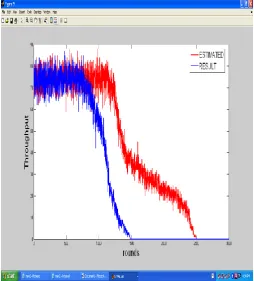
Figure. (a): Interval plot- Analysis of Throughput
Simulation results of new protocol illustrate increased throughput. Interval plots of new and traditional protocol in figure (a) and figure (b) clearly depicts performance of both protocols. To calculate throughput, assume that CHs can communicate freely with gateway node.
Figure (b): Interval plot- Analysis of Throughput
similarly nodes near BS transmit data directly to BS. Sensor nodes in both regions consume less transmission energy therefore, nodes stay alive for longer period. More alive nodes contribute to transmit more packets to BS.
6. CONCLUSION
In this paper, to address the problem, the priority is to introduce an unequal clustering mechanism to balance the energy consumption among the cluster heads. The Clusters which are closer to the base station have smaller sizes than those farther away from the base station, so cluster heads closer to the base station can preserve some energy for the purpose of inter-cluster data forwarding. Simulation results show that unequal clustering mechanism clearly improves the network lifetime over proposed protocol. Finding a solution that could determine the best value of these parameters according to network scale. The energy consumed by the nodes at time. This is clear that Adaptive technique is more energy efficient and the energy consumption is less in this technique as compared with other routing. After some time of simulation run, this check is performed to get the behavior of the network.
7. ADVANTAGES:
7.1 Advantages of WSNs over traditional methods are:
A. Wide coverage
B. Long monitoring periods C. No individual tracking
D. Data available directly to researcher’s location E. Land and Aquatic Coverage
F. Continuous monitoring
7.2 Advantages of WSNs over modern methods are: A. Area monitoring applications
B. Environmental applications C. Health applications
D. Industrial applications E. Disaster Management F. Commercial Applications I. Medical Applications J. Environment Observation K. Military Applications
8. FUTURE WORK
Performance parameters given below. A study the three performance metrics: Network lifetime, Residual energy and throughput.
[1] Our proposed protocol Performance analysis and compared resultsperforms well compared to Low Energy Adaptive Clustering Hierarchy.
[image:4.595.36.282.99.389.2] [image:4.595.35.290.472.754.2]© 2016, IRJET | Impact Factor value: 4.45 | ISO 9001:2008 Certified Journal | Page 275
REFERENCES
1. D.Johnson and D.Maltz, “Dynamic source routing in ad hoc wireless networks,” in Mobile Computing, T.Imelinsky and H.Korth, Eds., pp. 153–181. Kluwer Academic Publishers,1996.
2. The CMU Monarch Project, “The CMU monarch extensions to the ns simulator,” URL: http://www.monarch.cs.cmu.edu/. Page accessed on January 5th, 2001.
3. J.Boleng, “Normalizing mobility characteristics and enabling adaptive protocols for ad hoc networks,” in Proceedings of the 11th Local and Metropolitan Area Networks Workshop, March 2001.
4. J.Li, J.Jannotti, D.De Couto, D.Karger, and R.Morris, “A scalable location service for geographic ad hoc routing,” in Proceedings of the ACM/IEEE International Conference on Mobile Computing and Networking (Mobicom), 2000, pp.120–130.
5. T.Camp, J.Boleng, and L.Wilco x, “Location information services in mobile ad hoc networks,” in International Communications Conference (ICC), 2002, To appear. 6. Heinzelman, W., A. Chandrakasan and H. Balakrishnan,
2000. “Energy efficient communication protocol for wireless microsensor networks,” in System Sciences, 2000. Proceedings of the 33 Annual rd Hawaii International Conference On, pp: 10.
7. Yun, Y. and Y. Xia, 2010. “Maximizing the lifetime of wireless sensor networks with mobile sink indelay-tolerant applications,” Mobile Computing,IEEE Transactions On, 9(9): 1308-1318.
8. Liang, W., J. Luo and X. Xu, 2010. “Prolonging network lifetime via acontrolled mobile sink in wireless sensor networks,” in Global TelecommunicationsConference (GLOBECOM 2010), 2010 IEEE, pp: 1-6.
9. Sen, F., Q. Bing and T. Liangrui, 2011. “An improved energy-efficient pegasisbased protocol in wireless sensor networks,” in Fuzzy Systems and Knowledge Discovery (FSKD), 2011 Eighth International Conference On, 4: 2230-2233.
10. Meelu, R. and R. Anand, 2011. “Performance evaluation of cluster-based routing protocols used in heterogeneous wireless sensor networks,” International Journal of In-formation Technology and Decision Making, 4(1): 227-231.
11. .Haibo, Z., W. Yuanming and X. Guangzhong, 2009. “Edfm: a stable election protocol based on energy dissipation forecast method for clustered heterogeneous wireless sensor networks,” in Wireless Communications, Networking and Mobile Computing, 2009. WiCom’
12. 5th International Conference On, pp: 1-4. Ali Ghaffari, D.K. and H. Bannaeian, 2011. 13. Caione, C., D. Brunelli and L. Benini, 2012.“EER: Energy-efficient and real time routing protocol “Distributed compressive sampling for lifetime for wireless sensor networks,” World Applied optimization in dense wireless sensor
networks,” Sciences Journal, 14(2): 356-362. Industrial Informatics, IEEE Transactions On,
13. Soleimani, M., M. Ghasemzadeh and M. Agha Sarram, 8(1): 30-40. 2011. “A new cluster based routing protocol for 14. Ghaffari, A. and V. Takanloo, 2011. “Qos-based prolonging network lifetime in wireless sensor routing protocol with load balancing for wireless networks,” Middle-East Journal of Scientific multimedia sensor networks using genetic algorithm,” esearch, 7(6): 884-890. World Applied Sciences Journal, 15(12): 1659-1666.
14. Lindsey, S. and C. Raghavendra, 2002. 15. Yueyang, L., J. Hong and Y. Guangxin, 2006.“Pegasis: Power-efficient gathering in sensor “An energy-Power-efficient pegasisbased enhanced
15. information systems,” in Aerospace conference algorithm in wireless sensor networks,” China proceedings, 2002. IEEE, 3: 3-1125. Communications, pp: 91.
16. Nakayama, H., Z. Fadlullah, N. Ansari and N. Kato, 16. Luo, J. and J. Hubaux, 2010. “Joint sink mobility and 2011. “A novel scheme for wsan sink mobility based routing to maximize the lifetime of wireless sensor on clustering and set packing techniques,” networks: the case of constrained mobility,” Automatic Control, IEEE Transactions On, IEEE/ACM Transactions on Networking (TON),56(10): 2381-2389. 18(3): 871-884.