© 2016, IRJET | Impact Factor value: 4.45 | ISO 9001:2008 Certified Journal | Page 1168
Implementation and performance analysis of DCT-DWT-SVD based
watermarking algorithms for color images
Fareduddin Ahmed J.S
1, Swetha.G
21 Assistant professor, Dept. of ECE, BITM, Ballari, Karnataka, India
2
PG Student [DE], Dept. of ECE, BITM, Ballari, Karnataka, India
---***---Abstract -
This paper presents a robust and blind digitalimage watermarking technique to achieve image protection. In order to protect copyright material from illegal duplication, various technologies have been developed, like key-based cryptographic technique, digital watermarking etc. In digital watermarking, an image which we wanted to protect is secretly embedded in the image by using an algorithm. In our paper, we implement that algorithm of digital watermarking by combining both DWT and SVD techniques. Initially, we decompose the original (cover) image into 4 sub-bands using 2-D DWT, and then we apply the SVD on LL band by modifying their singular values. After subjecting the watermarked image to various attacks like blurring, adding noise, rotation, cropping, sharpening, lossy compression etc, we extract the originally inserted watermark image from only one band and compare them on the basis of their MSE and PSNR values.
Key Words: DWT,SVD, digital watermarking, MSE and PSNR
1.INTRODUCTION
Development of compression algorithms for multimedia data such as MPEG-2/4 and JPEG standards, and increase in the network data transmission speed have allowed widespread use of applications, which rely on digital data. In other words, digital multimedia data are rapidly spreading everywhere. On the other hand, this situation has brought
about the possibility of duplicating and/or manipulating the data. To keep on with the transmission of data over the Internet the reliability and originality of the transmitted data should be verifiable. It is necessary that multimedia data should be protected and secured.
One way to address this problem involves embedding an invisible data into the original data to mark ownership of them. There are many techniques for information hiding, which can be divided into different categories such as convert channels, steganography, anonymity, and watermarking. Convert channels techniques were defined in the context of multilevel secure systems. Convert channels usually handle properties of the communication channels in an unexpected and unforeseen way in order to transfer data through the medium without detection by anyone other than the entities operating the covert channel. Steganography is about preventing the detection of an encrypted data, which has been protected by cryptography algorithms. Digital watermarking has an extra requirement of robustness compared to steganography algorithms against possible attacks. It should be also noted that watermarking is not intended for protecting of the content of a message, and hence it is different from cryptography. In this thesis we focus on the implementation of the digital watermarking algorithms in the transform domain against common attacks.
© 2016, IRJET | Impact Factor value: 4.45 | ISO 9001:2008 Certified Journal | Page 1169 not resistant enough to lossy image compression and other
image processing. For instance, a simple noise in the image may eliminate the watermark data. On the other hand, frequency domain-based techniques can embed more bits for watermark and are more robust to attack. Some transforms such as Discrete Cosine Transform (DCT) and Discrete Wavelet Transform (DWT) are used for watermarking in the frequency domain .SVD(Singular value decomposition) is applied to get the singular values of dc coefficients.
These transforms are being used in several multimedia standards such as MEPG-2, MPEG-4, and JPEG2000. In addition, different watermark algorithms have been proposed using DCT and DWT. In considering the attacks on watermarks, the robustness feature of an algorithm becomes very important. In this regard, we classify a watermark method as robust if the watermark data embedded by that algorithm in an image or any other data, cannot be damaged or removed without destroying or damaging the data itself. Therefore, an attack is successful if it can eliminate the watermark without damaging the image itself.
2.
.EXISTING SYSTEM
The watermark embedding procedure is depicted in Fig-1 followed by a detailed explanation.
Step 1: Apply DWT to decompose the cover host image into four non-overlapping multi-resolution sub-bands: LL1, HL1, LH1, and HH1.
Step 2: Apply DWT again to sub-band HL1 to get four smaller sub-bands and choose the HL2 sub-band as shown in Fig. 2 a. Or, apply DWT to sub-band HH1 to get four smaller sub-bands and choose the HH2 sub-band as shown in Fig. 2 b.
Step 3: Divide the sub-band HL2 (or HH2) into 4 x 4 blocks.
Step 4: Apply DCT to each block in the chosen sub-band (HL2 or HH2).
Step 5: Re-formulate the grey-scale watermark image into a vector of zeros and ones.
Step 6: Generate two uncorrelated pseudorandom sequences. One sequence is used to embed the watermark bit 0 (PN_0) and the other sequence issued to embed the watermark bit 1 (PN_1). Number of elements in each of the two pseudorandom sequences must be equal to the number of mid-band elements of the DCT-transformed DWT sub-bands.
Step 7: Embed the two pseudorandom sequences, PN_0 and PN_1, with a gain factor _, in the DCT transformed 4x4 blocks of the selected DWT sub-bands of the host image.
Step 8: Apply inverse DCT (IDCT) to each block after its mid-band coefficients have been modified to embed the watermark bits as described in the previous step.
[image:2.595.311.541.446.574.2]Step 9: Apply the inverse DWT (IDWT) on the DWT transformed image, including the modified sub-band, to produce the watermarked host image.
Fig-1: block diagram of existing system
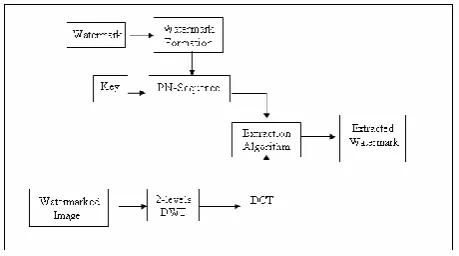
watermarking algorithm, and thus the original host image is not required to extract the watermark.
Step 1: Apply DWT to decompose the watermarked image into four non-overlapping multi-resolution sub bands: LL1, HL1, LH1, and HH1.
Step 2: Apply DWT to HL1 to get four smaller sub bands, and choose the sub-band HL2, as shown in Fig. 2 a. Or, apply DWT to the HH1 sub-band to get four smaller sub-bands, and choose the HH2 sub-band, as shown in Fig. 2 b.
© 2016, IRJET | Impact Factor value: 4.45 | ISO 9001:2008 Certified Journal | Page 1170
Step 4: Apply DCT to each block in the chosen sub-band (HL2 or HH2), and extract the mid-
Band coefficients of each DCT transformed block.
Step 5: Regenerate the two pseudorandom sequences (PN_0 and PN_1) using the same seed used in the watermark embedding procedure.
Step 6: For each block in the sub-band HL2 (or HH2), calculate the correlation between the mid-band coefficients and the two generated pseudorandom sequences (PN_0 and PN_1). If the
correlation with the PN_0 was higher than the correlation with PN_1, then the extracted watermark bit is considered 0, otherwise the extracted watermark is considered 1.
Fig-2 : Original Image
Fig-3: Original Watermark
Step 7: Reconstruct the watermark using the extracted watermark bits, and compute the similarity between the original and extracted watermarks
Haar Wavelet :
Haar Wavelet is used in thisalgorithm for performing 2 Level DWT,since it has simplest, orthogonal, not very good.
Drawbacks of existing system
Existing system works only for gray scale images
Original Image is required in order to achieve the extraction of watermark
Updation of the wavelet coefficients doesn’t ensure about the exactness when compared to the manually computed coefficients
Achieves the low psnr and high mse for bigger image sizes for various attacks
2.1PROPOSED SYSTEM:
In this algorithm first level decomposition of wavelet is applied to cover image then LL band is selected for second level decomposition and its HH band is selected. Now DCT is applied to this band and get DCT coefficient matrix. SVD is performed on this DCT coefficient matrix. Watermark image is decomposed at first level and HH band is selected. DCT is applied to this HH band and we get DCT coefficients of watermark then SVD is applied to it. Singular values of cover image DCT coefficients are modified with singular values of watermark. Perform inverse transform and we get watermark image.
2.1.1Watermark embedding process
The embedding process is divided into following steps and is briefly described as given below:
1. Let OI be the Original color image of size N x N.
2. Select Color Component any one among R,G,B(1,2,3).
© 2016, IRJET | Impact Factor value: 4.45 | ISO 9001:2008 Certified Journal | Page 1171 image
3. Apply 2D 5/3 DWT to decompose it into four N/2 x
N/2 sub-bands LL , HL , LH and HH .
4. Select LL band and Apply DWT to decompose it into
four N/4 x N/4 sub-bands LL_LL , LL_HL , LL_LH and LL_HH .
5. Select LL_HH band and apply DCT to it and get DCT coefficient matrix B.
6. Apply SVD to B, B=U*S*VT, and obtain U, S and V.
7. Let OW of size N/2 x N/2 to represent watermark. Apply 2D 5/3 DWT to decompose it into four N/4 x N/4 sub-bands WLL, WHL, WLH and WHH
8. Select WHH band and apply DCT to it and get DCT coefficient matrix D.
9. Apply SVD to D, D=U1*S1*V1T, and obtain U1, S1 and V1.
10. Modify S with watermark such that S2=S + a* S1.
11. Obtain B* using B*= U*S2*VT.
12. Apply inverse DCT to B* to produce LL_HH*.
13. Apply inverse 2D 5/3 DWT to LL_LL, LL_HL, LL_LH and LL_HH* to get LL*.
14. Apply inverse DWT to LL*, HL, LH and HH to get watermarked image colorname_WI for selected color component.
15. Set value of that component to Original color image.
16. Get color watermarked image WI.
2.1.2 Watermark Extraction Process
The extraction process is divided into following steps and is briefly described as given below:
1. Selected watermarked image color component.
2. Apply 2D 5/3-DWT to WI to get LL*, HL, LH and HH. 3. Apply 2D 5/3-DWT to WI to get LL_LL, LL_HL, LL_LH and LL_HH *
4. Select LL_HH* band and Apply DCT to sub band HH* and get matrix A.
5. Apply SVD to A, A= WU*WS*WVT and obtain WU,WS,WV
6. Obtain Sr=( S-WS ) /α. 7. Obtain Wr= U1*Sr*V1T
8. Apply inverse DCT to Wr and get W.
[image:4.595.324.531.237.674.2]9. Apply inverse DWT to LL, HL, LH and W and get extracted watermark EW.
Fig 4 : Original Image
Fig-5 Watermark image
LeGall 5/3:
[image:4.595.339.530.331.475.2]© 2016, IRJET | Impact Factor value: 4.45 | ISO 9001:2008 Certified Journal | Page 1172 implemented with integer operations only, used for lossless
image coding.
2.1.3 EXPERIMENTAL RESULTS ON SOME ATTACKS
Fig-5: salt & pepper
Fig-6: negative, swirl
Fig-7: emboss, oil painting.
Fig-8: geometrical croping ,90 deg rotation.
3.CONCLUSION:
As per experimental results, proposed algorithm I gives NCC value 1 for no attack. PSNR values for all images are higher in algorithm I than algorithm II. So imperceptibility in algorithm I is better than algorithm II. Various attacks are performed and experiment result shows that robustness of algorithm II is higher than algorithm I. Algorithm II gives best results in comparison with existing techniques results. Algorithm II gives quiet better results in all listed attacks. It gives good NCC value for jpeg up to 20% quality factor. In both algorithm extraction of watermark is done using original cover image so both are non-blind scheme. As a future work, the implemented algorithm can be improved using full band DWT-DCT-SVD further can be extended to video processing.
REFERENCES
1. Ben Wang , Jinkou Ding , Q iaoyan Wen , Xin Liao , Cuixiang Liu “An Image Watermarking Algorithm Based On DWT DCT And SVD”, Proceedings of IC-NIDC2009, 978-1-4244-4900- 2/09/$25.00 ©2009 IEEE.pp.1034-1038.
© 2016, IRJET | Impact Factor value: 4.45 | ISO 9001:2008 Certified Journal | Page 1173 3. K A Navas, Mathews Cheriyan Ajay, M Lekshmi,
Tampy S Archana, M Sasikumar “DWT-DCT-SVD Based Watermarking”, 3rd International Conference on Communication Systems Software and Middleware and Workshops COMSWARE 08 (2008).
4. R. Eswaraiah, Sai Alekhya Edara, E. Sreenivasa Reddy “Color Image Watermarking Scheme using DWT and DCT Coefficients of R, G and B Color Components”, International Journal of Computer Applications (0975 – 8887) Volume 50 – No.8, July 2012.
5. V.Santhi, N. Rekha , S.Tharini “A Hybrid Block Based Watermarking Algorithm using DWT-DCT-SVD Techniques for Color Images”, proceedings of International Conference on Computing, Communication and Networking, 2008. ICCCn 2008.