© 2018, IRJET | Impact Factor value: 6.171 | ISO 9001:2008 Certified Journal | Page 3077
Utilization of Reclaimed Asphalt Pavement (RAP) Materials: A
Synthesis Report
Umesh Kamariya
1, Dr. L.B. Zala
2, Amit A. Amin
31Student of Final Year, M. Tech (Transportation System Engineering), B.V.M. Engineering College, Vallabh Vidyanagar,
Gujarat, India,
2Professor and Head, Civil Engineering Dept., B.V.M. Engineering College, Vallabh Vidyanagar, Gujarat, India, 3Assistant Professor, Civil Engineering Dept., B.V.M. Engineering College, Vallabh Vidyanagar, Gujarat, India,
---***---
Abstract
- Today environmental and ecology concern hasbecome a global issue and almost every industry is putting emphasis on environment friendliness use of material, technology etc. Construction industry is also one of them. Recently, there have been tremendous increasing in the prices of bituminous pavement materials which led to attempts to find alternative use of materials. As we all know, day by day the quarries are disappearing with the extensive mining work and as a result of it, we are in crisis of quarry materials. Many industries are successfully and effectively using the “Recycling”. The same can be utilized in construction industry and that too in road construction. In addition, more attention is focused on the use of Reclaimed asphalt pavement (RAP) materials in new pavement design. So, recycling is one of the option by which more concerns are directed to preserving natural resource and reducing environmental impact of using fresh asphalt binders. This paper gives a brief overview of recycling of existing bituminous pavement methods, advantages of using RAP materials, sources of RAP material and the processing of RAP materials.
Key Words
:
Reclaimed Asphalt Pavement (RAP), Hotplace recycling (HIR), Hot plant recycling (HIP), Cold in-place recycling (CIR), Cold in-plant recycling (CIP), Full depth reclamation (FDR), Hot mix Asphalt (HMA).
1. INTRODUCTION
Reclaimed asphalt pavement (RAP) is the term given when existing asphalt pavement materials which are removed during resurfacing, rehabilitation, or reconstruction operations, the pavement material becomes RAP, which contains valuable asphalt binder and aggregate (Saride, S., et al. 2015). Aggregates and binder obtained from old asphalt pavement when properly crushed and screened, RAP consists of high-quality, well-graded aggregates coated with aged asphalt even after reaching the end of their service life.
RAP is one of the most recycled materials in the world. In Europe and United states, studies have concluded that 80% of the recycled material is utilized in road construction. Some studies have been carried out with 100% recycling of materials. 100% recycling can provide true sustainability by closing the materials cycle and to allow use of reclaimed asphalt in the same high value
application as that of conventional asphalt (Mhlongo, S.M., et al. 2014). Strict regulations are still allowing mixes of RAP material in proportions range between 5 to 50 % for hot mix asphalt (HMA) mixtures. Recent researches have established that RAP replacement at proportions above 50% is feasible to produce new HMA mixtures, and also obtaining satisfactory results in the mechanical properties. But this amount is mainly limited by practical issues related to the quality of production of the mixtures in the asphalt plant (Abu El-Maaty, A.E., et al. 2015).
Many studies indicate conventional mixes (mix without RAP) to evaluate the performance of mixes. Therefore, there is a necessity for study on mixes with and without utilization of recycling agents and also it indicates that utilization of certain percent of RAP materials to increases the performance properties of mixes (Pradyumna, A.T., et al. 2013). For highly oxidized and mixes contain a large percent of reclaimed material, Rejuvenator is suitable for recycling agents. Rejuvenation of bitumen is replacement of the oils lost during aging process and balancing the bitumen proportions such that it no longer becomes brittle in nature. Though, rejuvenator is not encouraged or even not allowed for recycling in some states in US due to the uncertainty of the rutting properties of recycled mixtures containing a rejuvenator (Mhlongo, S.M., et al. 2014).
2. OVERVIEW OF RECLAMATION
© 2018, IRJET | Impact Factor value: 6.171 | ISO 9001:2008 Certified Journal | Page 3078 which are also cold processes, may involve ripping and
pulverizing the non-bituminous bases/ sub-bases (IRC: SP:120-2015).
[image:2.595.327.546.83.230.2]There are essentially two type of recycling technology (1) In-place and (2) In-plant, each having two variants, (a) Cold and (b) Hot. Cold recycling technology has three options, (i) Foam bitumen, (ii) Emulsion, (iii) Stabilization. Hot technology has two options depending upon the manner of reclamation by (i) Hot process, or (ii) Cold process. This is shown in Fig 1.
Fig -1: Flow diagram of Overview of Reclamation and Recycling
2. ASPECT OF RECYCLING
The following are the aspects of recycling process as per IRC: 120-2015.
1) Hot in-place recycling (HIR) 2) Cold in-place recycling (CIR) 3) Hot in-plant recycling (HIP) 4) Cold in-plant recycling (CIP) 5) Full depth reclamation (FDR)
2.1 Hot In-place recycling (HIR)
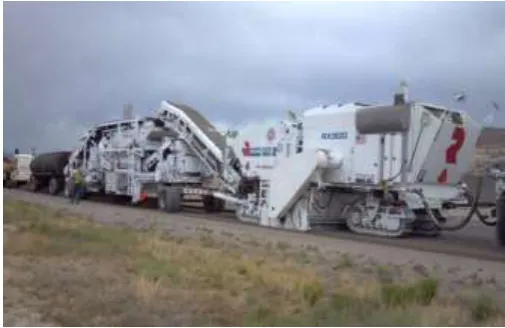
[image:2.595.38.288.220.352.2]In HIR, 100 percent of the reclaimed material is utilized. However, its limitation is that no more than 50 mm thick bituminous layer can be satisfactorily recycled. This process is a series of equipment that have the ability to perform different function such as infrared heating of pavement surface to soften it, milling the softened hot pavement surface, transferring the milling material into pug mill mixer of recycling equipment through the belt conveyer, adding fresh mix/binder/rejuvenator as per requirement of design into the pug mill, discharging the remixed materials into integrated paving screeds for paving the remixed output, rolling and compaction of the paved material. If the pavement needs to be overlaid from structural consideration, a secondary of Hot mix overlay may have to be done on top of the recycled surface and in such situations, HIR has to be done in two layers, as indicate in Fig 2.
Fig -2: Hot In-place recycling (HIR)
2.2 Cold In-place recycling (CIR)
In this process, milling and mixing processes are simultaneously accomplished by a single equipment or a train of equipment capable of milling and conveying the milled material to be fed to a pug mill, with parallel supply line for feeding fresh aggregate also, and separate feeding lines to pug mill for bitumen emulsion, and rejuvenator shown Fig 3. This type of recycling is considered suitable for depth up to 150 mm and the use of reclaimed material is also in same order (typically 30 to 50%) as in HIP. Another variant of cold in-place recycling is (CIR) Full Depth Reclamation, where the thickness of pavement to be recycled is greater than typically 150 mm (IRC: 120-2015).
Fig -3: Cold In-place recycling (CIR)
2.3 Hot In-plant recycling (HIP)
[image:2.595.316.569.432.596.2]© 2018, IRJET | Impact Factor value: 6.171 | ISO 9001:2008 Certified Journal | Page 3079 Fig -4: Hot In-plant recycling (HIP)
Therefore, the hot mix production process, has to be suitably modified. It is suggested that not more than 50% of the reclaimed material is to be used, though a widely accepted percentage is only 30% and thickness is 100 mm (IRC: SP:120-2015).
2.4 Cold In-plant recycling (CIP)
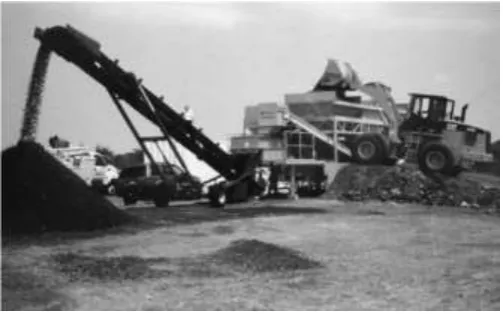
This process involves production of the mix in a plant using either emulsion or foam bitumen and laying and compaction in usual manner. Rejuvenator is to be added in the mixing process to soften the hard binder in the reclaimed material. Depth of recycling and use of reclaimed materials is same as for cold in-place recycling. Cold in- plant recycling is shown in Fig 5. The requirement of CIP, therefore, involve proper control on material feed and mixing process, including the mixing time.
Fig -5: Cold In-plant recycling (CIP)
2.5 Full depth reclamation (FDR)
Full depth reclamation (FDR) is basically a cold mix recycling process in which different types of additives such as foam bitumen, bituminous emulsion and chemical agents such as cement, fly ash, and lime, including
commercially available cementitious stabilizers are added, mostly in-situ, and compacted to obtain an improved base.
[image:3.595.318.561.257.378.2]In full depth reclamation (FDR) all the reclaimed materials of the pavement, with or without fresh material, is stabilized in-situ with suitable stabilizers to produce the base course of the pavement to be overlaid by bituminous course as shown in Fig 6. The thickness varies between 100 to 300 mm. It produces “granular” pavement layer which can be used as is, can have additional granular materials placed over it, or can be enhanced with the addition of an additive.
Fig -6: Full depth reclamation (FDR)
3. ADVANTAGES OF USING RECLAIMED ASPHALT PAVEMNT (RAP)
However, there are multiple benefits of using reclaimed asphalt pavement. Some of the advantages are listed in the following sections.
Less user delays Conservation of energy Preservation of environment Reduction construction cost
Conservation of fresh aggregate and binder Preservation of existing pavement geometric Elimination of disposal problem
Economic saving
3.1 Economical Benefits
[image:3.595.34.286.488.645.2]© 2018, IRJET | Impact Factor value: 6.171 | ISO 9001:2008 Certified Journal | Page 3080 3.2 Environmental Benefits
Recycling of old asphalt pavement is a sustainable option of road construction. There is a considerable reduction in consumption and use of natural resources. The disposal of RAP material is an important issue. Thus, using these waste materials as a material for construction of new pavement addresses this problem. With Increasing use of RAP percent total bitumen content in mix can significantly reduce greenhouse gas emissions by eliminating significant fuel consumption required to acquire and process raw materials for fresh mix.
3.3 Benefits associated with repeated resurfacing
The construction of bituminous road is being done for a very long time. When an existing road reaches its design life or deteriorates to a level which is not able to fulfill its functional requirements, a new construction is required. Due to repeated resurfacing as a periodic maintenance, many pavements have reached to a higher raised level as compared to adjoining/ abutting properties in old urban areas. The raised level of pavement can be lowered down up to desired and feasible depth with sophisticated milling machines and then after the same can be resurfaced with suitable wearing coat (Maulik et al. 2014).
3.4 Technical Benefits
RAP is a stiffer and more brittle material as compared to fresh asphalt mix. The studies were conducted on moisture and rutting resistance characterization. Results showed that introduction of RAP led to the increased resistance to permanent deformation and moisture damage.
4. SOURCES OF RECLAIMED ASPHALT PAVEMENT (RAP)
RAP may be obtained from several sources. The performance of a RAP mix depends on the source from which it is extracted and the method of extraction. There are many different methods of extraction of RAP. The most common method is through milling operation, also known as cold planning. Two other common sources of RAP are full depth pavement demolition and Hot mix plant waste. The various possible sources of RAP are as follows (West, R.C., 2010).
4.1 Generation from milling of HMA layer
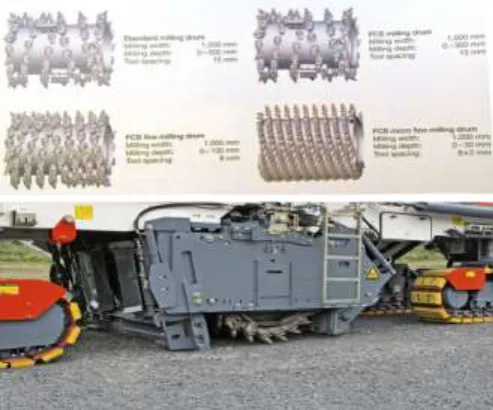
[image:4.595.312.559.86.248.2]Milling is the controlled removal of an existing pavement to a desired depth, using specially designed equipment having replaceable tungsten carbide cutting teeth mounted on a rotor drum driven by the power supplied by milling machine (IRC: SP:120-2015) as shown in Fig 7.
Fig 7: Rehabilitation of Bituminous pavement by milling.
Important aspects to be considered in cold milling are the depth of milling, appropriate milling tools to govern the size of milled material, control of dust, collection and transportation of milled material (IRC: SP:120-2015). The milling depth is determined based on visual inspection of cores to determine depth of surface cracks and location of weak layer and interfaces. Fig 8 shows the different types of milling teeth on rotar. Proper consideration must be done while examining the milling process to ensure that the material is not contaminated with impurities like soil, base material, geotextiles or debris. The maximum limit of deleterious material is recommended as 1% for evaluating the RAP contamination (IRC: SP:120-2015).
Fig -8: Different types of milling teeth on Rotar
4.2 Pavement demolition
[image:4.595.310.557.438.643.2]© 2018, IRJET | Impact Factor value: 6.171 | ISO 9001:2008 Certified Journal | Page 3081 process into a useable recycled material. In case if the
material is contaminated with soil, the material needs to be crushed and is used as shoulder or base material. (IRC: SP:120-2015).
4.3 Full depth reclamation (FDR)
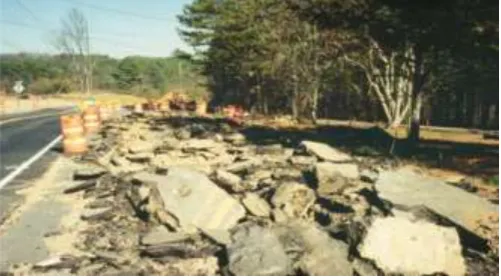
[image:5.595.35.286.284.424.2]In Full depth reclamation (FDR) all the reclaimed materials of the pavement, with or without fresh materials, is stabilized in-situ with suitable to produce the base course of the pavement to be overlaid by bituminous course(s). Fig 9 shown full-depth reclamation. If economically feasible, it is preferable to reclaim the bituminous layer and other granular or bound layers separately to retrieve as much useful and high value bituminous materials as possible (IRC: SP:120-2015).
Fig -9: Full-Depth Demolition of Roadway
4.4 Waste from HMA generated at plant
During the production of HMA plant operations it contains some waste produced during plant start-up, clean out, and transition between mixes. Another waste was generated from improper coating of aggregate and insufficient temperature during mixes.
5. PAVEMENT INVESTIGATION TO DETERMINE
RECYCLING OPTION
The results of the investigation of the existing pavements should be analyzed in terms of:
1. Serviceability of the pavement 2. The extent of surface defects
3. Structural strength 5.1 Serviceability of Pavement
Serviceability of the pavement is usually a subjective assessment in terms of riding quality and comfort. The driver’s characteristics according to PIEV, raveled bumpy road. When the serviceability of the pavement deteriorates beyond a point, one of the options available is
recycling apart from many other maintenance and repair measures like sealing, patching, micro-surfacing, surface renewal, etc. Recycling should be considered an option, IRC: 120-2015 Guidelines recommend that where
The distresses can be categorized as “High Severity” distress as defined in IRC 82:2015. Road roughness exceeds 3000 mm per km.
Rut depth exceeds 20mm, should be considered for recycling
5.2 Extent of Surface Defects
It would be necessary to know whether the defects appearing on the surface are confined to the surfacing course itself or have progressed in the lower layers of pavement as well, such as bituminous bases or granular or bound bases/sub bases. Pavement should be recycled to the depth of distress. If the distress extends into the bituminous bases, this is a clear indication of failure of the base as well. If the distress extends into granular or bound bases, the bituminous pavement material should be reclaimed and the base pulverized, stabilized and relayed while the bituminous layers could be built using reclaimed and fresh materials.
5.3 Structure Strength
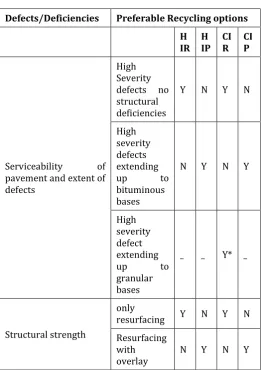
If the structural evaluation of the pavement reveals that the residual life of the pavement is sufficient to take the wheel load repetitions for the next five years, the pavement should be considered as adequate for the time being and recycling of only surface layers should be considered if the surface condition warrants it as shown in Fig 10 Otherwise, recycling should be combined with overlaying.
Fig -10: General criteria for recycling overlay and Full Depth Reclamation
5.4 Recycling Options
[image:5.595.306.553.520.660.2]© 2018, IRJET | Impact Factor value: 6.171 | ISO 9001:2008 Certified Journal | Page 3082 reclaimed materials to the maximum extent. There is not
[image:6.595.31.293.210.581.2]much merit in using in-plant methods in such cases as only 30 per cent of the reclaimed materials can be used. When recycling in deeper depth is required, in-plant methods are the only options. As far as choice between hot or cold processes, for both in-plant and in-place methods, is concerned, the choice would depend upon economic, environmental and the capability (of producing the mix meeting the design requirements) factors.
Table 1:- Recycling options
Defects/Deficiencies Preferable Recycling options H
IR HIP CIR CIP
Serviceability of pavement and extent of defects
High Severity defects no structural deficiencies
Y N Y N
High severity defects extending
up to
bituminous bases
N Y N Y
High severity defect extending
up to
granular bases
_ _ Y* _
Structural strength
only
resurfacing Y N Y N Resurfacing
with
overlay N Y N Y
6. PROCESSING OF RECLAIMED BITUMINOUS
(ASPHALT) PAVEMENT (RAP) MATERIALS
There are several sources from which RAP materials may be obtained. The most common method is through cold milling operation. RAP materials can also have obtained by two another sources are full-depth pavement demolition and bituminous plant waste. The milled material obtained can be of high quality such that it may not require any process. However, it is desirable to screen out. In some case use of oversize particles to maximum utilization of RAP materials mixes. The RAP particles can also be separated into coarse and fine stockpiles that may be used wherever required. This separation of RAP on the basis of
size increases the control over quality and reduces the variability. The basic goals of processing RAP are (West 2010):
To collect different RAP material sample from several source creation of a uniform stockpile of RAP material are required.
RAP materials are separated and crushing large lumps of particles to size that can be efficiently heated, broken, and uses during mixing with the fresh materials.
Reducing the maximum aggregate particle size in the RAP so that the RAP can be used in surface mixes (or other small nominal maximum aggregate size mixtures).
6.1 Processing Milling Material
The millings obtained from a single source are often consistent in gradation, asphalt properties, and binder properties. But one of the problems associated with increased usage of RAP in bituminous mixture was dust particle in RAP materials. Since milled RAP materials already contain a large amount of dust therefore further crushing of milled material is not desirable.
6.2 Process of RAP Materials from Multiple Sources
From multiple source RAP materials may be obtained that have different in compositions and must be processed to create a uniform material suitable for use in a new bituminous mixture. Blending as a part of processing operations is a key to achieve a consistent RAP from multiple sources. An excavator, bulldozer, or similar equipment should be used to blending of materials from different locations in the multiple-source RAP material stockpile as it is fed into the screening and crushing operation.
6.3 Stockpiling RAP
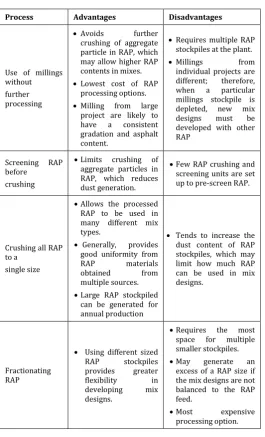
© 2018, IRJET | Impact Factor value: 6.171 | ISO 9001:2008 Certified Journal | Page 3083 Table 2: - Advantages and Disadvantages of RAP
Processing Options (IRC: 120-2015)
Process Advantages Disadvantages
Use of millings without further processing
Avoids further crushing of aggregate particle in RAP, which may allow higher RAP contents in mixes. Lowest cost of RAP
processing options. Milling from large
project are likely to have a consistent gradation and asphalt content.
Requires multiple RAP stockpiles at the plant. Millings from
individual projects are different; therefore, when a particular millings stockpile is depleted, new mix designs must be developed with other RAP
Screening RAP before
crushing
Limits crushing of aggregate particles in RAP, which reduces dust generation.
Few RAP crushing and screening units are set up to pre-screen RAP.
Crushing all RAP to a
single size
Allows the processed RAP to be used in many different mix types.
Generally, provides good uniformity from RAP materials obtained from multiple sources. Large RAP stockpiled
can be generated for annual production
Tends to increase the dust content of RAP stockpiles, which may limit how much RAP can be used in mix designs.
Fractionating RAP
Using different sized RAP stockpiles provides greater flexibility in developing mix designs.
Requires the most space for multiple smaller stockpiles. May generate an
excess of a RAP size if the mix designs are not balanced to the RAP feed.
Most expensive processing option.
7. CONCLUSIONS
Based on this study each of these method/technics treats the RAP materials in differently and hence suggested constituents varying in their proportion and content. So, by using the RAP materials in flexible pavement construction the problem of disposal of RAP wastes can be easily solved and adverse effect on environment may be avoided. In order to save money and natural resources now-a-days higher percentage of RAP materials are being adopted in terms of a substantial saving of the money and materials.
REFERENCES
[1] Abu El-Maaty, A.E.,and Elmor, A.I. (2015).
“Characterization of recycled asphalt pavement (RAP) for use in flexible pavement.” American Journal of
Engineering and Applied Sciences (AJEAS)., pp. 233-248.
[2] Copeland, A. (2011). “Reclaimed asphalt pavement in
asphalt mixture: state of the practice.” Federal Highway Administration.
[3] IRC (Indian Roads Congress). (2015). “Recommended
practice for recycling of bituminous pavements.” IRC: 120-2015, New Delhi, India.
[4] Mhlongo, S.M., Abiola, O.S., Ndambuki, J. M., and
Kupolati, W.K. (2014). “Use of recycled asphalt material for sustainable construction and rehabilitation of roads.” International Conference on Biological, Civil and Engineering (ICBCEE)., pp. 91-94.
[5] Pradyumna, A.T., Mittal, A., and Jain, P.K. (2013).
“Characterization of reclaimed asphalt pavement (RAP) for use in bituminous road construction.” 2nd Conference of Transportation Research Group of India (2nd CTRG). Procedia – Social and Behavioral Sciences 104 p. 1149-1157.
[6] Prithvi S. Kandhal. (1997). “Recycling of asphalt
pavement – An overview.” National center for Asphalt Technology.
[7] Rao, M., and Shah, N.C. (2014). “Utilization of RAP
(Reclaimed Asphalt Pavement) material obtained by milling process: with several options in urban area at Surat, Gujrat, India.” International Journal of Engineering Research and Applications., ISSN: 2248-9622, Vol. 4, Issue 7 (Version 4), pp. 01-04.
[8] Saride, S., Avirneni, D., and Javvadi, S.C. (2015).
“Utilization of reclaimed asphalt pavement in Indian low-volume roads.” J. Mater. Civ. Eng., ASCE, ISSN 0899-1561/04015107(10), pp. 01-10.
[9] Sathikumar, R., and Nivedya, M.K. (2011). “Reclaimed
asphalt pavement (RAP) technology for a sustainable pavement.” National Technological congress college of Engineering Trivandrum, Kerala (NATCON)”., pp. 41-45.
[10] Umesh Kamariya., L. B. Zala., and Amit A. Amin.
(2018). “Characterization of Reclaimed Asphalt Pavement.” International journal of Technical Innovation in Modern Engineering & Science (IJTIMES)., e-ISSN: 2455-2585, Vol. 4, Issue 5, pp. 380-390.
[11] West., R.C. (2010). “Reclaimed asphalt pavement