Rule based Detection of SQL Injection Attack
Debasish Das
Department of Computer Science & Engineering
Tezpur University, Napaam(INDIA)
Utpal Sharma
Department of Computer Science & Engineering
Tezpur University, Napaam(INDIA)
D. K. Bhattacharyya
Department of Computer Science & Engineering
Tezpur University, Napaam(INDIA)
ABSTRACT
This paper presents an effective detection method RDUD for SQL injection attack. RDUD is an enhanced version of DUD [1]. The method comprises a supervised machine learning approach using a Support Vector Machine(SVM) to learn and to classify a query at runtime. Two web profiles - (i) legitimate web profile and (ii) attack web profile are generated for each of the web-application software which consists of a set of production rules extracted from the dynamic SQL queries. Both the web profiles are generated during training phase. At runtime a dynamic SQL query is matched with each of the web profile and accordingly it classify based on the matching distance. RDUD is independent of the developer‟s initialization of syntax rules, valid trusted string database, static or pre-generated program code checking, etc. Also the method is significant in view of its simplicity, efficient and its high detection rate in comparison to the earlier method [1].
General Terms
Algorithms, Performance, Design, Reliability, Experimentation, Security.
Keywords
web-application, SQL injection, classification, production rules, web profile, RDUD.
1.
INTRODUCTION
A web-application is application software which includes dynamic web-pages such that end users can access the software through client modules that run in web browsers. The coding of client modules is in browser-supported languages such as HTML, Java, ASP, PHP etc. In three-tire web-applications, the user provides query specification as input in a pre-defined format in the front tire. These inputs are used in constructing SQL queries by the application server in the middle tire. The back tire contains the database server. Web-applications are popular due to the ubiquity of web browsers, and the convenience of using a web browser as a client, sometimes called as thin client. The ability to update and maintain web-applications without distributing and installing software on potentially thousands of client computers is a key reason for their popularity. Common web-applications include - web-mail, on-line retail sales, on-line auctions, on-line banking, and many other functional applications. Mitre‟s Vulnerability statistics reported in the year 2010-2011[2], points out 25 most common program errors or vulnerabilities causing most successful SQL injection attack along with other web-application attacks. These vulnerabilities are dangerous because it gives chances * The department is funded by UGC‟s DRS-I under the SAP
to the attackers to steal data from the application database. It is claimed that the SQL Injection scored highest rank among the web-application attacks. It is reported that SQL Injections are one of the most common and easiest techniques adopted by attackers to attack web servers, data servers and sometimes the network. This category of web attack is conducted for unauthorized access of web-application, breaking the role based accessibility, and violating the integrity of the data storage. A significant rise in SQL injection attack is reported by CISCO[3] too. The Information Systems Audit Cell report[4] recommends review the application control in net-banking applications by conducting penetration testing keeping in view of the prevailing guidelines by Reserve Bank of India, IT Act and other applicable regulations in India and asked to check the vulnerabilities in the applications like - SQL injection, Cross-site scripting etc. In this paper, in section 2, we report the background of SQL injection attack and its different classes. In this section we also present its existing practice of detection. We finally discuss in this section 2, the brief idea of the approach called DUD. In section 3, the propose detection approach RDUD is described. We report our problem formulation along with the detection algorithms in section 4. Experimental results and finally the concluding remarks are reported in section 5 and 6 respectively.
2.
BACKGROUND OF SQL INJECTION
ATTACK(SQLIA) AND ITS CLASSIFIC-
ATION
SQLIA is an attack on web-application server. It occurs when an attacker changes the intended logic, semantics or syntax of an SQL query. The query generated dynamically based on user input, maliciously crafted with SQL keywords, operators, strings or literals execute in the database server. The structure of the query with insertion of such malicious input is different from the structure defined in the application code. Let us consider that an application database contain two attributes - user name and password. The application uses the values of the attributes for authentication, consist of the following code, written in JSP scripts.
query = “SELECT balance FROM account WHERE username=‟ ” +request.getParameter(“name”)+“‟ AND PASSWORD=‟ ”+request.getParameter(“pass”)+“ ‟ ”;
If a malicious input entered by a user for username “jimmy” and “ „ or „a‟=„a‟ ” for password field, the query string becomes:
Which will always be evaluated as true, and the user will bypass the authentication logic without entering the value of password field. Su and Wassermann[5] proposed a context free grammar to define syntactic formation of a valid query. Thus, a dynamically generated query is defined as legitimate if the parse tree Tq is possible based on the proposed
grammar. Otherwise, the query is considered as illegitimate or SQL injected query. According to their definition, a SQL query q generated by a web-application P with the input (i1, i2,
..., in) is a malicious query causing SQL injection attack
(SQLIA) if the query string q does not have a valid parse tree Tq with respect to the pre-defined valid grammar. In CANDID
[6], a dynamically generated query based on user input referred as Candidate Query (CQ), is considered as an attack or illegitimate query if its structure does not match with the corresponding structure of the valid query. The valid query is referred as Benign Query (BQ). BQ is generated with valid inputs corresponding to a valid query structure. According to their[6] definition:
Definition 1: The structure of the query on any valid user input v is the control path defined in the program which is generated runtime query with the valid input data v.
Definition 2: The validity of the input can be checked by matching the runtime query structure with its respective control path and the user input data is considered as invalid if it does not match.
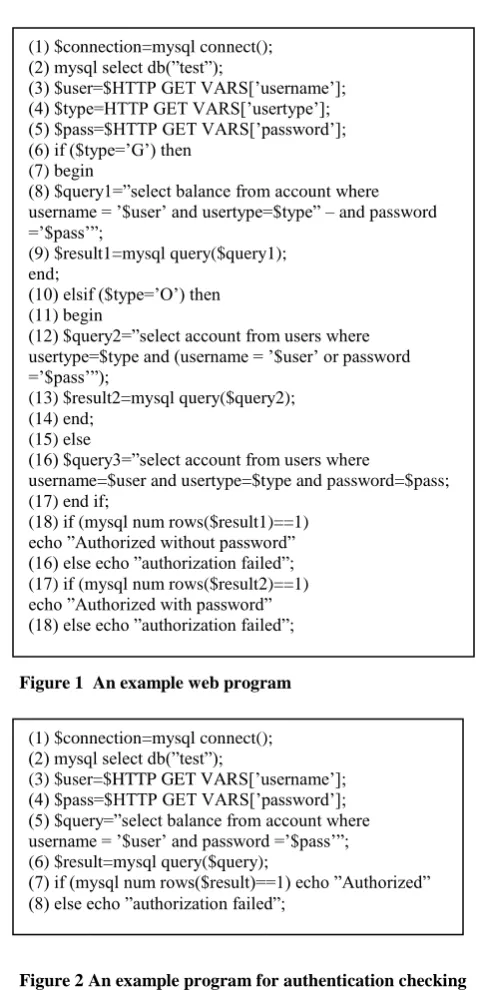
Turning back to our example given for the query string query, in the beginning of the section, the candidate input v : s←“Jimmey OR „a‟ = „a‟ ” is an SQL injection attack, since it generates a query whose structure is - select ? from ? where ?=? or ?=? while its corresponding benign input VR(v) = v1 : s←“John” exercises the control path structure - select ? from ? where ?=?. However, in case of multiple dynamic query structure some of the conditional query structures may be similar to the attack queries. In such cases, the program accepts input value and based on condition it generates queries with different structures. In our paper we address the formulation in detecting SQL injection attack under such scenarios also. Let us consider the web program written in PHP script language shown in figure 1. In it there are three programmer intended query structures - query1, query2 and query3. Each of the query executes based on the value of input data for user type. If the value of user type is ‟G‟ then it executes query structure query1. If the value of user type is ‟O‟ then it executes query structure query2, otherwise, it executes query3. Definitions of SQLIA given by [5] and [6], restrict such type of multiple query structures in applications. In our approach we propose that execution of such type of multiple query structure is justified based on the application requirement.
2.1
SQLIA Classification
SQLIA has been classified into five basic classes[1][10] with respect to the attacker‟s target and the vulnerabilities in web-applications. They are - (1) Bypassing Authentication(ByAut) (2) Unauthorized Knowledge of database(KDb) (3) Injected UNION Query (IUnion) (4) Injected Additional Query(AdQry) (5) Unauthorized remote execution of Procedures (UexRP). To explain the different classes of SQLIA, let us consider the PHP code written for user authentication checking shown in figure 2.
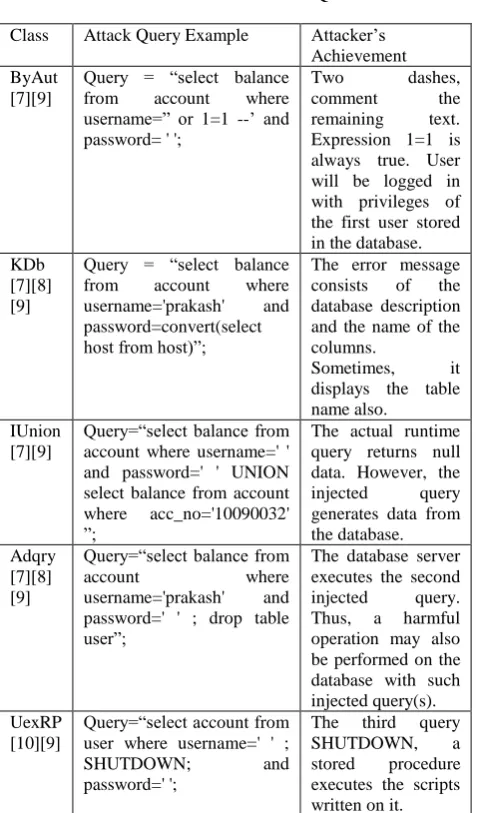
A classification of SQLIA and the attacker's achievements are illustrated in table 1.
[image:2.595.306.545.58.554.2]Figure 1 An example web program
Figure 2 An example program for authentication checking
2.2
SQLIA Detection and Prevention:
Related Work
Approaches for the detection of SQL injection attack can be categorized into - pre-generated and post-generated. Post-generated detection approaches are useful for analysis of dynamic or runtime SQL query, generated with user input data by a web application. Detection techniques under this post-generated category, executes before posting a query to the back-tire or database server. In pre-generated or static approaches programmers follow some guidelines for SQLIA detection during web-application development. An effective validity checking mechanism for the input variable data is also a requirement for the pre-generated method of detecting SQLIA.
(1) $connection=mysql connect(); (2) mysql select db(”test”);
(3) $user=$HTTP GET VARS[‟username‟]; (4) $type=HTTP GET VARS[‟usertype‟]; (5) $pass=$HTTP GET VARS[‟password‟]; (6) if ($type=‟G‟) then
(7) begin
(8) $query1=”select balance from account where username = ‟$user‟ and usertype=$type” – and password =‟$pass‟”;
(9) $result1=mysql query($query1); end;
(10) elsif ($type=‟O‟) then (11) begin
(12) $query2=”select account from users where usertype=$type and (username = ‟$user‟ or password =‟$pass‟”);
(13) $result2=mysql query($query2); (14) end;
(15) else
(16) $query3=”select account from users where
username=$user and usertype=$type and password=$pass; (17) end if;
(18) if (mysql num rows($result1)==1) echo ”Authorized without password” (16) else echo ”authorization failed”; (17) if (mysql num rows($result2)==1) echo ”Authorized with password” (18) else echo ”authorization failed”;
(1) $connection=mysql connect(); (2) mysql select db(”test”);
(3) $user=$HTTP GET VARS[‟username‟]; (4) $pass=$HTTP GET VARS[‟password‟]; (5) $query=”select balance from account where username = ‟$user‟ and password =‟$pass‟”; (6) $result=mysql query($query);
Table 1: Classification of SQLIA
Class Attack Query Example Attacker‟s Achievement ByAut
[7][9]
Query = “select balance from account where username=” or 1=1 --‟ and password= ' ';
Two dashes, comment the remaining text. Expression 1=1 is always true. User will be logged in with privileges of the first user stored in the database. KDb
[7][8] [9]
Query = “select balance from account where username='prakash' and password=convert(select host from host)”;
The error message consists of the database description and the name of the columns.
Sometimes, it displays the table name also.
IUnion [7][9]
Query=“select balance from account where username=' ' and password=' ' UNION select balance from account where acc_no='10090032' ”;
The actual runtime query returns null data. However, the injected query generates data from the database. Adqry
[7][8] [9]
Query=“select balance from
account where
username='prakash' and password=' ' ; drop table user”;
The database server executes the second injected query. Thus, a harmful operation may also be performed on the database with such injected query(s). UexRP
[10][9]
Query=“select account from user where username=' ' ;
SHUTDOWN; and
password=' ';
The third query SHUTDOWN, a stored procedure executes the scripts written on it.
[A] Post-Generated Approach
Some of the popular post-generated approach for the detection of SQLIA is found from [1]. It is found that researchers have evaluated the dynamic query strings by the - (i) Initialization of valid and invalid strings (ii) Syntax evaluation and (iii) Parse-tree grammar based evaluation. A novel approach for detection of SQLIA proposed in [6], for mining programmer intended queries with dynamic evaluation of candidate input. The idea is to construct dynamically the structure of the programmer-intended query corresponding to the runtime SQL query with candidate input. According to this approach a candidate input is considered as legitimate if the following two conditions hold:
Condition 1: Input must be benign, i.e., the candidate input must be evidently non-attacking, as envisioned by the programmer while coding the application. The query generated from the benign input is considered as a legitimate query.
Condition 2: Input must dictate the same path i.e., the structure of the programmer intended query given in the respective application program. A legitimate input to the executing program will dictate a control path to a point where query is issued. To deduce the programmer intended query structure for this particular path (i.e., control path), the candidate inputs must also exercise the same control path in the program. Given such candidate inputs, the method detect
attacks by comparing the query structures of the programmer-intended query and the possible attack query. The approach suggests the need for an oracle that, given a control path in a program, returns a set of benign candidate inputs that exercises the same control path. This oracle, if constructed, may actually offer a clean solution to the problem of deducing the query structure intended by the programmer. Practically, such an oracle is hard to construct and become possible for typical application. However, Bisht and Venkatakrishnan proposes[6] a real scalable automatic solution to dynamically detect and prevent SQL injection attacks. At a more abstract level, the idea of computing the symbolic query on sample inputs seems a powerful idea that probably has more applications in systems security. Proxy-based detection method proposed in [11], consists of four different components: (i) Query selection for evaluation. (ii) Extraction of input data. (iii) Parse-tree generation and (iv) Input data evaluation. To implement such a method, a separate proxy, architecturally residing in the middle tire with the web-application server, is used for query selection, input data extraction and parse-tree generation. Based on evaluation of input data using parse-tree evaluator, if it is found normal, the query is allowed to execute, otherwise, query is considered as malicious and is not executed. Unlike, other detection technique, such technique has added advantage due to its modularity in implementation. However, detection rate depends on the algorithms applied for each of the components of the detection technique.
[B] Pre-Generated Approach
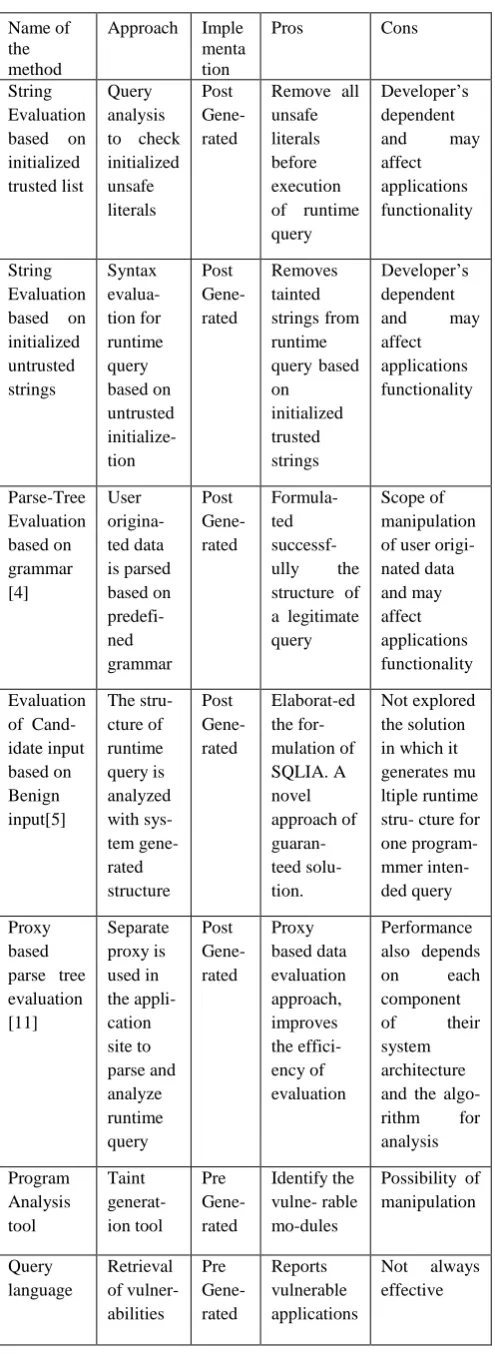
The pre-generated approaches for the detection of SQLIA, found in [1] consists of various analysis tools used for identifying the vulnerabilities. The detection approaches are mainly the mechanisms to identify the vulnerabilities in the web-application programs. These mechanisms include - (i) the validity checking and (ii) the integrity checking of web-programs. Pre-generated approaches are implemented with the software tools to check the vulnerabilities in web-programs so that the attackers cannot mis-utilize an application. By giving an application program as input to such software tools, the programmer intended SQL queries are analyzed using valid and tainted data. Based on such analysis, it reports the vulnerability points in an application program. It is also proposed the modules or methods used to rectify the vulnerability points. Detection methods proposed by the researchers and the category of implementing their approaches, and the pros and cons of each method are tabulated in the table 2. Based on our limited survey it is observed that -
(a) The pre-generated detection techniques for SQLIA depend on the effectiveness of the validity checking by the web programmer and the effectiveness of the tools applied to detect the integrity of the code that causes SQLIA.
(b) The post-generated approaches for detection of SQLIA are based on the initialization of trusted or untrusted strings, which are developer-dependent. The parse tree evaluation approach based on the pre-defined grammatical constraint, given in [5] and [6] may be considered better than the others. However, there is the possibility of manipulation of the initialized strings by the attacker, and pre-defined grammatical constraint is application dependent and restricts the variable runtime query structures.
2.3
DUD
DUD[1] is a post-generated approach for detection of SQLIA. It generates a master profile of legitimate dynamically generated queries and stored into a semi-structured form. At runtime, it converts the dynamic SQL query into semi-structured or XML form based on the Document Type Definition(DTD). It then matches the XML form query with the profile using algorithms for exact matching and approximate matching. At first, it executes exact matching algorithm and if it matches it considers the query as legitimate query and allows the query to transport to database server from execution. If it does not match, then it computes and retrieves the minimum distance with respect to all the queries available in the profile. A dynamic threshold is generated during training phase and is used for the detection of SQLIA by comparing with the distance value computed in approximate matching. A detailed discussion on the design, uses and its effectiveness is in [1].
3.
AN EFFECTIVE RULE BASED
DETECTION METHOD: RDUD
The proposed method RDUD, is an enhanced version of DUD and is a supervised machine learning classification approach. The method indexes the strings of the dynamic SQL queries and employs Support Vector Machine(SVM) to classify a runtime SQL query into normal or attack. A support vector machine (SVM) is a concept that maps the input vector into two or higher dimensional feature space (linear or non-linear mapping). SVM may be used most popularly in classification processing by analyzing data and recognizing the patterns[15]. We use standard binary linear SVM which takes a set of input data and predicts each input into two possible classes - attack or normal. By giving the computed distance value as input to SVM, it classifies into either of the two classes which makes the SVM a probabilistic binary linear classifier. The architecture of RDUD is shown in figure 3. It is composed of two major phases - (i) Training and (ii) Runtime detection; During training phase, it performs the following activities - (i) Generation of Rule Dictionary; (ii) Generation of two web profiles(normal and attack) separately for legitimate and attack queries; The runtime phase, comprises the following steps -(i) XML-conversion of runtime SQL queries; (ii) Production rule generation; (iii) Distance computation with respect to each of the web profiles; (iv) Classification - attack or normal based on distance value; Pre-processing of dynamic SQL during training phase, comprises the generation of both the web profiles. The web profile generation consists of three basic tasks - (1) Converting a dynamic SQL query into XML form; (2) Generating production rules; (3) Writing into web profile. Depending upon the input data values, we consider that the dynamic SQL query for an application may have different structures. Also, corresponding to each legitimate structure of the SQL query, it may have multiple attack queries whose structures are different(for example see figure 1). To accommodate variable schema of both legitimate and attack queries, we convert the dynamic SQL query into XML form. In contrast to the grammar verification context, rules(production) are generated to construct web profile from the test input(i.e. dynamic SQL query) during training phase. Query classification at runtime starts with the extraction of production rule(PR) from the dynamic SQL query, followed by the execution of matching process with both the web profiles (attack web profile and normal web profile). Based on the matching score a query is classified into normal class or attack class.
The PR of a dynamic SQL query, given for classification, can be any of the following status -(i) It exists in the legitimate
web profile; (ii) It exists in the attack web profile; (iii) It does not exists in both the profiles; For the first two conditions (1) and (2), it can be easily sorted out the class of the runtime query - attack or legitimate. In case the condition (3) holds, there may be two possibilities either the query itself is a new legitimate query or a new maliciously crafted attack query. In such case, the minimum distances (ω1 and ω2), with respect to
both legitimate and attack profiles respectively are calculated. Using the value of ω1 and ω2, we calculate the nearest plane
value(Pv). Such values are given input to the trained SVM to
identify the class of the query.
At first, it retrieves the PR of runtime SQL query. It is then computes the two distance values(ω1 and ω2) using the same
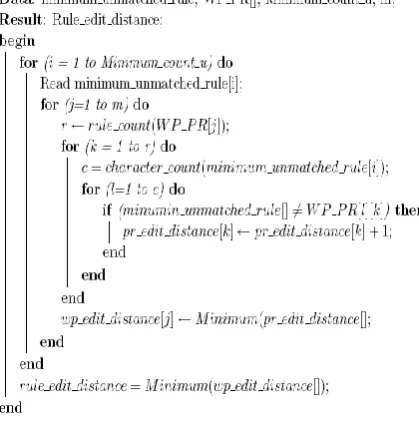
steps given in Distance Computation cited in Training Phase under this section. To execute the steps for computing the distance PR values of two dynamic SQL queries is given in algorithm 2. The algorithm is designed based on [13] calculates the distance by counting the number of unmatched rules or strings in a particular PR matching process. Let us consider the following two dynamic SQL queries (i) and (ii) in which both are considered as legitimate for an application. (i) select balance from accounts with usertype=„T‟ and username=„abc‟ and password=„p001‟;
(ii) select balance from accounts with usertype=„O‟ and username=„xyz‟ -- and password=„p001‟;
Suppose, an attack query (iii) given below is -
(iii) select balance from accounts with usertype=„T‟ and username=„abc‟-- and password=„p001‟;
In this case the structure of both the queries (ii) and (iii) are similar. However, the query (iii) given above is an illegitimate or attack query. If we execute the matching process in which the dynamic structure of the SQL query includes the structure and the values then only the query can be identified as different from the legitimate query. Because in this particular application only for the usertype „O‟, the password portion is not required. Thus, we get the minimum computed distance value is 2 when we include value portion in case of runtime query structure. To classify the above two SQL queries, we use the equation ωx ± b = 0. The plane of SVM, shown in figure 6, has two sides(+1 and -1). The value of two roots x1
and x2 are calculated and are plotted the points (x1,x2) in a two
dimensions (X,Y) plane. During training phase we experimented separately with a list of legitimate and attack queries. A separating plane is drawn which separates the support vector planes into both the sides of it. The value of Pv(nearest plane value) is calculated using the equation Pv(x)
Table 2: Detection approaches and their pros and cons
Name of the method
Approach Imple menta tion
Pros Cons
String Evaluation based on initialized trusted list
Query analysis to check initialized unsafe literals Post Gene- rated
Remove all unsafe literals before execution of runtime query
Developer‟s dependent and may affect applications functionality
String Evaluation based on initialized untrusted strings Syntax evalua-tion for runtime query based on untrusted initialize-tion Post Gene-rated Removes tainted strings from runtime query based on initialized trusted strings Developer‟s dependent and may affect applications functionality Parse-Tree Evaluation based on grammar [4] User origina-ted data is parsed based on predefi-ned grammar Post Gene-rated Formula-ted successf-ully the structure of a legitimate query
Scope of manipulation of user origi- nated data and may affect applications functionality Evaluation of Cand-idate input based on Benign input[5] The stru-cture of runtime query is analyzed with sys-tem gene-rated structure Post Gene-rated Elaborat-ed the for-mulation of SQLIA. A novel approach of guaran- teed solu- tion. Not explored the solution in which it generates mu ltiple runtime stru- cture for one program-mmer inten-ded query
Proxy based parse tree evaluation [11] Separate proxy is used in the appli-cation site to parse and analyze runtime query Post Gene- rated Proxy based data evaluation approach, improves the effici-ency of evaluation Performance also depends on each component of their system architecture and the algo- rithm for analysis Program Analysis tool Taint generat-ion tool Pre Gene- rated Identify the vulne- rable mo-dules
Possibility of manipulation Query language Retrieval of vulner- abilities Pre Gene- rated Reports vulnerable applications
[image:5.595.50.298.92.770.2]Not always effective
Figure 3: The Architecture of RDUD
For n number of queries, the basic input data format and output data domains in SVM are as follows:
(xi, yi), ..., (xn, yn), xi R, yi {+1,−1} where, xi is a two
dimensional real inputs vector, R is a set of all real numbers. The goal is to find out the margin of the plane that divides the points having yi = 1 from those having yi = −1. A plane drawn
on the set of points (x1, x2, .., xr) satisfying maximum-margin
plane and a margin for an SVM trained with samples for a particular class. Samples on the margin are called the support vectors. To identify the class a runtime SQL query is given input to the proposed method of matching process. If it is matched then declared the dynamic SQL query as legitimate(i.e., computed distance ω1=0). If the PR does not
matched with any of the Production Rule exists in the legitimate web profile then the module generates the unmatched legitimate rules (LR) as output. If the output of execution is the unmatched rules, the algorithm 3 also executed with the attack web profile and input for these modules are - PR of the dynamic SQL query and the attack web profile. If it is matched then it declared the dynamic SQL query as attack query(i.e., computed distance ω2=0).
Otherwise, the output of such execution are unmatched attack rules(AR). If the values of both LR and AR are not empty string then we execute the module called Distance Computation. The output of such execution is the number of unmatched rules in LR gives the distance (ω1) with respect to
the legitimate web profile(WP1). Then, we execute the module
Distance Computation by giving input - unmatched rules AR. The output of such execution is the number of unmatched rules in AR, gives the values of (ω2) with respect to the attack
web profile WP2. Next, we compute nearest plane value(x)
for a given value of b and classify the runtime SQL query based on the value of x. The output of the detection approach RDUD may be interpreted with the following cases:
(1) If ω1 = 0 then it lies in the normal plane and declared as a
normal query;
(2) If ω2 = 0 then it lies in the attack plane and declared as an
attack query;
(3) If the value of both ω1 and ω2 are non-zero then it
computes the value of x and plot the
value the two dimensional plane(X,Y), as shown in figure 6 and using trained support vectors it identifies the class. RDUD is significant in view of the following observations:
(a) Initialization of trusted/untrusted strings are avoided; (b) The matching logic is easy to implement;
(c) Web profile file is adaptively updated;
(d) No restriction is imposed on input strings/ characters; (e) No restriction of defining syntactical constraint for query structure;
constant depending on the application. To accommodate the variable schema of runtime queries, we convert dynamic SQL queries into semi-structured document (i.e., XML) before generation of web profile. Each rule in PR of the runtime SQL query is matched with all the PR of the web profile. Thus, the time complexity of such matching of PR extracted from XSQL and each PR of the web profile is n×m; n ← number of rules available in the XSQL and m ← number of rules available in a PR of the web profile. If T is a set of tags of an XML document, then σ = T {$}, where ”$” stands for the space and carriage return characters. The algorithm generates a context free grammar G=(V,σ,R,S); V is a finite set of string tags, R is a finite set of Production Rules and S is the initial string tag of G. A sample generated sequence of PR is shown in Table 4. The “Input” column shows the next input string tag, and the “Rules Generated” column shows the production rules. The empty production rule i.e., the start string tag, “r0→” and the next input symbol “< item >” are provided as
initial state. In step i and i+1, the non-terminal tagged string, in the form of production rule r1, r2, r3 etc. are generated. The
proposed approach is a semi-supervised classification method in which it is not considered the pre-defined parameters to categorize the SQL query strings. It is assumed that the attackers may conduct SQLIA, crafted with malicious strings having variable SQL query structure. The programmer intended SQL query also can have variable structures and are varying with application to application. For a dynamic SQL query the two numeric values - (i) computed distance with respect to the legitimate web profile and (ii) computed distance with respect to the attack web profile are given input to the SVM. The classification at runtime is done based on the plotted distance within the range of values learned during training phase.
4.
PROBLEM FORMULATION
A application is an application program coded in language, executed using browser. We define a web-application program as P = ({S},{F}), where S={s1, s2, .., sn}
is a set of finite string tags and F={f1, f2, .., fm} is a set of
finite web-functions or url (static or dynamic). The input vector (i1,i2,...,in), originated from the user input of
web-application P, transports into web-web-application server and may generate dynamic SQL query q. The query q then transports into the database server, where executing it and performs DBMS operation, such as - data insertion, data updating, data deletion and retrieving information. The output information converted into web-application program and sends to the client‟s point, executes by the web-browser. The problem is to form a basis to identify the dynamic SQL query q into a 2-class problem(legitimate or attack) with reference to two web profiles - attack web profile and normal web profile.
Definition 3(Rule-Segmented Query): The structure of a dynamic SQL query can be expressed into a set of rules(R), retrieved from the Rule Dictionary(RD). Again, each rule is expressed by a tuple (rule name, rule type, rule value). Rule-Segmented Query(RS) can be defined as a function fRS(q) which returns a set of rule name such that each sub-string of q has one rulename. Thus, we can write,
RS(q) : RS(q) → R; R = {r1, r2, .., rn} and ri = {rni, rti, rvi}.
Let us consider the query string query, cited in PHP code given in figure 2, the value of RS(query) can be written as -
RS(query)←(K1$A1$K2$T1$K3$Id1$Op1$V1Lop1$Id2
$Lop2$V2)
The function RS(q) returns the sequence of rule name from
RD corresponding to the sub-strings of the query, such that
each rule is separated by the literals „$‟; A sample shot of RD is given in the table 3. In this table it is shown the different columns of RD such as - Rule name, Rule type and Rule value.
Definition 4(Rule Dictionary): Rule Dictionary(RD) is a rule data-store, in which each rule is stored as a tuple (Rule Name, Rule Type, Rule Value). Executing a policy or method for generating RD, such that it creates an auto-generated unique rule name(Rn), which is one of the attribute of RD and stores
the unique rule value into it. Let, the rule name stored in RD with respect to an web-application, Rn = (rn1, rn2, .., rnk).
Corresponding to each rule name, rni, the policy or method
retrieves the string from a dynamic SQL query as a rule value(rvi) and its rule type i.e., Keyword, Attribute etc. Thus, a
rule is stored in RD in the form of a tuple (rni, rti, rvi). A
[image:6.595.310.548.267.410.2]method, (RD), implements the policy, generates the unique value of rule name
Table 3: Rule Dictionary in Tabular form
Rule name [1]
Rule Type [2]
Value [3]
K1 Keyword select
K2 Keyword from
K3 Keyword where
A1 Attribute account
A2 Attribute users
Id1 Identifier username
Id2 Identifier password
Rop1 Relational Operator =
V1 Value ddas
Lop1 Logical Operator and
V1 Value dd123
and retrieves the values for the other two attributes of RD - rule value(Rv) and rule type(Rt) from a dynamic SQL query.
The input to the algorithm of policy or method f(RD) is a dynamic SQL query, qa and output to the algorithm of policy
or method (RD) retrieves a set of rule tuples. Thus, the
data-store of RD consists of a set of rows, {R1,R2, ..,Rp}, p ≥ 1 and
we can express a dynamic SQL query, qa = Ri = {(rn1, rt1, rv1),
(rn2, rt2, rv2), .., (rnk, rtk, rvk)}; Ri RD.
Definition 5(Production Rule): A Production Rule(PR) is a sequence of rule names, PR=[r1,r2,..,rn], retrieved from RD
with respect to a sequence of strings available in the structure of a dynamic SQL query. Thus, for each dynamic SQL query(qa), we have one corresponding production rule(PRa). r i
N; PRa N; N← set of all rule names in RD; We consider
the example of query string query given in the section 2. The value of PR extracted from RD for query can be written as - K1$A1$K2$A2$K3$Id1$Rop1$V1$Lop1$Id2$Rop1$V2
Definition 6(web profile): A web profile is a summary of dynamic or runtime SQL queries generated for a web-application software. The content of the web profile is a set of finite numbers of unique Production Rules(PR), such as WP=[PR1, PR2, .., PRm]. According to our approach every
web-application software is executed with two web profiles - (i) legitimate web profile(WP1) and (ii) attack web
profile(WP2). Let us consider the example given in figure 1.
PR1=K1$A1$K2$A2$K3$Id1$Rop1$V1$Lop1$Id3$Rop1$V3
$Lop2 $Id2$Rop1$V2
PR2=K1$A1$K2$A2$K3$Id1$Rop1$V1$Lop1$Id3$Rop1$V4
$Lop2$Id2$Rop1$V2
The content of the attack web profile for the query string a query can be written as -
PR1 = K1$A1$K2$A2$K3$Id1$Rop1$V1$Lop1$Id3$Rop1$
V3$ Lop2$Id2$Rop1$V2$Lop2$Id4$Rop1$V4
Definition 7 (Nearest Plane Value(Pv)): For a given off-set value(b), the plane values(x1 and x2) are computed with the
values of ω1 and ω2 using the equation (x1×ω1+b) = 0 and
(x2×ω2−b) = 0. The values of the parameters ω(ω1 and ω2)
and b are constrained to solve the 2-class problem[12]. Thus, the Nearest Plane value(Pv) can be calculated as Pv = x1+x2.
The constraint parameter b called offset parameter and should be chosen such that the range of support vectors, Pv can be
projected on the decision surface. Nearest Plane Value(Pv) is
the value plotted in (X,Y) plane which gives a measure of the nearest or closest distance from the separating plane. The value of Pv(q) gives a measure of the dynamic query belongs to the class - attack(illegitimate) or normal(legitimate).
Definition 8(Malicious Query): The dynamic SQL query q generated with the input data (i1, i2, ..., in) is a malicious query
causing SQL injection attack (SQLIA) if any of the following conditions hold:
• The PR generated from the structure of the dynamic query q belongs to the attack web profile WP2, i.e., PR(q) : PR(q) ←
PRq WP2;
• The PR generated from the structure and the computed nearest plane value(Pv) are such that all the following three conditions hold -
(i) [PR(q) : PR(q) ← PRq WP1];
(ii) [PR(q) : PR(q) ← PRq WP2];
(iii) For a given value of b, the value of Pv is such that (−1 ≤
Pv(q) < 0).
Definition 9(Legitimate Query): The dynamic SQL query q generated with the input data (i1, i2, ...,in) is a legitimate query
if any of the following conditions hold:
• The PR generates from the structure of the dynamic SQL query q belongs to the legitimate web profile WP1, i.e., PR(q)
WP1;
• The PR generated from the structure of the dynamic SQL query q and the computed value of Pv are such that it holds all
the following three conditions - (i) [PR(q) : PR(q) ← PRq WP1];
(ii) [PR(q) : PR(q) ← PRq WP2];
(iii) For a given value of b, the value of Pv is such that (0 ≤
Pv(q) ≤ 1).
4.1
Algorithm
In this section we present the steps to implement our approach.
A. Training Phase
Generation of Rule Dictionary(RD): Let us, consider the example query string shown in figure 2. The XML equivalent of the query is shown in figure 4. The Document Type Definition for the conversion of such query string into XML form is shown in figure 5. The rule value <select> is identified by rule name - K1 and rule type - Keyword.
Similarly, the rule value <from> is identified by rule name K2
and rule type Keyword etc. Thus, using these string values of each dynamic query, the Rule Dictionary(RD) is generated. To generate RD, the following steps are executed –
Read each item - element, attribute, identifier, value, relational operator and logical operator from the XML form of dynamic SQL query(XSQL);
Check whether the rule value of the corresponding item already exists in the RD;
If the rule value of the corresponding item does not exist in RD then execute (i) to (iv) given below:
(i) Generate unique rule name(n) for each of the item; (ii) Retrieve each string of the dynamic SQL query as a rule value(v);
(iii) Identify the corresponding rule type(t); (iv) Insert the tuple (n,t,v) into RD;
Generation of web profile: To generate web profile from a dynamic SQL query the following steps are to be executed -
Read dynamic SQL query ;
Convert the dynamic SQL query into XML form called XSQL;
Read each item of XSQL - element, attribute and identifiers;
Retrieve corresponding rule name from RD for each item of XSQL;
Generate Production Rule (PR) of the corresponding dynamic SQL query by constructing the sequence of rule name retrieved in the previous steps;
Check whether the value of PR already exists in the web profile(WP);
If does not exists, insert PR into web profile(WP); The web profiles generated during training phase will be incrementally updated based on the detection at runtime phase.
Distance Computation: The distance between two SQL queries can be calculated by computing the minimum number of operations required to convert the PR of one query into the other. Let, us consider the two PR values PR1 and PR2 of two
different dynamic queries Q1 and Q2 as given below :
PR1=K1$A1$K2$A2$K3$Id1$Rop1$V1$Lop1$Id2$Rop1$V2
PR2=K1$A1$K2$A2$K3$Id1$Rop1$V1$Lop1$Id2$Rop1$V2$Lo
p1$Id3$Rop1$V3
The number of unmatched rule between two PR, gives the distance value ω. Thus, the value of ω in the above case between PR1 and PR2 becomes 2 due to the unmatched rule -
Id3 and V3. For a dynamic SQL query the value of ω1 and ω2
can be computed at runtime with respect to normal and attack web profiles. If the value of ω1 is zero, then it declares as
„Normal‟ query. If the value of ω2 is zero, then it declares as
„Attack‟ query. In case, the values both ω1 and ω2 are
Figure 4: XML record based on DTD given in figure 5
Figure 5: Document Type Definition (DTD) of XML equivalent of SQL query
During training phase, we perform tests with dynamic SQL queries (both legitimate and attack). For each matching process we compute the value of x1 and x2 and finally, the
nearest plane value NPV(x) = x1+x2. We experimented with
both normal and attack queries and plotted the value of x in a two dimensional plane(X,Y). A separating plane which separates both the dimensional planes(X and Y) equally is drawn, shown in figure 6. We also draw support vector plane by joining the plotted points, parallel to the separating plane. The plotted points below the separating plane and towards the X-axis are identified as normal class, and the plotted points above the separating plane towards the Y-axis are identified as attack class. The following steps are executed for the computation of distance value(ω) between PR of two queries.
• For all the m numbers of PR of a web profile(WP1) do {
• For all the rules of PR for dynamic runtime SQL query do { • Calculate the number of unmatched rules to each PR of WP1,
{C1,C2,C3, ..Cm} } }
• Retrieve the minimum value Ck from {C1,C2, ..,Cm} which is
the distance between the runtime SQL query with respect to the web profile WP1
Thus, the distance value may be computed at runtime between the PR value of dynamic SQL query with each PR value of both attack and normal web profile separately.
Figure 6: The plane of SVM
B. Runtime Phase(Query Classification):
To convert XSQL(XML form of runtime query) into sequence of rules called PR, we use the algorithm based on the SEQUITUR algorithm proposed by Nevill-Manning [14]. The algorithm for PR generation from a runtime SQL query is given in the algorithm 1. The algorithms for distance computation and the final classification based on PR matching are given in algorithm 2 and 3 respectively. A sample of the steps in generating PR is given in the table 5.
Algorithm 1: PR Generation <select>
<attribute attribute name=balance </attribute> <from>
<table table name=account </table> </from>
<where> <expression>
<identifier identifier name = username </identifier> <relational operator relational operator == </relational operator>
<value value = prakash </value> </expression> <logical operator logical operator = AND </logical operator>
<expression>
<identifier identifier name=password </identifier> <relational operator relational operator == </relational operator>
<value value = p123 </value> </expression>
</where> </select>
<!Element Select (attribute)* <!Element From (table)*
<!Element Where (expression, (Logical Operator, Expression)*)
<!Element Expression(Identifier, Relational Operator, Value) <!Element Logical Operator(AND|OR|NOT)
<!Element Identifier(#pcdata)
[image:8.595.320.533.393.626.2]Algorithm 2: Distance Computation between PR of two Queries
[image:9.595.58.268.115.327.2]Algorithm 3: PR Matching of two dynamic SQL queries
Table 4: Steps in generating Production Rules(PR)
Step Input
Rules Generated
1 <item> r0
2 $ r0<select>
3 <item> r0<select>$
4 $ r0<select>$<attribute>
5 <item> r0<select>$<attribute>$
6 $ r0<select>$<attribute>$<name=balance>
7 ….
<item> r0<select>$<attribute>
$<name=balance>$
i <item> r0<select>$<attribute>$name=balance$
>$</attribute>$<from>…</from>$ i+1 $ <select>r1r2 … </from>$
r0$</attribute>r3 … </where>
r1$<attribute> r2$<name=balance>
5.
EXPERIMENTAL RESULTS
In our experimental setup the detection modules of RDUD are installed in a web-application server of a three-tire application architecture. The web-application server is connected with a database server and is accessible to web clients. We generate two master files for each application. The first file consists of the legitimate dynamic SQL queries generated with legitimate access during training phase. The other file consists of the attack queries generated, corresponding to each intended structure of SQL queries defined in web-application program. Using the master file having legitimate SQL queries we generate the legitimate web profile(WP1). Similarly, we
generate attack web profile(WP2) with master file having the
attack SQL queries. Both the profiles WP1 and WP2 are stored
in the web-application server. The server also contains the modules for - (i) Rule Dictionary generation; (ii) Production Rules generation; (iii) Distance Computation and (iv) Query Classification. We used MySQL in the database server. To test the detection rate using our approach, we simulate the runtime environment using two different files - file 1 and file 2. The file 1 consistS of legitimate dynamic SQL queries and file 2 consistS of attack or illegitimate dynamic SQL queries. While generating the file 1 and file 2 we include dynamic SQL queries in it such that the corresponding PR of some of the queries exist in the respective web profiles, while other does not exists. To generate the web profiles, at first we construct the Rule Dictionary table and executed the module for generation of Production Rule(PR) using algorithm 1, from both the master files - legitimate master file and attack master file. Then the values of PR are stored in WP1 and WP2 respectively. The web-application is considered for our experiment, consists of three programmer intended SQL queries. The web profile(WP1) consists of 50 numbers of PR
values of dynamic SQL queries, which are considered as legitimate. Similarly, the web profile(WP2) consists of 60
numbers of PR values of attack SQL queries such that for each class of SQL injection attack, we considered 12 numbers of attack SQL queries. While computing the distance value (ω1 and ω2), if we avoid the value portion of an unmatched
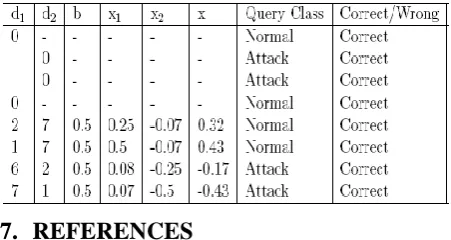
value computed for an unmatched value in an expression of a runtime SQL query. Thus, for each unmatched value we considered the Distance value as 1. In this experiment we got 100% detection rate We also experimented by considering the character wise edit distance method instead of considering the Distance value for unmatched rule value as 1. In this case also we got 100% detection rate for all the attack classes except the attack class ByAut. This is due to the fact that any new dynamic SQL queries consist of new value, can increase the distance. Thus, according to our experimental analysis, we should apply our detection approach including the character wise distance computation for all the attack classes of SQLIA except the attack class ByAut. For the detection of this particular attack class ByAut we should apply structure matching excluding the value of a dynamic SQL query. We tabulated the value of x1, x2 and the corresponding value of x
in table 5. The accuracy of the detection of query class is also cited in the table 5.
6.
CONCLUSIONS AND FUTURE
WORK
[image:10.595.54.280.402.522.2]Our detection method RDUD has been found to perform satisfactorily over a test data-set. The method is also found capable of handling the variable structure of dynamically generated SQL query based on user input. The effectiveness of updating mechanism of the web profile can be increased with additional checking module. However, special care needs to be taken for maintaining the integrity of the web profile files to avoid poisoning of web profiles. Also, the use of appropriate encoding technique can help to avoid stolen key attack.
Table 5: Values of x1, x2, x and query class detection
7.
REFERENCES
[1] Debasish das, Utpal Sharma & D.K. Bhattacharyya. An approach to detection of SQL injection attack based on dynamic query matching. International Journal of Computer Applications, 1(25), 2010.
[2] Common Weakness Enumeration. 2011 cwe/sans top 25 most dangerous software errors. MITRE Corporation, http://cwe.mitre.org/top25/#Listing, 2011.
[3] SPAM fighter products 2003-2011, CISCO Worldwide. A growing menace. http://spamfighter.com/News-15078-Sql-Injection-Attacks-A-Growing-Menace.htm, 2010. reports Forman, G. 2003. An extensive empirical study.
[4] Reports from Information System and Audit Cell(Indian Bank), Chennai(INDIA). Audit report for Core banking/net banking/ mobile banking/ atm/ data center/ d
r site/ networking infrastructure and other integrated systems.
[5] Z. Su and G. Wassermann. The essence of command injection attacks in web application. In the 33rd Annual Symposium on Principlas of Programming Languages, pages 372-382, January 2006.
[6] P. Madhusudan, Prithvi Bisht and V.N. Venkatakrishnan. Dynamic candidate evaluation for automatic prevention of SQL injection attacks. ACM Transactions on Information and System Security, 13, 2(14), 2010.
[7] C. Anley. Advanced SQL injection in SQL server applications. White Paper, Next Generation Security Software, http:/wwwgenss.com/papers/advanced sql injection.pdf, 2002.
[8] D. Litchfield, Director of Security Architecture. Web application dissembly with odbc error message, a report. http://www.atstake.com.
[9] M. Howard and D Le Blane. Writing Secure Code, volume II. Microsoft Press, Redmond, Washington, 2003.
[10] Jeremy Viegas William G.J. Halfond and Alessandro Orso. A classification of SQL injection attacks and countermeasures. In Proceedings of the IEEE International Symposium on Secure Software Engineering, Arlington, VA, USA, 2006.
[11] Yi Yuan Anyi Liu and Duminda Wijesekera. Sqlprob: a proxy based architecture towards preventing sql injection attacks. ACM Digital Library, 2009.
[12] Vladimir Vapnik Cornna Cortes. Machine Learning, 20, 273-297(1995).
[13] K. Krithivasan and R. Sitalakshmi. Efficient two dimensional pattern matching in presence of errors. Information Sciences, 43, 1987.
[14] James Law. Path based dynamic impact analysis. In IEEE Explore, Computer Science Department, Oregon State University, 2003.
[15] Steve R. Gunn. Support Vector machines for classification and regression. Technical report, Faculty of engineering, science and mathematics. School of Electronics and Computer Science. ecs.soton.ac.uk/srg/publications/pdf/SVM.pdf, 1998.
[16] F. Bouma. Stored Procedures are Bad, O‟Kay, Technical Report. Asp.Net/Weblogs, http://weblogs.asp.net/fbouma /archieve/2003/11/18/38178.aspx, November 2003.
[17] E.M. Fayo. Advanced sql injection databases, technical report. Agencies Information Security, Black hat Briefings, Black Hat U.S.A, 2005.
[18] S. McDoland. SQL Injection, modes of attack, defence and why it matters. GovernmentSecurity.org, April 2006.
![Table 3: Rule Dictionary in Tabular form Rule name [1]](https://thumb-us.123doks.com/thumbv2/123dok_us/8119679.793802/6.595.310.548.267.410/table-rule-dictionary-tabular-form-rule.webp)