A New DCT based Channel Estimation Algorithm
for OFDM Systems
Antony Nycil P.A.
Dept. of Electronics and Communication FISAT
M.G. University
Anoop E G
Asst. Professor
Dept. of Electronics and Communication FISAT, M.G. University
ABSTRACT
This paper deals with the estimation of the channel in orthogonal frequency division multiplexed systems. In this paper, a new DCT-based pilot-symbol-aided channel estimation method is proposed. The energy leakage in multipath channel with non-sample-spaced time delays is eliminated here. The proposed method uses symmetric property to extend the LS estimate in frequency domain to remove the effects of non-sample spaced time delays. The computer simulation results demonstrate that the new method can reduce the leakage energy efficiently, and the performance of the new channel estimation method is better than the LS and improved DFT algorithm.
Keywords
Channel estimation; OFDM; energy leakage; improved DFT; DCT.
1.
INTRODUCTION
Orthogonal frequency division multiplexing (OFDM) is a technique in which a large number of narrowband sub channels are transmitted in parallel over a large bandwidth thereby increasing the symbol duration and reducing the ISI. OFDM is an effective technique for combating multipath fading and for high-bit-rate transmission over mobile wireless channels. OFDM has been adopted in several wireless standards such as digital audio broadcasting (DAB), digital video broadcasting (DVB-T), the IEEE 802.11a local area network (LAN) standard and the IEEE 802.16a metropolitan area network (MAN) standard.
In order to achieve the potential advantages of OFDM-based systems, the channel coefficients should be estimated with minimum error. Various OFDM channel estimation schemes have been proposed in the literature. The pilot aided channel estimation helps to increase data rate. Least squares (LS) approach and Minimum Mean Square Error (MMSE) estimation is introduced in [1,2]. The LS estimation is the simplest channel estimation method. This algorithm has low complexity. For MMSE computational complexity is higher but result is better than LS estimation. The different interpolation methods used in pilot aided channel estimation are mentioned in [2,3].
In this paper a new DCT based channel estimation algorithm is introduced. This algorithm can make good compromise between performance and computational complexity. In non sample-spaced multipath channels, the channel impulse response will leak to all taps in the time domain. The improved DFT based [4] and DCT based [5,6] channel estimation methods are the two published methods used for
the channel estimation in the case of non-sample spaced time delays. The improved DFT based channel estimation method uses a symmetric extension in frequency domain [7] to reduce the leakage energy problem. The performance of the improved DFT based method degrades when more noise exists. The DCT based method helps to reduce the noise component and the high frequency components in the transform domain [8,9]. Based on these two methods, a new method to solve the problem of energy leakage is proposed. The outline of the paper is as follows. In Section 2, OFDM system model is described. In Section 3, LS algorithm is introduced. The new method is explained in Section 4. Simulation results are presented in Section 5. Finally Section 6 provides the conclusions.
2.
OFDM SYSTEM MODEL
2.1
Multipath channel model
The channel impulse response ℎ 𝑡 is treated as a time limited pulse train and the channel impulse response in multipath fading channel could be given by
ℎ 𝑡 = 𝑀−1𝑚 =0 𝑎𝑚δ(t −τmTs (1)
where M is the total number of multipaths, the amplitude
𝑎𝑚 are complex valued channel coefficient of the mth path, Ts
is sampling interval and τmTs is delay of mth path. If τm is an integer the multipath channel is sample spaced channel and when τm is not an integer the multipath channel is
non-sample spaced channel. In this work the non-non-sample spaced channel is considered. After sampling the frequency response of h(t) the channel impulse response can be given by[10]
ℎ𝑛=N1 𝑎𝑚e−j
π
N(n+(N−1)τm) sin (πτm)
sin Nπ(τm−n) 𝑀
𝑚 =1
(2)
The channel impulse response in frequency domain can be given by
𝐻 𝑘 = ℎ𝑛e −j2π
km N
𝑀
2.2
OFDM model
In the case of OFDM the data stream is modulated by inverse fast Fourier transform (IFFT) at the sending end and a guard interval is added for every OFDM symbol to eliminate ISI caused by multi-path fading channel. The receiver performs opposite operations. The received signal can be expressed as
Yl k = Hl k Xl k + Zl k (4)
Where Xl k , Yl k , Hl k , and Zl k denote the kth
subcarrier frequency components of the lth transmitted symbol, received symbol, channel frequency response, and noise in the frequency domain, respectively.
3.
CHANNEL ESTIMATION
ALGORITHM
The simplest of the channel estimation algorithms is the LS estimation algorithm. So LS algorithm is described first.
3.1
LS Channel Estimation
In the simplest case the channel estimates are found by straightforward multiplying the received pilot subsymbols by the inverse of the reference pilot subsymbol values – the so-called frequency-domain least squares (LS) estimator, which can be written as
HpLS = Xp−1Yp= X𝑝0
−1Y
𝑝0 … … … Xpp −1
−1Y pp −1
T
(5)
Where (𝑝0…….𝑝𝑝−1) denotes the set of subcarriers, which are
used to carry pilot subsymbols.
After that, the channel estimates HpzLS , z = 0,...,P -1,obtained at the pilot positions, are interpolated over the whole band to obtain the LS estimate 𝐻 𝐿𝑆 𝑘 .
4.
A NEW DCT BASED CHANEL
ESTIMATION METHOD
Step1: Calculate the LS estimate 𝐻 𝐿𝑆 𝑘
Step2: Extend 𝐻 𝐿𝑆 (𝑘 ) with a symmetric signal of its own:
𝐻 symmetric 𝑘 = 𝐻 𝐻 𝐿𝑆(𝑘 ) 0 ≤ 𝑘 ≤ 𝑁 − 1 𝐿𝑆 2𝑁 − 1 − 𝑘 𝑁 ≤ 𝑘 ≤ 2𝑁 − 1
(6)
Step 3: Covert 𝐻 𝑠𝑦𝑚𝑚𝑒𝑡𝑟𝑖𝑐 𝑘 to cosine domain by DCT. The channel impulse response in transform domain is then given by
𝐻 𝑠𝑦𝑚𝑚𝑒𝑡𝑟𝑖𝑐 𝑛 𝐷𝐶𝑇 = 𝐷𝐶𝑇 𝐻 𝑠𝑦𝑚𝑚𝑒𝑡𝑟𝑖𝑐 𝑘 (7)
0 ≤ 𝑛 ≤ 2𝑁 − 1
Step4: The channel response in the transform domain can be expressed by:
𝐻 𝐷𝐶𝑇 𝑛 =
0 𝑙𝑙𝑒𝑎𝑘≤ 𝑛 ≤ 2𝑁 − 1 − 𝑙𝑙𝑒𝑎𝑘
𝐻 𝑠𝑦𝑚𝑚𝑒𝑡𝑟𝑖𝑐 𝑛 𝐷𝐶𝑇 𝑜𝑡ℎ𝑒𝑟 (8)
Where 𝑙𝑙𝑒𝑎𝑘 is assumed as the first path number of starting
leaking energy. The performance improves as 𝑙𝑙𝑒𝑎𝑘increases.
Step 5: After padding with zeros, convert 𝐻 𝐷𝐶𝑇(𝑛) back to
frequency domain by IDCT
𝐻 𝑘 = IDCT 𝐻 𝐷𝐶𝑇(𝑛) 0 ≤ 𝑘 ≤ 2𝑁 − 1 (9)
Step 6: According to the symmetric property, the corresponding frequency response is expressed as:
𝐻 𝑘 =𝐻 𝑘 +𝐻 2𝑁−1−𝑘 2 0 ≤ 𝑘 ≤ 𝑁 − 1 ` (10)
5.
SIMULATION RESULTS
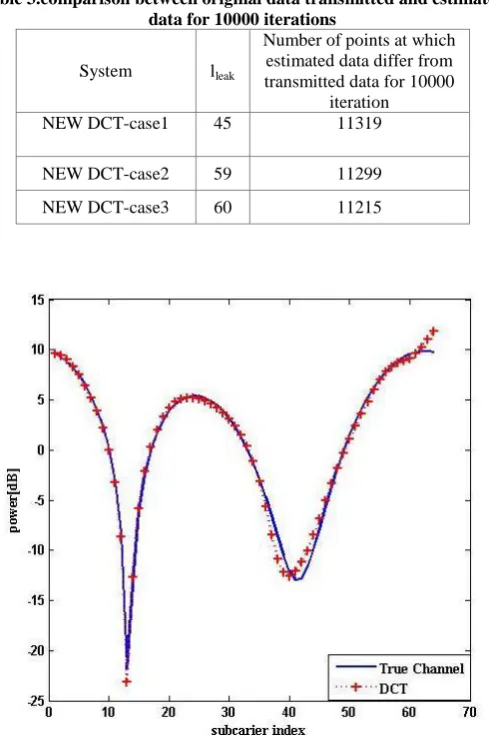
The performances of the existing and proposed methods are investigated through MATLAB simulation. An OFDMA system with N =64 subcarriers is considered. The guard interval is 24. A 4-path channel model is used. The symbols are modulated by 16QAM.The delay of the antenna is delay=(0, 1.5, 2.5, 3.5, 4.5)µs. Fig.1 shows the least squares estimation using linear and cubic spline interpolation methods. Fig.2 shows the estimated channel using conventional DCT based channel estimation. Using the estimated channel the data transmitted is extracted and the number of points at which the estimated data differed from the original transmitted data for 10000 iterations is calculated and the result is shown in table1. From table 1it can see that cubic spline interpolation method is better than the liner interpolation method and hence cubic spline interpolation method is used in further calculations. From table1 it can also been seen that when the DCT based method is used a better result obtained. Fig.3 shows the estimated channel using the improved DFT based method and table 2 shows the number of points at which the estimated data differ from the original transmitted data for 10000 iterations for the improved DFT based method. From table 2, it can see that as the leakage path increases the result of improved DFT based method becomes better. Fig.4 shows the estimated channel using the new DCT based method and corresponding result is shown in table3 which shows that for the same leakage path the new DCT based method is better than the improved DFT based method. Also it can be seen that as the leakage path number increases the performance of the new DCT based method gets improved. So proper lleak should be selected in order to
performance. From tables 1, 2&3 and figures 1, 2&3 it can see that the new DCT based method performs better.
5.1
Normal or Body Text
Please use a 9-point Times Roman font, or other Roman font with serifs, as close as possible in appearance to Times Roman in which these guidelines have been set. The goal is to have a 9-point text, as you see here. Please use sans-serif or non-proportional fonts only for special purposes, such as distinguishing source code text. If Times Roman is not available, try the font named Computer Modern Roman. On a Macintosh, use the font named Times. Right margins should be justified, not ragged.
5.2
This paragraph is a repeat of 3.1
Please use a 9-point Times Roman font, or other Roman font with serifs, as close as possible in appearance to Times Roman in which these guidelines have been set. The goal is to have a 9-point text, as you see here. Please use sans-serif or non-proportional fonts only for special purposes, such as distinguishing source code text. If Times Roman is not available, try the font named Computer Modern Roman. On a Macintosh, use the font named Times. Right margins should be justified, not ragged.
5.3
This paragraph is a repeat of 3.1
Please use a 9-point Times Roman font, or other Roman font with serifs, as close as possible in appearance to Times Roman in which these guidelines have been set. The goal is to have a 9-point text, as you see here. Please use sans-serif or non-proportional fonts only for special purposes, such as distinguishing source code text. If Times Roman is not available, try the font named Computer Modern Roman. On a Macintosh, use the font named Times. Right margins should be justified, not ragged.
5.4
Title and Authors
(a)
(b)
Fig1.Plot between channel power and subcarrier index for (a) LS-linear (b) LS-cubic Spline
Table2.comparison between original data transmitted and estimated data for 10000 iterations
System lleak
Number of points at which estimated data differ from transmitted data for 10000
iteration Improved DFT-case1 45 11358
Improved DFT-case2 59 11350 Improved DFT-case3 60 11339
Table.1 comparison between orginal data transmitted and estimated data for 10000 iteration
System Number of points at which estimated data differ from transmitted data for 10000 iteration
LS-linear 28877
LS spline 11335
[image:3.595.307.552.282.652.2]DCT 11330
Table 3.comparison between original data transmitted and estimated data for 10000 iterations
System lleak
Number of points at which estimated data differ from transmitted data for 10000
iteration
NEW DCT-case1 45 11319
NEW DCT-case2 59 11299
NEW DCT-case3 60 11215
\
(a)
(b)
(c)
Fig3 Plot between channel power and subcarrier index for (a) LS-Spline with improved DFT for lleak=45
(b) LS-Spline with improved DFT for lleak=59
(c) LS-Spline with improved DFT for lleak=60
(a)
(b)
(c)
Fig4 Plot between channel power and subcarrier index for (a) LS-Spline with new DCT for lleak=45
(b) LS- Spline with new DCT for lleak=59
6.
CONCLUSION
A new DCT-based channel estimation method with symmetric extension is proposed in this paper. The new method uses the symmetric property and cosine domain operations to reduce the effect of leakage power in the case of non-sample spaced multipath channels. The existing methods of channel estimation for non-sample spaced multipath channels i.e. improved DFT based channel estimation method and DCT based channel estimation method are simulated using MATLAB. The Simulation results show that the new DCT based method is better than the existing methods like LS estimation, improved DFT based estimation and conventional DCT based channel estimation methods. If the noise components are further reduced the performance of the estimator will improve. So further research is needed to optimize the method to reduce the noise components to get an improved result.
7.
REFERENCES
[1] Sinem Coleri, Mustafa Ergen, Anuj Puri, and Ahmad Bahai, “Channel Estimation Techniques Based on Pilot Arrangement in OFDM Systems,” IEEE transactions on broadcasting, vol. 48, no. 3, september 2002.
[2] Sinem Coleri, Mustafa Ergen,Anuj Puri, Ahmad Bahai, “A Study of Channel Estimation in OFDM Systems,” Vehicular Technology Conference, 2002. Proceedings. VTC 2002-Fall. 2002 IEEE 56th, Page(s): 894 - 898 vol.2.
[3] Xiaodai Dong, Wu-Sheng Lu, Anthony C. K. “Linear Interpolation in Pilot Symbol Assisted Channel Estimation for OFDM” IEEE transactions on wireless communications, VOL. 6, NO. 5, MAY 2007
[4] Zhang Jie, Huang Liqun, “An Improved DFT-based Channel Estimation Algorithm For MIMO-OFDM Systems,” Consumer Electronics, Communications and Networks (CECNet), 2011 International Conference on Page(s):3929 – 3932.
[5] Saqib Saleem, Qamar-ul-Islam, “On Comparison of DFT-Based and DCT-Based Channel Estimation for OFDM System,” IJCSI International Journal of Computer Science Issues, Vol. 8, Issue 3, No. 2, May 2011.
[6] Moussa Diallo, Rodrigue Rabineau, Laurent Cariou, Maryline Hélard. “Transform Domain based Channel Estimation for 3GPP/LTE Systems” Communications and Networking September 2010.
[7] Y. Wang, L. Li, P. Zhang and Z. Liu, “Channel estimation for OFDM systems in non-sample-spaced multipath channels,” Electronics Letters, vol. 45, January. 2009.
[8] H. Kobayaki and k. Mori. “Proposal of OFDM channel estimation method using discrete cosine transform”. Personal, Indoor and Mobile Radio Communications, 2004. Vol.3 . Page(s):1797 – 1801.
[9] T. Daisuke, T. Yasuhiko, and S. Kasumi. “Channel Estimation Scheme with low complexity Discrete Cosine Transformation in MIMO-OFDM System”. Vehicular Technology Conference, 2007. Page(s): 486 – 490. [10] Jan-Jaap van de Beek, O.Edfors, and M.Sandell, “On