MDA based approach towards Implementation of
Multi-Dimensional Database for Banking System
Amit Seth
Research Scholar, Department of Computer Science and
Engineering,
Kanpur institute of technology,
Kanpur, U.P., India
Akhilesh Yadav
Assistant Professor, Department of Computer Science and Engineering, Kanpur institute of technology,
Kanpur, U.P., India
Shubha Jain
Associate Professor, Department of Computer Science and Engineering, Kanpur institute of technology,
Kanpur, U.P., India
ABSTRACT
Today Banking System Combating with immerse competition are targeting the agile transaction, maintain in database and Customer satisfaction .In this paper we have used MDA approach towards Multi-dimensional database to leverage of impact factor like resolve the matter of inefficiency, transaction time, decrease maintenance cost, Customer satisfaction, Portability, increases productive, less disk storage requirement and MDA approach also gives the better environment to the database developer. In this paper used MDA approach design in Multi dimensional database in different level of abstraction like CIM, PIM, and PSM.
Keywords
Model Driven architecture (MDA), Entity Relationship (ER) Diagram, Platform independent models (PIM), Computation Independent Models (CIM), Platform specific models (PSM), Data Mining, OLAP, Data Cubes and Decision Support System.
1. INTRODUCTION
In this paper we continue to resolve recent upcoming problem related to the database like new technology, interoperability and reusability of the database and its design. In last paper, we have designed database using MDA approach in banking database system. Now in this paper we have implemented database in multi-dimensional database using MDA approach to resolve the matter of inefficiency like transaction time, maintenances costs, customer satisfaction, increase productivity, less storage space.
While it is feasible to build much more complex and larger database-based application systems, we are struggling with two major problems: development speed and costs. Systems are never built using only one technology and systems always need to communicate with other systems. With each new technology, much work needed to be done again and again. Furthermore, there is the problem of continuously changing requirements. [1]
In last paper [2], we proposed MDA-based methodologies in banking database system. Banking database design is difficult to understand and also difficult to handle technical complexity
found in the system due to which problems of maintainability and reusability persists for database system. We have designed database using MDA approach to enable the specific model. We have shown the database design process using MDA. The MDA separates the bank database in the level of abstraction. The first level CIM describes requirements of the system which defines Business model. The second level PIM describe the software specifications which defines the domain model of the system. The third level PSM describe the software realization model which defines detailed design of the system. The resulted database design is implemented for a particular required platform. [2]
[image:1.595.330.522.525.639.2]Several recent papers have already addressed some similarities between database technology and MDA concepts. However it is far from being clear how should database engineering concepts be reinterpreted in terms of MDA. [1-5] As OLAP uses several preprocessing operations such as data cleaning, data transformation, data integration, its output can serve as valuable data for data mining [6, 7]. OLAP operations (e.g., drilling, dicing, slicing, pivoting, filtering) enable users to navigate data flexibly, defined relevant data sets, analyzed data at different granularities and visualize results in different structures [8 - 10]. Applying these operations can make data mining more exploratory. The motivation for an integrated model, OLAP with data mining, is the concept hierarchy.
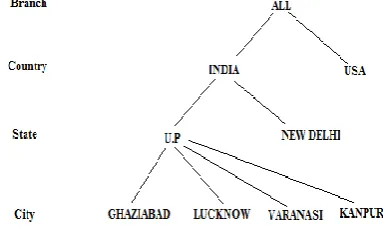
Fig 1: A concept hierarchy for different location
Data in OLAP and decision tree are organized into multiple dimensions where each dimension contains multiple levels of abstraction defined by the concept hierarchy [10, 11]. Analyze data at different granularities and visualize results in different structures [8 - 10]. Applying these operations on the hierarchy is illustrated in Fig. 1, where each member has one root and all members between roots have customers and every branch ends with a leaf member. OLAP data cubes which store concept hierarchies can be used to induce decision trees at
different levels of abstraction [11, 12]. Once the decision tree mining model is built, the concept hierarchies can be used to generalize individual nodes in the tree, which can then be accessed by OLAP operations and viewed at different levels of abstraction.
2 RELATED WORKS
paper Applying MDA in Traditional Database-based Application Development and also discussing in this paper problems applying in traditional database based application development [1].In my last paper , we have implemented MDA based approach towards Design of Database for Banking System [2].In this paper, we continue work MDA based approach towards Design of Multi-Dimensional Database for Banking System.
3 MODEL DRIVEN ARCITECTURE
(MDA)
[image:2.595.57.532.217.611.2]We propose here a collective lifecycle for MDA-based software development that can be used as a basis for constructing MDA-based methodologies. The phases and activities of the proposed lifecycle are described here in different levels of abstraction. In my last paper, we had shown the process of specifying a system independently of the software execution platform to that of transforming the system specification into one for a particular software execution platform. [2]
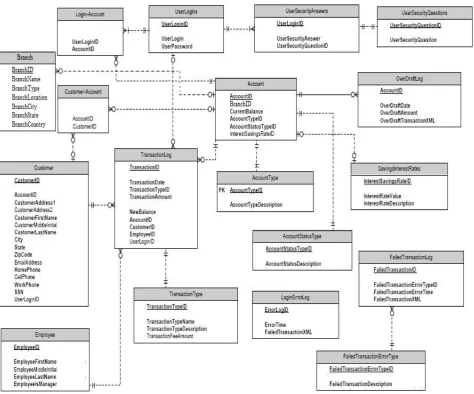
Fig 2: ER-Diagram Design using CIM
Banking database design is difficult to understand and also difficult to handle technical complexity found in the system due to which problems of maintainability and reusability persists for database system. We have designed database using MDA approach to enable the specific model. In last paper[2],we have shown the database design process using MDA. The MDA separates the bank database in the level of abstraction. The first level CIM describes requirements of the system which defines Business model. The second level PIM
3.1Computation Independent Models (CIM)
In MDA, system requirements are modeled using a Computation Independent Model (CIM). This model is called business model and it uses a vocabulary that is familiar to the domain experts. A CIM does not show details of the systems structure, but the environment in which the system will operate, being useful to understand the problem [13]. In [14] the authors have defined the scope of the software system through problem domain analysis and also the unambiguous black-box definition of the system, its objectives, and its scope have been produced [14].In fig.2 , CIM used in database to design the fundamental business entity types and the relation between them in database system. We design ER-diagram for different branch in India.
3.2 Platform independent models (PIM)
In the second level of abstraction authors [15] found the Platform Independent Model (PIM), which is a model with a relatively high abstraction level, which is independent from any implementation technology.
A platform independent analysis model is defined through analyzing the requirements model. System functionalities are
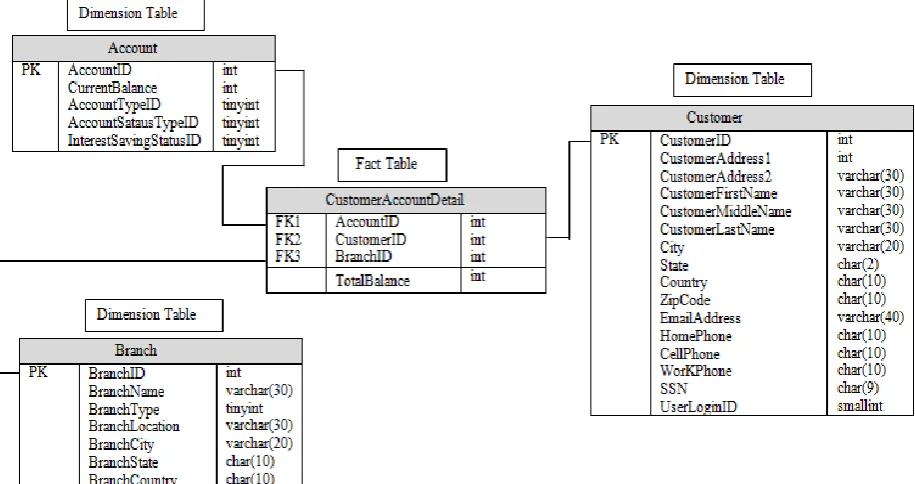
[image:3.595.59.517.338.580.2]described in the analysis PIM while maintaining traceability to the requirements model. Developers may use appropriate model elements stored in a model repository to produce some parts of this PIM. This model is not the final PIM, but forms the foundation for producing the final version. Conventional OO analysis techniques can be used for this activity, which is typically executed in an iterative and incremental fashion [14]. PIM aims to capture implementation-independent information about the system and business process modeled. The PIM gathers all the information of the system needed to describe the system behavior in a platform independent way. In fig.3, we define here for using multi-dimensional database; also design the fact table here. PIM to apply in database to create the multidimensional database. We have selected the required table to make the multidimensional database, also select the schemas for multi-dimensional database like stars, snowflakes and fact constellations. In this paper, we have select star schema of data warehouse for CustomerAccountDetails using dimension table like Account, Branch and Customer.
Fig 3: Star schema of data warehouse for CustomerAccountDetials using PIM
Define cube CustomerAccountDetails [AccountID, CustomerID, BranchID]:
TotalBalance = Sum (CurrenrBlance) define dimension Account as
(AccountID,BranchID,CurrentBalance,AccountTypeID,Acco untSatausTypeID,InterestSavingStatusID)
define dimension Branch as
(BranchID,BranchName,BranchType,BranchLocation,Branch City,BranchState,BranchCountry)
define dimension customer as (CustomerID,
CustomerAddress1, CustomerAddress2, CustomerFirstName, CustomerMiddleName, CustomerLastName, City, State,
Country, ZipCode, EmailAddress, HomePhone, CellPhone,WorKPhone, SSN, UserLoginID)
3.2.1. Stars, Snowflakes, and Fact constellations: Schemas for Multidimensional Databases
The most popular data model for a data warehouse is a multidimensional model. Such a model can exist in from of a star schema, a snowflake, or a fact constellation schema. The types of schema standards are follow are:
(dimension tables), one for each dimension. The schema graph resembles a starburst, with the dimension tables displayed in a radial pattern around the central fact table. [15]
Snowflake schema: The snowflake schema is a variant of the star schema model, where some dimensional tables are normalized, thereby further splitting the data into additional Tables. The resulting schema graph forms a shape similar to a snowflake. [15]
Fact constellation: Sophisticated applications may require multiple fact tables to share dimension tables. This kind of schema can be viewed as a collection of stars, and hence is called a galaxy schema or a fact constellation. [15]
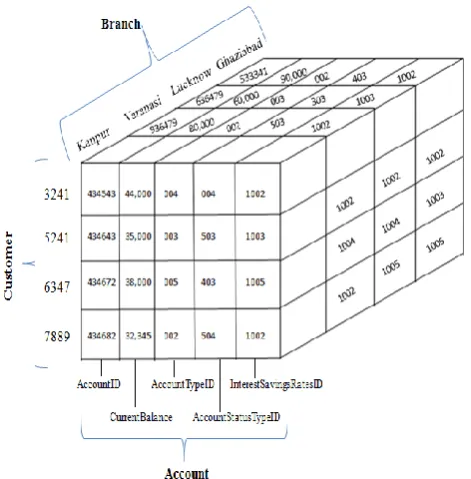
Fig 4: A 3-D bank data of all branch in India, according to the dimensions Customer, Account and Branch
3.3. Platform specific models (PSM):
Developing formal and automatic transformations between models (e.g. PIM-PSM) is the main advantage of MDA [16]. In [17] authors have given transformations following the declarative approach of QVT, thus relations between elements of the metamodels are used for constructing the transformation between models (i.e. PIM and PSM).
We have here using platform specific complex quires in database.PSM used in multi-dimensional database to create the complex queries and for result. In this chapter, we have design cube representation of the data, according to the dimensions Customer, Branch, and Account. We have used the queries to find the customer total balance amount in all over India.
select cad.AccountID, cad.CustomerID, cad.BranchID, sum (cad.TotalBalance)
from CustomerAccountDetail cad, Account a, Branch b, Customer c
where a.AccountID= cad.Account and b.BranchID= cad.BranchID and c.CustomerID= cad.CustomerID
Fig 5: A 3-D data cube representation of the data in above Table, according to the dimensions Customer, Branch and Account
4. Analysis result between MDA approach
using in rational database and
Multi-dimensional database:
In fig 6, we have use SQL Server Business Intelligence Development Studio to measures and analysis the result, after analysis and measure MDA based approach towards Traditional database and Multi-dimensional database in banking system. We have drawn this graph between running time in queries and measure database in increasing percentage of database. The difference shown in fig.5 which the table starting MDA towards approach in multi-dimensional is initial increase running time but when the database increases the multi-database is give faster result in comparison of the MDA based approach using in Traditional database.
Fig 6: Analysis between Traditional database and Multi-dimensional database using MDA approach
5. CONCLUSIONS
In the MDA used in Multi-dimensional database, we get the very retrieval of data from database in every level of abstraction because of several reasons:
The data corresponding to any combination of dimensional members can be retrieved with any single I/O.
Data is clustered compactly in a multidimensional array.
The index is small and can therefore usually reside in memory.
In the MDA used in Multi-dimensional database, we need less disk storage space in database the blocks contain only data and single index locates the block corresponding to a combination of sparse dimension numbers.
MDA used in Multi-dimensional database summering total amount value for each Customer is different from summarizing inventories, which require awareness of the relationship between different Branches.
MDA used in Multi-dimensional database ability to track actual analysis measures and monitor the variant between them is fundamental banking requirement.
MDA can easily handle richer analysis through sophisticated calculations in banking which can be easily done.
MDA is a Light weight Modeling so will easily implemented in complex multi-dimensional database design.
6. FUTURE SCOPES
The above work can be extended to the design of Distributed and parallel databases for handling complex databases such as multimedia database and complex quires.
7. ACKNOWLEDGMENTS
I especially extend my sincere and grateful thanks to
Assistant Prof. Mrs. Pradnya kamle, Head of the Department of Computer Science Department, and Assistant Prof. Mr. Milind Bhatt Maharana Pratap Engineering College GBTU University, Kanpur, Uttar Pradesh, India. I am also thankful to Mrs. Pragati Upadhyay, Ms. Shalini Bhardwaj and Ms. Neha Agrawal for extending moral support and technical discussions as and when required during this paper work.
8. REFERENCES
[1] Li.B, Liu.S, Yu.Z, The 9th International Conference on Computer Supported Cooperative Work in Design Proceedings, “Applying MDA in Traditional Database-based Application Development”
[image:5.595.56.291.550.696.2][3] Dubielewicz, I., Hnatkowska, B., Huzar, Z., Tuzinkiewicz, L .2006. Proceedings of the International Conference on Dependability of Computer Systems, IEEE” Feasibility Analysis of MDA-based Database Design”2006.
[4] Gholami.M.F, Ramsin.R, International Conference on Intelligent Systems, Modelling and Simulation, Strategies for Improving MDA-Based Development Processes, 2010
[5] Asadi M, Ravakhah M, Ramsin R,Second Asia International Conference on Modelling & Simulation “An MDA-based System Development Lifecycle”, IEEE, 2008
[6] Torben, B.P. and Christian, S.J., Multidimensional Database Technology, IEEE Computer, 34(12), 40-46, 2001, December
[7] Fayyad, U., Gregory, P.-S. and Smyth, P., From Data Mining to Knowledge Discovery in Databases, AI Magazine, 37(3), 37-54, 1996.
[8] Parseye, K., OLAP and Data Mining: Bridging the Gap. Database Programming and Design, 10, 30-37, 1998. [9] Han, J., Chiang, J.Y., Chee, S., Chen, J., Chen, Q.,
Cheng, S. & et al., DBMiner: A System for Data Mining in Relational Databases and Data Warehouses, Proceedings of the 1997 Conference of the Centre for Advanced Studies on Collaborative research, Ontario, Canada, 1-12, November,1997.
[10]Han, J., OLAP Mining: An Integration of OLAP with Data Mining, Proceedings of 1997 IFIP Conference on Data Semantics (DS-7), Leysin, Switzerland, 1-11, October, 1997.
[11]Han, J., Kamber, M., Data Mining Concepts and Techniques, San Diego, USA: Morgan Kaufmann Publishers, pp. 294- 296.
[12]Surajit, C. and Umeshwar, D., An Overview of Data Warehousing and OLAP Technology, ACM Sigmod Record, 26(1), 65-74, 1997.
[13]Miller, J., Mukerji, J.2003. MDA Guide Version 1.0.1., Object Management Group.
[14]Asadi,M.,Ravakhah,M., Ramsin,R.,Second.2008. Asia International Conference on Modelling & Simulation “An MDA-based System Development Lifecycle”, IEEE.
[15]Han.J, Kamber.M, 2006 “Data Mining Concepts and Techniques” second edition.
[16]Singh, Y., Sood, M.2009. "Models and Transformations in MDA," cicsyn, pp.253-258, 2009 First International Conference on Computational Intelligence, Communication Systems and Networks, IEEE computer society.