Tuberculosis Specimens: Establishing a Laboratory Testing Algorithm
for South Africa
Lesley Erica Scott,aNatalie Beylis,d,eMark Nicol,c,dGloria Nkuna,aSebaka Molapo,bLeigh Berrie,bAdriano Duse,d,e Wendy Susan Stevensa,b
Department of Molecular Medicine and Haematology, School of Pathology, Faculty of Health Science, University of the Witwatersrand, Johannesburg, South Africaa; National Health Laboratory Service, National Priority Program, Johannesburg, South Africab; Division of Medical Microbiology, Department of Clinical Laboratory Sciences and Institute for Infectious Diseases and Molecular Medicine, University of Cape Town, Cape Town, South Africac; National Health Laboratory Service, South Africad; Division of Clinical Microbiology and Infectious Diseases; University of the Witwatersrand, Johannesburg, South Africae
South Africa implemented Xpert MTB/RIF as the initial diagnostic test for pulmonary tuberculosis (TB). Xpert MTB/RIF’s accu-racy for diagnosing extrapulmonary tuberculosis (EPTB) was investigated. EPTB specimens (nⴝ7,916) from hospitalized pa-tients received over a 6-month period at a high-throughput TB referral laboratory in Johannesburg were investigated. Large-volume specimens were centrifuged, tissue biopsy specimens homogenized, and all specimens checked for growth of
contaminating bacteria on blood agar. Contaminated samples received NALC-NaOH (N-acetyl-L-cysteine–sodium hydroxide) decontamination prior to liquid culture. Residual specimens (volumes>1 ml) after inoculation of culture (nⴝ1,175) were tested using the Xpert MTB/RIF sputum protocol. Using culture as the reference, Xpert MTB/RIF’s overall sensitivity was 59% (95% confidence interval [95% CI], 53% to 65%) and specificity was 92% (CI, 90% to 94%), with the highest sensitivities of 91% (95% CI, 78% to 97%) for pus, 80% (95% CI, 56% to 94%) for lymph node aspirates, and 51% (95% CI, 44% to 58%) for fluids (ascitic, 59%; pleural, 47%). A difference in sensitivities was noticed between specimens classified as having a thick (87% [95% CI, 76% to 94%]) versus clear (watery) (48% [95% CI, 36% to 61%]) appearance. This was unchanged with traces of blood (52% [95% CI, 44% to 60%]) or precentrifugation (57% [95% CI, 28% to 82%]) among clear specimens. Xpert MTB/RIF generated an additional 124 specimen results that were contaminated by Mycobacterial Growth Indicator Tubes (MGIT; 10.5%) and diag-nosed rifampin (RIF) resistance earlier (9.6% [25/260]). Xpert MTB/RIF’s performance on EPTB specimens provides very prom-ising results and should be considered for incorporation into national TB guidelines. Xpert MTB/RIF is less affected by contami-nating bacteria and reduces laboratory labor and diagnostic delay compared to traditional methods.
E
vidence from 138 studies published before 2008 suggested thatnucleic acid amplification technologies (NAAT) could not re-place conventional mycobacterial tests (microscopy, culture) for diagnosing pulmonary and, especially, extrapulmonary
tubercu-losis (EPTB) (1). Only a few years later, GeneXpert technology (2)
has changed this paradigm, with a recent systematic review
show-ing pooled sensitivity of 88% and pooled specificity of 98% (3) for
diagnosis of pulmonary TB, but evidence (as of March 2012) for using Xpert MTB/RIF for diagnosing EPTB is still comparatively
weak (4). Globally, there is still a dearth of studies involving the
use of Xpert MTB/RIF in EPTB specimens, and few provide de-finitive answers. This is due mostly to the studies having small sample sizes across a range of various specimen types and differ-ences in preprocessing methodologies and in input volumes and to studies having been conducted in different populations (adults, children, HIV infected). In one large published study, the overall sensitivity of Xpert MTB/RIF on tissue biopsy specimens/fine-needle aspirates (FNA), pleural fluid, gastric aspirates, pus, cere-brospinal fluid (CSF), urine, and peritoneal/synovial/pericardial fluid was reported as 81% (95% confidence interval [95% CI], 76% to 86%), with specificity of 99.8% (95% CI, 99% to 100%)
(5). Other studies (3,6–15) showed sensitivity ranges of 25% to
97% and specificity ranges of 89% to 100%.
In 2011, the prevalence of pulmonary TB in South Africa was 768/100,000 (95% CI, 399 to 1,250), with an incidence of 993/ 100,000 (95% CI, 819 to 1,180). There were 325,321 new
pulmo-nary TB cases and 47,285 (15%) new EPTB cases reported, with the latter disease manifestation contributing to considerable
mor-bidity, mortality, and diagnostic cost (16). Management of EPTB
disease therefore needs to play a more prominent role in the National Tuberculosis Control Programmes, especially in high-HIV-burden
settings (17). Xpert MTB/RIF has been nationally implemented in
South Africa throughout smear microscopy laboratories as a replace-ment for smear microscopy for initial diagnosis of pulmonary TB. Three studies from the region on the performance of Xpert on EPTB
specimens have to date focused only on pleural TB (8), TB
lymph-adenitis (18), and HIV-associated lymph node TB (LNTB) (19) in
specific settings. The latter study performed Xpert MTB/RIF test-ing at the point of care at a large clinic, showtest-ing that all Xpert MTB/RIF-positive patients initiated treatment within 1 day and that Xpert MTB/RIF, with a sensitivity of 95%, could be endorsed
as the initial diagnostic for HIV-associated LNTB (19). We
there-Received20 December 2013Returned for modification25 January 2014
Accepted20 February 2014
Published ahead of print12 March 2014
Editor:G. A. Land
Address correspondence to Lesley Erica Scott, [email protected].
Copyright © 2014, American Society for Microbiology. All Rights Reserved.
doi:10.1128/JCM.03553-13
on May 16, 2020 by guest
http://jcm.asm.org/
fore investigated the use of Xpert MTB/RIF for diagnosing tuber-culosis on all nonrespiratory specimens routinely received in a busy routine testing laboratory with the aim of establishing the most appropriate laboratory testing algorithm for South Africa with the current knowledge base and availability.
MATERIALS AND METHODS
Laboratory site and specimen receipt.The study was performed in the National Health Laboratory Service Mycobacteriology Referral Labora-tory in Johannesburg, which provides a routine diagnostic service to pub-lic sector hospitals and clinics in 4 of 6 districts of the Gauteng province of South Africa. The laboratory processes on average 600 specimens daily for TB culture using Mycobacterial Growth Indicator Tubes (MGIT; Becton, Dickinson). On average, 80% of the specimens received in this laboratory are respiratory specimens, 10% blood specimens, and 10% nonrespira-tory specimens. The majority of EPTB specimens are obtained from hos-pitalized patients. The EPTB specimens submitted for routine mycobac-terial culture between 21 August 2012 and 21 February 2013 were evaluated in this study. This was purely a laboratory-based study, and no patient demographics were recorded other than those provided by the requesting clinician such as age, gender, and location. The HIV status was unknown as well as the results of any sputum or clinical follow-up testing. Ethics clearance for the use of residual specimens for laboratory evalua-tions was obtained through the University of the Witwatersrand Human Ethics Committee (approval no. M120875).
Laboratory processing of EPTB specimens.EPTB specimens from both children and adults were included in the study. Specimen contami-nation with bacteria was determined or excluded by plating all specimens onto a sheep blood agar plate and incubating at 37°C for 24 h. Nonsterile
specimens underwent decontamination with NALC-NaOH (N-acetyl-L
-cysteine–sodium hydroxide) to a final concentration of 1%, with the ad-dition of phosphate buffer according to the manufacturer’s instructions.
Fluid specimens⬎20 ml in volume were centrifuged before inoculation
of 0.5 ml of the pellet into MGIT. Tissue and biopsy specimens were homogenized in 0.5 ml phosphate buffer before inoculation of 0.5 ml into MGIT culture media. If smear microscopy was requested, it was per-formed prior to liquid culture using concentrated auramine fluorescence
microscopy. Growth ofMycobacterium tuberculosiscomplex was
con-firmed by Ziehl-Neelsen (ZN) staining. Definitive identification of the acid-fast bacilli (AFB) observed by ZN staining was performed using
GenoType MTBDRplusv1 (Hain Lifescience, Nehren, Germany) (if drug
susceptibility testing [DST] was requested by the clinician) or using a GenoType Mycobacterium CM line probe assay (Hain Lifescience) or the MPT64 antigen immunoassay (SD Bioline) if DST was not requested. If
resistance was detected by the MTBDRplusv1 assay, further drug
suscep-tibility testing by the MGIT proportion method (Becton, Dickinson) was performed. After routine processing and inoculation into MGIT, the re-sidual specimen (1 ml unconcentrated) was tested by Xpert MTB/RIF per the manufacturer’s instructions using sample reagent (SR). SR was added in a 2:1 ratio with 1 ml residual specimens that were not decontaminated. The residual volumes were documented as well as the macroscopic ap-pearance of the specimen.
Data analysis.All data were entered into MS Excel and analyzed using STATA v.12. Liquid culture was considered the reference standard for sensitivity and specificity calculations. These calculations were performed on the total sample size as well as for individual specimen types. Confi-dence intervals (CI) at 95% were reported for the latter analyses, and overlapping CI data were regarded as showing no significant difference between the results determined for the corresponding sample types.
RESULTS
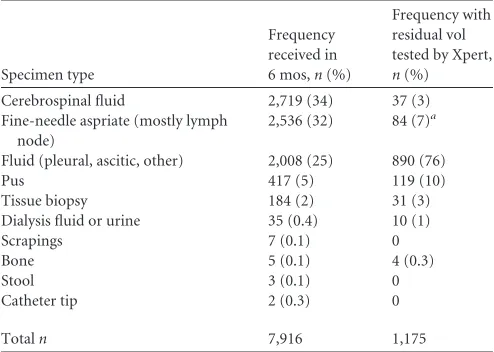
Description of routine EPTB specimens received and tested us-ing Xpert MTB/RIF.A total of 7,916 EPTB specimens were re-ceived in the laboratory within the 6-month period and
catego-rized as listed in column 2 ofTable 1 according to what was
inscribed by health care providers on the labels. Cerebrospinal fluid (CSF) accounted for 34% of samples, followed by 32% ac-counted for by fine-needle aspirates [FNA] (the majority of lymph nodes) and 25% accounted for by fluids (59% pleural, 17% ascitic, and 23% miscellaneous fluids). The remaining samples comprised pus (5%) and a miscellaneous 3% comprising bone, urine, dialysis fluid, skin scrapings, stool, tissue biopsy specimens, and catheter tips. This analysis focused on all specimen types except those iden-tified as FNA, as this was previously reported from this region
(19). The total number of specimens with sufficient residual
spec-imen volume for Xpert MTB/RIF testing was 1,175 (as listed in
column 3 ofTable 1) and included 84 aspirates not labeled as FNA
but rather as lymph node aspirates (LNA). The residual specimens
were from patients ranging in age from⬍1 year to 96 years
(me-dian age of 39 years, with 43 samples from children⬍15 years of
age); 55% were from males. Only 3% of CSF specimens had suf-ficient residual volume for Xpert testing.
Of all the 1,175 specimens plated on sheep agar plates, 36 (3%) were shown to be contaminated with bacteria and followed NALC-NaOH processing. This was not specific to any one speci-men type; however, 30.5% (11/36) were still contaminated on MGIT culture, and Xpert MTB/RIF testing was successful for all of these specimens. Overall, 10.5% (124/1,175) of MGIT cultures were contaminated, with the majority (58%, 72/124) being fluids that were thick (86%, 62/72). Of the MGIT-contaminated speci-mens, all (100%, 124/124) generated Xpert MTB/RIF results, of
which 28% (35/124) wereM. tuberculosispositive. Xpert MTB/
RIF could not generate results in 0.5% (6/1,175) due to 5011 er-rors (signal loss due to loss of tube pressure).
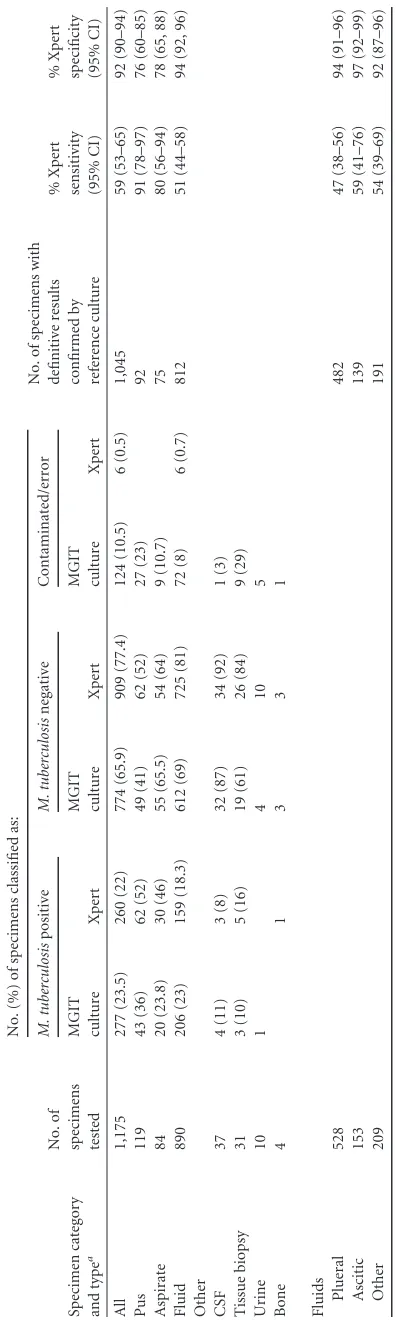
Performance of Xpert MTB/RIF compared to MGIT culture. Table 2describes the accuracy of Xpert MTB/RIF using mycobac-terial culture as the reference standard for the various sample types
and among the 1,175 specimens.M. tuberculosispositivity
[image:2.585.298.545.87.263.2]deter-mined by Xpert MTB/RIF was 22% (260/1,175) compared to 23.5% (277/1,175) by MGIT culture. The sensitivity and specific-ity of Xpert MTB/RIF versus MGIT culture on 1,045 specimens by both methodologies were 59% (95% CI, 53% to 65%) and 92% (95% CI, 90% to 94%), respectively. Xpert MTB/RIF had the
TABLE 1EPTB specimens received within 6 months and those with
residual volumes for XpertMTB/RIF testing
Specimen type
Frequency received in
6 mos,n(%)
Frequency with residual vol tested by Xpert, n(%)
Cerebrospinal fluid 2,719 (34) 37 (3)
Fine-needle aspriate (mostly lymph node)
2,536 (32) 84 (7)a
Fluid (pleural, ascitic, other) 2,008 (25) 890 (76)
Pus 417 (5) 119 (10)
Tissue biopsy 184 (2) 31 (3)
Dialysis fluid or urine 35 (0.4) 10 (1)
Scrapings 7 (0.1) 0
Bone 5 (0.1) 4 (0.3)
Stool 3 (0.1) 0
Catheter tip 2 (0.3) 0
Totaln 7,916 1,175
aValues represent only those labeled specifically as LNA (not as the majority labeled as FNA) where included in the analysis.
on May 16, 2020 by guest
http://jcm.asm.org/
highest sensitivity on pus (91% [95% CI, 78% to 97%]), followed by aspirates (80% [95% CI, 56% to 94%]) and fluids (51% [95% CI, 44% to 58%]), with nonoverlapping CIs between pus and fluids. The specificity values for Xpert compared to culture were lowest for pus (76% [95% CI, 60% to 85%]) and aspirates (78% [95% CI, 65% to 88%]). Among the fluids, Xpert MTB/RIF had a higher sensitivity for ascitic fluids (59% [95% CI, 39% to 69%]) than for pleural fluids (47% [95% CI, 38% to 56%]), but with overlapping CIs. Among the specimen types with sample
num-bers⬍40, Xpert MTB/RIF detected one moreM. tuberculosis
-positive result for bone and two more -positive results for tissue biopsy specimens than MGIT, whereas MGIT detected one more positive result on CSF and one more positive result on urine than Xpert MTB/RIF.
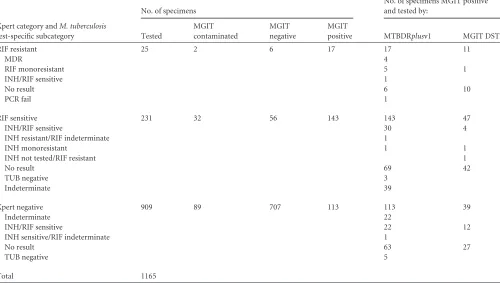
Fewer (10/132 [7.6%]) rifampin (RIF)-resistant cases were identified by traditional methods than by Xpert MTB/RIF, which provided an early diagnosis of RIF resistance (9.6%) in 25/260
cases (with 100% specificity) as detailed inTable 3. Traditional
methods were hampered by contamination, PCR failure, or
un-clear banding patterns of MTBDRplusv1 or were not requested.
Table 4further outlines Xpert MTB/RIF’s performance based on specimen appearance (clear [and watery], bloody, thick, and traces of blood) and shows that 53% of Xpert MTB/RIF-tested specimens had some trace of blood. Overall, the sensitivity of Xpert (compared to MGIT) was highest (87% [95% CI, 76% to 94%]) among thick specimens and was significantly different from that determined among blood trace (52% [95% CI, 44% to 60%]) and clear (48% [95% CI, 36% to 61%]) specimens. There was no significant difference in sensitivity between specimens classified as clear (66% of which were fluids) and those classified as having a trace of blood. Among the clear fluid specimens, 57% (127/223) were pleural fluids. The Xpert MTB/RIF PCR was not inhibited, and no errors were reported for the 10 specimens de-scribed as bloody.
Specimens centrifuged before further processing (14.6%, 171/ 1,175) were mostly fluids (40%, 69/171) and pus (26%, 45/171), with Xpert MTB/RIF generating positive results in 32% (54/171) compared to 21% (36/171) in MGIT. The sensitivity of Xpert MTB/RIF compared to MGIT (excluding those contaminated on
MGIT) in centrifuged samples (n⫽137) was 75% (95% CI, 58%
to 89%) compared to 57% (95% CI, 50% to 63%) for those not
centrifuged (n ⫽ 908), but with overlapping CIs, showing no
added benefit to fluids being centrifuged even if the specimen contained traces of blood.
DISCUSSION
The use of Xpert MTB/RIF for diagnosing pulmonary TB in South Africa has begun to result in a decline in the pulmonary TB
posi-tivity rate from⬃16% at national implementation (March 2011)
to⬃13% after 2.4 million Xpert MTB/RIF tests (November 2013)
at 100% program coverage (20). A number of factors, such as
earlier diagnosis and treatment (17), treatment of
microbiologi-cally confirmed cases, and the expansion of ARV coverage, may be contributing to the decline. National policy does not yet include the use of Xpert MTB/RIF for diagnosing EPTB, largely for rea-sons of data insufficiency. Xpert MTB/RIF’s introduction for pul-monary specimen testing has required changes in clinical and di-agnostic algorithms and changes in the requisition of samples and their processing and the laboratory and clinic workflow, to name a
few of the consequences (21). It has also exposed general
weak-TABLE 2 Xpert assay performance Specimen category and type a No. of specimens tested No. (%) of specimens classified as: No. of specimens with definitive results confirmed by reference culture % Xpert sensitivity (95% CI) % Xpert specificity (95% CI) M. tuberculosis positive M. tuberculosis negative Contaminated/error MGIT culture Xpert MGIT culture Xpert MGIT culture Xpert All 1,175 277 (23.5) 260 (22) 774 (65.9) 909 (77.4) 124 (10.5) 6 (0.5) 1,045 59 (53–65) 92 (90–94) Pus 119 43 (36) 62 (52) 49 (41) 62 (52) 27 (23) 92 91 (78–97) 76 (60–85) Aspirate 84 20 (23.8) 30 (46) 55 (65.5) 54 (64) 9 (10.7) 75 80 (56–94) 78 (65, 88) Fluid 890 206 (23) 159 (18.3) 612 (69) 725 (81) 72 (8) 6 (0.7) 812 51 (44–58) 94 (92, 96) Other CSF 37 4 (11) 3 (8) 32 (87) 34 (92) 1 (3) Tissue biopsy 31 3 (10) 5 (16) 19 (61) 26 (84) 9 (29) Urine 10 1 4 10 5 Bone 4 1331 Fluids Plueral 528 482 47 (38–56) 94 (91–96) Ascitic 153 139 59 (41–76) 97 (92–99) Other 209 191 54 (39–69) 92 (87–96) aFluids considered as a group and fluid types examined individually reflect data from the same specimens.
on May 16, 2020 by guest
http://jcm.asm.org/
[image:3.585.67.265.64.724.2]nesses in the general health care systems for TB, one being ongoing linkage to care postdiagnosis. In addition, the technology has chal-lenged the processes used in certain culture laboratories and the need for further standardization of gold standard practices. This was also evidenced in this study, with the low detection of bacterial contamination in EPTB specimens on sheep blood agar plates (3.1%) and the NALC-NaOH decontamination processing un-able to minimize MGIT contamination to a level below 10%. Xpert MTB/RIF, however, successfully generated results on all these specimens with less diagnostic delay and simultaneously re-ported RIF susceptibility results.
More than half of the specimens in this study were reported as containing traces of blood, but Xpert MTB/RIF’s performance was no different for those specimens with a clear appearance (sen-sitivity, 52% [95% CI, 44% to 60%] versus 48% [95% CI, 36% to 61%], respectively). A protocol for Xpert MTB/RIF testing on blood samples (20 ml) has recently been developed and requires a
special preprocessing buffer (22) to eliminate PCR inhibition;
however, this does not appear to be required for the EPTB speci-mens routinely received in this laboratory. Among these clear specimens, pleural fluids performed most poorly (sensitivity, 47% [95% CI, 38% to 56%]). This may be due to specimen collection,
storage, and preparation techniques (8) or to reduced numbers
(below the 131 CFU/ml threshold) (23,24) ofM. tuberculosisin
the specimen, a further dilution by SR buffer, or too harsh a treat-ment by SR buffer. The latter hypothesis may be the most realistic, since Xpert MTB/RIF’s performance was significantly better (sen-sitivity, 87% [95% CI, 76% to 94%]) on fluid and pus specimens that had a thick appearance. These may be more similar in
consti-tution to pulmonary specimens and therefore better suited to us-ing SR buffer, which is designed for liquefaction. Elimination of SR from the Xpert MTB/RIF processing of clear specimens might improve the sensitivity; however, it would also prevent Xpert MTB/RIF processing being performed outside a laboratory
envi-ronment (25). The study design, for reasons associated with
cur-rent standards of care laboratory practice, where routine specimen testing was performed prior to Xpert MTB/RIF testing, dramati-cally limited the number of CSF specimens (also clear in appear-ance) for performance comparison; therefore, conclusions based on clear specimens in this study cannot be extrapolated to CSF. This might improve if Xpert MTB/RIF were to be performed as the first-line diagnostic on the received specimen but would require further research to optimize the Xpert MTB/RIF protocol for CSF and clear specimens if SR is eliminated. Fluid and pus specimens that were centrifuged were more likely (but not statistically signif-icant) than uncentrifuged samples to give rise to a positive Xpert MTB/RIF result, in spite of the concentrated pellet being inocu-lated into MGIT and the residual supernatant being available for Xpert MTB/RIF testing. These specimens, however, were not paired, and centrifuged samples had a larger starting volume, but centrifugation would also be difficult to implement clinically in more-remote centers. The specificity of the Xpert MTB/RIF method was also lower among pus and aspirate specimens (76% and 78%, respectively), which may have been due to suboptimal
(nonviable) growth ofM. tuberculosisfrom these types of
speci-mens in MGIT, whereas filtration, capture of whole bacteria, and
amplification ofM. tuberculosisDNA in the Xpert cartridge would
[image:4.585.44.544.84.367.2]be possible and could report a positive result. Importantly, Xpert
TABLE 3Xpert MTB/RIF resultsa
Xpert category andM. tuberculosis
test-specific subcategory
No. of specimens
No. of specimens MGIT positive and tested by:
Tested
MGIT contaminated
MGIT negative
MGIT
positive MTBDRplusv1 MGIT DST
RIF resistant 25 2 6 17 17 11
MDR 4
RIF monoresistant 5 1
INH/RIF sensitive 1
No result 6 10
PCR fail 1
RIF sensitive 231 32 56 143 143 47
INH/RIF sensitive 30 4
INH resistant/RIF indeterminate 1
INH monoresistant 1 1
INH not tested/RIF resistant 1
No result 69 42
TUB negative 3
Indeterminate 39
Xpert negative 909 89 707 113 113 39
Indeterminate 22
INH/RIF sensitive 22 12
INH sensitive/RIF indeterminate 1
No result 63 27
TUB negative 5
Total 1165
a
A total of 10 samples, including 6 that returned errors and 4 that were classified as rifampin indeterminate, were excluded from the results. INH, isoniazid; TUB, tuberculosis.
on May 16, 2020 by guest
http://jcm.asm.org/
MTB/RIF was positive in 62 specimens of the 774 that were neg-ative by MGIT culture and positive in 35 of the 124 specimens that were contaminated on MGIT culture. The specificity of Xpert
MTB/RIF on pulmonary specimens is excellent (99%) (2), and it is
therefore likely that these positive Xpert MTB/RIF results repre-sent true-positive cases. Using this assumption, overall, the num-ber of cases for which Xpert MTB/RIF gave positive results was similar to that determined for MGIT culture (260 versus 277, re-spectively). Taking into account that Xpert MTB/RIF is less af-fected by contaminating bacteria, its use for diagnosing EPTB could significantly reduce labor in the laboratory and reduce the diagnostic delay. Sterility testing on blood agar plates followed by NALC-NaOH processing can be eliminated, and the need for MGIT culture and MPT64 antigen testing can be dramatically reduced, with a decrease in the turnaround time for patient result
reporting. The number of requests for the MTBDRplusassay and
phenotypic DST would also be reduced.
This report provides local data to support the introduction of TB screening of EPTB specimens with GeneXpert technology and similarly follows the pulmonary Xpert MTB/RIF algorithm with confirmation by DST and its use in the context of clinical suspi-cion. Without modification to the pulmonary Xpert MTB/RIF assay, clinicians practicing in the Johannesburg (Gauteng) region can expect the following sensitivities: 59% (95% CI, 53% to 65%) for all EPTB specimens; 91% (95% CI, 78% to 97%) for pus; 80% (95% CI, 56% to 94%) for aspirates (lymph node); 93% (95% CI,
88% to 97%) for HIV-associated FNA (19); and 51% (95% CI,
44% to 58%) for fluids (including pleural and ascitic fluids). It is acknowledged that the sample size for homogenized tissue biopsy specimens and bone in this study is low, but the sensitivity of Xpert MTB/RIF appears comparable to that of MGIT for these specimens.
These findings are not dissimilar from those of other studies
from Spain (11), with 58% sensitivity (95% CI, 49% to 68%) for
pleural fluid, lymph node, abscess aspirates, and tissues; from
In-dia (12), with 81% (95% CI, 76% to 85%) for tissue biopsy
spec-imens, pus, and body fluids; and from Italy (5), with 81% (95% CI,
76% to 86%) for tissue biopsy specimens, FNA, pleural fluid, gas-tric aspirates, pus, CSF, urine, and peritoneal and synovial/peri-cardial fluids. Implementation will, however, require a full costing analysis and ongoing studies for specific tissue types such as CSF (the predominant EPTB specimen received) where volumes and specimen preparation procedures have not been defined.
ACKNOWLEDGMENTS
We acknowledge Elizabeth Prentice for assistance of the study protocol as well as the laboratory staff for performing the difficult tasks of high-vol-ume EPTB testing.
This project has been supported by the President’s Emergency Plan for AIDS Relief (PEPFAR) through the Centers for Disease Control and Pre-vention (CDC) under the terms of 3U2GPS0001328-04.
This work is solely our responsibility and does not necessarily repre-sent the official views of the funder.
REFERENCES
1.Pai M, Ling DI.2008. Rapid diagnosis of extrapulmonary tuberculosis
using nucleic acid amplification tests: what is the evidence? Future
Micro-biol.3:1– 4.http://dx.doi.org/10.2217/17460913.3.1.1.
2.Boehme CC, Nabeta P, Hillemann D, Nicol MP, Shenai S, Krapp F,
Allen J, Tahirli R, Blakemore R, Rustomjee R, Milovic A, Jones M, O’Brien SM, Persing DH, Ruesch-Gerdes S, Gotuzzo E, Rodrigues C,
Alland D, Perkins MD.2010. Rapid molecular detection of tuberculosis
TABLE 4 Xpert MTB/RIF performance classified by specimen appearance, centrifuged specimens, and other a Specimen category and group No. (%) of specimens tested No. of specimens classified by: No. of specimens with definitive results confirmed by reference culture % sensitivity (95% CI) % specificity (95% CI) MGIT culture Xpert MTB/RIF Positive Negative Contaminated Positive b Negative Error Appearance Clear (watery) 292 (25) 62 201 29 51 240 1 262 48 (36 to 61) 93 (89 to 96) Bloody 10 (0.9) 0 9 1 1 9 0 Thick 255 (22) 62 131 62 92 162 1 192 87 (76 to 94) 85 (77 to 90) Trace of blood 618 (53) 153 433 32 116 498 4 582 52 (44 to 60) 93 (91 to 96) Centrifuge treatment Not centrifuged 1,004 (850) 241 673 90 206 792 6 908 57 (50 to 63) 94 (91 to 95) Centrifuged on receipt 171 (14.6) 36 101 34 54 117 0 137 75 (58 to 89) 81 (72 to 88) Treatment with sheep blood agar followed by NALC-NaOH c Aspirate 8 (22) 5 3 1 7 Fluid 12 (33) 2 8 2 2 10 Pus 8 (22) 3 2 3 4 4 Tissue 8 (22) 5 3 8 aA total of 1,175 specimens were tested. A total of 124 samples (10.5% of 1,175 samples), including 9 aspirate samples, 1 bone sample, 1 CSF sample, 5 urin e samples, 72 fluid samples, 27 pus samples, and 9 tissue biopsy samples, were classified as contaminated by MGIT culture testing. Xpert MTB/RIF classified 35 (28%) of these as positive and 89 (72%) of these as negative. bData include all RIF results (RIF sensitive, RIF resistant, and RIF indeterminate). cA total of 36 samples were subjected to 24 h of bacterial growth on sheep blood agar followed by NALC-NaOH treatment.
on May 16, 2020 by guest
http://jcm.asm.org/
and rifampin resistance. N. Engl. J. Med.363:1005–1015.http://dx.doi.org /10.1056/NEJMoa0907847.
3.Steingart KR, Schiller I, Horne DJ, Pai M, Boehme CC, Dendukuri N.
2014. Xpert MTB/RIF assay for pulmonary tuberculosis and rifampicin
resistance in adults (review). John Wiley & Sons, Hoboken, NJ.http://dx
.doi.org/10.1002/14651858.CD009593.pub3.
4.Lawn SD, Zumla AI.2012. Diagnosis of extrapulmonary tuberculosis
using the Xpert((R)) MTB/RIF assay. Expert Rev. Anti Infect. Ther.10:
631– 635.http://dx.doi.org/10.1586/eri.12.43.
5.Tortoli E, Russo C, Piersimoni C, Mazzola E, Dal Monte P, Pascarella
M, Borroni E, Mondo A, Piana F, Scarparo C, Coltella L, Lombardi G,
Cirillo DM.2012. Clinical validation of Xpert MTB/RIF for the diagnosis
of extrapulmonary tuberculosis. Eur. Respir. J.40:442– 447.http://dx.doi
.org/10.1183/09031936.00176311.
6.Armand S, Vanhuls P, Delcroix G, Courcol R, Lemaitre N. 2011.
Comparison of the Xpert MTB/RIF test with an IS6110-TaqMan real-time PCR assay for direct detection of Mycobacterium tuberculosis in
respira-tory and nonrespirarespira-tory specimens. J. Clin. Microbiol.49:1772–1776.
http://dx.doi.org/10.1128/JCM.02157-10.
7.Causse M, Ruiz P, Gutierrez-Aroca JB, Casal M.2011. Comparison
of two molecular methods for rapid diagnosis of extrapulmonary
tu-berculosis. J. Clin. Microbiol. 49:3065–3067. http://dx.doi.org/10
.1128/JCM.00491-11.
8.Friedrich SO, von Groote-Bidlingmaier F, Diacon AH. 2011. Xpert
MTB/RIF assay for diagnosis of pleural tuberculosis. J. Clin. Microbiol.
49:4341– 4342.http://dx.doi.org/10.1128/JCM.05454-11.
9.Hillemann D, Ruesch-Gerdes S, Boehme C, Richter E.26 January 2011.
Rapid molecular detection of extrapulmonary tuberculosis by automated
GeneXpert MTB/RIF system. J. Clin. Microbiol.http://dx.doi.org/10.1128
/JCM.02268-10.
10. Ligthelm LJ, Nicol MP, KGPH, Jacobson R, van Helden PD, Marais
BJ, Warren RM, Wright CA.31 August 2011. Xpert MTB/RIF for the
rapid diagnosis of tuberculous lymphadenitis from
fine-needle-aspiration biopsy specimens. J. Clin. Microbiol.http://dx.doi.org/10
.1128/JCM.01310-11.
11. Moure R, Martin R, Alcaide F. 2012. Effectiveness of an integrated
real-time PCR method for detection of the Mycobacterium tuberculosis complex in smear-negative extrapulmonary samples in an area of low
tuberculosis prevalence. J. Clin. Microbiol.50:513–515.http://dx.doi.org
/10.1128/JCM.06467-11.
12. Vadwai V, Boehme C, Nabeta P, Shetty A, Alland D, Rodrigues C.
2011. Xpert MTB/RIF: a new pillar in diagnosis of extrapulmonary
tuberculosis? J. Clin. Microbiol.49:2540 –2545.http://dx.doi.org/10
.1128/JCM.02319-10.
13. Malbruny B, Le Marrec G, Courageux K, Leclercq R, Cattoir V.2011.
Rapid and efficient detection of Mycobacterium tuberculosis in
respira-tory and non-respirarespira-tory samples. Int. J. Tuberc. Lung Dis.15:553–555.
14. Teo J, Jureen R, Chiang D, Chan D, Lin R.2011. Comparison of two nucleic
acid amplification assays, the Xpert MTB/RIF assay and the amplified Myco-bacterium Tuberculosis Direct assay, for detection of MycoMyco-bacterium
tuber-culosis in respiratory and nonrespiratory specimens. J. Clin. Microbiol.49:
3659 –3662.http://dx.doi.org/10.1128/JCM.00211-11.
15. Chang K, Lu W, Wang J, Zhang K, Jia S, Li F, Deng S, Chen M.2012.
Rapid and effective diagnosis of tuberculosis and rifampicin resistance
with Xpert MTB/RIF assay: a meta-analysis. J. Infect.64:580 –588.http:
//dx.doi.org/10.1016/j.jinf.2012.02.012.
16.World Health Organization. 2013. Global tuberculosis report 2013.
World Health Organization, Geneva, Switzerland.http://www.who.int/tb
/country/en/.
17. Schnippel K, Long L.2013. Impact and cost of algorithms for the
diag-nosis of adults with pulmonary tuberculosis in South Africa. S. Afr. Med. J.103:436.http://dx.doi.org/10.7196/SAMJ.7156.
18. Ligthelm LJ, Nicol MP, Hoek KG, Jacobson R, van Helden PD, Marais
BJ, Warren RM, Wright CA.2011. Xpert MTB/RIF for rapid diagnosis of
tuberculous lymphadenitis from fine-needle-aspiration biopsy
speci-mens. J. Clin. Microbiol.49:3967–3970.http://dx.doi.org/10.1128/JCM
.01310-11.
19. Van Rie A, Page-Shipp L, Mellet K, Scott L, Mkhwnazi M, Jong E, Omar
T, Beylis N, Stevens W, Sanne I, Menezes CN.10 May 2013. Diagnostic
accuracy and effectiveness of the Xpert MTB/RIF assay for the diagnosis of HIV-associated lymph node tuberculosis. Eur. J. Clin. Microbiol. Infect. Dis.http://dx.doi.org/10.1007/s10096-013-1890-0.
20. Stevens W, Erasmus L, Olsen F, Potgieter M, Candy S, Mvusi L, Molapo
S, Mametja D, Scott LE.2011. Reporting Xeprt MTB/RIF resistance data
from South Africa’s National TB programme, IUATLD. Abstr. 43rd Union World Conf. Lung Health, Kuala Lumpur, Malaysia, poster PC-687-16.
21. Aliyu G, El-Kamary SS, Abimiku A, Ezati N, Mosunmola I, Hungerford
L, Brown C, Tracy KJ, Obasanya J, Blattner W.2013. Mycobacterial
etiology of pulmonary tuberculosis and association with HIV infection
and multidrug resistance in northern Nigeria. Tuberc. Res. Treat.2013:
650561.http://dx.doi.org/10.1155/2013/650561.
22. Banada PP, Koshy R, Alland D. 2013. Detection of Mycobacterium
tuberculosis in blood by use of the Xpert MTB/RIF assay. J. Clin.
Micro-biol.51:2317–2322.http://dx.doi.org/10.1128/JCM.00332-13.
23. Helb D, Jones M, Story E, Boehme C, Wallace E, Ho K, Kop J, Owens
MR, Rodgers R, Banada P, Safi H, Blakemore R, Lan NT, Jones-Lopez EC, Levi M, Burday M, Ayakaka I, Mugerwa RD, McMillan B,
Winn-Deen E, Christel L, Dailey P, Perkins MD, Persing DH, Alland D.2010.
Rapid detection of Mycobacterium tuberculosis and rifampin resistance
by use of on-demand, near-patient technology. J. Clin. Microbiol.48:
229 –237.
24. Blakemore R, Story E, Helb D, Kop J, Banada P, Owens MR,
Chakra-vorty S, Jones M, Alland D.2010. Evaluation of the analytical
perfor-mance of the Xpert MTB/RIF assay. J. Clin. Microbiol.48:2495–2501.
25. Banada PP, Sivasubramani SK, Blakemore R, Boehme C, Perkins MD,
Fennelly K, Alland D.18 August 2010. Containment of bioaerosol
infec-tion risk by the Xpert MTB/RIF assay and its applicability to point-of-care
settings. J. Clin. Microbiol.http://dx.doi.org/10.1128/JCM.01053-10.