Volume 2008, Article ID 173645,11pages doi:10.1155/2008/173645
Research Article
On Intercell Interference and Its Cancellation in
Cellular Multicarrier CDMA Systems
Simon Plass
German Aerospace Center (DLR), Institute of Communications and Navigation, Oberpfaffenhofen, 82234 Wessling, Germany
Correspondence should be addressed to Simon Plass,[email protected]
Received 2 May 2007; Accepted 17 September 2007
Recommended by Luc Vandendorpe
The handling of intercell interference at the cell border area is a strong demand in future communication systems to guarantee effi -cient use of the available bandwidth. Therefore, this paper focuses on the application of iterative intercell interference cancellation schemes in cellular multicarrier code division multiple access (MC-CDMA) systems at the receiver side for the downlink. First, the influence of the interfering base stations to the total intercell interference is investigated. Then, different concepts for intercell interference cancellation are described and investigated for scenarios with several interfering cells. The first approach is based on the use of the hard decision of the demodulator to reconstruct the received signals. This does not require the higher amount of complexity compared to the second approach which is based on the use of the more reliable soft values from the decoding process. Furthermore, the extrinsic information as a reliability measure of this soft iterative cancellation process is investigated in more de-tail based on the geographical position of the mobile terminal. Both approaches show significant performance gains in the severe cell border area. With the soft intercell interference cancellation scheme, it is possible to reach the single-user bound. Therefore, the intercell interference can be almost eliminated.
Copyright © 2008 Simon Plass. This is an open access article distributed under the Creative Commons Attribution License, which permits unrestricted use, distribution, and reproduction in any medium, provided the original work is properly cited.
1. INTRODUCTION
The high data rate demands of next generation mobile com-munication systems require a very efficient exploitation of the available spectrum. Therefore, future cellular mobile concepts reuse the whole spectrum in each served cell [1] which corresponds to a frequency reuse of one. By applying the same frequency band in neighboring cells, the cell bor-der areas are highly influenced by intercell interference. This causes severe performance degradations or even connection loss.
Technologies which are currently considered candidates for these future communication systems are based on the generalized multicarrier (GMC) concept [2,3]. The technol-ogy multicarrier code division multiple access (MC-CDMA) [4,5] is within the GMC concept and combines the bene-fits of multicarrier transmission and spread spectrum. Mul-ticarrier transmission, namely, orthogonal frequency divi-sion multiplexing (OFDM) [6], offers simple digital realiza-tion due to the fast Fourier transformarealiza-tion (FFT) operarealiza-tion and low complex receivers. Additionally, spread spectrum,
namely code division multiple access (CDMA), gives high flexibility, robustness, and frequency diversity gains [7]. Re-cently, the cellular aspects of MC-CDMA were investigated. In [8,9], first analyses regarding the intercell interference modeling for cellular MC-CDMA environments are given. A Gaussian approximation was proposed for the intercell inter-ference modeling which was verified with more analytical in-vestigations in [10,11]. This simplified intercell interference assumption allows a large reduction of the simulation com-plexity for cellular MC-CDMA systems. In [12,13] the main focus was on the overall performance of an MC-CDMA sys-tem in a cellular environment. It was shown that there exist large performance degradations in the cell border area. Even a sectorized cellular system could not reduce these degrada-tions [14].
channel borrowing. Note that the packet-switched channel-aware scheduled transmissions which will take place in future systems complicate the use of many of the previously sug-gested schemes for intercell interference avoidance. For ex-ample, it is not, without additional side information, possi-ble to conclude that the interference power in a set of sub-carriers is likely to be higher/lower than average just be-cause it is measured as high/low at present. Therefore, due to the orthogonal spread data symbols and the resulting re-dundancy in the transmission the spread spectrum technique MC-CDMA provides the possibility to iteratively remove the intercell interference at the receiver side without the need of high complex intercell interference management schemes from the network side.
This paper presents iterative intercell interference cancel-lation schemes for a cellular MC-CDMA downlink. An in-tercell interference cancellation (ICIC) scheme was already proposed in [18] by taking into account the hard decisions from the demodulator to reconstruct the signal and cancel the intercell interference. In this paper, we propose to use ad-ditional signal power information for the cancellation pro-cess which improves thishard ICIC process. More reliable information are the soft values from the outer channel de-coder. Within a single MC-CDMA link the soft information is already used for iterative cancellation of the multiple access interference (MAI) [19]. It is possible to extend this principle to a cellular MC-CDMA downlink to cancel the intercell in-terference with asoftICIC [20,21]. Most cellular interference investigations on the link level are based on one interfering cell [8,10,12,18,20,21] due to complexity constraints. This paper studies the influence of a cellular environment with a whole tier of interfering base stations around the desired base station. The extrinsic information of the decoding process is considered as a degree of reliability for the soft ICIC process. In the following section, we first introduce the cellular MC-CDMA system and its cellular environment.Section 3 proposes different approaches of ICIC techniques. First, the hard decisions from the demodulator are used for the hard ICIC process. Further, an iterative ICIC technique based on soft values is presented in more detail which is named soft ICIC. The influence of intercell interference within a cellular environment is investigated inSection 4. Also in this section, the performances of the different ICIC schemes are com-pared by simulations.
2. CELLULAR MC-CDMA SYSTEM
2.1. MC-CDMA Transmitter
The MC-CDMA transmitter is shown inFigure 1. The sys-tem containsNc subcarriers forNu users. A channel-coder encodes the bit stream of each user. The encoded bits are in-terleaved by the outer interleaver Πout and the interleaved code bits c(n) of usern are passed to the symbol modula-tor. With respect to different modulation alphabets (e.g., PSK or QAM), the bits are modulated to complex-valued data symbols with the chosen cardinality. Before each modulated signal can be spread with a Walsh-Hadamard sequence of lengthL ≥ Nu, a multiplexer (MUX) arranges the signals
to Nd ≤ Nc/Lparallel data symbols per user. For the case thatNd=Nc/L, the data stream is distributed over all avail-able subcarriers. On the other hand, ifNd< Nc/L, other data streams are assigned to the remaining subcarriers, which are named user groups [7] and are independent from the afore-mentioned data stream. This guarantees equally loaded sub-carriers. Thekth symbol of all users,dk =[d(1)k ,. . .,d
(Nu)
k ]
T
, is multiplied with anL×Nuspreading matrixCLresulting in
sk=CLdk, sk∈C, 1≤k≤Nd. (1)
In an MC-CDMA system, the system load isNu/L and can be set to a value ranging from 1/Lto 1. For maximizing the diversity gain, the blocks =[s1,. . .,sNd]
T
is frequency-interleaved by the inner random interleaverΠin which rep-resents one OFDM symbol. By taking into account a whole OFDM frame the interleaving can be done in two dimension, that is, time and frequency.Xl(,mi)denotes the value of thelth
OFDM symbol in theith subcarrier at base station (BS) m
out ofNBS. Furthermore,Ns OFDM symbols describe one OFDM frame whereby each OFDM symbol hasNc subcarri-ers.
An OFDM modulation is performed on each block and contains operations as follows. First, an inverse FFT (IFFT) withNFFT ≥Ncpoints is done. Thus, the time domain sig-nal is given byxl(,mn) = IFFT{X
(m)
l,i }, wheren = 1,. . .,NFFT. Then, a guard interval (GI) in form of a cyclic prefix is in-serted having NGI samples. At the end of the transmitter a D/A conversion is carried out andx(m)(t) is obtained.
2.2. Cellular MC-CDMA receiver
Figure 2depicts the receiver structure of the MC-CDMA sys-tem. The signal x(m)(t) is transmitted over a mobile radio channel andy(t) is received. Then the inverse OFDM is per-formed including the removing of the GI and the FFT. We assume for the channel fading a quasi-static fading process, that is, the fading is constant for the duration of one OFDM frame. With this quasi-static channel assumption the well-known description of OFDM in the frequency domain is given.
After OFDM demodulation of the OFDM symbol, the re-ceived signal is
Yl,i= NBS−1
m=0
Xl(,mi)H
(m)
l,i +Nl,i, (2)
whereHl(,mi)is the channel transfer function andNl,i is the
additive white Gaussian noise (AWGN) with zero mean and varianceN0.
The inner deinterleaverΠ−in1and a parallel-to-serial con-verter arranges the received signal to thekth spread symbol of theNuusers rk =[rk,1,. . .,rk,L]T. The entries of the
User 1
Figure1: MC-CDMA transmitter of themth base station.
y(t)
Figure2: MC-CDMA receiver.
environment the MMSE has to be modified [11], resulting in the diagonal matrix entries
Gi,i=
0/Es) is the actual variance of the noise andNmBS−=0,1m=mE{|X(m
)
l,i H
(m)
l,i |2} is the total power of the
intercell interference. (·)∗denotes for complex conjugation. Therefore, the data symbols for the demodulator process re-sult in
All symbols of the desired userdk(1) are combined to a
serial data stream. Without loss of generality, we skip the symbol and user indiceskandnfor notational convenience in the following. The symbol demodulator demodulates the data symbols to real-valued soft-decisionsq. In addition, it calculates the log-likelihood ratio (LLR) [22] for each code bitcby
L(c)=logP
c=0|d
Pc=1|d. (5)
The sign of L(c) is the hard decision and the magnitude |L(c)|is the reliability of the decision. The code bits are dein-terleaved and decoded using the MAX-Log-MAP algorithm [23] which generates the LLR
L(c|q)=log
Figure3: Cellular environment.
Another degree of reliability of the decoder output can be given by the expectation ofE{c|q}, the so-called soft bits [19,24] which are defined by
λ(c|q)=(+1)·P(c=0|q) + (−1)·P(c=1|q) =tanhL(c|q)/2. (7)
These soft bits are in the range of [−1, +1]. The closer to the minimum or maximum, the more reliable the decoded bits are. There exists no reliable decision forλ(c|q)=0.
2.3. Cellular setup
We consider a synchronized cellular system in time and fre-quency. Themth BS has a distancedmto the desired mobile
terminal (MT) and the BSs are distributed in a hexagonal grid. We assume a normalized cell radius of one, and there-fore, the distance isd0=1 forα=30◦. The cellular setting is illustrated inFigure 3.
distancedmand a log-normal component representing
shad-owing losses [25].γrepresents the path loss factor andηm
is the Gaussian-distributed shadowing factor. Depending on the position of the MT the carrier-to-interference ratio (C/I) varies and is defined by
C
3. INTERCELL INTERFERENCE CANCELLATION
In this section we introduce different ICIC strategies. For most of interference cancellation schemes additional infor-mation is needed at the receiver. The receiver needs a de-tectable signaling from the involved BSs which can be given by an orthogonal signaling between the BSs. Further, a chan-nel estimation process is needed for all impinging signals. On the other side, intercell interference cancellation schemes at the receiver avoid large configurations to reduce the intercell interference at the transmitter side, namely, the base stations and network. In the following, the concepts of hard and soft ICICs are introduced which try to remove the interfering sig-nals from the desired signal. This can guarantee a more suc-cessful final decoding of the desired signal.
3.1. Hard ICIC
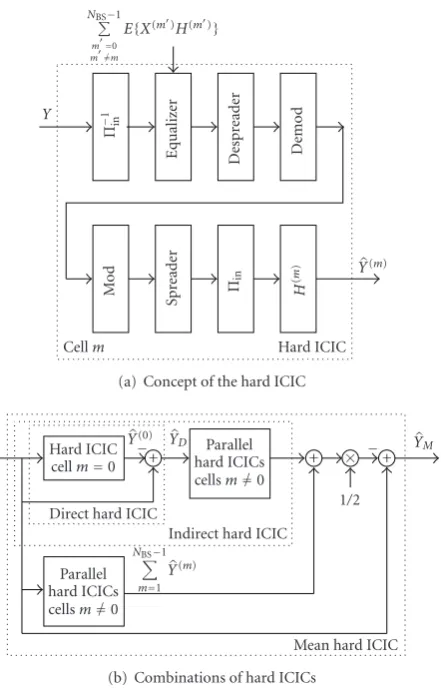
A first approach of ICIC is based on the use of the hard out-put of the demodulator at the receiver to reproduce the in-terfering or desired signalsY(m). We name this process hard ICIC. In [18] three different combinations of the hard ICIC are proposed. Simplified block diagrams of the hard ICIC and its combinations are shown in Figures 4(a)and 4(b). Without loss of generality, we skip the subcarrier and time indiceslandifor notational convenience in the following. We extend the already proposed hard ICIC concepts to more than one interfering cell. This is done by parallel processing of the reconstruction of the interfering signals (m=0). All blocks are set up with their specific cell parameters. First, the
directhard ICIC (D-ICIC) with output
can be seen as the basic concept block. Note that for the D-ICIC the processing of the interfering cells (m=0) is used. Theindirecthard ICIC (I-ICIC) tries to reconstruct the de-sired signal first and then the interfering signals. It should be mentioned that the estimated interfering signals will be sub-tracted in the final step from the received signalYin contrast toFigure 4(b). Therefore, the I-ICIC calculates
(a) Concept of the hard ICIC
Y Hard ICIC
(b) Combinations of hard ICICs
Figure4: Concept and combination of the hard ICIC.
whereYY(m(0)) represents the estimates depending on the first
estimateY(0) = Y −Y(0). Themean hard ICIC (M-ICIC) combines the D-ICIC and I-ICIC concepts by
All three concepts try to remove the intercell interference sig-nals from the desired signal. In the final step, the output of the hard ICIC is taken to be demodulated and decoded.
Due to the use of orthogonal signaling between the cells, pilot signals can be used to achieve the received signal power, for example, if the communication system is sufficiently syn-chronized. Therefore, we propose to use this information for the equalization process (cf. (3)) in all ICIC concepts (cf. Figure 4(a)) which should influence and improve the over-all performance of the hard ICICs.
3.2. Soft ICIC
Y +
Reconstruction of other interfering cells
m=m
Figure5: Concept of soft ICIC.
Y is processed as described in Section 2.2in respect to its specific cell parameters mfor the desired and intercell in-terference signals in parallel. In contrast to the hard ICIC process, the demodulator computes from the received sym-bols soft-demodulated extrinsic log-likelihood ratio values
LE
Demod. Unlike (5) without the use of a priori knowledge, the demodulator, and therefore,LE
Demodexploits the knowledge of a priori LLR-valuesLA
Demodwith
LADemod=log
P(c=0)
P(c=1) (12) coming from the decoder.LE
Demodis given by
LEDemod(c)=log
In the initial iteration, the LLR-valuesLADemodfor the demod-ulator are set to zero. After deinterleaving, the extrinsic LLR-valuesLEDemodbecome the a priori LLR-valuesLADecod of the channel decoder. The channel decoder computes for all code bits the a posteriori LLR-valuesL(c|q) using the MAX-Log-MAP algorithm (cf. (6)) and the extrinsic informationLEDecod is given by
LE
Decod=L(c|q)−LADecod. (14) The extrinsic LLR-values LE
Decod are then interleaved to be-come the a priori LLR-valuesLA
Demodused in the next itera-tion in the demodulator. The signals of the desired cellYdes
and the interfering cellsYint(m) are reconstructed and for the next iteration step the inputs of the processing blocks are
Ydes=Y−
The iterative cancellation process requires high computa-tional complexity at the receiver and addicomputa-tionally introduces a delay to the signal processing. Each canceled interfering sig-nal needs the same processing as the desired sigsig-nal. Further-more, this complexity is multiplied by the number of pro-cessed iterations.
In contrast to the hard ICIC concepts, the soft ICIC is not limited to one processing iteration. With this iterative approach, the intercell interference can be stepwise removed from the received signal.
4. SIMULATION RESULTS
The transmission system is based on a carrier frequency of 5 GHz, a bandwidth of 101.25 MHz, and an FFT length of
Table1: Parameters of the transmission system.
Carrier frequency 5 GHz
Bandwidth 101.25 MHz
No. of subcarriers 768
FFT length 1024
Guard interval length 226
Sample duration 7.4 ns
Frame length 16
Spreading length 8
Modulation QPSK
Channel coding CC (561, 753)8
Channel coding rate 1/2
ΔPdecay between adjacent taps
Δτtap spacing
Time
· · ·
Q0number of
nonzero taps
Q0=12
τmax=177Tsamp
Δτ=16Tsamp
ΔP=1 dB
Figure6: Parameters of the used power delay profile of the channel model.
in a half-loaded case or in a single-user mode. The interfer-ing BSs have the identical parameters as the desired BS which also includes the number of active users. For the simulations, different signal-to-noise ratios (SNRs) are chosen and per-fect channel knowledge of all cells is assumed. Furthermore, a (561, 753)8 convolutional code with rateR =1/2 was se-lected as channel code. A 2-dimensional random frequency interleaving is carried out. We assume i.i.d. channels with equal stochastic properties from each BS to the MT. The used channel model is a tapped delay-line model with equidis-tant 12 taps with a 1 dB decrease per tap and a maximum channel delay ofτmax = 1.31 microseconds. The path loss factor is set to γ = 4.0 and the standard deviation of the Gaussian-distributed shadowing factorηmis set to 8 dB for
each cell.Table 1 summarizes the used simulation parame-ters and Figure 6illustrates the power delay profile. In the following, we separate the simulation results in three blocks. First, we discuss the influence of the intercell interference; then, the simulation results of the different hard ICIC con-cepts are investigated; finally, the simulation results of the soft ICIC and its extrinsic information as reliability informa-tion are described.
4.1. Influence of intercell interference
Since the complexity of cancellation techniques depends di-rectly on the number of paths or signals to be canceled, we in-vestigate the influence of the neighboring signals to the over-all interfering signal.Figure 7shows the receivedC/Iratio at the mobile terminal for different locations within the cellular setup for a varying number of interfering cells. We assume that the MT moves along a straight line between the cell cen-ter and the oucen-ter part of the desired cell cencen-tered between
0 0.2 0.4 0.6 0.8 1 1.2 1.4 1.6 Distance
−20
−10 0 10 20 30 40
C/
I
(dB)
1 interfering cell 2 interfering cells 3 interfering cells
4 interfering cells 6 interfering cells
Figure7: Influence of varying number of interfering cells on the C/Iratios at different MT positions.
two interfering BSs (α=30◦). At the positiond0 = 1.0, the MT receives the same signal power from the three closest BSs. For these simulations, the order of interfering BSs are chosen by their decreasing distance to the MT. The closest interfer-ing BS is the first and an SNR of 10 dB is given within all cells. Since the spreading combines the signals and all avail-able subcarriers are allocated, there is no difference in theC/I
ratio by varying the system load [26].
The simulation results for one interfering BS show at
d0 =1.0 the expectedC/I ratio of about 0 dB because both signals are received with the same power at this location. By increasing the number of interfering BSs a degradation of the
C/Iratio over all MT positions is given. In the outer regions of the desired cell (d0≥0.8) there is no influence on theC/I ratio for more than two interfering BSs. In the inner part of the desired cell a small influence of the number of interfering cells is visible because the MT is nearly equidistant to all sur-rounding BSs. These results show that the main contribution of the intercell interference in a cellular MC-CDMA system is generated by the two closest interfering BSs. Therefore, it is appropriate and sufficient to take into account only the two strongest interfering signals for ICIC techniques.
4.2. Impact of hard ICIC
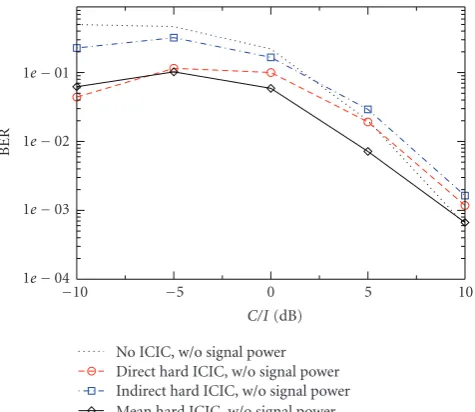
In the following, we verify the results in [18] by using the pro-posed hard ICIC concepts as described inSection 3.1. These hard ICIC techniques do not take into account the possible available signal powers for the equalization process.Figure 8 presents the bit-error rate (BER) performance versus theC/I
ratio. The simulations are carried out with an SNR of 10 dB and within a two-cell environment where each cell is half loaded. Therefore, the lowC/Ivalues represent the outer part of the desired cell,C/I=0 dB is the cell border, and positive
−10 −5 0 5 10
C/I(dB) 1e−04
1e−03 1e−02 1e−01
BER
No ICIC, w/o signal power Direct hard ICIC, w/o signal power Indirect hard ICIC, w/o signal power Mean hard ICIC, w/o signal power
Figure8: Performance of half-loaded system with different hard ICIC concepts in the cell border area with an SNR of 10 dB, without signal power knowledge.
All three hard ICIC concepts can increase the BER per-formance for lowC/Ivalues and at the cell border compared to the non-ICIC performance. The combination of D-ICIC and I-ICIC, namely, M-ICIC, can benefit from their perfor-mance behavior and provides the best perforperfor-mance. Only for
C/I≤ −5 dB, M-ICIC performs worse than D-ICIC because the first component in the I-ICIC generates wrong estimates of the recovered signal. This is caused by the weak desired signal and the hard decided output. Since the decoding and re-encoding process is not used in the hard ICIC concept, the performances of the D-ICIC and I-ICIC suffer from wrong recovered signals in the reconstruction process for highC/I
values. This should be avoided by the soft ICIC concept. Figure 9 shows the performance gains of the different combinations for hard ICIC with the proposed knowledge of the received signal powers. Since the D-ICIC tries to remove only the interfering signal, it cannot profit from both signal powers and does not outperform the I-ICIC in contrast to Figure 8and [18]. Only for high intercell interference sce-narios the D-ICIC reconstructs and removes the interfering signal better than I-ICIC. There is no performances diff er-ence between the I-ICIC and M-ICIC forC/I≥ −5 dB. Only for larger intercell interference the M-ICIC benefits from the parallel D-ICIC for interfering cellm= 1 (cf.Figure 4(b)). But the inner I-ICIC still causes errors and the pure D-ICIC outperforms the M-ICIC.
By comparing Figures8and9, we see a performance dif-ference of the redif-ference curves without an applied hard ICIC concept due to the knowledge of the interfering signal power. There is also a large performance gain for the hard ICIC con-cepts with the additional information of this power. In terms of theC/I ratio, the M-ICIC or I-ICIC can gain at the cell border about 2.5 dB with the additional power information compared to the M-ICIC without power knowledge.
−10 −5 0 5 10 15
C/I(dB) 1e−04
1e−03 1e−02 1e−01
BER
No cancelation DPIC
IdPIC MPIC
Figure9: Performance of half-loaded system with different hard ICIC concepts in the cell border area with an SNR of 10 dB, with signal power knowledge.
4.3. Impact of soft ICIC
The influence to the performance within a cellular MC-CDMA system by applying a soft ICIC concept is shown in the following. It is possible to use the extrinsic information (cf. (14)) as a degree of reliability for the iterative process of the signal reconstruction. For the soft ICIC the mean of the absolute extrinsic informationLE
Decodover all desired bits within one OFDM frame is taken to calculate a reliability in-formation of the decoded signal in thejth iteration following the definition of soft bits (cf. (7)) by
λj=tanh
1
N
N
n=0
LE Decod/2
, (16)
whereNrepresents the total number of desired bits. Since the absolute value ofLE
Decodis taken, the range ofλjis now from
[0, 1]. The lowerλj the lower is the reliability of a correct
reconstruction of the signal and vice versa. The difference
Δλj+1,j=λj+1−λj (17)
represents the reliability change between the iterations. The a posteriori knowledge L(c | q) (cf. (6)) is not taken into account in this paper which would give a measure of the re-sulting BER in the final decoding step [27].
A whole tier of cells, that is, 6 interfering cells, around the desired cell are assumed for the following investigations. The reliability information λj of the desired signal is
sim-ulated for positions of the mobile terminal in the range of
2
(a) 3D presentation of first iteration
−2 −1.5 −1 −0.5 0 0.5 1 1.5 2
(b) 2D presentation of first iteration
2
(c) 3D presentation of second iteration
−2 −1.5 −1 −0.5 0 0.5 1 1.5 2
(d) 2D presentation of second iteration
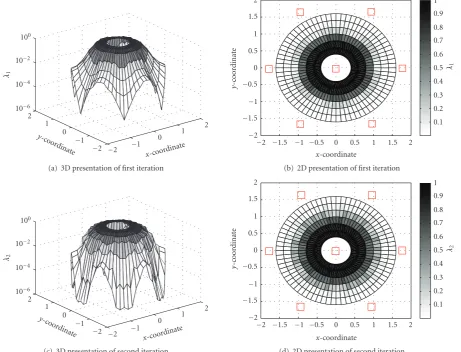
Figure10: Resulting values ofλj for the desired signal within the coverage of the desired base station depending on the position of the
mobile terminal (base stations have rectangular markers) in two- and three-dimensional representations.
between the mobile terminal position are also visible, for ex-ample, the mobile terminal experiences one strong interfer-ing BS ((x,y)=(−1.4, 0)) or the mobile terminal is located between two weaker interfering BSs ((x,y)=(−1.2,−0.7)). The distribution ofλ2for the second iteration is shown in Figure 10(c). Already the second iteration can increase λ2 over the whole area for this scenario compared toλ1. Even in the cell border area, (d0=[0.8, 1.2])λ2achieves values close to one. Therefore, this second iteration broadens the area for successful detection of the desired signal. Another represen-tation ofλj within the cellular environment is given in
Fig-ures10(b)and10(d)for one and two iterations, respectively. The positions of the involved BSs are given by the rectangu-lar marks. These plots show more precisely that in the first iteration the more reliableλ1values are limited tod0 <1.0. For the second iteration reliable,λ2values stretch already to
d0≤1.2.
Due to the large simulation complexity of the whole cel-lular environment and its reproduction, we also provide the differenceΔλ2,1in the three dimensional plot ofFigure 11. It is clearly visible that the rim area gains in reliability for the decoding process for the second iteration. There are
cor-ridors without an increase ofλ2 due to the constellation of the cellular environment. Since the signal strength of the two closest interfering cells in these corridors (e.g.,α=30◦) do not differ significantly, the soft ICIC process cannot improve the already good λ1 values in the second iteration. If only one BS is the major interferer (e.g., α=0◦) and the signal strength between the desired and main interferer differs, the soft ICIC can detect both signals in the second iteration more precisely.
The distribution ofλj depends directly on the chosen
scenario.Figure 12presents different SNR scenarios within a one-tier cellular environment. We investigate λj for the
desired and the two closest interfering signals where the mobile terminal is located close to the cell border with al-most the same distance to all these three BSs, that is,d0 = 0.9,α=30◦, or (x,y)=(0.78, 0.45). Due to the previous re-sults inSection 4.1, the two closest interfering cells are taken into account for the soft ICIC process. Furthermore, we as-sume a single-user case within all cells. For low SNR values (SNR≤0 dB), low and constant values ofλjare given over
all iterations. If the SNR is larger than 2 dB,λjincreases for
2 1
0
−1
−2 y-c
oor dinat
e
0 0.2 0.4
Δ
λ2,1
−2
−1 0
1 2
x-coordinat e
Figure11: DifferenceΔλ2,1=λ2−λ1of the reliability information
between the first and second iterations of the soft ICIC process.
0 1 2 3 4
Iteration 0
0.25 0.5 0.75 1
λj
Desired cell First interfering cell Second interfering cell
−2 dB 0 dB 2 dB 4 dB 8 dB
SNR
Figure12: Reliability of decoding process of recovering the signals of different cells close to the cell border for several iterations at vary-ing SNR scenarios.
exists a large step between the first and second iteration but the following iterations do not increaseλjforj >2 anymore.
Due to the small power differences of the three received sig-nal (d0=0.9), the reliability informationλjvaries for the
de-tected signals. It is obvious that a higher SNR provides better detection possibilities than low SNR scenarios for the desired signal.
The same simulation setup is chosen forFigure 13 ex-cept that this single-user scenario is directly located at the cell border (d0 = 1.0,α=30◦). The performance regarding the BER versus SNR is given. As an upper bound of the sys-tem, the performance with no ICIC is illustrated. The lower bound is represented by the single-user performance with-out any intercell interference. Already the first iteration in-creases the performance for SNR >2 dB. The second itera-tion can increase the performance significantly which
con-−2 0 2 4 6 8
SNR (dB) 1e−04
1e−03 1e−02 1e−01
BER
Indirect hard ICIC No ICIC at cell border Direct hard ICIC Mean hard ICIC Soft ICIC, 1 iteration
Soft ICIC, 2 iterations Soft ICIC, 3 iterations Soft ICIC, 4 iterations No inter-cell interference, single user
Figure13: Performance of the soft ICIC for the single-user case at the cell border for different SNR values.
firms the characteristics of theλj values inFigure 12. Even
the single-user bound can be almost reached within 2 itera-tions for higher SNRs. With 4 iteraitera-tions it is possible to reach the single-user bound, and therefore, the intercell interfer-ence is removed.
For comparison we included the performance curves of the hard ICIC concepts in Figure 13. Since no decoding is taken into account in this cancellation technique, the perfor-mance does not reach the first iteration perforperfor-mance of the soft ICIC. Still the M-ICIC and D-ICIC can improve the per-formance significantly compared to no applied ICIC. In con-trast to a two-cell scenario (cf.Figure 9), the I-ICIC cannot handle the intercell interference of several interfering cells appropriately, and therefore, there exists a large performance loss.
0.6 0.8 1 1.2 1.4 1.6 Distance
1e−04 1e−03 1e−02 1e−01
BER
w/o soft ICIC Mean hard ICIC Soft ICIC, 1 iteration
Soft ICIC, 2 iterations Soft ICIC, 3 iterations Soft ICIC, 4 iterations
Figure14: Performance of a half-loaded system with soft ICIC in the cell border area with an SNR of 10 dB.
signal powers, the soft ICIC can maximize the performance atd0=1.2. This performance is similar to the almost inter-cell interference free case atd0 =0.8. For larger distances to the desired BS (d0>1.2), the performance degrades because the desired signal becomes weak and the final decoding step for the desired signal can fail.
We can conclude from these investigations that the less complex hard ICIC concepts can be beneficial in scenarios where the impinging signals can be well distinguished. This correlates directly to the behavior of the decoding capabil-ity of the first iteration in the soft ICIC. The more complex soft ICIC technique is more robust to different scenarios and can improve the performance significantly by using several iterations. Due to the larger complexity of the soft ICIC, this technique can be applied at receivers with the available pro-cessing capabilities.
5. CONCLUSIONS
In this paper, we have described and investigated sev-eral approaches of intercell interference cancellation (ICIC) schemes in a cellular MC-CDMA downlink environment. The hard ICIC takes into account the hard decided output of the demodulator and with the proposed use of the signal power information the overall performance benefits. A more sophisticated approach is based on the use of the soft out-puts of the decoder to reconstruct the signals for cancellation. Both schemes can improve significantly the performance in the severe cell border area. Performance results show that the soft ICIC approaches the single-user bounds without inter-cell interference, and therefore, the interference of the inter- cellu-lar environment can be almost eliminated. The extrinsic in-formation of the decoding process can give a reliability infor-mation about the successful decoding process, and therefore, the behavior of the soft ICIC for different scenarios can be described and analyzed. The profit of the soft ICIC depends
directly on the given scenarios and the used number of itera-tions.
REFERENCES
[1] IST-4-027756 WINNER Project,https://www.ist-winner.org/. [2] J. A. C. Bingham, “Multicarrier modulation for data
transmis-sion: an idea whose time has come,”IEEE Communications Magazine, vol. 28, no. 5, pp. 5–14, 1990.
[3] Z. Wang and G. B. Giannakis, “Wireless multicarrier commu-nications: where Fourier meets Shannon,”IEEE Signal Process-ing Magazine, vol. 17, no. 3, pp. 29–48, 2000.
[4] K. Fazel and L. Papke, “On the performance of convo-lutionally-coded CDMA/OFDM for mobile communications systems,” in Proceedings of the IEEE International Sympo-sium on Personal, Indoor and Mobile Radio Communications (PIMRC ’93), pp. 468–472, Yokohama, Japan, September 1993.
[5] N. Yee, J.-P. Linnartz, and G. Fettweis, “Multi-carrier CDMA for indoor wireless radio networks,” inProceedings of the IEEE International Symposium on Personal, Indoor and Mobile Ra-dio Communications (PIMRC ’93), pp. 109–113, Yokohama, Japan, September 1993.
[6] S. Weinstein and P. Ebert, “Data transmission by frequency-division multiplexing using the discrete Fourier transform,”
IEEE Transactions on Communications, vol. 19, no. 5, part 1, pp. 628–634, 1971.
[7] K. Fazel and S. Kaiser,Multi-Carrier and Spread Spectrum Sys-tems, John Wiley & Sons, New York, NY, USA, 2003.
[8] G. Auer, S. Sand, A. Dammann, and S. Kaiser, “Analysis of cel-lular interference for MC-CDMA and its impact on channel estimation,” European Transactions on Telecommunications, vol. 15, no. 3, pp. 173–184, 2004.
[9] S. Plass, S. Sand, and G. Auer, “Modeling and analysis of a cel-lular MC-CDMA downlink system,” inProceedings of the 15th IEEE International Symposium on Personal, Indoor and Mo-bile Radio Communications (PIMRC ’04), vol. 1, pp. 160–164, Barcelona, Spain, September 2004.
[10] X. G. Doukopoulos and R. Legouable, “Impact of the inter-cell interference in DL MC-CDMA systems,” inProceedings of the 5th International Workshop on Multi-Carrier Spread-Spectrum (MC-SS ’05), pp. 101–109, Oberpfaffenhofen, Ger-many, September 2005.
[11] S. Plass, X. G. Doukopoulos, and R. Legouable, “On MC-CDMA link-level inter-cell interference,” inProceedings of the 65th IEEE Vehicular Technology Conference (VTC ’07), pp. 2656–2660, Dublin, Ireland, April 2007.
[12] F. Bauer, E. Hemming, W. Wilhelm, and M. Darianian, “Inter-cell interference investigation of MC-CDMA,” inProceedings of the 61st IEEE Vehicular Technology Conference (VTC ’05), vol. 5, pp. 3048–3052, Stockholm, Sweden, May-June 2005. [13] S. Plass, “Hybrid partitioned cellular downlink structure for
MC-CDMA and OFDMA,”Electronics Letters, vol. 42, no. 4, pp. 226–228, 2006.
[14] S. Plass and A. Dammann, “On the error performance of sec-torized cellular systems for MC-CDMA and OFDMA,” in Pro-ceedings of the 16th IEEE International Symposium on Personal, Indoor and Mobile Radio Communications (PIMRC ’05), vol. 1, pp. 257–261, Berlin, Germany, September 2005.
[16] I. Katzela and M. Naghshineh, “Channel assignment schemes for cellular mobile telecommunication systems: a comprehen-sive survey,”IEEE Personal Communications, vol. 3, no. 3, pp. 10–31, 1996.
[17] N. Feng, S.-C. Mau, and N. B. Mandayam, “Pricing and power control for joint network-centric and user-centric radio re-source management,”IEEE Transactions on Communications, vol. 52, no. 9, pp. 1547–1557, 2004.
[18] X. G. Doukopoulos and R. Legouable, “Intercell interference cancellation for MC-CDMA systems,” in Proceedings of the 65th IEEE Vehicular Technology Conference (VTC ’07), pp. 1612–1616, Dublin, Ireland, April 2007.
[19] S. Kaiser and J. Hagenauer, “Multi-carrier CDMA with it-erative decoding and soft-interference cancellation,” in Pro-ceedings of the IEEE Global Telecommunications Conference (GLOBECOM ’97), vol. 1, pp. 6–10, Phoenix, Ariz, USA, November 1997.
[20] M. Chacun, M. H´elard, and R. Legouable, “Iterative intercell interference cancellation for DL MC-CDMA systems,” in Pro-ceedings of the 6th International Workshop on Multi-Carrier Spread Spectrum, S. Plass, A. Dammann, S. Kaiser, and K. Fazel, Eds., vol. 1, pp. 277–286, Springer, Herrsching, Ger-many, May 2007.
[21] S. Plass, “Investigations on soft inter-cell interference cancella-tion in OFDM-CDM systems,” inProceedings of the 12th Inter-national OFDM Workshop (InOWo ’07), Hamburg, Germany, August 2007.
[22] J. Hagenauer, E. Offer, and L. Papke, “Iterative decoding of bi-nary block and convolutional codes,”IEEE Transactions on In-formation Theory, vol. 42, no. 2, pp. 429–445, 1996.
[23] P. Robertson, E. Villebrun, and P. Hoeher, “A comparison of optimal and sub-optimal MAP decoding algorithms operat-ing in the log domain,” inProceedings of the IEEE International Conference on Communications (ICC ’95), vol. 2, pp. 1009– 1013, Seattle, Wash, USA, June 1995.
[24] P. A. Hoeher, P. Robertson, E. Offer, and T. Woerz, “The soft-output principle reminiscences and new developments,” Euro-pean Transactions on Telecommunications, 2007.
[25] G. D. Ott and A. Plitkins, “Urban path-loss characteristics at 820 MHz,”IEEE Transactions on Vehicular Technology, vol. 27, no. 4, pp. 189–197, 1978.