Semantic RelationExtraction with Semantic Patterns:
Experiment on Radiology Report
Mathieu Lafourcade, Lionel Ramadier
LIRMM, University of Montpellier 860, rue de St Priest, 34095 Montpellier
E-mail: [email protected], [email protected]
Abstract
This work presents a practical system for indexing terms and relations from French radiology reports, called IMAIOS. In this paper, we present how semantic relations (causes, consequences, symptoms, locations, parts…) between medical terms can be extracted. For this purpose, we handcrafted some linguistic patterns from on a subset of our radiology report corpora. As semantic patterns (de (of)) may be too general or ambiguous, semantic constraints have been added. For instance, in the sentence néoplasie du sein (neoplasm of breast) the system knowing neoplasm as a disease and breast as an anatomical location, identify the relation as being a location: neoplasm r-lieu breast. An evaluation of the effect of semantic constraints is proposed.
Keywords: Relation Extraction, Semantic constraints, NLP
1.
Introduction
In the domain of radiology, the amount of pictures and textual reports is growing at an unprecedented rate. This quantity of medical information exceeds the ability of the radiologist to manage it effectively. One challenge is then to figure how to make computer help to effectively use these findings and to improve the management of patients. NLP methods allow for enhanced indexing and searching of medical reports with the linking of relevant terms through semantic relations and enabling on the fly inference of new knowledge.
This work presents a practical system for indexing terms and relations from French radiology reports, called IMAIOS. The main task of this system is to extract semantic relations from unstructured text that can be integrated in a lexical-semantic network in order to improve the quality of the latter. The IMAIOS system differs from other techniques by the use of the french lexical-semantic JeuxDeMots (JDM) network as supporting resource. Although the JDM network is primarily a knowledge base of common sense, it contains also many specialized facts, including medicine/radiology, which have been added within the framework of IMAIOS system. With such a large lexico-semantic network, we can devise quite crude algorithms that are very efficient. In this paper, we present how semantic relations (causes, consequences, symptoms, locations, parts…) between medical terms can be extracted. For this purpose, we handcrafted some linguistic patterns from on a subset of our radiology report corpora. As semantic patterns (de (of)) may be too general or ambiguous, semantic constraints have been added. For instance, in the sentence néoplasie du sein (neoplasm of breast) the system knowing neoplasm as a disease and breast as an anatomical location, identify the relation as being a location: neoplasm r-lieu breast. An evaluation of the effect of semantic constraints is proposed.
2.
Background
Most work concerning the extraction of semantic relation focus on domain-independent relations (Snow et al., 2006; Chklovski et al., 2004). In the general domain, the extraction of semantic relations between entities uses either statistical approaches (Hindle et al., 1990; Nazar et al 2012) either techniques of machine learning as well as approaches based on the use of linguistic patterns (Hearst et al., 1992) and even approaches combining these two techniques.
Seen the difficulty, according the linguistic pattern selected to determine the kind of relations between two terms (because of the ambiguity of the linguistic pattern) Girju (Girju et al., 2003) suggested adding semantic constraints in order to discover meronymy relation. They determine 20 constraint thanks to a machine learning algorithm and obtain 83% of precision. Other lexical and synctatical constraints were applied to relations expressed by verbs (Ferber ey al., 2011).
et al., 2015 propose an MSA (multiple sequence alignment) based framework for generating automatically lexical patterns (but not semantic ones).
.
3.
Our Approach: Semantic Patterns
The principle of our approach is quite simple (if not simplistic). As a first step, we identify compound terms. In a second step, we identify semantic relations between terms using semantic patterns. In the sentence fracture of orbital floor passing by the infra-orbital canal, the first step identify fracture_of_orbital_floor and infra-orbital_canal as an anatomical location. Thanks to the linguistic patterns passing by the, we are be able to validate the presence of a semantic relation between the two terms.
Our technique of entity extraction can be categorized in a dictionary-based approach and our method of relation extraction uses patterns or rules. The knowledge base on which our radiological reports entity extraction relies is the French lexical network JeuxDeMots (Lafourcade 2007). Although this network is general, it contains many specialty data, including medicine/radiology, which we have added within the framework IMAIOS project. The JDM network is a lexical-semantic graph for the French language whose lexical relations are generated both through GWAP (Games with a purpose) and via a contributory tool called Diko (manual insertion and automatic inferences with validation). At the time of this writing the JDM network contains over 23 millions relations between around 500,000 terms (many with inflected forms like plurals).
The identification of compound terms is made upstream compared to the content of JeuxDeMots network. We use the underscore to aggregate the two parts of a compound word so that it is considered as an entity at the time of the extraction (tibia_fracture). In our work, we are able to identify from JDM concepts like disease, symptom, anatomical location, characteristic (hyperintensity or hyperdensity), associated to terms.Moreover, to identify POS (part of speech) we use also JDM network. This information is available in the network.
3.1 Semantic Relation Extraction
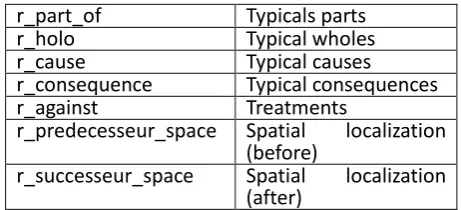
Our relation extraction approach is based on the use of linguistic patterns, similar to (Embarek and al, 2008). For each relation type (tableau 1), we build patterns and match them with the sentences to identify the correct relation.
Types of relations
Meaning
r_synonym
Synonyms or quasi
synonyms
r_syn_strict
Strict synonyms
(direct substitution is
possible)
r_isa
Generic
terms
(hypernym)
r_charac
Typical characteristics
r_target
Target
of
disease
(people, organ, etc)
r_symptom
Symptoms of disease
r_location
Typical locations
r_part_of
Typicals parts
r_holo
Typical wholes
r_cause
Typical causes
r_consequence
Typical consequences
r_against
Treatments
r_predecesseur_space
Spatial
localization
(before)
r_successeur_space
Spatial
localization
(after)
Table 1: list of relations using for extraction
We have chosen these 15 semantic relations for radiology report indexation following the advice of radiologists, but they can be of any general purpose. Some authors have already noted that the use of patterns is an effective method for automatic information extraction from corpora if they are efficiently designed (Embarek et al., 2008; Cimino et al., 1993).
3.2 Linguistic Patterns + Contraint = Semantic
Patterns
For many relation types of the JDM network, we designed a set of linguistic patterns (tableau 2). These patterns are (for now) manually built through partial analysis of our corpus. In our experiment, we restricted ourselves to 42 semantic patterns, 12 of which are specific to medicine.
Relations
Examples
of
patterns
in
English
Exemples
of
patterns
in
French
location
E1 on the E2
E1 au niveau de
E2
location
E1 in E2
E1 dans E2
location
E1 is on the E2
E1 se trouve
dans E2
location
E1 passing by E2 E1 passant par
E2
causes
E1 may trigger
E2
E1 déclenchant
E2
characteristic
E1
is
characterized by
E2
E1
est
caractérisé par
E2
characteristic
Noun Adj
Nom + Adjectif
synonym
E1 also called E2 E1
encore
appelé
causes
E1 can produce
E2
E1
produire E2
peut
consequence
E1 cause E2
E1 provoque E2
hypernym
E1 is a E2
E1 est un E2
consequence
E1 leading to a
E2
E1 menant à E2
Table 2: Examples of relations patterns. The actualpatterns are in French.
ambiguity appeared. For the relation of location, we can distinguish two kinds of relations depending on the pattern. First the relation r_lieu (hepatocellular carcinoma is at the level of the liver). The second relation is holonomy. It defines the relationship between a term denoting the whole and a term denoting a member of the whole (femur r_holo lower limb). For some connectors (of in caudate lobe of liver) both relations are correct (caudate lobe r_lieu liver and caudate lobe r_holo liver). Note, that we also make use detection of immediate co-occurences of entities for characteristic relation. For instance mutifocal hepatocellular carcinoma (HCC) appears five times together, so we consider multifocal as a probable characteristic of HCC (HCC r_characteristic multifocal).
3.3 Constraint on Patterns
For some linguistic patterns it is very difficult to determine precisely the kind of relation (for example the French connector de (of), sous (under)). So, we have added some semantic constraints on linguistic patterns. A semantic constraint is a condition that should verify the reification of one of variable of the pattern. We may have any number of constraints on $x and $y. We present some examples below:
$x de $y
If $x r_isa illness & $y r_isa anatomical_location $x r_location $y
If $x r_isa anatomical_structure and $y r_isa anatomical_structure $x r_part_of $y
$x en $y
If $x r_isa disease & $y r_isa anatomical_location $x r_location $y
$x avec $y
If $x r_isa disease & $y r_isa clinical sign $x r_symptom $y
$x sous $y
If $x r_isa disease & $y r_isa treatment $x r_against-1 (is treated by) $y
$x au niveau du $y
If $x r_isa disease & $y r_isa anatomical_location $x r_location $y
$x due à $y
If $x r_isa disease & $y r_isa microorganism || r_isa environment factor $x r_cause $y
$x porteur de $y
If $x r_isa person & $yr_isa disease$y r_target$x
$x $y
If $x r_pos Adj & $y r_pos Nom $y r_carac $x
$x $y
If $x r_pos Noun & $y r_pos Adj $x r_carac $y
In some cases, it is difficult to find some proper rules. Then we decide to incorporate some adjectival or adverbial multiword expressions in the network. For example, to deal with the noun phrase lesion in (en) hyperintensity, the expression in hyperintensity is added to the JDM network.
As mentioned above, we have crafted a small set of semantic patterns for testing purpose (we have, for the moment, identified 12 semantic patterns specific to medicine and 30 more general ones) and especially to detect properly relations for common connectors (de(of), du, en, avec, sous).
3.4 Algorithm
Starting from a given corpus (a radiological in our case), the procedure for extracting relations is informally the following:
Let S the result set, being the empty set at
initialization
Finding pattern occurrence in the text by
moving a word window of size
n
(essentially similar to using a Finite
State Automata implementing the
recognition of the linguistic patterns)
For each pattern occurrence applying
constraints to the instantiated variables
If constrains are verified then the
associated semantic relation is
associated to $x and $y, that is to
say added to S
Return S
The value of n is the length of the longest pattern (including both variables). The result set S is weighted, the weight is the number of time that a given semantic relations between two given terms have been found in the text. Let’s take an example with the following semantic patterns:
“$xdu$y” | $x r_isa disease & $y r_isa anatomical_place $xr_location$y
“$x du $y” | $x r_isa anatomical_place & $y r_isa anatomical_place $yr_has_part$x
From the noun phrase below (in French):
« contusion intra-osseuse de l’os sous-chondral en zone portante du condyle latéral »
contusion intra-osseuse r_location os sous-chondral
os sous-chondral r_has_part condyle latéral
4.
Results and Discussion
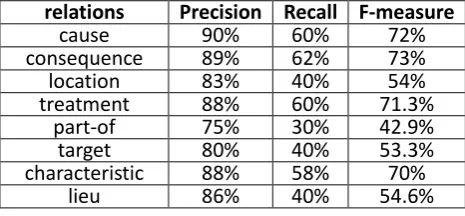
In order to evaluate the performances of our algorithm, we used classical measures namely precision, recall and F-measure (table 3). From a corpus of more 30 000 medical reports, we extracted a random subset of around 120 000 relation instances for the different relation types. About 800 of these relations were manually checked for evaluating precision. For assessing recall, we manually identified the relations in about 300 medical reports and then we applied our algorithm for comparison.
relations
Precision Recall F-measure
cause
74%
60%
66%
consequence
70%
62%
63.4%
location
48%
40%
43.6%
treatment
70%
60%
64.6%
part-of
32%
30%
31%
target
45%
40%
42.4%
characteristic
60%
58%
60%
lieu
45%
39%
41.7%
Table 3: Results of the extraction of semantic relationswithout constrains
relations
Precision Recall F-measure
cause
90%
60%
72%
consequence
89%
62%
73%
location
83%
40%
54%
treatment
88%
60%
71.3%
part-of
75%
30%
42.9%
target
80%
40%
53.3%
characteristic
88%
58%
70%
lieu
86%
40%
54.6%
Table 4: Results of the extraction of semantic relationswith constrains
Globally the precision measure is quite good when we add constraints on semantic relations. The results show an improvement of the F1-measure. We notice that the method with semantic patterns improves the precision without modifying the recall. We can explain this by the fact that the addition of constraints allows a better characterization of the relation (by consequence an improvement of the precision) while the number of extracted relation does not vary (so the recall is not modified) because we do not add linguistic patterns. A comparison with other works seems a little difficult because we extract relations from specific corpus (radiology reports). Embarek et al., 2008 used linguistic patterns to extract disease-treatment relations with 78% for F1-measure. Abacha et al., 2011, that applied a method similar to our work, obtained 60.46% recall, 75.72% precision and 67.23% F-measure for the extraction of treatment relations. Other works about
relation extraction in radiology extraction use machine learning techniques (Rink et al., 2011; Esuli et al., 2013). Some relations cannot be easily extracted because (not so) surprisingly they do not appear in our corpus. For instance, the relation of hypernym or synonymy is rarely present in our corpus which seems normal as radiologist knows already taxonomic information like that a carcinoma is a cancer. Another cause of limitation is the fact that some terms do not belong to the same sentence.
Our approach shows much better results with the addition of semantic constraints on relations. In our experiment, these constraints can be assessed thanks to a large knowledge which is the JDM lexical network.
We also have applied our proposed method to other corpora. For a cooking corpus of 45 000 recipes, we extracted 245 000 relations with a precision of 95% (manually evaluated on a sample of 755 relations). Furthermore, we extracted 789 000 relations for randomly Wikipedia pages with a precision of 92% (manually evaluated on a sample of 1250 relations). Hypernym extraction on Wikipedia articles has a precision of about 94%.
5.
Conclusion
In this article, we have proposed a fast method for extracting semantic relations between entities. The method is based on the use of linguistic patterns with semantic constraints to be checked with the large JDM French lexical network. We showed that adding constraints improve tremendously both recall and precision, without having to rely of a POS tagger or syntactic analyzer.
Future work is to improve the coverage of our system by discovering lexical pattern from texts in an automatic way. A future work is to automate the generation of lexical pattern (Meng et al., 2015). We can take advantage of the knowledge between terms contained in the lexical network to infer the semantic relations hold by some recurrent linguistic patterns identified automatically by high occurrence level.
6.Bibliographical References
Abacha, A. B., & Zweigenbaum, P. (2011). Automatic extraction of semantic relations between medical entities: a rule based approach. J. Biomedical Semantics, 2(S-5), S4.
Auger, A., & Barrière, C. (2008). Pattern-based approaches to semantic relation extraction: A state-of-the-art. Terminology, 14(1), pp. 1-19.
for Computational Linguistics.
Cimino, J. J., & Barnett, G. O. (1993). Automatic knowledge acquisition from MEDLINE. Methods of information in medicine, 32, 120-120.
Chklovski, T., & Pantel, P. (2004, July). VerbOcean: Mining the Web for Fine-Grained Semantic Verb Relations. In EMNLP (Vol. 2004, pp. 33-40).
Embarek, M., & Ferret, O. (2008). Learning Patterns for Building Resources about Semantic Relations in the Medical Domain. In LREC, may 2008.
Esuli, A., Marcheggiani, D., & Sebastiani, F. (2013). An enhanced CRFs-based system for information extraction from radiology reports. Journal of biomedical informatics, 46(3), pp. 425-435.
Fabre, C., Bourigault, D. (2006). Extraction de relations sémantiques entre noms et verbes au-delà des liens morphologiques. TALN 2006, Leuven, 10-13 avril 2006, pp. 121-129.
Fader, A., Soderland, S., & Etzioni, O. (2011) Identifying relations for open information extraction. In Proceedings of the conference on Empirical Mthods in Natural Language Processing (pp 1535-1545). Association for Computational Linguistics.
Girju, R., Badulescu, A., & Moldovan, D. (2006). Automatic discovery of part-whole relations. Computational Linguistics, 32(1), 83-135.
Hearst, M. A. (1992). Automatic acquisition of hyponyms from large text corpora. In Proceedings of the 14th conference on Computational linguistics (pp 268-275) Association for Computational Linguistics. Hindle, D. (1990). Noun classification from
predicate-argument structures. In Proceedings of the 28th annual meeting on Association for Computational Linguistics (pp. 268-275). Association for Computational Linguistics.
Jelier, R., Jenster, G., Dorssers, L. C., van der Eijk, C. C., van Mulligen, E. M., Mons, B., & Kors, J. A. (2005). Co-occurrence based meta-analysis of scientific texts: retrieving biological relationships between genes. Bioinformatics, 21(9), pp. 2049-2058. Lee, C. H., Na, J. C., & Khoo, C. (2003, November). Ontology Learning for Medical Digital Libraries. In Digital Libraries: Technology and Management of Indigenous Knowledge for Global Access: 6th International Conference on Asian Digital Libraries, ICADL 2003, Kuala Lumpur, Malaysia, December 8-12, 2003, Proceedings (Vol. 2911, p. 302). Springer Science & Business Media.
Lafourcade, M. (2007, December). Making people play for Lexical Acquisition with the JeuxDeMots prototype. In SNLP'07: 7th international symposium on natural language processing (p. 7).
Liu, Y., Bill, R., Fiszman, M., Rindflesch, T. C., Pedersen, T., Melton, G. B., & Pakhomov, S. V. (2012). Using SemRep to label semantic relations extracted from clinical text. In AMIA.
Meng, F., & Morioka, C. (2015). Automating the generation of lexical patterns for processing free text in clinical documents. Journal of the American Medical Informatics Association, ocv012.
Nazar, R., Vivaldi, J., & Wanner, L. (2012).
Co-occurrence graphs applied to taxonomy extraction in scientific and technical corpora. Procesamiento del lenguaje natural, 49, 67-74.
Rindflesch, T. C., Bean, C. A., & Sneiderman, C. A.
(2000). Argument identification for arterial branching predications asserted in cardiac catheterization reports. In Proceedings of the AMIA Symposium (p. 704). American Medical Informatics Association.
Rink, B., Harabagiu, S., & Roberts, K. (2011). Automatic extraction of relations between medical concepts in clinical texts. Journal of the American Medical Informatics Association, 18(5), 594-600. Song, M., Kim, W. C., Lee, D., Heo, G. E., & Kang, K. Y. (2015). PKDE4J: Entity and relation extraction for public knowledge discovery. Journal of biomedical informatics, 57, 320-332.
Song, M., Yu, H., & Han, W. S. (2011). Combining active learning and semi-supervised learning techniques to extract protein interaction sentences. BMC bioinformatics, 12(Suppl 12), S4.
Snow, R., Jurafsky, D., & Ng, A. Y. (2006, July). Semantic taxonomy induction from heterogenous evidence. In Proceedings of the 21st International Conference on Computational Linguistics and the 44th annual meeting of the Association for Computational Linguistics (pp. 801-808). Association for Computational Linguistics
.
Srinivasan, P., & Rindflesch, T. (2002). Exploring text mining from MEDLINE. In Proceedings of the AMIA Symposium (p. 722). American Medical Informatics Association.
Suchanek, F. M., Ifrim, G., & Weikum, G. (2006, August). Combining linguistic and statistical analysis to extract relations from web documents. In