R E S E A R C H A R T I C L E
Open Access
Evaluation of a birth preparation program on
lumbopelvic pain, urinary incontinence, anxiety
and exercise: a randomized controlled trial
Maria Amélia Miquelutti
1, José Guilherme Cecatti
1and Maria Yolanda Makuch
2*Abstract
Background:Antenatal preparation programmes are recommended worldwide to promote a healthy pregnancy and greater autonomy during labor and delivery, prevent physical discomfort and high levels of anxiety. The objective of this study was to evaluate effectiveness and safety of a birth preparation programme to minimize lumbopelvic pain, urinary incontinence, anxiety, and increase physical activity during pregnancy as well as to compare its effects on perinatal outcomes comparing two groups of nulliparous women.
Methods:A randomized controlled trial was conducted with 197 low risk nulliparous women aged 16 to 40 years, with gestational age≥18 weeks. Participants were randomly allocated to participate in a birth preparation programme (BPP; n=97) or a control group (CG; n=100). The intervention was performed on the days of prenatal visits, and consisted of physical exercises, educational activities and instructions on exercises to be performed at home. The control group followed a routine of prenatal care. Primary outcomes were urinary incontinence, lumbopelvic pain, physical activity, and anxiety. Secondary outcomes were perinatal variables.
Results:The risk of urinary incontinence in BPP participants was significantly lower at 30 weeks of pregnancy (BPP 42.7%, CG 62.2%; relative risk [RR] 0.69; 95% confidence interval [CI] 0.51-0.93) and at 36 weeks of pregnancy (BPP 41.2%, CG 68.4%; RR 0.60; 95%CI 0.45-0.81). Participation in the BPP encouraged women to exercise during pregnancy (p=0.009). No difference was found between the groups regarding to anxiety level, lumbopelvic pain, type or duration of delivery and weight or vitality of the newborn infant.
Conclusions:The BPP was effective in controlling urinary incontinence and to encourage the women to exercise during pregnancy with no adverse effects to pregnant women or the fetuses.
Trial registration:Clinicaltrials.gov, (NCT01155804)
Keywords:Antenatal exercises, Birth preparation program, Urinary incontinence, Low back pain, Pelvic pain, Anxiety, Pregnancy
Background
Antenatal preparation programmes involve several tech-niques and activities performed by different healthcare pro-fessionals. The main aims of antenatal preparation programmes are to promote healthy practices, minimize ex-cessive anxiety and prevent or minimize the discomforts of pregnancy and labor. Such programmes may include educa-tional activities, physical exercise and psychoprophylactic
techniques, among others. Despite the fact that such programmes are recommended in different parts of the world, Gagnon and Sandall in a systematic review found no evidence regarding the benefits of general antenatal educa-tion for childbirth [1].
The practice of regular physical exercise during preg-nancy with the objective of keeping women healthy dur-ing pregnancy is recommended by the American College of Obstetricians and Gynecologists (ACOG) [2], and can be included in antenatal programs. Moreover, daily exer-cises can prevent gestational diabetes and excessive * Correspondence:[email protected]
2
Center for Research on Reproductive Health of Campinas (Cemicamp), Campinas, SP, Brazil
Full list of author information is available at the end of the article
gestational weight gain [2-4]. There is evidence that physical exercise during pregnancy does not increase the risk of muscle injuries or changes in arterial blood pres-sure [5], and does not increase the risk of preterm labor or low fetal weight [3,6-8].
Investigations have been conducted to evaluate
whether exercise during pregnancy is able to reduce dis-comfort resulting from lumbopelvic pain and decrease the occurrence of urinary incontinence. Pennick and Young [9] in a systematic review showed evidence that the practice of specific exercises was able to alleviate lumbopelvic pain during pregnancy. However, it is still under debate whether pelvic floor muscle exercises dur-ing pregnancy could protect against urinary incontin-ence both during pregnancy and in the postpartum period [10-12].
Anxiety during pregnancy has been related to adverse outcomes, such as fetal distress, premature labor, low birth weight, and problems in child development [13-16]. Khianman et al. [16], in a systematic review discussed how the use of relaxation techniques (breath-ing exercises, massage, yoga, reflexology, visualization) during pregnancy may reduce stress and anxiety.
Information related to the effect of antenatal prepar-ation programmes on perinatal outcomes is scarce. Some studies have suggested that a shorter duration of labor and a reduction in Cesarean section (C-section) rates is important to improve perinatal outcomes [17,18]. The existing evidence is mainly based on small studies that analysed outcomes in women from middle or low income countries with high C-section rates.
The objective of this study was to evaluate the effect-iveness and safety of a birth preparation programme (BPP) to minimize lumbopelvic pain, urinary incontin-ence, anxiety, and increase physical activity during preg-nancy, as well as, to compare its effects on perinatal outcomes comparing two groups of nulliparous women.
Methods
A prospective, randomised, controlled clinical trial was conducted at the Women’s Integral Health Care Hospital (CAISM), University of Campinas (UNICAMP) and four municipal primary healthcare centers in Campinas, São Paulo between June 2009 and September 2011. The study was approved by the Institutional Review Board. The eli-gible women were recruited at the same time as the first data collection was performed and after the explanation about the study they had a time to consider participation or not. Those who agreed to participate gave their written consent prior to being included in the study.
Primary outcomes were: lumbopelvic pain, urinary in-continence (UI), anxiety, and physical activity performed at home.
Sample size
Sample size was calculated based on the occurrence of lumbar pain in a previous study (66% in the control group and 46% in the intervention group; n=192) [18]. The primary outcomes considered for sample size esti-mation were urinary incontinence, lumbopelvic pain, and anxiety; however lumbar pain presented the lowest variation and therefore the highest sample to be studied. A proportion of one intervention for each control was determined [1:1 ratio], with a significance level of 5% and an 80% power of the test, resulting in 192 subjects to be randomized into two groups. Considering the pos-sibility of post-randomization exclusions, 205 women were randomized.
Patients and eligibility
The inclusion criteria were: pregnant women with a sin-gle fetus, age 16 to 40 years and gestational age 18 to 24 weeks. The exclusion criteria were: pathological condi-tions prior to pregnancy (heart condicondi-tions, diabetes, hyper-tension, bronchitis, asthma, HIV positive); pathological conditions of the pregnancy (gestational hypertension, ges-tational diabetes, and preeclampsia), contraindications to the practice of physical activity (persistent bleeding, pre-term labor, incompetent cervix, acute febrile infection, and fetal growth restriction) or indication for elective C-section (placenta previa, cephalopelvic disproportion).
Patient evaluation
Data collection during pregnancy was performed on the days of medical visits at: 18–24 weeks of pregnancy at
admission to the study; 28–30 weeks of pregnancy
(intermediate evaluation) and at 36–38 weeks of
preg-nancy (final evaluation). Anxiety was evaluated through the state-trait anxiety inventory (STAI), validated for use
in Brazil [19]. Anxiety levels were cathegorised
since the study was not blinded to the evaluators. Pelvic floor muscle knowledge was evaluated using categorical questions elaborated for this purpose to asses if they had knowledge or had heard about pelvic floor muscles and its function. Any information given on these issues was con-sidered a positive answer. Urinary incontinence was evalu-ated through a set of questions elaborevalu-ated for this study to collect information on women’s urine leakage, either as a result of stress incontinence or incontinence associated with urgency. Because it was a pragmatic study, pelvic floor function was not evaluated. Participants who reported any involuntary loss of urine were considered in-continent [22]. Lumbopelvic pain self-reported by women and confirmed by the women indicating the localization of the pain on their own body and on a graphical repre-sentation of the human body and the perception of the in-tensity of the pain was evaluated using a 10 cm visual analogue scale (VAS) [23] on which the participants recorded the average of pain experienced over the preced-ing days. Neonatal wellbepreced-ing, evaluated uspreced-ing the 1st and
5th minute Apgar scores, and perinatal results were
obtained from the participants’medical records. To evalu-ate the adherence of the intervention group with the exer-cises to be performed at home, a diary was given to each woman to record the activities performed. The women were instructed to bring the diary back to the clinic on follow-up visits.
Randomisation
Prior to randomisation, all the participants completed the STAI and the PPAQ, and their sociodemographic and obstetric data were collected. To guarantee that the allocation to groups remained concealed until women were admitted to the study; randomisation was done by opening a sealed, opaque, consecutively numbered enve-lope containing the information on the group to which the participant was being allocated in accordance with a previously prepared, computer-generated random se-quence of numbers. The randomisation was 1:1, and the process and preparation of the envelopes containing the information were carried out by a person who was not directly involved with the study. Participants received only reimbursement of expenses related with participa-tion in the study.
Intervention
The women assigned to the control group participated in educational activities routinely offered at the prenatal clinics where they received prenatal care. These activities consisted of information provided by the nursing staff on breastfeeding, the signs and symptoms of labor and a visit to the delivery ward. During labor, at the maternity ward, systematic information on the use of
non-pharmacological pain relief techniques was provided by trained physiotherapy, nursing and medical staff.
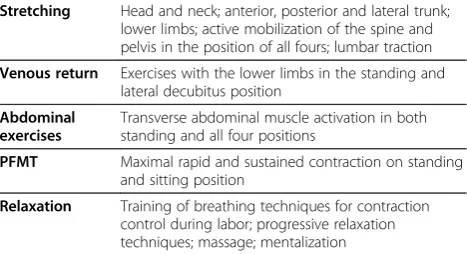
Women of the intervention group participated in the physical and educational activities of the BPP conducted in addition to routine activities offered at the prenatal clinic, on the same days of the prenatal visits, in order to minimize the difficulties women from low resource set-tings have to attend health education activities organized otherwise. During the meetings of approximately 50 mi-nutes women performed non aerobic exercises of a protocol adapted for pregnancy and designed to attempt to reduce back pain, possibly to help venous return and to prevent UI and minimize anxiety (Table 1). At the first BPP meeting women received oral guidance on the awareness of pelvic floor muscles–they were instructed to contract the pelvic floor as if they were trying to avoid urination and focus on the sensation of the pelvic floor muscles during this movement and during relaxation after the contraction. Women who did not manage to perform this exercise were advised to try the contraction of the pelvic floor during urination, attempting to stop urine flow and informed that this exercise during urin-ation was only for the identificurin-ation of the sensurin-ation.
During BPP meetings information was provided on the prevention of pain in pregnancy, the role of the pelvic floor in pregnancy, delivery and in the postpartum, the physiology of labor, breathing exercises for delivery, and non-pharmacological pain control techniques during labor. Participants received a guide with the exercises to be performed daily at home, consisting of: pelvic floor muscle training (PFMT) including rapid (30 times) and sustained maximal contractions (20 times holding for 10 seconds), stretching exercises to reduce back pain and exercises to improve venous return in the lower limbs. The women were also encouraged to practice aerobic exercise daily for at least 30 minutes and received writ-ten information based on the ACOG guidelines [2] re-garding the warning signs that indicated that the exercise should be stopped.
The activities performed in the BPP were planned and structured specifically for the study and supervised by
Table 1 Short description of the BPP exercises
Stretching Head and neck; anterior, posterior and lateral trunk; lower limbs; active mobilization of the spine and pelvis in the position of all fours; lumbar traction
Venous return Exercises with the lower limbs in the standing and lateral decubitus position
Abdominal exercises
Transverse abdominal muscle activation in both standing and all four positions
PFMT Maximal rapid and sustained contraction on standing and sitting position
trained physiotherapists who worked exclusively for the study. The birth preparation programme meetings were held on the same days of prenatal visits on a monthly basis up to 30 weeks of pregnancy, fortnightly between 31 and 36 weeks of pregnancy and weekly from 37 weeks of preg-nancy onwards. Meetings were either conducted as open group or individual sessions; the modality depended on the number of women present.
Statistical analysis
Analysis was performed according to the group to which participants were assigned, on an intention-to-treat basis. To test the differences between the groups, the Mann–Whitney test and Student’s t-test were used for the continuous variables and the χ2 test and Fisher’s
exact test for the categorical variables. For categorical dependent variables, risk ratios (RR) were calculated, to-gether with their respective 95% confidence intervals (95%CI). For numerical dependent variables, mean dif-ferences and their respective 95%CI were also estimated. Significance was established at p<0.05.
Results
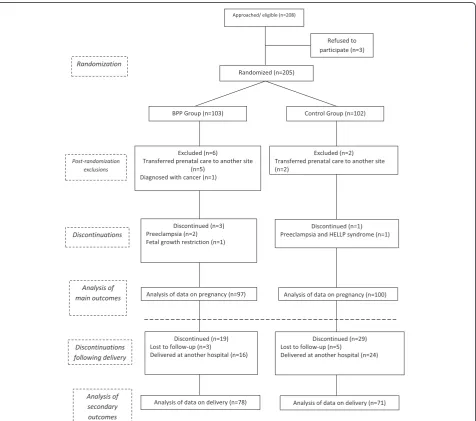
For the study, 208 eligible pregnant women were identi-fied. Three women refused the invitation to participate and 205 women were randomised into the intervention and control groups. Eight women were excluded post-randomisation. A total of 197 women participated in the study, 97 allocated to the intervention group and 100 to the control group. Figure 1 shows randomisation process
regarding the groups and the follow-up of the partici-pants in accordance with the flowchart suggested by the Consolidated Standards of Reporting Trials (CONSORT) [24]. Apart from the 8 initial cases of exclusion following randomisation, the only data that were lost was secondary data referring to delivery and the newborn infant in 48 cases (24%) in which delivery occurred in other institu-tions. There was no difference between the groups regard-ing the sociodemographic and obstetric characteristics (Table 2). The women in the BPP intervention group participated in a median of 5 meetings (range 2 to 10 meetings).
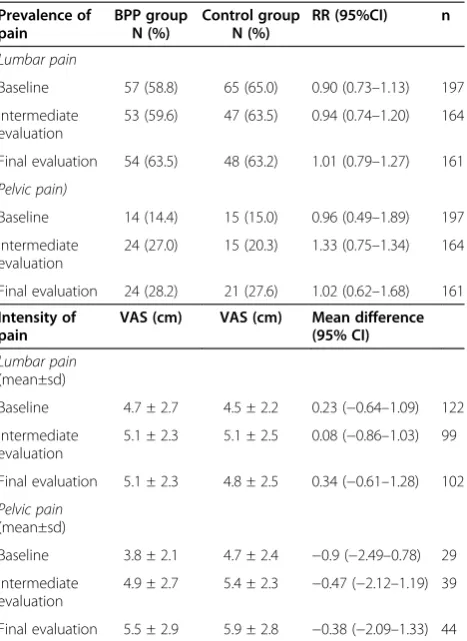
When compared baseline data, a significant reduction was reported in the number of complaints of UI by the women in the BPP group (41%), whereas in the control group the number of complaints increased at the final evaluation (68%) (Table 3). The number needed to treat (NNT) was 5.1 at the intermediate evaluation and 3.7 at the final evaluation. There was no difference between the groups regarding to the prevalence or to the inten-sity of lumbopelvic pain throughout pregnancy (Table 4). In addition, the use of medication to control pain was similar in both groups at the three evaluation times (data not shown).
Anxiety level was similar in both groups throughout pregnancy, being low/moderate (scores between 20 and 49) in the majority of women at the three evaluations. The Table 5 shows the percentages of the women who presented high and very high anxiety levels. Data related to the physical activities evaluated using the PPAQ,
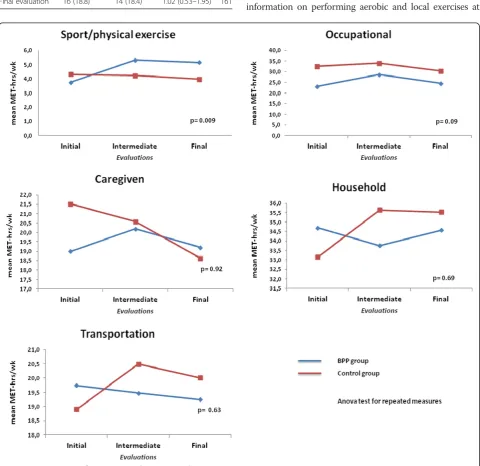
showed a difference between the groups regarding the energy expenditure of physical exercise, with increased (initial to final evaluation) in the BPP (1.4 MET-hrs/wk) and decreased in the CG (−0.3 MET-hrs/wk), with a sig-nificant difference between groups (p=0.009; Anova test). There was no difference between the groups regarding the other types of physical activity (Figure 2). The me-dian increase in maternal weight between baseline and the final evaluation was similar in both groups, 8,5 kg (interquartile range–Q1: 6,2 kg; Q3: 11,8 kg) in the BPP group and 7,9 kg (Q1: 6,4 kg; Q3: 10,6 kg) in the control
group (p=0.81, Mann–Whitney test; data not shown).
Table 2 Socio demographic and obstetric characteristics at baseline evaluation
Gestational age (mean±sd) 20.7 ± 1.8 20.4 ± 2.0
Body mass index (mean±sd) 25.4 ± 5.0 25.2 ± 5.3
N (%) N (%)
Education
Primary 16 (16.5) 19 (19.0)
Secondary 64 (66.0) 64 (64.0)
University 13 (13.4) 17 (17.0)
Technical 4 (4.1) 0 (0.0)
Steady partner 77 (79.4) 78 (78.0)
Planned pregnancy 51 (53.1) 47 (47.0)
Practiced physical activity prior to pregnancy
25 (25.8) 31 (31.0)
Knowledge of pelvic floor muscles 23 (23.7) 13 (13.0)
Urinary incontinence prior to pregnancy
17 (17.5) 18 18.0
All values are not statistically significant.
Table 3 Reported urinary incontinence by group and the risk of developing urinary incontinence
BPP Group N (%)
Control Group N (%)
RR (95%CI) n
Baseline 52 (53.6) 53 (53.0) 1.01 (0.78–1.31) 197
Intermediate evaluation
38 (42.7) 46 (62.2) 0.69 (0.51–0.93) 164
Final evaluation 35 (41.2) 52 (68.4) 0.60 (0.45–0.81) 161
Values in bold mean they are statistically significant.
Table 4 Occurrence of lumbopelvic pain and the respective pain scores of the intervention and control group
Baseline 57 (58.8) 65 (65.0) 0.90 (0.73–1.13) 197
Intermediate evaluation
53 (59.6) 47 (63.5) 0.94 (0.74–1.20) 164
Final evaluation 54 (63.5) 48 (63.2) 1.01 (0.79–1.27) 161
Pelvic pain)
Baseline 14 (14.4) 15 (15.0) 0.96 (0.49–1.89) 197
Intermediate evaluation
24 (27.0) 15 (20.3) 1.33 (0.75–1.34) 164
Final evaluation 24 (28.2) 21 (27.6) 1.02 (0.62–1.68) 161
Intensity of pain
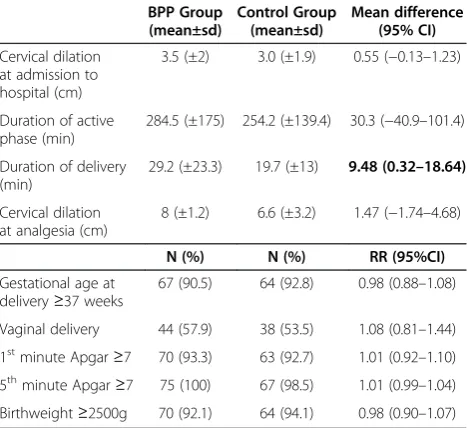
Analysis of the participants’adherence with the exercises to be performed at home was unfeasible because the women either failed to complete the exercise diary or failed to bring it with them on their return to the clinic. No adverse events associated with the exercise were reported by the participants. Regarding the analysis of the perinatal data, no difference was found between the groups, except for length of delivery (Table 6).
Discussion
This study evaluated a birth preparation programme linked to women’s visits to the clinic for prenatal care that in-cluded various interventions: general supervised exercise, information on performing aerobic and local exercises at
Table 5 High and very high anxiety level of the intervention and control group
BPP group N (%)
Control group N (%)
RR (95%CI) n
STAI TRAIT)
Baseline 33 (34.0) 26 (26.0) 1.30 (0.84–1.99) 197
Intermediate evaluation
17 (19.1) 20 (26.7) 0.72 (0.41–1.27) 164
Final evaluation 18 (21.2) 20 (26.3) 0.80 (0.46–1.40) 161
STAI STATE)
Baseline 18 (18.8) 21 (21.0) 0.89 (0.51–1.57) 197
Intermediate evaluation
16 (18.0) 16 (21.3) 0.84 (0.45–1.57) 164
Final evaluation 16 (18.8) 14 (18.4) 1.02 (0.53–1.95) 161
home and educational activities. The main findings showed that a systematically performed programme with clear ob-jectives exerts a positive effect by reducing complaints of UI and increasing the practice of physical exercise through-out pregnancy.
In relation to the prevention and control of UI during pregnancy, these findings are in agreement with the re-sults of a systematic review [10] that showed that nul-liparous women are able to avoid UI in pregnancy by performing PFMT. Maybe, the fact that women in the BPP group had received information regarding pelvic floor muscle and PFMT resulted in increased awareness and consequently in reduced urinary leakage [25]. Fur-thermore, PFMT was given at the BPP meetings and the importance of continuing to practice these exercises at home was emphasized.
Regarding the practice of exercise, prevalence studies showed that women do not tend to comply with the guidelines recommended by ACOG for the practice of exercise [2], perform little exercise during pregnancy and the practice of exercise tends to diminish as preg-nancy progresses [26-30]. In accordance with the results of the present study, the energy expenditure improve-ment with the practice of physical exercise during preg-nancy may be associated with encouragement and guidance. Although they had maintained a moderate
level of exercise intensity (3.0–6.0 METs) [20], the
women in the control group, who received neither guid-ance nor encouragement, had a decrease in energy ex-penditure with the practice of physical exercise during pregnancy.
On the other hand, the BPP had no effect on relieving or preventing lumbopelvic pain. Other studies have shown that specific exercises to reduce pain in the lumbopelvic region were effective when the exercise was supervised and practiced once a week or once a fort-night [31-34]. In the present study, supervised practice occurred only on the days of prenatal medical visits, which were scheduled monthly throughout most of the pregnancy and fortnightly between 31 and 36 weeks of pregnancy and weekly from 37 weeks of pregnancy on-wards. In addition, the exercises that the women were instructed to perform at home consisted of only two types of stretching exercise for the lumbopelvic region, which, in our opinion, are those safest and easiest to carry out unsupervised. On the other hand, in previous studies [32,33], the number of exercises that the women were counseled to perform at home for this purpose was greater. These results lead us to believe that this type of discomfort during pregnancy requires greater attention, with a need for more frequent supervised interventions, a greater number of specific exercises or the practice of different types of exercise at home. It was not possible to evaluate adherence to home exercises for pain in the present study.
At the end of pregnancy, anxiety levels may increase as labor approaches [35]. Nevertheless, in this study anx-iety remained low or moderate in both groups. This may be due to the fact that the women participated in routine counseling groups throughout their prenatal care at which timely information was provided on the signs and symptoms of labor and visits were made to the delivery ward. Furthermore, the study population consisted of low-risk pregnant women with access to prenatal care, which may have contributed to their low levels of anxiety.
One limitation of this study was that the attempt to evaluate adherence by asking the women in the study to complete an exercise diary was not successful since women failed to complete their diaries and consequently it was not possible to perform an analysis of adherence. Also another possible limitation was the loss to follow-up due, in some cases, to the fact that some participants delivered their babies at other facilities and in other cases to the loss of contact with some of the partici-pants, which hampered evaluation of the secondary data. Another limitation may lay on the fact that the study was not blinded, what could have resulted in women giv-ing“right answers”to questions regarding urinary incon-tinence and practice of physical exercise as a courtesy bias. However, if this was the case, the same could be expected for answers concerning lumbopelvic pain and anxiety, but this did not happen at all.
The results of this study may contribute towards im-proving birth preparation programmes; however, further
Table 6 Obstetric, perinatal and neonatal data of the intervention and control group
BPP Group delivery≥37 weeks
67 (90.5) 64 (92.8) 0.98 (0.88–1.08)
Vaginal delivery 44 (57.9) 38 (53.5) 1.08 (0.81–1.44)
1stminute Apgar≥7 70 (93.3) 63 (92.7) 1.01 (0.92–1.10)
5thminute Apgar≥7 75 (100) 67 (98.5) 1.01 (0.99–1.04)
Birthweight≥2500g 70 (92.1) 64 (94.1) 0.98 (0.90–1.07)
studies are required to establish the most effective tech-niques for reducing lumbopelvic pain. Further evaluation also needs to be made of the ideal number of meetings and how frequently they should take place for a programme including different types of interventions.
Conclusions
This BPP was effective in preventing and controlling UI and in encouraging women to exercise during preg-nancy, while preserving maternal and fetal health; how-ever, the program failed to control lumbopelvic pain, and had no effect on perinatal outcome.
Details of ethics approval
This study was approved by the Institutional Review Board of the School of Medicine, State University of Campinas (UNICAMP) under registration number 407/ 2008 on 24 June 2008. The study was also registered at clinicaltrials.gov (NCT01155804).
Abbreviations
RCT:Randomized controlled trial; BPP: Birth preparation program; CG: Control group; RR: Risk ratio; CI: Confidence interval; ACOG: the American College of Obstetricians and Gynecologists; CAISM: Women’s integral health care hospital; UNICAMP: University of Campinas; PPAQ: Pregnancy physical activity questionnaire; STAI: State-trait anxiety inventory; PFMT: Pelvic floor muscle training; MET: Metabolic equivalent.
Competing interest
The authors declare that they have no competing interests.
Authors’contributions
MAM participated in designing the research project, was involved in the data collection, in the interpretation of the results and writing of the manuscript. MYM participated in designing the research project, interpreting the results and preparing the manuscript. JGC contributed to the final editing of the research project, interpretation of the results and preparation of the manuscript. All authors read and approved the final manuscript.
Acknowledgements
The authors would like to express their gratitude to the physiotherapists who collaborated in this study, to the Physiotherapy Department and to the nursing staff of the outpatient prenatal clinic at the Maternity Department, CAISM/UNICAMP.
Funding
Financial support was provided by the Foundation for the Support of Research of the State of São Paulo(Fundação de Amparo à Pesquisa do Estado de São Paulo–FAPESP)grant #08/10392-5. The first author received partial financial support from the Coordination for the Improvement of Higher Education Personnel (CAPES).
Author details
1Department of Obstetrics and Gynecology, School of Medical Sciences,
University of Campinas (UNICAMP), Caixa Postal 618113083-970, Campinas, São Paulo, Brazil.2Center for Research on Reproductive Health of Campinas (Cemicamp), Campinas, SP, Brazil.
Received: 3 December 2012 Accepted: 1 July 2013 Published: 29 July 2013
References
1. Gagnon AJ, Sandall J:Individual or group antenatal education for childbirth or parenthood, or both.Cochrane Database Syst Rev2007, 3:CD002869.
2. ACOG Committee Obstetric Practice:ACOG Committee opinion. Number 267, January 2002: exercise during pregnancy and the postpartum period.Obstet Gynecol2002,99:171–173.
3. Hegaard HK, Pedersen BK, Nielsen BB, Damm P:Leisure time physical activity during pregnancy and impact on gestational diabetes mellitus, pre-eclampsia, preterm delivery and birth weight: a review.Acta Obstet Gynecol Scand2007,86:1290–1296.
4. Schmidt MD, Pekow P, Freedson PS, Markenson G, Chasan-Taber L:Physical activity patterns during pregnancy in a diverse population of women. J Womens Health2006,15(8):909–918.
5. O'Connor PJ, Poudevigne MS, Cress ME, MotI RW, Clapp JF 3rd:Safety and efficacy of supervised strength training adopted in pregnancy.J Phys Act Health2011,8:309–320.
6. Barakat R, Lucia A, Ruiz JR:Resistance exercise training during pregnancy and newborn’s birth size: a randomised controlled trial.Int J Obes (Lond) 2009,33:1048–1057.
7. Haakstad L, Bø K:Exercise in pregnant women and birth weight: a randomized controlled trial.BMC Pregnancy Childbirth2011,11:66. 8. Zavorsky GS, Longo LD:Adding strength training, exercise intensity, and
caloric expenditure to exercise guidelines in pregnancy.Obstet Gynecol 2011,117:1399–1402.
9. Pennick VE, Young G:Interventions for preventing and treating pelvic and back pain in pregnancy.Cochrane Database Syst Rev2007, 2:CD001139.
10. Hay-Smith J, Mørkved S, Fairbrother KA, Herbison GP:Pelvic floor muscle training for prevention and treatment of urinary and faecal incontinence in antenatal and postnatal women.Cochrane Database Syst Rev2008, 4:CD007471.
11. Bø K, Haakstad LA:Is pelvic floor muscle training effective when taught in a general fitness class in pregnancy? A randomised controlled trial. Physiotherapy2011,97:190–195.
12. Whitford HM, Alder B, Jones M:A cross-sectional study of knowledge and practice of pelvic floor exercises during pregnancy and associated symptoms of stress urinary incontinence in North-East Scotland. Midwifery2007,23:204–217.
13. Teixeira JM, Fisk NM, Glover V:Association between maternal anxiety in pregnancy and increased uterine artery resistance index: cohort based study.BMJ1999,318:153–157.
14. Copper RL, Goldenberg RL, Das A, Elder N, Swain M, Norman G,et al:The preterm prediction study: maternal stress is associated with spontaneous preterm birth at less than thirty-five weeks’gestation. National Institute of Child Health and Human Development Maternal-Fetal Medicine Units Network.Am J Obstet Gynecol1996,175:1286–1292. 15. Marc I, Toureche N, Ernst E, Hodnett ED, Blanchet C, Dodin S,et al:
Mind-body interventions during pregnancy for preventing or treating women's anxiety.Cochrane Database Syst Rev2011,7:CD007559. 16. Khianman B, Pattanittum P, Thinkhamrop J, Lumbiganon P:Relaxation
therapy for preventing and treating preterm labour.Cochrane Database Syst Rev2012,8:CD007426.
17. Khunpradit S, Tavender E, Lumbiganon P, Laopaiboon M, Wasiak J, Gruen RL:Non-clinical interventions for reducing unnecessary caesarean section.Cochrane Database Syst Rev2011,6:CD005528.
18. Mehdizadeh A, Roosta F, Chaichian S, Alaghehbandan R:Evaluation of the impact of birth preparation courses on the health of the mother and the newborn.Am J Perinatol2005,22:7–9.
19. Biaggio AM, Natalicio I, Spielberger CD:Desenvolvimento da forma experimental em português do inventário de ansiedade traço-estado (IDATE), de Spielberger.Arq Bras Psicol Aplic1997,29:31–44. 20. Chasan-Taber L, Schmidt MD, Roberts DE, Hosmer D, Markenson G,
Freedson PS:Development and validation of a pregnancy physical activity questionnaire.Med Sci Sports Exerc2004,36:1750–1760. 21. Silva FT, Costa FS:[Physical activity level evaluation during pregnancy].
Rev Bras Ginecol Obstet2007,29:490.
22. Haylen BT, de Ridder D, Freeman RM, Swift SE, Berghmans B, Lee J, International Urogynecological Association; International Continence Society:An International Urogynecological Association (IUGA)/ International Continence Society (ICS) joint report on the terminology for female pelvic floor dysfunction.Neurourol Urodyn2010,29:4–20. 23. Huskisson EC:Measurement of pain.Lancet1974,2:1127–1131. 24. Boutron I, Moher D, Altman DG, Schulz KF, Ravaud P, CONSORT Group:
nonpharmacologic treatment: explanation and elaboration.Ann Intern Med2008,148:295–309.
25. Miller JM, Ashton-Miller JA, DeLancey JOL:A pelvic muscle precontraction can reduce cough-related urine loss in selected women with mild SUI. J Am Geriatr Soc1998,46(7):870–874.
26. Duncombe D, Wertheim EH, Skouteris H, Paxton SJ, Kelly L:Factors related to exercise over the course of pregnancy including women’s beliefs about the safety of exercise during pregnancy.Midwifery2009, 25:430–438.
27. Fell DB, Joseph KS, Armson BA, Dodds L:The impact of pregnancy on physical activity level.Matern Child Health J2009,13:597–603. 28. Ribeiro CP, Milanez H:Knowledge, attitude and practice of women in
Campinas, São Paulo, Brazil with respect to physical exercise in pregnancy: a descriptive study.Reprod Health2011,8:31.
29. Haakstad LAH, Voldner N, Henriksen T, Bo K:Physical activity level and weight gain in a cohort of pregnant Norwegian women.Acta Obstet Gynecol2007,86:64–559.
30. Owe KM, Nystad W, Bo K:Correlates of regular exercise during pregnancy: the Norwegian Mother and Child Cohort Study.Scand J Med Sci Sports 2009,19:637–645.
31. Kluge J, Hall D, Louw Q, Theron G, Grové D:Specific exercises to treat pregnancy-related low back pain in a South African population.Int J Gynaecol Obstet2011,113:187–191.
32. Kashanian M, Akbari Z, Alizadeh MH:The effect of exercise on back pain and lordosis in pregnant women.Int J Gynaecol Obstet2009,107:160–161. 33. Garshasbi A, Faghih Zadeh S:The effect of exercise on the intensity of
low back pain in pregnant women.Int J Gynaecol Obstet2005,88:271–275. 34. Martins RF, Pinto e Silva JL:An exercise method for the treatment of
lumbar and posterior pelvic pain in pregnancy.Rev Bras Ginecol Obstet 2005,27:275–282.
35. Figueiredo B, Conde A:Anxiety and depression in women and men from early pregnancy to 3-months postpartum.Arch Womens Ment Health 2011,14:247–255.
doi:10.1186/1471-2393-13-154
Cite this article as:Miqueluttiet al.:Evaluation of a birth preparation program on lumbopelvic pain, urinary incontinence, anxiety and
exercise: a randomized controlled trial.BMC Pregnancy and Childbirth
201313:154.
Submit your next manuscript to BioMed Central and take full advantage of:
• Convenient online submission
• Thorough peer review
• No space constraints or color figure charges
• Immediate publication on acceptance
• Inclusion in PubMed, CAS, Scopus and Google Scholar
• Research which is freely available for redistribution