R E S E A R C H
Open Access
Efficient visual tracking via low-complexity
sparse representation
Weizhi Lu
1*, Jinglin Zhang
2, Kidiyo Kpalma
1and Joseph Ronsin
1Abstract
Thanks to its good performance on object recognition, sparse representation has recently been widely studied in the area of visual object tracking. Up to now, little attention has been paid to the complexity of sparse representation, while most works are focused on the performance improvement. By reducing the computation load related to sparse representation hundreds of times, this paper proposes by far the most computationally efficient tracking approach based on sparse representation. The proposal simply consists of two stages of sparse representation, one is for object detection and the other for object validation. Experimentally, it achieves better performance than some
state-of-the-art methods in both accuracy and speed.
Keywords: Object tracking; Sparse representation; Low complexity
1 Introduction
Object tracking is a challenging task in computer vision due to the constant changes of object appearance and location. Sparse representation has recently been intro-duced in this area for its robustness in recognizing objects with high corruption [1]. Although related tracking works have been proposed with competitive performance, the application efficiency of sparse representation has not received enough attention. This paper is thus proposed to address this problem.
Sparse representation is mainly developed within the framework of particle filter, where it is used to mea-sure the similarity between the particle and the dictionary with the representation error. Currently, this method still faces some challenges in terms of complexity and per-formance. To be specific, it should be noted that sparse representation has to be calculated for each particle, while the number of particles is often of the level of hundreds (e.g., 600 particles in [2-4]). Obviously, it is a consider-able computation cost, especially in the setting where each sparse solution is also computationally expensive. Pre-cisely, to represent the particle with relatively little error, sparse representation usually requires a relatively large dictionary (with a trivial template) and relatively dense
*Correspondence: [email protected]
1UMR 6164, IETR, INSA, Université Européenne de Bretagne (UEB), 35708 Rennes, France
Full list of author information is available at the end of the article
coefficients, which both will increase the solution com-plexity. Regarding the tracking performance, it is neces-sary to point out that sparse representation cannot resolve the problem of identity drift, if it is simply used to weight the particle. There are two major reasons. First, sparse representation cannot provide a reliable similarity mea-sure due to the potential overfitting solution, which tends to introduce excessive nonzero coefficients to reduce the representation error. In practice, it seems difficult to com-pletely avoid the overfitting problem, because the sparsity of sparse solution is usually unknown. Second, the sim-ilarity threshold between object and background is hard to be determined with sparse representation, since the similarity level usually varies with the changing of object appearance.
To address the aforementioned problems, this paper develops a simple but effective tracking-by-detection scheme by exploring the distribution of sparse coefficients instead of the sparse representation error for similar-ity measure. The proposed scheme consists of two-stage sparse representation. In the first step, the object of interest is detected by the largest sparse coefficient; in the second step, the detected object is validated with a binary classifier based on sparse representation, which outputs the decision in terms of the distribution of sparse coefficients.
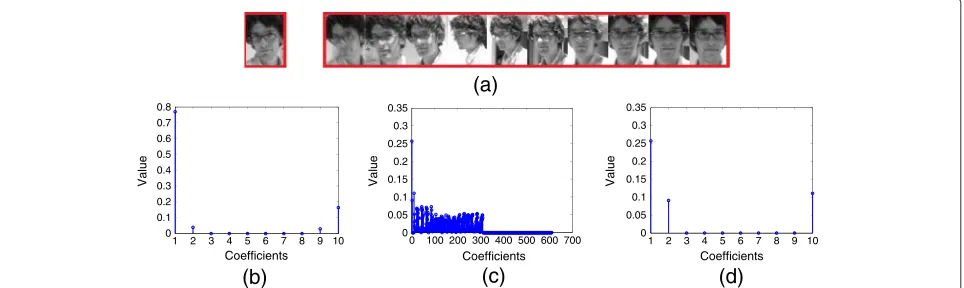
Compared with the traditional framework of particle filter, the proposed scheme will not only significantly reduce the computation cost related to sparse repre-sentation, but also effectively avoid identity drift. In the following part, these two advantages are briefly explained. The computation advantage mainly results from the following two facts. First, as stated before, the proposed scheme only involves two-step sparse represen-tation; in contrast, the particle filter usually has to repeat sparse representation hundreds of times. Second, in the proposed scheme sparse representation is explored by considering the distribution of the few largest sparse coef-ficients rather than the representation error. This allows sparse representation to be carried out with a relatively small dictionary and a relatively high representation error, thereby introducing a relatively low solution cost. For better understanding to this property, we specially give an example in Figure 1, from which it can be observed that the distribution of the few largest coefficients is not sensitive to the representation error. Precisely, in the example an object vector of size 300×1 (left in in Figure 1a) is sparsely approximated by a dictionary of ten objects (right in Figure 1a) with sparse solution shown in Figure 1b, and by a dictionary combining the ten objects and a trivial template [I−I] with sparse solution shown in Figure 1c. Here, I denotes an identity matrix of size 300×300. Then the sparse solution is of length equal to 10 in Figure 1b and 310 in Figure 1c. The sparse solution in Figure 1b has four nonzero entries and the represen-tation error is about 10−1. In contrast, the solution in Figure 1c holds 300 nonzero coefficients, and lowers the representation error to 10−3. For clarity, the first ten coefficients in Figure 1c corresponding to the ten objects above are detailed in Figure 1d. Then the high similarity between Figure 1b and Figure 1d verifies that the distri-bution of the largest few coefficients is indeed insensitive to the representation error. As for the robustness of the proposed scheme to identity drift, it mainly benefits
from the binary classifier based on sparse representation, which can effectively identify the background sample even when the background model is not well trained.
The rest of this paper is organized as follows. In the next Section 2, the tracking works related to sparse rep-resentation are briefly reviewed. In Section 3, a brief summary about sparse representation is presented. In Section 4, the proposed tracker with two-step sparse representation is described and analyzed. In Section 5, extensive experiments are conducted with comparison to the state-of-the-art. Finally, a conclusion is given in Section 6.
2 Related work
Extensive literature has been proposed on object tracking. Due to the limited writing space, we mainly review the tracking works related to sparse representation in terms of performance and complexity.
Sparse representation is introduced into the tracking mainly for improving the performance of recognition or feature selection. Mei and Ling [5] first explored sparse representation into an on-line tracking system, where a trivial template with high dimension is introduced to approximate noise and occlusion. Later, to improve the high-dimensional feature selection, Liu et al. [6] attempt to learn discriminative high-dimensional features using dynamic sparsity group. To reduce the sensitivity to back-ground noise in the selected object area, Wang et al. [2] and Jia et al. [7] applied the sparse coding histogram based on local patches to describe objects. Zhong et al. [8] proposed a collaborative model that weights particles by combining the confidences of local descriptor and holistic representation. Note that the tracking methods described above are mainly focused on the performance improve-ment, while ignoring the complexity of implementation. In the traditional tracking framework of particle filter, the computation cost introduced by sparse representation
usually cannot be ignored, because it has to be calcu-lated for each particle. In this sense, it is of practical interests to reduce the complexity related to sparse repre-sentation. Mei et al. [3] proposed to discard insignificant samples by limiting their linear least square errors before resampling particles with more computationally expen-sive 1-regularization. In terms of compressed sensing
theory, random projection is introduced to reduce the fea-ture dimension in [9,10]. Strictly speaking, the random projection based feature selection arises from random projection theory rather than compressed sensing theory [11]. In this paper, we also apply the similar method for feature selection. According to random projection theory, we will implement random projection with random matri-ces rather than fixed matrimatri-ces as applied in [9,10]. By this means, the feature selection performance of random pro-jection should be improved [12]. In [13], Bao et al. devel-oped a fast sparse solution solver with the accelerated proximal gradient approach. However, their solver is sen-sitive to a parameter termed as Lipschitz constant, which is computational load during the template updating. Liu and Sun [14] attempted to weight each particle only with corresponding sparse coefficient such that sparse repre-sentation needs to be conducted only once. This method seems very attractive in complexity; however, it should be noted that the magnitude of each coefficient in fact can-not be ensured ‘proportional’ to the similarity/correlation between the corresponding particle and the query object. Mathematically, with the principle of least squares, we can derive that the exact ‘proportion’ exists only when the sub-dictionary corresponding to sparse coefficients is orthog-onal. Obviously, this condition is hard to be satisfied by the realistic dictionaries. With the erroneous similarity measure, however, the method in [14] still presents rela-tively good performance. This is because empirically the particles corresponding to large coefficients tend to be similar to the query object. In this case, the selected par-ticles with high weights are not inclined to change the attribute of particle filter, then the tracking performance will not be influenced. Besides the theoretical limitation, this method in [14] also holds a critical performance lim-itation: it is sensitive to identity drift, because the object out of the scene can hardly be detected only with the distribution of sparse coefficients. Zhang et al. [15] pro-posed to jointly represent particles by using multi-task learning to explore the interdependencies between par-ticles. In addition, to detect an occlusion, the nonzero coefficients in the trivial template were used to locate occluded pixels in [3]. However, this method seems unreli-able due to the potential overfitting solution. In particular, when the overfitting solution occurs as in Figure 1c, all pixels are likely to be classified as occlusion, though in fact there is no occlusion. In this paper, to reduce the complexity of sparse representation, we also exploit the
sparse coefficients instead of representation error for sim-ilarity measure. However, we successfully avoid the limi-tations mentioned above by developing a novel tracking scheme.
To account for the change of object appearance, almost all the trackers mentioned above explore an adaptive appearance model for the on-line sample updating [5] or learning [16,17]. It is known that the adaptive model is likely to lead to the identify drift, if the background sample cannot be effectively excluded. However, to effectively dis-criminate the background sample from the object is still a challenging task due to the change of object appearance. For instance, in practice it is hard to set a decision thresh-old between the object and background with representa-tion error [4,16,18,19]. To address this problem, it is better to introduce a binary classifier which involves a defini-tive decision threshold [20-23]. Thus, in the proposed approach, we specially develop a binary classifier based on sparse representation. Compared with traditional binary classifiers, as will be shown later, the proposed classifier is competitive in both performance and complexity.
3 Sparse representation-based classification This section briefly introduces sparse representation-based classification with the typical face recognition as an example. Let vectory ∈ Rm×1denote a test face, and matrixD=DG1,DG2,. . .,DGN
∈Rm×nbe a dictionary consisting ofN classes of labeled face vectors, where the ith sub-matrixDGi= test face can be approximated by a linear combination of few labeled face vectors, namely:
y=Dβ+ (1)
whereβ is required to hold at mostknnonzero pos-itive entries; and is the tolerated error. Subsequently, the feature vectoryis viewed as close to the subspace of labeled samples corresponding to the nonzero entries of β. In other words, it can be identified as the class:
ˆ
i=argmax i {δi(β)|
1≤i≤N}, (2)
where δi(β) is a function that sums the elements of β corresponding to DGi. The solution to k-sparse
vec-tor β can be simply derived with greedy algorithms of complexity O(mnk), such as OMP [24] or least-angle regression (LARS) [25]. Note that to reduce the represen-tation error, the dictionaryDis often further concatenated with a trivial template consisting of two identity matrices [I−I]∈Rm×2m, thereby dramatically increasing the solu-tion complexity [2,3,5-7,9,15].
entries of β empirically incline to scatter among some different classes instead of focusing on a specific class. So the novel face can be detected with a threshold as:
max{δi(β)|1≤i≤N}< γ n
j=1
βj (3)
where 0 < γ < 1 is an empirical parameter. As will be detailed in Section 4.3, the feature of detecting novel objects can be used to detect the outlier during the object tracking.
4 Proposed tracking scheme
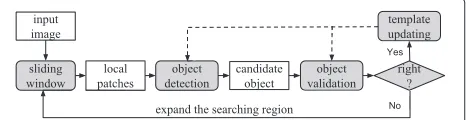
The proposed tracking scheme mainly consists of two steps: object detection and object validation, as sketched in Figure 2. In this section, we first introduce the fea-ture selection method, then detail the tracking scheme in Subsections 4.2 and 4.3. The computation advan-tage of the proposed tracking scheme is analyzed in Subsection 4.4.
4.1 Random-projection-based feature selection
In tracking scenarios, it is usually hard to obtain ideal object features. The raw image and color histogram have been two kinds of popular features. In this paper, we use the random projection of raw image as a feature. Specif-ically, before performing sparse representation, we first project the vector of raw image to a relative low dimension with a random matrix [12]. This simple feature selection method has achieved competitive performance for face recognition [1]. In this case, the sparse representation of formula (1) can be reformulated as:
Ry=RDβ+ (4)
where R ∈ Rd×m is a random projection matrix,d < m. The random matrixRis commonly constructed with elements independently and identically drawn from the Gaussian distribution. Here, for simpler computation, we exploit a more sparse random matrix which holds exactly one nonzero entry being±1 equiprobably in each column. This kind of matrix has shown better feature selection performance than Gaussian matrices [11], and it also per-forms well in the following tracking work. Note that to obtain relatively reliable feature selection, for each given y, random projection usually requires to be carried out several times and then to consider the average result [12].
Figure 2The block diagram of the proposed tracking scheme.
In this process, the matrixRis random generated. More precisely, in our approach the random projection together with sparse representation will be repeated five times for each given y. Then, the average value of five sparse solutionsβis used to make a decision fory.
Despite its low implementation complexity, random projection clearly is not the best feature selection tool in terms of performance. However, considering the variation of object appearance, it is reasonable to argue that the feature comparison based on the sum of few randomly selected pixels is probably more robust than the con-ventional pixel-wise comparison. This also explains why random projection can present satisfactory recognition performance in the proposed tracker.
4.2 Object detection
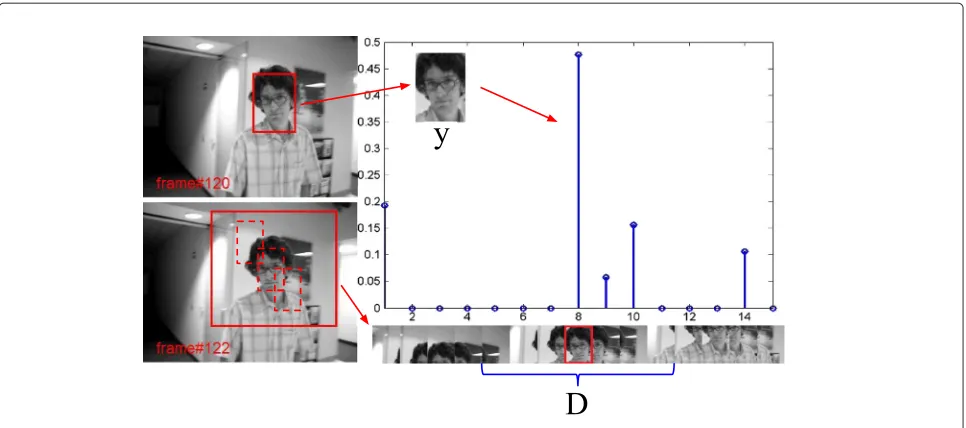
In this section, the object detection is simply implemented by approximating the known object with local patches detected from current frame. To be specific, as illustrated in Figure 3, letybe a known/query object extracted from the former adjacent frame, andD consisting of overlap-ping local patches collected from current frame. Here, the local patches are extracted from a rectangle region of interest with a sliding window of fixed size. Supposeycan be sparsely approximated with the dictionary D. Then, the candidate object can be located with the element of Dwhich corresponds to the largest component of sparse solutionβ.
Figure 3An example of object detection with sparse representation.
Algorithm 1 Object detection
Definitions: LetY = [YsYd] be a set of known object samples from former frames, whereYsrepresents the subset of static samples from the initial frames andYd denote the subset of dynamic samples from the recent frames, andD be the dictionary consisting of over-lapping local patches extracted from some regions of current frame, with a fixed space layout. And then supposeyj: 1≤j≤Nc is a set ofNcquery samples randomly selected fromYsorYd.
1. The average value of sparse coefficient β¯ =
1
Nc
Nc
j=1βjis derived with respect toRyj=RDβj+,
whereRis the random projection matrix for feature selection.
2. The candidate object is located by the local patch with indexˆi = argmaxiβi¯ , whereβi¯ indicates the ith component of vectorβ¯.
It is necessary to point out that the detection cor-responding to the largest coefficient is not always reliable or correct. An obvious evidence is that there would remain an ‘object area’ defined by the largest coefficient, even though the object has been occluded or out of the image. To avoid such kind of false detection, we have to introduce a binary classifier to further validate the detection, as detailed in the sequel.
4.3 Object validation and template updating
In this section, a binary classifier based on sparse repre-sentation is developed for discriminating the object from
the background. Here, sparse representation is adopted for the following four reasons:
• It is computationally competitive, since it only involves simple operations of matrix-vector product.
• The decision can be easily derived in terms of the distribution of sparse coefficients.
• Compared with traditional binary classifiers, it has an exclusive advantage: it can detect the outliers which is not included in the current background model, because in this case, the sparse coefficients tend to scatter rather than focus [1]. This property has been verified in our recent work on multi-object tracking, in which the novel object is detected as an outlier according to the scattering sparse coefficients [26]. This implies that we can detect the background sample, even when the background model is not robust or large. Then, the computation and storage loads on background modelling can be significantly reduced.
between individual samples rather than directly dividing the sample space into two parts [1].
The proposed binary classifier can be briefly described as follows. Suppose yc is the candidate object detected from the former step, which can be sparsely approximated by a dictionaryZ, namely:
Ryc=RZβ+. (5)
Here,Z= ZGpZGn
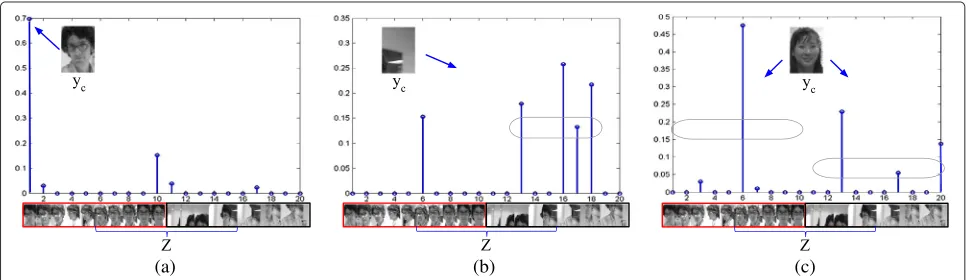
consists of two parts, which rep-resent the subset of positive samples and the subset of negative samples, respectively; and the two subscriptsGp andGnare the subsets of column indexes. Then, we can determine the attribute of the candidate object with the distribution of sparse coefficients. Precisely, as illustrated in Figure 4a,b, the candidate object will be regarded as positive if the sparse coefficients mainly focus on the part of positive samples; otherwise, the decision is negative.
The parameters of the proposed classifier are further detailed as follows. The positive samplesZGpcome from
the aforementioned static and dynamic appearance mod-els Y, and the negative samples ZGn are collected by a
sliding overlapping window from the neighborhood of tracked object, where partial object region is included as opposed to relatively complete object region in pos-itive samples. Correspondingly, the sparse solution β is also divided into two parts: β = βGpβGn
. Note that the classifier is not sensitive to the representation error, and so β can be very sparse, e.g., it holds at most ten nonzero entries in our experiments. In terms of the dis-tribution of sparse coefficients, we proposetworules to define the positive output. One is that the largest coef-ficient of sparse solution β corresponds to a positive sample ofZGp; namely, argmaxi{βi} ∈ Gp. Andthe other is that the sparse coefficients corresponding to positive samples, βGp, take higher energy than the sparse
coef-ficients corresponding to negative samples,βGn; that is,
||βGp||1/||β||1 > 0.5. Empirically, the latter criterion is
more strict than the former, since it measures the similar-ity between the candidate object and the whole positive subspace, instead of the individual positive samples. In this paper, to present a relatively fluent tracking trajectory, the detection is positively labeled, when either of the two criterions above is satisfied. But for the template updat-ing, we only apply the second criterion with a stricter threshold, i.e.,||βGp||1/||β||1>0.8, which provides more
reliable features and then prevents the template from identity drift. In practice, the threshold value needs to be tuned empirically. Recall that random projection needs to be carried out several times to achieve better feature selec-tion performance for the unique candidate object [12]. In our experiments, the random projection together with sparse representation is repeated five times, and then the average value of five sparse solutionsβis used for the final decision.
It is necessary to emphasize that the proposed classi-fier holds an exclusive advantage: it can detect the outlier. Typical outliers include the dynamic background samples and the sudden and great changes of object appearance, which usually cannot be well described with the current background model. In this case, as shown in Figure 4c, the sparse coefficients incline to scatter among the posi-tive and negaposi-tive subspaces rather than focusing on one of them, namely||βGp||1/||β||1 ≈ 0.5. Then, the outliers
can be easily excluded from the template updating, if a rel-atively strict threshold is adopted, e.g.,||βGp||1/||β||1 >
0.8. This advantage allows us to build a background model of relatively few samples, since the classifier is not very sensitive to the robustness of the background model. Finally, it is necessary to discuss the case where the object is lost. In this case, the object will be searched again within a larger region. If the search fails, the object will be assumed to move with a constant velocity or keep still in the following few frames. The whole flow of this part is summarized in Algorithm 2.
Algorithm 2 Object validation and template updating Definitions: Letycdenote the candidate object derived
in Algorithm 1, andZ=ZGpZGn
be the dictionary consisting of object samples and background samples, where the Gp andGn denote the index sets corre-sponding to above two classes of samples. Note that ZGp⊆Yof Algorithm 1. Rj denotes the jth random projection with j ∈ {1, 2,. . .,Nr}, and correspondingly βj is the sparse solution. Here,Nr is the frequency of repeating ran-dom projection.
2. The candidate object is labeled, if argmaxiβi¯ ∈Gp and 0.5<|| ¯βGp||1/|| ¯β||1<0.8, whereβi¯ denotes the
ith element of vectorβ¯.
3. The candidate object is labeled and updated for dynamic object modelYd, and its neighboring back-ground patches are updated forZGn, if argmaxi
¯ βi ∈ Gpand|| ¯βGp||1/|| ¯β||1>0.8.
4. If both steps 2 and 3 cannot be performed, the object is assumed to keep still or move with a constant velocity.
5. If step 4 is active in a few consecutive frames, object detection in Algorithm 1 is performed again in a larger region.
4.4 Computation cost related to sparse representation There are two major factors affecting the computation cost related to sparse representation: 1) the repetition number of sparse representation and 2) the complexity of sparse solution. Compared with the traditional track-ing framework of particle filter, the proposed approach presents obvious advantages on these two factors, as detailed below.
• The proposed scheme only involves two-step sparse representation, in which sparse representation allows to be performed only twice, if the feature is robust. To obtain relatively reliable features, in our experiments sparse representation along with random projection is repeated dozens of times, namely(Nc+1)Nrtimes. In contrast, the traditional framework of particle filter has to be carried out for each particle, such that the repetition times of sparse representation is usually of the level of hundreds, e.g., about 600 times in [2-4].
• Recall that the solution complexity is roughly proportional to the dictionary sizem×nand the sparsityk. In the traditional methods, the dictionary size is usually large, since to reduce representation error, it has to involve a high-dimensional trivial template[I−I]with the size of object feature. The
sparsitykcannot be restricted, unless the
representation error is small enough. In contrast, the proposed approach is not sensitive to the
representation error. Thus, in the paper, we significantly reduce the dictionary column sizenby excluding the trivial template, while restricting the sparsitykto a relatively low value, e.g.,k=10in our experiments. Furthermore, the dictionary row sizem
is also drastically reduced with random projection.
Recently, some trackers based on sparse representa-tion have been proposed with ‘real-time’ performance by reducing the complexity of sparse solution [9,13]. However, these trackers cannot reduce the repetition number of sparse representation due to their framework of particle filter. Thus, their computational gain is still limited compared with our approach. For a better under-standing, here, we analyze two typical real-time trackers: real-time compressed sensing tracker (RTCST) [9] and APGL1 [9]. For the tracker RTCST, compressed sens-ing theory is exploited to reduce the feature dimension with linear projection, thereby reducing the complexity of sparse solution. The strategy is also adopted in our approach with random projection theory [11]. So com-pared with our approach, the tracker RTCST has no computational advantage. Furthermore, it is worth noting that the linear projection-based feature selection is based on random projection theory rather than compressed sensing theory [11]. The tracker APGL1 is developed by exploring the accelerated proximal gradient (APG) approach for sparse solution. The APG approach seems to be computationally attractive, since it does not require the operation of matrix inversion, which is of complexity O(k3)and often involved in current solution algorithms.
However, it should be noted that the convergence perfor-mance of the APG approach is sensitive to a parameter termed the Lipschitz constant, which needs to be evalu-ated with the largest singular value of the dictionaryD. This implies that the singular value of the dictionary has to be calculated for each dictionary updating, while the solution of singular value holds a relatively high complex-ity O(n3). Then, we can say that the updating of Lips-chitz constant will drastically degrade the computational advantage of the APG approach, especially in the com-plex scene where the dictionary requires to be frequently updated.
5 Experiments
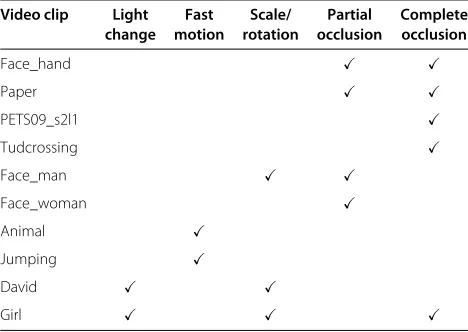
in Table 1. They are exploited here especially to validate the robustness of the proposed approach on identity preservation. To present more significant challenges of occlusion than the public available videos, we specially produce two videos, termed ‘paper’ and ‘face_hand,’ in which the occlusions share the similar feature with the targets, and last a long-time. For the video results, please see the link (https://sites.google.com/site/wzlusd/home/ tracking-project).
For comparison, we perform four known trackers: incre-mental visual tracker (IVT) [16], L1 tracker [5], partial least squares (PLS) tracker [4], and sparsity-based col-laborative model (SCM) tracker [8]. These four trackers all explore an adaptive appearance model. The first two trackers are mainly focused on the updating of dynamic appearances, while the latter two trackers further intro-duce the static model to prevent the identity drift. Note that the trackers L1 and SCM are both developed based on sparse representation. L1 is the first tracker that explores sparse representation, and to the best of our knowledge, SCM is currently known the best tracker based on sparse representation [27]. For fair comparison, the four track-ers are all implemented with their original codes, and the tracked object is initialized with same position. Regard-ing the parameters tunRegard-ing, we use the default parameters of L1 and PLS. Since the trackers IVT and SCM have provided some options of parameters for some popular videos, we adopt their default parameters for the videos they have evaluated, and select proper parameter options for other videos, e.g., using their parameters for ‘head’ and ‘pedestrian’ to track ‘head’ and ‘pedestrian’ in other videos. Recall that the proposed tracker cannot cope with scales. In contrast, the other four trackers all exploit the technique of affine transform. Empirically, some track-ers are probably sensitive to the initialization. For fair and comprehensive performance evaluation, we exploit
Table 1 The attributes of ten tested videos on five typical challenges
Video clip Light Fast Scale/ Partial Complete
change motion rotation occlusion occlusion
Face_hand
two initialization methods: one-pass evaluation (OPE) and spatial robustness evaluation (SRE) [27]. The OPE method simply initializes the tracker with the ground truth. The SRE method sets the initialization region by scaling the ground truth with five ratios 0.8, 0.9, 1, 1.1, and 1.2, and then the average tracking performance is considered.
The parameters related to the two-step sparse represen-tation are detailed as follows. In the step of object detec-tion, ten query samples are collected from the static model Ys and five query samples collected from the dynamic modelYd. The step length of the sliding window is around 4 pixels. Both the object retrieval region and background sampling region are not more than three times the object size. In the step of object validation, the classifier con-sists of 50 positive samples and 100 negative samples. The positive detection cannot be used for model updat-ing unless ||βGp||1/||β||1 > 0.8. In the two steps above,
the sparse representation based on random projection is repeated five times for each instance. The random projec-tion matrix is of size(d = 200,m = 32×32). It implies that the object is extracted and represented with a vector of size 32×32, which is further reduced to the dimension of 200 by random projection before performing sparse representation. The upper bound of sparsitykis set to 10 during the sparse solution.
5.1 Computational efficiency
Table 2 The implementation speed (frames per second) of the four trackers based on sparse representation with varying feature size
Feature size 10×10 20×20 30×30 40×40 50×50
L1 [5] 2.0172 0.3263 0.0166 0.0039 0.0019
SCM [8] 1.9025 0.9760 0.5648 0.3512
APGL1 [13] 18.0518 6.7513 0.7084 0.3160 0.1329
Ours_1 18.1232 8.5850 2.5802 0.9241 0.4040
Ours_2 18.3729 15.7857 13.0183 11.0276 7.8666
The best and second best results are in bold and italic texts, respectively. Theindicates that the software cannot run with the corresponding feature size.
by settingd = m; for the case of Ours_2, with random projection, the feature vector of lengthmis projected to the low dimensiond = 50 < m. Theoretically, the case of Ours_2 should run faster than the case of Ours_1 due to its dimension reduction, which is validated with the results of Table 2. This implies that the random projection can indeed significantly improve the tracker’s speed, as the projection dimensionddecreases. Note that the smaller dtends to lead to the worse feature selection. Thus, the value of d cannot be too small in practice. Compared with other three trackers, as it is expected, both Ours_1 and Ours_2 present much higher speed. For instance, the frame rate is improved dozens of times in Ours_2. From Table 2, it can be observed that their speed advan-tages become more obvious as the feature size increases. This is because the increasing computation of sparse solu-tion gradually turns into the tracker’s time bottleneck, and then our low-complexity on sparse representation is fully displayed. In summary, the low complexity of the proposed tracker is fully verified by its obvious speed advantage over state-of-the-art.
5.2 Quantitative evaluation
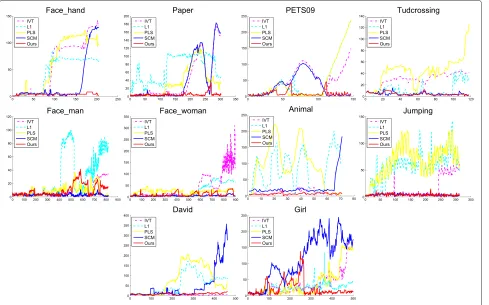
We measure the tracking accuracy of aforementioned trackers based on the center location error and the over-lap rate [29]. The center location error is the Euclidean distance between the central points of tracked objectRT and the corresponding manually labeled ground truthRG. The OPE center location error plots on all test sequences are shown in Figure 5, where the vertical axis indicates the location error and the horizontal axis is the frame index. The average location errors are given in Table 3. The over-lap rate, defined asarea(RT∩RG)/area(RT∪RG), evaluates the success rate, which is shown in Table 4. From Figure 5, it can be observed that the proposed approach achieves relatively persistent and stable tracking and obtains bet-ter overall performance than other four trackers on the ten videos. However, its performance advantage is not sufficiently mirrored in Table 4, since we simply exploit a fixed-size rectangle to represent an object with vary-ing size. Precisely, even if we have successfully captured the object, like in the sequencedavid, the overlap rate is
still small, because our tracking window is often larger or smaller than the ground-truth.
By comparing the results of OPE and SRE in each video of Table 3, we can see that the performance of the pro-posed tracker is relatively stable in the two cases. This implies that the proposed tracker is robust to the scale of initialization region. In fact, it presents poor performance only in the video ‘PETS09_s2l1,’ where it fails in the scal-ing cases of SRE. In contrast, the other four trackers seem sensitive to the initialization: this might be explained by the following fact. These trackers all exploit the technique of affine transform, which inclines to gradually converge to the local part of the target when the feature is not robust. From Table 4, it can be observed that the the SRE result is a little worse than the OPE result in each video, although as shown in Table 3, the proposed tracker in fact presents comparable performance in these two cases. As explained before, this is because the SRE method intro-duces a relatively large difference between the initialized tracking window and the ground truth in the first frame.
5.3 Qualitative evaluation
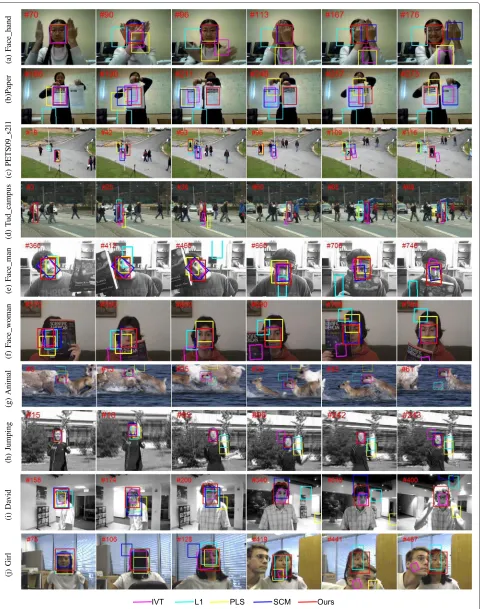
In addition to quantitative evaluation, the qualitative eval-uation, as illustrated in Figure 6, is presented in terms of the following several typical challenges.
Figure 5The OPE center location errors of five trackers on all test sequences.
The proposed approach performs well on the videos mentioned above. In contrast, the other four trackers fail, when the long-time complete occlusion occurs or the occlusion shares similar feature with the target. For instance, in the sequence face_hand, IVT, L1, and PLS early drift to the background when a short-time occlusion occurs, and SCM finally drifts to one hand which covers the face for a long period. In the sequencepaper, the four trackers all drift to the occlusion or background. It is inter-esting to note that SCM is robust to short-time occlusion due to the application of static object model. Nevertheless, it remains sensitive to the long-time occlusion, as demon-strated in the sequenceface_hand. This implies that SCM cannot effectively detect the collusion, which finally mod-ifies the attribute of the dynamic object model by the accumulation of false samples.
Motion and blur: The fast or abrupt motion has been a great challenge for the traditional framework of particle filter, whose motion estimation parameters are usually continuous. However, this problem can be eas-ily addressed within the proposed tracking-by-detection scheme by expanding the object retrieval region. It is known that the blur caused by fast motion is unfavorable for object recognition. However, the fluent tracking results in sequencesanimalandjumpingvalidate that the
proposed approach works well in this case. It indicates that the random projection of raw image is robust to the blur. By exploring the sparse coding histogram as fea-ture, SCM also performs well in this case. In contrast, the remaining three methods perform relatively worse. They all drift from the target in the sequencejumping.
Scale and rotation:There are drastic scale changes and in-plane or out-of-plane rotations in the two sequences david and girl. They pose great challenges to the pro-posed approach which only holds a fixed-sized tracking window. In this case, the object detection of the proposed approach is usually false. However, the false detection can be effectively identified with object validation. This will help the proposed tracker effectively avoid the iden-tity drift caused by scale or rotation. So in the sequences davidandgirl, the proposed approach successfully recap-tures the object after severe scalings or rotations. In contrast, the other four methods incline to lose the tar-get for ever in the presence of severe scale changes or rotations, e.g., the out-of-plane rotation in the sequence girl.
Journal
o
n
A
dvances
in
Signal
Processing
(2015) 2015:21
Page
11
of
14
Table 3 Average center location errors (in pixel)
Face_hand Paper PETS09_s2l1 Tudcrossing Face_man Face_woman Animal Jumping David Girl
OPE SRE OPE SRE OPE SRE OPE SRE OPE SRE OPE SRE OPE SRE OPE SRE OPE SRE OPE SRE
IVT 57.80 51.23 38.77 38.64 51.26 42.17 29.11 22.30 7.41 18.01 39.99 30.41 10.02 21.27 15.25 15.10 5.49 6.74 36.50 30.22
L1 43.98 45.12 70.42 55.28 45.04 45.22 11.49 11.17 28.96 23.47 24.06 20.30 81.02 33.08 55.68 52.03 58.32 57.00 24.53 45.13
PLS 62.08 59.30 34.77 39.11 42.98 44.71 43.11 37.60 9.09 17.10 22.57 20.00 91.94 32.90 66.93 72.44 77.73 78.17 39.51 54.00
SCM 23.82 18.17 40.89 37.01 32.12 23.00 4.36 6.35 3.06 6.81 4.68 4.58 25.75 14.22 3.73 3.66 47.20 40.90 110.49 51.18
Ours 4.08 6.22 4.45 4.12 8.47 40.06 4.23 6.29 9.74 13.40 10.45 9.79 6.39 9.73 3.77 4.15 8.65 10.21 22.68 26.43
Journal
o
n
A
dvances
in
Signal
Processing
(2015) 2015:21
Page
12
of
14
Table 4 Average overlap rates between the tracked region and the ground truth
Face_hand Paper PETS09_s2l1 Tudcrossing Face_man Face_woman Animal Jumping David Girl
OPE SRE OPE SRE OPE SRE OPE SRE OPE SRE OPE SRE OPE SRE OPE SRE OPE SRE OPE SRE
IVT 0.40 0.37 0.48 0.40 0.20 0.21 0.15 0.15 0.56 0.32 0.46 0.45 0.74 0.58 0.52 0.45 0.64 0.63 0.37 0.38
L1 0.35 0.30 0.12 0.16 0.39 0.35 0.54 0.51 0.36 0.32 0.54 0.54 0.23 0.37 0.11 0.14 0.26 0.24 0.48 0.25
PLS 0.35 0.29 0.44 0.39 0.38 0.35 0.09 0.11 0.52 0.34 0.43 0.40 0.21 0.37 0.07 0.07 0.25 0.25 0.39 0.27
SCM 0.70 0.61 0.54 0.48 0.38 0.47 0.69 0.70 0.67 0.61 0.82 0.78 0.57 0.62 0.80 0.80 0.37 0.36 0.13 0.28
Ours 0.93 0.77 0.82 0.73 0.64 0.30 0.74 0.69 0.56 0.47 0.67 0.59 0.84 0.69 0.82 0.73 0.39 0.35 0.51 0.48
the proposed approach performs well together with other four methods. For instance, in the sequencedavid, the five methods all successfully track the object walking from the dark to the light in the early few frames.
Overall performance: The proposed approach shows better overall performance than others due to the robust-ness of sparse representation on both object detection and validation. The two trackers SCM and PLS both explore a static object model to identify the object, while they can-not prevent the false detection from updating the dynamic object model. So they perform worse than the proposed tracker in our experiments. Note that SCM obviously out-performs PLS. This can be explained by the fact that SCM explores both static and dynamic features to weight par-ticles, while PLS only adopts the dynamic feature. The remaining two trackers IVT and L1 cannot cope with severe appearance changes, since the ground truth is not preserved in their template updating.
6 Conclusions
This paper has proposed an efficient tracking-by-detection scheme based on two-stage sparse represen-tation. In order to evaluate the proposed approach, extensive experiments are conducted on ten benchmark videos comprising various challenges like light change, fast motion, scale and rotation, partial occlusion, and complete occlusion. Compared with traditional track-ers based on sparse representation, the proposed tracker presents obvious advantages on both accuracy and plexity. Specifically, it significantly reduces the com-putation cost related to sparse representation, thereby presenting much higher speed than state-of-the-art. Thanks to its robustness to identity drift, it also achieves better tracking performance than state-of-the-art espe-cially in the presence of severe occlusions.
Competing interests
The authors declare that they have no competing interests.
Author details
1UMR 6164, IETR, INSA, Université Européenne de Bretagne (UEB), 35708
Rennes, France.2School of Atmospheric Science, Nanjing University of Information Science and Technology, 210044 Nanjing, China.
Received: 16 October 2014 Accepted: 23 January 2015
References
1. J Wright, AY Yang, A Ganesh, SS Sastry, Y Ma, Robust face recognition via sparse representation. IEEE Trans. Pattern Anal. Machine Intelligence. 31(2), 210–227 (2009)
2. Q Wang, F Chen, W Xu, M-H Yang, Online discriminative object tracking with local sparse representation. IEEE workshop on application of computer vision (WACV), IEEE, Breckenridge, CO, 9-11 January, 2012 3. X Mei, H Ling, Y Wu, Minimum error bounded efficient1tracker with
occlusion detection. IEEE conference on computer vision and pattern recognition (CVPR), IEEE, Colorado Springs, CO, 21–23 June, 2011 4. Q Wang, F Chen, W Xu, M-H Yang, Object tracking via partial least squares
analysis. IEEE Trans. Image Process.21(10), 4454–4465 (2012)
5. X Mei, H Ling, Robust visual tracking using1minimization. IEEE international conference on computer vision, IEEE, Kyoto, 29 September–2 October, 2009
6. B Liu, L Yang, J Huang, P Meer, L Gong, C Kulikowski, Robust and fast collaborative tracking with two stage sparse optimization. European Conference on Computer Vision (ECCV), Crete, Greece, 5-11 September, 2010
7. X Jia, H Lu, M-H Yang, Visual tracking via adaptive structural local sparse appearance model. IEEE conference on computer vision and pattern recognition (CVPR), IEEE, Providence, RI, 16–21 June, 2012 8. W Zhong, H Lu, M-H Yang, Robust object tracking via sparsity-based
collaborative model. IEEE conference on computer vision and pattern recognition (CVPR), IEEE, Providence, RI, 16–21 June 2012
9. H Li, C Shen, Q Shi, Real-time visual tracking using compressive sensing. IEEE conference on computer vision and pattern recognition (CVPR), IEEE, Colorado Springs, CO, 21–23 June, 2011
10. K Zhang, L Zhang, M-H Yang, Real-time compressive tracking. European Conference on Computer Vision (ECCV), Firenze, Italy, 7-13 October, 2012 11. W Lu, W Li, K Kpalma, J Ronsin, Sparse matrix-based random projection
for classification. arXiv:1312.3522 (2014)
12. XZ Fern, CE Brodley, Random projection for high dimensional data clustering: A cluster ensemble approach. International Conference on Machine Learning (ICML), Washington, DC, 21-24 August, 2003 13. C Bao, Y Wu, H Ling, H Ji, Real time robust L1 tracker using accelerated
proximal gradient approach. IEEE conference on computer vision and pattern recognition (CVPR), IEEE, Providence, RI, 16–21 June, 2012 14. H Liu, F Sun, Visual tracking using sparsity induced similarity. IEEE
international conference on pattern recognition (ICPR), IEEE, Istanbul, 23–26 August, 2010
15. T Zhang, B Ghanem, S Liu, N Ahuja, Robust visual tracking via multi-task sparse learning. IEEE conference on computer vision and pattern recognition (CVPR), IEEE, Portland, OR, 23-28 June, 2013 16. D Ross, J Lim, R-SLM-H Yang, Incremental learning for robust visual
tracking. Int. J. Comput. Vision.77(1), 125–141 (2008)
17. D Wang, H Lu, M-H Yang, Online object tracking with sparse prototypes. IEEE Trans. Image Process.22(1), 314–325 (2013)
18. J Kwon, KM Lee, Visual tracking decomposition. IEEE Conference on Computer Vision and Pattern Recognition (CVPR), IEEE, San Francisco, CA, 13-18 June, 2010
19. A Adam, E Rivlin, I Shimshoni, Robust fragments-based tracking using the integral histogram. IEEE Conference on Computer Vision and Pattern Recognition (CVPR), IEEE, New York, NY, 17-22 June, 2006
20. B Babenko, M-H Yang, S Belongie, Visual tracking with online multiple instance learning. IEEE Conference on Computer Vision and Pattern Recognition (CVPR), IEEE, Miami, FL, 20-26 June, 2009
21. S Avidan, Ensemble tracking. IEEE Conference on Computer Vision and Pattern Recognition (CVPR), IEEE, San Diego, CA, 20-26 June, 2005 22. H Grabner, H Bischof, On-line boosting and vision. IEEE Conference on
Computer Vision and Pattern Recognition (CVPR), IEEE, New York, NY, 17-22 June, 2006
23. Z Kalal, J Matas, K Mikolajczyk, P-N learning: Bootstrapping binary classifiers by structural constraints. IEEE Conference on Computer Vision and Pattern Recognition (CVPR), IEEE, San Francisco, CA, 13-18 June, 2010 24. YC Pati, R Rezaiifar, PS Krishnaprasad. Orthogonal matching pursuit:
recursive function approximation with applications to wavelet decomposition. Asilomar Conference on Signals, Systems and Computers (ACSSC), IEEE, Pacific Grove, CA, 1-3 Nov, 1993
25. B Efron, T Hastie, R Tibshirani, Least angle regression. Ann. Stat.32, 407–499 (2004)
26. W Lu, C Bai, K Kpalma, J Ronsin. Multi-object tracking using sparse representation. IEEE International Conference on Acoustics, Speech and Signal Processing (ICASSP), IEEE, Vancouver, BC, 26-31 May, 2013 27. Y Wu, J Lim, M-H Yang. Online object tracking: A benchmark. IEEE
Conference on Computer Vision and Pattern Recognition (CVPR), IEEE, Portland, OR, 23-28 June, 2013
28. J Mairal, F Bach, J Ponce, G Sapiro, Online learning for matrix factorization and sparse coding. J Machine Learning Res.11, 19–60 (2010)