A MIMO System with Backward Compatibility
for OFDM-Based WLANs
Jianhua Liu
Department of Electrical and Computer Engineering, University of Florida, P.O. Box 116130, Gainesville, FL 32611-6130, USA
Email:[email protected]
Jian Li
Department of Electrical and Computer Engineering, University of Florida, P.O. Box 116130, Gainesville, FL 32611-6130, USA
Email:[email protected]
Received 16 December 2002; Revised 28 June 2003
Orthogonal frequency division multiplexing (OFDM) has been selected as the basis for the new IEEE 802.11a standard for high-speed wireless local area networks (WLANs). We consider doubling the transmission data rate of the IEEE 802.11a system by using two transmit and two receive antennas. We propose a preamble design for this multi-input multi-output (MIMO) system that is backward compatible with its single-input single-output (SISO) counterpart as specified by the IEEE 802.11a standard. Based on this preamble design, we devise a sequential method for the estimation of the carrier frequency offset (CFO), symbol timing, and MIMO channel response. We also provide a simple soft detector based on the unstructured least square approach to obtain the soft information for the Viterbi decoder. This soft detector is very simple since it decouples the multidimensional QAM symbol detection into multiple one-dimensional QAM symbol—and further PAM symbol—detections. Both the sequential parameter estimation method and the soft detector can provide excellent overall system performance and are ideally suited for real-time implementations. The effectiveness of our methods is demonstrated via numerical examples.
Keywords and phrases:MIMO system, OFDM, WLAN, symbol timing, carrier synchronization, channel estimation.
1. INTRODUCTION
Orthogonal frequency division multiplexing (OFDM) has been selected as the basis for several new high-speed wireless local area network (WLAN) standards [1], including IEEE 802.11a [2], IEEE 802.11g, and HIPERLAN/2. IEEE 802.11g and HIPERLAN/2 are very similar to IEEE 802.11a in terms of signal generation and detection/decoding. We use IEEE 802.11a to exemplify our presentation in this paper.
The OFDM-based WLAN system, as specified by the IEEE 802.11a standard, uses packet-based transmission. Each packet, as shown in Figure 1, consists of an OFDM packet preamble, a signal field, and an OFDM data field. The pream-ble can be used to estimate the channel parameters such as the carrier frequency offset (CFO), symbol timing, as well as channel response. These parameters are needed for the data symbol detection in the OFDM data field. The preamble de-sign adopted by the standard is specifically tailored to the single-input single-output (SISO) system case where both the transmitter and receiver deal with a single signal. This standard supports a data rate up to 54 Mbps.
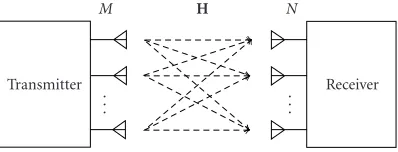
Transmission data rates higher than 54 Mbps are of par-ticular importance for future WLANs. Deploying multiple antennas at both the transmitter and receiver is a promising way to achieve a high transmission data rate for multipath-rich wireless channels without increasing the total transmis-sion power or bandwidth [3]. The corresponding system, as shown inFigure 2, is referred to as a input multi-output (MIMO) wireless communication system, where M andNin the figure denote the numbers of transmit and re-ceive antennas, respectively.
t10
t9
t8
t7
t6
t5
t4
t3
t2
t1
10×0.8=8µs 1.6 + 2×3.2=8µs
OFDM packet preamble OFDM data field
GI2 T1 T2 GI Signal
Signal field
0.8 + 3.2=4µs 0.8 + 3.2=4µs
GI OFDMsymbol · · · GI OFDMsymbol
Figure1: Packet structure of the IEEE 802.11a standard.
H
M N
Receiver Transmitter .
. .
. . .
Figure2: Diagram of a MIMO system.
can also be done via the sphere decoding (SPD) algorithm [8].
Our focus herein is on doubling the data rate of the SISO system as specified by the IEEE 802.11a standard by using two transmit and two receive antennas (referred to as the MIMO system in the sequel) based on the BLAST scheme. We propose a preamble design for this MIMO system that is backward compatible with its SISO counterpart as speci-fied by the IEEE 802.11a standard. That is, a SISO receiver can perform CFO, symbol timing, and channel response es-timation based on the proposed preamble design and detect up to the signal field. The SISO receiver is then informed, by using, for example, the reserved bit in the signal field, that a transmission is a SISO or not. Our preamble design can be used with two transmit and any number of receive antennas. However, we mainly focus on the two receive antenna case herein. Based on our MIMO preamble design, we propose a sequential method, ideally suited for real-time implementa-tions, to estimate the CFO, symbol timing, and MIMO chan-nel response.
The convolutional code specified in the IEEE 802.11a standard will also be used in our MIMO system for chan-nel coding. As a result, soft information from the MIMO tector is needed by the Viterbi decoder to improve the de-coding performance. Both the efficient ICNA and SPD algo-rithms offer only hard output. Soft output can be inferred with the ICNA-based algorithm for iterative detection and decoding [9]. However, this algorithm is computationally ex-tremely heavy—exponentional in terms of transmit antenna numberMas well as the constellation size. Although reduced complexity versions were alluded to in [9], the costs in per-formance degradation by using these versions were not clear. The space time bit-interleaved coded modulation (STBICM) approach [10] can deliver soft output, in both the iterative and noniterative modes, but it is also computationally ex-tremely heavy. A list sphere decoder (LSD) algorithm [11] was recently proposed to reduce the computational
complex-ity of STBICM with a small performance degradation. How-ever, LSD is still very complicated and hard to implement in real time for OFDM-based MIMO WLAN applications due to the high data rate. We present herein a simple MIMO soft detector, based on the unstructured least square (LS) fit-ting approach. This LS-based soft detector is ideally suited for real-time implementations since it decouples the multidi-mensional quadrature amplitude modulation (QAM) sym-bol detection into multiple one-dimensional QAM symsym-bol detections. We show that the real and imaginary parts of the noise of the decoupled detection output are indepen-dent of each other. Hence, the QAM symbol detection can be further simplified into two pulse amplitude modulation (PAM) symbol detections. As a result, this LS-based soft de-tector is orders of magnitude more computationally efficient than LSD; yet, the efficiency is achieved at a cost of a small performance degradation, due to the aforementioned de-coupling. The LS-based detector can also be seen as related to the zero-forcing or to the linear decorrelating detector [12].
The remainder of this paper is organized as follows. Section 2describes the MIMO system. The new preamble de-sign is given in this section.Section 3presents our sequen-tial method for CFO, symbol timing, and MIMO channel response estimation. The MIMO soft detector is provided in Section 4. Numerical examples are given inSection 5to demonstrate the effectiveness of the proposed methods. Fi-nally, we end our paper with comments and conclusions in Section 6.
2. SYSTEM DESIGN
Our MIMO system closely resembles its SISO counterpart as specified by the IEEE 802.11a standard. We first give a brief overview of the IEEE 802.11a SISO system before we proceed to describe our MIMO system.
2.1. IEEE 802.11a standard
Figure 1shows the packet structure as specified by the IEEE 802.11a standard. The nominal bandwidth of the OFDM signal is 20 MHz and the in-phase/quadrature (I/Q) sam-pling interval tS is 50 nanoseconds. In this case, the num-ber of samplesNS =64 for an OFDM data symbol is equal to the number of subcarriers. The OFDM packet preamble consists of ten identical short OFDM training symbols ti,
long OFDM training symbols, there is a long guard interval (GI2) consisting of 2NC=32 data samples. GI2 is the cyclic prefix (CP) for the long OFDM training symbol T1, that is, it is the exact replica of the last 2NCsamples of T1.
The information carrying data are encoded in the OFDM data field. The binary source data sequence is first scrambled and then convolutionally encoded by an industrial standard constraint lengthK=7, rate 1/2 encoder, which has genera-tion polynomialsg0=(133)8andg1 =(171)8. The encoded output is then punctured according to the data rate require-ment and is segrequire-mented into blocks of length NCBPS (num-ber of coded bits per OFDM symbol), each of which corre-sponds to an OFDM data symbol. The binary data in each block is first interleaved among the subcarriers (referred to as the frequency domain (FD) interleaving in the sequel) and then mapped (in groups of log2Abits) intoA-QAM symbols, which are used to modulate the different data carrying sub-carriers. Each OFDM data symbol in the OFDM data field employsNS =64 subcarriers, 48 of which are used for data symbols and 4 for pilot symbols. There are also 12 null sub-carriers with one in the center and the other 11 on the two ends of the frequency band. The OFDM data symbols, each of which consists ofNS=64 samples, are obtained via taking the inverse fast Fourier transform (IFFT) of the data symbols, pilot symbols, and nulls on theseNSsubcarriers. To eliminate the intersymbol interference (ISI), each OFDM data symbol is preceded by a CP or GI, which contains the lastNCsamples of the OFDM data symbol.
The signal field contains the information including the transmission data rate and data length of the packet. The information is contained in 16 binary bits. There is also a reserved bit (which can be used to distinguish the MIMO from SISO transmissions) and a parity check bit. These 18 bits, padded with 6 zeros, are then encoded (by the same en-coder as for the OFDM data field) to obtain a 48-bit binary sequence. The encoded sequence is then interleaved among subcarriers and used to modulate the 48 data carrying sub-carriers using BPSK. The signal field consists of 64 samples and is obtained via taking the IFFT of these 48 BPSK sym-bols, 4 pilot symsym-bols, and 12 nulls. Also, there is a CP of lengthNCto separate the preamble from the signal field.
2.2. SISO data model
To establish the data model, consider first the generation of an OFDM data symbol in the OFDM data field. Let xSISO =[x11 x12 · · · xNS1 ]T be a vector ofNSdata symbols, where (·)T denotes the transpose andx1
nS,nS =1, 2,. . .,NS, is the symbol modulating the nSth subcarrier and is equal to 0 for null subcarriers, 1 or−1 for pilot subcarriers, and in C for data carrying subcarriers. Here C is a finite con-stellation, such as BPSK, QPSK, 16-QAM, or 64-QAM. Let WNS ∈CNS×NS be the fast Fourier transform (FFT) matrix. Then the OFDM data symbolscorresponding toxSISOis ob-tained by taking the IFFT ofxSISO. That is,s=WHNSxSISO/NS, where (·)Hdenotes the conjugate transpose. To eliminate the ISI, each OFDM data symbol is preceded by a CP or GIsC formed usings.
Let
h(t)(t)=
p
αpδt−τptS (1)
denote the time-domain analogue channel impulse response of the frequency-selective time-invariant fading channel, whereαp andτptS, 0≤ τp ≤ NC,p ∈ Z, are the complex gain and time delay of thepth path, respectively. Let
h(t)=h(t) 0 h
(t)
1 · · · h (t)
NS−1 T
(2)
be the equivalent finite impulse response (FIR) filter response of h(t)(t), that is, ifh = W
NSh(t) = [h1 h2 · · · hNS]T is the sampled frequency domain channel response, then for
nS=1, 2,. . .,NS,
hnS=
p
αpe−jτptSωω=2π(nS−1)/(NStS). (3)
Thelth element ofh(t),l=0, 1,. . .,N
S−1, can be written as
h(t)
l =
p αpe
−jπ(l+(NS−1)τp)/NS sin
πτp
sinπτp−l/NS, (4)
which includes the leakage effect due to the frequency do-main sampling [13].
By discarding the firstNC samples at the receiver (as-suming a correct symbol timing), the noise-free and CFO free received signal vector zne
SISO ∈ CNS×1, due to sampling the received signal, is the circular convolution ofh(t)ands. Hence the FFT output of the received data vector zSISO = zneSISO +eSISO, whereeSISO ∼ N(0, (σ2/NS)INS) is the addi-tive zero-mean white circularly symmetric complex Gaussian noise with varianceσ2, can be written as [14]
ySISO=WNSzSISO=diag{h}xSISO+WNSeSISO∈CNS×1. (5)
The data model in (5) can also represent the OFDM symbols in the signal field and the preamble.
Equation (5) can also be written as
ySISO=diag{xSISO}h+WNSeSISO. (6)
Note that (5) is useful for symbol detection whereas (6) is used for channel estimation.
For the sake of simulation simplicity, the equivalent channel h(t) is often approximated by an exponentially de-caying FIR filter with lengthLF[14], denoted as
h(t)LF =h(t)
0 h(t)1 · · · h(t)LF−1 T
. (7)
In this case, the received signal can be easily simulated as the convolution of the channel h(t)LF and the transmitted signal. Lettr be the root mean square (RMS) delay spreading time andtn=tr/tS. ThenLF = 10tn+ 1, wherexdenotes the smallest integer not less thanx. ForlF =0, 1,. . .,LF−1, we have
h(t)
lF ∼N
0,1−e−1/tne−lF/tn. (8)
t10
Long training symbol block 2 Long training symbol block 1
Short training symbols
IEEE 802.11a compatible packet preamble
OFDM data field
Figure3: Proposed MIMO preamble (and signal field) structure.
Note that our symbol timing estimation method, which will be presented in Section 3, works equally well for the channel models given by both (4) and (7). Our MIMO chan-nel response estimation method also works equally well for both models. We use (7) to generate channels to simplify our simulations.
2.3. MIMO preamble design
For the IEEE 802.11a SISO system, the short OFDM training symbols can be used to detect the arrival of the packet, al-low the automatic gain control (AGC) to stabilize, compute a coarse CFO estimate, and obtain a coarse symbol timing, whereas the long OFDM training symbols can be used to cal-culate a fine CFO estimate, refine the coarse symbol timing, and estimate the SISO channel response.
The MIMO system considered herein has two transmit and two receive antennas (such as a crossed dipole pair for both the transmitter and the receiver). Two packets are trans-mitted simultaneously from the two transmit antennas. We design two preambles, one for each transmit antenna. We as-sume that the receiver antenna outputs suffer from the same CFO and has the same symbol timing. To be backward com-patible with the SISO system, we use the same short OFDM training symbols as in the SISO preamble for both of the MIMO transmit antennas, as shown inFigure 3.
As for the long OFDM training symbols, they should be designed to support the MIMO channel response estimation. MIMO channel response estimation has attracted much re-search interest lately. Orthogonal training sequences tend to give the best performance (see, e.g., [16] and the references therein). We also adopt this idea of orthogonal training se-quences in our preamble design. In the interest of backward compatibility, we use the same T1and T2(as well as GI2) as for the SISO system for both of the MIMO transmit antennas before the signal field, as shown inFigure 3. After the signal field, we use T1and T2(and GI2) for one transmit antenna, and−T1and−T2(and−GI2) for the other. This way, when the simultaneously transmitted packets are received by a sin-gle SISO receiver, the SISO receiver can successfully detect up to the signal field, which is designed to be the same for both transmit antennas. The reserved bit in the signal field can tell the SISO receiver to stop its operation whenever a MIMO transmission follows or otherwise to continue its operation. The long OFDM training symbols before and after the sig-nal field are used in the MIMO receivers for channel esti-mation. Although the employment of an additional pair of
long OFDM training symbols can increase the overhead, the corresponding loss of efficiency is not significant for larger packet. The reserved bit in the signal field can also inform the MIMO receiver that the transmission is a SISO one. When this occurs, the MIMO receiver can modify its channel esti-mation and the data bit detection steps slightly, as detailed at the end of Sections3and4, respectively.
Other MIMO preamble design options with backward compatibility are possible. For example, by exploiting the transmit/receive diversities, we may get improved symbol timing or CFO correction. However, these improvements do not necessarily result in improved packet error rate (PER). Hence, we prefer the straightforward MIMO preamble de-sign shown inFigure 3.
2.4. MIMO data model
To stay as close to the IEEE 802.11a standard as possible, we use in our MIMO system the same scrambler, convolutional encoder, puncturer, FD interleaver, symbol mapper, pilot se-quence, and CP as specified in the standard. To improve di-versity, we add a simple spatial interleaver to scatter every two consecutive bits across the two transmit antennas. This spatial interleaving is performed before the FD interleaving.
Consider thenSth subcarrier (for notational convenience, we drop the notational dependence onnSbelow). Consider the case of N receive antennas. (Note that considering the general case ofNreceive antennas does not add extra diffi -culties for the discussions below.) LetHdenote the MIMO channel matrix for thenSth subcarrier:
H=
wherehn,m denotes the channel gain from themth transmit antenna to the nth receive antenna for thenSth subcarrier. Lety denote a received data vector for thenSth subcarrier, which can be written as
y=Hx+e∈CN×1, (10)
wherex=[x1 x2]T is the 2×1 QAM symbol vector sent on thenSth subcarrier ande∼N(0,σ2IN) is the additive white circularly symmetric complex Gaussian noise with variance
3. CFO, SYMBOL TIMING, AND CHANNEL ESTIMATION
In this section, we present our sequential CFO, symbol tim-ing, and MIMO channel response estimation approach based on our MIMO preamble design. The CFO can be esti-mated from the samples of two consecutive data blocks due to the periodic inputs (the short OFDM training symbols t1,. . ., t10). Because of the fact that the CFO can be out-side the unambiguous range measurable by the long OFDM training symbols, we have to estimate the CFO in two steps: (a) a coarse CFO estimation using the short OFDM train-ing symbols and then (b) a fine CFO estimation, to deter-mine the residue of the coarse CFO correction, using the long OFDM training symbols. After estimating and accounting for the CFO, we can obtain the symbol timing. We estimate the symbol timing also in two steps: the coarse symbol tim-ing and fine symbol timtim-ing. The former is obtained by ustim-ing the later portion of the short OFDM training symbols in the packet preamble. The fine symbol timing is obtained by us-ing the long OFDM trainus-ing symbols before the signal field. Finally, we obtain the MIMO channel response estimate. The parameter estimates are obtained in the order presented be-low.
3.1. Coarse CFO estimation Letzn(l)=zne
n (l) +en(l),n= 1,. . .,N, denote thelth time sample of the signal received from thenth receive antenna, starting from the moment that the receiver AGC has become stationary (the receiver AGC is assumed to become station-ary at least before receiving the last two short OFDM training symbols and remain stationary while receiving the remainder of the packet). In the presence of CFO, we have [17]
zne
nl+NC=znen(l)ej2NCπ, n=1,. . .,N, (11)
whereis the normalized CFO (with respect to the sampling frequency), which we still refer to as CFO for convenience. For each receive antenna output, consider the correlation be-tween two consecutive noise-free received data blocks, each of which is of lengthNC. Then the sum of the correlations for all receive antennas can be written as
N
n=1
k+NC−1
l=k
zne
n (l)znnel+NC∗=e−j2NCπ N
n=1
NC−1
l=0 zne
n(l)2
Pe−j2NCπ,
(12)
where (·)∗denotes the complex conjugate andkis any non-negative integer such thatzne
n(k+ 2NC−1) is a sample of the
nth receive antenna output due to the input (transmit an-tenna output) being a sample of the short OFDM training symbols of the MIMO packet preamble. Let
PS= N
n=1
NC−1
l=0
zn(l)z∗nl+NC
=Pe−j2NCπ+e P,
(13)
whereePis due to the presence of the noise. We calculate the coarse CFO as [18]
ˆ
C= − 1
2NCπ∠PS, (14)
where∠xdenotes taking the argument ofx.
We next correct the CFO using ˆCto get the data samples
z(C)
n (l),n=1, 2,. . .,N, as follows:
z(C)
n (l)=zn(l)e−j2lπˆC. (15)
Correspondingly, we have
P(C)
S =PSej2NCπˆC. (16)
In the sequel, we only consider the CFO corrected data given above. For notational convenience, we drop the superscript ofzn(C)(l),n=1, 2,. . .,N.
3.2. Coarse symbol timing estimation
Now we can use a correlation method, modified based on the approach presented in [17] to estimate the coarse symbol timing. The symbol timing is referred to as the starting time sample due to the input being the long OFDM training sym-bol T1(before the signal field). Once the starting time sample due to the long OFDM training symbol T1is determined, we can determine the starting time sample due to every OFDM data symbol thereafter. According to the specification of the IEEE 802.11a standard and the sampling rate of 20 MHz, the true symbol timingT0is 193, as shown inFigure 4.
From (13) and (16), we note that the correlation (after the CFO correction) is approximately the real-valued scalar
Pplus a complex-valued noise. Hence we propose to use the following real-valued correlation sequence for coarse symbol timing determination. We calculate the correlation sequence in an iterative form similar to the complex-valued approach in [17] as follows:
PR(k+ 1) =PR(k)
+ Re N
n=1
znk+NCz∗n
k+ 2NC−zn(k)z∗nk+NC
=PR(k) + N
n=1
¯
znk+NCz¯nk+ 2NC−z¯n(k)
+ ˜znk+NCz˜nk+ 2NC−z˜n(k), (17)
t10
t9
t8
t7
t6
t5
t4
t3
t2
t1
t10
t9
t8
t7
t6
t5
t4
t3
t2
t1
GI2 GI2
T1
T1
T2
T2 T0
TF
TC PR
TP
TC+ 3NC
TI
NS
h(t)
Thresholds
Figure4: Illustration of symbol timing determination.
input being GI2 or the long OFDM training symbols follow-ing the short OFDM trainfollow-ing symbols in the preamble.
When some of the data samples of the sliding data blocks are taken from the received data due to the input being GI2 or the long training symbols following the short OFDM train-ing symbol,PR(k) will drop since (11) no longer holds. This property is used to obtain the coarse symbol timing. Let
TP, as shown inFigure 4, denote the first time sample when
PR(k) drops to less than half of its peak value. The coarse symbol timing
TC=TP+3
2NC+NC (18)
is the coarse estimate of the beginning time sample due to the input being the long OFDM training symbol T1 before the signal field. The second term at the right-hand side of the above equation is due to the fact thatPR(k) will drop to approximately one half of its maximum value when the data samples of the second half of the second of the two sliding blocks are due to the first GI2 in the preamble as input; the third term is due to one half of the length of GI2. When the channel spreading delay tD = max{τp−τl}is assumed to satisfytD ≤NC, only the first half of GI2 can suffer from ISI. Hence our goal of coarse timing determination is to place the coarse timing estimate between the true timingT0=193 andT0−NC = 177 to make accurate fine CFO estimation possible. This explains why we useNCinstead of 2NCfor the third term in (18).
3.3. Fine CFO estimation
For each receive antenna output, we calculate the correlation between the two long OFDM training symbols before the sig-nal field. We then sum the correlations for all receive anten-nas as follows:
PL= N
n=1
NS−1
l=0
znl+TCz∗n
l+TC+NS. (19)
Then the fine CFO estimate can be computed as
ˆ
F= − 1
2NSπ∠PL. (20)
We can use ˆFin the same way as ˆCto correct the CFO. We assume that for the data we use below, ˆFhas been already corrected.
Note that the aforementioned simple fine CFO estima-tion approach may not be optimal. For example, the CFO estimation accuracy could be improved by using the long OFDM training symbols after the signal field as well; how-ever, our simple fine CFO estimation approach is sufficiently accurate in that the overall system performance can no longer be improved with a more accurate CFO estimate, especially when pilot symbols are exploited. For the data bit detection, no matter how accurate the CFO estimate is, it can never be perfect due to the presence of noise. Pilot symbols are used to track the CFO residual phase for each OFDM data symbol before data bit detection. A maximum likelihood (ML) CFO residual tracking scheme is given inAppendix C.
3.4. Fine symbol timing estimation
We now move on to obtain the fine symbol timing by using the long OFDM training symbols before the signal field. The fine symbol timing is estimated by using theN data blocks of lengthNS, starting from the time sampleTC+ 3NC. With this choice, due to the fact that T1is identical to T2, the data blocks are most likely due to the input being the second half of T1 and the first half of T2, even when the coarse symbol timing has a large error.
Letyndenote theNS-point FFT of the data block from the nth receive antenna and leth(t)n,m be the equivalent FIR channel in the time domain between themth transmit an-tenna and thenth receive antenna,n=1, 2,. . .,N,m=1, 2. Then, by neglecting the existence of the residual CFO,yncan be written as (cf. (6))
yn=XBWNS
2
m=1
h(t)n,m+WNSen, (21)
ˆ
n |. (Our empirical experi-ence suggests that selecting the threshold to be 1/3 gives the best result.) Then the fine symbol timingTFis obtained as
TF=TC−NC+TI−3. (23)
The second term above is used to compensate for the afore-mentioned 3NCshift due to the fact thatNS−3NC=NCand the last term above is chosen to be 3 to ensure thatTF > T0 occurs with very low probability.
3.5. MIMO channel response estimation
After we obtainedTF, we can now estimate the MIMO chan-nel response. Letyn,1denote theNS-point FFT of the average of the two consecutive blocks, each of which is of lengthNS, associated with the two long training symbols before the sig-nal field, from the nth receive antenna. Letyn,2 denote the counterpart ofyn,1after the signal field. Then, for thenSth subcarrier, we have the dependence onnSfor notational simplicity. Solving (24) and (25) yields
When the reserved bit in the signal field indicates a SISO transmission, we only need to estimatehn,1,n=1, 2,. . .,N, in a way similar to (26).
4. A SIMPLE MIMO SOFT DETECTOR
With the CFO, symbol timing, and MIMO channel response determined and accounted for, we can proceed to detect the data bits contained in each BLAST layer and subcarrier of the OFDM data symbols in the OFDM data field. In the sequel, we present a very simple soft detector for the MIMO system. Note that this soft detector can be used in a general setting of the BLAST system and hence we present it in a general frame-work based on the data model of (10), whereHis assumed to beN×Mandxto beM×1. (We use ˆHto replaceHin our simulations.)
Consider first the ML hard detector of the BLAST system. For the data model of (10), the ML hard detector is given by
ˆ
x=arg min
x∈CM×1
y−Hx2
, (28)
where · 2denotes the Euclidean norm. The cost function in (28) can be written as tion, that by ignoring the constellation constraint onx, we can obtain an unstructured LS estimate ˆxus of x, which is given by
ˆ
xus=H†y=x+H†ex+c. (30)
Note that ˆxus is the soft decision statistic that we are inter-ested in. We refer to this simple scheme of obtaining a soft de-cision statistic as the MIMO soft detection scheme. Note that a necessary condition forHHHto be nonsingular isN≥M. Also note thatcis still Gaussian with zero mean and covari-ance matrix
EccH=σ2H†H†H=σ2HHH−1. (31)
Due to the use of the interleaver and deinterleaver, the data bits contained inxare independent of each other. By ig-noring the dependence among the elements ofc, we can con-sider only the marginal probability density function (pdf) for the elements ˆxus(m),m =1, 2,. . .,M, of ˆxus. (Note that an approximation is made here, which can lead to performance degradation. However, the computation is greatly simplified by the approximation.) Let
Obviously,cmis still Gaussian with zero mean and variance
σ2
m=Ecm2
=h˘m2σ2. (34)
The estimate of the above noise varianceσ2can be easily ob-tained via the difference of the two consecutive blocks of the
nth receive antenna, from which we gotyn,1(cf. (24)). Note thatσ2
malong with ˆxus(m)provide the soft information for the
Note that for SISO systems we usually consider an or-dinary QAM symbol as two PAM symbols (e.g., a 64-QAM symbol can be considered as two 8-ary PAM symbols) due to the orthogonality between the real and imaginary parts of a QAM symbol as well as the independence between the real and imaginary parts of the additive circularly symmetric Gaussian error. A bit metric computation scheme for PAM symbols is presented inAppendix A. InAppendix B, we show that the real and imaginary parts ofcm are independent of each other. Hence we can significantly simplify the bit metric computations by exploiting these independencies.
The minimum mean square error (MMSE) detector is often deemed to be better than the LS-based one [12]. Al-though this can be true for the constant modulus constella-tions, such as PSK, it is not necessarily true for QAM sym-bols, as suggested by our simulations due to the different power levels of the QAM symbols. Hence, we do not provide an MMSE counterpart of the LS-based soft detector.
When the reserved bit in the signal field indicates a SISO transmission, theHin (28) is in fact a vector. Hence the ˆxusin (30) and the E[ccH] in (31) are scalars, and they are the soft information used as in the SISO system for data bit detection.
5. NUMERICAL EXAMPLES
In this section, we provide numerical examples to demon-strate the effectiveness and performance of our sequential es-timation method for CFO, symbol timing, and MIMO chan-nel response based on our MIMO preamble design as well as the simple MIMO soft detector.
In the IEEE 802.11a standard, the maximum transmis-sion data rate is 54 Mbps; in this case, the 64-QAM constella-tion is used and the channel coding rate isR =3/4, which comes from puncturing the RC = 1/2 encoded sequence with the puncturing rate RP = 2/3. We consider doubling the maximum 54 Mbps transmission data rate by using two transmit and two receive antennas, that is,M =N =2. In our simulations, each of the MN =4 time domain MIMO channels is generated according to the Chayat model; the 4 channels are independent of each other.
Due to the fact that 52 out of 64 subcarriers are used in the OFDM-based WLAN system, the signal-to-noise ra-tio (SNR) for the SISO system used in this paper is defined as 52/(64σ2) for the constellations whose average energies are normalized to 1. Whereas for the MIMO system, the SNR is defined as 52/(128σ2) (i.e., we use the same total transmis-sion power for the MIMO system as for its SISO counter-part).
We first provide a simulation example for symbol timing estimation. Two curves inFigure 5show the 104Monte Carlo simulation results of the coarse symbol timing estimates for the Chayat channels withtr =25 andtr =50 nanoseconds, respectively, when SNR=10 dB. Note that the coarse symbol timing estimates fall within the desired interval with a high probability. Note also that the adverse effect of the coarse symbol timing estimate being smaller thanT0−NC =177 is usually not significant since, due to the exponentially de-caying property of the channels, the ISI in the receiver
out-P
robabilit
y
Desired interval for coarse timing
195 190
185 180
175 170
0 0.1 0.2 0.3 0.4 0.5 0.6 0.7 0.8 0.9
Symbol timing Fine timing (tr=25 ns) Fine timing (tr=50 ns) Coarse timing (tr=25 ns) Coarse timing (tr=50 ns)
Figure5: Coarse and fine symbol timing estimates.
put due to the input being the latter portion of the first half of GI2 is minimal. (Since the adverse effect of the coarse symbol timing estimate being larger thanT0 =193 is usually trou-blesome for the fine CFO estimation, we prefer the coarse timing estimateTC to be well ahead ofT0.) The other two curves inFigure 5show the 104Monte Carlo simulation re-sults of the fine symbol timing estimates for the Chayat chan-nels withtr=25 andtr=50 nanoseconds, respectively, when SNR =10 dB. Note that our simple fine symbol timing ap-proach gives highly accurate timing estimates.
PE
R
30 29 28 27 26 25 24 23 22 21 20 10−1
100
SNR (dB) Estimated channel (2×2) Perfect knowledge (2×2) Estimated channel (1×1) Perfect knowledge (1×1)
Figure6: PER versus SNR at the 108 Mbps data rate for the Chayat channels withtr=50 nanoseconds.
Note also that the MIMO soft detector is effective in that the MIMO system needs only 2 to 3 dB extra total transmission power to keep the same PER (we are mostly interested in PERs being 0.1, according to the IEEE 802.11a standard) as its SISO counterpart, but with the data rate doubled.
Finally, we show the performance comparisons of the SPD hard detector [8], the MIMO soft detector, as well as the LSD-based soft detector [11], an approximation of STBICM, the ideal MIMO soft detector.Figure 7gives PER curves ob-tained from 104 Monte Carlo simulations for these detec-tors as a function of SNR for the MIMO system, with esti-mated channel parameters. (The simulation parameters are the same as those in the previous example.) Note that the MIMO soft detector is much better than SPD and is outper-formed by LSD in terms of PER. However, the MIMO soft detector is much more efficient than LSD. We did not at-tempt to optimize our Matlab simulation codes. Even so, our preliminary results indicate that the LS-based MIMO soft detector requires only about one fifth of the computations needed by SPD. Unlike SPD, whose sphere radius shrinks when finding better solutions, LSD keeps the sphere radius constant, which means that it is computationally much more demanding than SPD, especially when the sphere radius is large. We do not have an exact flop comparison, yet we be-lieve LSD flops SPD flops≈5 times MIMO soft detector flops, which means that the LS-based soft detector can be or-ders of magnitude more computationally efficient than the LSD-based one.
6. CONCLUDING REMARKS
We have proposed a preamble design for the MIMO system with two transmit and two receive antennas. This MIMO
PE
R
35 34 33 32 31 30 29 28 27 26 25 24 23 22 10−1
100
SNR (dB) Hard SPD
Soft LS List SPD
Figure7: PER versus SNR at the 108 Mbps data rate for the Chayat channels withtr=50 nanoseconds.
preamble design is backward compatible with its SISO coun-terpart as specified by the IEEE 802.11a standard. Based on this MIMO preamble design, we have devised a sequen-tial method for the estimation of CFO, symbol timing, and MIMO channel responses. We have also provided a simple soft detector for the MIMO system based on the unstruc-tured LS approach to obtain the soft information for the Viterbi decoder. Both the sequential parameter estimation method and the soft detector are very efficient and ideally suited for real-time implementations. The effectiveness of our methods has been demonstrated via numerical exam-ples.
APPENDICES
A. BIT METRIC CALCULATION FOR THE QAM SYMBOL
To make this paper self-contained, we describe in this ap-pendix briefly our bit metric calculation method for the QAM symbol. Note that the real and imaginary parts of a QAM symbol plus the additive circularly symmetric complex Gaussian noise are independent of each other. Hence the soft decision statistic corresponding to a transmitted QAM sym-bol can be easily divided into the real and imaginary parts, which correspond to the soft decision statistic of two real valued PAM symbols. The variance of the noise additive to the PAM symbols is halved as compared to the QAM sym-bols. In view of this, we only present the method for calcu-lating the bit metric for a symbol in the PAM constellation
R.
LetDi,j = {s :s∈R}denote the set of all the possible PAM symbols with theith bitvi = j,i =1, 2,. . ., log2A/2,
7
−3
−5
−7 · · ·
000 001 011 100
Figure8: Illustration of 8-ary PAM symbols with Gray labeling and their pdf curves.
PAM constellation shown inFigure 8, we have
D1,0= {−7,−5,−3,−1}, (A.1)
where the first bit is the left most one shown in Figure 8. Then, for a given soft information (x,σ) of the PAM symbol,
being the pdf given the symbol s and the variance σ2, as shown in Figure 8. The occurrence of each symbol inRis often assumed to be equally likely, that is, p(s) = (1/2)B/2,
To speed up the bit metric calculation in practical ap-plications, we can make a grid forx andσ to precalculate a lookup table for the ˆvi’s. The bit metric calculation in our simulations is based on such a table.
B. A PROPERTY OF THEcmIN(33)
With ¯xand ˜xdenoting the real and imaginary parts ofx, re-spectively, we get from (33)
c=H¯†+jH˜†(¯e+j˜e)
C. PHASE CORRECTION USING PILOT SYMBOLS
The CFO correction will never be perfect in practice due to the presence of noise. Hence, there will be a phase errorφfor each OFDM data symbol caused by the error in the fine CFO estimate ˆF. The errorφincreases linearly with time.
As we mentioned earlier, each OFDM data symbol con-tains four known pilot symbols. We denote these pilot sym-bols by a 4×1 vectorp. The pilot symbols can be used to correctφfor each OFDM data symbol after CFO correction using ˆF. Lety(p)n be the vector containing the correspond-ing four elements of the FFT output of an OFDM data sym-bol in the OFDM data field received from thenth antenna,
n=1, 2,. . .,N. Let ˆh(p)n,mbe the 4×1 estimated channel vec-tor from transmit antennamto receive antennanfor the four corresponding subcarriers. LetP=diag{p}. We have
y(p)n =ejφP
where {e(p)n }Nn=1 are zero-mean white circularly symmetric complex Gaussian noise vectors that are independently and identically distributed. Then the ML criterion leads to
ˆ
REFERENCES
[1] R. van Nee, G. Awater, M. Morikura, H. Takanashi, M. Web-ster, and K. W. Halford, “New high-rate wireless LAN stan-dards,” IEEE Communications Magazine, vol. 37, no. 12, pp. 82–88, 1999.
[2] IEEE 802.11a-1999, “IEEE Standard for Information technol-ogy—Telecommunications and information exchange be-tween systems—Local and metropolitan area networks— specific requirements—Part 11: Wireless LAN Medium Ac-cess Control (MAC) and Physical Layer (PHY) specifica-tions—Amendment 1: High-speed Physical Layer in the 5 GHz band,” 1999.
[3] A. F. Naguib, N. Seshadri, and A. R. Calderbank, “Increas-ing data rate over wireless channels,” IEEE Signal Processing Magazine, vol. 17, no. 3, pp. 76–92, 2000.
[4] G. J. Foschini, “Layered space-time architecture for wireless communication in a fading environment when using multi-element antennas,” Bell Labs Tech. Journal, vol. 1, no. 2, pp. 41–59, 1996.
[5] G. D. Golden, G. J. Foschini, R. A. Valenzuela, and P. W. Wol-niansky, “Detection algorithm and initial laboratory results using the V-BLAST space-time communication architecture,”
Electronics Letters, vol. 35, no. 1, pp. 14–15, 1999.
[6] G. J. Foschini and M. J. Gans, “On limits of wireless commu-nications in a fading environment when using multiple an-tennas,” Wireless Personal Communications, vol. 6, no. 3, pp. 311–335, 1998.
[7] I. E. Telatar, “Capacity of multi-antenna Gaussian channels,”
European Transactions on Telecommunications, vol. 10, no. 6, pp. 585–595, 1999.
[8] O. Damen, A. Chkeif, and J.-C. Belfiore, “Lattice code decoder for space-time codes,” IEEE Communications Letters, vol. 4, no. 5, pp. 161–163, 2000.
[9] X. Li, H. Huang, G. J. Foschini, and R. A. Valenzuela, “Ef-fects of iterative detection and decoding on the performance of BLAST,” inProc. IEEE GLOBECOM’00, vol. 2, pp. 1061– 1066, San Francisco, Calif, USA, November 2000.
[10] A. M. Tonello, “Space-time bit-interleaved coded modulation with an iterative decoding strategy,” inProc. IEEE 52th Vehic-ular Technology Conference, vol. 1, pp. 473–478, Boston, Mass, USA, September 2000.
[11] B. M. Hochwald and S. ten Brink, “Achieving near-capacity on a multiple-antenna channel,” IEEE Transactions on Com-munications, vol. 51, no. 3, pp. 389–399, 2003.
[12] C. Z. W. Hassell Sweatman, J. S. Thompson, B. Mulgrew, and P. M. Grant, “A comparison of the MMSE detector and its BLAST version for the MIMO channel,” inIEE Seminar on MIMO: Communications Systems from Concept to Implemen-tations, pp. 19/1–19/6, London, UK, December 2001. [13] J.-J. van de Beek, O. Edfors, M. Sandell, S. K. Wilson, and P. O.
B¨orjesson, “On channel estimation in OFDM systems,” in
Proc. IEEE 45th Vehicular Technology Conference, vol. 2, pp. 815–819, Chicago, Ill, USA, July 1995.
[14] Z. Wang and G. B. Giannakis, “Wireless multicarrier com-munications,” IEEE Signal Processing Magazine, vol. 17, pp. 29–48, May 2000.
[15] N. Chayat, “Tentative criteria for comparison of modulation methods,” IEEE P802.11-97/96, September 1997.
[16] E. G. Larsson and J. Li, “Preamble design for multiple-antenna OFDM-based WLANs with null subcarriers,” IEEE Signal Processing Letters, vol. 8, no. 11, pp. 285–288, 2001. [17] T. M. Schmidl and D. C. Cox, “Robust frequency and timing
synchronization for OFDM,” IEEE Transactions on Commu-nications, vol. 45, no. 12, pp. 1613–1621, 1997.
[18] J. Li, G. Liu, and G. B. Giannakis, “Carrier frequency offset estimation for OFDM-based WLANs,”IEEE Signal Processing Letters, vol. 8, no. 3, pp. 80–82, 2001.
Jianhua Liureceived the B.S. degree in elec-trical engineering from Dalian Maritime University, Dalian, China, in 1984, the M.S. degree in electrical engineering from the University of Electronic Science and Tech-nology of China, Chengdu, China, in 1987, and the Ph.D. degree in electronic engi-neering from Tsinghua University, Beijing, China, in 1998. From March 1987 to Febru-ary 1999, he worked at the
Communica-tions, Telemetry, and Telecontrol Research Institute, Shijiazhuang, China, where he was an Assistant Engineer, Engineer, Senior En-gineer, and Fellow Engineer. From March 1995 to August 1998, he was also a Research Assistant at Tsinghua University. From Febru-ary 1999 to June 2000, he worked at Nanyang Technological Uni-versity, Singapore, as a Research Fellow. Since June 2000, he has been a Research Assistant in the Department of Electrical and Com-puter Engineering, the University of Florida, Gainesville, working towards a Ph.D. degree majoring in electrical engineering and mi-noring in Statistics. His research interests include wireless commu-nications, statistical signal processing, and sensor array processing.
Jian Lireceived the M.S. and Ph.D. degrees in electrical engineering from The Ohio State University, Columbus, in 1987 and 1991, respectively. From April 1991 to June 1991, she was an Adjunct Assistant Profes-sor with the Department of Electrical Engi-neering, The Ohio State University, Colum-bus. From July 1991 to June 1993, she was an Assistant Professor with the Department of Electrical Engineering, University of