EXPRESS LETTER
Electrical resistivity modeling
around the Hidaka collision zone, northern
Japan: regional structural background
of the 2018 Hokkaido Eastern Iburi earthquake
(
M
w
6.6)
Hiroshi Ichihara
1*, Toru Mogi
1,2,3, Hideyuki Satoh
4and Yusuke Yamaya
5Abstract
The Hidaka collision zone, the collision boundary between the NE Japan and Kurile arcs, is known to be an ideal region to study the evolution of island arcs. The hypocenter of the 2018 Hokkaido Eastern Iburi earthquake (Mw 6.6) in the western part of the Hidaka collision zone was unusually deep for an inland earthquake, and the reverse fault that caused the earthquake has an uncharacteristically steep dip. In this study, we used three-dimensional inversion to reanalyze broadband magnetotelluric data acquired in the collision zone. The inverted resistivity model showed a significant area of high resistivity around the center of the collision boundary. We also identified a conductive zone beneath an area of serpentinite mélange in a zone of high P–T metamorphic rocks west of the high-resistivity zone. The conductive zone possibly reflects areas rich in pore fluids related to the formation and elevation of the serpen-tinites. Sensitivity tests indicated the need for additional magnetotelluric survey data to delineate the resistivity distribution around the epicentral area of the 2018 earthquake although the resistivity model showed a conductive zone in this area.
Keywords: Hidaka collision zone, Magnetotellurics, Electrical conductivity, Resistivity, Serpentinite, 2018 Hokkaido Eastern Iburi earthquake
© The Author(s) 2019. This article is distributed under the terms of the Creative Commons Attribution 4.0 International License (http://creat iveco mmons .org/licen ses/by/4.0/), which permits unrestricted use, distribution, and reproduction in any medium, provided you give appropriate credit to the original author(s) and the source, provide a link to the Creative Commons license, and indicate if changes were made.
Introduction
The Hidaka collision zone (HCZ) is generally recognized as an ideal area for research on crustal evolution in sub-duction systems. The obliquely subducting Pacific plate drives westward migration of the forearc sliver of the Kurile arc, which results in obduction of the sliver onto
the NE Japan arc (e.g., Kimura 1986) (Fig. 1a). The
obduc-tion has exposed the low-P–T metamorphic and plutonic
rocks of the Hidaka metamorphic belt east of the Hidaka
main thrust (HMT) (Fig. 1b). In the NE Japan arc on the
western side of the HMT, metamorphosed
accretion-ary complexes that formed under high P–T conditions
(Kamui-kotan belt) are distributed between Cretaceous sedimentary rocks. The Kamui-kotan belt is charac-terized by ultramafic rock bodies, mainly serpentinite mélange. However, the mechanism that elevated these
rocks is not well understood (e.g., Ueda 2006). West of
the Kamui-kotan belt, the collision has resulted in the formation of foreland fold-and-thrust structures in the thick sequence of Cretaceous to Neogene sedimentary rocks, thus providing an ideal area for research on
crus-tal shortening (e.g., Kato et al. 2004). Therefore, further
investigation of crustal structures is essential to under-stand the tectonics around the HCZ.
The 2018 Hokkaido Eastern Iburi earthquake (Mw
6.6) occurred near the western edge of the HCZ and
Open Access
*Correspondence: [email protected]
1 Earthquake and Volcano Research Center, Graduate School of Environmental Studies, Nagoya University, Furo-cho, Chikusa-ku, Nagoya 464-8601, Japan
140˚ 145˚ 40˚
45˚
~9cm/year
Pacific Plate
Hokkadiofore-arc
sliver
NE Japan
Arc
Kurile
Arc
HM T
Honshu
42˚ 43˚
Elevation (m) (b)
Hidaka Collision zone (HCZ)
Hidaka metamorphic belt 400 420
440 460 480
490
100 115
130 150 170 190
260 282
300 410 430
450 470
485 500
110 120 141
160 180
210
220 230
234
240
250 270
290
310
320 340
330
HM T Kamui-kotan belt
2018 Hokkaido
Eastern Iburi EQ
(M
w6.6)
141˚ 142˚ 143˚
−2000 −1000 0 1000 2000
a
b
Fig. 1 Maps showing locations of the study area and MT stations. a Tectonic setting of the Hokkaido region showing the study area. Red triangles
denote active volcanoes. b Map of the study area showing simplified local geology and the locations of MT stations. Yellow and blue circles denote
MT stations used in 2000–2001 and 2005, respectively. Green diamonds are MT stations used in resistivity modeling by Yamaya et al. (2017). Note
that MT data from stations 420 and 450–500 were used in the 3-D inversions of both this study and that of Yamaya et al. (2017). The gray line marks
the seismic refraction/wide-angle reflection profile of Iwasaki et al. (2004). The background elevation image was constructed from the ETOPO1
caused devastating damage and 41 fatalities. The esti-mated hypocentral depth of 37 km is anomalously deep because it significantly exceeds the depth of the
brittle–ductile boundary (e.g., Scholz 2002). Although
the focal mechanism indicates that the earthquake was caused by reverse faulting, the distribution of after-shock hypocenters indicates that the fault dips about
80°E (Japan Meteorological Agency 2019). This fault
orientation is uncharacteristic of reverse faulting but can be explained by high pore fluid pressure in the
fault zone (e.g., Sibson 1990). Kita et al. (2012)
iden-tified a steep seismic velocity boundary along another anomalously deep earthquake fault in the HCZ (1982
Urakawa-oki earthquake, Mw 6.9), which might be
associated with enhancement of the fault rupture. Thus, geophysical imaging is essential to further inves-tigate the deep faulting in the HCZ. Because electri-cal resistivity data can constrain fluid and temperature distributions that control fault behavior and the depth of the brittle–ductile boundary, examination of these data should contribute to our understanding of these anomalous features of reverse faulting in the HCZ.
Yamaya et al. (2017) proposed a subsurface 3-D
resistivity model for the area around the Ishikari Plain based on their MT observations and some of the MT data acquired by Mogi and Hidaka 2000 MT
Group (2002) (Fig. 1). Their model showed
remark-able conductors beneath the Shikotsu caldera and Ishikari-Teichi-Toen fault, which implied the pres-ence of magmatic fluid under the former and aque-ous fluid under the latter. However, structures around the center of the HCZ and the focal area of the 2018 Hokkaido Eastern Iburi Earthquake have not yet been clearly elucidated by 3-D magnetotelluric (MT) resis-tivity modeling.
In this study, we estimated the resistivity distribution beneath a long MT survey transect through the HCZ between the volcanic front of the NE Japan arc and
the Tokachi plain of the Kurile arc (Fig. 1b). Although
Mogi and Hidaka 2000 MT Group (2002) used 2-D
inversion to construct a preliminary resistivity model along this transect, the MT data indicated strong
three-dimensionality (see “Magnetotelluric data and
impedance” and “Phase tensor and induction vectors” sections), so a robust resistivity model has not yet been estimated. We therefore applied 3-D inversion to the resistivity data acquired by Mogi and Hidaka 2000 MT
Group (2002) and interpreted the inversion results to
gain an understanding of the 2018 Hokkaido Eastern Iburi earthquake and the tectonics of the HCZ.
Observations and analyses Magnetotelluric data and impedance
We used broadband MT data acquired at 36 sites by the
Mogi and Hidaka 2000 MT Group (2002) in 2000–2001
(Fig. 1b). The MT stations were located at 4–10 km
inter-vals along a survey line previously used to acquire seismic refraction and wide-angle reflection data (Iwasaki et al.
2004). We also acquired broadband MT data in 2005 at
two sites in the Hidaka metamorphic belt where
cover-age of the 2000–2001 survey data was sparse (Fig. 1b). All
of the data were recorded using MTU-5 systems manu-factured by Phoenix Geophysics Ltd. Three orthogo-nal components of the magnetic field were acquired using induction coils, and two horizontal components
of the electric field were acquired using Pb-PbCl2
elec-trodes. The duration of data acquisition at each site was 2–6 days.
Magnetotelluric impedance tensors and geomagnetic transfer functions were estimated using an SSMT-2000 system supplied by Phoenix Geophysics Ltd. To reduce local electromagnetic field noise, we applied the remote
reference technique of Gamble et al. (1979) using the
horizontal component of magnetic field data. The remote data for the 2000–2001 survey were recorded simultane-ously with the main dataset, but at a different MT site on the survey line. For remote reference data for the 2005 MT data, we used horizontal geomagnetic field data acquired by the MTU-5 system at the Esashi geomag-netic observatory, which is operated by the Geospatial Information Authority of Japan.
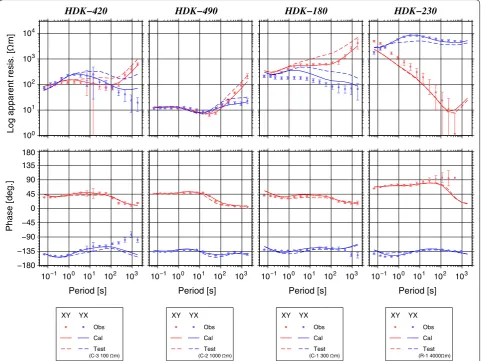
The calculated MT impedance tensors, which were converted to apparent resistivity and impedance phase
(Fig. 2, Additional file 1), showed considerable
varia-tion. Apparent resistivities were low (< 10 Ωm) beneath the Ishikari lowland and Tokachi Plain, but were high beneath the Hidaka metamorphic belt. The impedance phases showed out-of-quadrant phases in off-diagonal components at a few sites around the Shikotsu Caldera and Hidaka metamorphic belt (e.g., sites 420 and 230 in
Fig. 2). The out-of-quadrant phases possibly represent
the combined effect of two anisotropic layers, each with a
different anisotropic azimuth (e.g., Pek and Verner 1997;
Heise and Pous 2003), or channeling and bending of the
telluric current that requires resolution by 3-D
resistiv-ity modeling (e.g., Ichihara and Mogi 2009; Ichihara et al.
2013).
Phase tensor and induction vectors
We calculated the phase tensor (Caldwell et al. 2004)
and Parkinson’s induction vector (Parkinson 1962) to
that describes the phase relationship contained in the
MT impedance tensor (Caldwell et al. 2004). It
pre-serves the effect of regionally heterogeneous resistivity, whereas the MT impedance tensor is distorted by the galvanic effects produced by heterogeneity of near sur-face resistivity. The root of the determinant of the phase tensor is called Φ2. In the simple 1-D case, Φ2 > 45° and
Φ2 < 45° indicate decreasing and increasing resistivity,
respectively, with increasing depth.
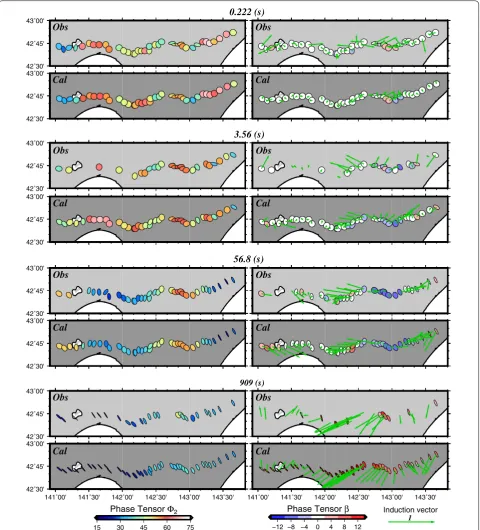
The phase tensor ellipses showed high Φ2
val-ues (> 60°) at 0.222 s under the Ishikari lowland and Tokachi Plain, but low values (< 30°) in these areas at
56.8 s (Fig. 3, Additional file 2). These observations
indicate that the shallow resistivity decreased with depth, whereas the deep resistivity increased with depth. In the area of the Hidaka metamorphic belt,
high Φ2 (> 50°) was estimated between 3.56 and 56.8 s,
implying decreasing resistivity with depth.
The azimuths of the principal axes of phase tensor ellipses, which indicate the azimuth of strike (or azimuth perpendicular to strike) of a resistivity structure in a 2-D model, were mostly aligned at 330° at 909 s. However, the azimuths of the principal axes varied considerably at shorter periods, indicating that the shallow electri-cal resistivity structure has strong three-dimensionality.
Absolute values of skew angle (β) were large (> 5°) at
peri-ods longer than 56.8 s at more than half of the MT sites, which is also an indicative of strong three-dimensionality.
Negative values of β at 56.8 s near the HCZ had become
positive at 909 s, which implies an asymmetric resistivity distribution.
The Parkinson’s induction vector is defined as the reverse vector of the real part of the geomagnetic trans-fer function, and it commonly points to a conductive
anomaly (Parkinson 1962). Parkinson’s induction vectors
between 3.56 and 56.8 s trend toward the Ishikari lowland
XY YX
Log apparent resis.
[
m]
HDK−420 HDK−490 HDK−180 HDK−230
XY YX
and the Tokachi Plain, which may indicate conductive areas there. They trend WSW with a maximum length of 0.7 at 909 s and can be attributed to current channeling
beneath the Ishikari Lowland because of the combination of conductors consisting of narrow conductive sediment
beneath the lowland and seawater (Yamaya et al. 2017).
1
15 30 45 60 75
Phase Tensor Φ2
909 (s) 56.8 (s) 0.222 (s)
Induction vector 141˚00' 141˚30' 142˚00' 142˚30' 143˚00' 143˚30'
42˚30' 42˚45' 43˚00'
141˚00' 141˚30' 142˚00' 142˚30' 143˚00' 143˚30' 42˚30'
42˚45' 43˚00' 42˚30' 42˚45' 43˚00' 42˚30' 42˚45' 43˚00'
−12 −8 −4 0 4 8 12 Phase Tensor β 42˚30'
42˚45' 43˚00' 42˚30' 42˚45' 43˚00' 42˚30' 42˚45' 43˚00' 42˚30' 42˚45' 43˚00'
3.56 (s) Obs
Cal
Obs
Cal
Obs
Cal
Obs
Cal
Obs
Cal
Obs
Cal
Obs
Cal
Obs
Cal
Fig. 3 Observed (OBS) and model-predicted (Cal) phase tensor ellipses and induction vectors. In the panels on the left, colored ellipses indicate
Φ2 of the phase tensor. Observed data with large errors (Φ2 > 10°) are not shown. In the panels on the right, colored ellipses indicate β of the phase
Therefore, 3-D resistivity modeling that includes the presence of seawater is necessary to correctly estimate the subsurface resistivity distribution in the study area.
3‑D inversion
Although the MT stations were along a single line across the HCZ, we used 3-D rather than 2-D inversion for the following reasons. (1) The phase tensor ellipses and
induction vectors (Fig. 3) indicated strong
three-dimen-sionality of resistivity structures that 2-D modeling sometimes misinterprets. (2) 3-D inversions can provide more realistic images of resistivity structure beneath MT stations if those stations are along a single profile and the structure is strongly three-dimensional (e.g., Siripunvara-porn et al. 2005b).
We used 3-D inversion code WSINV3DMT
(Siripun-varaporn and Egbert 2009; Siripunvaraporn et al. 2005a).
The objective function consisting of model roughness term and data misfit term is minimized in the inversion. The former term allows to estimate broader resistivity anomaly compared to true anomaly. The inversion uses data-space formulation in the objective function and the Occam scheme to evaluate the balance of model rough-ness and data misfit. The settings and procedures we
used are provided in Additional file 3.
The sounding curves calculated from the inverted model agreed reasonably with the measured curves
(Fig. 2, Additional file 1) as did the measured phase
ten-sor ellipses and induction vectors (Fig. 3, Additional
file 2). However, high-amplitude diagonal components
of MT impedance and the geomagnetic transfer function at short periods were not well resolved at several sites
(Additional file 1), mainly because the horizontal mesh
size of the model (> 4 km) was too large to explain small-scale horizontal variations of resistivity.
Results and discussion
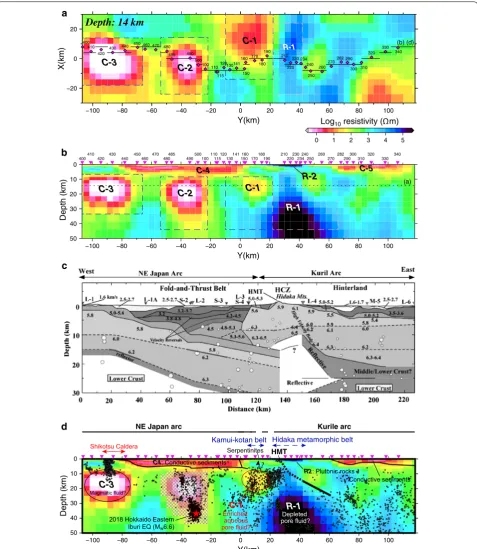
The inverted resistivity model (Fig. 4a, b) shows
signifi-cant resistivity variations: (1) three distinct low-resistivity anomalies (conductors) between 7 and 40 km depth on the NE Japan arc side of the HMT (C-1, C-2, and C-3), (2) two shallow conductive layers at 0–6 km depth beneath the Ishikari lowland (C-4) and Tokachi Plain (C-5), and (3) two resistive zones in the center of the HCZ (R-1 and R-2).
The anomalous conductor beneath the Shikotsu caldera (C-3) was verified by the sensitivity test, as
described in Additional file 4 (see also station HDK-420
in Figs. 2, 4a, b, and Table 1). It supports the
conduc-tive region previously identified by Yamaya et al. (2017)
(Additional file 5) because we used mostly different
MT dataset from they used. This conductive region
possibly represents a region of magmatic fluid beneath
the Shikotsu caldera as Yamaya et al. (2017) discussed.
However, we do not discuss the detailed resistivity
distribution in this area because Yamaya et al. (2017)
modeled more-detailed resistivity distribution (see
Additional file 4 for details).
Yamaya et al. (2017) detected a deep conductor
beneath the Ishikari-teichi-toen fault (C1 in Yamaya
et al. 2017) that our inverted resistivity model did not
reproduce (Additional file 5). We attribute its absence
in our model to the low sensitivity in the data due to following two effects. There is no MT site directly above the conductor. The electromagnetic field is atten-uated by surface conductor C-4 and thus is slightly pen-etrated beneath the C-4.
The low apparent resistivities at shorter periods
(Fig. 2, Additional file 1) and high Φ2 values of the
phase tensor (Fig. 3, Additional file 2) clearly suggest
the presence of the two shallow subsurface conductors C-4 and C-5, which are spatially consistent with areas
of low seismic velocity (Vp < 4.5 km/s) that were
inter-preted by Iwasaki et al. (2004) to represent Cretaceous
or younger sedimentary rocks (Fig. 4c, d). Previous MT
studies (Ichihara et al. 2008, 2016; Yamaya et al. 2017)
have also recognized thick near-surface conductors associated with the sedimentary rocks.
In the following sections, we discuss our interpreta-tions of the resistivity anomalies in the center of the HCZ (R-1, R-2, C1) and beneath the epicenter of the 2018 earthquake (C-2).
Interpretation of the conductor beneath Kamui‑kotan belt (C‑1)
The sensitivity tests (Additional file 4) demonstrated
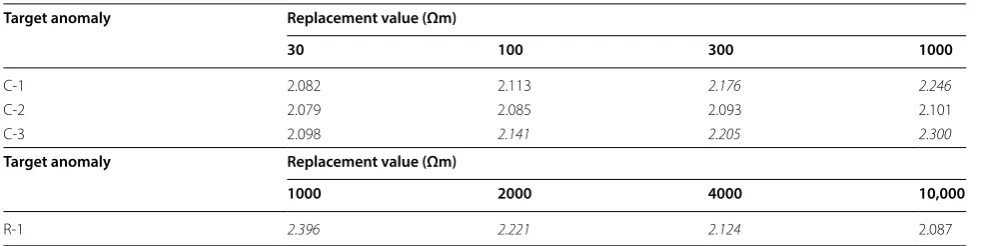
that the observed data require the resistivity of C-1
to be lower than 300 Ωm (Table 1) and that the C-1
anomaly possibly extended to the north of the profile
(Fig. 4a). Ogawa et al. (1994) previously identified a
conductor around the center of the C-1 anomaly. The distribution of the C-1 anomaly is consistent with the surface distribution of serpentinite mélange in the Kamui-kotan belt. In addition, seismic tomographic modeling has shown an area of high attenuation of seis-mic energy beneath the Kamui-kotan belt (Kita et al.
2014). Such attenuation is a characteristic of rocks
con-taining aqueous pore fluids. Thus, we interpret the C-1 anomaly to represent a zone enriched in aqueous pore fluid. Because geological studies have suggested that the root of serpentinitic material in the middle crust is
in the region of C-1 (Katoh 2018; Ueda 2006), the C-1
0
410 430 450 470 485 500
100 115 130 150 170 190 220 234 250 270 290 310 330
400 420 440 460 480 490
X(km)
430 440 450 460 470 480 485 490
R2: Plutonic rocks
C4: Conductive sediments
Conductive sediments
Kamui-kotan belt Hidaka metamorphic belt
NE Japan arc Kurile arc
a
b
c
d
Fig. 4 Interpreted 3-D resistivity model. a Horizontal section of the inverted resistivity model at 14 km depth. Dashed lines show areas of sensitivity
tests (where resistivity values were replaced). b Vertical cross-section beneath an east–west line around MT stations assembled from short east–
west profiles shown as solid lines in a. Dotted line marks the horizontal position of a. c Interpreted seismic velocity section (from Iwasaki et al.
2004). The location of the seismic survey line corresponds closely to that of the MT survey line of this study. d Interpretations superimposed on
the vertical cross-section of b. The red star denotes the hypocenter of the 2018 Hokkaido Eastern Iburi earthquake (Mw 6.6). The small circles
denote hypocenters of earthquakes between 2001 and 2019. The red circles indicate hypocenters occurred after the 2018 Hokkaido Eastern Iburi
Resistive bodies beneath the Hidaka metamorphic zone (R‑1 and R‑2)
High apparent resistivities between sites 210 and 234
(see site 230 in Fig. 2) correspond to the surface
resis-tive zone of the Hidaka metamorphic belt (R-2), which contains granulite and plutonic rocks. The electri-cal resistivity of dry granulite from this area is high
(2000 Ωm at 570 K; Fuji-ta et al. 2004). Moreover, dry
plutonic rocks under surface conditions generally show high resistivity. Thus, the R-2 anomaly can be explained by the presence of granulite and plutonic rocks. The distribution of the eastern part of the R-2 anomaly is consistent with the distribution of plutonic rocks identified from gravity survey data (Kamiyama et al.
2005). Alternatively, the area of relatively low resistivity
beneath the R-2 anomaly can be interpreted to repre-sent metasedimentary rocks, as discussed by
Kamiy-ama et al. (2005).
Sensitivity modeling showed that the R-1 high-resis-tivity anomaly (> 4000 Ωm) is at depths around the
middle crust (Additional file 4). Based on the surface
trace of the HMT and a dipping seismic reflector
previ-ously observed in the middle crust (Iwasaki et al. 2004),
the R-1 anomaly is within the footwall of the HMT
(Fig. 4d). In contrast, Ichihara et al. (2016) identified
a conductive zone in the footwall of the HMT in the southern part of the HCZ and interpreted it to repre-sent dehydration fluid flow from the Pacific plate
(Addi-tional file 5). Such variations of resistivity along the
footwall of the HMT possibly reflect a dependence of the supply of dehydration fluid on the depth of the plate boundary. However, resistivity distribution between the C-1 and R-1 anomalies is not constrained because of the sparse MT coverage between sites 190 and 210
(Fig. 4). More-detailed observations with a gridded
array of MT sites are essential to obtain a detailed 3-D resistivity model for this anomaly.
Conductive anomaly (C‑2) near the hypocenter of 2018 Hokkaido Eastern Iburi earthquake
We applied a sensitivity test (as for the C-1 anomaly) to
the C-2 anomaly (see Fig. 4, Table 1, Additional file 4),
which lies above the hypocenter of the 2018 Hokkaido
Eastern Iburi earthquake. Yamaya et al. (2017) also
showed a weak conductive anomaly in the area of our C-2
anomaly (Additional file 5). Although the sensitivity test
degraded the fit of the sounding curves to the observed
data (see station 490 in Fig. 2), the RMS misfit was
insuf-ficiently different from that of the final model to satisfy
the F-test (Table 1, Additional file 4). Therefore, the
observed data we used cannot resolve conductive area C-2. We suggest that attenuation of the electromagnetic field by surface conductor C-4 above the C-2 anomaly decreased the strength of the MT response of the under-lying rocks.
To further clarify the resistivity distribution in the area of the C-2 anomaly, we need to increase data quality and quantity to overcome the effect of attenuation of the magnetic field by shallow conductors. The C-2 anomaly has sensitivity to the MT response around the site 490 and will be demonstrated by additional MT
measure-ments (Additional file 4). If the modeled C-2 conductor is
indeed genuine, it may represent a region rich in pore
flu-ids that control fault rupture (e.g., Scholz 2002). It would
therefore be a key to understand the anomalous faulting in the HCZ. Therefore, denser MT survey data coverage is required around the epicentral area of the 2018 Hok-kaido Eastern Iburi earthquake.
Conclusions
We used 3-D inversion to reanalyze MT imped-ances and geomagnetic transfer functions beneath an east–west transect that crosses the HCZ and the focal zone of the 2018 Hokkaido Eastern Iburi earthquake. The resultant electrical resistivity model showed a Table 1 RMS misfits obtained in sensitivity tests of the inverted electrical resistivity model
For target anomalies named with a leading “R” (or “C”), only the blocks with higher (or lower) resistivities than that shown in the “Replaced value” column were replaced. Italic RMS misfits indicate a model significantly different from the inverted model. The RMS misfit for the final inverted model was 2.082, and all models have 7296 degrees of freedom
Target anomaly Replacement value (Ωm)
30 100 300 1000
C-1 2.082 2.113 2.176 2.246
C-2 2.079 2.085 2.093 2.101
C-3 2.098 2.141 2.205 2.300
Target anomaly Replacement value (Ωm)
1000 2000 4000 10,000
near-surface high-resistivity zone (R-2) beneath the Hidaka metamorphic belt that we interpreted to repre-sent elevated mid-crustal plutonic rocks and granulite. Beneath resistive zone R-2, we identified a deep resis-tive zone R-1 on the footwall of the HMT, although
Ichihara et al. (2016) identified conductive zones on
this side of the fault in the southern part of the HCZ. The variations of resistivity we modeled possibly reflect variations of the amount of aqueous pore fluid supplied from the subducting Pacific plate. West of resistive zone R-1, we identified conductive zone C-1 beneath
the high P–T metamorphic Kamui-kotan belt. Because
the C-1 conductive zone is spatially related to the ser-pentinite mélange of the Kamui-kotan belt, it likely represents a zone of enriched pore fluid related to the formation of the serpentinite. The resistivity model also showed a conductive anomaly (C-2) above the hypo-center of the 2018 Hokkaido Eastern Iburi earthquake; however, this anomaly was not resolved by our mod-eling owing to the sparse coverage and poor quality of the MT data we used. Additional dense MT surveys of high quality in the area around the epicenter of the 2018 earthquake will clarify the existence and distribu-tion of that conductor and make an important contri-bution to our understanding of fault rupture processes in the deep crust in the HCZ.
Supplementary information
Supplementary information accompanies this paper at https ://doi. org/10.1186/s4062 3-019-1078-7.
Additional file 1. Sounding curves. Apparent resistivity and phase of MT impedance are shown in upper and middle boxes, respectively. Tipper amplitudes are shown in lower boxes. Symbols labeled with “Obs” and “Cal” indicate observed and model-predicted MT responses, respectively.
Additional file 2. Pseudosections of observed (OBS) and model-predicted (Cal) Φ2 (upper two panels) and β (lower two panels) of phase tensor ellip-ses. Observed data with large errors (Φ2 > 10°, β > 5°) are not shown.
Additional file 3. Settings and procedures for 3-D inversion.
Additional file 4. Verification of resistivity anomalies by sensitivity tests.
Additional file 5. Comparison of the inverted 3-D resistivity model of this study with these of Yamaya et al. (2017) and Ichihara et al. (2016).
Abbreviations
MT: magnetotelluric; HCZ: Hidaka collision zone; HMT: Hidaka main thrust.
Acknowledgements
We thank the members of the Hidaka 2000 MT observation group and Dr. Hiroyuki Kamiyama (Ueyama-shisui Co. Ltd.) for making the MT data available for this study. Continuous geomagnetic records by the Esashi geomagnetic observatory, Geospatial Information Authority of Japan, were used for remote references. Comments from Prof. H. Takahashi and Prof. Takeshi Hashimoto of Hokkaido University and two anonymous reviewers improved the manuscript. We used computer systems at the Earthquake and Volcano Information Center, Earthquake Research Institute, The University of Tokyo, for 3-D inver-sion and sensitivity tests. Generic Mapping Tools software (Wessel and Smith
1998) was used to draw the figures.
Authors’ contributions
All authors contributed to the analyses of data and interpretation of the resistivity modeling and approved the final manuscript. All authors read and approved the final manuscript.
Funding
This research was supported in part by a grant from the Japanese Ministry of Education, Culture, Sports, Science and Technology, KAKENHI Grant no. 18K19952.
Availability of data and materials
The corresponding author can be contacted to access the digital data under-pinning the 3-D resistivity model.
Ethics approval and consent to participate
Not applicable.
Consent for publication
Not applicable.
Competing interests
The authors declare that they have no competing interests.
Author details
1 Earthquake and Volcano Research Center, Graduate School of Environmental Studies, Nagoya University, Furo-cho, Chikusa-ku, Nagoya 464-8601, Japan. 2 Division of Sustainable Resources Engineering, Graduate School of Engineer-ing, Hokkaido University, N13W8, Sapporo 060-8628, Japan. 3 Volcanic Fluid Research Center, School of Science, Tokyo Institute of Technology, Tokyo, Japan. 4 Nuclear Regulation Department, Secretariat of Nuclear Regulation Authority, 1-9-9, Roppongi, Minato-ku, Tokyo 106-8450, Japan. 5 Renewable Energy Research Center, Fukushima Renewable Energy Institute, AIST, 2-2-9 Machiikedai, Koriyama, Fukushima 963-0298, Japan.
Received: 5 March 2019 Accepted: 26 August 2019
References
Amante C, Eakins BW (2009) ETOPO1 1 Arc-minute global relief model: procedures, data sources and analysis. NOAA Technical Memorandum NESDIS NGDC-24. National Geophysical Data Center, NOAA. https ://doi. org/10.7289/v5c82 76m
Caldwell TG, Bibby HM, Brown C (2004) The magnetotelluric phase tensor. Geophys J Int 158:457–469
Fuji-ta K, Katsura T, Tainosho Y (2004) Electrical conductivity measurement of granulite under mid- to lower crustal pressure–temperature conditions. Geophys J Int 157:79–86
Gamble TD, Clarke J, Goubau WM (1979) Magnetotellurics with a remote magnetic reference. Geophysics 44:53–68
Heise W, Pous J (2003) Anomalous phases exceeding 90° in magnetotel-lurics: anisotropic model studies and a field example. Geophys J Int 155:308–318
Ichihara H, Mogi T (2009) A realistic 3-D resistivity model explaining anomalous large magnetotelluric phases: the L-shaped conductor model. Geophys J Int 179:14–17. https ://doi.org/10.1111/j.1365-246X.2009.04310 .x
Ichihara H, Honda R, Mogi T, Hase H, Kamiyama H, Yamaya Y, Ogawa Y (2008) Resistivity structure around the focal area of the 2004 Rumoi-Nanbu earthquake (M 6.1), northern Hokkaido, Japan. Earth Planets Space 60:883–888. https ://doi.org/10.1186/Bf033 52841
Ichihara H, Mogi T, Yamaya Y (2013) Three-dimensional resistivity modelling of a seismogenic area in an oblique subduction zone in the western Kurile arc: constraints from anomalous magnetotelluric phases. Tectonophysics 603:114–122. https ://doi.org/10.1016/j.tecto .2013.05.020
Iwasaki T, Adachi K, Moriya T, Miyamachi H, Matsushima T, Miyashita K, Takeda T, Taira T, Yamada T, Ohtake K (2004) Upper and middle crustal deforma-tion of an arc–arc collision across Hokkaido, Japan, inferred from seismic refraction/wide-angle reflection experiments. Tectonophysics 388:59–73 Japan Meteorological Agency (2019) The seismological Bulletin of Japan.
http://www.data.jma.go.jp/svd/eqev/data/bulle tin/index _e.html. Accessed 8 June 2019
Kamiyama H, Yamamoto A, Hasegawa T, Kajiwara T, Mogi T (2005) Gravity and density variations of the tilted Tottabetsu plutonic complex, Hok-kaido, northern Japan: implications for subsurface intrusive structure and pluton development. Earth Planets Space 57:E21–E24. https ://doi. org/10.1186/BF033 51894
Kato N, Sato H, Orito M, Hirakawa K, Ikeda Y, Ito T (2004) Has the plate bound-ary shifted from central Hokkaido to the eastern part of the Sea of Japan? Tectonophysics 388:75–84
Katoh T (2018) A geological east-west cross section through the Iwanai-dake peridotite mass in Hidaka town based on the tectogenesis of ultramaic masses, Hokkaido. Bull Hidaka Mt Mus Hidaka Mt Res 1:21–30 Kimura G (1986) Oblique subduction and collision—Fore-arc tectonics
of the Kuril Arc. Geology 14:404–407. https ://doi.org/10.1130/0091-7613(1986)14%3c404 :Osacf t%3e2.0.Co;2
Kita S, Hasegawa A, Nakajima J, Okada T, Matsuzawa T, Katsumata K (2012) High-resolution seismic velocity structure beneath the. J Geophys Res-Solid Earth. https ://doi.org/10.1029/2012j b0093 56
Kita S, Nakajima J, Hasegawa A, Okada T, Katsumata K, Asano Y, Kimura T (2014) Detailed seismic attenuation structure beneath Hokkaido, northeastern Japan: Arc-arc collision process, arc magmatism, and seismotectonics. J Geophys Res-Solid Earth 119:6486–6511. https ://doi.org/10.1002/2014j b0110 99
Mogi T, Hidaka 2000 MT Group (2002) Broadband MT surveys in Hidaka area. Monthly Chikyu 24:485–487 (in Japanese)
Ogawa Y, Nishida Y, Makino M (1994) A collision boundary imaged by mag-netotellurics, Hidaka Mountains, Central Hokkaido, Japan. J Geophys Res-Solid Earth 99:22373–22388
Parkinson WD (1962) The influence of continents and oceans on geomagnetic variations. Geophys J R Astron Soc 6:441–449
Pek J, Verner T (1997) Finite-difference modelling of magnetotelluric fields in two-dimensional anisotropic media. Geophys J Int 128:505–521 Scholz CH (2002) The mechanics of earthquakes and faulting, 2nd edn.
Cam-bridge University Press, CamCam-bridge
Sibson RH (1990) Rupture nucleation on unfavorably oriented faults. Bull Seismol Soc Am 80:1580–1604
Siripunvaraporn W, Egbert G (2009) WSINV3DMT: vertical magnetic field transfer function inversion and parallel implementation. Phys Earth Planet Interiors 173:317–329. https ://doi.org/10.1016/J.Pepi.2009.01.013
Siripunvaraporn W, Egbert G, Lenbury Y, Uyeshima M (2005a) Three-dimen-sional magnetotelluric inversion: data-space method. Phys Earth Planet Interiors 150:3–14
Siripunvaraporn W, Egbert G, Uyeshima M (2005b) Interpretation of two-dimensional magnetotelluric profile data with three-two-dimensional inver-sion: synthetic examples. Geophys J Int 160:804–814
Ueda H (2006) Geologic structure of Cretaceous accretionary complexes in the frontal Hidaka collision zone, Hokkaido, Japan. J Geol Soc Jpn 112:699–717
Wessel P, Smith WHF (1998) New, improved version of Generic Mapping Tools released. EOS Trans Am Geophys Union 79(47):579
Yamaya Y, Mogi T, Honda R, Hase H, Hashimoto T, Uyeshima M (2017) Three-dimensional resistivity structure in Ishikari Lowland, Hokkaido, northeast-ern Japan—implications to strain concentration mechanism. Geochem Geophys Geosyst 18:735–754. https ://doi.org/10.1002/2016g c0067 71
Publisher’s Note