Volume 2006, Article ID 17526, Pages1–11 DOI 10.1155/WCN/2006/17526
Adaptive Downlink Resource Allocation Strategies for
Real-Time Data Services in OFDM Cellular Systems
Navid Damji and Tho Le-Ngoc
Department of ECE, McGill University, 3480 University street, Montr´eal, Qu´ebec, Canada H3A 2A7
Received 1 October 2005; Revised 25 February 2006; Accepted 21 March 2006
This paper presents a detailed performance analysis of adaptive downlink resource allocation based on users’ instantaneous channel responses using power minimization (PM) and bandwidth constrained power minimization (BCPM) strategies. This study shows that, in cellular systems, where interference is a dominant factor, the link outage performance of a resource allocation strategy varies significantly depending on the user channel parameters. In particular, both analytical and simulation results indicate that the PM strategy outperforms BCPM in a mild shadowing environment. However, in severe shadowing conditions, this trend is reversed. This assessment holds true for both flat and frequency-selective fading.
Copyright © 2006 N. Damji and T. Le-Ngoc . This is an open access article distributed under the Creative Commons Attribution License, which permits unrestricted use, distribution, and reproduction in any medium, provided the original work is properly cited.
1. INTRODUCTION
The next generation of mobile communications is envisioned to offer a multitude of services that are available and acces-sible anywhere and anytime. With the introduction of new multirate, multi-QoS services, the future networks should be designed for economic packet data transfers [1]. These ser-vices are highly asymmetrical and require high transmission bandwidth on the downlink. However, due to the limitations of the available frequency spectrum, its efficient use is cru-cial to the success of the next generation wireless networks. Novel access methods coupled with adaptive resource man-agement techniques, specifically for downlink transmission, require more attention in order to improve the spectral effi-ciency [1].
Orthogonal frequency division multiplexing (OFDM) is potentially suited for supporting high-speed downlink trans-mission as it can offer high spectral efficiency due to its ro-bust performance over heavily impaired links. OFDM has been demonstrated as an efficient way to mitigate the adverse effects of frequency selective multipath fading by transmit-ting signals over a number of flat-faded narrow-band chan-nels. The inherent multicarrier nature of OFDM also allows the use of adaptive modulation and power allocation accord-ing to the responses of the narrow-band channels, which can significantly enhance the system performance. In order to exploit fully the advantages of OFDM in cellular systems, dynamic allocation techniques need to be devised, which
efficiently use the resources such as bandwidth, power and modulation to increase the spectral efficiency of the system.
which results in using the lowest possible modulation, and hence a larger transmission bandwidth (i.e., number of sub-carriers) to meet the rate constraint. In a distributed cellular system, where the base-stations do not know each other al-locations in advance, this allocation strategy leads to using a larger proportion of bandwidth, which increases the proba-bility of experiencing interference in other cells. This in it-self may not be bad, since if the power of interference is low compared to the signal power (i.e., the channel response of the interference is much lower than that of the signal), then the users will still be able to decode the data with low BER. However, when the power of interference is high, the user will experience outage with high probability since the inter-ference is present in a large fraction of the bandwidth. In this scenario, it may make sense to limit the transmission band-width of the users, such that if the subcarriers are chosen in a random manner, the probability of interference will be lower than in the previous case. This implies that, in order to sat-isfy the user rate requirements, higher modulation and hence higher transmission power will be used on these subcarri-ers.
A simple resource allocation scheme for the downlink OFDM cellular system known as the best subcarrier allo-cation (BSA), presented in [8], aims to minimize the re-quired number of subcarriers for transmission, and then the transmission power. A similar formulation was also given in [9] which is more suitable to point-to-point networks. A more detailed problem formulation and analysis was given in [10] and the BSA algorithm was refined to a more opti-mal strategy known as bandwidth constrained power mini-mization (BCPM). It was shown that in a severe shadowing environment, BCPM gives a better outage performance than PM since it keeps the probability of interference to a mini-mum.
The objective of this paper is to present a more general analysis of the two schemes discussed above, in order to have an insight into how the two schemes perform in different environments. Specifically, under what channel conditions would the one scheme perform better than the other. For this purpose we develop analytical models of link outage for both severe and nonsevere shadowing conditions in flat fading conditions. The impact of using lower power (lower modula-tion and larger bandwidth) versus lower bandwidth (higher modulation and higher power) is studied as the load per cell is increased for the two cases. It is shown inSection 4that in less severe shadowing environments, using lower power (basis of PM) performs better than using smaller bandwidth (basis of the BCPM strategy), whereas the opposite is true for severe shadowing. InSection 6, the performance of the PM and BCPM strategies is given for a more realistic de-ployment scenario that uses multiple antenna beams per sec-tor to isolate the effects of interference, using real-time data models [11]. Both severe and nonsevere shadowing environ-ments are simulated and the same performance trend is ob-served.
The remainder of the paper is organized as follows. In
Section 2, problem formulation is given for the two strate-gies.Section 3discusses the analytical model used to evaluate
the link outage probability in flat fading environment with different levels of shadowing, whileSection 4gives perfor-mance results of the two strategies.Section 5briefly describes the algorithms that can be used to solve the PM and BCPM optimization problems. Finally, in Section 6, the perfor-mance of the two schemes (using the algorithms inSection 5) is evaluated for real-time data services in different shadowing environments.
2. RESOURCE ALLOCATION IN OFDM SYSTEMS
The aim of resource allocation is to deliver the traffic of mul-tiple users within the given system bandwidth while meeting the QoS requirements. The users’ traffic translates to a given rate requirement, and the bandwidth of the system is given by the total number of subcarriers used in the cell, each hav-ing a fixed symbol rate. The rate constraint can be met us-ing adaptive modulation (also referred to as bit loadus-ing) on all subcarriers such that the total rate transmitted on all the subcarrier equals the total rate requirement of the users. The QoS on the other hand is greatly affected by time-varying channel conditions in a wireless cellular environment. In ad-dition, cochannel interference is a major factor that affects the link outage probability. From this perspective, one strat-egy of resource allocation would be to transmit the lowest amount of power while satisfying the rate constraints, which is the power minimization strategy. The other is to minimize the probability of experiencing interference, which is the ba-sis of using minimum bandwidth (BCPM) required to satisfy user constraints. The mathematical formulation of the two problems is given as follows.
2.1. Power minimization (PM)
The aim of power minimization is to use the least amount of power to deliver all of the users’ traffic in the given band-width. The optimization problem can be mathematically stated as follows:
min N
n=1
K
k=1 pn,k=
N
n=1
K
k=1 ρn,kfP
cn,k
γn,k
(1)
subject to
cn,k∈
0,c0,c1,. . .,cη
, whereci< ci+1; (2)
K
k=1
ρn,kcn,k≥bn ∀n∈ {1, 2,. . .,N}; (3)
N
n=1
ρn,k≤1 ∀k∈ {1, 2,. . .,K},
ρn,k=
⎧ ⎨ ⎩
0 ifcn,k=0, 1 ifcn,k>0;
(4)
where
(i) nis user index,
(iv)Kis total number of subcarriers,
(v) pn,k =ρn,kfP(cn,k)/γn,kis power on thekth subcarrier of thenth user withcn,kbits,
(vi) cn,kis the bit loading level corresponding modulation and coding scheme,
(vii) fP(·) is power function corresponding to the bit load-ing levelcn,k,
(viii) γn,kis channel attenuation on thekth subcarrier of the
nth user,
(ix) bnis the number of bits per OFDM symbol required by thenth user.
Constraints (2)–(4) in the above-stated problem formulation aim to satisfy the user rate requirements to achieve the objec-tive of minimum power. In order to meet the required rates in constraint (3) with the smallest power, the selection of bit loading levels,cn,k, in constraint (2) tends to use low values
ciand hence, a large amount of subcarriers. As a result, this increases the occurrence of interference in subcarriers.
2.2. Bandwidth constrained power minimization (BCPM)
The BCPM strategy aims to use the minimum number of subcarriers to satisfy the rate requirement with minimum power. Alternatively, the problem can be stated as minimiz-ing power while satisfyminimiz-ing the user rate requirements with the smallest possible number of subcarriers. Consider the rate re-quirement of the usernrepresented by the required number of bits per OFDM symbol,bn. The smallest possible num-ber of subcarriers,Smin
n , to satisfybnis obtained by using the highest bit loading level,cη, that is,Sminn = bn/cη. There-fore, to satisfy the user rate requirements with the small-est possible number of subcarriers we can add another con-straint for the newbandwidth-constrained power minimiza-tion (BCPM), stated as follows:
min N
n=1
K
k=1 pn,k=
N
n=1
K
k=1 ρn,kfP
cn,k
γn,k (5)
subject to
cn,k∈
0,c0,c1,. . .,cη
, wherecj< cj+1; (6)
K
k=1
ρn,kcn,k≥bn ∀n∈ {1, 2,. . .,N}; (7)
N
n=1
ρn,k≤1 ∀k∈ {1, 2,. . .,K};
ρn,k=
⎧ ⎨ ⎩
0 ifcn,k=0, 1 ifcn,k>0;
(8)
K
k=1
ρn,k≤Sminn =
bn
cη
∀n∈ {1, 2,. . .,N}. (9)
It is noted that constraint (9) in the BCPM problem may in-crease the minimum power as compared to that in the PM problem.
Mj
rj j
θj j
Bj
ri j
Di j
Mi
rii θ ii ϕ
i j
Bi R
Figure1: Interaction of two cells.
3. EFFECTS OF INTERFERENCE IN FLAT FADING ENVIRONMENT
For PM strategy, the goal would be to minimize the modu-lation on each subcarrier and, as a consequence, the number of subcarriers is increased to support the rate requirement. Whereas for BCPM strategy, the aim would be to transmit in the least number of subcarriers by increasing modula-tion level in each subcarrier. In order to understand the im-pacts of the two strategies on the system performance, we de-velop an analytical framework to evaluate the performance of the users in terms of expected link outages as a function of the system load in terms of the number of users, and the number of subcarriers used to deliver the rate require-ment. The framework of outage probability calculation in-volves accounting for flat fading and shadowing with cochan-nel interference. Given the number of users in the system, the number of subcarriers allocated per user and the signal-to-interference ratio (SIR) required for the modulation/coding scheme in use, the analysis gives the expected outage proba-bility. In this section, we show that the relative performance of PM and BCPM strategies highly depends on the level of shadowing.Section 3.1, gives an overview of the system and the probability density functions (pdf) that are required to derive the expected outage for a given number of users. These results will be used inSection 3.2where the overall expected outage probability is derived.
3.1. System model
We consider a cellular system with 3 sectors/cell, assuming that the path-loss model has the following general form:
angle of the user with respect to his base-station (as indicated inFigure 1).
The distance from theith base-station to the user jcan be expressed in terms ofDi j,φi j,rj jandθj jas follows:
In presence of Rayleigh fading and log-normal shadowing, the pdf of instantaneous received power psi j from the ith base-station to thejth user can be given as [12] the following equation assuming the transmission power of base-stationi
is 0 dB:
wherepli jis the logarithmic local mean power with logarith-mic area mean powermi j and logarithmic standard devia-tionσexpressed in natural units. The logarithmic area mean power is given asmi j= −βln(ri j) and theσis related to deci-bel standard deviationσdBaseσ=10σdB/10.
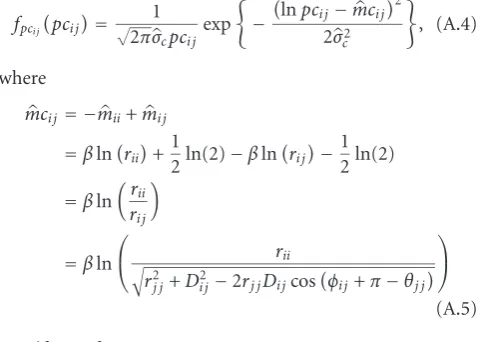
In the PM and BCPM strategies, the power control is per-formed on the instantaneous channel response, which has both the fading and shadowing components (as described above). The first step is to derive the pdf of the received power of one interferer, given that the signal power is normal-ized at 1 (0 dB).Appendix Apresents the derivation [10] for shadowing standard deviation larger than 10 dB, by approxi-mating the received interference as a log-normal distributed component [12]. Unfortunately, the results become inaccu-rate for lower shadowing standard deviation. For less severe shadowing, an alternative method based on Pad´e approxima-tion [13] to derive the pdf of the received interference power from one user is given inAppendix B. Our derivation shows that the approximated distribution has a form of a mixture of Pareto distributions. Finally, we give the distribution of users within a cell. If the users are uniformly distributed in the sec-tor then the pdf ofriiandθiifor allican be given by
3.2. Expected outage probability
Outage occurs when the desired signal does not meet the required SIR for reliable communications. The interference arises from the closest users that use the same subcarrier. Let
j=0 be the user of interest. Givenninterfering users using
the same subcarrier as the user 0, the SIR can be given as
The probability of outage givenninterfering users can be ex-pressed as
wherez is the minimum SIR protection ratio required for reliable communications. Note thatzis different for different
modulation/coding schemes used in the system.
For severe shadowing conditions, where the individual interference components are approximated by log-normal distributions, the pdf ofpcn0can be approximated by another
log-normal distribution, that is,
fpcn0 rived by using the method proposed by Schwarz and Yeh [14]. Hence the outage probability given usersncan be stated as follows: For less severe shadowing conditions, the interference is a mixture of Pareto-distributed components, and a closed-form pdf of the sum in (14) is difficult to find analytically by using the Pad´e approximation. An alternative approach is to approximate the sum of independent Pareto random vari-ables by the pdf of the largest one, since it is the dominant term in the sum. The cdf of the maximum of the distribu-tions is readily given as follows:
Fpcn0(pcn0)F The outage probability for theninterferers can then be given simply by using the following expression:
Table1: Modulation/coding schemes and parameters.
Modulation and coding schemes Bandwidth efficiency Nscufor 20 kbps Nscufor 120 kbps zdBrequired at BER=10−6
rate-1/2 QPSK 1 bps/Hz 2 12 2 dB
rate-1/2 16QAM 2 bps/Hz 1 6 7.01 dB
rate-3/4 16QAM 3 bps/Hz — 4 11.17 dB
The expressions of outage above are valid for a given set of mean powers of transmit and receive power of interfer-ing users, which in turn depend on the distance of user i
and user 0 from their corresponding base stations. Hence, this expression is conditioned on the distance vector R = {r00,r11,. . .,rnn}andθoo. In order to get the average outage probability, we generateM samples of the vector Rchosen from frii(rii) andθoo chosen from fθoo(θoo), and average the
result.
The next step is to derive the user outage probability in terms of system load (represented by the number of users
N in each sector) and the number of subcarriers Nscu
al-located per user. Define the load per subcarrier per sector,
Ls=NNscu/K, whereKis the number of subcarriers per
sec-tor, and T as the total number of interfering sectors, with
I= {It, 1≤t≤T}as the set of indexes of the interfering sec-tors. Let the system statesSj, 0≤j≤2T−1, represent all pos-sible combinations of the elements ofI, which are currently interfering with user 0, for example,S0 = {∅},S1 = {I1}, S2 = {I2},. . .,ST+1 = {I1,I2},S2T−1 = {I1,I2,. . .,IT}.
As-sume that the bandwidth is divided intoK/Nscucontiguous
sets ofNscusubcarriers each. For uniform distribution in
al-locating subcarrier set, the probability of being in stateSj,k is
PrSj
=Ls
nj
1−Ls
T−nj
, (20)
wherenjis the number of interferers in the stateSj. It follows that Pr{outage|Sj} =Pr(outage|nj) given in (17) and (19) and the total probability of outage is
Pr{outage} =
2T−1
j=0
Proutage|Sj
PrSj
. (21)
The above derivation gives the analytical framework for the performance evaluation of the PM and BCPM criterions. Power minimization alone tends to increase the number of subcarriers in order to reduce the required modulation level and hence the transmitted power; whereas bandwidth min-imization in order to reduce the probability of interference tends to reduce the number of subcarriers used and increase the modulation levels and the corresponding power.
4. PERFORMANCE IN FLAT FADING AND
SHADOWING ENVIRONMENT
Consider an OFDM system with 180 subcarriers (60 subcar-riers per cell). Each subcarrier has a bandwidth of 10 kHz and can ideally support 10ksps. We investigate the perfor-mance of the PM and BCPM strategies for the two follow-ing traffic scenarios. In the first scenario, each user requires
20 kbps (low-rate scenario). In this case, for each user, we can use 2 rate-1/2 QPSK subcarriers with a required SIR of 2 dB or 1 rate-1/2 16-QAM subcarrier with a required SIR of 7.01 dB. In the second scenario, each user needs 120 kbps (high-rate scenario). This can be supported by 12 rate-1/2 QPSK, 6 rate-1/2 16-QAM, or 4 rate-3/4 16-QAM subcarri-ers with increased SIR requirements.Table 1summarizes the modulation and coding techniques taken from [15] with the corresponding rate and SIR protection ratio for reliable com-munication (BER=10−6), and also gives the number of
sub-carriers required by each modulation for the low- and- high rate scenarios. The analysis is carried out forσdB=5 dB and
10 dB.
The analysis is also verified by simulations with a 3-sector, 19-cell system shown inFigure 2(a)in the presence of Rayleigh flat fading and path-loss exponentβ=3.5. Within one cell, each sector has a hard division amongst the subcar-riers to allocate so that they do not interfere with each other. For analytical results, only 2 first-tier cells and 5 second-tier cells shown inFigure 2(b)are taken into account since they contain the dominant interferers.
Figures 3(a) and 3(b) show the results for low-rate (20 kbps) and high-rate (120 kbps) scenarios, respectively. Solid lines indicate the analytical results for severe shadowing withσdB = 10 dB, while dashed-dotted lines represents the
mild shadowing withσdB=5 dB.
For both low- and high-rate data scenarios, in the case of mild shadowing with standard deviation of 5 dB, the PM approach using low bandwidth-efficient modulation/coding schemes (e.g., rate-1/2 QPSK) provides better performance (i.e., lower outage probability) than the BCPM approach. However, for severe shadowing, the trend is reversed. This can be explained by the fact that, for the same margin sep-arating the mean signal and interference powers, the chance of crossing the protection ratio (i.e., margin) in mild shad-owing scenarios is smaller than that in the case with severe shadowing (i.e., large shadowing variance). Hence, minimiz-ing power alone in the severe shadowminimiz-ing case is not enough to guarantee low link outage. Instead, reducing the proba-bility of interference by using minimum bandwidth yields a higher protection against outage. On the other hand, in a low shadowing scenario, as the minimum power approach al-ready gave sufficient protection against outage, using BCPM approach may increase the interfering power level that leads to higher outage.
Figure 3(b) shows that, in the higher-rate case (120 kbps), for mild shadowing with σdB = 5 dB, going from
(a) Simulation system with 19 cells, 2-tier interferers.
(b) Analytical model with 2 first-tier and 5 second-tier interferers. Figure2: Cellular system: simulation and analytical models.
60 54 48 42 36 30 24 18 12 6
Users per cell 10−2
10−1
Expect
ed
outage
pr
obabilit
y
QPSK 0.5/5 dB analysis QPSK 0.5/5 dB simulation 16QAM 0.5/5 dB analysis 16QAM 0.5/5 dB simulation
QPSK 0.5/10 dB analysis QPSK 0.5/10 dB simulation 16QAM 0.5/10 dB analysis 16QAM 0.5/10 dB simulation
(a) Outage probability for 20 kbps.
15 12
9 6
3
Users per cell 10−2
10−1 100
Outage
pr
obabilit
y
16QAM 0.75/5 dB analysis 16QAM 0.75/5 dB simulation 16QAM 0.5/5 dB analysis 16QAM 0.5/5 dB simulation QPSK 0.5/5 dB analysis QPSK 0.5/5 dB simulation
16QAM 0.75/10 dB analysis 16QAM 0.75/10 dB simulation 16QAM 0.5/10 dB analysis 16QAM 0.5/10 dB simulation QPSK 0.5/10 dB analysis QPSK 0.5/10 dB simulation (b) Outage probability for 120 kbps.
Figure3: Performance comparison of various modulation/coding schemes.
degrade the performance if crossed. The results support the power minimization argument that keeping lower modu-lation (with lower SIR thresholds) would yield better per-formance for mild shadowing cases. The reverse situation for the case of severe shadowing withσdB = 10 dB is also
shown in Figure 3(b): moving from 4 to 6 subcarriers has smaller performance penalty than from 6 to 12 subcarriers. This is consistent with the argument that the probability of interference is the dominant factor indicating the system per-formance in severe shadowing.
5. ALGORITHMS FOR RESOURCE ALLOCATION
In this section, we discuss algorithms for the two strategies that we implement for the performance evaluation of real-time data services.
5.1. Power minimization
There have been several proposed algorithms in the litera-ture that try to solve the power minimization problem. In [2], Lagrangian relaxation technique is used to derive an it-erative technique of allocation. This approach has high com-plexity in the number of iterations required to solve the prob-lem. The brute-force integer programing formulation and its linear programing counterpart have been discussed in [16]. This approach has even higher complexity, although it per-forms better than the previous approach. In [17], an intuitive approach to power minimization was proposed that divides the allocation problem into three steps: (i) bandwidth alloca-tion, (ii) subcarrier assignment, and (iii) bit loading. This is the approach we use in implementing the power minimiza-tion algorithm. The subcarrier assignment proposed in [17] is replaced by the one in [18] since this algorithm gave bet-ter performance in bet-terms of minimum power. The bit load-ing algorithm is the greedy approach proposed in [19], which is optimal for single user allocation. The details of the algo-rithms can be found in respective literature. Here, we sum-marize them as follows.
(i) Bandwidth allocation.
(1) Initialize the subcarrier allocation for usernto
Sn =Sminn = bn/cη, whereSnis the number of subcarriers assigned to the usern.
(2) WhileNn=0Sn< N,
(a) let ∂rn = ((Sn+ 1)/γ¯n)fp(bn/(Sn+ 1)) − (Sn/γ¯n)fp(bn/Sn) for alln, where ¯γnis the av-erage channel response of usernand∂rnis the power reduction if one more subcarrier was allocated to the user;
(b) assign the additional subcarrier to the user who causes the minimum power reduction, that is,
– m=arg minn∂rn, – Sm=Sm+ 1.
(ii) Subcarrier assignment.
(1) Initialize each user nby sorting his subcarriers in ascending order in terms of fn/γn,k, where
fn= fP(cn) andcn= bn/Sn. Herecnis seen as the average number of bits loaded per subcarrier. The actual number of bits per subcarrier is only decided in the bit loading stage, and cnis used here conveniently to simplify the subcarrier as-signment process.
(2) Allocate in a round-robin manner the best un-used subcarrier to user n from the above list of sorted subcarriers until its subcarrier require-ment is satisfied.
(3) Determine the effective power reductionΔpi j =
∂pi j+∂pjifor each user pair (i,j), where (a)∂pi j is the minimum power reduction
among all subcarriers of i when a subcar-rier of i is reassigned to j, that is, ∂pi j = mink{∂pki j}, andki j = arg mink{∂pki j}and
∂pk
i j= fj/γj,k−fi/γi,kis the potential power reduction when subcarrier k belonging to useriis reassigned to userj.
(4) DetermineΔpmin=min{Δpi j}amongst all user
pairs (i,j). If Δpmin < 0, perform the
cor-responding subcarrier re-assignment; otherwise stop, the power cannot be reduced further. (iii) Bit loading.
(1) Initialize for each usernthe bit loading level on each subcarrierkassigned to usernin the previ-ous step to becn,k=0. Let the initial power incre-ment be∂pn,k= fp(1)/γn,kon each subcarrier. (2) For each usern, whileKk=1cn,k< bn,
(a)l=arg mink∂pn,k, (b)cn,k=cn,k+ 1,
(c) ∂pn,k= fp(cn,k+ 1)/(γn,k)−fp(cn,k)/(γn,k).
5.2. Bandwidth constrained power minimization
For this strategy of resource allocation, a simple algorithm that assigned the minimum number of best available subcar-riers to the users was proposed in [8]. In [10], a more optimal approach was proposed that follows the three-step approach described above. However the first two steps are replaced by the following.
(i) Bandwidth allocation.
(1) For each usern, allocate the minimum number of subcarriers that would satisfy the users rate re-quirement, determined asSn=Sminn = bn/cη. (ii) Subcarrier assignment.
(1) For each usern, sort the subcarriers in ascending order in terms of fn/γn,k.
(2) Allocate in a round-robin manner the best un-used subcarrier to user n from the above list of sorted subcarriers until its subcarrier require-ment is satisfied.
(3) Determine the effective power reductionΔpi j = min{∂pi j+∂pji, ∂pi j+∂pji+∂pii, ∂pi j+∂pi j+
∂pj j}for each user pair (i,j), where
(a)∂pi j is the minimum power reduction amongst all subcarriers ofiwhen a subcar-rier of i is reassigned to j, that is, ∂pi j = mink{∂pki j}, andki j = arg mink{∂pki j}and
∂pk
54 48 42 36 30 24 18 12 6
Number of users per cell 10−2
10−1
Exp
ec
te
d
pa
ck
et
er
ro
r
rate
PM 5 dB BCPM 5 dB
PM 10 dB BCPM 10 dB (a) 32 kbps.
15 12
9 6
3
Number of users per cell 10−2
10−1
Exp
ec
te
d
pa
ck
et
er
ro
r
rate
PM 5 dB BCPM 5 dB
PM 10 dB BCPM 10 dB (b) 64 kbps.
Figure4: Performance of PM and BCPM schemes in supporting real-time data services.
(b)∂pii is the minimum power reduction amongst the unused subcarriers when an unused subcarrier k is used instead ofkji, wherekjiwas reassigned from userjto user
i, that is,∂pii = mink{fi/γi,k− fi/γi,kji for
all kof ununsed subcarriers}. Determine Δpmin = min{Δpi j} among all user pairs
(i,j). IfΔpmin<0, perform the
correspond-ing subcarrier reassignment; otherwise stop, the power cannot be reduced further. (iii) Bit loading.
(1) Initialize for each usernthe bit loading level on each subcarrierkassigned to usernin the previ-ous step to becn,k=0. Let the initial power incre-ment be∂pn,k= fp(1)/γn,kon each subcarrier. (2) For each usern, whileKk=1cn,k< bn,
(a)l=arg mink∂pn,k, (b)cn,k=cn,k+ 1,
(c) ∂pn,k= fp(cn,k+ 1)/γn,k−fp(cn,k)/γn,k. Note that this is the same bit-loading algorithm used for power minimization.
6. PERFORMANCE OF REAL-TIME DATA SERVICES IN
FREQUENCY SELECTIVE FADING AND DIFFERENT SHADOWING ENVIRONMENTS
For performance evaluation of data services, we simulate a cellular environment with a 19-cell configuration that in-cludes the effects of up to second-tier interferers. Each hexag-onal cell is divided into three sectors, with 3 beams per sector. The OFDM system has 90 traffic subcarriers (30 subcarriers
per sector); each having a bandwidth of 10 kHz and can support a symbol rate of 10 ksps (same assumption as in
Section 3). The modulation and coding levels are the same as used in Section 3, which give a spectral efficiency of 1– 4 bps/Hz. The resource allocation interval is 20 ms in which the channel is assumed to be unchanged. The modified Hata model is used to represent the loss model with a path-loss exponent of 3.5.
Shadowing is assumed to be correlated log-normal using the method stated in [20] with standard deviation of 5 and 10 dB and correlation distance of 20 m, which is commonly used for a vehicular environment. The simulated multipath power delay profiles are vehicular-B [11], and Rayleigh fad-ing is assumed with the Jake’s method [20]. At the beginning of the simulation, the mobiles are dropped in the sectors with speed of 30 km/h. No handoffs are simulated, and it is as-sumed that if the mobile leaves the sector from one edge, it enters from another to preserve the number of mobiles in the area during simulation.
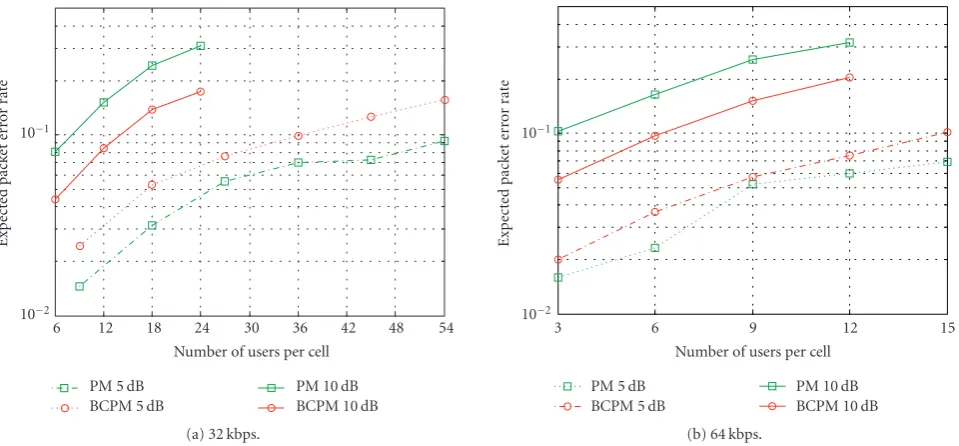
We simulate two data rate scenarios. The low-rate sce-nario consists of a constant rate of 32 kbps [11] with packet sizes of 320 bits at a constant inter-arrival time of 10 ms. The high-rate scenario consists of a constant rate of 64 kbps [11] with packet sizes of 640 bits at a constant inter-arrival time of 10 ms. The packet error rate is used as a performance mea-sure that captures the link outage.
Figure 4(a)shows the performance results for 32 kbps in both 5 and 10 dB shadowing scenarios. It can be seen that the same trend is followed in this figure as the analysis. In a mild shadowing environment (σdB=5 dB), the PM scheme
performs better with 1.5 times more users at PER=10%. On the other hand, in a severe shadowing environment (σdB =
Figure 4(b)also gives similar conclusions as the analysis for 64 kbps data services: PM outperforms BCPM for mild shadowing (σdB=5 dB) and the situation is reversed for
se-vere shadowing (σdB = 10 dB). However, the difference in
performance between PM and BCPM is smaller. This may be attributed to the fact that at high rates, a lot more subcarri-ers are employed for the lower bandwidth-efficient modula-tion scheme (e.g., at 15 users per cell, rate-1/2 QPSK would need 105 subcarriers). However, since there are only a lim-ited number of subcarriers, the PM algorithm would have to use higher bandwidth-efficient modulation schemes in some subcarriers to satisfy the rate requirements. Hence, the differ-ence in performance between PM and BCPM at higher rates and higher loads is less pronounced.
7. CONCLUSIONS
In this paper, we have shown that in downlink OFDM mo-bile cellular systems, the probability of interference occur-rence is an important factor in determining the system per-formance, which should be accounted for in the resource al-location strategy. The proposed BCPM schemes to minimize first the number of subcarriers and then power minimization in satisfying user rate requirements can significantly enhance link performance. We derived a framework to analyze the expected outage probability of different transmission band-widths and corresponding modulation schemes in flat fading and shadowing cellular environment and showed the ben-efits of constraining number of allocated subcarriers. It was shown that in frequency-selective fading, the BCPM schemes significantly outperform PM strategy alone for both voice and data services.
APPENDICES
A. PDF OF RECEIVED INTERFERENCE POWER FOR SEVERE SHADOWING
The density function of psi j can be approximated by a log-normal distribution [12] with a reduced logarithmic area mean powermi j and an increased logarithmic standard de-viationσgiven as follows:
Hence the approximated pdf ofpsi jcan be given as
fpsi j
Given the received power pdf based on a transmit power of 1, for a power controlled system, the instantaneous trans-mit power of userifrom base-stationican be given by ptii =1/ psiiassuming that the received power of useriis normal-ized to 1. The corresponding pdf ofptiiis
fptii
The interference power from useri’s base-station to user j
can be given aspci j = ptii·psi j, and the corresponding pdf
B. PDF OF RECEIVED INTERFERENCE POWER FOR MILD SHADOWING
Pad´e approximation technique [13] can be used to approx-imate the pdf of pci j for mild shadowing case. The power series of a pdf around two points can be expressed as
h(u)= Details of the above equations are given in [13]. In the case of received powerpsi jgiven 0 dB transmit power,μnand fn(0) can be derived as
μn=n! exp
Once the coefficientsanandbnare found, then a partial frac-tion decomposifrac-tion can be done:
P([L/MJ,K)]=
M−1
n=0 anun 1 +Mn=1bnun
= M
m=1 λi
u+qm. (B.5)
Inverting this expression, we get a mixture of exponential dis-tributions:
f(x)= M
m=1 λiexp
−qmx
. (B.6)
Hence, the pdf ofpsi jfor 0 dB transmit power can be approx-imated by the above expression. Following the same argu-ment as inAppendix A, the transmit power of a user within the same cell can be given byptii =1/ psii. The interference power from useri’s base-station to userjgiven aspci j=ptii.
psi j = psi j/ psiican now be calculated by transformation of random variables since bothpsi jandpsiifollow the same dis-tribution as (B.6),
fpci j(pci j)=
M
l=0
M
m=0
λmsλlt 1
qmspci j+qlt
2, (B.7)
whereqms,λmsare the coefficients of received power of inter-ference, andqlt,λltare the coefficients for the derived trans-mit power of the interference.
ACKNOWLEDGMENT
This work is partially supported by an NSERC CRD Grant with Nortel Networks.
REFERENCES
[1] W. Mohr and W. Konh¨auser, “Access network evolution be-yond third generation mobile communications,”IEEE Com-munications Magazine, vol. 38, no. 12, pp. 122–133, 2000. [2] C. Y. Wong, R. S. Cheng, K. B. Letaief, and R. D. Murch,
“Mul-tiuser OFDM with adaptive subcarrier, bit, and power allo-cation,” IEEE Journal on Selected Areas in Communications, vol. 17, no. 10, pp. 1747–1758, 1999.
[3] W. Rhee and J. M. Cioffi, “Increase in capacity of multiuser OFDM system using dynamic subchannel allocation,” in Pro-ceedings of 51st IEEE Vehicular Technology Conference (VTC ’00), vol. 2, pp. 1085–1089, Tokyo, Japan, May 2000.
[4] G. Song and Y. Li, “Cross-layer optimization for OFDM wire-less networks - part I: theoretical framework,”IEEE Transac-tions on Wireless CommunicaTransac-tions, vol. 4, no. 2, pp. 614–624, 2005.
[5] G. Song and Y. Li, “Cross-layer optimization for OFDM wire-less networks - part II: algorithm development,”IEEE Trans-actions on Wireless Communications, vol. 4, no. 2, pp. 625–634, 2005.
[6] A. Seyedi and G. J. Saulnier, “A sub-channel selective orthogo-nal frequency division multiplexing spread spectrum system,” in Proceedings of IEEE Military Communications Conference (MILCOM ’01), vol. 2, pp. 1370–1374, McLean, Va, USA, Oc-tober 2001.
[7] L. Loyola and T. Miki, “An OFDMA/CDMA-based bandwidth resource allocation scheme for future broadband mobile networks,” in Proceedings of 56th IEEE Vehicular Technol-ogy Conference (VTC ’02), vol. 1, pp. 42–46, Vancouver, BC, Canada, September 2002.
[8] N. Damji and T. Le-Ngoc, “Adaptive downlink multi-carrier resource allocation for real-time multimedia traffic in cellu-lar systems,” inProceedings of IEEE International Conference on Communications (ICC ’04), vol. 7, pp. 4258–4262, Paris, France, June 2004.
[9] G. Kulkarni, S. Adlakha, and M. Srivastava, “Subcarrier al-location and bit loading algorithms for OFDMA-based wire-less networks,”IEEE Transactions on Mobile Computing, vol. 4, no. 6, pp. 652–662, 2005.
[10] N. Damji and T. Le-Ngoc, “Adaptive BCPM downlink resource allocation strategies for multiuser OFDM in cellular systems,” inProceedings of the 2nd International Conference on Broad-band Networks (BROADNETS ’05), Boston, Mass, USA, Octo-ber 2005.
[11] TR 101 112 V3.2.0 (1998-04),Universal Mobile Telecommuni-cations System (UMTS); Selection procedures for the choice of radio transmission technologies of the UMTS, ETSI, 1998. [12] R. Prasad and J. C. Arnbak, “Effects of Rayleigh fading on
packet radio channels with shadowing,” inProceedings of 4th IEEE Region 10 International Conference (TENCON ’89), pp. 546–548, Bombay, India, November 1989.
[13] H. Amindavar and J. A. Ritcey, “Pad´e approximations of prob-ability density functions,”IEEE Transactions on Aerospace and Electronic Systems, vol. 30, no. 2, pp. 416–424, 1994.
[14] S. C. Schwartz and Y. S. Yeh, “On the distribution function and moments of power sums with log-normal components,”
The Bell System Technical Journal, vol. 61, no. 7, part 1, pp. 1441–1462, 1982.
[15] S. Vishwanath and A. Goldsmith, “Adaptive turbo-coded modulation for flat-fading channels,” IEEE Transactions on Communications, vol. 51, no. 6, pp. 964–972, 2003.
[16] I. Kim, H. L. Lee, B. Kim, and Y. H. Lee, “On the use of lin-ear programming for dynamic subchannel and bit allocation in multiuser OFDM,” inProceedings of IEEE Global Telecom-munications Conference, vol. 6, pp. 3648–3652, San Antonio, Tex, USA, November 2001.
[17] D. Kivanc, G. Li, and H. Liu, “Computationally efficient band-width allocation and power control for OFDMA,”IEEE Trans-actions on Wireless Communications, vol. 2, no. 6, pp. 1150– 1158, 2003.
[18] C. Y. Wong, C. Y. Tsui, R. S. Cheng, and K. B. Letaief, “A real-time sub-carrier allocation scheme for multiple access down-link OFDM transmission,” inProceedings of IEEE Vehicular Technology Conference (VTC ’99), Amsterdam, The Nether-lands, September 1999.
[19] D. Hugh-Hartogs, Ensemble modem structure for imperfect transmission media, U.S. Patents Nos. 4679227, July 1987; 4731816, March 1988; and 4833796, May 1989.
Navid Damji received his Bachelor’s and Master’s degrees in electrical engineering from McGill University, Montreal, Canada, in 2002 and 2004, respectively. Since September 2004, he has been with SRTele-com as a Software DSP Engineer involved in the development of the physical layer for the IEEE 802.16 standards. He is pursing his Ph.D. in electrical engineering at McGill University. His research interests are in the
area of broadband wireless communications with emphasis on re-source allocation and interference mitigation in OFDM cellular systems.
Tho Le-Ngoc obtained his B.Eng. degree (with distinction) in electrical engineering in 1976, his M.Eng. degree in micropro-cessor applications in 1978 from McGill University, Montreal, and his Ph.D. degree in digital communications in 1983 from the University of Ottawa, Canada. During 1977–1982, he was with Spar Aerospace Ltd. as a Design Engineer and then a Senior De-sign Engineer, involved in the development