Optimized Irregular Low-Density Parity-Check
Codes for Multicarrier Modulations over
Frequency-Selective Channels
Val ´erian Mannoni
ETIS/ENSEA/UCP CNRS 8051, 6 Avenue du Ponceau 95014 Cergy-Pontoise Cedex, France
Laboratory of Decision and Communications Systems (D´eCom), University of Reims Champagne-Ardenne, UFR Sciences, Moulin de la Housse, 51687 Reims Cedex 2, France
Email:[email protected]
David Declercq
ETIS/ENSEA/UCP CNRS 8051, 6 Avenue du Ponceau 95014 Cergy-Pontoise Cedex, France Email:[email protected]
Guillaume Gelle
Laboratory of Decision and Communications Systems (D´eCom), University of Reims Champagne-Ardenne, UFR Sciences, Moulin de la Housse, 51687 Reims Cedex 2, France
Email:[email protected]
Received 1 March 2003; Revised 30 October 2003
This paper deals with optimized channel coding for OFDM transmissions (COFDM) over frequency-selective channels using irregular low-density parity-check (LDPC) codes. Firstly, we introduce a new characterization of the LDPC code irregularity called “irregularity profile.” Then, using this parameterization, we derive a new criterion based on the minimization of the transmission bit error probability to design an irregular LDPC code suited to the frequency selectivity of the channel. The optimization of this criterion is done using the Gaussian approximation technique. Simulations illustrate the good performance of our approach for different transmission channels.
Keywords and phrases: orthogonal frequency division multiplexing, frequency-selective channel, optimized channel coding, irregular LDPC codes, density evolution.
1. INTRODUCTION
In this paper, we address the problem of designing codes for transmissions over frequency-selective channels when or-thogonal frequency division multiplexing (OFDM) modula-tion technique is used. Multicarrier modulamodula-tions are good candidates for the emerging high rate transmissions, either wired, wireless, single, or multiuser. Several standards have chosen OFDM modulation because it allows a very simple mitigation of intersymbol interference (ISI), which could be very destructive when the information rate is high [1,2]. The OFDM modulator transforms a frequency-selective channel into a set of flat-fading channels, which are easier toequalize. The problem of channel coding for OFDM systems (Coded-OFDM or C(Coded-OFDM) has been already addressed [3]. Based on the emerging capacity approaching coding schemes, we propose an alternative coding structure for COFDM. In some
applications, like wired xDSL transmissions, there exists a backward channel that propagates some information from the receiver back to the transmitter. Properly used, this in-formation can give to the transmitter an estimation of the channel that is going to be crossed. We propose in this pa-per to make use of this Information to design a code that is adapted to a frequency-selective OFDM channel. Although we assume perfect channel state information (CSI) at the transmitter, we will see that partial CSI is sufficient for our code design.
various kind of channels. It has been shown that irregular LDPC codes are especially interesting because one can op-timize the parameters that characterize their irregularity in order to find the codes that are the closest to the capacity for various types of channels. The optimization of these codes has been done for the binary erasure channel (BEC) [8] and for the AWGN channel [9]. The optimization of LDPC codes for various nonstandard channels has also been addressed in the literature [10,11].
We propose in this paper to optimize the LDPC code irregularity for OFDM frequency-selective channels. After the OFDM demodulation, the signal that feeds the chan-nel decoder is seen as coming from a set of Gaussian flat-fading channels, each one having a different noise power. So, this channel can be interpreted as a nonstationary Gaussian channel for which the optimization of LDPC codes is not a direct generalization of existing work. Indeed, such an opti-mization requires a finer characterization of the LDPC code irregularity, that we callirregularity profile[12]. This paper is organized as follow. InSection 2, we define the irregularity profile and make some recalls about OFDM signaling, LDPC codes, and their decoding algorithm.Section 3describes our optimization algorithm suited to OFDM frequency-selective channels, the results are presented inSection 4, and a conclu-sion is given inSection 5.
2. PARAMETERIZATION OF LDPC CODED OFDM
In this section, we introduce the main concepts and nota-tions about LDPC codes that we will use for the optimiza-tion. As well as turbo codes, LDPC codes can achieve reli-able transmission for a signal-to-noise ratio (SNR) extremely close to the Shannon limit on the AWGN channel [13]. More-over, these codes present some advantages, such as a simple description of their structure, the easiness to make them ir-regular, and a fully parallelizable decoding implementation [14].
2.1. Irregularity profile
In this section, we propose to generalize the parameteriza-tion of LDPC irregularity in order to cope with nonstaparameteriza-tion- nonstation-ary channels. This new parameterization is called irregularity profile [12]. LDPC block codes are defined by a sparse parity-check matrix H(M ×N), where N denotes the codeword length andMthe number of parity checks (in this work, we use only full-rank parity-check matrix, so, if Ris the code rate we haveM=(1−R)N). An LDPC code can also be rep-resented by its factor graph which is a bipartite graph with two kinds of nodes: data nodes representing the codeword bits and function nodes representing the parity checks [15]. Thenth data node and thekth check node are connected by an edge if and only ifHk,nis equal to 1.
A regular (N,tc,tr) LDPC code has a parity-check matrix with exactlytconesper column andtronesper row. When the data nodes and the check nodes have unequal connection de-grees (number of edges connected to a node), the LDPC code is irregular. The irregularity is conveniently specified by two polynomials:λ(x)= tcmax
i=2 λixi−1 andρ(x) = trmax
j=2 ρjxj−1,
7 4 2
C
o
nnectio
n
d
eg
ree
λ7(1) λ4(2) λ2(3)
1
N
0
(7) (4) (4) (2) (2) (2)
u1 u2 u3 r1 r2 r3 Codeword
Random permuter
Parity checks
(9) (6) (6)
M
Figure 1: Factor graph of a rateR = 1/2 irregular LDPC code. The connection degree of each node is specified in braces. We have drawn the irregularity profile according to the fraction of data nodes.
whereλiis the fraction of edges which are connected to a de-greei data nodes andρj is the fraction of edges which are connected to a degree jcheck nodes.tcmaxandtrmax
repre-sent the maximal data and check node connection degrees and a degreeidata node (resp., a degree jcheck node) is a node connected to exactlyi(resp.,j) edges. These two poly-nomials are related by (1−R)tcmax
i=2 λi/i = trmax
j=2 ρj/ j. It is also useful to use the following dual polynomial represen-tation:λ(x) =tcmax
i=2 λixi−1andρ(x) = trmax
j=2 ρjxj−1 with
λi being the fraction of data nodes with a connection de-gree i and ρj being the fraction of degree j check nodes. (λi,ρj) and (λi,ρj) are related byλi =(λi/i)/
tcmax
k=2 λk/kand
ρj =(ρj/ j)/ trmax
k=2 ρk/k. Using these irregularity parameters, the optimization of LDPC codes has already been performed for various channels, including BEC [8,13], AWGN [9], and Rayleigh channels [16]. The optimization method is based on the study of the asymptotic behavior of the LDPC codes during the decoding steps. For more details about irregular codes, we refer the reader to [13].
In the above described parameterization, (λ(x),ρ(x)) represents the distribution functions of the node degrees, but a node with a given degree could be placed anywhere within the codeword. This is not an issue for memoryless channels, but when the channel is not stationary or has memory, the order in which the nodes are placed in the codeword matters. That is why we introduce a more gen-eral description of irregular LDPC codes that we call irreg-ularity profile. This parameterization includes the location
pi of the set of data nodes with a given connection degree
i. For example, the code described inFigure 1is defined by
λ(x)=tcmax i=2 λ
(pi)
bn LDPC
Figure2: OFDM transmission with LDPC channel coding over frequency-selective channels.
check nodes is arbitrary since the parity checks are not influ-enced by the channel. This irregularity description provides a good framework in order to optimize the LDPC param-eters for a wide range of channels, including nonstationary channels. We will denote the irregularity profile (λ,p,ρ). The vectorsλandρcollect the coefficients of the two polynomi-als (λ(x),ρ(x)) while the vectorpindicates the positions of the different groups of nodes. Using this parameterization, we assume that the nodes with the same degree are located in the same channel neighborhood. Even if better codes that do not fulfil the last assumption may exist, in order to complete the optimization of the irregularity profile in a “reasonable time,” we have decided to restrict the number of parameters. We will see in the simulations that, although restrictive, this definition of the irregularity profile yields a significant per-formance improvement.
Our goal is to optimize the irregularity profile for OFDM frequency-selective channels, which can be interpreted, at the OFDM demodulator output, as a no-stationary flat-fading Gaussianchannel. Now, we will briefly present the OFDM transmission scheme and the derivation of the likelihood ex-pression which are needed to initialize the LDPC decoder.
2.2. OFDM communication system
The OFDM system consists in dividing the available spec-trum into many carriers, each one being modulated by a low-rate data stream. The structure of the communication system is shown inFigure 2. The information bitsbnare en-coded by an LDPC code and the resulting codeword is sent to the OFDM transmitter. After a serial-to-parallel conversion the bits are mapped into a 4-QAM constellation on theNc subcarriers to obtain a block of symbolsXk(k=1,. . .,Nc). Then, this block is transformed into a time-domain sequence by the inverse discrete Fourier transform (IDFT). In wired (xDSL) transmissions, the signal is baseband and therefore real valued. Although the optimization of LPDC codes does not require a baseband channel, we have decided to restrict the derivation of the formula to this case. In order to transmit a real signal, we build a block of symbols with a Hermitian symmetry which leads us to a real signal by IDFT. The
trans-mit signal isxn= 2Nc
k=1Skcos(2πk f0n+φk) withXk=Skeiφk. A cyclic prefix longer than the channel memory is used as a preamble and the signal xnis sent through the frequency-selective channel. After removing the cyclic prefix, the re-ceived signal can be written asyn=
L−1
j=0hjxn−j+nn, withhj
(j=0,. . .,L−1) representing the coefficients of the channel
impulse response andnnbeing the AWGN with zero mean and variance σ2
n. The DFT-transforms the time-domain se-quence yn into a frequency-domain sequence Yk and the frequency-selective channel becomes a set ofNcGaussian ISI free channels with fadingHk:
Yk=HkXk+Nk ∀k=1,. . .,Nc, (1)
withHk being thekth channel spectrum coefficient,Xk the
kth symbol, andNkthe Gaussian noise with zero mean and varianceσ2
n. The equalization corrects the channel distortion, and is easily done in the frequency domain with a simple multiplication by a coefficientKk (for allk =1,. . .,Nc) on each subcarrier:Rk = KkYk for allk = 1,. . .,Nc. We have used the zero forcing (ZF) equalizer and, so, thekth equal-izer coefficient isKk=Hk∗/|Hk|2. Note that the choice of the equalizer type is not important in our case since any of the usual equalizers used in OFDM transmission (ZF, MMSE, maximum likelihood) would lead to the same expressions of the messages feeding the LDPC decoder. For the sake of sim-plicity, we then chose the ZF equalizer. Using the equalizer outputRkand the channel model (1), we obtain the expres-sions of the observed log-likelihood ratiosu0k(LLRs):
where (C2k,C2k+1) are the 2 codeword bits used to form the kth 4-QAM symbolXk, and Re{·}and Im{·}denote the real and the imaginary parts, respectively. Using these LLRs as initialization messages, we finally iteratively decode the noisy codeword to obtain an estimate ˆunof the input sequence. The decoding algorithm will be presented in the next section.
2.3. Decoding LDPC codes using belief propagation
LDPC codes are easily decoded by an iterative probabilistic algorithm known as belief propagation [7]. The belief prop-agation algorithm, using the Bayes rule locally, iteratively up-dates the a posteriori probabilities (APPs) of each bit in the codeword. So, this algorithm can be viewed as an iterative message-passing algorithm on the associated factor graph. Moreover, for a finite codeword length, the factor graph of an LDPC code contains many cycles which lead to a subopti-mal calculation of the APPs.
Each iteration of belief propagation is composed of two steps:
(i) the data pass which updates the messages through the variable nodes;
(ii) the check pass which updates the messages through the check nodes.
Usually, it is more convenient to use LLRs as messages. Let
v = log(p(y|c=1)/ p(y|c= −1)) the output message of a variable node andu = log(p(y|c=1)/ p(y|c= −1)) the output message of a check node. During the data pass on a variable node with a connection degree equal toi, the output messagevon theqth branch is as follows
vq=u0+
i
n=1
n=q
un ∀q=1,. . .,i, (3)
whereun,n=1,. . .,i, are the incoming messages from all the data node neighbors andu0is the observed LLR (or channel
value). At the first decoding iteration, all theunare set to zero
forn = 1,. . .,i. During a check pass, we use the following
“tanh rule” [17] to express the output messageuon thepth branch:
tanhup 2 =
j
m=1
m=p tanhvm
2 ∀p=1,. . .,j, (4)
wherevm,m=1,. . .,j, are the incoming messages from the check node neighbors.
After a few iterations of belief propagation, we can cal-culate the a posteriori ratio wfor each data node which is equal to the sum of all messages feeding a variable nodewk=
u0+
i
n=1un,k=1,. . .,N. Finally, we usewkto estimate the
information bits: ˆuk=(1−sign(wk))/2,k=1,. . .,N. Thus, after having introduced in this part the main notations and concepts which are essential to optimize the LDPC codes over OFDM frequency-selective channel, we present in the next section our proposed optimization scheme.
3. OPTIMIZATION WITH A GAUSSIAN APPROXIMATION
In order to determine the performance of LDPC codes un-der belief propagation, Richardson and Urbanke [18] have introduced a general method to predict the asymptotic be-havior of the LDPC codes. This method calleddensity evo-lutionis based on the study of the probability density func-tions (pdfs) of messages being propagated in the factor graph during the decoding steps under the assumption of cycles-free graph. For memoryless binary-input continuous-output AWGN channels, Chung et al. [9] proposed a Gaussian ap-proximation of message densities to simplify the analysis of the density evolution. For many channels, including the AWGN channel, LDPC codes (with an infinite codeword length) exhibit a threshold phenomenon. This threshold cor-responds to an SNR above which the bit error probability converges to zero when the number of belief propagation it-erations tends to infinity (in [9], the threshold was defined as a noise power). The criterion used by Chung to optimize the LDPC codes on the AWGN channels is to choose the code which exhibits the lowest threshold. So, the Gaussian approx-imation allows to calculate this threshold quickly and ensures an easier design for good LDPC codes on AWGN channels. In this section, we extend Chung’s algorithm to OFDM trans-missions over frequency-selective channels.
3.1. Gaussian approximation for AWGN channels
We first introduce the notations used in the Gaussian approx-imation method for a stationary AWGN channel. We assume that the channel is Gaussian with zero mean and varianceσ2
n, the constellation is BPSK, and the all-zero codeword is sent. Then the observed LLRu0is also Gaussian with mean 2/σn2 and variance 4/σ2
n. We note that the variance ofu0is equal
to twice the mean, and this property (calledconsistency con-ditionin [13]) is preserved through the belief propagation steps. This reduces the study of the density evolution to only the mean of the pdf. It is stated in [9] that the Gaussian ap-proximation is rather a good apap-proximation for the variable nodes outputsv, but not so good for the check nodes outputs
u. We found that Gaussian approximation has been shown sufficiently accurate to provide a good LDPC optimization.
From (3), the meanm(vl,)iof the output message of a vari-able node with a degreeiis given by
m(vl,)i=mu0+ (i−1)m(ul−1), (5)
wheremu0is the mean of observed LLRu0andldenotes the lth decoding iteration. At thelth iteration, an incoming mes-sagevto a check node has the following Gaussian mixture density fv(l):
f(l)
v =
tcmax
i=2
λiN m(vl,)i, 2m
(l)
v,i
. (6)
meanm(ul)at thelth iteration can be expressed as follows: along the decoding iteration. Recalling that the word error probability converges to zero if and only ifm(ul)→+∞when
l → +∞. It is easy to calculate the threshold corresponding to an SNR above whichm(ul)tends to infinity whenltends to infinity.
3.2. Gaussian approximation for OFDM frequency-selective channels
We will now extend the Gaussian approximation approach to OFDM channels which are not stationary. This will lead us to the optimization of the irregularity profile (λ,p,ρ).
Before studying the asymptotical behavior of the decoder, we first discuss the statistical properties of the observed mes-sages. As stated inSection 2.2, the messages at the input of the decoder are
Assuming that the all-zero codeword is sent:
C2k,C2k+1
=(0, 0)∀k, i.e.,Xk=1 +j, (9)
the observed LLRs become
U0,k=u0,2k=u0,2k+1= So, the observed messageU0,k has aconsistentGaussian pdf
fu0,k: First of all, remark that the “local tree” assumption re-quires an infinite codeword length, and thereby an infinite number of subcarriers. Unlike the AWGN channel case, each observed message has different statistical properties. Since we have an infinite number of observed messages (one for each subcarrier), the model of the densities (11) involves an in-finite number of equations. To circumvent this problem, we build a rectangular approximation of the channel spectrum which reduces the model to a finite number of equations.
|H(ν)|
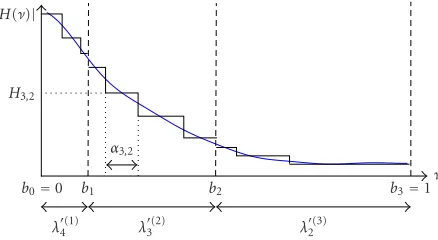
Figure3: Rectangular approximation of a frequency-selective chan-nel spectrum.
First, we split the channel spectrum into tcmax − 1
parts according to the irregularity profile as represented in Figure 3. Each part corresponds to the spectrum bandwidth (of lengthλ(pi)
i ), where the bits with the same connection de-greeiare transmitted. We sort the parts in ascending order of the positions piin the irregularity profile so that
Bi=
In order to build the rectangular approximation of the channel spectrumH(ν) in each bandBi, we have chosen a staircase function such that the amplitude of the channel spectrum is divided intoNs(i) equal parts. This type of ap-proximation is called asimple function[19]. This means that the channel is modeled, in the bandBi, by number of stairs in each band,Hi,kare the amplitudes of the stairs, andAi,k(ν) are the sets defined as
have drawn onFigure 3the approximation of a typical ADSL spectrum, and its approximation with tcmax −1 = 3 and
(Ns(4)=3, Ns(3)=4,Ns(2)=3).
channels or when channel estimation errors occur. This issue is further discussed in the conclusion.
Letαi,k denote the normalized width of the subband k located in the bandwidthBiwith
αi,k=
So, an observed message incoming a data node with a con-nection degreeihas a Gaussian mixture density fu0,i:
fu0,i=
It is important to note that the density fu0,i is consistent for
all i because it is a mixture of consistent Gaussian densi-ties. Therefore, the variance of the messagesu0,i is twice its mean and so, density evolution can be used for frequency-selective channels. Thus, the main difference between OFDM frequency-selective channels and AWGN channels is that the density of incoming messages to the factor graph fu0,i is a
function of the code irregularity profile. Actually, as shown in (17), the meanmu0(Hi,k) depends on theλi’s through the parameterαi,kand the setAi,k.
Now, we discuss the accuracy of the rectangular approx-imation. The greater Ns(i) in each bandwidthBi, the best the approximation, but the resulting density will be more computationally difficult to manage—because it is a mix-ture of Ns(i) Gaussian densities. In order to choose the number of stairs in each Bi, we fix a maximum number
Nsmaxand a thresholdε. Then we evaluate the Kullback
di-vergence iteratively between fu0,i(Nsmax) and fu0,i(n) for all
n∈ {1,. . .,Nsmax}. We choose forNs(i) the maximum value
of n such that DK(fu0,i(Nsmax),fu0,i(n)) < ε. Using a
Kull-back divergence [20], well suited to evaluate the distance be-tween the tails of pdfs, we ensure that the likelihood values computed from the approximation will not be too different than the actual likelihood values—and so will be the mean
mu0(Hi,k). The choice ofNsmaxand ofεis a tradeoffbetween
accuracy and computational complexity.
It is now easy to generalize the equations describing the evolution of the mean (5)–(7) to the case of OFDM frequency-selective channels. The mean m(vli),k of the output
message of a variable node with a degreeiin thekth subband
Biis given by
Then, at thelth iteration of belief propagation decoding, an incoming messagevto a check node will have the
follow-ing Gaussian mixture density fv(l):
which leads to the generalization of (7):
m(l)
Now, using (18) and (20) iteratively, we can follow the evo-lution ofm(ul)along the decoding iterations for a frequency-selective channel. We will make use of these equations in or-der to optimize the LDPC code profile.
3.3. Optimization
In [9], the optimization criterion was to minimize the LDPC decoding threshold, which seems to be the best choice for sta-tionary channels. We think that a different optimization cri-terion could be used for OFDM frequency-selective channels based on their nonstationarity, leading to a codeword which is unequally fed by varying likelihoods. Indeed, it is more rel-evant to place the information bits in the codeword when the channel is less noisy. For this reason, as an optimization criterion, we choose to minimize the information bit error probabilityafterLiterations of belief propagation at a care-fully chosenEb/N0. Using this optimization criterion, we get
the LDPC code that asymptotically achieves the best perfor-mance after a finite number of decoding iterations for a given
Eb/N0. We will see through simulations that the choice of this
optimization criterion is relevant, especially for small block length.
The probability of error at thelth iteration for a degreei
bits that is transmitted in the subbandk(which is located in
Bi) is given by
whereQ(·) is the Gaussian tail function.
LetBinfo be the band of normalized lengthRwhere the
information bits are transmitted. Likewise,Binfo,i,k =Binfo∩ Ai,kdefines the band where the information bits of degreei of the subbandkare transmitted. So, the lengthαinfo,i,kof this band can be written as
αinfo,i,k= sup
ν∈Binfo,i,k
|ν| − inf
ν∈Binfo,i,k
|ν|. (22)
Therefore, we have the following property:
tcmax
i=2
Nst(i)
k=1
With these notations, the bit error probability on the in-formation bits is defined by
Pel,info= 1
R
tcmax
i=2
Nst(i)
k=1
αinfo,i,kQ
$
mu0
Hi,k
+ im(ul) 2
. (24)
We can note that this bit error probability depends on the λi and pi through the parameterαinfo,i,k and the mean
mu0(Hi,k). The problem is that the dependance of (24) is non-linearin the required parametersλi, which is the main diff er-ence of our optimization scheme compared to existing work. It should be noted that the nonlinearity is not a result of the criterion chosen, but comes from the nonstationarity of the channel. It is then not possible to optimize the code profile easily with linear programming, as in [9,18] for the erasure and the AWGN channels.
This nonlinear cost function minimization with contin-uous space parameters can be solved efficiently using diff er-ential evolution [21], a method that has been previously used for LDPC optimization in Rayleigh fading channels [16]. For more details about differential evolution applied, we refer the reader to [22].
4. SIMULATION RESULTS
This part presents the results obtained with our approach (minPe) for different channels including AWGN channel, ADSL channel, and a nonmonotonous spectrum channel. The results are compared with those of a regular channel cod-ing scheme and the method which consists in the minimiza-tion of the threshold for frequency-selective channels called minT. Section 4.1 presents the obtained irregular profiles whileSection 4.2gives the comparison of the performances for different codeword lengths.
4.1. Optimized irregular LDPC code profiles
In this section, we present the structure of optimized LDPC codes over the two different frequency-selective channels:
(i) a typical ADSL channel called chAwith impulse re-sponse
hA=[0.06, 0.72, 0.54, 0.36, 0.18, 0.114,
0.078, 0.054, 0.033, 0.018, 0.012]; (25)
(ii) a nonmonotonous spectrum channel denoted by chB
with impulse response
hB=[−0.21,−0.17, 0.31, 0.68,−0.27,−0.15, 0.19, 0.13]. (26)
In order to find the good profiles in a reasonable time, some parameters of the LDPC codes are fixed. Here we set
ρ(x)=x7,t
cmax =10, and we choose a coding rate equal to
R=1/2.
To obtain the optimized code for a given channel, we have minimized the bit error probability (using (24)) for a value of Eb/N0 slightly lower than the threshold exhibited by the
minTmethod. Figures4and5depict the irregularity profiles
Subcarrier number Channel spectrum×5
Irregularity profile
Information Redundancy
0 200 400 600 800 1000 1200
1 2 3 4 5 6 7 8 9 10 11
Figure4: Data nodes connection degrees for the chAwithR=0.5.
Subcarrier number Channel spectrum×7
Irregularity profile Information
Redundancy Redundancy
0 200 400 600 800 1000 1200
1 2 3 4 5 6 7 8 9 10 11
Figure5: Data nodes connection degrees for the chBwithR=0.5.
of LDPC codes obtained after optimization with respect to chAand chB. The resulting degree distributionsλchAand
λchBare
λchA=
λ2,. . .,λ10
=[0.5, 0.1221, 0.0165, 0.1035, 0.0029, 0.1016, 0.0675, 0.0772, 0.0087],
λchB=
λ2,. . .,λ10
=[0.5, 0.0069, 0.111, 0.1202, 0.1455, 0.0263, 0.0102, 0.0058, 0.0745].
Interestingly, the optimization process gives proportions of degree 2 bit nodes (λ2) equal to 1−R,Rbeing the code
rate. This result is due to the minimization of the probabil-ity of erroronly on the information bits, which represent ex-actly a proportion ofRof the codeword. This means that the optimization criterion tries to protect the information bits better that the redundancy bits by allocating more edges in the graph to the information bits. Again, this would not be an issue on stationary channels, but for OFDM frequency-selective channels, the position of the information bits in the codeword matters.
Having a look at Figures4and5, we remark that putting the node degree locations as parameters in the cost function leads to an irregularity profile that has two behaviors. First, the redundancy bits are connected to exactly 2 edges and are placed in the codeword where the channel has the low-est gain. Secondly, the connections on the information bits are inversely proportional to the channel shape. This kind of profile could be interpreted as a compensation for the chan-nel selectivity. We can explain this phenomenon by the fol-lowing way: a bit which is connected to a large number of check nodes is well protected against the additive noise be-cause it gets lots of information coming from the other bits during the decoding process. So, an information bit trans-mitted on a subcarrier with a small SNR must have a large connection degree in order to be well protected. We once more recall that the obtained profiles result from the op-timization process thanks to the introduction of location parameters in the code profile, and do not require any a pri-ori or heuristic.
4.2. Performance study
One of LDPC drawbacks is their high encoding complex-ity. Several authors have proposed LDPC encoding meth-ods whose complexity scales asO(N) [12,23,24], but these methods need to permute the codeword bits, breaking down the desired irregularity profile of the code. In [25], MacKay et al. propose to encode the information bits directly with the parity matrix, which can be done in linear time when the par-ity matrix is upper triangular. This approach allows to keep the irregularity profile while ensuring a simple encoding. For this purpose, we have derived a bit filling algorithm to build an upper triangular parity matrixHwith the profiles of Fig-ures4and5and no cycles of length 4.
In our simulations, the number of subcarriersNcis set to 1024, the length of the cyclic prefix is set to 12, and the LDPC codeword lengthN =k×Nc. Two codeword block sizes are used:N =16384 (which is decoding with 200 iterations of belief propagation) in order to obtain the performances close to the asymptotic behavior andN=1024 (decoding with 40 iterations of belief propagation) in order to consider more practical cases. The results are plotted in Figures6–10.
Figures6and7illustrate the performance between reg-ular and optimized irregreg-ular coding schemes for a transmis-sion over the AWGN, chA, and chBchannels. The regular code is defined by λ(x) = x3 andρ(x) = x7. For an error
probability equal to 10−5, we can note an improvement of
1.5 dB for the optimized code compared to the regular one
Regular code ADSL channel Optimized code ADSL channel Regular code AWGN channel Optimized code AWGN channel
0 1 2 3 4 5 6 7 8
Eb/N0(dB)
10−6 10−5 10−4 10−3 10−2 10−1 100
BER
Figure6: Performance comparison between our method and the regular coding scheme for a rateR =1/2 over chAand over the AWGN channel.N=1024.
Optimized code Regular code
2 2.5 3 3.5 4 4.5 5 5.5 6 6.5
Eb/N0(dB)
10−5 10−4 10−3 10−2 10−1 100
BER
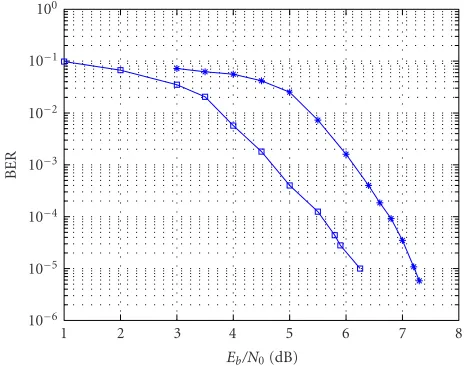
Figure7: Performance comparison between our method and the regular coding scheme for a rateR=1/2 over chB.N =1024.
for chA with roughly the same decoding complexity. The same remarks hold true for chB with an improvement of 0.8 dB.
Code optimized by the minimization of the threshold Code optimized by the minimization ofPe
1 2 3 4 5 6 7 8
Eb/N0(dB)
10−6 10−5 10−4 10−3 10−2 10−1 100
BER
Figure 8: Performance comparison over chA between the code obtained using the minPeand the minT methods.R = 1/2 and
N =1024.
Code optimized by the minimization ofPe
Code optimized by the minimization of the threshold 1 1.5 2 2.5 3 3.5 4 4.5 5 5.5 6
Eb/N0(dB)
10−5 10−4 10−3 10−2 10−1 100
BER
Figure 9: Performance comparison over chA between the code obtained using the minPeand the minT methods.R = 1/2 and
N =16384.
Figures 8 and 9 compare the performances of LDPC codes obtained with two different optimization criteria, namely, the minimization of the bit error probability minPe and the threshold minimization minT. In the case where
N = 1024 (Figure 8), the LDPC code obtained by minPe outperforms the one obtained by the minTmethod. For ex-ample, for a bit error rate (BER) equal to 10−5, we observe
an improvement equal to 1.1 dB. For N = 16384 depicted inFigure 9, two regions can be distinguished, namely, a re-gion in which the performances obtained by minPeare
bet-Optimized code ADSL channel Interleaved AWGN code ADSL channel
1 2 3 4 5 6 7 8
Eb/N0(dB)
10−6 10−5 10−4 10−3 10−2 10−1 100
BER
Figure10: Performance comparison over chAbetween our method and the LDPC code obtained by optimization on AWGN channel for a rateR=1/2.N=1024.
ter than ones obtained with minT. This region is defined for the SNRs lower than 5.15 dB. For SNR higher than 5.15 dB, the minT code presents a threshold phenomenon and out-performs the minPe code. So, for applications whereN is constrained to a relatively small value, the use of minPe criterion to design an optimized channel coding scheme will be preferable.
In order to be sure that the optimization of LDPC codes for a specific channel is of great importance, we have also compared our codes to irregular LDPC codes presented in [18], which have been optimized for the AWGN channel (with the same parameters, i.e.,ρ(x)=x7,t
cmax = 10, and R =1/2). Because the positions of the codeword bits are a result of our optimization process, we have added an inter-leaver in the case of the code optimized on the AWGN chan-nel. The comparison is done inFigure 10for a codeword of length 1024 and with the frequency-selective channel chA. We can notice that adapting the LDPC code irregularity to the channel shape leads to a high improvement of the coding performances.
5. DISCUSSION AND CONCLUSION
compared to a regular LDPC code. This improvement is greater than the one observed on stationary Gaussian chan-nel, which means that using irregular LDPC codes is even more important on OFDM frequency-selective channels than moresimplechannels.
We must emphasize that the proposed method does not required a perfect a priori knowledge on the CSI for the op-timization of the channel code and therefore is well suited to practical case. Actually, the a priori knowledge on the CSI is quite often incomplete due to the use of a short training se-quence to estimate it. Moreover, we think that our method is still interesting for a slowly varying channel and/or when channel estimation mismatches occurs. However, we are cur-rently working on the robustness of the optimized codes with respect to partial or wrong CSI. This work will be reported in future publication. Another discussion can be engaged to compare our approach and power allocation approach as in DMT standard. When perfect CSI knowledge is available at the transmitter, the power allocation transforms a frequency-selective channel into an AWGN channel. So, in theory, it is possible to find theoptimalchannel code leading to the fre-quency channel capacity. We can notice that this assumes a perfect power allocation with respect to waterfilling principle. Once again, in some practical case, perfect power allocation is not a realistic assumption due to the CSI estimation but also because power allocation implies the use of a bit load-ing algorithm which authorizes to use just a few number of constellations which assume to use integer bits. For these rea-sons, we believe that power allocation and irregularity pro-file optimization are not necessarily competitive and could be used jointly in order to achieve performance close to the capacity.
The methods that we have developed in this paper could also be successfully applied to multiuser multicarrier modu-lations such as MC-CDMA.
ACKNOWLEDGMENTS
We wish to thank the reviewers for their helpful comments that have improved the presentation of this paper and gave us some insights about future developments. This work was partially supported by the Groupe de Recherche Informa-tion, Signal, Images et Vision (GdR ISIS, CNRS).
REFERENCES
[1] J. A. C. Bingham, “Multicarrier modulation for data transmis-sion: an idea whose time has come,” IEEE Communications Magazine, vol. 28, no. 5, pp. 5–14, 1990.
[2] H. Sari, G. Karam, and I. Jeanclaude, “Transmission tech-niques for digital terrestrial TV broadcasting,”IEEE Commu-nications Magazine, vol. 33, no. 2, pp. 100–109, 1995. [3] W. Y. Zou and Y. Wu, “COFDM: an overview,”IEEE
Transac-tions on Broadcasting, vol. 41, no. 1, pp. 1–8, 1995.
[4] C. E. Shannon, “A mathematical theory of communication,”
Bell System Technical Journal, vol. 27, pp. 379–423, 623–656, July–October 1948.
[5] C. Berrou, A. Glavieux, and P. Thitimajshima, “Near Shannon limit error-correcting coding and decoding: Turbo-codes,” in
Proc. IEEE International Conference on Communications (ICC ’93), vol. 2, pp. 1064–1070, Geneva, Switzerland, May 1993. [6] M. Sipser and D. A. Spielman, “Expander codes,”IEEE
Trans-actions on Information Theory, vol. 42, no. 6, pp. 1710–1722, 1996.
[7] D. J. C. MacKay, “Good error-correcting codes based on very sparse matrices,” IEEE Transactions on Information Theory, vol. 45, no. 2, pp. 399–431, 1999.
[8] A. Shokrollahi and R. Storn, Design of Efficient Erasure Codes with Differential Evolution, Bell Laboratories, Murry Hill, NJ, USA, 1999.
[9] S.-Y. Chung, T. J. Richardson, and R. L. Urbanke, “Analysis of sum-product decoding of low-density parity-check codes using a Gaussian approximation,”IEEE Transactions on Infor-mation Theory, vol. 47, no. 2, pp. 657–670, 2001.
[10] D. Doan and K. Narayanan, “Design of good low rate codes for ISI channels based on spectral shaping,” inProc. 3rd Inter-national Symposium on Turbo-Codes & Related Topics, Brest, France, September 2003.
[11] H. Pishro-Nik, N. Rahnavard, J. Ha, F. Fekri, and A. Adibi, “Low-density parity-check codes for volume holographic memory systems,” Applied Optics-IP, vol. 42, no. 5, pp. 861– 870, 2003.
[12] D. Declercq, G. Gelle, and V. Mannoni, “Irregular chan-nel coding for OFDM transmission,” inProc. 6th Interna-tional Symposium on Communication Theory and Applications (ISCTA ’01), Ambleside, UK, July 2001.
[13] T. J. Richardson, M. A. Shokrollahi, and R. L. Urbanke, “De-sign of capacity-approaching irregular low-density parity-check codes,” IEEE Transactions on Information Theory, vol. 47, no. 2, pp. 619–637, 2001.
[14] F. Verdier and D. Declercq, “A LDPC parity check matrix con-struction for parallel hardware decoding,” inProc. 3rd Inter-national Symposium on Turbo-Codes & Related Topics, Brest, France, September 2003.
[15] F. R. Kschischang, B. J. Frey, and H.-A. Loeliger, “Factor graphs and the sum-product algorithm,” IEEE Transactions on Information Theory, vol. 47, no. 2, pp. 498–519, 2001. [16] J. Hou, P. H. Siegel, and L. B. Milstein, “Performance analysis
and code optimization of low density parity-check codes on Rayleigh fading channels,” IEEE Journal on Selected Areas in Communications, vol. 19, no. 5, pp. 924–934, 2001.
[17] C. R. Hartmann and L. D. Rudolph, “An optimum symbol-by-symbol decoding rule for linear codes,”IEEE Transactions on Information Theory, vol. 22, no. 5, pp. 514–517, 1976. [18] T. J. Richardson and R. L. Urbanke, “The capacity of
low-density parity-check codes under message-passing decoding,”
IEEE Transactions on Information Theory, vol. 47, no. 2, pp. 599–618, 2001.
[19] M. Capinski and E. Kopp, Measure, Integral and Probability, Springer-Verlag, New York, NY, USA, 1999.
[20] M. G. Kendall and A. Stuart,The Advanced Theory of Statistics, C. Griffin, London, UK, 2nd edition, 1963.
[21] V. Mannoni, D. Declereq, and G. Gelle, “Optimized irregular Gallager codes for OFDM transmission,” inProc. 13th IEEE International Symposium on Personal, Indoor and Mobile Ra-dio Communications (PIMRC ’02), vol. 1, pp. 222–226, Lisboa, Portugal, September 2002.
[22] R. Storn and K. Price, “Differential evolution—a simple and efficient heuristic for global optimization over continuous spaces,” Journal of Global Optimization, vol. 11, no. 4, pp. 341–359, 1997.
[24] T. J. Richardson and R. L. Urbanke, “Efficient encoding of low-density parity-check codes,” IEEE Transactions on Infor-mation Theory, vol. 47, no. 2, pp. 638–656, 2001.
[25] D. J. C. MacKay, S. T. Wilson, and M. C. Davey, “Com-parison of constructions of irregular Gallager codes,” IEEE Trans. Communications, vol. 47, no. 10, pp. 1449–1454, 1999.
Val´erian Mannoni was born in 1977 in Brou-sur-Chantereine, France. He received the Diplome d’Etudes Approfondies (M.S.) degree in automatic and digital signal processing from the University of Reims Champagne-Ardenne, Reims, France, in 2000. Since October 2000, he has been pursuing the Ph.D. degree in the Labora-tory of Decision and Communication Sys-tems (D´eCom), the University of Reims
Champagne-Ardenne and in the ETIS laboratory, the University of Cergy-Pontoise, France. His research interests are in the channel coding for the multicarrier transmissions, more especially with the Low-Density Parity-Check codes.
David Declercqreceived his Ph.D. degree in electrical and computer engineering in 1998 from the University of Cergy-Pontoise, France. He is now an Associate Professor at the ETIS laboratory in the University of Cergy-Pontoise, in the Signal Process-ing Research Group. He is the Head of the Signal Processing Group since 2003. His research interests are mainly in statistical model estimation and information theory
for digital communication. In particular, he is interested in design-ing good LDPC codes for various types of nonstandard channels (OFDM, multiuser, etc.).
Guillaume Gelle was born in France in 1969. He received the DEA (M.S.) degree in 1994 and the Ph.D. degree in 1998 from the University of Reims Champagne-Ardenne in electrical and computer engineering. He is currently an Associate Professor in the Deptartment of Electrical Engineering and in the Laboratory of Decision and Com-munications Systems (D´eCom) where he leads the Communication Systems Team