ABSTRACT
HA, EUN YOUNG. Modeling Discourse Structure and Temporal Event Relations for Automated Document Summarization with Markov Logic Networks. (Under the direction of James C. Lester.)
Recent years have seen significant progress in natural language processing. A key challenge posed by many natural language applications ranging from text summarization to question answering and machine translation is designing an effective discourse processing framework. Linguistic phenomena that hold across sentence boundaries are still not well understood, even though they provide crucial knowledge for integrating the information communicated by individual sentences. Our work addresses automatic processing of natural language spanning multiple sentences. More specifically, it concerns modeling discourse structure and temporal event relations in support of automated document summarization.
Modeling Discourse Structure and Temporal Event Relations for Automated Document Summarization with Markov Logic Networks.
by Eun Young Ha
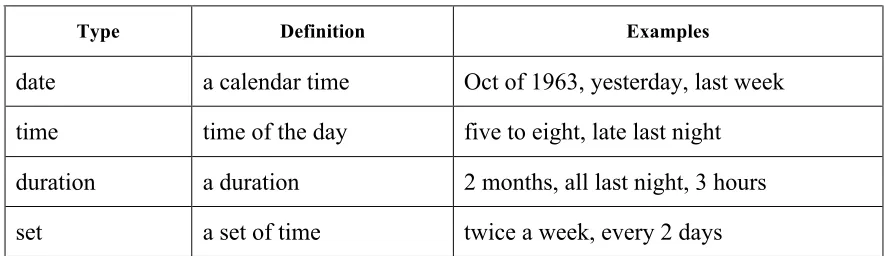
A dissertation submitted to the Graduate Faculty of North Carolina State University
in partial fulfillment of the requirements for the Degree of
Doctor of Philosophy
Computer Science
Raleigh, North Carolina
2010
APPROVED BY:
___________________________ ___________________________ Patrick J. FitzGerald Robert D. Rodman
___________________________ ___________________________ R. Michael Young James C. Lester
DEDICATION
BIOGRAPHY
ACKNOWLEDGMENTS
First and most, I would like to thank my advisor James Lester, who has provided me continuous support and encouragements during my Ph.D. study. He has been a great advisor throughout the years of collaboration and also is a lifetime role model. I am deeply grateful to the members of my committee, Patrick FitzGerald, Robert Rodman, and Michael Young, for their insightful comments and suggestions.
I greatly benefited from working with talented colleagues in the IntelliMedia research group. Kristy Boyer kindly read earlier drafts of this dissertation and provided numerous suggestions to improve the quality of its presentation. Alok Baikadi implemented the software to compute the transitive and the symmetric closure for the VerbOcean verb relations. I have enjoyed helpful discussions with Julius Goth, Joe Grafsgaard, Seung Lee, Bradford Mott, Chris Mitchell, Rob Phillips, Jonathan Rowe, Marc Russo, Jennifer Sabourin, Andy Smith, Michael D. Wallis, and Donnie Wrights. I was also fortunate to collaborate with an undergraduate researcher, Carlyle Licata, who applied his talents to implementing feature extractors for the discourse parser and the temporal analyzer.
Last but not the least, I would like to thank my best friend and husband, Sung Ho, daughter, Jiun, and my parents, for their patience, encouragements, and loving care during my pursuit of the Ph.D. study. It was impossible for me to complete this journey without their unconditional support. I am also very grateful to my brother, Jong Wook, and his family, for their emotional support.
TABLE OF CONTENTS
LIST OF TABLES... viii
LIST OF FIGURES ... ix
CHAPTER 1 Introduction... 1
1.1 Motivation... 2
1.2 Challenges... 4
1.3 Research Questions and Hypotheses... 7
1.4 Approach... 8
1.5 Contributions... 10
1.6 Organization... 11
CHAPTER 2 Related Work and Background... 12
2.1 Discourse Parsing... 12
2.2 Sentence Compression ... 15
2.3 Modeling Temporal Relations ... 20
2.4 Markov Logic... 22
CHAPTER 3 Discourse Parsing with Markov Logic... 26
3.1 Rhetorical Structure Theory... 27
3.2 Modeling Discourse Structure ... 29
3.3 The Corpus... 30
3.4 Features ... 31
3.5 The Markov Logic Network ... 35
3.6 Model Training ... 37
CHAPTER 4 Discourse-Based Sentence Compression... 41
4.1 Task Definition ... 42
4.2 Discourse-Based Sentence Compression ... 44
4.3 Architecture... 46
4.4 Summary of Chapter ... 48
CHAPTER 5 Modeling Temporal Relations with Markov Logic and Lexical Ontology ... 50
5.1 Task Definition ... 52
5.2 The Corpus... 53
5.3 Features ... 55
5.4 The Markov Logic Network ... 59
5.5 Model Training ... 64
5.6 Summary of Chapter ... 67
CHAPTER 6 An Implemented Document Summarization System... 68
6.1 Architecture... 68
6.2 Three Phases of Document Summarization ... 71
6.3 An Illustrated Procedure ... 73
6.4 Summary of Chapter ... 76
CHAPTER 7 Evaluation... 77
7.1 Evaluation of Learned Discourse Model ... 77
7.2 Sentence Compressor Evaluation... 84
7.3 Evaluation of Learned Temporal Relation Model ... 89
7.4 Summary of Chapter ... 93
CHAPTER 8 Conclusion ... 94
8.1 Hypotheses Revisited... 95
8.3 Limitations ... 99
8.4 Future Work ... 100
8.5 Concluding Remarks... 101
REFERENCES... 103
APPENDICES... 114
APPENDIX A: Predicate Definition for the Discourse Structure MLN... 115
APPENDIX B: Predicate Definition for the Temporal Event Relations MLN... 117
LIST OF TABLES
[1]Table 2.1. Example of a first-order knowledge base and corresponding MLN...24
Table 3.1. Hidden and observable predicates in the proposed MLN...36
Table 5.1. Event attributes defined in TimeML...54
Table 5.2. Types of time expressions...54
Table 5.3. Semantic relations between verbs in VerbOcean ...58
Table 5.4. Hidden and observable predicates in the proposed MLN...61
Table 5.5. Optimized feature sets for each task ...66
Table 7.1. Performance of learned models ...81
Table 7.2. Comparison with other systems...83
Table 7.3: Average ratings by human subjects and compression rates...87
Table 7.4: Example compressions shown to human judges ...88
Table 7.5. Results of joint models without global constraints...90
Table 7.6. Results of joint models with global constraints ...91
Table 7.7: Confusion matrix for predicted temporal relations...92
LIST OF FIGURES
[2]Figure 2.1. Graphical structure of MLN in table 2.1 ...24
Figure 3.1. Example discourse tree...28
Figure 3.2. Illustrated example of head node and attachment node...33
Figure 3.3. Binary conversion of n-ary relations ...38
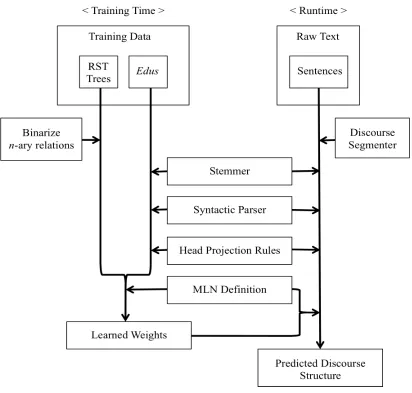
Figure 3.4. Training and Runtime Procedures ...39
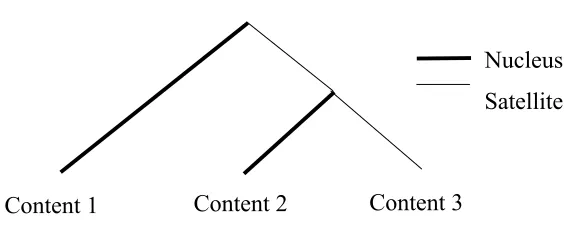
Figure 4.1. Hierarchical nuclearity structure ...46
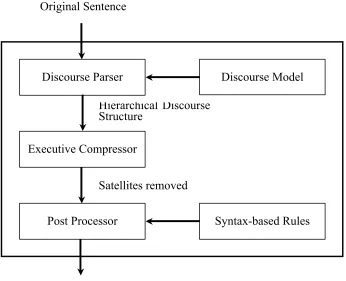
Figure 4.2. Architecture of Sentence Compressor ...47
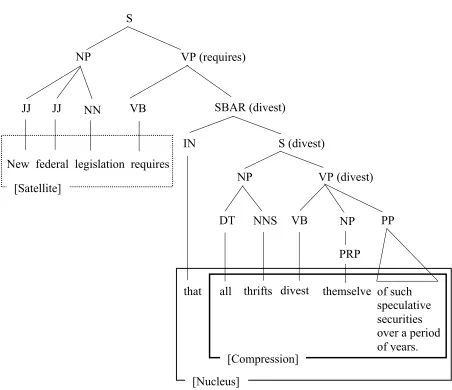
Figure 4.3. Illustration of satellite removal and the grammaticality post-processor ...49
Figure 6.1. Architecture of the integrated system...69
Figure 6.2. Three Phases of Automated Summarization ...72
CHAPTER 1
Introduction
Language is believed to be a window into human intelligence. Naturally, making computers understand human language is one of the fundamental problems within the field of artificial intelligence (AI). As a subfield of AI, natural language processing (NLP) concerns automatic processing of either written or spoken human language by computers.
NLP has many practical application areas. For instance, automated text summarization aims to automatically generate concise summaries of text. Machine translation translates text written in one language into another language. Information extraction aims to automatically extract from text certain facts that are related with an entity of interest (i.e., extracting time, location, and participants for an event described in a text). Question-answering automatically answers a question that is given in natural language. Information retrieval returns documents that are relevant to the natural language queries posed by humans. Despite the difference in the targeted tasks, the common theme in these applications is to make information content more easily consumable, which will help both human and computers process information content more efficiently.
phenomena that hold across sentence boundaries are still understudied, even though they provide crucial knowledge for combining the information contained in individual sentences.
This dissertation addresses automatic processing of human language at a level that is beyond individual sentences. More specifically, the research described in this dissertation concerns automated text summarization. With increasing volume of digital information, automated text summarization techniques promise much appeal as they can condense important information content into a concise representation. Given a single document at a time, the goal of the proposed summarizer is to generate a concise summary of the original document. Generating a document summary requires both understanding the original document and generating a new summary text. The proposed summarizer utilizes the knowledge about the discourse structure of a given document in order to understand its content. In order to generate a summary of the document, the summarizer refers to the temporal relations among the events described in the document.
1.1 Motivation
The first step of automated summarization is to analyze the meaning of the original document in order to recognize important content. The automatic summarizer described in this dissertation utilizes the analyzed discourse structure of the original document in order to extract salient content that will be included in the summary. Discourse structure is what makes a coherent text distinguishable from a random collection of sentences (Marcu, 2000). In other words, discourse structure is an implicit mechanism by which sentences and paragraphs are semantically related with each other to form well-written text. Therefore, acquiring knowledge of this implicit structure is an essential requirement for the comprehensive understanding of text. Previous research (Daumé and Marcu, 2002; Clarke, 2008) has shown that knowledge of the discourse structure of a document plays an important role in identifying salient information within it.
Another important step of automated summarization is structuring the extracted content into a summary. Many genres of human-written text, such as news articles, children’s stories, and criminal reports, describe the sequences of events that occur along a certain timeline. Mani (2005) suggests the temporal order of events is a natural way of structuring the content of the summary when there are inherent temporal semantics in the original content. Adopting this suggestion, the automatic summarizer described in this dissertation structures the content of the summary according to a chronological order of the events.
Therefore, finding an effective strategy for ordering the extracted content is often challenging (Mani, 2001). Second, temporal ordering could reduce the cognitive burden on readers by removing ambiguities in temporal relations that are often present in human-written text (Mani, 2005). Third, when the summarizer is used as a module in a larger system, it could provide richer semantic information (i.e., temporal relations among events) to other modules. 1.2 Challenges
This work proposes a novel approach to automated single document summarization. Given a single document at a time, the proposed summarizer aims to generate a summary of the document by extracting salient content based on the discourse structure of the original document and then by structuring the extracted content in a chronological order. The proposed task poses a number of challenges, which are described in the following sections.
1.2.1 Modeling Discourse Structure
Although discourse modeling within the RST framework has been extensively studied in previous work, it still remains an unsolved problem (Marcu, 2000; Reitter, 2003; Soricut and Marcu, 2003; LeThanh et al., 2004; Sporleder and Lascarides, 2004; Sporleder and Lapata, 2005; duVerie and Prendinger, 2009). In fact, the only discourse parser publicly available today is limited to intra-sentence discourse phenomena, meaning the discourse phenomena that hold beyond the sentence level is not being well understood yet (Soricut and Marcu, 2003). One line of research has addressed discourse analysis of entire documents (LeThanh et al., 2004; duVerie and Prendinger, 2009). However, these approaches have not yet achieved the same level of performance as in other fields of NLP. The accuracy of the state-of-the-art discourse parser (duVerie and Prendinger, 2009) is below 60% in terms of the F1 measure, on building complete rhetorical structure trees, while syntactic parsing has already achieved over 80% accuracy for newspaper articles (Charniak, 2000).
There are many linguistic cues that show certain properties of discourse structure. For example, tense can signal temporal relations. The presence of a proposition in one sentence and the referred noun phrase in another sentence can imply the semantic relatedness of the two sentences. However, these cues are often ambiguous or absent. For instance, duVerie and Prendinger (2009) find that using an explicit set of about 300 discourse-signaling cue phrases suggested by Oberlander et al. (1999) did not improve the performance of their discourse parser.
1.2.2 Modeling Temporal Relations
One line of research has focused on recognizing the different knowledge sources that contribute to inferring the temporal relations among events (Passoneau, 1988; Webber, 1988; Hwang and Schubert, 1992; Kamp and Reyle, 1993; Lascarides and Asher, 1993; Hitzeman et al., 1995; Kehler, 2000). Among the recognized features are temporal adverbials, tense and aspect of verbs, rhetorical relations, pragmatic conventions, and background knowledge. However, the mapping between these knowledge sources and the temporal relations is not always straightforward, as can be shown in the following two examples.1
Max stood up. John greeted him. (1.1)
Max fell. John pushed him. (1.2)
While these two examples have the same tense structure (past tense followed by another past tense), they represent different temporal relations. In example 1.1, the order of the sentences follows the chronological order of the two events (Max’s standing up occurs BEFORE John’s greeting max). However, in example 1.2, the order of the sentences is reversed (Max fell AFTER John pushed him). In other words, example 1.1 follows a pragmatic convention of describing events chronologically, while this convention is overridden in example 1.2 by a rhetorical relation (explanation). Also, according to Lascarides and Asher (1993), humans use commonsense to reason about the temporal relations in 1.2. However, a commonsense database that is large enough for automatic temporal reasoning for the general domain does not exist and building a new one is both time- and cost-expensive.
1.3 Research Questions and Hypotheses
To address the challenges described in the previous section, this dissertation aims at answering the following research questions.
Research Question 1: What properties of discourse are useful for identifying important content to be included in the summary?
Hypothesis 1: Because the notion of salience of meaning is reflected in the nuclearity information within RST, the nuclearity structure of documents can inform the relative importance of content (Sections 4.2, 4.3, 7.2).
Research Question 2: How can the structure of discourse be modeled when explicit discourse markers may be ambiguous or absent?
Hypothesis 2.1: The discourse structure of documents can be modeled in a data-driven way using statistical machine learning techniques with shallow linguistic features, such as lexical, punctuational, syntactic, and organizational features, instead of using explicit discourse markers (Sections 3.2 - 3.6, 7.1).
Research Question 3: How can temporal relations be modeled when the temporal expressions may be abstract or absent?
Hypothesis 3.1: A temporal relation model can be modeled in a data-driven way, using a statistical machine learning technique with a variety of features, such as surface features (e.g., word tokens and stems), manually annotated semantic attributes of events and time expressions, syntactic features, and lexical relations (Sections 5.2 - 5.5, 7.3).
Hypothesis 3.2: Analyzing temporal relations among events often requires commonsense reasoning. Because lexical ontologies provide commonly agreed semantic relations between words, they will provide important clues to temporal relation identification (Section 5.3, 7.3)
Hypothesis 3.3: Temporal relations are transitive. That is, if event A happens before event B and B happens before event C, then it also holds that A happens before C. Imposing the transitive property of the temporal model as global constraints improves the quality of the learned model (Sections 5.4, 7.3).
1.4 Approach
described in this dissertation addresses each of these as follows. The domain is newspaper articles.
• Analysis (Chapter 3). This phase analyze the nucelarity structure of the original document by referring to a model of nuclearity structure. Using a supervised machine learning approach, the nuclearity structure model is learned from a corpus of newspaper articles that is manually annotated with discourse structure. Markov logic (Richardson and Domingos, 2006) is used as the learning framework in order to jointly model the rhetorical relatedness of two adjacent discourse units and the nuclearity assignment to individual discourse units. This phase addresses hypotheses 2.1 and 2.2.
• Refinement (Chapter 4). The refinement phase transforms the original sentences into new sentences, which will be placed in the summary. A sentence compression technique (Knight and Marcu, 2000) is adopted. Sentence compression aims to summarize individual sentences only by deleting certain words from the original sentence. Based on the inferred nuclearity structure from the analysis phase, the refinement phase removes all the satellites from the original sentences. Simple post-processing rules are additionally applied after the deletion of the satellites to improve the grammaticality of the resulting compressed sentences. This phase addresses hypothesis 1.
1.5 Contributions
This dissertation makes the following contributions to the field of NLP.
• Joint modeling for discourse structure. The Markov logic approach for the nuclearity structure of text jointly models the rhetorical relatedness of two adjacent discourse units and the nuclearity assignment to individual discourse units. Previous work has shown joint modeling approaches improve the performance of learned model for many NLP tasks (Poon and Domingos, 2008; Meza-Ruiz and Riedel, 2009; Yoshikawa et al., 2009).
• Discourse-based sentence compression. The sentence compression technique based on the nuclearity structure of text can be used to recognize important content from the original document and to transform the original sentences by removing the satellites. The empirical evaluation with human judges shows that the discourse-based sentence compression approach can effectively identify important content from the original documents.
• Joint modeling for temporal relations of events. Temporal relations of events can be effectively modeled with Markov logic using a variety of features, including lexical ontologies. Joint modeling improves the overall performance of the learned model, by imposing global constraints for the transitivity of temporal relations over the local temporal relation models (Ha et al., 2010a; Ha et al., 2010b).
• Temporal ordering as a strategy for structuring summary content. The usefulness of temporal ordering as a strategy for structuring summary content is explored. A prototype single document summarizer that utilizes the temporal strategy was implemented as a proof-of-concept.
1.6 Organization
CHAPTER 2
Related Work and Background
The work presented in this dissertation draws on several lines of research in computational linguistics that have been developed independently of each other, including discourse parsing, sentence compression, and modeling temporal relations of events. The following sections provide overviews of each of these areas. We also introduce the Markov logic statistical relational learning framework, which forms the technical backbone of our work. 2.1 Discourse Parsing
Much discourse parsing work to date has employed the Rhetorical Structure Theory framework (Marcu, 2000; Reitter, 2003; Soricut and Marcu, 2003; LeThanh et al., 2004; Sporleder and Lascarides, 2004; Sporleder and Lapata, 2005; duVerie and Prendinger, 2009), which explains the rhetorical structure of a text in terms of semantic relations (rhetorical relations) that hold between adjacent text spans and the salience (nuclearity) of a text span in relation to another text span. Some of these efforts have addressed full tasks of discourse parsing, including 1) segmenting text into elementary discourse units (edus)2, 2) combining smaller text spans into a larger span with a rhetorical relation, 3) identifying the type of rhetorical relation that combines two smaller text spans, and 4) assigning nuclearity (either nucleus or satellite) to the text spans.
2Elementary discourse unit (edu) is defined as a minimal unit of the discourse that represents a single concept (Mann and
Marcu (2000) proposed the first data-driven approach to full discourse parsing based on decision-tree classifiers, where discourse parsing proceeds in two steps: first, identifying edu boundaries with a discourse segmenter, and second, building up the hierarchical discourse tree of an entire text with the parsing model. The discourse segmenter was trained using a decision-tree classification technique with a total of twenty-five features, including the part-of-speech (pos) tags within a 5-word window of context, discourse markers, and punctuation marks. Given a list of edus, the parsing model builds up the rhetorical structure tree by applying shift and reduce operations adopted from syntactic parsing algorithms.
The rule-based discourse parser of LeThanh et al. (2004) similarly decompose the task of building discourse tree into two levels of analysis, sentence-level and text-level. The sentence-level discourse parser first segments edus and builds the discourse structure of sentences with edus. In the next step, the text-level discourse parser aggregates the sentence-level discourse structures and into a single hierarchical tree structure. A beam search is used to determine the best discourse structures. The rules used by the discourses parses at both levels are based on syntactic information and cue phrases, and cohesive devices such as synonyms and hyponyms.
Reitter (2003) views parsing as a series of classification decisions. As a chart parser proceeds one segment at a time, it tries to determine the best hypothesis for the rhetorical relation between the text spans that have been identified thus far. Rhetorical relations are modeled with support vector machines (SVMs) using a rich set of features at different linguistic levels, such as punctuation, parts-of-speech of the words at the boundary of text spans, length of text spans, and lexical chains (Hirst and St-Onge, 1998). However, in that work the parsing algorithm that employs the rhetorical relation classifiers is only conceptually proposed but never implemented.
set is used for predicting the relatedness of two adjacent text spans and another is used to predict the rhetorical relation. The classifiers are repeatedly applied in an alternating manner to build up a hierarchical discourse tree from a given set of edus. The set of 18 rhetorical relations considered by their system is expanded to 41 unique labels that augment rhetorical relations with possible combinations of nuclearity.
Several attempts have focused exclusively on the discourse structure at a specific level of text organization. For instance, Soricut and Marcu (2003) are concerned with sentence-level discourse structure. They build statistical models for discourse segmenting and discourse parsing based on the concept of dominance set. The dominance set is a feature representation of a lexicalized syntactic tree for an edu, which includes the syntactic and the lexical contexts of the edu at its boundary. Using this information, the discourse segmenter determines whether to insert a discourse boundary after each token in the sentence. The discourse parser searches through the space of all legal discourse parse trees based on the learned discourse model in a bottom-up manner.
Similar to Soricut and Marcu (2003), Sporleder and Lapata (2005) present a discourse chunking technique that operates at the sentence level. While Soricut and Marcu’s discourse parser builds a complete discourse hierarchy of individual sentences by annotating each node in the discourse tree with both rhetorical relations and nuclearity, Sporleder and Lapata’s discourse chunker assumes a flat structure of sentence-level discourse and labels each edu with its nuclearity. Their proposed chunking algorithm proceeds in two steps, segmentation and labeling. The models for segmenting and labeling are built with a variety of linguistic features, including tokens, parts-of-speech, syntactic chunks, clause information, discourse connectives, token position and context.
linguistic cues that signal rhetorical relations in smaller text spans such as inter-sentential level are not valid in larger text spans. Also, training instances become more sparse. The proposed approach utilizes a hierarchical clustering technique to build a tree structure with a set of paragraphs. This technique uses segment position, segment length, term overlap, punctuation, tense, cue phrases, and lexical chains.
Several efforts have leveraged the utility of other frameworks outside of RST for discourse parsing. Forbes et al. (2001) propose a full discourse parser based on Lexicalized Tree Adjoining Grammars (XTAG-Group, 1995). A rule-based parser of Polanyi et al. (2004) is based on the Linguistic Discourse Model framework (Polany, 1988), which provides a semantic account of discourse structure. Baldridge and Lascarides (2005) develop a probabilistic head-driven discourse parser for dialogue based on Segmented Discourse Representation Theory (Asher and Lascarides, 2003). Wellner et al. (2006) build a maximum entropy classifier of rhetorical relations based on the Graphbank corpus (Wolf and Gibson, 2005), which represents informational discourse relations as a graph. Subba and Di Eugenio (2009) propose a full discourse parser for instructional text trained on a corpus whose annotation is based on both the coding scheme for explanatory dialogue (Moser et al., 1996) and RST.
Like the majority of the previous work, our approach is based on RST. However, it differs from previous work in that our focus is on the explicit construction of the nuclearity structure of entire texts as an independent subtask of discourse parsing, separate from rhetorical relation classification. Our approach is the first to employ joint modeling for discourse parsing.
2.2 Sentence Compression
Turner and Charniak, 2005; Galley and McKeown, 2007), and maximum entropy (Riezler et al. 2003) to support vector machines (Le Nguyen et al., 2004), large-margin online learning (McDonald, 2006), and Integer Linear Programming (Clarke, 2008; Filippova and Strube, 2008).
Knight and Marcu (2000) are among the first who propose a data-driven approach to sentence compression based on a noisy-channel model. This model assumes that the sentences were originally a shorter string (the compression) and then optional words and phrases were added to the original string. The goal of this approach is to identify the original string from which a given sentence was derived. The noisy-channel model consists of three components: a source model, a channel model, and a decoder. Based on probabilistic context-free grammar (PCFG) rules and a bigram language model, the source model assigns to every string a probability that this given string is generated as an original short string. The channel model assigns every pair of strings a probability that one is an expansion of the other, in which the channel probability is calculated as the product of the probability for each required transformation to expand the short string to the long string. The decoder searches for a short string that maximizes the probability of the short string given a long string.
To address the lack of training data, Turner and Charniak (2005) propose an unsupervised approach to sentence compression based on the noisy channel model of Knight and Marcu (2000). Because a parallel corpus of original sentences and compressions is no longer available, their unsupervised model modifies the channel model to use joint rules approximated from Penn Treebank (Marckus et al., 1999).
sentence compression, the target-side string (the compression) is restricted as a substring of the source-side string (the original long sentence). Markovization factorizes n-ary grammar productions into products of n right-hand side probabilities.
While the noisy-channel technique is a generative method that models the joint probability of a given sentence and its compression, a different line of research has proposed a discriminative approach. Riezler et al. (2003) presents a method based on a maximum entropy classification technique. To produce a compressed version of a sentence, their system first parses the sentence using Lexical Functional Grammar for English, producing a set of packed functional structures (f-structure) for an ambiguous sentence. In the next step, a transfer component modifies the parser output to reduced f-structures, which are then filtered by a generator to determine syntactic well-formedness. Using a maximum entropy disambiguator trained on parsed and manually disambiguated f-structures for pairs of sentences and their compressions, the most probable reduced f-structure is selected. A string (compression) is generated from this f-structure.
Le Nguyen et al. (2004) propose a probabilistic method for sentence compression based on SVMs. Their goal is to generate globally optimal compressions, in which the aggregated compression probability for an entire document is maximized. Compression rules are learned with SVMs using syntactic, semantic, and operation features.
Clarke (2008) and Filippova and Strube (2008) utilize Integer Linear Programming (ILP) (Vanderbei 2001) for sentence compression. Clarke (2008) views sentence compression as an optimization problem, in which a compression is a substring of a given long sentence that maximizes a scoring function. The scoring function is a language model combined with a set of constraints that ensures grammaticality of the output compression. Within the ILP framework, these language model and constraints are encoded as linear inequalities.
Filippova and Strube (2008) present an approach that compresses dependency trees of a given word, not strings of words. Similar to Clarke (2008), they consider sentence compression an optimization problem, which is solved using ILP. Taking syntactic constraints and the importance of a word to a given topic into account, the proposed method compresses sentences by removing dependency edges from the dependency tree of a given sentence.
Despite the diversity of the techniques employed, most approaches rely primarily on syntactic features derived from the syntactic parse structure of a sentence to determine which sentence constituents (e.g., words, phrases, or clauses) to remove. While relying on syntactic structure offers the advantage of assuring the grammaticality of resulting compressions, syntactic structure alone does not provide much information about the semantic importance of a given sentence constituent.
within a training corpus, indicating the relative significance of the topic word. Similar techniques are adopted in later work (Clarke, 2008; Filippova and Strube, 2008).
In contrast to these approaches that compute the focus of meaning only at a local lexical level, Sporleder and Lapata (2005) propose a sentence compression technique that computes the focus of meaning in terms of discourse salience based on the RST framework. Using a discourse chunker trained on a corpus annotated with nuclearity information (Carlson et al., 2002), each edu in a sentence is assigned a nuclearity label whose value is either nucleus or satellite. Following the widely accepted assumption that satellites can often be deleted without harming discourse coherence, their sentence compressor removes all the satellites and generates a compression by concatenating remaining nuclei.
While conceptually appealing, this approach has the drawback that it does not employ any additional mechanisms to ensure the grammaticality of the resulting compression. For example, there are cases in which an edu that includes the main subject and the main verb of a sentence is a satellite. In such cases, removing the satellite is likely to result in an ungrammatical compression. Another limitation is that the discourse chunking technique attempts to model only sentence-level discourse structure. While this is not necessarily a problem with the task of sentence compression, it limits the scope of the applicability of the approach.
2.3 Modeling Temporal Relations
With the recent emergence of the TimeBank corpus (Pustejovsky et al., 2003b), data-driven approaches to modeling temporal relations are gaining momentum. Boguraev and Ando (2005) is the first to address temporal relation recognition based on the TimeML markup language for events and temporal relations (Pustejovsky et al. 2003a), which the annotation scheme for the TimeBank corpus complies with. Boguraev and Ando apply semi-supervised learning using a word profiling technique, which uses features based on word co-occurrence counts to recognize events and to infer temporal relations between time expressions and their anchored events in TimeBank.
Mani et al. (2006) focus on the prediction of six types of temporal relations (simultaneous, before, immediately before, begins, ends, and includes) between events as well as between events and time expressions. They train maximum entropy classifiers on the combination of TimeBank and the Opinion Corpus3 using gold standard features. To address
data sparseness, they expand training data by computing the transitivity of temporal relations, which improves the accuracies of the prediction.
The TempEval-1 shared task challenge (Verhagen et al., 2007) proposes three standard tasks for analyzing temporal relations of events, which includes indentifying temporal relations between events and time expressions within the same sentence; events and document creation times; and events in adjacent sentences. Six types of temporal relations (before, before-or-overlap, overlap, overlap-or-after, after, and vague) are considered.
To address this challenge, the participants of TempEval-1 investigate a variety of features. Bethard and Martin (2007) approach the task of temporal relation identification as pair-wise classification tasks and introduce syntactic features generated by a phrase-based syntactic parser. An SVM classifier is trained for each of the three temporal relation
identification tasks with syntactic parse-driven features as well as manually annotated semantic attributes of the events and time expressions. To ensure consistency between the classifier decisions, the classifiers are pipelined such that the output of one classifier is provided as an input to the other two classifiers.
Cheng et al. (2007) present a sequence-labeling approach to temporal relation classification that utilizes a sequence labeling technique. The features to represent the target instances are derived from dependency parse trees, indicating the position of the target node in relation to other nodes in the dependency parse tree. The sequence labeling model is trained using HMM-SVM4.
In contrast to the other participants in TempeEval-1 who take a machine-learning approach, Puscasu (2007) incorporates a knowledge base into statistical techniques. The proposed approach relies on the syntactic structure of the sentences, as well as the propagation of the temporal relations between syntactic constituents in a bottom-up manner. They use syntactic and lexical properties of the constituents and the relations between them.
While most machine learning approaches model temporal relations as local pairwise classifiers that ignore possible inconsistencies among predicted temporal relations, Chambers and Jurafsky (2008) show that adding global constraints over local classifiers improves model accuracy by enforcing consistency between local classification decisions. Using ILP, they model two-way (before and after) temporal relations between events.
Similarly, Yoshikawa et al. (2009) show that joint modeling improves temporal relation classification based on the Markov logic framework. Using TempEval-1 data, they address three subtasks including prediction of 1) temporal relations between events and temporal expressions in the same sentence, 2) between events in a document and the document creation time, and 3) between two main events in consecutive sentences.
Our work is most closely related to Yoshikawa et al. (2009) in that Markov logic is used for joint modeling of temporal relations. However, our approach is different from their work in two primary respects. First, we introduce new lexical relation features derived from two English lexical ontologies, WordNet (Fellbaum, 1998) and VerbOcean (Chklovski and Pantel, 2004), as effective predictors of temporal relations between two events. Second, our model addresses a new task introduced in TempEval-2, which is to identify temporal relations between main and syntactically dominated events in the same sentence. We also employ phrase-based syntactic features (Bethard and Martin 2007) rather than dependency-based syntactic features.
2.4 Markov Logic
Markov logic is a statistical relational learning framework (Getoor and Taskar, 2007) that focuses on joint inference of statistical variables by incorporating global correlations that hold between them. Markov logic is a probabilistic extension of first-order logic that allows formulae to be violated. In contrast to first-order logic that assigns a possible world either 1 (when a world satisfies all the formulae) or 0 probability (when a world violates one or more formulae), Markov logic assigns a weight to each formula, reflecting the strength of the constraint the formula represents. Thus, Markov logic is equivalent to first-order logic in its syntax except that each formula has an associated weight. Semantically, Markov logic formulae represent a probability distribution over possible words. From the probability perspective, Markov logic offers a compact language by which large Markov networks can be specified, allowing a modular approach to incorporate knowledge bases into them. From the first-order logic perspective, Markov logic provides a mechanism to handle uncertainty and contradictory knowledge.
each ground predicate has a corresponding binary node and each ground formula is a feature. The value of a binary node is 1 if the ground predicate is true; otherwise it is 0. Similarly, the value of a feature is 1 if the ground formula is true; otherwise it is 0. The probability of a state
€
x in a MLN is given by
€
P(X =x)= 1
Zexp i=1ωini(x) F
∑
(2.1)
where
€
F
is the number of formulae in the MLN,€
ω
i is the weight of the€
i
th clause€
f
i in€
x,
€
ni(x) is the number of true groundings of
€
f
i in€
x, and
€
Z
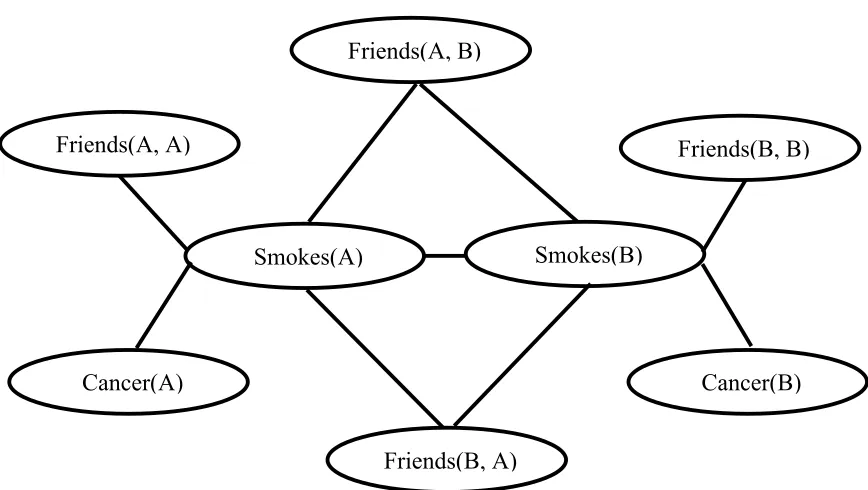
is a normalization constant. MLNs define probability distributions over possible worlds. An MLN can be viewed as a template by which one can construct Markov networks. Different sets of constants result in different Markov networks, but there are certain regularities across different Markov networks that are maintained by the structure of the MLN.Figure 2.1 shows a graphical structure of a ground MLN, which is constructed by applying constants A and B to the MLN in Table 2.1.5 Each node in this graph is a ground
atom. There is an edge between two nodes in the MLN if and only if there is at least one grounding of one formula in which the two ground atoms appear together.
Table 2.1. Example of a first-order knowledge base and corresponding MLN
First-Order Logic Clausal Form Weight
€
∀
xSmokes
(
x
)
⇒
Cancer
(
x
)
Smoking causes cancer.
€
¬
Smokes
(
x
)
∨
Cancer
(
x
)
1.5€
∀
x
∀
yFriends
(
x
,
y
)
⇒
(
Smokes
(
x
)
⇔
Smokes
(
y
))
If two people are friends, either both smoke or neither does.
€
¬Friends(x,y)∨Smokes(x)∨¬Smokes(y)
€
¬Friends(x,y)∨¬Smokes(x)∨Smokes(y)
1.1 1.1
Friends(A, B)
Friends(A, A) Friends(B, B)
Friends(B, A)
Smokes(A) Smokes(B)
Cancer(A) Cancer(B)
CHAPTER 3
Discourse Parsing with Markov Logic
It is widely agreed that text is not merely a sequence of clauses and sentences but exhibits a complex discourse structure. While the discourse structure of text is not explicitly visible at the level of word strings, its presence is perceived by readers as the coherence of the text (Marcu, 2000). When this structure is absent, text becomes difficult to understand. In other words, discourse structure is an implicit mechanism by which individual phrases and sentences are glued together. To be able to correctly understand the meaning of text, natural language systems should be able to infer discourse structure of the text. Discourse parsing aims at automatically deriving this implicit discourse structure of text, which requires the recognition of basic building blocks of discourse and creating a structure with those building blocks.
the context of preceding questions (Chai and Jing, 2004; Sun and Chai, 2007). In an automated essay scoring system, discourse models learned from well-written text could be used to score coherence of student-written essays (Burstein and Marcu, 2003).
However, discourse parsing remains a hard problem. A publicly available discourse parser that is capable of analyzing a full document has not emerged yet. Current state-of-the-art accuracy for discourse parsing is still low (duVerie and Prendinger, 2009). The linguistic cues that signal different discourse properties are not fully understood yet.
Addressing these challenges, this chapter proposes a data-driven approach to modeling discourse structure. Our approach utilizes a supervised machine learning approach to automatically analyze the nuclearity structure of text, based on RST (Mann and Thompson, 1988). RST is among the most influential computational frameworks for discourse analysis for text. It has been applied to many different areas of natural language processing including text generation, parsing, summarization, argument evaluation, machine translation, and essay scoring (Taboada and Mann, 2006).
3.1 Rhetorical Structure Theory
the satellite. Relations could be either mononuclear or multinuclear. Mononuclear relations hold between two text spans when one text span (the nucleus) is more important than the other text span (the satellite). Multinuclearrelations hold among two or more text spans that are equally important.
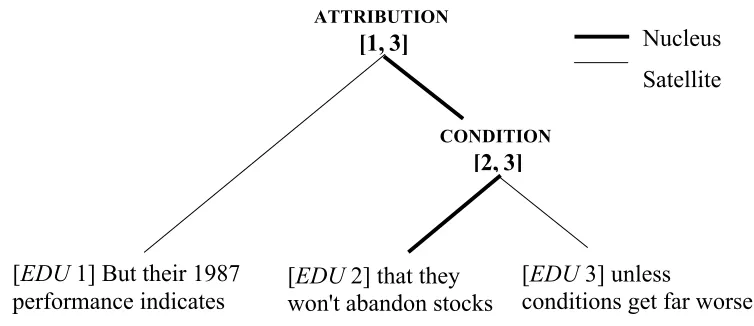
Figure 3.1 shows an example discourse structure of the sentence consisting of three edus, “But their 1987 performance indicates that they won’t abandon stocks unless conditions get far worse.”6 In this sentence, the second and the third edus are combined by the rhetorical relation CONDITION, forming a larger text span [2, 3]. The text span [2, 3] is again combined with the first edu by another rhetorical relation ATTRIBUTION. The text span [2, 3] is the nucleus of the ATTRIBUTION relation, and the first edu is the satellite. The second and the third edus are the nucleus and the satellite, respectively, of the CONDITION relation.
6 This sentence is extracted from the RST Discourse Treebank (Carlson et al., 2002).
Figure 3.1. Example discourse tree [EDU 1] But their 1987
performance indicates [won't abandon stocks EDU 2] that they
[EDU 3] unless
conditions get far worse. CONDITION
[2,3]
Nucleus Satellite ATTRIBUTION
To build such a tree structure from raw text, a discourse parser needs to address several inter-related subtasks: identifying edu boundaries; determining whether a given text span is rhetorically related with its adjacent text span; assigning appropriate rhetorical relations to related text spans; and inferring the nuclearity of each text span.
3.2 Modeling Discourse Structure
Recent data-driven approaches to discourse parsing have often treated the task of inferring the nuclearity of a text span as a part of rhetorical relation assignment. These approaches augment each rhetorical relation with possible combinations of nucleus and satellite, then use these augmented rhetorical relations as the target classification labels the system attempts to predict (Soricut and Marcu, 2003; duVerie and Prendinger, 2009).7 Thus, the nuclearity structure of text is only implicitly modeled via the rhetorical relations model. However, this approach is undesirable for certain applications that require only nuclearity information but do not require rhetorical relations (e.g., Sporleder and Lapata, 2005). In addition, the increased number of rhetorical relations the system needs to consider would render the problem of classifying rhetorical relations unnecessarily more difficult because the training data for each relation instance would become more sparse.
To address the shortcomings of previous approaches and to support a more modular approach to discourse parsing, this dissertation proposes an alternate approach that treats modeling the nuclearity structure of text as a standalone discourse parsing task, independent of modeling rhetorical relations. The approach involves focusing on two tasks of discourse parsing: (1) determining whether two adjacent text spans are rhetorically related, and (2) inferring the nuclearity of each text span. Taking a supervised machine-learning approach
7 For example, given a rhetorical relation attribution, two sub-relations, attribution-NS and attribution-SN, are
with the Markov Logic statistical relational learning framework (Richardson and Domingos, 2006), we model these two tasks jointly. In contrast to pipelined approaches, in which decisions made in earlier stages of the pipeline are propagated to later stages without a means of incorporating feedback from the later stages, a joint modeling approach allows communication among different tasks during inference. We show in later sections that joint modeling improves the performance of the learned nuclearity structure model. Moreover, our best-performing joint model uses much simpler features than the current state-of-the-art and yet achieves comparable results.
3.3 The Corpus
We take a supervised machine learning approach to modeling the nuclearity structure of text. We use the RST Discourse Treebank (RST-DT) corpus (Carlson et al., 2002) to both train and test our models. RST-DT consists of 385 Wall Street Journal articles that are taken from the Penn Treebank (Marcus et al., 2009). The length of an article varies between 31 and 2124 words, with an average of 458.14 words per article. The entire corpus consists of more than 176,000 words. The corpus is partitioned into a training set of 347 articles consisting of 6132 sentences and a test set of 38 articles containing 991 sentences. The corpus is manually annotated with discourse structure following the RST framework. The corpus contains 21,789 edus with an average of 56.59 edus per article. The average length of an edu is 8.1 words.
(Marcu, 2000; Soricut and Marcu, 2003; LeThanh et al., 2004; duVerie and Prendinger, 2009) that treats edu boundary identification as a separate task. We assume this task is performed by an external discourse segmenter such as SPADE (Soricut and Marcu, 2003) and focus on learning hierarchical nuclearity structure of discourse.
3.4 Features
To model the nuclearity structure of text, each text span (equivalently, each node in the RST tree) is represented with three types of features: surface, syntactic, and organizational. These features are extracted from each edu. The internal nodes of the RST that consist of more than one edus are represented by the edus at the boundary (i.e., the beginning and the end of the internal node). The following sections describe each of these types of features more in detail.
3.4.1 Surface Features
The words at the boundaries of a given text span are used as features. This is our relaxed approach to discourse markers. Discourse markers have been shown to be good predictors of discourse structure (Marcu, 2000) and tend to be placed at the boundary of a text span. However, rather than manually composing the list of discourse markers, we simply use word tokens at the boundaries. To keep the feature space to a manageable size, we consider only three tokens at each boundary and use stems of words instead of word token themselves. We also take punctuation into account. Punctuation at the boundaries of text spans is used as a feature along with its position (either beginning or end) in the given text span.
• begin_word_3: the stems of the first three word tokens at the beginning of an edu • end_word_3: the stems of the last three word tokens at the end of an edu
3.4.2 Syntactic Features
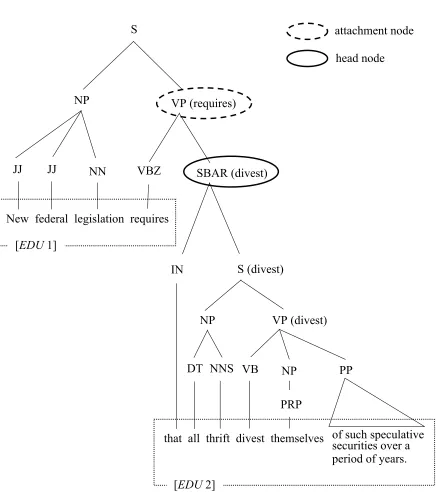
For syntactic features, we consider part-of-speech (pos) tags of both the first and the last three word tokens of an edu, as well as dominance set whose concept was introduced by Soricut and Marcu (2003). The pos tags at the boundaries are a syntactic generalization of the corresponding surface features (begin_word_3 and end_word_3) described in the previous section. Dominance set represents syntactic characteristics at edu boundaries, which consists of a head node and a corresponding attach node. A head node of an edu is defined as the node at the highest position (e.g., the distance to the root of the syntactic parse is the shortest) in a syntactic parse that has one of the words in the given edu as its lexical head (Figure 3.2). A corresponding concept is an attachment node, which is defined as the parent node of the head node. A head node and its attachment node always belong to different edus, thus providing important clues for sentence-level discourse structure. We use the stems of lexical heads and the syntactic categories of both head nodes and attachment nodes as features.
• begin_pos_3: the pos tags of the first three word tokens at the beginning of an edu • end_pos_3: the pos tags of the first three word tokens at the end of an edu
Figure 3.2. Illustrated example of head node and attachment node attachment node head node S
VP (requires) NP
JJ JJ NN VBZ
New federal legislation requires [EDU 1]
that all thrift divest themselves IN
[EDU 2]
SBAR (divest)
S (divest)
NP
DT NNS
VP (divest)
VB PP
of such speculative securities over a period of years. NP
3.4.3 Organizational Features
These features encode the organizational levels of text, such as sentences and paragraphs. Previous work has found a strong correlation between different organizational levels of text and the structure of RST trees (Marcu, 2000). In addition, both the absolute and relative position of a given text span are used. Absolute position of a text span is represented by an offset from the beginning of the text in terms of three different units: paragraph, sentence, and token. Relative position is a “bucketized” version of the absolute position when the text is divided into five equal-sized buckets. The value of relative position is also given in terms of paragraph, sentence, and token.
• begin_of_sentence: a binary feature indicating a given edu begins a sentence • end_of_sentence: a binary feature indicating a given edu is ends of a sentence
• same_sentence: a binary feature indicating two adjacent edus belong to the same sentence
• begin_of_paragraph: a binary feature indicating a given edu begins a paragraph • end_of_paragraph: a binary feature indicating a given edu ends a paragraph
• same_paragraph: a binary feature indicating two adjacent edus belong to the same paragraph
• position_in_paragraph: an absolute offset of an edu from the beginning of the text in terms of number of paragraphs
• position_in_sentence: an absolute offset of an edu from the beginning of the text in terms of number of sentences
• position_in_token: an absolute offset of an edu from the beginning of the text in terms of number of tokens
• relative_position_in_sentence: the bucket an edu belongs to when the text is divided into 5 equal-sized buckets in terms of sentence
• relative_position_in_token: the bucket an edu belongs to when the text is divided into 5 equal-sized buckets in terms of token
3.5 The Markov Logic Network
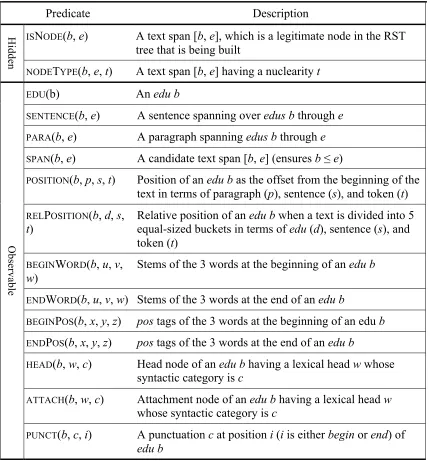
To represent our MLN, a set of predicates is defined as the basic building blocks from which formulae are composed (Table 3.1). There are two types of predicates, hidden and observed.
Hidden predicates are those that are not directly observable during test time. Instead, they are predicted by inference. In other words, hidden predicates are what we want to predict with the learned model. We define two hidden predicates, ISNODE(b,e) and NODETYPE(b,e,t). The predicate ISNODE(b,e) represents the proposition that a text span [b, e] is a legitimate node in the RST tree that is being built for a given text. Note that a node in an RST tree is either an edu at the leaf level, or a larger text span combining smaller text spans at an intermediate level. Thus, ISNODE(b,e) models whether or not two adjacent text spans could be combined together. NODETYPE(b, e, t) represents that the type of a text span [b, e] is t, where the value of t is either nucleus or satellite. This hidden predicate models the nuclearity of a node in the RST tree.
Table 3.2. Hidden and observable predicates in the proposed MLN
Predicate Description
ISNODE(b, e) A text span [b, e], which is a legitimate node in the RST tree that is being built
H
id
de
n NODETYPE(b, e, t) A text span [b, e] having a nuclearity t
EDU(b) An edub
SENTENCE(b, e) A sentence spanning over edusb through e PARA(b, e) A paragraph spanning edusb through e SPAN(b, e) A candidate text span [b, e] (ensures b≤e)
POSITION(b, p, s, t) Position of an edub as the offset from the beginning of the text in terms of paragraph (p), sentence (s), and token (t) RELPOSITION(b, d, s,
t)
Relative position of an edub when a text is divided into 5 equal-sized buckets in terms of edu (d), sentence (s), and token (t)
BEGINWORD(b, u, v, w)
Stems of the 3 words at the beginning of an edub ENDWORD(b, u, v, w) Stems of the 3 words at the end of an edub
BEGINPOS(b, x, y, z) pos tags of the 3 words at the beginning of an edu b ENDPOS(b, x, y, z) pos tags of the 3 words at the end of an edub
HEAD(b, w, c) Head node of an edub having a lexical head w whose syntactic category is c
ATTACH(b, w, c) Attachment node of an edub having a lexical head w whose syntactic category is c
O
bs
er
va
ble
Local formulae are those that contain only one hidden predicate. An example of a local formula in the MLN is
SPAN(b, e)
€
∧ b≤e
€
∧ BEGINP(b, x, y, z)
€
⇒ NODETYPE(b, e, t) (3.1)
Given a candidate text span [b, e], this formula looks at the first three words of the first edub belonging to this candidate span to determine the nuclearity of this potential RST node.
Global formulae contain more than one hidden predicate. To maintain consistency across the two hidden predicates, several global formulae are defined as hard constraints, such as:
ISNODE(b, e)
€
⇒ |
€
∃t: NODETYPE(b, e, t)| = 1 (3.2)
NODETYPE(b, e, t)
€
⇒ ISNODE(b, e) (3.3)
Formula (3.2) asserts that if a candidate text span [b, e] is a legitimate node in the RST tree, then it should be assigned exactly one nuclearity. Formula (3.3) enforces the constraint that if a candidate text span has an assigned nuclearity, it must also be a legitimate RST node. 3.6 Model Training
and cascading the nuclearity information down to the newly added nodes. The resulting new structures are right-branching binary subtrees (Figure 3.3). In the following step, the data are stemmed and syntactically parsed with the Porter Stemmer implementation in NLTK (Bird and Loper, 2004) and the Charniak Parser (Charniak, 2000). The syntactic parse trees are then lexicalized by applying a set of canonical head-projection rules (Magerman, 1995).
After preprocessing, features are extracted by pairing the preprocessed training data with their corresponding RST trees. The training process computes weights of each formula in the MLN, reflecting the importance of a given formula in predicting the value of grounded hidden predicates, as observed from the training data. The resulting set of learned weights along with the MLN definition constitute a model.
Figure 3.3. Binary conversion of n-ary relations
head-projection rule. The final result is a set of predicted hidden predicates along with their associated ground constants that violate the learned model least. Figure 3.4 illustrates the training and runtime procedures.
3.7 Summary of Chapter
CHAPTER 4
Discourse-Based Sentence Compression
Sentence compression is a text-to-text generation task that aims to generate a concise summary of a single sentence. The compressed sentence should preserve the salient meaning of the original sentence as well as being grammatical (Jing, 2000). Automatic sentence compression holds much appeal for many application areas. For example, sentence compressors could be used within audio scanning devices that convert text to the audio signals for the visually impaired (Grefenstette, 1998). For the visually imparied, it is difficult to quickly navigate a document by listening to what a machine reads. Sentence compression would make the navigation easier by removing non-essential information from the sentences. Sentence compression can also contribute to improving automated document summarizers (Lin, 2003). Most automated document summarizers are extractive, which assume the minimal unit of content is a sentence (Radev et al., 2000). Summaries are generated by extracting important sentences from multiple sources of document and then by linearly organizing the extracted sentences. Sentence compression can further process the extracted sentences to remove redundant information.
that is based on the salient structure of discourse. The proposed approach draws on the notion of nuclearity in RST to identify essential content in a sentence. After redundant content is removed from a sentence based on its nuclearity, the compressed sentence is post-processed with a set of simple syntax-based rules to improve the grammaticality of the final output. 4.1 Task Definition
The most general formulation of the sentence compression task requires operations such as reordering, substituting, deleting, and inserting words (Cohn and Lapata, 2008). However, most work on sentence compression focuses only on a simplified approach that involves word deletion (Knight and Marcu, 2000; Le Nguyen et al., 2004; Sporleder and Lapata, 2005; Turner and Charniak, 2005; McDonald, 2006; Galley and McKeown, 2007; Clarke, 2008; Filippova and Strube, 2008). Like the previous work, the approach described in this chapter defines sentence compression in terms of word deletion. Under this simplified approach, sentence compression is defined as8:
Given a sentence X = x1, …, xn, where xi is the ith word in X, find a substring
Y = y1, …, ym, such that yi
€
⊂{x1, …, xn}, |X| > |Y|, and each pair of words in
Y preserves the relative orderings between the pairs of words in X. (4.1)
The following examples show sentence compressions that comply with the given definition. Both the compressed Sentences 1 and 2 were generated only by deleting certain words from the original sentence. Both of these sentences are also grammatical. However, the content conveyed by these two sentences are different. While the compressed Sentence 1 preserves the most important content (i.e., the fact that the securities get top credit ratings)
from the original sentence, the compressed Sentence 2 fails to convey this important content and focuses on peripheral information.
[Original Sentence]
These securities get top credit ratings because the issuers have put aside U.S. bonds that will be sold to pay off holders when the municipals are retired.
[Compressed Sentence 1]
These securities get top credit ratings because the issuers have put aside U.S. bonds that will be sold when the municipals are retired.
[Compressed Sentence 2]
The issuers have put aside U.S. bonds that will be sold to pay off holders.
meaning. The more words that are deleted form the original sentence, the more concise the resulting compression becomes, but the deletion may result in the loss of important content. The converse is also true. The balance between this trade-off depends on the requirements of the application.
4.2 Discourse-Based Sentence Compression
Empirical evidence suggests that information at the discourse level plays an important role in human summarization (Endres-Niggemeyer, 1998). Based on this evidence, a promising line of investigation utilizes models of discourse to identify important sentences in a document (Barzilay and Elhadad, 1997; Marcu, 2000; Daumé III and Marcu, 2002; Teufel and Moens, 2002). Analogous discourse-level information is potentially effective for sentence compressors to identify important text units (e.g., words, phrases, and clauses) within a sentence. However, the utility of discourse-level information for sentence compression has not been extensively explored. Most work to date on sentence compression has primarily relied on syntactic and lexical information to determine whether to remove a certain word, phrase, or clause to compress a sentence (Knight and Marcu, 2000; Le Nguyen et al., 2004; Turner and Charniak, 2005; McDonald, 2006; Galley and McKeown, 2007; Filippova and Strube, 2008). Notable exceptions are found in work by Sporleder and Lapata (2005), as well as the approach described in Clarke (2008). Sporleder and Lapata (2005) describe a sentence compressor that identifies important content based on the nuclearity structure of discourse. Clarke’s work (2008) focuses on the lexical coherence across sentences to identify important content.
hold between adjacent text spans, which are hierarchically built up into larger text spans. RST also characterizes each text span in terms of nuclearity, according to its importance within a given rhetorical relation. The nucleus is central to a given rhetorical relation, while the satellite is auxiliary.
The approach described in this chapter focuses on this notion of nuclearity in RST, and hypothesizes that the nuclearity information can effectively guide a sentence compressor’s decision making about whether to remove a certain text unit in a sentence. In the proposed approach, the sentence compressor first analyzes the nuclearity structure of a given sentence based on a hierarchical nuclearity structure model. The nuclearity structure model was learned from an annotated corpus, as described in Chapter 3. From the analyzed nuclearity structure of the sentence, the sentence compressor removes text units that are recognized as satellite. In the following phase, the remaining nuclei are post-processed using syntax-based rules in order to improve the grammaticality of the resulting compression. The final summary is generated by concatenating the post-processed nuclei.