Privacy Preservation and Anonymization of
Data in Cloud Computing
Asmita R. Patil, M.K. Kodmelwar
M. E Student, Department of Computer Engineering, TSSM’s BSCOER, Narhe, Pune, Savitribai Phule Pune
University Pune India
Asst. Professor, Department of Computer Engineering, TSSM’s BSCOER, Narhe, Pune, Savitribai Phule Pune
University Pune India
ABSTRACT: Proposed solution greatly decreases communication overhead by allowing more accurate datato be transmittedfor multiparty analysis, yet preserving the anonymity of the data making it more secure for persisting the data on cloud DB. In cloud computing maintaining the anonymity of data to be shared across multiple entities is crucial for privacy of users in various application domains patient medical records, electronic voting, e-mail, social networking, etc. Existing Anonymization techniques and new algorithms for assigning anonymous IDs are examined with respect to trade-off s between communication and computational requirements. The new algorithms can be built on top of a secure sum data mining operations using encryption for Privacy Preserving Data Sharing with Anonymous ID Assignment. An algorithm for distributed solution of certain polynomials over finite fields can enhance the scalability of the Anonymization technique. The algorithm for anonymous sharing of private data among parties is to be developed. This assignment of anonymous ids is done for users so that the identities received are unknown to the other members of the group such that it allows more complex data to be shared and has applications to other problems in privacy preserving data mining, collision avoidance in communications and distributed database access.
KEYWORDS: Anonymization and de-anonymization cloud and distributed computing systems, multiparty computation, privacy preserving data mining, privacy protection, security and trust in cooperative communications.
I. INTRODUCTION
explored broadly. Scientists have additionally researched the pertinence of secrecy and additionally security in different application areas: tolerant therapeutic records, electronic voting, email, person to person communication, and so on.
Another type of secrecy, as utilized as a part of secure multi-party calculation, al-lows different gatherings on a system to together complete a worldwide calculation that relies on upon information from each gathering while the information held by each gathering re-mains obscure to alternate gatherings. A protected calculation work generally utilized as a part of the writing is secure whole that enables gatherings to figure the entirety of their individual contributions without revealing the contributions to each other. This capacity is pervasive in information mining applications and furthermore portrays the complexities of the protected multi-party calculation. This work manages effective calculations for relegating identifiers (IDs) to the hubs of a system such that the IDs are unknown utilizing an appropriated calculation with no focal expert. Given hubs, this task is basically a stage of the numbers with every ID being known just to the hub to which it is allocated. The primary calculation depends on a technique for secretly sharing basic information and results in strategies for proficient sharing of complex information. There are numerous applications that require dynamic one of a kind IDs for system hubs. Such IDs can be utilized as a major aspect of plans for sharing/separating correspondences transmission capacity, information stockpiling, and different assets namelessly and without strife. The IDs are required in sensor systems for security or for regulatory assignments requiring unwavering quality, for example, con guration and checking of individual hubs, and download of parallel code or information total portrayals to these hubs. An application where IDs should be mysterious is matrix figuring where one may look for administrations without disclosing the character of the administration requester. To di separate mysterious ID task from unknown correspondence; consider a circumstance where parties wish to show their information on the whole, however namelessly, in openings on an outsider site.
II. MOTIVATION
In cloud computing maintaining the anonymity of data to be shared across multiple entities is crucial for privacy of users in various application do-mains: patient medical records, electronic voting, e-mail, social networkingetc. Multiple tenants share cloud infrastructure, in multi-tenancy. This poses concerns for deliberate or accidental exposure of data. Data safety is important for cloud by preparing for potential security breaches. For instance, store the cloud data in such a way that it is worthless to anyone else except the owner of the data
III. LITERATURE SURVEY 1. SCRYPT
implementation much more ex-pensive, and therefore limiting the amount of parallelism an attacker can use, for a given amount of financial resources.
2. SALT (CRYPTOGRAPHY)
In cryptography, a salt is random data that is used as an additional input to a one-way function that hashes a password or passphrase.[1] The primary function of salts is to defend against dictionary attacks versus a list of pass-word hashes and against pre-computed rainbow table attacks.A new salt is randomly generated for each password. In a typical setting, the salt and the password are concatenated and processed with a cryptographic hash function, and the resulting output (but not the original password) is stored with the salt in a database. Hashing allows for later authentication while defending against compromise of the plaintext password in the event that the database is somehow compromised.Cryptographic salts are broadly used in many modern computer systems, from UNIX system credentials to Internet security. A public salt makes it more time-consuming to crack a list of passwords. However, it does not make dictionary attacks harder when cracking a single password. The attacker has access to both the hashed password and the salt, so when running the dictionary attack; the attacker can simply use the known salt when attempting to crack the password.To understand the difference between cracking a single password and a set of them, consider a single password le that contains hundreds of usernames and passwords. Without a salt, an attacker could compute hash (attempt [0]), andthen check whether that hash appears anywhere in the le. The likelihood of a match, i.e. cracking one of the passwords with that attempt, increases with the number of passwords in the le. If salts are present, then the attacker would have to compute hash (salt[a] . attempt[0]), where "." denotes concatenation, compare against entry A, then hash(salt[b] . attempt[0]), compare against entry B, and so on. This defeats the "reusing" hashes in attempts to crack multiple passwords.Salts also combat the use of rainbow tables for cracking passwords. A rainbow table is a large list of pre-computed hashes for commonly used passwords. For a password le without salts, an attacker can go through each entry and look up the hashed password in the rainbow table. If the look-up is consider-ably faster than the hash function (which it often is), this will considerably speed up cracking the le. However, if the password le is salted, then the rainbow table would have to contain "salt .Password" pre-hashed. If the salt is long enough and sufficiently random, this is very unlikely. Unsalted pass-words chosen by humans tend to be vulnerable to dictionary attacks since they have to be both short and meaningful enough to be memorized. Even a small dictionary (or its hashed equivalent, a rainbow table) has a significant chance of cracking the most commonly used passwords. Since salts do not have to be memorized by humans they can make the size of the rainbow table required for a successful attack prohibitively large without placing a burden on the users.More technically, salts protect against rainbow tables as they, in effect, ex-tend the length and potentially the complexity of the password. If the rainbow tables do not have passwords matching the length (e.g. an 8-byte password, and 2-byte salt, is effectively a 10-byte password) and complexity (non-alphanumeric salt increases the complexity of strictly alphanumeric passwords) of the salted password, then the password will not be found. If found, one will have to remove the salt from the password before it can be used.Salts also make dictionary attacks and brute-force attacks for cracking large numbers of passwords much slower (but not in the case of cracking just one password). Without salts, an attacker who is cracking many passwords at the same time only needs to hash each password guess once, and compare it to all the hashes. However, with salts, each password will likely have a different salt; so each guess would have to be hashed separately and compared for each salt, which is considerably slower than only comparing.
3. ANONYMIZATION TECHNIQUES
wishes to make public anonymously to the other participants.Our network is not anonymous and the participants are identifiable in that they are known to and can be addressed by the others. Methods for assigning and using sets of pseudonyms have been developed for anonymous communication in mobile networks. The methods developed in these works generally require a trusted administrator, as written, and their end products generally differ from ours in form and/or in statistical properties. To be precise, with nodes the algorithms distribute a computation among the nodes generating a permutation of chosen with a uniform probability of from the set of all permutations of where will know only. Such a permutation can also be produced by algorithms designed for mental poker.
The algorithms for mental poker are more complex and utilize cryptographic methods as players must, in general, be able to prove that they held the winning hand. Throughout this paper, we assume that the participants are semi-honest [10], also known as passive or honest-but-curious, and execute their required protocols faithfully. Given a semi-honest, reliable, and trusted third party, a permutation can also be created using an anonymous routing protocol.
Despite the differences cited, the reader should consult and consider the alternative algorithms mentioned above before implementing the algorithms in this paper. This paper builds an algorithm for sharing simple integer data on top of secure sum. The sharing algorithm will be used in each iteration of the algorithm for anonymous ID assignment (AIDA). This AIDA algorithm, and the variants that we discuss, can require a variable and unbounded number of iterations. Finitely-bounded algorithms for AIDA are discussed in Section IX. Increasing a parameter in the algorithm will reduce the number of expected rounds. However, our central algorithm requires solving a polynomial with coefficients taken from a finite field of integers modulo a prime. That task restricts the level to which can be practically raised. We show in detail how to obtain the average number of required rounds, and in the Appendix detail a method for solving the polynomial, which can be distributed among the participants.
IV. PRIVACY PRESERVING APPROACHES IN DATA PUBLISHING
4.1 L-Diversity
L-diversity is a form of group based anonymization that is used to preserve .The l-diversity model is an extension of the k-anonymity model which reduces the granularity of data representation using techniques including generalization and suppression such that any given record maps onto at least k other records in the data. The l-diversity model handles some of the weaknesses in the k-anonymity model where protected identities to the level of k-individuals is not equivalent to protecting the corresponding sensitive values that were generalized or suppressed, especially when the sensitive values within a group exhibit homogeneity.
4.2 T-Closeness
Given the existence of attacks where sensitive attributes may be inferred based upon the distribution of values for l-diverse data, the t-closeness method was created to further l-diversity by additionally maintaining the distribution of sensitive fields. An equivalence class is said to have t-closeness if the distance between the distribution of a sensitive attribute in this class and the distribution of the attribute in the whole table is no more than a threshold t.
4.3 Generalization Approach
4.4. K-Anonymity
K-anonymity is a property possessed by certain anonymized data. Given person-specific field-structured data; produce a release of the data with scientific guarantees that the individuals who are the subjects of the data cannot be re-identified while the data remain practically useful. A release of data is said to have the k-anonymity property if the information for each person contained in the release cannot be distinguished from at least k-1 individuals.
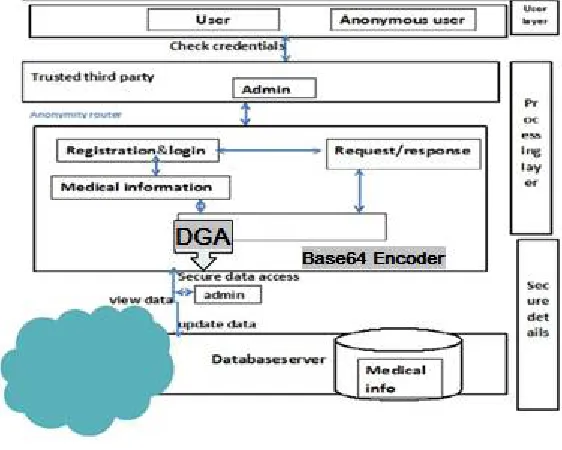
V. PROPOSED SYSTEM ARCHITECTURE
1. User Layer: The users of this system are the users who want to publish and share the data on cloud without revealing the identity of the data owner. The anonymous users can also access the system just to collect or read the data.
2. Processing Layer: This layer actually resides in the secure environment. This module can be deployed in the private cloud as well. Here the trusted 3rd Party users are authenticated to be allowed to store the data in the system. Functions of this layer -
3. Secure Details Cloud Layer: This layer is deployed on public cloud server onto the public database.
Figure 1: System Architecture
Advantages of Proposed System
1. This model defines the privacy of the output of a process and not of the process itself. This is in sharp contrast to the vast majority of privacy models that were suggested earlier, and it is in this sense of privacy that clients are usually interested.
2. It is a simple, intuitive, and well understood model. Thus, it appeals to the non-expert who is the end client of the model.
4. The assumptions regarding separation mode of attack and variability of private data have so far withstood the test of real-life scenarios.
5. The model takes care of Security attacks like - Linking attacks, False Rows Injection
6. The model validates that the value of the private attributes for a given set of individuals is not same, even though the value is same the salt is different and hence the encrypted key remains unique.
7. Data can be analyzed using Bucket-ization techniques as well as generalization.
8. The proposed system gives optimal performance due to dynamic generalization – by using combination of generalization, k-anonymization and t-closeness algorithms, there byeliminating the possibility of linking attacks, however providing the greater accuracy of results to be analyzed.
9. Reverse data collection is possible to apply higher level of generalization in future, thereby eliminating the data-distortion. Data’s originality is preserved using encryption of a higher degree, thereby making the generalization dynamic and configurable.
VI. ALGORITHM USED 1) Encrypt/Decrypt Salt :
Method of encryption and decryption using a salt is used. The salt is random data very often used in cryptography as additional input to a hash function. Doing encryption and decryption of a String with a salt implies that you should:
Read an initial String.
Generate random bytes to be placed in the salt.
Create a sun.misc.BASE64Decoder (a Utility Class to encode a String or Byte Array as a Base64 encoded String) and a byte array to be used as a salt.
Use the BASE64Encoder to encode both the salt and the String and return them, as described in
the encrypt(String str) method.
Read the encrypted String.
Create a sun.misc.BASE64Encoder (A utility class to decode a Base64 encoded String to a Byte Array) to decode the String to a byte array.
Return the String representation of the byte array, as shown in the decrypt(String encstr) method.
2) Find k closest elements to a given value:
Given a sorted array arr[] and a value X, find the k closest elements to X in arr[]. Examples:
Input: K=4, X=35
arr[]={12,16,22,30,35,39,42,45,48,50,53,55,56 }
Output: 30 35 39 42
Note that if the element is present in array, then it should not be in output, only the other closest elements are required.
A simple solution is to do linear search for k closest elements. 1) Start from the first element and search for the crossover point (The point before which elements are smaller than or equal to X and after which elements are greater). This step takes O(n) time. 2) Once we find the crossover point, we can compare elements on both sides of crossover point to print k closest elements. This step takes O(k) time.
The time complexity of the above solution is O(n).
An Optimized Solution is to find k elements in O(Logn + k) time. The idea is to use Binary Search to find the crossover point. Once we find index of crossover point, we can print k closest elements in O(k) time.
a. Result table and Graph
Accuracy Existing System(%) Proposed System(%)
VII. CONCLUSION
Proposed solution greatly decreases communication overhead, by facilitating the accurate yet, anonymous data on sharing on the communication channel to transmit the data more secure for persisting the data on cloud DB. To overcome the problem of identifying details and changing information anonymous id was utilized. Random encrypted key using Scrypt and Salt encryption is used to identify whether the data requesting person is a correct authorized person or hackers. With private communication channels, the algorithms are secure in an information theoretic sense. A lot of ambiguity can be avoided even though the private attributes combination is duplicate, since the salt is used for encrypting the anonymized data. The id generated by applying this process can be used to link the private and public DBs and the false injected rows attacks can be easily identified, since the matching entries will need to be there in public and private DBs both.
REFERENCES
[1] B.C.M. Fung, K. Wang, R. Chen and P.S. Yu, “Privacy-Preserving Data Publishing: A Survey of Recent Developments,” ACM Comput. Surv., vol. 42, no. 4, pp.1-53, 2010.
[2] K. LeFevre, D.J. DeWitt and R. Ramakrishnan, “Workload- Aware Anonymization Techniques for Large-Scale Datasets,” ACM Trans. Database Syst., vol. 33, no. 3, pp. 1-47, 2008.
[3] B. Fung, K. Wang, L. Wang and P.C.K. Hung, “Privacy- Preserving Data Publishing for Cluster Analysis,” Data Knowl.Eng., Vol.68, no.6, pp. 552-575, 2009.
[4] B.C.M. Fung, K. Wang, and P.S. Yu, “Anonymizing Classification Data for Privacy Preservation,” IEEE Trans. Knowledge and Data Eng., vol. 19, no. 5, pp. 711-725, May 2007.
[5] Amazon Web Services, “Amazon Elastic Mapreduce,”http://aws.amazon.com/elasticmapreduce/, 2013.
[6] Xuyun Zhang, Laurence T. Yang, Senior Member, IEEE, Chang Liu, and Jinjun Chen, Member, IEEE “A Scalable Two-Phase Top-Down Specialization Approach for Data Anonymization Using MapReduce on Cloud”, vol. 25, no. 2, february 2014.
[7] K. LeFevre, D.J. DeWitt and R. Ramakrishnan,“Workload- Aware Anonymization Techniques for Large-Scale Datasets,” ACM Trans. Database Syst., vol.33, no. 3, pp. 1-47, 2008.
[8] K. LeFevre, D.J. DeWitt, and R. Ramakrishnan, “Incognito: Efficient Full-Domain K-Anonymity,” Proc. ACM SIGMOD Int’l Conf. Management of Data (SIGMOD ’05), pp. 49-60, 2005.
[9] T. IwuchukwuandJ.F. Naughton, “K-Anonymization as Spatial Indexing: Toward Scalable and Incremental Anonymization,” Proc. 33rdInt'lConf. VeryLargeDataBases (VLDB'07), pp.746-757, 2007
[10] J. Dean and S. Ghemawat, “Mapreduce: Simplified Data Processing on Large Clusters,” Comm. ACM, vol. 51, no. 1, pp. 107-113,2008. [11] A.Machanavajjhala, J.Gehrke, and D.Kifer, et al, “ℓ-diversity: Privacy beyond k-anonymity”, In Proc. ofICDE, Apr.2006.
[12] Dean J, Ghemawat S. Mapreduce: a flexible data processing tool. Communications of the ACM 2010;53(1):72–77. DOI: 10.1145/1629175.1629198.
[14] N. Mohammed, B.C. Fungand M. Debbabi, “Anonymity Meets Game Theory: Secure Data Integration with MaliciousParticipants,”VLDBJ.,vol.20,no.4,pp.567-588,20.
[15] N. Li, T. Li, and S. Venkatasubramanian, “t-Closeness:Privacy Beyond k-anonymity and l-Diversity”, In Proc.of ICDE, 2007, pp. 106-115. [16] Jiuyong Li, JixueLiu ,MuzammilBaig , Raymond Chi-Wing Wong” Information based data anonymization for classification utility”
[17] Larry A. Dunning, Member, IEEE, and Ray Kresman - Privacy Preserving Data Sharing With Anonymous ID Assignment, IEEE TRANSACTIONS ON INFORMATION FORENSICS AND SECURITY, VOL. 8, NO. 2, FEBRUARY 2013, pp. 402-413
[18] Friedman, R. Wol , and A. Schuster, Providing k-anonymity in data mining, VLDB Journal, vol. 17, no. 4, Jul. 2008, pp. 789804.
[19] Jun Li and Baochun Li Erasure Coding for Cloud Storage Systems: A Survey TSINGHUA SCIENCE AND TECHNOLOGY, ISSNll1007-0214ll06/11ll, Volume 18, Number 3, June 2013, pp. 259-272.
[20] Dr, Nedhal A, Al-Saiyd, Nada Sail DATA INTEGRITY IN CLOUD COMPUTING SECURITY - Journal of Theoretical and Applied Infor-mation Technology, Dec-2013, Vol.59 No.3, pp. 570-582
[21] B.Srinivasulu1, B.V.Usha, R.V.Gandhi, K. Ramakrishna Privacy Pre-serving Updates to Anonymous and Con dential Database (Secure Com-puting) - International Journal of Advanced Research in Computer and Communication Engineering Vol. 2, Issue 7, July 2013 , pp. 2661-2667 [22] Alberto Trombetta, Wei Jiang, Elisa Bertino, Lorenzo Bossi Privacy-Preserving Updates to con dential and Anonymous Databases, Oct-2007, Computer Science Technical Report, Purdue University.
[23] R.K. Pandya and Prof. Sutaria DATA INTEGRITY TECHNIQUES IN CLOUD: AN ANALYSIS -JOURNAL OF INFORMATION, KNOWL-EDGE AND RESEARCH IN COMPUTER ENGINEERING, pp.413-417.