A growing number of studies indicate that playing digital games can improve various
cognitive abilities. However, the lack of experimental control in commercially available games limits conclusions about the mechanisms that connect digital gameplay to improved
cognitive functioning. One common hypothesis suggests that specific cognitive abilities benefit from experiences which place demands on those functions. This has been tested with game-like cognitive tasks which attempt to control the cognitive processes utilized during
gameplay. This intervention compares two approaches to game-based cognitive interventions by modifying a real-time strategy game (StarCraft 2) to exercise working
memory. Seventy three young adults were randomly assigned to play either the original version (SC2) or a working memory version (WMSC2) of the game, or to the no-contact
control group. Between-group analysis of change in working memory and visual processing ability from pretest to posttest indicated the WMSC2 group improved in visuospatial working memory. Additionally, an examination the moderating effects of the experience of flow and
William Charles McClure Grenhart
A thesis submitted to the Graduate Faculty of North Carolina State University
in partial fulfillment of the requirements for the Degree of
Master of Science
Psychology
Raleigh, North Carolina 2015
APPROVED BY:
________________________________ ______________________________
Jason C. Allaire, Ph.D. Anne Collins McLaughlin, Ph.D.
Committee Chair
DEDICATION
This thesis is dedicated to my loving and supportive partner, Allison. I cannot
BIOGRAPHY
William Grenhart was born in Aurora, Colorado. He earned a Bachelor of Arts degree with a double major in Psychology and Philosophy from the University of Colorado at Boulder in December 2009. In 2012 he entered the Lifespan Developmental Psychology program at
ACKNOWLEDGEMENTS
To begin, I would like to thank my adviser, Dr. Jason Allaire, for playing an integral role in this thesis and my training. I deeply appreciate your guidance and patience. I am
incredibly grateful for the opportunities you have provided me and all the attention and effort
you expended during our collaboration.
I would like to thank the many undergraduate research assistants that helped collect and enter the data for this project. I could not have completed this study without your
assistance.
Finally, I give my thanks to Dr. Erin Banks and the Initiative for Maximizing Student Diversity for funding the first two years of my graduate training and nourishing my
TABLE OF CONTENTS
LIST OF TABLES ... vi
LIST OF FIGURES ... vii
INTRODUCTION ...1
Correlational Studies of Digital Game Players ...1
Training Studies Using Digital Games ...2
Comparing Training Groups ...4
Customizing GADGs ...5
Working Memory...6
Digital Games & Working Memory ...8
Possible Covariates of Training Effectiveness ...9
Flow ...10
Digital Game Experience ...11
SPECIFIC AIMS ...12
METHOD ...14 Participants ...14 Procedure ...14 Training ...15 SC2 ...15 WMSC2 ...16 MEASURES ...17 RESULTS ...22 Sample...22
Aim 1 ...22
Aim 2 ...23
Aim 3 ...24
DISCUSSION ...25
Training Effects ...26
Impact of Flow ...28
Digital Game Use ...29
Unique Advancements ...29
Limitations ...30
Future Directions ...32
Conclusion ...33
TABLES ...34
FIGURES ...39
REFERENCES ...43
APPENDICES ...47
LIST OF TABLES
Table 1. Demographics and Game Usage by Group ...34
Table 2. Adjusted Marginal Means and Significance Tests for ANCOVA of Cognitive Abilities ...35
Table 3. Correlations between Cognitive Change Scores and Flow Subscales ...36
Table 4. Adjusted Marginal Means of the Player by Group ANCOVAs ...37
LIST OF FIGURES
Figure 1. Adjusted marginal means based on the ANCOVA of symmetry span scores at posttest ...39
Figure 2. Adjusted marginal means based on the ANCOVA of operation span scores ..40
Figure 3. Comparison mean group flow score by subscale ...41
Figure 4. Adjusted marginal means based on the Player by Group ANCOVA of
Introduction
A growing body of research suggests that playing commercially available digital
games (CADGs) can lead to improved cognitive function (Powers, Brooks, Aldrich,
Palladino, & Alfieri, 2013). Most of CADGs were not designed for the expressed purpose of
improving cognition. Consequently, future digital games specifically designed to improve cognition may yield even greater results. In order to maximize the potential of digital games the relevant features and qualities that bolster cognitive performance must be identified. The
exact mechanisms that connect playing digital games to improved cognitive functioning remain unclear. This is due in part to the fact that most CADGs do not allow for
experimental manipulation. Other studies have pursued cognitive improvement by designing training games that closely resemble laboratory cognitive tests, thereby controlling the
abilities utilized during gameplay. The current study compares these two approaches by developing a single task intervention game within a CADG and comparing it with the original version of the game. Specifically, the primary goal of this study is to determine if
focused working memory training using a modified game leads to greater improvements in cognitive abilities than the unmodified version of the game. Additionally, this study also
investigates if greater engagement (i.e. flow) and regular digital game usage moderate these changes in cognition.
Correlational Studies of Digital Game Players
(Donohue, Wolforff, & Mitroff, 2010; Durlach, Kring, & Bowens, 2009; Sungur & Boduroglu, 2012), spatial imagery (Sims & Mayer, 2002; Terlecki & Newcombe 2005), general processing speed (Dye, Green, & Bavelier, 2009), and cognitive control (Karle,
Watter, & Shedden, 2010; Strobach, Frensch, & Schubert, 2012). The broad scope of these findings likely originates in the diversity of game genres and gameplay experiences. A
recent investigation comparing regular players of first-person shooting (FPS) games to regular players of real-time strategy (RTS) games and nDGPs found differential cognitive proficiencies across groups (Dobrowolski, Hanusz, Sobczyk, Skorko, Wiatrow, 2014). FPS
players outperformed RTS players, and both groups of gamers outperformed nDGPs on a task switching reaction time task. RTS players, but not FPS players, demonstrated an
advantage over nDGPs on a multiple object tracking task. This difference in performance suggests that the kind of cognitive abilities that can be improved, as well as the size of the effect, from playing digital games depends on the type of gameplay. Regardless of the
precise nature of these effects, there exists a well-established potential to reap cognitive rewards from regular digital game play.
Training Studies Using Digital Games
Experimental studies using both older and younger adults have determined that these findings do not just reflect self-selection or cohort effects. Digital game interventions have
been shown to improve a wide spectrum of cognitive domains including visual perception (Green & Bavelier, 2003), spatial imagery (Feng, Spence, & Pratt, 2007; Okagaki & Frensch,
particularly interesting because transfer to untrained tasks is rare, making playing digital games a relatively unique activity.
Digital games come in a multitude of different varieties and different games have
yielded different effects. 3D racing games and Tetris improve mental rotation and spatial imagery abilities (Charney, 2008). First-person shooter (FPS) games like Medal of Honor
and Unreal Tournament 2004 sharpen visual processing (Green & Bavelier, 2006). Real-time strategy games like Rise of Nations improve executive function (i.e. task switching), visual short term memory, and fluid intelligence (Raven’s; Basak et al., 2008). Older adults
who played World of Warcraft improved their attentional control and spatial orientation (Whitlock, McLaughlin, & Allaire, 2012). The general explanation for these effects is that
certain forms of gameplay involve and exercise specific cognitive abilities leading to improvement in these spheres. However, this kind of hypothesis is difficult to confirm because CADGs are complex, require many different kinds of cognitive abilities, and do not
allow for rigorous experimental manipulation.
Not all studies have concluded that playing digital games significantly improves
cognition (e.g., Ackerman, Kanfer, Calderwood, 2010), which suggests that only certain games present challenges that generate durable cognitive improvements (Kennedy, Boyle, Traynor, Walsh, Hill, 2011). Furthermore, the breadth of abilities improved from playing
Comparing Training Groups
Most of the intervention studies using CADGs examine pretest to posttest differences between a control group and an experimental group assigned to play a different digital game
for a set number of hours over many sessions. In most cases, the control group either does not participate in any training sessions (Basak et al., 2008) or plays a different digital game
(Green & Bavelier, 2006). Because the digital games used in these studies are off-the-shelf CADGs the experimenter is unable to exert experimental control over the various game features. This lack of experimental control limits the conclusions of these studies. That is, it
is not possible to determine the specific mechanism behind these changes in cognitive abilities.
In one frequently used design (e.g., Bavelier, Green, Pouget, & Shrater, 2012) that exemplifies the problem with comparing one CADG to another, participants in the
experimental group play a fast-paced FPS (e.g., Call of Duty 2) and those in the control
group played a “non-action” game (e.g., The Sims 2). Presumably, comparison between the effects of these two types of games rests on the assumption that the important difference
between them lies in the speed of gameplay. Indeed, action games (by definition) do present more temporally visually demanding challenges, whereas games like The Sims 2 move at the pace of the player, but a profusion of other differences may also play an explanatory role.
Functional improvement may have resulted from one, all, or some combination of the following: fast motion animation, tracking multiple enemies spatially, monitoring
environment, or simply the stressful and arousing excitement of an action game.
Furthermore, the open-ended, interactive nature of these (and most) types of games allows for vastly different experiences between users.
Part of the success of many CADGs may be that they present intensely engaging and stimulating experiences by including a wide variety cognitive demands. Without
experimental control it is impossible to know which aspect of the game or combination of factors is associated with gains in cognition. In one meta-analysis the authors framed this problem thusly:
“Unfortunately, to date, simply not enough studies have compared the effects of different game types within a single information processing domain. It will be imperative for future studies to use crossover designs in which learners are trained on two different games and their abilities are assessed across multiple information processing domains (e.g. Sanchez, 2012); ideally, such studies should utilize an additional control condition to allow for
comparisons of each game type to a uniform baseline.” (Powers et al., 2013, p 1072) Customizing CADGs
Most of the intervention studies using CADGs have employed a “black box intervention approach” where differences in pretest to posttest change were compared
between a control group and a group assigned to play a specific digital game for a set number
of hours. The content experienced in most CADGs is fixed, so that each player experiences more or less the same content. Lack of experimental control has limited the previous research to date in two ways. First, without some level of manipulation and control of
for intervention, making conclusions on the breadth of transfer effects difficult. So although the use of digital games to improve cognition is not novel, the current study is one of the first to manipulate the in-game content of a CADG. This allowed for experimental control over
the demands of the game and precise targeting of a single cognitive ability, specifically working memory.
In order to isolate a single cognitive ability from a complex game, a custom game was created within StarCraft 2 (SC2) and compared with the original game (Blizzard, 2013). SC2 was chosen for several reasons. First, a powerful editor accompanies SC2 which enables full
control over all elements of the game. Second, SC2 falls in the same genre as another game previously shown to lead to cognitive improvement (i.e. Rise of Nations; Basak et al., 2008),
and a recent study has shown the SC2 itself to improve cognitive performance (Glass, Maddox, & Love, 2013) Finally, the gameplay of SC2 places demands on a wide array of cognitive abilities and so isolating a single ability would provide a useful comparison in the
effort to determine how exactly playing games like SC2 improve cognitive functioning, especially working memory.
Working Memory
The current study chose to focus on developing a game that exercises working memory. Working memory is defined as a system for maintaining access to goal-relevant
attention, short- and long-term memory, and executive control. Perhaps because of this complexity, working memory capacity predicts performance across many other mental abilities including emotion regulation (Kleider, Parrott, & King, 2010), hindsight bias
(Calvillo, 2012), multi-tasking (Hambrick, Oswald, Darowski, Rench, & Brou, 2010), susceptibility to stereotype threat (Hutchison, Smith, & Ferris, 2012), and fluid intelligence
(Conway, Cowan, Bunting, Therriault, & Minkoff, 2002; Kane, Hambrick, & Conway, 2005). Given the importance of working memory, any comprehensive cognitive improvement venture should prioritize the maintenance and enhancement of working
memory capacity and its elemental operations. Furthermore, because WM relates to so many domains that do not obviously rely on memory, the improvement of WM capacity represents
a strong candidate for far transfer to unrelated cognitive domains (Bleckley, Foster, & Engle, 2014).
A number of cognitive intervention programs, such as Cogmed, have targeted
working memory with qualified success (Brehmer, Westerberg, & Bäckman, 2012). Direct training of working memory seems to effectively increase working memory capacity, but
these types of training do not yield benefits outside of working memory (Bastian & Oberaurer, 2013; Melby-Lervåg & Hulme, 2013). Specifically, fluid intelligence has not been shown to improve in response to working memory capacity increases (Redick,
activities, such digital games. Some training paradigms employ single tasks and other studies stimulate WM using multiple training tasks.
Digital Games and Working Memory. Many types of digital games utilize working memory to various degrees. First-person shooter games require the player to keep track of multiple enemies, allies, ammo reserves and goal objectives; real-time strategy games
demand continuous monitoring of resources, building and technology advancement, and army creation and deployment; and even action games call for a fluid understanding and execution of numerous input commands and actions, each specifically suited for particular
situations. However, few studies have investigated the specific impact of playing digital games on working memory. Meta-analyses covering the effects of digital game play on
information processing group the working memory effects with other abilities related to executive functions (Powers et al., 2013; Toril, Reales, Ballesteros, 2014).
One quasi-experimental study compared the working memory ability of avid digital
game players to people without extensive digital game experience and found that gamers displayed superior working memory capacity (Colzato, van den Wildenberg, Zmigrod, &
Hommel, 2012). During the N-2 Back task, the gamers not only had significantly faster reaction speeds but also significantly better accuracy in every way possible (i.e. more hits, more correct rejections, fewer false alarms, and fewer misses). However, studies using
quasi-experimental design cannot lead to causal conclusions. It may be the case that the experienced digital game players choose to play more complex games because aspects
Indeed, another quasi-experimental study found that experience playing digital games was not related to greater WM capacity (Hambrick et al., 2010). However, digital game
experience was measured with only two items, and this study was mostly females (70.6%),
who reported significantly lower digital game experience compared to males. In an
intervention study utilizing mobile games, Oei and Patterson (2013) found that participants
who played match-3, spatial memory, and hidden object games improved their spatial
working memory; and those who played match-3 and action games improved verbal working memory.
Possible Covariates of Training Effectiveness
In addition to the primary goal of investigating the main effect of gameplay on
cognition, this study will also consider possible covariates that may moderate the
effectiveness of the training. There are several possible factors that could affect the strength of training-related improvements, but the two that will be examined here are the experience
flow and past digital game use. The presence of the flow state could have affective, neurological, and motivational implications that lead to a qualitatively different training
experience, and hence a different cognitive outcome. Prior digital game expertise may allow a player to reach higher difficulty levels faster, effectively creating more challenging
circumstances compared to the novice. These two possible moderators will now be described
Flow. The flow state represents an enjoyable, maximized form of engagement (Ullén, de Manzano, Theorell, & Harmat, 2010). Generally, a person will experience flow when focusing on an activity that is both challenging and pleasurable. Traditionally, the flow
state is characterized by nine elements: 1) an optimal balance between challenge and skill, 2) the merging of action and awareness, 3) clearly understood goals, 4) unambiguous feedback,
5) high levels of concentration, 6) a sense of control of the environment, 7) a loss of self-consciousness, 8) experiencing the activity as autotelic (or intrinsically rewarding), and 9) a distorted sense of time (Csikszentmihalyi, 1990). Notable indications of a flow state include
an optimal balance between skill and challenge, perfect clarity of objectives and feedback,
effortless attention, automatic action deployment and an enjoyable feeling of complete
immersion. Digital games have been shown to more effectively engender flow experiences
compared to cognitive task training (Belchior, Marsiske, Sisco, Yam, & Mann, 2012). The
source of this difference lies in the ability for digital games to adjust the difficulty level to the skill of the player. Without the feature of adaptability it would be unlikely for the skill of the player to match the preset amount of challenge, thus preventing the experience of flow.
Flow theory has recently been updated to make predictions about neural activation with specific consideration for digital games since digital games can be played while inside
an fMRI machine without significant disruption to either gameplay or the measurement of neural activation (Weber, Tamborini, Westcott-Baker, & Kantor, 2009). Specifically, the authors “posit flow as a discrete, energetically optimized, and gratifying experience resulting
of balance between challenge and skill” (p.379). Indeed, an investigation into the patterns of neural activation during digital game play suggests that the flow state produces coordinated activation in the brain areas related to both reward and attention, among others (Klasen,
Weber, Kircher, Mathiak, & Mathiak, 2012). These specialized neural activation patterns support the notion that gameplay experiences that include the flow state may generate
significantly different outcomes than gameplay experiences devoid of flow.
Beyond neurological reasons, the experience of flow may also improve the success of cognitive interventions by fostering motivation to perform and persist while playing. The
experience of flow strongly predicted addictive behavior over and beyond mere repetitive use in gamers surveyed online (Chou & Ting, 2003).
It is possible that previous traditional working memory interventions may have failed because they did not generate far transfer improvements due to their inability to engender experiences of flow. Thus, through the fostering of the flow state, game-based working
memory training programs may be more likely to lead to far transfer than traditional working memory training. Furthermore, individuals within the same game condition who experience
stronger feelings of flow may demonstrate greater cognitive improvements that those who experience less flow.
Digital Game Usage. In addition to enhanced cognitive abilities, DGPs may also come equipped with general knowledge about games and strategies for learning and
benefit of playing digital games is a general increase in brain plasticity and ability to learn (Bavelier et al., 2012). Most studies control for digital experience by either selecting DGPs (in the case of quasi-experimental studies; e.g. Strobach et al., 2012), or by admitting only
nDGPs (in the case of intervention studies; e.g. Oei & Patterson, 2013). Few, if any, studies have directly compared the training outcomes of DGPs and nDGPs. By starting with basic
skills to advance quickly in a digital game DGPs may be more likely to reach higher difficulty levels, and therefore reach the limits of the cognitive ability more readily than nDGPs.
Specific Aims
To review, past research suggests that playing commercially available digital games
(CADGS) improves specific cognitive abilities across the lifespan (Basak et al., 2008; Green & Bavelier, 2003, 2007; Whitlock et al., 2012). Specifically, several studies have found that playing games similar to StarCraft 2 (SC2) produce cognitive benefits in the abilities related
to executive function such as working memory and task switching (Basak et al., 2008; Glass et al., 2013). However, due to a lack of control over gamecontent, the underlying
mechanisms responsible for these gains in cognition are unclear. This study attempts to differentiate the causal mechanisms behind these gains by comparing a working memory targeted intervention within SC2 to the traditional version of the game.
SC2 against the computer. The WM training group played a version of SC2 that has been customized to resemble the symmetry span working memory test. In the WMSC2 version participants were asked to remember the locations of several targets while actively
performing a spatial distraction task. The meta-analysis of digital game training studies concluded that dosages over 10 h attained comparable outcomes to dosages under 10 h
(Powers et al., 2013). Therefore, it was expected that eight one-hour sessions would provide a sufficient amount of gameplay to enact change in this sample.
Aim 1. Determine if focused working memory training using a modified game produces greater increases in cognitive abilities than the unmodified version of the game.
The WMSC2 group is predicted to improve their working memory performance more
than the active control group. Because the traditional version of SC2 plays in real time compared to the metered play of the WM version, SC2 group is expected to improve their attentional blink and divided attention performance more than the WMSC2 group.
Aim 2. Determine if a stronger experience of flow during an intervention predicts greater cognitive improvement.
Participants who are more engaged and report more flow during the training are expected to demonstrate greater cognitive improvement than those who are less engaged and report less flow. Furthermore, SC2 is hypothesized to engender a stronger experience of
Aim 3. Investigate the effect of digital game experience on the effectiveness of the cognitive interventions.
Participants with more digital game experience are anticipated to show greater
improvement from playing the traditional version of SC2 than participants with less experience due to the complexity of the game. On the other hand, due to the simplicity of
WMSC2, prior digital game experience is not expected to impact the effectiveness of the training.
Method Participants
Undergraduate and graduate students at North Carolina State University (N = 73)
were recruited through the psychology course participant pool and through posted fliers. All participants received either course credit or $100. Two participants did not complete the study due to scheduling conflicts.
Procedure
Participants attended a pretest session consisting of questionnaires and cognitive tests.
The pretest session lasted up to 90 minutes. Participants were then randomly assigned to either the SC2 (N = 29) or WMSC2 group (N = 25). A no-contact control group (N = 16) was added midway through the study and included in randomization. Participants in the
the number comparison test (see measures section). Following the training sessions, participant returned for a posttest session containing the same cognitive tests and
questionnaires as the pretest. The no-contact control group returned three weeks after the
pretest to complete the posttest.
Training. During the first session following the pretest participants in the WMSC2 group and the SC2 group received game-specific instructional training. Participants in the SC2 group learned to play SC2 by first completing the in.-game tutorial that comes with the game. This tutorial takes approximately 10 minutes to complete. Following the in-game
tutorial, participants viewed a 25 minute instructional video that described several features of the game in detail. After watching this video participants played their first real intervention
game of SC2 for the remainder of the first game session (usually about 10-15 minutes). Participants who were already very familiar with SC2 were permitted to skip the tutorial and video and begin their intervention games immediately.
Participants in the WMSC2 group played through an in-game tutorial custom made for the WMSC2 game. The tutorial introduced participants to the various features of the
game and provided short practice trials for the two subcomponents of the game. This tutorial took approximately 10 minutes to complete, after which the first real intervention game was initiated.
arena. The goal of the game is to build up an army and destroy your enemy before it destroys you. This is accomplished by collecting resources, building structures, upgrading
technology, and creating and deploying troops. SC2 falls in the genre of real-time strategy
game because the game environment is constantly moving and there are a large number of options to choose from to overcome your opponent (i.e. strategy). Successful SC2 players
will efficiently manage all the various units under their control. Proficient performance in SC2 requires efficient execution of working memory.
Participants in the SC2 group played 1v1 games against the computer on one of four
predetermined two-player maps. All players started at the lowest difficulty (very easy) unless they were already very experienced with SC2. Players would increase in difficulty
after two consecutive wins and fall in difficulty after two consecutive losses. Adapting the difficulty level served to present the players with an optimally challenging experience.
WMSC2. Using the SC2 editor, a custom training game was designed to exercise visual WM. The game was modeled after the automated symmetry span task (Unsworth, Heitz, Schrock, & Engle, 2005). The setting of the game is a gas mining facility on another
planet that must be defended from attackers (e.g., space bugs). Like the symmetry span task, the game consisted of two alternating tasks. First, two 5x5 grids near the center of the screen would morph to display a pattern for a limited time (1000-2500ms). Once the time expired,
the grids would morph back to appear blank and the player was prompted to choose whether the two grids displayed the same pattern (“identical”), or the opposite pattern (“flipped”).
Sixteen turrets around the perimeter of the facility served as the possible memory targets. Following the grid task a single turret would illuminate momentarily, alerting the player that the enemy bugs would be attacking that turret soon, this “advance warning system” acts as the memory target indicator. These two tasks rotated 2-15 times depending
on the current memory span setting. The memory span is adapted to the previous success of
the player and the maximum number of turrets still remaining. Once all the memory targets have been illuminated, the player is prompted to turn on the turrets that will be attacked by clicking on them. In contrast to the symmetry span task, the player was not required to recall
the order in which the targets were presented.
After the player confirms their selection among the memory targets (turrets) the bugs
attack and the player is given feedback on their responses in the form of gas awarded or deducted. Correct activations award 15 gas, false alarms deduct 20 gas, and if the player fails to activate an attacked turret 25 gas is deducted and the turret is destroyed, removing it
from the pool of memory targets. The game is over when the player collects 2000 gas or loses half (8) of their turrets. Full games last about 30-35 minutes and a second game was
started if more than 15 minutes remained in the session.
Measures Daily Affect
one-word emotions using a labeled 5-point scale: 1) Not at all, 2) A Little, 3) Moderately, 4) Quite a Bit, 5) Very much. The positive and negative items contribute to two subscales (i.e. positive affect and negative affect). Participants completed the PANAS at the pretest and
posttest as well as at the beginning of each training session.
Personality
Big five inventory (BFI). The BFI assess the Big Five personality traits of Extraversion (eight items), Agreeableness (nine items), Conscientiousness (nine items), Neuroticism (eight items) and Openness (ten items), over 44 items total. Each item finished the sentence “I am a person who…” with a few words. Responses take the form of a 7 point
scale, ranging from 1) strongly disagree to 7) strongly agree. Participants completed the BFI
during the pre and posttest.
Flow
Flow state scale-2 (FSS-2). During the posttest, participants in the game groups completed the well-established FFS-2 to assess their level of flow during the training (see Appendix A, Jackson & Marsh, 1996). The instructions prompt participants to “Think about
how you feel about playing StarCraft 2 for the past 8 sessions.” The FSS-2 is composed of nine subscales with four items each. These dimensions are Challenge-Skill Balance (“I was challenged, but I believed my skill would allow me to meet the challenge”); Merging of action and awareness (“I made the correct movements without thinking about trying to do
really clear to me that I was doing well”); Total Concentration (“My attention was focused
entirely on what I was doing”); Sense of Control (“I had a sense of control over what I was doing”); Loss of Self-consciousness (“I was not concerned with what others may have been thinking of me”); Transformation of Time (“Time seemed to alter – either slowed down or sped up”); and Autotelic Experience (“I really enjoyed the experience”). Responses were
recorded on a 5-point scale from 1) strongly disagree to 5) strongly agree.
Processing Speed
Number comparison. The number comparison test assess processing speed by having participants compare pairs of number ranging from 3-13 digits in length. Each pair of numbers is either identical or different by one digit, which the participant indicates by
marking nothing or an X between the two numbers. Participants complete as many problems as possible in 90 seconds. The total score was the sum of correct responses so that higher scores reflect better performance or faster processing speed. The number comparison test
was administered at the pretest and posttest and at the beginning of each training session.
Visual Processing
Useful field of view (UFOV). The computerized useful field of view (UFOV) test assesses visual processing speed, divided attention and selective attention. These three abilities are structured progressively with each stage increasing in complexity. Stimuli are
processing speed, a vehicle is presented in a box at the center of the screen and the
participant must decide if the image depicted a car or a truck. To test divided attention, in addition to the determination task in the center of the screen an additional vehicle is
presented simultaneously in the periphery in one of eight possible positions. Finally, to assess selective attention, in addition to the first two tasks, the visual field also includes 47
triangle distractors.
Attentional blink.Attentional Blink (AB) refers to the suppressed perception of a second target stimulus (T2) when displayed briefly after a first target stimulus (T1). The
phenomenon usually occurs when the targets are embedded within a rapid serial visual presentation (RSVP) stream of items and the two targets are separated by a 200 to 500 ms.
Previous studies have indicated that relative AB performance provides a strong indication of impaired or superior visual processing (Green & Bavelier, 2003; Maciokas & Crognale, 2003). In the AB test employed during this study cartoon images were presented at a rate of
one every 100 ms. After approximately 20 images have been shown the participant is tasked with determining if the first specific target image was facing left or right and if the second
specific target image was facing upright or downward. The same target images were used throughout the task. The number of images between the two targets was adjusted randomly between one and six and each lag condition was repeated eight times for a total of 48 trials.
Working Memory
Both WM tasks follow a similar structure: alternate between a distraction and memory target, then a memory test when the target span has been presented. Both tasks
require participants to remember both the features of the memory targets as well as their order in the target span. Participants were randomly presented with three sets of each size,
with the span size (i.e. number of memory targets) ranging between three and seven items. This led to a total of 75 memory targets and 75 distraction tasks over 15 trials per test. Correctly recalling more targets indicates higher WM capacity and both total and perfect
memory scores will be analyzed. The total score indicated the total number of memory targets correctly recalled and the perfect score counts only trials in which all of the memory
target are recalled correctly.
Symmetry span. In the symmetry span test, the distraction task presents an 8x8 grid of black and white squares and the participant must determine if the grid is symmetrical
around the vertical axis. A 4x4 grid provides the possible memory targets. When a memory target is presented a single square of the 4x4 grid is colored in red. During the memory test
participants must choose which of the squares were colored in red in the proper sequence.
Operation span. For the operation span test, intermediate arithmetic problems provide the distraction from the memory task. After the participant has solved the problem
math problem a single letter is presented. During the memory test the participant must determine which letters were presented and in what order.
Results Sample
Of the total of 73 participants recruited to participate in the intervention, two
participants dropped out before taking the posttest the study due to scheduling conflicts. A number computer malfunctions disrupted the assessment of as many three participants per task. The following analyses utilize all available data to maximize power. Table 1 contains
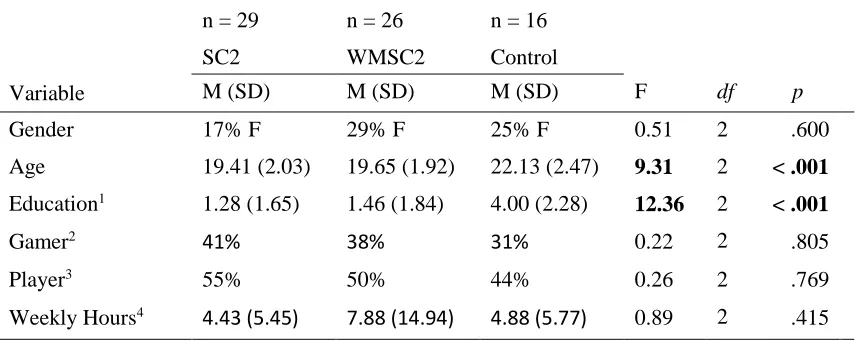
the demographic information for each group. The control group was significantly older and had a significantly higher level of education compared to the SC2 and WMSC2 groups.
Aim 1. Effectiveness of cognitive intervention
The first aim of this study was to examine the efficacy of the interventions to improve cognitive functioning. To examine change in cognitive ability from pretest and posttest and
whether changes differed by treatment groups (i.e. SC2, WMSC2, and Control) an analysis of covariance (ANCOVA) was performed for each of the cognitive variables. The five
cognitive variables included: UFOV – divided attention, UFOV – selective attention, symmetry span – visuospatial working memory, operation span – verbal working memory, and attentional blink – visual processing. The corresponding pretest score for each cognitive
design was chosen in favor to repeated measures ANOVA because ANCOVA has more power to detect differences between groups (Van Breukelen, 2006).
As can be seen in Table 2, there were significant group differences at posttest
(controlling for pretest levels) in symmetry span and operation span tasks. Post hoc analyses using Fisher’s Least Significant Difference test examined the significant differences between
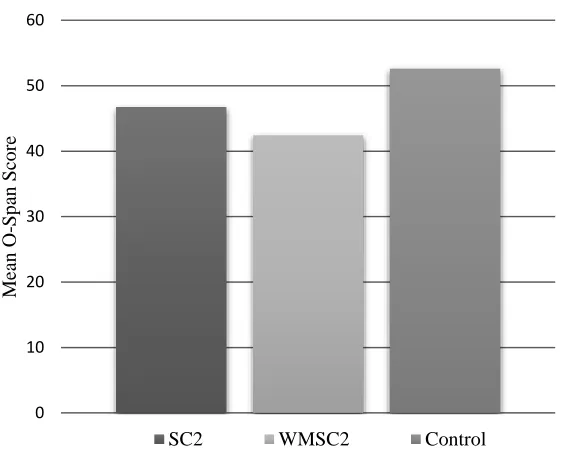
the three groups. For symmetry span (see Figure 1), the WMSC2 group scored significantly higher than the control group (p = .033) and the SC2 group (p = .040). For operation span (see Figure 2), the control group scored significantly higher than the WMSC2 group (p = .015) but not significantly greater than the SC2 group (p = .143).
Aim 2. The Flow State and Cognitive Change
The second aim of this investigation was to determine if the experience of flow impacted pretest to posttest change in cognitive functioning. Change scores were calculated for each cognitive by subtracting the pretest score from the post test score such that positive
change scores reflected gain and negative score indicated loss from pretest to posttest. As only participants in the game groups reported completed the FSS-2 (assessment of flow),
only those participants were included in this analysis (n = 57).
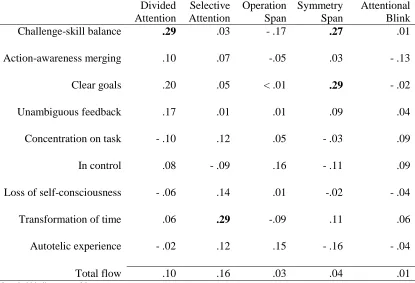
Table 3 contains the correlations among the cognitive change scores and the nine subscale as well as the total score for the FSS-2. Although total flow score was not
positively correlated with change in divided attention and symmetry span performance. Change in symmetry span performance was also significantly positively correlated with the Clear goals subscale. Lastly, change in selective attention performance was significantly
positively related to the Transformation of time subscale.
Next, analysis tested for differences in flow between the two intervention groups. A
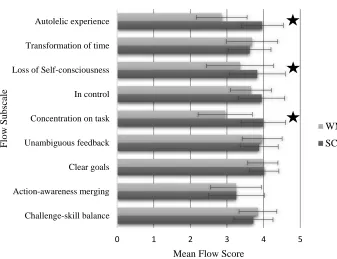
MANOVA conducted on the 9 subscales of the FSS-2 indicated that there was significant differences in flow experience between the two intervention groups; F (9, 45) 7.27, p < .001, µ2 = .59. Follow up ANOVA’s indicated the SC2 group scored significantly higher than the WMSC2 group on the subscales of Concentration on task (F (1, 53) = 32.80, p < .001, µ2 = .38), Loss of self-consciousness (F (1, 53) = 4.35, p = .042, µ2 = .08), and Autotelic
experience (F (1, 53) = 42.13, p < .001, µ2 = .44; see Figure 3). Aim 3. Impact of Digital Game Use on Training
The third aim of this study was to examine if regular digital game use impacted the
efficacy of the interventions. Participants were divided into two digital game use groups (Players and non-Players) using a median split on the question “in a typical week, how many
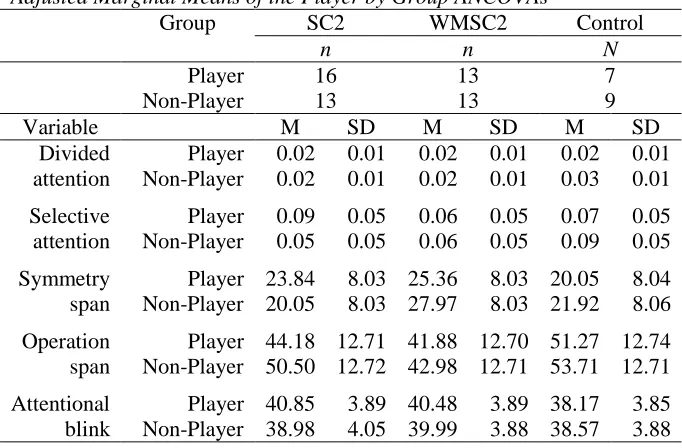
hours do you play any kind of video game?” Players reported playing three hours or more per week and non-Players reported playing less than three hours per week. Each treatment group contained roughly equal numbers of Players and non-Players (see Table 4).
cognitive variables. Following the same method as in Aim 1, the corresponding pretest score for each cognitive test served as the covariate while the score at posttest was the dependent variable. Table 4 contains the resulting estimated marginal means.
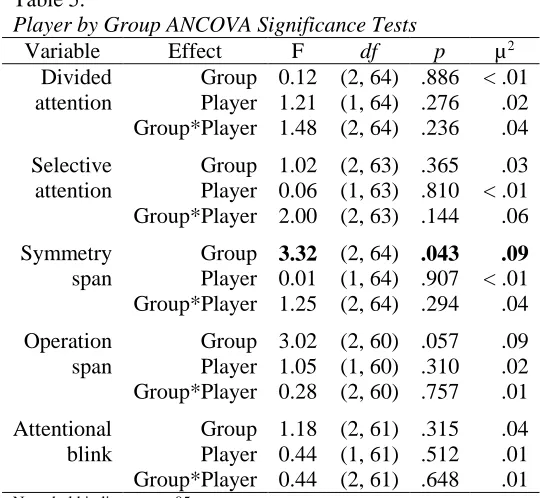
As detailed in Table 4, there were significant group differences in symmetry span scores at posttest (controlling for pretest levels). There were no significant differences
between Players and non-Players, and no significant interactions between Player and Treatment group. Post hoc analyses using Fisher’s Least Significant Difference test examined the significant group differences for the symmetry span task. Mirroring the
findings in Aim 1, the results indicated that the WMSC2 group significantly outperformed the control group (p = .031) and the SC2 group (p = .034; see Figure 4).
DISCUSSION
The primary aim of this study was to compare the efficacy of two common
approaches in game-based cognitive interventions. The first approach employs off-the-shelf
CADGs as the treatment program, which may place demands on a variety of cognitive abilities (e.g. Basak et al., 2008). The second approach utilizes games specifically designed
to mimic cognitive tests, which exercise limited and specific abilities (e.g. Brehmer et al., 2012). In line with the first approach, one group played the commercial version of StarCraft 2; while another group played a modified version of StarCraft 2 modeled after the symmetry
processing performance were assessed before training and following an 8-day intervention. Secondarily, this study examined the relationship between the experience of flow and change in cognitive performance as well as differences in flow between treatment games. The third
and final aim of this study examined the moderating potential of regular digital game use on cognitive change.
Results indicated that participants who played WMSC2 significantly improved their visuospatial WM compared to the SC2 group and the control group. Some aspects of the flow experience were associated with cognitive improvement, including: Challenge-skill
balance, Clear goals, and Transformation of time. Participants who played SC2 reported stronger flow experiences than participants in the WMSC2 group in the aspects of Autotelic
experience, Loss of self-consciousness, and Concentration on task. Lastly, regular digital game use did not significantly moderate the treatment effects.
Training Effects
Transfer effects embody central purpose of cognitive training programs. Transfer occurs when performance on non-trained tasks improves as a result of training. To capture
possible transfer effects the three treatment groups in this study were assessed on 5 cognitive abilities: divided attention, selective attention, attentional blink, verbal WM, and visuospatial WM. In relation to the WMSC2 game, these 5 abilities conceivably fall on a continuum of
transfer based on how closely each ability resembles the gameplay in WMSC2.
WMSC2 closely mirrors the visuospatial WM task (i.e. symmetry span). Whereas
improvement in verbal WM performance connotes less near, or domain general transfer; and improvement in the visual attention abilities would imply far transfer. Previous studies have
commonly found near transfer effects, but much more rarely far transfer effects (Powers et al., 2013).
The WMSC2 group significantly improved their visuospatial WM compared to the SC2 and control groups, signifying a near transfer effect. However, the control group aberrantly demonstrated significantly greater verbal WM ability at posttest, preventing an
examination of a domain general transfer effect. The reason for the improved performance in the control group remains unknown but additional participants in the control group may have
attenuated this anomalous result.
Contrary to expectations and previous research (Glass et al., 2013), The SC2 group did not exhibit a significant improvement in cognitive functioning relative to the other
treatment groups. Improvement in any of the cognitive abilities would have suggested a relatively far transfer effect because the gameplay in SC2 does not obviously resemble any of
the 5 assessed cognitive tasks. One reason for the lack of significant improvement in WM ability in the SC2 group may lie in the differences in experiences between novice and experienced players. In SC2, as the difficulty increases so too do the number of things
happening at once. Players of higher skill will more efficiently manage the many
lower difficulty levels can succeed by playing in a more sequential manner and use their WM only intermittently.
Impact of Flow
The analysis of the experience of flow revealed that cognitive change was selectively related certain aspects of flow and that SC2 engendered some other aspects of flow better
than WMSC2. Participants in the SC2 group reported significantly higher flow in the areas of Autotelic experience, Loss of self-consciousness, and Concentration on task. The reason for these differences likely relates to the broad gap in complexity and depth of gameplay
between SC2 and WMSC2. The repetitive nature of WMSC2 may prevent these aspects of flow from arising after an extended periods of play.
In the pooled sample of both game groups, cognitive change in certain abilities was associated with greater flow in the areas of Challenge-skill balance, Clear goals, and Transformation of time. Integrating these two analyses of flow reveals that the three flow
subscales significantly related to change in cognitive performance (Challenge-skill balance, Clear goals, and Transformation of time) were experienced similarly by both groups.
Experiencing these aspects of the flow state may play a necessary, but not sufficient, role in generating cognitive change. A game in which the participant does not understand the goals or the challenge does not match their skill level may be less likely to improve cognitive
experience or Loss of self-consciousness. If these aspects of flow truly contribute to cognitive improvement then they may do so independently of specific gameplay content.
Digital Game Use
Most game-based intervention studies specifically target non-players in the hope that the new exposure to the intervention game will yield the greatest change (e.g. Glass et al.,
2013; Oei & Patterson, 2013). This is one of few studies to look at training differences with respect to digital game use in a natural selection of players and non-players. The current findings suggests that regular digital game use in general did not substantially alter the
outcome of the intervention. Although this conclusion requires replication to confirm, restricting intervention participation to non-players may prove unnecessary. Furthermore, as
digital games continue to grow in popularity and become increasingly ubiquitous this precaution would limit sample pools and reduce ecological validity.
Unique Advancements
The design of this study embodies several innovations in the field of game-based cognitive interventions. This represents one of the first attempts to modify a CADG to train working
memory, and moreover, to then compare the modified version with the original game. Previous studies often use a second game group as an active control rather than an alternate experimental group expected to yield similar positive results as the primary experimental
group. A complete understanding of the types of gameplay that lead to cognitive
partially replicate previous studies which concluded that playing digital games can improve visual processing abilities (e.g. Green & Bavelier, 2006). The fact than neither treatment group improved in their visual processing performance provides support for the notion that
only certain games which place substantial demands on the visual system (e.g., FPSs) will yield visual processing improvement.
Limitations
This study endured several limitations, some common to cognitive interventions and others unique. These limitations relate to three areas of the study design: the limitations of the
groups, the limitations of the games, and the limitations the measures.
Limitations of the groups. The control group failed to serve its purpose as a neutral baseline as evident by its improved verbal WM performance from pretest to posttest
compared to the treatment groups. The fact that the control group entered the group randomization in the second half of the study and that the control group was significantly
older and more educated than the treatment groups may have contributed to this anomalous result. The control group would have benefited from being included in the randomization
from the beginning of testing and by representing a larger sample size. Similarly, larger samples in the treatment groups would have allowed for a more exhaustive analysis of the individual factors which may have impacted to effectiveness of the intervention (e.g.
Limitations of the games. Using a complex and open-ended game such as SC2 means that participants may have vastly different intervention experiences. Because the difficulty level adapted to participant’s performance, higher skill players experienced a very
fast-paced and demanding game while many novice players played a relatively slow and leisurely game. This diversity of gameplay experiences may have prevented the SC2 group
from demonstrating a single, detectible pattern of cognitive change. Particularly in comparison to WMSC2 which also adapts the difficulty to the skill of the player but maintains a relatively similar gameplay experience.
Another potential criticism of the game design involve the lack of similarity between SC2 and WMSC2. Although the modifying a CADG and comparing it to the original version
represents a notable advancement, other than the same game engine and art style, the two games actually have very little in common. This severely limits the examination of the relevant gameplay mechanics as they relate to the cognitive outcomes.
Limitations of the measures. A perfect cognitive intervention would assess as many cognitive abilities as exist valid measures, but limited resources allow for only a small
number of cognitive tests. Addition cognitive measures may have detected other interesting and relevant effects. Specifically, measures of multi-tasking ability, spatial reasoning, or general intelligence revealed other effect, or at least attempted replication of other studies
(Basak et al., 2008; Glass et al., 2013). Conversely, this study attempted to replicate
previous work (e.g. Feng et al., 2007) by including the UFOV test but the version used here
ay near floor, which meant detecting stimuli within a 62 ms display window but other versions allow for display windows as low as 10 ms. Future studies utilizing this measure to assess young adults should ensure an appropriate temporal resolution.
Lastly, assessing flow only once, at posttest, rather than immediately following the final gameplay session may have skewed these scores. Although most participants scheduled
their sessions on sequential days, as many as seven days separated the final intervention session and the posttest; and so requiring participants to rely more heavily on their memory of their gameplay experience. Additionally, the experience of flow may have fluctuated
across the intervention. For example, the WMSC2 group may have experienced stronger states of flow but become bored and disengaged by the end of the intervention. Additional
flow assessments could have captured patterns such as this.
Future Directions
This study represents a modest advancement in the field of game-based cognitive
interventions relative to the considerable amount of work remaining in order to fully understand the mechanisms that connect play digital games to improved cognitive
functioning. To start, focused task training (e.g. WMSC2) appears to reliably produce near transfer effects, but games that improve more distant and relevant cognitive abilities will require likely more complex gameplay with diverse cognitive demands, such as variable
gameplay. This type of study design will play a vital role in unraveling the aforementioned challenge facing cognitive intervention researchers. In addition to examining various forms of gameplay, future investigations should include individual differences in gameplay
experience. In particular, differences in flow states and the person-based variables that affect flow, such as personality and previous game experience, will impact what kinds of people
may benefit most from certain kinds of games. Just as a drug-based interventions target specific groups of patients, cognitive games may benefit some player more than others. Discovering the relevant individual differences poses an equally important target as
identifying the key gameplay mechanics.
Conclusion
In summary, focused task training in the form of a modified CADG yielded an
expected near transfer effect and improved performance on a related visuospatial WM task. Analysis of flow experience resulted in the qualified conclusion that some aspects of the flow experience may relate to cognitive outcomes. Finally, regular digital game use did not
ostensibly affect the positive results of the cognitive intervention. However, the relative lack of the significant changes cognitive ability in the treatment groups may have prevented the
Table 1.
Demographics and Game Usage Information by Group
n = 29 n = 26 n = 16
SC2 WMSC2 Control
Variable M (SD) M (SD) M (SD) F df p
Gender 17% F 29% F 25% F 0.51 2 .600
Age 19.41 (2.03) 19.65 (1.92) 22.13 (2.47) 9.31 2 < .001
Education1 1.28 (1.65) 1.46 (1.84) 4.00 (2.28) 12.36 2 < .001
Gamer2 41% 38% 31% 0.22 2 .805
Player3 55% 50% 44% 0.26 2 .769
Weekly Hours4 4.43 (5.45) 7.88 (14.94) 4.88 (5.77) 0.89 2 .415
1 Measured in years of completed higher education.
Table 2.
Adjusted Marginal Means and Significance Tests for ANCOVAs of Cognitive Abilities
SC2 WMSC2 Control
Variable M (SD) M (SD) M (SD) F df p µ2
Divided Attention 0.02 (0.01) 0.02 (0.01) 0.02 (0.01) 0.01 (2,
67) .911 < .01
Selective
Attention 0.07 (0.05) 0.06 (0.05) 0.08 (0.05) 1.26
(2,
66) .289 .04
Symmetry Span 22.14 (8.01) 26.66 (8.0) 21.10 (8.04) 3.16 (2,
67) .049 .09
Operation Span 46.76
(15.58)
42.43 (12.59)
52.64 (12.59) 3.16
(2,
63) .049 .09
Attentional Blink 40.09 (3.80) 40.16 (3.87) 38.47 (3.84) 1.12 (2,
64) .332 .03
Table 3.
Correlations between Cognitive Change Scores and Flow Subscales
Divided Attention
Selective Attention
Operation Span
Symmetry Span
Attentional Blink
Challenge-skill balance .29 .03 - .17 .27 .01
Action-awareness merging .10 .07 -.05 .03 - .13
Clear goals .20 .05 < .01 .29 - .02
Unambiguous feedback .17 .01 .01 .09 .04
Concentration on task - .10 .12 .05 - .03 .09
In control .08 - .09 .16 - .11 .09
Loss of self-consciousness - .06 .14 .01 -.02 - .04
Transformation of time .06 .29 -.09 .11 .06
Autotelic experience - .02 .12 .15 - .16 - .04
Total flow .10 .16 .03 .04 .01
Table 4.
Adjusted Marginal Means of the Player by Group ANCOVAs
Group SC2 WMSC2 Control
n n N
Player 16 13 7
Non-Player 13 13 9
Variable M SD M SD M SD
Divided attention
Player 0.02 0.01 0.02 0.01 0.02 0.01 Non-Player 0.02 0.01 0.02 0.01 0.03 0.01
Selective attention
Player 0.09 0.05 0.06 0.05 0.07 0.05 Non-Player 0.05 0.05 0.06 0.05 0.09 0.05
Symmetry span
Player 23.84 8.03 25.36 8.03 20.05 8.04 Non-Player 20.05 8.03 27.97 8.03 21.92 8.06
Operation span
Player 44.18 12.71 41.88 12.70 51.27 12.74 Non-Player 50.50 12.72 42.98 12.71 53.71 12.71
Attentional blink
Table 5.
Player by Group ANCOVA Significance Tests
Variable Effect F df p µ2
Divided attention
Group 0.12 (2, 64) .886 < .01 Player 1.21 (1, 64) .276 .02 Group*Player 1.48 (2, 64) .236 .04
Selective attention
Group 1.02 (2, 63) .365 .03 Player 0.06 (1, 63) .810 < .01 Group*Player 2.00 (2, 63) .144 .06
Symmetry span
Group 3.32 (2, 64) .043 .09 Player 0.01 (1, 64) .907 < .01 Group*Player 1.25 (2, 64) .294 .04
Operation span
Group 3.02 (2, 60) .057 .09 Player 1.05 (1, 60) .310 .02 Group*Player 0.28 (2, 60) .757 .01
Attentional blink
Group 1.18 (2, 61) .315 .04 Player 0.44 (1, 61) .512 .01 Group*Player 0.44 (2, 61) .648 .01
Figure 1. Adjusted marginal means based on the ANCOVA of symmetry span scores at posttest.
0 5 10 15 20 25 30
Me
an
S
-Sp
an
Sco
re
Figure 2. Adjusted marginal means based on the ANCOVA of operation span scores. 0
10 20 30 40 50 60
Me
an
O
-Sp
an
Sco
re
Figure 3. Comparison mean group flow score by subscale.
0 1 2 3 4 5
Challenge-skill balance Action-awareness merging Clear goals Unambiguous feedback Concentration on task In control Loss of Self-consciousness Transformation of time Autolelic experience
Mean Flow Score
Flo
w
Su
b
sca
le
WMSC2
Figure 4. Adjusted marginal means based on the Player by Group ANCOVA of symmetry span scores at posttest.
0 5 10 15 20 25 30
Player Non-player
Me
an
Sy
m
m
etr
y
Sp
an
Sco
re
REFERENCES
Ackerman, P. L., Kanfer, R., & Calderwood, C. (2010). Use it or lose it? Wii brain exercise practice and reading for domain knowledge. Psychology and Aging, 25(4), 753. Basak, C., Boot, W., Voss, M., & Kramer, A. (2008). Can training in a real-time strategy
video game attenuate cognitive decline in older adults? Psychology and Aging, 23, 765–777. doi:10.1037/a0013494
Bavelier, D., Green, C., Pouget, A., & Schrater, P. (2012). Brain plasticity through the life span: Learning to learn and action video games. Annual Review Of Neuroscience, 35, 391-416. doi:10.1146/annurev-neuro-060909-152832
von Bastian, C. C., & Oberauer, K. (2014). Effects and mechanisms of working memory training: a review. Psychological Research, 78(6), 803-820.
Belchior, P., Marsiske, M., Sisco, S., Yam, A., & Mann, W. (2012). Older adults'
engagement with a video game training program. Activities, Adaptation & Aging, 36(4), 269-279. doi:10.1080/01924788.2012.702307
Bleckley, M. K., Foster, J. L., & Engle, R. W. (2014). Working memory capacity accounts for the ability to switch between object-based and location-based allocation of visual attention. Memory & Cognition, 1-10.
Blizzard Entertainment, Inc. (2013). StarCraft 2 [PC game]. Irvine, CA: Blizzard Entertainment.
Brehmer, Y., Westerberg, H., & Bäckman, L. (2012). Working-memory training in younger and older adults: Training gains, transfer, and maintenance. Frontiers in Human Neuroscience, 6. doi:10.3389/fnhum.2012.00063
Broadway, J. M., Redick, T. S., & Engle, R. W. (2010). Working memory capacity: Self-control is (in) the goal. In R. R. Hassin, K. N. Ochsner, Y. Trope (Eds.), Self control in society, mind, and brain (pp. 163-173). New York, NY, US: Oxford University Press. doi:10.1093/acprof:oso/9780195391381.003.0009
Calvillo, D. P. (2012). Working memory and the memory distortion component of hindsight bias. Memory, 20(8), 891-898. doi:10.1080/09658211.2012.706309
Colzato, L. S., van den Wildenberg, W. M., Zmigrod, S., & Hommel, B. (2013). Action video gaming and cognitive control: Playing first person shooter games is associated with improvement in working memory but not action inhibition. Psychological Research, 77(2), 234-239. doi:10.1007/s00426-012-0415-2
Cherney, I. D. (2008). Mom, let me play more computer games: They improve my mental rotation skills. Sex Roles, 59(11-12), 776-786.
Csikszentmihalyi, M. (1990). Flow: The psychology of optimal experience. New York: Harper and Row.
Chou, T., & Ting, C. (2003). The role of flow experience in cyber-game addiction. Cyberpsychology & Behavior, 6(6), 663-675. doi:10.1089/109493103322725469 Dobrowolski, P., Hanusz, K., Sobczyk, B., Skorko, M., & Wiatrow, A. (2015). Cognitive
enhancement in video game players: The role of video game genre. Computers in Human Behavior, 44, 59-63.
Donohue, S. E., Woldorff, M. G., & Mitroff, S. R. (2010). Video game players show more precise multisensory temporal processing abilities. Attention, Perception, & Psychophysics, 72, 1120–1129.
Durlach, P. J., Kring, J. P., & Bowens, L. D. (2009). Effects of action video game experience on change detection. Military Psychology, 21, 24–39.
Dye, M. W. G., Green, C. S., & Bavelier, D. (2009). The development of attention skills in action video game players. Neuropsychologia, 47(8), 1780-1789.
Feng, J., Spence, I., & Pratt, J. (2007). Playing an action video game reduces gender differences in spatial cognition. Psychological Science, 18(10), 850-855. doi:10.1111/j.1467-9280.2007.01990.x
Glass, B. D., Maddox, W. T., & Love, B. C. (2013). Real-time strategy game training: emergence of a cognitive flexibility trait. PloS one, 8(8), e70350.
Green, C., & Bavelier, D. (2003). Action video game modifies visual selective attention. Nature, 423(6939), 534-537. doi:10.1038/nature01647
Green, C. S., & Bavelier, D. (2006). Effect of action video games on the spatial distribution of visuospatial attention. Journal of Experimental Psychology: Human Perception and Performance, 32(6), 1465.
Hambrick, D., Oswald, F., Darowski, E., Rench, T., & Brou, R. (2010). Predictors of multitasking performance in a synthetic work paradigm. Applied Cognitive Psychology, 24, 1149–1167.
Hutchison, K. A., Smith, J. L., & Ferris, A. (2013). Goals can be threatened to extinction using the stroop task to clarify working memory depletion under stereotype threat. Social Psychological and Personality Science, 4(1), 74-81.
Kane, M. J., Hambrick, D. Z., & Conway, A. R. A. (2005). Working memory capacity and fluid intelligence are strongly related constructs: Comment on Ackerman, Beier, and Boyle (2005).Psychological Bulletin,131, 66–71
Karle, J. W., Watter, S., & Shedden, J. M. (2010). Task switching in video game players: Benefits of selective attention but not resistance to proactive interference. Acta Psychologica, 134, 70–78.
Kennedy, A. M., Boyle, E. M., Traynor, O., Walsh, T., & Hill, A. D. K. (2011). Video gaming enhances psychomotor skills but not visuospatial and perceptual abilities in surgical trainees. Journal of Surgical Education, 68(5), 414-420.
Klasen, M., Weber, R., Kircher, T. J., Mathiak, K. A., & Mathiak, K. (2012). Neural contributions to flow experience during video game playing. Social Cognitive and Affective Neuroscience, 7(4), 485-495. doi:10.1093/scan/nsr021
Kleider, H. M., Parrott, D. J., & King, T. Z. (2010). Shooting behaviour: How working memory and negative emotionality influence police officer shoot decisions. Applied Cognitive Psychology, 24(5), 707-717.
Kramer, A. F., Larish, J. F., & Strayer, D. L. (1995). Training for attentional control in dual task settings: A comparison of young and old adults. Journal of Experimental Psychology: Applied, 1(1), 50−76.
Maciokas, J. B., & Crognale, M. A. (2003). Cognitive and attentional changes with age: Evidence from attentional blink deficits. Experimental Aging Research, 29(2), 137-153.
Melby-Lervåg, M., & Hulme, C. (2013). Is working memory training effective? A meta-analytic review. Developmental Psychology, 49(2), 270-291. doi:10.1037/a0028228 Oei, A. C., & Patterson, M. D. (2013). Enhancing cognition with video games: a multiple
game training study. PLoS One, 8(3), e58546.
Okagaki, L., & Frensch, P. A. (1994). Effects of video game playing on measures of spatial performance: Gender effects in late adolescence. Journal of Applied Developmental Psychology,15(1), 33-58. doi:10.1016/0193-3973(94)90005-1
Powers, K. L., Brooks, P. J., Aldrich, N. J., Palladino, M. A., & Alfieri, L. (2013). Effects of video-game play on information processing: A meta-analytic investigation.
Psychonomic Bulletin & Review, 20(6), 1055-1079. doi:10.3758/s13423-013-0418-z Redick, T. S., Unsworth, N., Kelly, A. J., & Engle, R. W. (2012). Faster, smarter? Working
Shipstead, Z., Hicks, K. L., & Engle, R. W. (2012). Cogmed working memory training: Does the evidence support the claims?. Journal of Applied Research in Memory and
Cognition, 1(3), 185-193. doi:10.1016/j.jarmac.2012.06.003
Sims, V. K., & Mayer, R. E. (2002). Domain specificity of spatial expertise: The case of video game players. Applied Cognitive Psychology, 16(1), 97-115.
Strobach, T., Frensch, P. A., & Schubert, T. (2012). Video game practice optimizes executive control skills in dual-task and task switching situations. Acta Psychologica, 140, 13– 24.
Sungur, H., & Boduroglu, A. (2012). Action video game players form more detailed representation of objects. Acta Psychologica, 139(2), 327-334.
doi:10.1016/j.actpsy.2011.12.002
Terlecki, M. S., & Newcombe, N. S. (2005). How important is the digital divide? The relation of computer and videogame usage to gender differences in mental rotation ability. Sex Roles, 53(5-6), 433-441.
Toril, P., Reales, J. M., & Ballesteros, S. (2014). Video game training enhances cognition of older adults: A meta-analytic study. Psychology And Aging, 29(3), 706-716.
doi:10.1037/a0037507
Unsworth, N., Heitz, R. P., Schrock, J. C., & Engle, R. W. (2005). An automated version of the operation span task. Behavior Research Methods, 37(3), 498-505.
Weber, R., Tamborini, R., Westcott-Baker, A., & Kantor, B. (2009). Theorizing flow and media enjoyment as cognitive synchronization of attentional and reward networks. Communication Theory, 19(4), 397-422. doi:10.1111/j.1468-2885.2009.01352.x Whitlock, L. A., McLaughlin, A. C., & Allaire, J. C. (2012). Individual difference in
APPENDIX A Flow State Scale-2 (FSS-2)
Instructions: “Think about how you feel about playing StarCraft 2 for the past 8 sessions.”
Response options: 5-point scale: 1-Strongly disagree, 2-Disagree, 3-Neither agree nor disagree, 4-Agree, 5-Strongly agree.
Items by subscale: Challenge-skill balance
1. I was challenged, but I believed my skills would allow me to meet the challenge. 2. My abilities matched the high challenge of the situation.
3. I felt I was competent enough to meet the high demands of the situation. 4. The challenge and my skills were at an equally high level.
Action-awareness merging
1. I made the correct movements without thinking about trying to do so. 2. Things just seemed to be happening automatically.
3. I performed automatically.
4. I did things spontaneously and automatically without having to think. Clear goals
1. I knew clearly what I wanted to do.
2. I had a strong sense of what I wanted to do. 3. I knew what I wanted to achieve.
4. My goals were clearly defined. Unambiguous feedback
1. It was really clear to me that I was doing well. 2. I was aware of how well I was performing.
3. I had a good idea while I was performing about how well I was doing. 4. I could tell by the way I was performing how well I was doing.
Concentration on task