Recombinogenic Activity of Chimeric
recA
Genes (Pseudomonas
aeruginosa/Escherichia coli): A Search for RecA Protein
Regions Responsible for This Activity
Irina V. Bakhlanova,* Tomoko Ogawa
†and Vladislav A. Lanzov*
*Division of Molecular and Radiation Biophysics, Petersburg Nuclear Physics Institute, Russian Academy of Sciences, Gatchina/St. Petersburg 188300, Russia and†Department of Cell Genetics, National Institute of Genetics, Mishima, Shizuoka-ken 411-8540, Japan
Manuscript received April 20, 2001 Accepted for publication June 18, 2001
ABSTRACT
In the background of weak, if any, constitutive SOS function, RecA fromPseudomonas aeruginosa(RecAPa) shows a higher frequency of recombination exchange (FRE) per DNA unit length as compared to RecA fromEscherichia coli(RecAEc). To understand the molecular basis for this observation and to determine which regions of the RecAPa polypeptide are responsible for this unusual activity, we analyzedrecAX chimeras between therecAEc andrecAPa genes. We chose 31 previously described recombination- and repair-proficient recAXhybrids and determined their FRE calculated from linkage frequency data and constitutive SOS function expression as measured by using thelacZgene under control of an SOS-regulated promoter. Relative torecAEc, the FRE ofrecAPawas 6.5 times greater; the relative alterations of FRE for recAXgenes varied fromⵑ0.6 to 9.0. No quantitative correlation between the FRE increase and constitutive SOS function was observed. Single ([L29M] or [I102D]), double ([G136N, V142I]), and multiple substitu-tions in related pairs of chimeric RecAX proteins significantly altered their relative FRE values. The residue content of three separate regions within the N-terminal and central but not the C-terminal protein domains within the RecA molecule also influenced the FRE values. Critical amino acids in these regions were located close to previously identified sequences that comprise the two surfaces for subunit interactions in the RecA polymer. We suggest that the intensity of the interactions between the subunits is a key factor in determining the FRE promoted by RecAin vivo.
T
HE RecA protein is an essential component of ho- in constitutive expression of SOS functions due to a protease constitutive (Prtc) phenotype. Thesemuta-mologous SOS-independent and SOS-dependent
tions, however, do not cluster to a specific domain in recombination in bacteria. The two types of
recombina-the RecA molecule (Wang and Tessman 1986). On tion processes differ in the frequency of recombination
the other hand, RecAPa-mediated stimulation of FRE exchanges (FRE) per DNA unit length, which is about
activity inE. colimost likely does not result from a consti-an order of magnitude higher under conditions of SOS
tutive SOS response, since a concomitant increase in response (BreslerandLanzov1978;Lloyd1978; V. A.
-galactosidase levels from an sfiA::lacZ fusion is not
Lanzov and A. J. Clark, unpublished results). This
observed in these cells (Namsaraevet al.1998). The un-dramatic increase results from derepression of the SOS
coupling of the RecAPa hyperrecombinogenic (hyper-regulon (controlled by the LexA repressor and the RecA
rec) activity and the constitutive SOS has been explained allosteric inducer) and induction of a number of repair
by the tight binding of RecAPa to a single- and especially and recombination enzymes (LittleandMount1982).
to a double-stranded DNA (ss- and dsDNA, respectively). A distinguishing characteristic of RecA protein from
Because the RecA::ATP::ssDNA presynaptic ternary
com-Pseudomonas aeruginosa(RecAPa) is its
hyperrecombino-plex can bind to either dsDNA or the LexA protein in genic activity inEscherichia colicells in which the
endoge-a mutuendoge-ally exclusive mendoge-anner (Yu andEgelman 1993; nousE. coli recAgene (recAEc) is replaced by its homolog
Rehraueret al.1996), the high affinity of RecAPa for fromP. aeruginosa,recAPa. In fact, RecAPa increases FRE
dsDNA favors initiation of recombination instead of 6- to 8-fold inE. coli(Namsaraevet al.1998). A similar
LexA repressor binding to induce the constitutive SOS increase can be also achieved with single amino acid
response. substitutions inrecAEcthat show a 10- to 17-fold increase
RecAEc is composed of 352 amino acids (Horii et al.1980) that constitute three domains: an N-terminal domain from residues 1–36⫾8, a central domain
(resi-Corresponding author:Vladislav A. Lanzov, Division of Molecular and dues 36–266⫾4), and a C-terminal domain consisting Radiation Biophysics, Petersburg Nuclear Physics Institute, Russian
of residues 266–352 (Story et al.1992). The RecAPa
Academy of Sciences, Gatchina/St. Petersburg 188350, Russia.
E-mail: [email protected]; [email protected] protein, which is 71% identical and 86% similar to
In each transformation, several transformants were tested for
RecAEc (Sano and Kageyama 1987), is shorter than
Rec⫹and UVr phenotypes; all tests were well reproducible,
RecAEc by 6 amino acids (Figure 1) but probably has
and two transformants were used in further analyses.
similar, if not identical, secondary structure. All 10 The strains KL227: HfrP4xmetB1 rel-1Strsand KL226: HfrC ␣-helices of the RecAPa protein have been recon- Strs(E. coli Genetic Stock Center) were used as donors in
conjugational crosses. The strains JC10289L, GY7109L, and
structed and analyzed as homologs of RecAEc (
Petuk-KL226L (the same as JC10289, GY7109, and KL226, respec-hovet al.1997).
tively, butlexA3) were made by P1 transduction oflexA3from
A unique property of the RecA family of proteins is
RB800:malE::Tn5 lexA3 (G. Walker’s collection).lexA3
con-their ability to form nucleoprotein filaments composed ferred a UVs phenotype and was 75% cotransducible with
of RecA, ATP, and ssDNA. This activates RecA for either malE::Tn5. The presence of thelexA3mutation in JC10289L,
GY7109L, and KL226L was confirmed by repeated P1
transduc-recombination or the SOS response (Kowalczykowski
tion of themalE::Tn5 lexA3from these strains to JC7623 (the et al.1994;RocaandCox1997). The X-ray crystal
struc-same as AB1157, butrecBC⫺sbcB⫺) to observe again the Kanr
ture analysis of RecA revealed that RecA monomers are
UVsphenotype of these transductants in addition to the Rec⫺
packed together to form a continuous helical polymer phenotype that served as a specific characteristic of lexA3 (Storyet al. 1992) with an axial hole that accommo- recBC⫺sbcB⫺strains.
Plasmids pEC19 and pAK610 (Ogawaet al.1992) contain,
dates at least three strands of DNA (Cox1995),
includ-respectively, therecAEcandrecAPagenes transcribed from the
ing the ssDNA of one of the recombination partners
lacpromoter. They were used for the expression of RecAEc
and the dsDNA of the other. Each polymer subunit has
and RecAPa proteins in determining both FRE and SOS
char-two separate surfaces that form the contact interface acteristics. Plasmids carrying recAEc/recAPa chimeric genes (Figure 1). As is easily seen in Figure 1A, one surface (designated here asrecAX1,recAX2, . . . , etc.) were constructed
earlier from pEC19 and pAK610 (Ogawaet al.1992).
(region I) consists of 14 residues located in positions
Chemicals:O-Nitrophenyl--d-galactopyranoside (ONPG),
6–30 (region Ia) of the N-terminal and 13 residues
lo-ampicillin, and streptomycin were purchased from Sigma
cated between positions 172 and 257 (region Ib) of
Chemical (St. Louis). All other reagents used were commercial
the central domain, while the complementary surface products of the highest grade available.
includes 28 residues between positions 89 and 156 (re- FRE analysis: Quantitative estimations of FRE alterations gion II) of the central domain (Story et al. 1992). (⌬FRE) promoted by differentrecAXgenes relative to the FRE value promoted by therecAEcgene were done by use of the
Figure 1, B and C, show, respectively, a general and
modified Haldane formula: ⫽ 1⁄
2 [1⫹exp(2l/)], where
detailed spatial structure of the interface. One can see
is the coinheritance (linkage frequency) of selected and
spatial positions of separate amino acid residues partici- unselected transferred donor markers in Hfr⫻F⫺crosses,l pating in the subunit-subunit interaction. is the distance between these markers in minutes of E. coli Fifty-four recAgene chimeras composed ofP. aerugi- map, andis an average distance between two neighboring recombination exchanges (Bresler and Lanzov 1978). If nosaandE. coli recAgene fragments (recAXgenes) were
coinheritances of the same pair of markers are measured in
either selected in vivoor constructed in vitro(Ogawa
two different crosses and promoted by two differentrecAgenes et al. 1992). In the present work, 31
recombination-(values1and2, respectively), then the FRE alterations can
proficient recAX genes from this collection were used be calculated via the formula⌬FRE⫽ln(2
1⫺1)/ln(22⫺
in an attempt to determine which residues of RecAPa 1). The events of conjugational recombination proceeding in the 19-min intervaltsx-argEof the 100-minE. coligenetic map
are critical for its hyper-rec activity. A comparison of
(Rudd 1998) are well described by the Haldane formula in
both the recombinogenic and constitutive SOS
charac-crosses between donors of HfrP4x or HfrC and recipients of
teristics of theserecAXgenes led us to conclude that, like
AB1157 ancestry (Bresleret al. 1978; Lanzov et al.1991).
RecAPa, some chimeric proteins contain an increased These strains were chosen for measurements of linkage be-recombinogenic activity that does not correlate with tween selected thr⫹and unselectedleu⫹donor markers, lo-their effect on constitutive SOS expression. A search for cated at 0 and 1.75 min ofE. colimap, respectively. Because values of marker coinheritance, and consequently FRE,
de-residues responsible for the increase of recombinogenic
pend on different physiological factors including
tempera-activity of these RecA chimeras (RecAX) suggests that
ture, pH of the media, medium shift down, and growth phase
intersubunit interactions specify the hyper-rec activity of recipients (V.Lanzov, I.Bakhlanovaand A.Clark, un-of both RecAX and RecAPa proteins. published results), standard experimental conditions
(includ-ing minimal medium for all stages of conjugation and expo-nential growth phase, pH 7.5, 37⬚) were used in all crosses.
Both Hfr and F⫺strains were grown in minimal 56/2 me-MATERIALS AND METHODS
dium (Adelberg and Burns 1960) supplemented with re-quired growth factors. Selection was carried out on the same
Bacterial strains and plasmids:The structure of recAX
hy-brids between recAgenes from E. coliand P. aeruginosa was medium plus 1.5% agar and lacking threonine. Since strains of the AB1157 line are isoleucine- and valine-deficient at tem-described earlier (Ogawa et al. 1992). Thirty-one original
plasmids carrying the chimeric genes with Rec⫹phenotype peratures⬎37⬚(TessmanandPeterson1985), growth and selective media contained these amino acids in all crosses. were transformed both into the strain JC10289 (of AB1157
ancestry) with the relevant genotype⌬recA thr-1 leu-6Strr(A. J. When Hfr donors were metB⫺, growth and selective media contained methionine. Donors and recipients were mixed for Clark’s collection) to analyze FRE and into the strain GY7109
(of AB1157 ancestry) with the relevant genotype ⌬recA conjugation in ratio 1:10; conjugation was allowed for 60 min; and the mating mixture was diluted 1:100 with 56/2 buffer sfiA::lacZ(R. Devoret’s collection) to analyze the level of
conju-gation, Thr⫹ Strr transconjugants were selected. Both Hfr
chimeras:Table 1 summarizes the changes in FRE values
KL227 and Hfr KL226 transfer markers in the following order: (named⌬FRE) for different structural types of chimeras origin,leu⫹, andthr⫹. About 200–300 unpurified colonies from
described earlier (Ogawa et al. 1992) relative to the
each selection were inoculated as patches in a regular array
FRE value ofrecAEc. The⌬FRE values for the chimeras
on selective media. After overnight incubation the
transconju-varied widely fromⵑ0.6 (for X49 chimera) up toⵑ9.0
gants were replica plated onto the same selective media
omit-ting threonine and leucine to score inheritance of unselected (for X53). The level of constitutive SOS expression
me-leu⫹. As minimum, three crosses were performed with each diated by the different chimeras is also presented rela-pair of strains, the results were averaged, and standard devia- tive to RecAEc, which was taken as 1.0. These ⌬SOS tions were determined.
values varied in range fromⵑ1.3 for X54 toⵑ3.5 for
Under the standard conditions described, the FRE value
X47 with a moderate constitutive SOS for several
chime-was found to be 4.43⫾0.22 recombination exchanges per
ras (X9, X35, X45–X47, and X49) and a weak SOS
the 100-min length of DNA. This value is valid for therecAEc⫹
recipients of AB1157 line in theE. colimap region between expression, if any, for most of them. For comparison,
90 and 10 min. All⌬FRE alterations found in this study were a high (17-fold) increase of constitutive SOS by a single calculated relative to the FRE value forrecAEc, 4.43 exchanges
E. colimutant recA730 (Tessmanand Peterson 1985;
per 100 min.
Cazauxet al.1993) results in a 7-fold increase of⌬FRE
-Galactosidase assay: Spontaneous SOS gene expression
(V.Lanzov, I.Bakhlanovaand A.Clark, unpublished
was measured in strain GY7109⌬recAcarrying plasmids with
differentrecAX chimeras. Cultures were grown overnight at results).
37⬚in mineral 56/2 medium containing all necessary growth The quantitative correlation coefficient between factors and 25g/ml ampicillin. Overnight cultures were di- ⌬FRE and ⌬SOS values for all 31 chimeras was found luted 40-fold in the same medium and grown to an optical
to be insignificant (0.144) and, furthermore, this
coef-density of 0.1–0.2 at 600 nm. The-galactosidase assay was
ficient was negative (⫺0.268) for the 15 chimeras (X8–
essentially that described byMiller(1972). A portion (1 ml
X10, X21, X32–X35, X38, X45–X48, X53, and X54),
as a rule) of an exponentially growing cell suspension was
diluted by the same volume of phosphate Z-buffer (pH 7) and which promoted a threefold and more increase of⌬FRE
the optical density at 600 nm (OD600) was measured. The cell values. These estimations do not negate earlier
observa-suspension was permeabilized by sodium dodecyl sulfate and tions of qualitative connection between the constitutive chloroform; 0.4 ml ONPG (4 mg/ml) was added; the reaction,
SOS expression and FRE increase, but rather they show
proceeding an appropriate time at 28⬚, was stopped by
addi-the existence of some additional parameters that
deter-tion of 1 ml of 1mNa2CO3; the mixture was centrifuged to
mine quantitative changes of⌬FRE values. In fact, two
remove debris; and the OD420of the reaction mixture was
determined. The protein activity was calculated in arbitrary chimeras with similar ⌬SOS values (for example, X7
units as recommended byMiller(1972), using the formula and X48) showed different⌬FRE values and vice versa
-gal⫽1000(OD420/OD600·t·v), where OD420is an optical (compare X45 and X54). On the other hand, even small
density of the reaction mixture at 420 nm, OD600is an optical
changes in the primary structures in related RecAX
pro-density of cell suspension in Z-buffer at 600 nm,tis time of
tein pairs (Figure 1, Table 1) such as RecAX7–X8 (three
the reaction in minutes, andvis a portion (in milliliters) of
amino acid substitutions between positions 136 and
the cell suspension in Z-buffer taken in the reaction. These
units were proportional to the amount ofO-nitrophenol in- 150), X20–X21 (one substitution in the region 29–31),
creased per minute per bacterium. The data of two or three X37–X38 (three substitutions in the interval 102–110), independent assays, each of which contained two or three and X48–X49 (five substitutions among positions 251– probes taken at different optical density (OD600) of growing
266) resulted in, respectively, four-, three-, two-, and
culture, were averaged and standard deviations were
deter-even sixfold⌬FRE alterations under conditions of
insig-mined.⌬SOS is a ratio of the-gal level promoted by RecAX
nificant differences in their⌬SOS values. Thus, the
in-or RecAPa to that of RecAEc. Cin-orrelations between⌬FRE
and⌬SOS data were calculated through Pierson correlation trinsic recombinogenic ability of an individual RecA
coefficients. Calculations of uncertainty in determinations of protein may be predetermined by this primary structure. relative values of FRE and the -galactosidase activity were Inhibition of constitutive SOS expression by lexA3 done according toRobytandWhite’s(1990) manual.
Stan-mutation does not affect the hyper-rec activity of RecAX dard deviation,s, from the mean (xm) for a sample of data
proteins: If the hyper-rec activity of RecAX proteins
(xi) ofnobservations was calculated by the following formula:
even partially depended on constitutive SOS expression,
s⫽√(xi⫺xm)2/(n⫺1). the addition of alexA3mutation that results in a
com-plete loss of SOS expression to therecAXgenetic
back-Sequence analysis: The positions of chimera junctions in
ground would proportionally inhibit its hyper-rec
activ-recAX7,recAX8,recAX20,recAX21,recAX45, andrecAX53genes
ity. This was not the case, because, like RecAXPa, five
showing unusual FRE characteristics were confirmed by the
RecAX chimeras belonging to different structural types
Sanger method (Sambrooket al.1989).
(Table 2) did not change the⌬FRE values under condi-tions of complete suppression of their constitutive SOS. This result was unexpected, at least for RecAX47, in
RESULTS
which the⌬SOS value was significant at 3.5. A possible
A lack of correlation observed between FRE values explanation of these findings is the existence of a thresh-old constitutive SOS expression that must be overcome
TABLE 1
Recombination properties of chimericrecAXgenes and their proteinsin vivo
aChimera types and names are those that have been used earlier (Ogawaet al.1992).
bSolid and open bars show portions of RecAEc and RecAPa proteins, respectively. The position of a chimera
junction is shown as that of the first different residue attributed to another protein in the sequence, read from left to right.
cThe yield of Thr⫹Strrrecombinants in all crosses was between 3.5 and 7.7% of donor cells, which were
present at levels 10-fold less than that of recipients. The only exception was HfrP4x⫻ JC10289⌬recAEc / pRecA38, which resulted in a recombinant level of 0.5⫾0.1%.
d⌬FRE, calculated from marker coinheritance data, and⌬SOS, measured from the spontaneous level of -galactosidase from asfiA::lacZfusion, are FRE and SOS values of RecAX proteins relative to those of RecAEc.
eFor RecAEc, the absolute value of FRE was 5.01⫾0.43 (coinheritance ofthr⫹andleu⫹markers was 0.931⫾
Figure 1.—Amino acid residues involved in the interface of subunit-subunit interactions in the RecA polymer structure according toStoryet al.(1992). (A) The amino acid sequence alignment of the RecAPa protein relative to RecAEc. The RecAPa amino acid residues identical to those of RecAEc are shown by dots. The residues involved in the interface of subunit-subunit interactions are framed. Solid circles below the sequences indicate residues participating in one face of the interface (they are located in region Ia between positions 6 and 30 and additionally in region Ib between positions 172 and 257). Open circles indicate the residues involved in the structure of the other face located in region II between positions 89 and 156. Designations of␣-helices A, B, C, . . . , J;-strands 0, 1, 2, . . . , 10; and loops L1 and L2 are those used byStoryet al.(1992). (B) The spatial structure of RecAEc dimer and the interface of subunit-subunit interaction (Storyet al.1992). Two RecA protomers are shown in cyan and green, and the amino acid residues in the interface are colored red. (C) Details of the spatial structure of the interface shown in B. Letters (A, D, E, G, and F), numbers (0, 2, 3, 6, 7, and 8), and designation L1 show, respectively, the
TABLE 2
FRE and SOS activities of RecAPa and some RecAX chimeras in genetic background
of either a wild-type or mutatedlexAallele
Chimera
Recombinogenic activity SOS activity
lexA⫹ No. of clones No. of probes
Type Name orlexA3 analyzed ⌬FRE analyzed ⌬SOS
I X8 lexA⫹ 300 4.95⫾0.45 3 2.36⫾0.24
X8 lexA3 800 4.09⫾0.28 6 1.02⫾0.12
II X21 lexA⫹ 300 3.17⫾0.25 3 1.83⫾0.25
X21 lexA3 800 3.00⫾0.20 6 1.01⫾0.12
X32 lexA⫹ 300 5.92⫾0.57 3 2.17⫾0.22
X32 lexA3 800 6.11⫾0.57 6 1.01⫾0.17
III X47 lexA⫹ 300 3.00⫾0.24 3 3.47⫾0.37
X47 lexA3 800 3.00⫾0.20 6 1.09⫾0.13
IV X53 lexA⫹ 300 8.22⫾0.57 3 1.43⫾0.16
X53 lexA3 800 7.12⫾0.46 6 1.08⫾0.11
RecAPa lexA⫹ 700 6.52⫾0.47 3 1.80⫾0.22
RecAPa lexA3 700 6.58⫾0.53 6 1.03⫾0.12
All designations and calculations are similar to those used in Table 1. Donor strain KL226 was used in the
⌬FRE determination. The yield of Thr⫹Strrrecombinants in all crosses was between 2.7 and 5.3% of donor
cells.
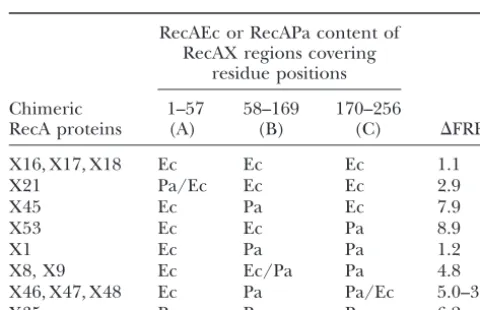
to trigger FRE alterations. Since none of the proteins X53, which was lost in the X1 structure. At last, the chimeric protein with all three (A, B, and C) regions analyzed in Table 2 (including the ancestral RecAPa)
from RecAPa showed a relatively high recombinogenic overcome this threshold, the latter can be estimated as
activity (compare X1 and X35).
⌬SOS⬎3.5.
The analysis presented above reveals the role of three
The recombinogenic activity of the RecAX chimeras
separate regions of the RecAPa protein in mediating of
depends upon the amino acid content of the three
pro-the hyper-rec activity of RecAX chimeras. The analysis
tein regions:The comparison of RecAX chimera
struc-also indicates that some residues in these regions must tures and ⌬FRE alterations (Table 1) showed that all
be better compatible to generate the hyper-rec activity essential FRE determinants reside in the first 255
resi-of a RecAX protein. dues because the C-terminal amino acid residues (256–
Several amino acid substitutions are critical for the
352) of either RecAPa or RecAEc had no significant influence. In fact, the⌬FRE of RecAX16, consisting of RecAEc over the first 255 residues and the RecAPa over
TABLE 3
256 to the C-terminal end, differed insignificantly from
Relative change of recombinogenic activity of RecAX proteins
the⌬FRE of RecAEc. Another example is the similarity
that differ by the amino acid content in three arbitrary
(at least within the limit of error) of the FRE values for
regions of the N-terminal and central domains
X53 and X54, which differ only at region 256–352. On the basis of their contribution to the⌬FRE values,
RecAEc or RecAPa content of
the RecA chimeras can be divided into three regions: RecAX regions covering A (residues 1–57), B (58–169), and C (170–255; Table residue positions 3). Relative to RecAEc, a three-, eight-, and ninefold
Chimeric 1–57 58–169 170–256
increase in recombinogenic activity was seen in
chime-RecA proteins (A) (B) (C) ⌬FREa
ras containing a significant portion of either region A
X16, X17, X18 Ec Ec Ec 1.1
(X21), B (X45), or C (X53), respectively, from RecAPa.
X21 Pa/Ec Ec Ec 2.9
On the other hand, the chimera with both region B
X45 Ec Pa Ec 7.9
and C from RecAPa showed a basal recombinogenic
X53 Ec Ec Pa 8.9
activity similar to that of RecAEc (compare X1 and X16– X1 Ec Pa Pa 1.2 X18). However, a small expansion of RecAEc sequence X8, X9 Ec Ec/Pa Pa 4.8 from region A over region B as well as substitution of X46, X47, X48 Ec Pa Pa/Ec 5.0–3.0
X35 Pa Pa Pa 6.2
a small part of the RecAPa sequence in either region
B (X8–X9 relative to X1–X7, Figure 1) or region C aThese data were averaged from those presented in Table
(X46–X48vs. X1) by RecAEc restored, though incom- 1. For RecAEc and RecAPa, ⌬FRE values are 1.0 and 6.5,
respectively.
RecAX protein recombinogenic activity:Table 1 shows subunit-subunit interactions whereas the B region con-tains amino acids from the other surface, II (Figure 1). the roles of individual residues or combinations of
resi-dues in altering ⌬FRE values. RecAX20 differs from This suggests that intensity of subunit-subunit interac-tions during RecA protein polymerization could be one X21 by a single residue substitution of residue 29 from
leucine to methionine, [L29M] (Figure 1). This substi- of the factors responsible for recombinogenic activity of the RecA presynaptic complex.
tution resulted in a nearly threefold increase of FRE. Note that this position is located on one of the two surfaces involved in RecAEc subunit-subunit
interac-DISCUSSION
tions.
RecAX10 and X9, which differ by three substitutions A wild-type RecAPa protein initiates recombination exchanges about sixfold more frequently than a wild-[I159M], [S162A], and [M164V], showed a 1.5-fold
dif-ference of⌬FRE. [T150V], the only difference between type RecAEc protein. This hyper-rec activity is not associ-ated with a noticeable constitutive SOS expression RecAX9 and X8, appeared to be neutral. The double
substitution [G136N] and [V142I], the difference be- (Namsaraevet al.1998). To verify this observation, 31 recombination-proficient recAXchimeras were chosen tween RecAX8 and X7, showed a nearly 5-fold decrease
of⌬FRE. These data indicate that either these residues for a comparative analysis of their constitutive recombi-nogenic and SOS activities. A quantitative comparison themselves or the regions where these positions were
present could be critical for the RecA protein recombi- of these parameters showed all combinations of⌬FRE and⌬SOS values in different groups of chimeras, includ-nogenic activity. The substitution [I102D], the only
dif-ference between RecAX37 and X38, resulted in a 2-fold ing such contradictory combinations as a high ⌬FRE and low⌬SOS (X53 and X54), high⌬FRE and moderate increase in recombinogenic activity.
Multiple substitutions in region 170–189 (RecAX45 ⌬SOS (X33 and X45), and low ⌬FRE and moderate
⌬SOS (X49), etc. In no instance did a ⌬SOS value
vs. X46), a single substitution [I228T] (RecAX46 vs.
X47), and the combination of [I251V, A252S, A253P, achieve the level of RecA730 protein, a classical example of a direct correlation between FRE and SOS activities. K256R] substitutions (RecAX48vs.X49) consecutively
decreased the RecAX recombinogenic activity from 7.88 To determine if the observed FRE increase was at least partially coupled to the constitutive SOS increase, to 0.56, making this activity even less than that of an
ordinary RecAEc. On the other hand, the double substi- we measured the ⌬FRE values of several chimeras be-longing to different structural types in the presence of tution [E235D, N236E] (RecAX47vs.X48) had no
no-ticeable influence on ⌬FRE value. These residues are the lexA3 mutation, which makes the LexA repressor uninducible. All five chimeras chosen for this analysis, all present in the C region of the RecAX chimeras and
all the⌬FRE alterations were observed with the RecAEc as well as their ancestor RecAPa, showed similar⌬FRE values in both thelexA⫹andlexA3genetic background sequence in region A and the RecAPa sequence in
re-gion B. In principle, these data indicate a functional (Table 2). These findings imply that the moderate level of the constitutive SOS expression promoted by these interconnection between regions A, B, and C in the
RecAX proteins. Both the A and C regions contain chimeric RecAX proteins is not sufficient to increase the RecAX recombinogenic activity. It suggests also that amino acids that comprise two separate parts, Ia and
Ib, of one surface of the RecA protein interface for a certain threshold in the⌬SOS value determines the
commencement of SOS stimulation of the RecA hyper- duration, and level of intermediate and final product formation in the DNA strand exchange reaction. The rec activity. Such a threshold was overcome by RecA730
latter is characterized by a quick accumulation of joint but not by either RecAPa or the protein chimeras
ana-molecules as well as significant delay and decrease in lyzed. The described situation is illustrated in Figure 2.
accumulation of final products (Eldinet al.2000). Addi-According to presented data, the threshold discussed
tionally, the RecA[R28A] protein displays a time-depen-can be estimated as ⌬SOS ⬎ 3.5. In other words, a
dent formation of so-called network products, the large SOS-dependent mechanism of hyperrecombination is
DNA-protein complexes resulting from multiple initia-at work under conditions of significant derepression of
tion events. These latter characteristics are similar to the SOS regulon. Another SOS-independent
mecha-those described earlier for such hyper-rec proteins as nism is based on RecA protein’s internal ability to be
RecA441 and RecAPa (LaveryandKowalczykowski
more aggressive in initiation of recombination. Both
1990;Namsaraevet al.1998) and, in principle, predict mechanisms can be mutually additive.
the hyper-rec phenotype of RecA[R28A]. The FRE and SOS characteristics of RecAX-related
The third example of interface substitutions is proteins support the idea that intrinsic biochemical
RecA[L29M]. This substitution has dramatic conse-properties of the RecA protein determine its ability to
quences for the RecA properties that are thought to initiate recombination. In fact, single residue
substitu-be responsible for the protein recombinogenic activity. tions [L29M] and [I102D] resulted in a 3- and 2-fold
These include (1) an increased affinity for double-increase of FRE, respectively; a double substitution
stranded DNA, (2) a more active displacement of SSB [G136N, V142I] resulted in a 5-fold decrease of FRE;
protein from ssDNA, (3) a decreased end-dependent and several consecutive substitutions of 9, 1, 2, and 4
RecA protein dissociation from presynaptic complex, residues in the region between positions 170 and 265
and (4) a greater accumulation of intermediate prod-(see chimeras X45 to X49, Table 1) resulted,
respec-ucts relative to the final prodrespec-ucts in the strand exchange tively, in 1.6-, 1.7-, 0.9-, and 5.4-fold decreases of FRE
reaction (D. Chervyakova, A. Kagansky, M.
Petuk-that give by multiplication a 14-fold FRE decrease. It
hovand V.Lanzov, unpublished results). is noteworthy that these single, double, and multiple
We are grateful to Namrita Dhillon, Michael Lichten, Gerry Smith,
substitutions were not coupled to significant, if any,
James R. Walker, and unknown reviewers for critical reading of the
change of the RecAX constitutive SOS activity.
manuscript, valuable comments, and English correction; and to Yuri
The critical substitutions mentioned above are lo- Kil and Michael Petukhov for help with figure preparations. This work cated either in the N-terminal or in the central domain was supported by an International Research Scholar’s Award from Howard Hughes Medical Institute (grant 75195-546101 to V.A.L.) and
of RecA (but not in the C-terminal domain) where Ia,
a Fogarty International Research Collaboration Award (grant 1 R03
Ib, and II regions of the interface between subunits in
TWO1319-01A1).
the RecA polymer are also localized (Figure 1). Further-more, some of the critical substitutions such as those in positions 29 and 102 directly participate in this
inter-LITERATURE CITED
face. These observations suggest that the intensity of
subunit-subunit interactions in the RecA filament struc- Adelberg, E. A., andS. M. Burns, 1960 Genetic variation in the sex factor ofEscherichia coli. J. Bacteriol.79:321–330.
ture can be one of the factors responsible for hyper- or
Bresler, S. E., andV. A. Lanzov, 1978 Inducible recombination
hyporecombinogenic activity of the RecA protein. inEscherichia coliK-12: recombinogenic effect oftif1mutation.
Rep. Acad. Sci. USSR238:715–717.
The structure of subunit-subunit interface is crucial
Bresler, S. E., S. V. KrivonogovandV. A. Lanzov, 1978 Scale
to the RecA filamentous structure and, consequently,
of the genetic map and genetic control of recombination after
for all of RecA genetic and biochemical activities. The conjugation inEscherichia coliK-12. Hot spots of recombination. Mol. Gen. Genet.166:337–346.
loss of only one interprotomer contact (for example,
Cazaux, C., A. M. Mazardand M. Defais, 1993 Inducibility of
by deletion of seven amino acid residues from the N
the SOS response in arecA730or recA441strain is restored by
terminus of RecA that includes the K6 residue from transformation with a new allele. Mol. Gen. Genet.240:296–301. Cox, M. M., 1995 Alignment of three (but not four) DNA strands
the interface, Figure 1A) appears to be sufficient to
in a RecA protein filament. J. Biol. Chem.270:26021–26024.
inactivate the RecA protein (Zaitsevand Kowalczy- Eldin, S., A. L. Forget, D. M. Lindenmuth, K. M. LoganandK. L. kowski1998). The [K6A] substitution changes several Knight, 2000 Mutations in the N-terminal region of RecA that disrupt the stability of free protein oligomers but not RecA-DNA
wild-type RecA activities, showing (1) a significantly
re-complexes. J. Mol. Biol.299:91–100.
duced affinity for ssDNA, (2) a twofold inhibition of Horii, T., T. OgawaandH. Ogawa, 1980 Organization of therecA ssDNA-dependent ATPase activity, and (3) a marked gene ofEscherichia coli. Proc. Natl. Acad. Sci. USA77:313–317.
Kowalczykowski, S. C., D. A. Dixon, A. K. Eggelston, S. D. Lauder
delay in the appearance of final products in the strand
andW. M. Rehrauer, 1994 Biochemistry of homologous
re-transfer reaction (Eldinet al.2000). combination inEscherichia coli. Microbiol. Rev.58:401–465. In contrast to wild-type RecA and the RecA[K6A] Lanzov, V., I. Stepanova andG. Vinogradskaja, 1991 Genetic
control of recombination exchange frequency inEscherichia coli
mutant protein, another interface mutant, RecA[R28A],
K-12. Biochimie73:305–312.
shows a higher affinity for ssDNA, only slight decrease Lavery, P. E., and S. C. Kowalczykowski, 1990 Properties of
RecA441 protein-catalyzed DNA strand exchange can be
uted to an enhanced ability to compete with SSB protein. J. Biol. and role in recombinational DNA repair. Prog. Nucleic Acid Res. Mol. Biol.56:129–222.
Chem.265:4004–4010.
Little, J. W., andD. W. Mount, 1982 The SOS-regulatory system Rudd, K. E., 1998 Linkage map ofEscherichia coliK-12, edition 10: the physical map. Microbiol. Mol. Biol. Rev.62:985–1019. ofEscherichia coli. Cell29:11–22.
Lloyd, R. G., 1978 Hyper-recombination inEscherichia coliK-12 mu- Sambrook, J., E. F.Fritschand T.Maniatis, 1989 Molecular Clon-ing: A Laboratory Manual, Ed. 2. Cold Spring Harbor Laboratory tants constitutive for protein X synthesis. J. Bacteriol.134:929–
935. Press, Cold Spring Harbor, NY.
Sano, Y., andM. Kageyama, 1987 The sequence and function of Miller, J. H., 1972 Experiments in Molecular Genetics. Cold Spring
Harbor Laboratory Press, Cold Spring Harbor, NY. therecAgene and its protein inPseudomonas aeruginosaPAO. Mol. Gen. Genet.208:412–419.
Namsaraev, E. A., D. M. Baitin, I. V. Bakhlanova, A. A. Alexseyev,
H. Ogawaet al., 1998 Biochemical basis of hyper-recombino- Story, R. M., I. WeberandT. A. Steitz, 1992 The structure of the
E. coliRecA protein monomer and polymer. Nature355:318–324. genic activity ofPseudomonas aeruginosaRecA protein inEscherichia
colicells. Mol. Microbiol.27:727–738. Tessman, E. S., andP. Peterson, 1985 Plaque color method for rapid isolation of novelrecAmutants ofEscherichia coliK-12: new Ogawa, T., A. Shinohara, H. Ogawa andJ.-I. Tomizawa, 1992
Functional structures of the RecA protein found by chimera classes of protease-constitutive recA mutants. J. Bacteriol. 163:
677–687. analysis. J. Mol. Biol.226:651–660.
Petukhov, M., Y.Kil, S.Kuramitsuand V. A.Lanzov, 1997 Insights Wang, W.-B., andS. E. Tessman, 1986 Location of functional re-into thermal resistance of proteins from the intrinsic stability of gions of theEscherichia coliRecA protein by DNA sequence analysis their␣-helices. Proteins Struct. Funct. Genet.29:309–320. ofrecAprotease constitutive mutants. J. Bacteriol.168:901–910. Rehrauer, W. M., P. Lavery, E. Palmer, R. N. Singhand S. C. Yu, X., andE. N. Egelman, 1993 The LexA repressor binds within Kowalczykowski, 1996 Interaction ofEscherichia coliRecA pro- the deep helical groove of the activated RecA filament. J. Mol. tein with LexA repressor. I. LexA repressor cleavage is competitive Biol.231:29–40.
with binding of a secondary DNA molecule. J. Biol. Chem.271: Zaitsev, E. N., andS. C. Kowalczykowski, 1998 Essential mono-23865–23873. mer-monomer contacts define the minimal length for the Robyt, J. F., andB. J. White, 1990 Biochemical Techniques:Theory N-terminus of RecA protein. Mol. Microbiol.29:1317–1318.
and Practice. Waveland Press, Prospect Heights, IL.