Study of Mechanical and Durability
Properties of SIFCON by Partial Replacement
of Cement with Fly Ash as Defined By an
Experimental Based Approach
Patil Deepesh1, Kanase Jayant2
P.G. Student, Department of Civil Engineering, Trinity College of Engineering, Pune, Maharashtra, India1
Associate Professor, Department of Civil Engineering, Trinity College of Engineering, Pune, Maharashtra, India2
ABSTRACT: In this experimental investigation testing of mechanical and durability properties of Slurry Infiltrated Fibrous Concrete (SIFCON) using hooked ended steel fibers is carried out. Similarly the replacement of cement with fly ash in three different proportions as 5%, 10%, 15%, and replacement of fine aggregate with bottom ash in three different proportions of 10%, 20% and 30% was done. The main goal is to improve the tensile strength and flexural strength of concrete. To optimize this serious defect partial incorporation of fibers is practiced. In this study we have induced 2% and 3% fibers of the total volume of the specimen. For the study of durability of concrete, the cubes were kept immersed in MgSO4 for 28 days and the attack of chemical on concrete was studied. Mechanical tests such as
compression test, flexural test, split tensile test were carried out on standard size of cubes, beams and cylinder respectively at the age of 7, 28, 56 days.
In this investigation it was observed that the mechanical as well as the durability properties of SIFCON were severely affected in a positive manner by using the substitute as fly ash and by adding steel fiber reinforcement in defined percentage.
KEYWORDS: SIFCON, Steel hooked end fibres, Mechanical properties, Durability properties, Fly Ash, Bottom Ash.
I. INTRODUCTION
mix, SIFCON is prepared by infiltrating cement slurry into a bed of fibers preplaced and packed tightly in the molds. In spite of their relatively high cost, high performance fiber reinforced cement-based composites are used more widely all over the world especially in seismic retrofit design and in the structures under explosive and impact effects. High or ultrahigh strength concrete with very high compressive strength values remains basically a brittle material. The inclusion of adequate fibers improves tensile strength and provides ductility.
II. RELATEDWORK
In literature survey of last 15 years different research has been carried out to develop the high performance fiber Reinforced in different country under different climatic conditions, assumptions, and materials, etc. The technique of infiltrated layers of steel fibers with Portland cement based materials was first proposed by Haynes (1968).Lankard (1979) modified the method used by Haynes and proved that if percentage of steel fibres in cement matrix could be increased, one could get a material with very high strength properties which he christened as SIFCON. He presented the basic properties of SIFCON such as load-deflection curve, ultimate compressive and flexural strengths, impact and abrasion resistance.
SundarsanaRao and Ramana tested the SIFCON slab elements under flexure and compared the results with FRC and PCC slabs and concluded that SIFCON slabs exhibit superior performance in flexure when compared to FRC and PCC slabs. He investigated the response of SIFCON two way slabs under impact loading and concluded that the SIFCON slabs with 12% fibre volume fraction exhibit excellent performance in strength and energy-absorption characteristics. He presented the behavior of SIFCON two way slabs in punching shear and show that the SIFCON slabs with 12% fibre volume fraction exhibits excellent performance in punching shear among other slabs. However, literature review reveals that a very little work has been carried out on SIFCON to determine the durability characteristics.
Mr. Bryan Thane Wood from of North Carolina State University, Raleigh worked on "Use of Slurry Infiltrated Fiber Concrete (SIFCON) in Hinge Regions for Earthquake Resistant Structures" In this paper the researcher demonstrated that reinforced SIFCON hinges can exhibit superior performance as compared to reinforced concrete hinges. Many problems encountered with reinforced concrete hinges do not occur when using SIFCON hinges. There are three primary advantages of using reinforced SIFCON flexural hinges in place of reinforced concrete hinges.
1. Greater shear strength and toughness prevent shear sliding on through-depth flexural cracks in reinforced SIFCON. In contrast, reinforced concrete hinges develop a through-depth flexural crack. As loading progresses, sliding occurs on this plane, quickly degrading structural integrity. However, the SIFCON hinges tested in this program rarely developed any through-depth cracks. If a through-depth flexural crack developed, it never opened enough to degrade the shear capacity of the section.
2. Although SIFCON enables the reinforcing to undergo cyclic yielding withoutbuckling, minimal confining steel may be required. Reinforced concrete hinges require longitudinal and transverse confining steel to not only confine the flexural.
Mr.HalitYazici and others from Turkey has developed the practical technique of Development of “Autoclaved SIFCON with high volume Class C fly ash binder phase”. In his work Cement was replaced with up to 60% FA (fly ash) in SIFCON compositions and three different steel fiber volumes (2%, 6% and 10%) were used. Test results were presented in comparison with the control mix (0% FA and 0% fiber). Mechanical properties were positively affected almost at every FA replacement. Moreover, by increasing the fibre volume, flexural strength and toughness were remarkably increased. This behaviour was more pronounced at 10% fibre volume. At this fibre volume ratio, flexural strength of 55 MPa could be achieved with 60% FA replacement.
Mr. D. Elavarasi& others from India has developed and worked on “Behavior of fly Ash based slurry Infiltrated Fibrous”. In this work the author has explained the use of high content of Fly ash with replacement to cement in making of SIFCON so as to overcome the problems such as greater heat of hydration, higher shrinkage & high production cost. The author studied the effect of fly ash and fiber content on mechanical properties of SIFCON. In this course of work the author replaced cement with 10, 20, 30 % of fly ash. Fibre content in SIFCON varied with 6, 8, and 10%.
and any unintentional grading over the specimen size of CARDIFRC® on its mechanical properties. CARDIFRC® is an UHPC reinforced with steel fibres of two differentlengths and a compressive strength of about 200 MPa. Tests were performed to investigate the effect of fibre orientation and the unintentional grading over the specimen size of CARDIFRC.
III. OBJECTIVES AND SCOPE OF RESEARCH
As stated above, being a relatively new construction material, very little information on SIFCON durability characteristics is known from published previous researches. In light of this, the objectives of this study are to investigate and provide information about various aspects of SIFCON durability, mainly permeability, resistance to chloride penetration, freezing and thawing and drying shrinkage. This information will help in providing the necessary database and knowledge about the ability of SIFCON to withstand the conditions for which it has been designed without deterioration, especially when it is intended to be used in aggressive environments like the cases of marine structures or bridges subjected to freeze-thaw damage and de-icing salts in cold regions. The understanding of SIFCON behaviour related to durability will help in achieving a rational design of structure using.
1.
To determine the compressive strength of SIFCON as a replacement of cement with fly ash and replacement of fine aggregate with bottom ash separately.
2. To determine the flexural strength of SIFCON as a replacement of cement with fly ash and replacement of fine aggregate with bottom ash separately.
3. To determine the split tensile strength of SIFCON as a replacement of cement with fly ash and replacement of fine aggregate with bottom ash separately.
4. To study the influence of magnesium sulphate attack on SIFCON specimen and to determine its compressive strength after the sulphate attack under 28 days chemical water curing.
5. To determine the Dynamic Modulus of elasticity of SIFCON as a replacement of cement with fly ash and replacement of fine aggregate with bottom ash separately
IV. PREPARATION OF SIFCON
Analogous to preplaced aggregate concrete, SIFCON is preplaced fiber concrete with the placement of steel fibers in a mold or form, or on a substrate, as the initial construction step. Fiber placement is accomplished by hand or through the use of commercial fiber dispersing units. As stated before, the amount of fibers that can be incorporated depends on fiber dimensions, especially aspect ratio (l/d), fiber geometry. The fiber density at the edges of the mold can be much less, compared to the interior. Once the steel fibers have been placed on a substrate or in a mold, then they are infiltrated with a fine-grained cement-based slurry. The slurry must be flow able and liquid enough and have sufficient fineness to infiltrate thoroughly the dense matrix in the fiber-filled forms. As the slurry is self-compacted, it does not need any external vibrations
V. MATERIALS AND MIX PROPORTION
The primary constituent materials of SIFCON are steel fibers and cement based slurry. The matrix can contain: 1. Only cement (slurry or cement paste)
2. Cement and sand mortar
3. Cement and other additives (mainly fly ash or silica fumes ) 4. Bottom ash
STEEL FIBERS
deformed and straight fibers are used also, but they are less popular. In most cases, the cross section of steel fibers is circular. It can be also rectangular, square, triangular or flat. In this case Hooked end steel fiber of diameter 1. 00 mm and length of 30 mm giving aspect ratio of 30 was used. Fibers were oriented in the form in random manner.
MATRIX
The matrix of SIFCON does not contain coarse aggregate which, of course, cannot infiltrate through the tiny spaces between the steel fibers. In the given matrix composition fine aggregate is replaced by Bottom ash. The matrix is of 5%, 6%,7% with three different proportions of bottom ash- 1%, 2%, 3%.
MIX PROPORTION
The primary variables in the mix proportioning are fiber content and matrix composition. The fiber volume fraction is commonly controlled by the placement technique and the fiber geometry. The recommended water-cement ratio for the slurry (matrix) is 0.4 or less. As per the definition SIFCON is a self-compacted concrete, we need to improve the workability of concrete. Super plasticizers (SP) can be used, if necessary, to improve the flow ability of the slurry, which should be liquid enough to flow through the dense fiber bed without leaving honeycombs. Viscosity modifying agent (VMA) can be used. Only fine sand should be used. Very fine sand of less than 0.5 mm in size is reported to use in preparing mortar SIFCON.
VI. EXPERIMENTAL RESULTS
All the mechanical and durability properties were tested on different specimen. The compression test was carried out on specimens cubical. The cube specimens are of the size 150 x 150 x 150 mm. The splitting tension test was performed on cylindrical specimen of size 150 mmdiameter and 300mm length. The test consists of applying compressive line load along the opposite generator of a concrete placed with its axis horizontal between the platen of a compression testing machine.The flexural strength is determined by testing standard test specimen (prism) of size 500 mm x 100 mm x 100 mm under symmetrical two point loading according to IS : 516 – 1959.
Sr. No
Compressive strength in MPa (2 % fibres)
Compressive strength in MPa (3 % fibres)
Age of concrete in days
7 days 28 days 56 days 7 days 28 days 56 days
1. C.S 36.72 53.12 56.09 42.25 56.28 59.05 2. FLY ASH (5%) 37.05 52.00 56.67 43.69 55.10 60.13 3. FLY ASH(10%) 39.12 51.67 58.00 45.36 54.67 62.00 4. FLY ASH (15%) 45.05 50.00 59.33 49.10 52.00 65.19
Figure No. 1. Compression test of 2% fibres with comparison of C.S & F.A (5%, 10%, and 15%)
Sr. No
Split Tensile strength in MPa (2 % fibres)
Split Tensile strength in MPa (3 % fibres)
Age of concrete in days
7 days 28 days 56 days 7 days 28 days 56 days
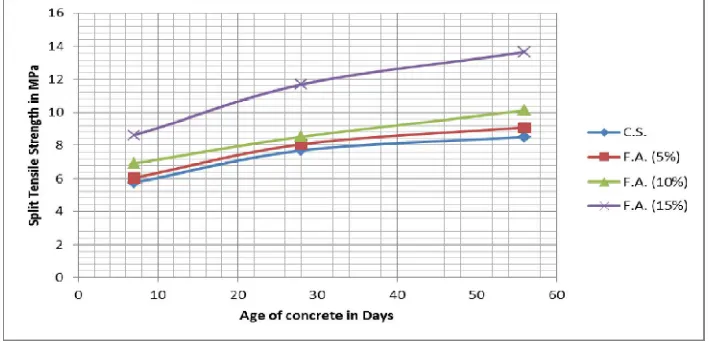
1. C.S 5.76 7.68 8.5 8.00 9.76 12.76 2. FLY ASH (5%) 6.05 8.050 9.10 8.515 10.113 13.00 3. FLY ASH (10%) 6.910 8.510 10.133 9.210 12.01 14.85 4. FLY ASH (15%) 8.610 11.67 13.67 12.85 14.133 15.833
Table No. 2. Split Tensile test result on cylindrical specimen for 7, 28, 56 dayswith replacementof cement with Fly Ash 5%, 10%, 15%
Sr. No
Flexural testing strength in MPa (2 % fibres)
Flexural testing strength in MPa (3 % fibres)
1 Age of concrete in Days
28 DAYS 28 DAYS
2 C.S 13.75 16.5
3 FLY ASH (5%) 13.55 16.97
4 FLYASH (10%) 16.00 19.67
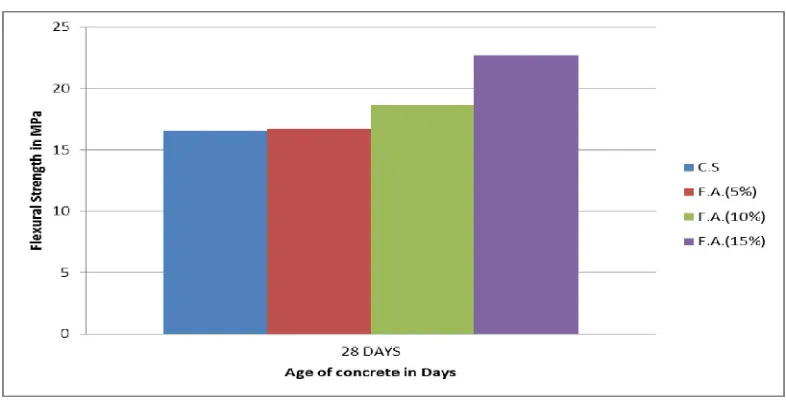
5 FLY ASH (15%) 19.33 24.67
Table No. 3. Flexural Testing test resultfor 28 days with replacement of cement with Fly Ash 5%, 10%, 15%
Figure No. 3. Flexural Test of 3% fibre with comparison of C.S & F.A (5%, 10%, 15%)
VII. CONCLUSION
In this experimental study various properties of SIFCON such as Compression test, Split tensile test, flexural test, Impact test, water permeability/Sulphate attack test, and Ultra sonic pulse velocity test have been carried out. Hooked-end steel fibers with two different volume percentages were considered for one type of concrete.
The following conclusions were drawn out based on results obtained from this study:
b) In Split tensile test, SIFCON specimen of Fly ash (5%, 10%, and 15%) with 2% & 3% steel fibre showed higher tensile strength in Comparison with Controlled SIFCON specimen at 28 & 56 days curing. It showed tremendous increase in tensile strength for 3% steel fiber, with 10% fly ash replacement with cement. It might be because of good bonding and less pores. The specimens added with fly ash with 2% steel fibres have significantly improved results over the compressive strength for the specimens alsoSimilarly, when fine aggregate was replaced with bottom ash tensile strength was increased due to the effect of steel fibers.
c) In Flexural test, SIFCON specimens of Fly ash (5%, 10%, and 15%) with 2 % and 3 % steel fiber showed higher flexural strength in Comparison with Controlled SIFCON specimen. Similarly when Fine aggregates were replaced with bottom ash with 2% steel fibers and 3% steel fibers showed significant improved results over controlled SIFCON specimen under 28 days curing.
REFERENCES
[1] S.Balaji and G.S. Thirugnanam, “Flexural Strengtheningof reinforced concrete beams using precast SIFCONlaminates” Journal of structural Engineering, Vol.40, Issue No. 3, pp.262-267, 2013.
[2] Lankard, D.R., “Preparation, Applications: Slurry Infiltrated FiberConcrete (SIFCON)”, Concrete International, Vol.6,Issue No.12, pp. 44-47, 1984.
[3] Naaman, A.E., Otter, D., and Najm, H., “Elastic Modulus of SIFCON in Tension and Compression”, ACI Materials Journal, Vol. 88, Issue No.6, pp. 603-612, 1991.
[4] Naaman, A.E., and Baccouche, M.R., “Shear Response of Dowel Reinforced SIFCON”, ACI Structural Journal, Vol. 92, Issue No.5, pp. 587-569, 1995.
[5] Naaman, A.E., Reinhardt, H.W., and Fritz, C., “Reinforced Concrete Beams with a SIFCON Matrix”, ACI Structural Journal, Vol. 89, Issue No.1, pp. 79-88, 1992.
[6] Naaman, A.E., and Homrich, J.R., “Tensile Stress-Strain Properties of SIFCON”, ACI Materials Journal, Vol. 86, Issue No.3, pp. 244-251, 1989.
[7] Hamza, A.M., and Naaman, A.E., “Bond Characteristics of Deformed Reinforcing Steel Bars Embedded in SIFCON”, ACI Materials Journal, Vol. 93, Issue No.6, pp. 578-588, 1996.
[8] Lankard, D.R., “Factors Affecting the Selection and Performance of Steel Fiber Reinforced Monolithic Refractories”, American Ceramic Society Bulletin, Vol. 63, Issue No.7, pp. 919-925, 1984.
[9] Zhang, J., and Li, V.C., “Influences of Fibers on Drying Shrinkage of Fiber-reinfocedCementituous Composites”, ASCE Journal of Engineering Mechanics, Vol. 127, Issue No. 1, pp. 37-44, 2001.