Analyzing Different Features of Artificial
Neural Networks and Its Applications
In Different Fields
Ms. Sujata Kundu1, Ms. Shyamapriya Chowdhury2, Mr. Soumya Bhattacharyya3
Asst. Professor, Department of Information Technology, Narula Institute of Technology, India1
Asst. Professor, Department of Information Technology, Narula Institute of Technology, India2
Asst. Professor, Department of Information Technology, Narula Institute of Technology, India3
ABSTRACT: A brain has billions of tiny, exceptionally simple units called neurons, those have their own programming and decision making power without any help from outside authority. An artificial neural network also referred to as biologically inspired methods of computing, which do the exactly same type of job, simulated with software. ANNs are also considered as nonlinear statistical data modelling tools, which can modelled the complex relationships between inputs and outputs. In this paper we also discuss different features of ANN, how do they work, How Neural Networks Differ from Traditional Computing, applications and advantages of ANN.
KEYWORDS: “Neurons, Artificial Neural Network (ANN), Feedback Network, Feed Forward Network, backpropagation algorithm”
I. INTRODUCTION
A neuron is the fundamental processing element of neural network. It is also known as the basic building blocks of the
neuralnetwork
.
A neuron is a communication medium which accepts input and produces output simultaneously. Theneuron receives inputs either from another neuron or from the user program. The neuron sends the output to another neuron or to the user program Neurons receive signals through synapses which located on the dendrites or membrane of the neuron. When the signals received are strong enough (surpass a certain threshold), the neuron is activated and emits a signal though the axon. This signal might be sent to another synapse, and might activate other neurons. The below Fig.1 shows the important parts of the simple neuron.
II. RELATED WORK
The neurophysiologists, McCulloch and the mathematician Pitts used the first model of a neuron with electric circuits. This model neuron had two inputs and one output. They found that for equal weight input binary output was found and it’s found to be zero untill the inputs summed up with a thresh hold value. An ANN is an information processing paradigm which is inspired by the biological nervous systems, like brain, process information, etc.
Normally neurons are connected together. As these types of connections are not equal so, that it can be assigned individual weights. By adjusting the weights, the neural networks can recognize different patterns. Adjustment of the network weights is a very important operation.
III.AN ARTIFICIAL NEURAL NETWORK
An artificial neural network (ANN) can referred to as biologically inspired methods of computing do the exactly same
type of job, but simulated by the software. The goal of artificial neural networks is to solve any problem by
understanding of nature's capabilities which cannot be solved by traditional computing.
An artificial neuron is a computational model which is inspired by the natural neurons. ANNs combine artificial
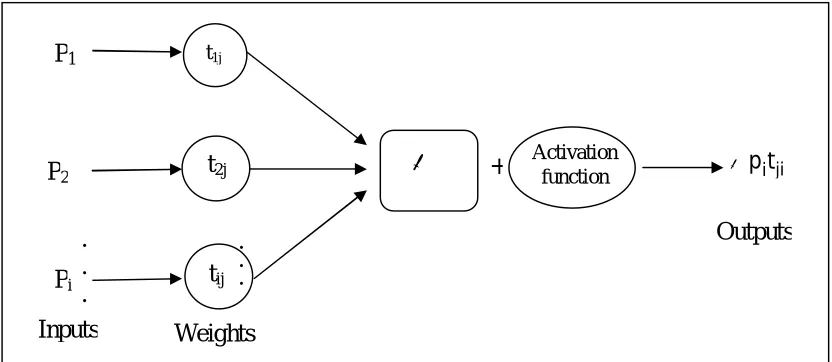
neurons to process information.Fig.2 shows a fundamental representation of an artificial neuron.
Figure 2. A Basic Artificial Neuron.
Artificial Neural Networks have three interconnected layers: input, hidden, output. The input layer consists of input
neurons, which send data on to the hidden layer, after that sends the output neurons to the output layer. The
mathematical symbol, pi is the various inputs to the network which are multiplied with the connection weight tji.
Normally the products of pi & tji are simply summed and pass through the transfer function to generate the result, which
produce the output.
t1j
t
2jt
ijP
1P
2P
ip
it
ji Activationfunction
+
Inputs
Weights
Outputs
.
.
.
NEURAL NETWORKS VERSUS CONVENTIONAL COMPUTERS:
Neural networks analyse data and recognize patterns within that data in a different way, than traditional computing methods. Neural network process works in a similar way like the human brain does. Neural network does not need any programming to perform a specific task. Disadvantage of neural network is that its operation is unpredictable as because the network solve the problem by itself. But conventional computers use cognitive approach to solve problems. Neural networks and conventional algorithmic computers are complement to each other, a large number of tasks, require systems which use a combination of the two approaches (normally a conventional computer is used to supervise the neural network) to perform maximum efficiency.
IMPLEMENTATION OF ARTIFICIAL NEURAL NETWORK:
Most of the ANN consists of three important layers of units: the 1st layer of input units is connected to the 2nd layer of
hidden units, which is also connected to the last layer of output units.
The input unit collects the raw information which is feed into the network.
The movement of each hidden unit can be determined by the movements of the input units and the
connection’s weights between the hidden and the inputs units.
Finally the activity of the output units depends on the movement of the hidden units and the weights between
the output and hidden units
Fig3.A Simple Artificial Neural Network
Training an Artificial Neural Network:
When the network has been prepared for a particular application, then that network is ready to be trained. To begin this process the initial weights are randomly chosen. There are two types of training - supervised training and unsupervised training.
Supervised training includes a way to provide the network with the desired output either by manually
"arrange" the network's performance or to provide the desired outputs of the inputs.
Feed Forward Network:
Feed-forward ANNs (Figure4) is a straight forward network which associates with inputs & outputs. The data enters at the inputs layers & passes into the network, layer by layer, until it reaches at the output layers. These hidden layers can be connected to the other hidden layers or it directly connected to the output layer and there can be any number of hidden layers. Normally neural networks have only one hidden layer. In neural network it is very rare to have more than two hidden layers. This network is known as feed forward neural networks because there is no feedback between layers. This network also referred to as bottom-up or top-down approach.
Fig4. An example of a simple feedforward network
Feedback networks:
In feedback networks (Figure5) signals can travel in both directions in the network using loops. Feedback network is a very complicated, dynamic and powerful network. This network changes their state continuously until an equilibrium point arrives. They persist at this point until change of any input and need of a new equilibrium point. In this network the output of one layer can get back to a previous layer.
Figure5. Simple Network with Feedback Network.
Feedback
Inputs Outputs
Inputs
THE BACK-PROPAGATION ALGORITHM
Backpropagation (backward propagation of errors) is a method of training ANN with gradient descent. The backpropagation algorithm is used in layered feed-forward artificial neural networks. For that the artificial neurons are well ordered in the layers, which sends their signals “forward”, and then the errors are generated backwards. The network collects inputs from the neurons of the input layer and the neurons on the output layer generate the output of the network with the help of some intermediate hidden layers. This algorithm helps the network to compute outputs from the inputs and then calculate the error (the difference between actual and expected results). The main purpose of the backpropagation algorithm is to reduce this error, until the network learns the training data. The training starts with the random weights & the goal is to minimise the error to adjust them.
The activation function applies the backpropagation algorithm as the summations of the products of the inputs pi and their respective weights tji). In ANN this function also known as transfer function for a network with small no of nodes.
( , ) =∑ (1)
As because the training time for the networks grows exponentially, for that reason artificial neural networks implementation using the backpropagation algorithm does not have too many layers. Also we can do the filtration of the backpropagation algorithm.
IV. APPLICATIONS
Artificial neural networks have various applications in different fields. Now a day’s character recognition has become very important role and with the help of neural networks we can recognize handwritten characters. At a time vast amounts of information can be process and receive by artificial neural networks to make them useful in image compression. The day-to-day stock market in the business network is very complicated. A lot of factors arises depends on the up and down of the stock of a particular day. Using neural networks we can easily find out information as well as sort this information very quickly which can help to predict stock prices. Artificial neural networks can also solve the travelling salesman problem, but there are some limitations. These are some very useful and interesting applications of
neural networks.
V. CONCLUSION
In this paper we analyze different features of artificial neural networks and its applications. An artificial neural network has a very good impact on computing world and with the help of example it’s became very powerful and flexible. There are lots of advantages of artificial neural networks than conventional networks. Depends on the application and the strength of the internal data patterns we can generally expect a well trained network. This applies to the problems where the relationships may be non-linear or dynamic. Artificial neural networks are very useful to predict time series because of getting only information from examples, without adding additional information which can take more confusion than prediction. Now ANNs are capable to generalize and defiant to noise. Now artificial neural networks are often successfully using to predict time series. Finally, it observe that even though artificial neural networks have a very good prospective, when they are integrated with computing, AI, fuzzy logic and related subjects then only we will get the best of them.
REFERENCES
[2] Lippmann, R.P, “An introduction to computing with neural nets”, IEEE Accost. Speech Signal Process. Mag., vol 4, pp 22, April 1987. [3] Ajith Abraham, “Artificial Neural Networks”, Stillwater,OK, USA, 2005.
[4] Carlos Gershenson, “Artificial Neural Networks for Beginners”, United kingdom.
[5] Anil K Jain, Jianchang Mao and K.M Mohiuddin, “Artificial Neural Networks: A Tutorial”, Michigan State university, 1996. [6] Ugur HALICI, “ Artificial Neural Networks”, ANKARA, Chapter 1.
[7] Eldon Y. Li, “ Artificial Neural Networks and their Business Applications”, Taiwan, 1994. [8] Christos Stergiou and Dimitrios Siganos, “Neural Networks”.
[9] Limitations and Disadvantages of Artificial Neural Network from website http://www.ncbi.nlm.nih.gov/pubmed/8892489
[10] About Artificial Neural Network from website http:// en.wikipedia.org/wiki/Artificial_neural_network
[11] RC Chakraborty, “Fundamentals of Neural Networks”, myreaders.info/html/artificial_intelligence.html, june 01, 2010. [12] Prof. Leslie Smith, “ An Introduction to Neural Networks”, University of Stirling., 1996,98,2001,2003.
[13] Prof. Dr. Eduardo Gasca A., “ Artificial Neural Networks”, Toluca