DOI: 10.1534/genetics.108.088880
The Generation and Maintenance of Genetic Variation by
Frequency-Dependent Selection: Constructing Polymorphisms
Under the Pairwise Interaction Model
Meredith V. Trotter and Hamish G. Spencer
1Allan Wilson Centre for Molecular Ecology and Evolution, Department of Zoology, University of Otago, Dunedin, New Zealand, 9054 Manuscript received March 4, 2008
Accepted for publication August 27, 2008
ABSTRACT
Frequency-dependent selection remains the most commonly invoked heuristic explanation for the maintenance of genetic variation. For polymorphism to exist, new alleles must be both generated and maintained in the population. Here we use a construction approach to model frequency-dependent selection with mutation under the pairwise interaction model. The pairwise interaction model is a general model of frequency-dependent selection at the genotypic level. We find that frequency-dependent selection is able to generate a large number of alleles at a single locus. The construction process generates multiallelic polymorphisms with a wide range of allele-frequency distributions and genotypic fitness relationships. Levels of polymorphism and mean fitness are uncoupled, so constructed polymorphisms remain permanently invasible to new mutants; thus the model never settles down to an equilibrium state. Analysis of constructed fitness sets reveals signatures of heterozygote advantage and positive frequency dependence.
S
INCE the development of molecular techniques first revealed widespread genetic variability in nature (Hubby and Lewontin 1966; Lewontin and Hubby1966), population geneticists have been puzzling over just why there are so many alleles. The neutral (Kimura
1983) and nearly neutral (Ohta 1973; Kimura 1983)
theories hold that the majority of variation is selectively neutral (or nearly so) and thus is a consequence of mutation and random drift. Nevertheless, we have long known that a wide range of natural systems have multi-allelic polymorphisms at loci that cannot be assumed to be selectively neutral (Keith 1983; Keith et al.1985;
Moriyamaand Powell1996; Hahn2008). The
abun-dance of selectively maintained variation in nature behooves theoreticians to investigate just what modes of selection could be responsible.
The other side of the selection coin is fitness. If we wish to quantify what ‘‘kinds’’ of selection are best at maintaining variation, we really need to determine what kinds of fitnesses are best at keeping extant alleles from going extinct. Taken together, the fitnesses of all the genotypes in a population compose a ‘‘fitness set.’’ The standard approach has been to generate many fitness sets either randomly (Lewontinet al.1978; Clarkand
Feldman1986) or according to some preselected
pat-tern (Karlin 1981) and, using various techniques, to
determine which arrangements of fitness are most likely to maintain genetic variation. The potential for variation
under a given model is often measured as the volume of total available fitness space that maintains variation. We refer to these types of model as the ‘‘parameter-space’’ approach.
Early work (Gillespie 1977; Lewontin et al.1978)
found that for constant viability selection coefficients, the potential for a randomly chosen fitness set to main-tain more than five alleles is vanishingly small. Even when fitness sets are structured so as to focus on bio-logically plausible fitness patterns (Karlin1981; Karlin
and Feldman1981), the selective maintenance of a fully
polymorphic equilibrium remains unlikely. The situa-tion is similarly bleak in models of constant fertility selection (Clarkand Feldman1986). These results do
not necessarily suggest that selectively maintained poly-morphism is unlikely in nature, but merely that it is unlikely in mathematical models that assume constant viabilities. Few (if any) population geneticists truly be-lieve fitness to be a constant quantity (Kojima1971).
Se-lection is a function of the organism’s environment and is likely to change, for example, in space or time.
One straightforward way to model changing selection at the genotype level is to make genotypic fitnesses change with the genetic composition of the population in which they are found. Negative frequency-dependent selection (FDS) (selection in favor of rare alleles) in par-ticular provides a heuristic explanation for the mainte-nance of variation (Clarke 1979), and indeed it has
been detected in many natural systems (Sinervo and
Lively1996; Bondand Kamil1998; Hugheset al.1999;
Olendorfet al.2006). Positive FDS (selection in favor of
common alleles), which intuition suggests should
elim-1Corresponding author: Department of Zoology, University of Otago, P.O. Box 56, Dunedin, New Zealand, 9054.
E-mail: [email protected]
inate variability, is also found in polymorphic natural systems, such as those involving Mullerian mimicry (Langham 2004). The wide variety of FDS regimes
found in nature (for a review see Sinervoand Calsbeek
2006) suggests that an assessment of the ability of FDS to maintain variation should use a general model of frequency dependence.
The most general model of FDS is the pairwise interaction model (PIM), first put forth almost 40 years ago (Schutzand Usanis1969; Cockerhamet al.1972)
as a model of selection due to intraspecific competition. In the PIM, genotypic viabilities are determined by a weighted sum of fitnesses in competitive interactions with other genotypes in the population. This formula-tion allows for a vast number of frequency-dependent viability schemes (including constant viability) to be parameterized by the model. It must be noted that in this study we omit any density-dependent effects of intraspe-cific competition from our models and focus only on genetic FDS.
Parameter-space approaches to modeling FDS (Asmussen
and Basnayake 1990; Trotter and Spencer 2007)
find that general FDS results in a greater potential for maintaining variation for any given number of alleles than the constant viability model. Nevertheless, the proportion of random sets that keep more than five alleles remains very low.
For polymorphism to exist new alleles must be both generated and maintained in the population. Most work has focused on the latter issue. Recall that for a system withnalleles, if we ignore mutation and drift and assume constant selection, the eventual fate of the system (e.g., fixation of one allele, extinction of one or more alleles, full polymorphism) depends entirely on the fitnesses of the genotypes in the population. Under FDS, the end state of the system depends on both the fitness set and the starting allele-frequency vector (Asmussen and
Basnayake1990). Trotterand Spencer(2007) showed
that very few fitness sets keep allnoriginal alleles for all initial allele frequencies.
In the natural world, allele frequencies are the pro-duct of a historical process of mutation and selection. The static equilibrium focus of the parameter-space approach ignores this dynamic of mutation–selection balance. It follows, then, that to extend our understand-ing of the maintenance of variation by FDS we must include a historical mutational process in our models.
One way to model mutation is to start with a mono-morphism and bombard it with mutant alleles over many generations (Spencerand Marks1988).
Depend-ing on their relative fitness, the mutant alleles either invade the growing polymorphism or are repelled to extinction. Similar models have been applied to the problem of ecological community assembly, where his-torical invasion processes can have significant impacts on the extant community structure (Ginzburg 1979;
Taylor 1989; Nee 1990; Akcakaya and Ginzburg
1991). We refer to this class of model as the construction approach.
Each generation of a model using the construction approach has three steps: mutation, reproduction (in-cluding selection), and extinction check. Starting from an initial monomorphism, each generation mutant alleles are added to the system at some low frequency according to a mutation rate,m. Second, all allele frequencies are iterated according to their fitnesses. Finally, alleles that have fallen below some threshold frequency are re-moved from the system and considered ‘‘extinct.’’
Early construction models found that constant selec-tion can generate large numbers of alleles when combined with a mutational process (Spencer and
Marks1988). This type of approach has been used to
investigate the dynamics of the invasion/extinction process, the effect of different mutational fitness dis-tributions (Marks and Spencer 1991; Spencer and
Marks1992), and selection in spatially structured
pop-ulations (Staret al.2007).
In this study, we continue our investigations of the potential for variation under FDS (see Trotterand
Spencer2007). We continue to use the PIM of FDS, this
time incorporating a mutational process into the model. We model mutation by starting with single initial allele, which is then bombarded by novel mutant alleles with PIM fitnesses. By adding mutation to the model we can measure the potential for polymorphism in two new ways: First, we can observe the model for some arbitrary number of generations and record the dynamics of allele numbers and frequencies over that time period. Second, we can stop the mutation process at some point and continue iterating allele frequencies to assess the maximum number of alleles at the stable equilibrium for that fitness set (at the time mutation was stopped).
This dynamic style of modeling allows us to ask a variety of questions about the generation and mainte-nance of polymorphism. In equilibrium-based models, FDS fitnesses tend to maintain more alleles than constant fitnesses (Trotterand Spencer2007) but it
is not at all clear that this increased potential for poly-morphism under FDS extends to construction models. Does assuming PIM fitness, using a construction ap-proach, lead to polymorphisms with more alleles than those produced using constant fitness? What kinds of PIM fitnesses best facilitate the invasion of an existing polymorphism by new alleles? Which of these also inhibit the extinction of extant alleles? We are also interested in the number and frequency distribution of alleles generated by this construction approach to the PIM. Throughout we use constant-viability construction model results as a basis for comparisons.
THE MODELS
dynam-ics of allele frequencies at a single locus. Each replicate run of the model begins with a monomorphism. Every generation, a new mutant allele, Aj, is added to the
existingn-allele system at low frequency (pj¼106,j¼ n11). The addition of thejth allele always results inj
new mutant genotypes. When generating mutant fit-nesses, we assume all genotypic fitnesses are frequency dependent. We implement frequency-dependent selec-tion by using the general PIM.
Under the PIM, each genotype AiAj has distinct
fitnesses (wij;kl) in its interactions with the other
genotypes AkAl in the population. These values are
referred to individually as interaction fitnesses and collectively as fitness sets.AiAjis assumed to be
equiva-lent to AjAi, and thus wij;kl ¼wji;kl ¼wij;lk ¼wji;lk. All
interaction fitnesses are drawn randomly from the uniform distribution [0, 1]. The consequences of drawing fitnesses from different distributions will be discussed elsewhere. We assume random mixing, such that intergenotypic interactions occur in proportion to genotype frequencies. Overall genotypic fitnesses, wij,
are linear functions of the interaction fitnesses with all other genotypes in the model, weighted by the frequen-cies of the interacting genotypes:
wij ¼
Xn
k¼1 Xn
l¼1
pkplwij;kl:
The marginal fitness ofAiis a sum of fitnesses for all
genotypes involvingAi, weighted by their frequencies: wi ¼
Pn j¼1pjwij.
The single initial allele A1 is assigned intermediate
fitness,w1¼0.5. The frequency of alleleAiat generation t11 is calculated using the standard equation
p9i ¼piwi
w ; ð1Þ
wherepiis the frequency of alleleiat generationt, and
w is the mean fitness of the population at generation
t. The change in allele frequency after selection is
Dp¼pi9pi. After allele frequencies are iterated, alleles
whose frequencies fall below 106are considered to be
extinct and are removed from the system. Each gener-ation we recorded the numbers, ages, and frequencies of all alleles and also the mean fitness. These per-generation measures were used to calculate summary statistics to characterize the overall range of behaviors of the model. After 10,000 such generations had passed, we recorded snapshot fitness sets, numbers, and fre-quencies of alleles.
To successfully invade a polymorphism, a new mutant allele must be fitter on average than the existing alleles in the system (Equation 1). In models using constant viability, the mean fitness of the system increases after each successful invasion. As repeated invasions drive the mean fitness toward its maximum of 1, the upper bound of the uniform distribution of mutational fitnesses, new
mutants are less and less likely to be more fit than average, and so invasions become rarer. Spencer and
Marks(1988) found that the mutant-invasion process in
constant-selection construction models ‘‘settles down’’ after104generations, after which point invasions are
rare but not impossible.
No such settling down occurs in the PIM construction model. The data discussed this chapter were taken from simulations which ran for 104generations. Smaller
num-bers of replicates were also run for 105, 106, and even 107
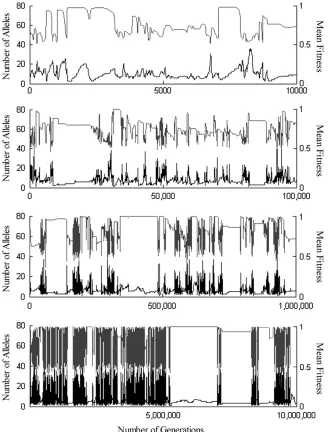
generations. While long periods of relative stability can occur (see Figure 1), regardless of timescale, the system invariably returns to its dynamic fluctuating behavior. Measurements taken after 10,000 generations thus rep-resent a snapshot of a population in a perpetual state of flux. Some of the alleles captured in that snapshot will be firmly established, others are new invaders, some are on their way to becoming common, and others on their way to extinction. To separate the transitory from the perma-nent, after 10,000 generations had passed, the mutation process was halted. The final fitness sets and allele frequencies were then allowed to continue iterating, in the absence of mutation, until equilibrium was reached (either a fixation equilibrium or alljDpij,108).
The snapshot statistics taken after 104 generations
provide us with an instantaneous sample of the model’s behavior, analogous to a single sample one might take from an evolving population in nature. The equilibrium statistics indicate how much of the snapshot variation is transient and how much is likely to be permanent.
RESULTS
Allele numbers:PIM polymorphism construction is a dynamic process of mutant invasion and extinction of extant alleles. The snapshot and equilibrium numbers of alleles in polymorphisms produced by both PIM and constant-viability construction approaches are illus-trated in Figure 2. Snapshot numbers indicate the level of polymorphism present in the model run after 10,000 generations. Equilibrium numbers suggest how many of the snapshot alleles would be permanent in the absence of mutation.
In contrast to the snapshot results, the PIM equilib-rium polymorphisms have fewer alleles on average (3.4) than do the constant-viability equilibria (4.6). The PIM shows a very drastic decrease in the number of alleles after iteration from snapshot to equilibrium. The iter-ation from snapshot to equilibrium effectively cuts out rare transient alleles, of which there are many more in the PIM snapshot polymorphisms than in their constant-viability counterparts.
Also notable, six PIM runs finished with monomor-phism, while monomorphism is all but impossible to achieve in the constant-viability model.
Potential for polymorphism:Historically (Lewontin et al.1978; Asmussenand Basnayake1990; Staret al.
2007; Trotterand Spencer2007), the ‘‘potential’’ for
polymorphism under any given model has been mea-sured as the proportion of random initial allele frequen-cies and randomly generated fitness sets that maintain all alleles. In the context of the construction approach,
then, one could measure a sort of potential as the proportion of runs that had the same numbers of final and equilibrium alleles. For example, in the PIM con-struction model we found that 134 runs reached gen-eration 104with five alleles. Of these 134 fitness sets, 44
increases. The region of parameter space that maintains polymorphism is minuscule for n . 4 (Trotterand
Spencer2007). In our constructed sets, the proportion
that kept all alleles decreases approximately linearly with increasingn, a much less precipitous drop-off than that observed for random sets. The increased potential for polymorphism in constructed sets thus agrees with earlier studies (Spencerand Marks 1988) that found
that selection tends to preserve alleles with fitnesses in those regions of fitness space that are most likely to maintain variation.
As an additional measure of potential for variation under the construction approach, each snapshot fitness set was iterated to equilibrium from 1000 randomly generated starting allele-frequency vectors (as in Star et al. 2007). The proportion of random vectors that maintain all snapshot alleles for a particular fitness set gives an estimate of the domain of attraction for the fully polymorphic equilibrium of that set. Staret al.(2007)
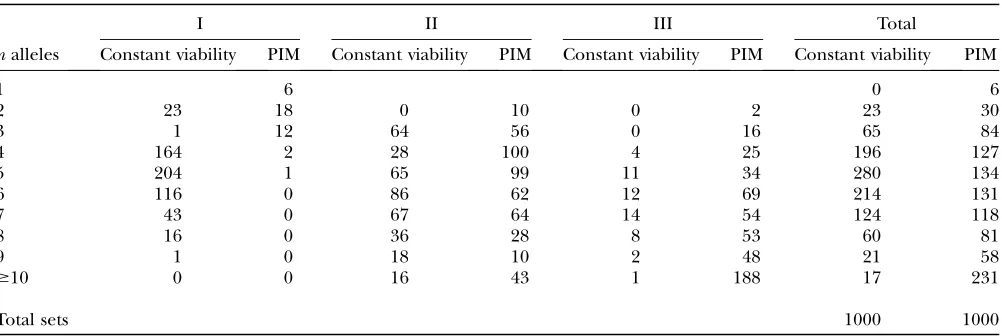
use this method to partition their equilibrium fitness sets into three classes as follows: Type I fitness sets main-tain all alleles from all start vectors and can be con-sidered to have globally stable equilibria. Type II fitness sets maintain all alleles from only a subset of all start vectors and can be considered to have locally stable equilibria. Type III fitness sets lose at least one allele from all start vectors, implying that some of their snap-shot alleles were transients. Numbers of types I, II, and III fitness sets from the constant and PIM construction models can be found in Table 1. Nearly half of all PIM snapshot equilibria contained at least one transient allele. Less than 1% of PIM sets were globally stable, but 24.4% of sets kept all alleles from the snapshot allele-frequency vector.
Allele-frequency distributions:We recorded the num-ber and frequencies of alleles in the polymorphism after
10,000 generations and at the eventual equilibrium. We wished to see if the construction approach to the PIM left any particular signature in the allele-frequency dis-tributions of the polymorphisms it produced. Here we use I ¼Pni¼1ðpi1=nÞ
2
as a measure of centrality of allele frequencies. If all alleles present are equally frequent, pi/1=n andI/0. If one or two alleles are
very common and the others rare, I will approach its maximum value ofn1/n.
Distributions ofI-values for the polymorphisms with five alleles present in the PIM construction model after 10,000 generations, at equilibrium, as well as five-allele polymorphisms from the PIM parameter-space ap-proach and random allele frequencies can be found in Figure 4. Random allele frequencies were generated by breaking the interval (0, 1) inton pieces, usingn 1 uniform random numbers (broken-stick method; see Holst1980).
Polymorphisms produced by the PIM parameter-space approach are in general slightly more centered than expected by chance (Figure 4, dotted line). Polymor-phisms produced by the PIM construction approach, both at snapshot and at equilibrium, however, are gen-erally less centered than expected by chance. TheI-values of the equilibrium polymorphisms tend to be more centered than those of the snapshot polymorphisms.
Mean fitness: The relationship between allele num-ber and mean fitness in the constant and PIM construc-tion models, as seen in two randomly chosen model runs, is illustrated in Figure 5. In the constant-selection model, mean fitness rapidly asymptotes to a value near 1 during an initial burst of successive mutant invasion. This positive relationship between allele number and mean fitness eventually breaks down after 100 gen-erations. After this time, highly fit mutants begin to drive other extant alleles to extinction, resulting in a drop in allele number but continuing small increases in
Figure3.—Proportion of PIM fitness sets that maintained all snapshot alleles at equilibrium, starting from the snapshot allele-frequency vector. Open circles are data from Figure 1A in Trotterand Spencer(2007).
mean fitness. The extremely high mean fitness finally makes the polymorphism resistant to invasion.
In the PIM results mean fitness and allele number appear tightly coupled when viewed over long time-scales (Figure 1). In these trajectories, it appears that allele number and mean fitness are negatively corre-lated. However, a closer look at shorter timescales (Figure 5) shows that mean fitness and allele number are actually much less tightly coupled in the PIM than in the constant-viability model. The initial spike in allele number is accompanied by an increase in mean fitness. Another sharp spike in allele number between 500 and 600 generations is accompanied by a decrease in mean fitness. Nevertheless, the steady increase in allele number between 600 and 800 generations coincides with a plateau in the mean fitness.
In the snapshot results of both models, there is a slight negative relationship between allele number and
mean fitness (constant selection model,r¼ 0.327,P,
0.001; PIM,r¼ 0.301,P,0.001). This relationship is much stronger in the equilibrium results for constant viabilities (r¼ 0.675,P,0.001) and much weaker in the equilibrium results for the PIM (r¼ 0.138,P ,
0.001), where it appears that there is no strong rela-tionship between mean fitness and allele number. Equi-librium polymorphisms with many alleles are only marginally less fit than those with few alleles.
Analysis of fitness sets:We now turn to the question of what fitnesses are best at maintaining variation under the PIM. To facilitate comparisons across sets with differentn, we have summarized the information con-tained in the fitness sets by partitioning the interaction-fitness values from each set into classes. The interaction-fitness-class values themselves are the means of all interaction fitnesses that fall into that class. The classes are parti-tioned according to the homozygosity and the degree of allele sharing between the interacting genotypes. The class of homozygote-by-unlike-homozygote interactions is characterized by Cii,jj, that of
homozygote-by-like-heterozygote interactions byCii,ij, etc. The final class is
composed of all genotypes’ fitnesses in interactions with their own genotypes,Cij,ij.
Interaction-class means for constructed PIM poly-morphisms of alln.3 follow the same general pattern. Fitness-class data for PIM constructed and parameter-space polymorphisms of size n ¼ 5 can be found in Figure 6. We chose to use then¼5 case as it is indicative of the general pattern found in fitness sets for both approaches and provides the largest number of snap-shot replicates from both the PIM and the constant-viability model.
In the parameter-space approach, homozygote fit-nesses tend to be lower than heterozygote fitfit-nesses (implying heterozygote advantage), and interaction fit-nesses decrease as allele sharing increases (giving a strong suggestion of negative FDS; see Trotterand
TABLE 1
Numbers of types I, II, and III fitness sets from 1000 runs each of the constant-viability and PIM construction models
I II III Total
nalleles Constant viability PIM Constant viability PIM Constant viability PIM Constant viability PIM
1 6 0 6
2 23 18 0 10 0 2 23 30
3 1 12 64 56 0 16 65 84
4 164 2 28 100 4 25 196 127
5 204 1 65 99 11 34 280 134
6 116 0 86 62 12 69 214 131
7 43 0 67 64 14 54 124 118
8 16 0 36 28 8 53 60 81
9 1 0 18 10 2 48 21 58
$10 0 0 16 43 1 188 17 231
Total sets 1000 1000
Spencer2007). In both PIM construction results, the
signal for heterozygote advantage remains strong but negative FDS is not evident. Interaction fitnesses with like homozygotes (Cii,ii,Cij,jj) are maximal, not minimal,
in the constructed fitness sets. High-fitness interactions with similar genotypes are indicative of positive FDS, which is a counterintuitive mechanism for maintaining alleles.
In the multiallelic case, positive self-FDS can be overwhelmed by the fitness impacts of other alleles in the system. In other words, the fitness of a given allele may be more strongly dependent on the frequency of a different allele than on its own frequency. Further analysis of constructed fitness sets that had five alleles after 10,000 generations reveals that for all alleles, fitness is often strongly correlated with the frequency of the most common allele (A1in most cases) than with
any other allele frequency.
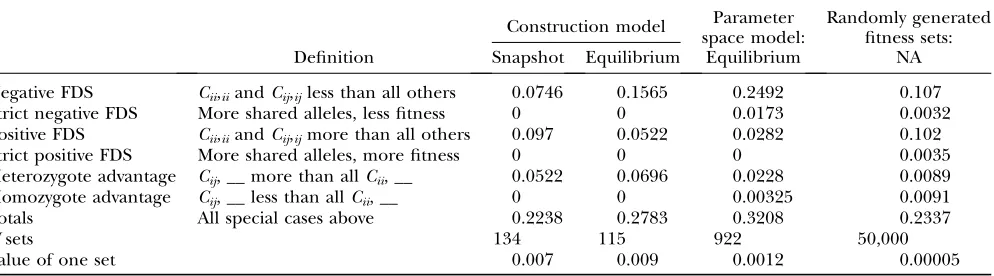
Flavors of frequency dependence: Another method of finding patterns in unwieldy PIM fitness sets is to search the constructed sets for common ‘‘flavors’’ of selection such as negative FDS, positive FDS, and heterozygote advantage and disadvantage. We define our flavors on the basis of schemes defined by relation-ships between fitness classes. A genotype will have higher fitness at low frequency if it has low fitness in interactions with like genotypes. We consider a fitness set to be under negative FDS if self–self interactions (Cii,ii and Cij,ij) are the lowest fitness-class values. To
define strict negative FDS, we extend the above defini-tion to include low fitness in interacdefini-tions between genotypes that share similar alleles (Cii,ii, Cii,ij, Cij,jj, Cij,ik). A fitness set was considered to contain
heterozy-gote advantage if all heterozyheterozy-gote fitness-class values were greater than all homozygote fitness-class values. Positive FDS schemes are the mirror images of the negative FDS schemes, and homozygote advantage is the opposite of heterozygote advantage.
Frequencies of the different flavors of FDS in con-structed, parameter space, and random fitness sets can be found in Table 2. Again, Table 2 lists only results for
fitness sets wheren¼5 although the general pattern of flavor for each model holds true for any n . 5. The fitness schemes we used accounted for between 22 and 32% of fitness sets, while the majority of sets had no obvious intuitive pattern to their fitnesses.
Negative FDS was more common in the parameter-space results than in the construction approach results, while the reverse was true of positive FDS. The preva-lence of positive FDS may seem counterintuitive at first, as we usually think of positive FDS as favoring mono-morphism. In the multidimensional fitness space of the PIM, the total fitness of an allele under positive self-FDS is likely to be more strongly dependent on the frequency of a nonself allele. The constructed fitness sets also revealed a stronger signal for heterozygote advantage than did the parameter-space fitness sets.
DISCUSSION
Incorporating history into the analysis of polymor-phism maintained by FDS reveals several exciting
Figure 5.—Levels of polymorphism (solid line) and mean fitness (dotted line) as functions of time for 1000 generations each from single-example runs of the constant-fitness con-struction model and the PIM construction model.
features. First, the PIM construction approach can produce high levels of polymorphism. Within 104
gen-erations, PIM construction produced as many as 59 alleles, and one model run that went for 107generations
had polymorphisms of up to 70 alleles. To our knowl-edge, this is the first model to predict such large numbers of alleles without specifically invoking negative FDS.
The parameter-space approach tells us that the volume of the total PIM parameter space that has positive potential for variation is infinitesimally small forn .5 (Trotterand Spencer2007). The
equilib-rium model results provide a means of comparing the construction and parameter-space approaches to mod-eling the maintenance of variation. The number of constructed PIM fitness sets that maintained all their snapshot alleles at equilibrium was orders of magnitude larger than one would expect had we iterated randomly generated fitness sets to equilibrium from the same initialn. Thus, while the total volume of parameter space maintaining variation is small, the polymorphism con-struction process evolves fitnesses and allele frequencies into those regions of the parameter space. This finding begs the question, What is it about PIM fitnesses that enables such high numbers of alleles? Since the PIM is based on the premise that selection is a consequence of competition, we can gain insight from comparisons with other competition-based models. Our models of the maintenance of genetic variation under the PIM have much in common both with species-coexistence models in community ecology and with phenotypic-evolution models of evolutionary game theory.
Ecological models of multispecies coexistence, for example, are in some ways analogous to parameter-space models of multiple-allele polymorphism. Each of these aims to investigate the relationships between species (or alleles) that best facilitate coexistence (poly-morphism). In models of multispecies community assembly, intransitive competitive interactions increase
the likelihood of multispecies coexistence (Lairdand
Schamp 2006). In a perfectly intransitive competitive
network, all competitors win and lose to an equal number of competing strategies (A beats B beats C beats A) as in rock–paper–scissors (RPS), whereas in a transitive/hierarchical network, some strategies are universally superior (A beats B and C, B beats C.) Several naturally polymorphic systems have been iden-tified where variation is maintained by genetic RPS games (Shusterand Wade1991; Sinervoand Lively
1996; Sinervo et al. 2007). In our construction
ap-proach to the PIM, each new mutant’s interaction fitnesses are drawn from the uniform distribution on [0, 1], so that on average half its interactions will have values .0.5 (a competitive ‘‘win’’) and the other half
,0.5 (a competitive ‘‘loss’’). Since this distribution of fitnesses will tend to produce equal numbers of wins and losses across rows in the fitness matrix, the way in which we have generated mutant fitnesses could thus be interpreted as promoting a kind of weak intransitivity at the level of genotypic fitness. At the level of marginal allelic fitness, however, the intuitive argument for implicit intransitivity disappears.
At a glance, the PIM fitness matrix is also reminis-cent of the payoff matrix of evolutionary game theory (MaynardSmith1982). Game theoretic approaches to
FDS assume that, in the long term, the genetic in-formation underlying phenotypic evolution can be ignored. Population genetic models concern them-selves more with the short-term genetic changes that go on between long-term (stable phenotypic equilib-rium) ‘‘stops.’’ It is interesting, then, that the FDS construction model rarely settles down to any long-term stable state. Our PIM population remains in a constant intermediate state between fixations, with monomor-phisms being exceptionally rare. The initially mono-morphic founder allele remained in the population after 10,000 generations in only 1 replicate. Indeed, the turnover of alleles is so consistent and rapid that one
TABLE 2
Frequencies of selection schemes in snapshot, equilibrium, parameter-space equilibrium, and random fitness sets wheren¼5 alleles
Construction model Parameter space model:
Randomly generated fitness sets:
Definition Snapshot Equilibrium Equilibrium NA
Negative FDS Cii,iiandCij,ijless than all others 0.0746 0.1565 0.2492 0.107
Strict negative FDS More shared alleles, less fitness 0 0 0.0173 0.0032
Positive FDS Cii,iiandCij,ijmore than all others 0.097 0.0522 0.0282 0.102
Strict positive FDS More shared alleles, more fitness 0 0 0 0.0035
Heterozygote advantage Cij, __ more than allCii, __ 0.0522 0.0696 0.0228 0.0089
Homozygote advantage Cij, __ less than allCii, __ 0 0 0.00325 0.0091
Totals All special cases above 0.2238 0.2783 0.3208 0.2337
Nsets 134 115 922 50,000
fails to see how a long-term phenotypic equilibrium would come about at all.
In constructed polymorphisms with constant selec-tion, the mean fitness of the population necessarily increases with each successful mutant invasion. Eventu-ally, successive mutant invasions drive the mean fitness so high as to make subsequent mutant invasions all but impossible. In the FDS model, the level of polymor-phism and the population mean fitness are less closely coupled. When plotted across generations, the mean fitness and the level of polymorphism exhibit booms and crashes that are not necessarily coincident in time (Figure 5). There is actually a weak negative relationship between mean fitness and allele number, but this is notably skewed by the small number of observations of high allele numbers. The uncoupling of the mean fitness and the allele number is part of what allows the FDS polymorphism to remain permanently invasible. Low mean fitness increases the possibility of a new mu-tant being sufficiently fit to invade the polymorphism.
If a new mutant invades that has negative impacts on other allelic fitnesses, as the mutant’s frequency in-creases so too will the magnitude of its negative impact on other alleles, depressing the mean fitness and po-tentially resulting in extinctions. The extinction of unfit alleles then allows the mean fitness to rebound. Alter-natively, if a low-fitness allele goes extinct, but had largely positive interactions with the other alleles in the system, its loss may cause the mean fitness of the remaining alleles to drop. The lack of relationship between allele number and mean fitness, then, makes more sense once one realizes that the addition of a new mutant can either increase or decrease mean fitness and that an extinction can similarly either increase or decrease mean fitness.
Another interesting result of the PIM construction approach is the wide range of snapshot and equilibrium allele-frequency distributions produced (Figure 4). Re-call that if all alleles are present at equal frequencies,I¼
0, and we say the distribution is central. LargerI-values indicate skewed allele-frequency distributions. The skewness of snapshot allele frequencies could be ex-plained by the presence of rare transient alleles. One would expect that the subsequent iteration from snap-shot to equilibrium would remove any transient alleles and produce more centered (I 0) allele frequencies. Somewhat counter to expectation, equilibrium distri-butions of alleles remain far less centered than expected by chance. Our results here mirror the findings of the constant-viability construction approach studies done in the 1990s (Spencer and Marks 1988, 1992, 1993;
Marksand Spencer1991). They found that
constant-viability construction approaches produce allele-frequency distributions that are less central than expected by chance (Marksand Spencer1991; Spencerand Marks
1992, Figure 1). Constant-viability parameter-space approaches predict that highly polymorphic
allele-frequency distributions will be more central than ex-pected by chance (Lewontinet al.1978, Figure 3) and
so are also much more central than constructed poly-morphisms. In the case of the PIM, the constructed polymorphisms are much less even than predicted by the parameter-space models. The distributions of the equilibrium constructed polymorphisms suggest that unevenness cannot be explained away by the influence of rare transient alleles. The more complex fitness structure of the PIM allows for richer equilibrium be-havior and a wide variety of equilibrium allele-frequency distributions.
One of the challenges of multiallelic models is pro-ducing measures for comparing between systems with different n alleles. We are interested in the kinds of fitnesses that best maintain variation, but the sorts of fitness relationships that are possible in systems of 10 alleles differ from those in systems of n ¼3 and also from those ofn¼30. The partitioning of fitness sets into classes (Cij,kl) and flavors allows us to compare fitness
sets across alln, and indeed the general patterns shown in Figure 6 and Table 2 apply to all constructed fitness sets withn.5.
In the context of fitness classes, negative FDS could be produced by very low values in theCii,ii,Cij,ij, andCij,jj
classes. Logically, if a genotype fares poorly in interac-tion with similar genotypes, it will be less fit when its component alleles are common. By extension, negative FDS will occur whenever the values of interaction fitnesses are negatively correlated with the numbers of alleles shared between interacting genotypes. Biologi-cally, these kinds of interactions could be caused by mate choice, disease transmission, resource limitation, etc. Parameter-space approaches find just such a pattern of negative FDS in the overall means of fitness-class values (Figure 6). Surprisingly, the self-interaction classes were maximal in both the snapshot and the equilibrium constructed fitness sets (Figure 6). This kind of fitness pattern suggests positive FDS, which was found in 5% (snapshot) and 9%(equilibrium) of con-structed fitness sets (Table 2). In the PIM construction model, fitnesses are favored that facilitate generating variation more than those that maintain it. A high positive self-interaction fitness serves to nudge fitness higher at the initial stages of invasion.
Similarly, one could also postulate a large polymor-phism where all fitnesses depend most strongly on the frequency of one or a few ‘‘keystone’’ alleles. Finally, the snapshot polymorphisms could owe their existence to ‘‘ghosts of interactions past’’ from earlier in the con-struction process of invasion and selection.
The only noteworthy difference between the snap-shot and the equilibrium fitness sets was the increased signal for heterozygote advantage in equilibrium fitness sets (Table 2). In single-locus constant-viability models, average superiority of heterozygotes (wij.wii) is a
nec-essary (but not sufficient) condition for polymorphism (Ginzburg1979). Homozygote fitnesses were higher in
snapshot than in equilibrium sets, while heterozygote fitnesses were higher in equilibrium sets. This result reconfirms the finding of parameter-space approaches that heterozygote advantage is beneficial for the main-tenance of alleles—presumably the alleles lost in be-tween the snapshot and the equilibrium states of the construction model were those that did not exhibit heterozygote advantage.
This implementation was the first construction ap-proach under FDS. It is encouraging that this con-struction approach to the PIM, which borrows from both ecological (Ginzburg et al. 1988; Akcakaya
and Ginzburg 1991) and evolutionary construction
(Spencerand Marks1988, 1992; Marksand Spencer
1991) traditions, is able to explain larger amounts of variation than its progenitors.
An obvious feature of this model is the assumption of independently distributed mutant fitnesses. A more natural way to model mutation would be to assume each mutant allele to be descended from an existing parent allele (Spencer and Marks 1993), and such
investigations are already underway. Further modeling projects will address the effects of variable mutation rate, as well as finite population size, drift, and spatial structure on the potential for polymorphism under FDS.
The authors thank Bastiaan Star for helpful discussion and Lev Ginzburg and an anonymous reviewer for comments on the manu-script. This work was supported by the Marsden Fund of the Royal Society of New Zealand (contract U00315) and by the Allan Wilson Centre for Molecular Evolution and Ecology. M.V.T. was the recipient of a scholarship from the Division of Sciences of the University of Otago.
LITERATURE CITED
Akcakaya, H. R., and L. R. Ginzburg, 1991 Community
construc-tion—speciation versus invasion. Trends Ecol. Evol.6:100–101.
Asmussen, M. A., and E. Basnayake, 1990 Frequency-dependent
selection—the high-potential for permanent genetic-variation in
the diallelic, pairwise interaction-model. Genetics125:215–230.
Bond, A. B., and A. C. Kamil, 1998 Apostatic selection by blue jays
produces balanced polymorphism in virtual prey. Nature395:
594–596.
Clark, A. G., and M. W. Feldman, 1986 A numerical-simulation of
the one-locus, multiple-allele fertility model. Genetics 113:
161–176.
Clarke, B. C., 1979 Evolution of genetic diversity. Proc. R. Soc.
Lond. Ser. B Biol. Sci.205:453–474.
Cockerham, C. C., T. Prout, S. S. Young and P. M. Burrows,
1972 Frequency-dependent selection in randomly mating
pop-ulations. Am. Nat.106:493–515.
Gillespie, J. H., 1977 General-model to account for enzyme
varia-tion in natural-populavaria-tions. 3. Multiple alleles. Evoluvaria-tion 31:
85–90.
Ginzburg, L. R., 1979 Why are heterozygotes often superior in
fit-ness. Theor. Popul. Biol.15:264–267.
Ginzburg, L. R., H. R. Akcakayaand J. H. Kim, 1988 Evolution of
community structure—competition. J. Theor. Biol.133:513–523.
Hahn, M. W., 2008 Toward a selection theory of molecular
evolu-tion. Evolution62:255–265.
Holst, L., 1980 On the lengths of the pieces of a stick broken at
random. J. Appl. Probab.17:623–634.
Hubby, J. L., and R. C. Lewontin, 1966 A molecular approach to
study of genic heterozygosity in natural populations. I. Number
of alleles at different loci inDrosophila pseudoobscura. Genetics
54:577.
Hughes, K. A., L. Du, F. H. Roddand D. N. Reznick, 1999 Familiarity
leads to female mate preference for novel males in the guppy,
poecilia reticulata. Anim. Behav.58:907–916.
Karlin, S., 1981 Some natural viability systems for a multiallelic
locus—a theoretical-study. Genetics97:457–473.
Karlin, S., and M. W. Feldman, 1981 A theoretical and numerical
assessment of genetic-variability. Genetics97:475–493.
Keith, T. P., 1983 Frequency-distribution of esterase-5 alleles
in 2 populations of Drosophila pseudoobscura. Genetics 105:
135–155.
Keith, T. P., L. D. Brooks, R. C. Lewontin, J. C. Martinezcruzado
and D. L. Rigby, 1985 Nearly identical allelic distributions of
xanthine dehydrogenase in 2 populations of
drosophila-pseu-doobscura. Mol. Biol. Evol.2:206–216.
Kimura, M., 1983 The Neutral Theory of Molecular Evolution.
Cam-bridge University Press, CamCam-bridge, UK/London/New York. Kojima, K. I., 1971 Is there a constant fitness value for a given
gen-otype—no. Evolution25:281–285.
Laird, R. A., and B. S. Schamp, 2006 Competitive intransitivity
pro-motes species coexistence. Am. Nat.168:182–193.
Langham, G. M., 2004 Specialized avian predators repeatedly attack
novel color morphs of heliconius butterflies. Evolution58:2783–
2787.
Lewontin, R. C., and J. L. Hubby, 1966 A molecular approach to
study of genic heterozygosity in natural populations. 2. Amount of variation and degree of heterozygosity in natural populations ofDrosophila pseudoobscura.Genetics54:595.
Lewontin, R. C., L. R. Ginzburgand S. D. Tuljapurkar, 1978
Het-erosis as an explanation for large amounts of genic
polymor-phism. Genetics88:149–169.
Marks, R. W., and H. G. Spencer, 1991 The maintenance of
single-locus polymorphism. 2. The evolution of fitnesses and allele
frequencies. Am. Nat.138:1354–1371.
MaynardSmith, J., 1982 Evolution and the Theory of Games.
Cam-bridge University Press, CamCam-bridge, UK/London/New York. Moriyama, E. N., and J. R. Powell, 1996 Intraspecific nuclear DNA
variation in drosophila. Mol. Biol. Evol.13:261–277.
Nee, S., 1990 Community construction. Trends Ecol. Evol.5:337–
340.
Ohta, T., 1973 Slightly deleterious mutant substitutions in
evolu-tion. Nature246:96.
Olendorf, R., F. H. Rodd, D. Punzalan, A. E. Houde, C. Hurtet al.,
2006 Frequency-dependent survival in natural guppy
popula-tions. Nature441:633.
Schutz, W. M., and S. A. Usanis, 1969 Inter-genotypic competition
in plant populations. 2. Maintenance of allelic polymorphisms with frequency-dependent selection and mixed selfing and
ran-dom mating. Genetics61:875.
Shuster, S. M., and M. J. Wade, 1991 Equal mating success among
male reproductive strategies in a marine isopod. Nature 350:
608–610.
Sinervo, B., and R. Calsbeek, 2006 The developmental,
physiolog-ical, neural, and genetical causes and consequences of
frequency-dependent selection in the wild. Annu. Rev. Ecol. Evol. Syst.37:
Sinervo, B., and C. M. Lively, 1996 The rock-paper-scissors game
and the evolution of alternative male strategies. Nature 380:
240–243.
Sinervo, B., B. Heulin, Y. Surget-Groba, J. Clobert, D. B. Miles
et al., 2007 Models of density-dependent genic selection and
a new rock-paper-scissors social system. Am. Nat.170:663–680.
Spencer, H. G., and R. W. Marks, 1988 The maintenance of
single-locus polymorphism. 1. Numerical-studies of a viability selection
model. Genetics120:605–613.
Spencer, H. G., and R. W. Marks, 1992 The maintenance of
single-locus polymorphism. 4. Models with mutation from existing
al-leles. Genetics130:211–221.
Spencer, H. G., and R. W. Marks, 1993 The evolutionary
construc-tion of molecular polymorphisms. N. Z. J. Bot.31:249–256.
Star, B., R. J. Stoffelsand H. G. Spencer, 2007 Single-locus
poly-morphism in a heterogeneous two-deme model. Genetics176:
1625–1633.
Taylor, P. J., 1989 Developmental versus morphological
ap-proaches to modeling ecological complexity. Oikos 55: 434–
436.
Trotter, M. V., and H. G. Spencer, 2007 Frequency-dependent
se-lection and the maintenance of genetic variation: exploring the parameter space of the multiallelic pairwise interaction model.
Genetics176:1729–1740.