ABSTRACT
IYENGAR, BALAJI. Non-Blocking Algorithms for Garbage Collected Environments. (Under the direction of Edward Gehringer.)
Garbage collection has been one of the primary reasons for the increasing popularity of runtime based languages such as Java™. A bulk of the current enterprise workloads run on the Java™ runtime platform. However, garbage collection algorithms that are currently shipping as part of Java™ runtime environments for the past decade are starting to be the source of bottleneck in scaling application throughput as well as in meeting application response time requirements. This is primarily an artefact of the ever increasing application memory footprints and the inability of current garbage collection algorithms to deal with this without affecting application performance.
The large and variable cost of synchronization between the application and concurrent compacting garbage collectors is the primary reason for jitters in application responses and throughput. We describe two different concurrent compacting collectors that aim to reduce this cost. We introduce new terms and requirements useful for analyzing concurrent compacting col-lectors, including definitions of referrer sets, object transplantation and the distinction between individually transplantable and non-individually transplantable objects. Our collectors build on these terms and the notions of an object’s legal transplantation states to support concurrent compaction.
The Collie collector, the first of these collectors, uses a combination of read barriers and hardware transactional memory operations to support concurrent compaction. The collector uses a wait-free, constant time read-barrier that supports direct object references and does not pay the constant indirection cost of Brook’s [19] style barriers or handle based heaps. It is demonstrated using the multi-address atomicity feature, a form of hardware transactional memory supported by the Azul Vega architecture. The Collie collector is the first concurrent compacting collector based on a transactional memory implementation.
marker threads mark an object “live” by atomically setting a bit in a mark-bitmap or a bit in the object header. Most of these parallel algorithms strive to improve the marking throughput by using work-stealing algorithms for load-balancing and to ensure that all participating threads are kept busy. A purely “processor-centric” [42] load-balancing approach in conjunction with a need to atomically set the mark bit, results in significant contention during parallel marking. This limits the scalability and throughput of parallel marking algorithms.
© Copyright 2012 by Balaji Iyengar
Non-Blocking Algorithms for Garbage Collected Environments
by Balaji Iyengar
A dissertation submitted to the Graduate Faculty of North Carolina State University
in partial fulfillment of the requirements for the Degree of
Doctor of Philosophy
Computer Engineering
Raleigh, North Carolina
2012
APPROVED BY:
Yan Solihin Matthias Stallmann
Huiyang Zhou Edward Gehringer
DEDICATION
BIOGRAPHY
The author was born in Mumbai, India in 1980. He attended the University of Mumbai from 1997-2001, graduating with a bachelors degree in computer engineering in 2001. He then be-gan his graduate studies in the Department of Electical and Computer Engineering at North Carolina State University in 2001. He completed his Masters in 2003 and started his Ph.D. program under the guidance of Dr. Edward Gehringer in 2004. After an internship at the Sun Microsystems Research Laboratory, he joined Azul Systems Inc. in 2005. Balaji has been part of the Java virtual machine team at Azul Systems Inc. for the past 6 plus years, helping ship an industrial strength JVM that includes an implementation of the state of the art, C4 garbage collection algorithm. He re-enrolled in the Ph.D. program in 2011.
ACKNOWLEDGEMENTS
I would like to begin by expressing my sincere thanks to my research advisor, Dr. Edward Gehringer. He took me under his tutelage in 2004 as a doctoral candidate and has been an exemplary source of both academic and non-academic guidance. He has invested hours, sculpting my abilities as a researcher, providing valuable feedback and improving my abilities to express my ideas in a clear and technically rich manner. A significant portion of my doctoral program was spent with me being remote and Dr. Gehringer’s dedication and persistence were of immense help in navigating the special set of challenges introduced by the geographical separation. In addition, I have thoroughly enjoyed all his classes. I sincerely appreciate his effort and dedication towards my future and the success of my research.
I am also extremely appreciative of the members of my advisory committee, Dr.Yan Soli-hin, Dr.Matthias Stallmann and Dr.Huiyang Zhou. They have provided me with valuable and timely feedback and guidance. They were very supportive during my remotely conducted oral preliminary examination. I sincerely thank them for the time and energy they have invested in my doctoral program.
I have spent the last 6 plus years working on various aspects of the Java™ virtual machine developed by Azul Systems. Azul Systems has built a custom system (CPU, chip, board, and OS) specifically to run garbage collected virtual machines. The custom CPU includes a number of features that have allowed Azul to design, implement and ship an industry leading concurrent and parallel garbage collector. The custom CPU includes the only currently shipping imple-mentation of hardware transactional memory. This amazing piece of technology served as the platform on which I have developed and implemented my research algorithms. This research ef-fort would have been a significant challenge to implement on any other platform. I truly believe that having access to this platform allowed me to fundamentally break new ground in garbage collection research and in the use of new concurrency primitives such as transactional memory. These new primitives are now starting to appear on standard commodity platforms. I am truly indebted to everybody who had a hand in the design and implementation of this engineering marvel. I would like to express my deepest gratitude and thanks to the founders of Azul, the hardware design engineers, the kernel engineers, the JVM engineers and last but not the least the QA engineers.
the best mentor one could hope for. His breadth and depth of computer science knowledge is inspritational as is his ability to lay out a complex technical argument in the most lucid manner. Gil’s ability to dissect and present a technical discussion is nothing short of an art form and I sincerely hope that some of it has rubbed off on me. Gil spent an immense amount of time helping me iron out the subtle details and the inevitable race conditions while I was designing and writing up the algorithm that forms the core of this dissertation. I would also like to thank my manager at Azul, Bean Anderson, who has been extremely supportive of my endevor to finish my doctoral research.
On a non-technical note, Gil and Joe Coha of Azul Systems, helped my wife and I, plan our first backpacking trip in the Sierra’s and several other similar hikes. I have also had a lot of fun playing foose-ball and ping-pong with Laksh, my colleague and cube-neighbour. All these have helped me immensely in maintaining my sanity over the past year and a half, while I worked full time, took courses and worked on my research.
To my parents, I can’t ever fully thank them for their dedication towards my success and their tireless efforts to expose me to the best of opportunities. I thank them for all the sacrifices they have made over the years to provide me with everything I have ever needed. My elder sister and her husband, have been a constant source of support, guidance and inspiration over the years. She has supported me in every possible way over the years and I truly feel gifted to have her as my elder sister. My niece and nephew have always helped me keep things in perspective and their wishes during this journey have been a constant motivational source.
TABLE OF CONTENTS
List of Tables . . . .viii
List of Figures . . . ix
Chapter 1 Introduction . . . 1
1.1 Garbage Collection Overview . . . 3
1.2 Synchronization between the Garbage Collector and Application Threads . . . . 4
1.2.1 Stop-the-world Synchronization . . . 6
1.2.2 Barrier Synchronization . . . 8
1.3 Transactional Memory Overview . . . 9
1.3.1 Transactional Memory: Design Space . . . 10
1.3.2 Hardware Transactional Memory: Implementation Notes . . . 13
1.4 Garbage Collection Performance . . . 17
1.5 Thesis Organization . . . 18
Chapter 2 The Collie : A Wait-Free Compacting Collector . . . 19
2.1 Introduction . . . 19
2.2 A General Look at Concurrent Compaction . . . 21
2.2.1 Referrer Sets and Object Transplantation . . . 23
2.2.2 Constraints for General Concurrent Transplantation . . . 23
2.3 Individual Transplantation . . . 24
2.4 Barrier-Free Compaction . . . 27
2.5 Platform Support . . . 30
2.5.1 The Loaded Value Barrier (LVB) . . . 30
2.5.2 Self-Healing . . . 31
2.5.3 Reference Metadata . . . 31
2.5.4 Checkpoints . . . 32
2.6 The Collie Collector Algorithm . . . 32
2.6.1 Mirrored-to-space and Zero-Copy Transplantation . . . 32
2.6.2 Mutator Protocol . . . 33
2.7 The Collector Protocol . . . 34
2.7.1 Mark-Record Phase . . . 35
2.7.2 The Transplantation Phase . . . 36
2.8 Discussion . . . 38
2.8.1 Trap Storms . . . 38
2.9 Implementation . . . 39
2.10 Evaluation . . . 40
2.10.1 Evaluating the Collector Properties . . . 41
2.10.2 Latency Evaluation . . . 44
2.10.3 Throughput Evaluation . . . 44
2.11 Related Work . . . 46
Chapter 3 Wait-free Concurrent Compaction Using Single Word Atomicity. . 48
3.1 Introduction . . . 48
3.2 Multi-word Object Transplantation State . . . 49
3.3 Algorithm . . . 51
3.3.1 The Collector Protocol . . . 51
3.3.2 The Mutator Protocol: Read Barrier . . . 52
3.4 Discussion and Implementation . . . 53
3.5 Read Barrier Comparison . . . 55
3.6 Performance . . . 57
3.7 Conclusion & Future Work . . . 57
Chapter 4 Scalable Concurrent and Parallel Mark . . . 60
4.1 Introduction . . . 60
4.2 Related Work . . . 62
4.3 Evaluating a Parallel Marking Algorithm . . . 64
4.3.1 Baseline Algorithm . . . 64
4.3.2 Evaluation Methodology . . . 65
4.4 Scalable Work Sharing at Cache Line Boundaries . . . 73
4.4.1 Data Structures . . . 75
4.4.2 Algorithm . . . 76
4.4.3 Discussion . . . 77
4.5 Results . . . 80
4.6 System-Topology-Aware Work Distribution . . . 82
4.6.1 Evaluation . . . 85
4.7 Conclusion . . . 86
Chapter 5 Concurrency and Parallelism in the Virtual Machine . . . 88
5.1 Concurrent compaction . . . 88
5.1.1 The Collie and the Single-Stateword Collectors . . . 89
5.2 Implementation of Language Level Synchronization in the Virtual Machine . . . 90
5.2.1 Thin Locks . . . 91
5.2.2 Biased Locking . . . 91
5.2.3 Transactional Memory use in the Virtual Machine: Speculative Lock Elision 91 5.3 Work-sharing Among Parallel Marking Threads . . . 92
5.3.1 Work-stealing Algorithms . . . 93
5.4 Conclusion . . . 94
LIST OF TABLES
Table 2.1 MMU % at different time windows for the Collie/Pauseless collectors: Col-lie shows high MMU even at small time windows . . . 45 Table 2.2 SPECjbb2000 32 warehouse run, 30G heap: throughput comparison . . . . 45 Table 2.3 SPECjbb2000 32 warehouse run: MMU % at different time windows . . . . 45
LIST OF FIGURES
Figure 1.1 Heap Graph Timeline . . . 5
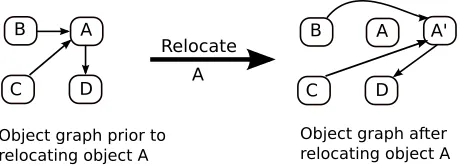
Figure 2.1 Object Graph Illustrating Object Relocation . . . 27 Figure 2.2 % of garbage collected increases as more pages are compacted with
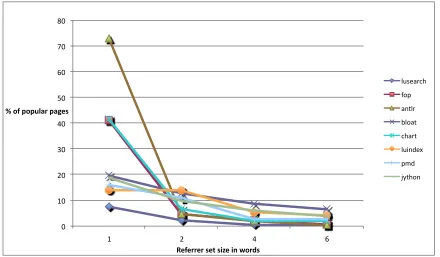
in-creasing referrer set size . . . 42 Figure 2.3 % of popular pages decreases with increasing referrer set size . . . 42 Figure 2.4 % of copy-aborted pages increases as an increase in referrer set size allows
the collector to relocate more pages . . . 43
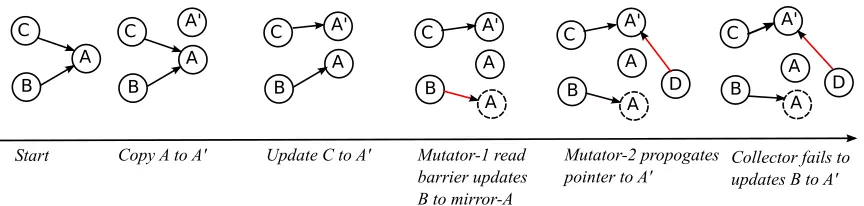
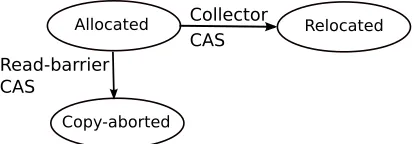
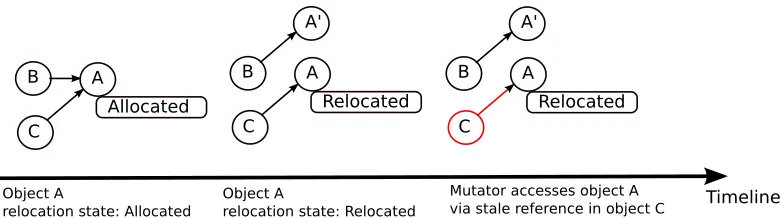
Figure 3.1 Stable referrer set requirements being violated when object transplanta-tion is carried out using CAS . . . 50 Figure 3.2 64-bit stateword used for maintaining per-object relocation state . . . 51 Figure 3.3 Object relocation state transitions . . . 52 Figure 3.4 Stable referrer set requirements being violated when object
transplanta-tion is carried out using CAS . . . 54
Figure 4.1 Cycles to mark a reference increases with the number of task-threads . . . 71 Figure 4.2 Speedup in parallel marking time flattens out as the number of
task-threads crosses a threshold . . . 72 Figure 4.3 Number of task-threads writing to a cache line in the mark-bitmap relative
to number of task-threads . . . 74 Figure 4.4 Marking data structures for a task thread . . . 75 Figure 4.5 Cycles to mark a reference relative to number of task-threads scales much
better compared to the baseline algorithm . . . 81 Figure 4.6 Speedup in parallel, marking time continues to scale with the number of
task-threads . . . 82 Figure 4.7 Number of task-threads writing to a cache line in the mark-bitmap relative
Chapter 1
Introduction
The performance of microprocessors has been driven my Moore’s law for quite some time now. Memory chips have simply become faster over time on a course described by Moore’s law, while processor speeds have often increased at a rate faster than that predicted by Moore’s law. Advanced micro-architecture techniques that exploit parallelism in the instruction stream, i.e., instruction-level parallelism, combined with deep processor pipelines and sophisticated branch
prediction techniques, are primarily responsible for faster growth in processor speeds. On-chip caches have helped bridge the gap between processor and memory speedups. All these have resulted in system architectures being able to extract parallelism from software in a manner transparent to the programmer, keeping their tasks simpler. Programmers have benefited from the resulting software speedups.
Unfortunately, it is becoming increasingly difficult for processor designers to further enhance the speed of modern processors by using these techniques. Typical instruction streams have only a limited amount of usable parallelism among instructions. Processors that issue more than 4 instructions in a cycle achieve very little incremental speedup, while paying high costs in terms of power and complexity. Power has become the most limiting factor for modern processor design. Modern processors require up to 100W of power, necessitating advanced and expensive cooling techniques. Given this “power ceiling,” processor architectures must limit the amount of wasteful speculation and use other approaches to further reduce execution times.
hundred concurrent client requests. Individual requests have “soft” latency bounds, and sus-taining throughput is critical, i.e., there should be no dropped requests. Throughput computing is thus able to support a larger number of concurrent requests at lower power.
Meanwhile, software has undergone a transformation to keep up with the paradigm shift in hardware design towards multi-core architectures. This was necessary to prevent software from becoming the bottleneck. Multi-threaded programming has become more universal. Ap-plications built using modern programming languages, such as Java™ [34], that run on top of managed runtime environments, i.e., virtual machines, have built-in support for “threads”, as well as support for synchronization primitives such as locks. The libraries that ship with Java™, i.e., the JDK, also ship with thread-safe implementations of commonly used data struc-tures such as hashtables [41]. These feastruc-tures, as well as automated memory management, i.e., garbage collection, have resulted in wide spread adoption of Java™ in the enterprise markets. Currently, by some estimates Java™accounts for about 80% of the enterprise software market. Garbage collection has been an ymportant aspect of the Java™ language. It has been crit-ical to increasing programmer productivity and the robustness of programs. Without garbage collection, programmers, have to write their own memory-management modules. These tend to spring memory leaks and cause memory corruption, especially as the program scales to use more memory. This is not a reflection on a programmer’s ability but a direct reflection of the challenges involved in implementing a scalable and thread-safe memory management module. Garbage collection significantly reduces memory leaks and memory corruption, thereby increas-ing program robustness, and allowincreas-ing programmers to focus on implementincreas-ing the core business logic of their application. Automated memory management has gotten so much traction in re-cent years that even older languages such as C++ are redefining their specification to include garbage collection. Newer languages such as Scala [46], tend to be runtime-based languages that support garbage collection.
This dissertation focuses on the effect of garbage collection1 on application response times and throughput, as well as its effectiveness in performing its primary functionality, i.e., recycling memory. We begin with a short overview of garbage collection in section 1.1. The next two chapters of this dissertation focus on reducing the cost of GC-induced synchronization and making it predictable. We set the stage with a discussion of the need for synchronization between the garbage collector and the application threads, the synchronization mechanisms used for this purpose and their impact on the application performance in section 1.2.
The concurrent garbage collection algorithm, called the Collie collector(Chapter 2), makes use of hardware transactional memory, a new concurrency primitive used for multi-address atomic updates. Transactional memory(TM) has been an active area of research for the past couple decades; we give an overview of the design space and discuss the some of the general
1
techniques used in the implementation of hardware transactional memory in section 1.3. The final aspect of this dissertation deals with improving the performance of marking, a core functionality shared by several garbage collection algorithms. We briefly discuss the design variables in implementing a high-performance, concurrent marking algorithm in section 1.4.
We build on these to highlight the research problems that this dissertation deals with and to layout the structure of the dissertation in section 1.5.
1.1
Garbage Collection Overview
The garbage collector’s first task is to identify parts of the memory that are accessible to the application program. Java being an object oriented program, the garbage collector views memory as a collection of objects. Each application program thread has its own execution context. This generally includes the thread stack, the registers and certain special pointers to objects, referred to as “handles,” that are stored in special thread-local areas. The execution context of an application thread can hold pointers to objects in memory. The objects in memory, accessible via the pointers in the execution contexts of application threads, are considered reachable or live and are not recyclable by the garbage collector. In addition, objects that can be reached by following pointers from a live object are also considered to be live. The objects that are directly reachable via pointers in the execution context of the application threads, are commonly referred to as the “root-set.” The garbage collector walks the entire heap graph starting from the root-set, marking every object it reaches as live. Marking an object generally implies setting a bit associated with the object address that identifies the object as live. This phase is commonly referred to as the marking phase.
Once the garbage collector has finished scanning the heap and has identified a set of live objects, its next task is to free up the unused memory. There are a couple different ways that a garbage collector recycles unused memory. The first method is to “sweep” the garbage objects, sort them by size and return them to free lists of memory blocks. These freed memory blocks are then used to satisfy allocation requests by application threads. By definition, application threads can’t access garbage objects; hence the garbage collector can recycle these objects without a need for additional synchronization with the application threads.
Free-list management on the allocation path can slow down the supported allocation rate, thereby adversely effecting application throughput. Application throughput is directly related to how fast an application can allocate, and therefore free lists are not the most desirable allocation mechanism.
The other approach to recycle unused memory is to defragment the heap by copying live objects into new contiguous locations and freeing up memory where they are currently located. Objects are packed next to each other while being copied, avoiding GC-induced fragmentation. This also results in large chunks of memory being freed up. These larger chunks of memory are now handed out to application threads as thread-local allocation buffers to satisfy allocation requests. Application threads can use a fairly straightforward bump-pointer allocation [67] within these thread-local buffers. This significantly increases allocation speeds, which results in increased application throughput.
Garbage collection algorithms generally operate in two distinct phases, i.e., a mark-phase and a sweep-phase or a compact-phase. A separate family of collectors fuses the mark and the compact phases into a single “copying” phase. Hence, these are classified as “copying” collectors. This dissertation focuses on the “mark-compact” family of collectors, since they have distinct advantages over the other family of collectors [42] and find predominant use in modern JVMs.
1.2
Synchronization between the Garbage Collector and
Appli-cation Threads
We will now discuss the need for synchronization between concurrently executing application threads (mutators) and the collector. The execution context of an application thread is mutable, i.e., is constantly changing as the program continues its execution. The garbage collector’s view of the application thread’s execution context can differ from that of the application thread’s view of its own execution context. Thus there is a need for synchronization between the collector and the application threads, i.e., mutators. As described previously, a mark algorithm walks the object heap graph and marks the reachable objects as live, while the application threads continue to run and mutate the heap graph. Starting from the root-set, for each object that a collector reaches, it does the following:
1. marks it live.
2. scans the “outwardly-directed” pointers in the object and proceeds to walk through them in a breadth- or depth-first manner.
processed. In the absence of synchronization between a mutator and the collector, a mutator thread can write a pointer to a yet unvisited object into an object that the garbage collector considers to be “completely” processed. This freshly written pointer will not be seen by the garbage collector since it considers the object the pointer is written into to have already been visited or processed. This can result in heap corruption if this pointer turns out to be the only pointer to the object; in this case the collector can’t reach the object via any other path and it ends up recycling it as garbage.
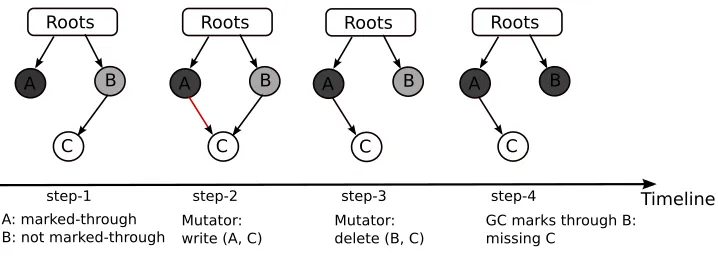
This is illustrated further in figure 1.1. The figure shows a timeline of the object graph in the heap. The figure illustrates the snapshot of the object graph at four different times. In step 1, the garbage collector has already marked through object A, indicated by the black shade. The garbage collector will not revisit object A after this point, since it considers object A to be visited or completely processed. It has also marked object B as live, but is yet to traverse through the outward pointers emanating from object B. This state is indicated by the gray shaded object B. As can be seen, object A and B are directly reachable via the root-set. Object C is reachable via object B. Object C hasn’t been visited by the garbage collector; this state is indicated by the white shade.
Roots
A B
C
Roots
A B
C
Roots
A B
C
Roots
A B
C
A: marked-through B: not marked-through
step-1 step-2 step-3 step-4
Mutator:
write (A, C) Mutator:delete (B, C) GC marks through B:missing C
Timeline
Figure 1.1: Heap Graph Timeline
marking.
In addition to being able to track pointers in heap objects, the collector also needs to track pointers to objects in mutator execution contexts, i.e., the stacks and the registers. There needs to be a low-overhead synchronization mechanism that allows the collector to track down all the object pointers in the mutator stacks and registers. We discuss this further in section 1.2.1.
Concurrent heap compaction follows the mark phase in a garbage-collection cycle and in-volves copying/relocating live objects in discontiguous locations to contiguous memory loca-tions. This results in a compact packing of these objects, allowing the garbage collector to recycle the original memory locations of the relocated objects.
Concurrent compaction has to meet a few requirements, listed below:
• Copy the object to its new location in a coherent manner, i.e., concurrent updates to the original object by the mutator should not be missed.
• Update references to the old location of the object to make them point to its new location.
• Prevent propagation of pointers to the old location of a relocated object.
• Prevent access to the old location of a relocated object once it has been copied to its new location.
In order to meet these requirements, the collector needs to synchronize with the concurrent executing mutators during the compaction phase. Concurrent marking poses a multiple-readers, single-writer coherence problem, since both the mutator and the collector read pointer fields but only the mutator can modify them. Concurrent compaction on the other hand poses a multiple-readers, multiple-writers coherence problem, since both the collector and the mutator are writing to the heap. Having discussed the need for synchronization between the collector and the mutators during both the phases, we will now discuss the various forms of synchronization and their uses in both the collector phases.
1.2.1 Stop-the-world Synchronization
Stop-the-world synchronization is a heavyweight form of synchronization between the collector and the mutator. It involves bringing all the application threads to a stop at the start of a GC phase and restarting them at the end of the GC phase. This precludes all races between the collector and the mutator. In addition, an entirely stop-the-world collection cycle allows the collector to identify a “precise” and correct live-set and relocate this live-set in a thread-safe manner.
JIT compilers; GC “safe” points are places in the application code where a mutator execution can be suspended without violating the legal language and platform specification. Most systems have short sequences of code that must be run in their entirety in order to preserve the invariants relied on by the collector. We cannot have a GC “safe” point in the midst of this section of code. An example is code executed by the mutator to setup an execution stack frame as well code for initializing newly allocated objects. GC safepoints also provide the collector with precise information on the location of object pointers in the stacks and registers. This is generally implemented using stack maps [42] that are bitmaps indicating the precise location of object pointers in the stack frames. The JIT compiler is generally tasked with the duty of generating stack maps. Most systems allow garbage collection at certain restricted safepoints, and produce stack maps only for those points.
The minimal set of safepoints needed for correctness includes each allocation, and each call of a routine in which there may be allocation or which may cause the thread to suspend in a wait. Beyond the minimal points needed for correctness, a system may wish to allow garbage collection at more locations so as to guarantee that garbage collection can proceed without an unbounded wait for the thread to reach its next safepoint. To make this stronger guarantee, there needs to be a safepoint in each loop; safepoints are generally placed at each backwards branch in a function. Function entries and returns can also be safepoints. These additional safepoints do not do anything that actually can trigger a garbage collection; hence they need to have an added check for whether garbage collection is needed/requested. Agesen [5] describes and compares the two ways of causing a thread to suspend at a GC-point. One ispolling, where a thread checks a flag that indicates that a garbage collection has been requested. The other technique is patching, and involves modifying the code at the next GC-point(s) of the thread so that when the suspended thread is restarted, it will stop at the next GC-point.
1.2.2 Barrier Synchronization
Memory-management systems augment individual application pointer2 reads/writes with addi-tional funcaddi-tionality that turns the operation into abarrier: an action that results in synchronous or asynchronous communication with the collector. These provide finer grain synchronization compared to the stop-the-world synchronization and find extensive use in all concurrent phases of the garbage collection. We will discuss the types of barriers and some general implementation techniques; the particular barrier code depends on the collection algorithm. In abstract terms, barrier mechanisms are used by the collector to detect and act on “interesting” pointers. The notion of what counts for an “interesting” pointer depends on the collection algorithm. Detec-tion is the process of determining that a pointer is interesting. Acting on an interesting pointer generally involves recording the pointer for later use by the collector and in some cases might involve additional action such as “correcting” the pointer [63, 21].
Barriers are generally small sequences of code emitted by the JIT compiler prior to or following a pointer read/write. A typical barrier involves one or more checks that guard an action. Typical checks include null-checks and generation-checks on the pointer of interest. Most barrier implementations include a fast-path that is inlined for speed and a slow-path that the fast-path code can call if necessary. A well designed fast-path code can improve instruction cache performance and reduce the overhead on the application code.
Write barriers track pointer writes in application code and generally record the pointer of interest, which is either the pointer being overwritten or the new pointer value being stored. The flavor of the write-barrier depends on the collection algorithm and the intended use of the barrier. Write barriers also use a variety of data structures to record these pointers, such as card tables [59, 66], sequential store buffers [16] and hashtables [33]. While the common write-barrier implementations use inlined code sequences, the early flavors of write-write-barriers relied on operating system and hardware support. Tagged pointer architectures allowed pointers and non-pointers to be discriminated, and a hardware write barrier could set bits in a page table [50]. However, it is possible to use operating-system support to track writes without special-purpose hardware, For example, Shaw [56] modified the HP-UX operating system to use its paging system to record dirty pages. Boehm et al. [17] use write-protection on pages after a collection; the first write to a page since it was protected leads to a fault, and the trap handler sets the dirty bit for the page before unprotecting it to prevent further faults.
Read barriers track pointer reads in application code and are generally used by copy-ing/compacting collectors to support concurrent relocation of objects3. In case of copying/compacting collectors, it is often the case that there are multiple copies of a single object during the process of relocation; these collectors use read-barriers to enforce an invariant that all mutators see a
common and current version of the object. Baker [13] read barrier was among the earliest to sup-port incremental collection to enforce a to-space invariant. This was extended by Halstead [35] to support concurrent copying. A Baker style read barrier tracks a pointer to the from-space location of an object and forwards it to the corresponding to-space location of the object, copy-ing the object in the process if necessary. The Brooks [19] read barrier is an indirection barrier where all heap accesses, of pointers, non-pointers and mutable values in header words, require an unconditional dereference operation to follow an indirection pointer. The indirection pointer points to the “current” location of the object. Brooks style read barriers are generally used in conjunction with write barriers to ensure termination of the GC phase [19].
Read-barriers, similar to write-barriers, can be implemented as inlined code [63] or by using virtual memory protection techniques. Appel et al. [7] and the Compressor algorithm [44] use similar virtual-memory page-protection primitives. Protection serves as the read barrier for concurrent copying collection, in order to prevent the mutator from accessing to-space pages whose objects have not yet been copied or contain unforwarded pointers. Ossia et al. [52] also use protection to allow concurrent forwarding of pointers in pages containing compacted objects.
Barrier implementations often use underlying hardware concurrency primitives such as the compare-and-swap (CAS) instruction [53, 63, 47]. Barriers that use page-protection techniques are generally expensive since they incur the penalty of switching to kernel code. They are also prone to “trap storms” as many protection faults are triggered immediately after a collection to unprotect the program’s working set [44, 21].
Barrier implementations also differ in the kind of progress guarantee [39] they provide to the application code. Most barrier implementations provide lock-freedom and obstruction-freedom. Considering that barriers are executed by the application code at every pointer read/write, application response times and throughput are stronly impacted by the concurrency primitives used in the barrier code, the design of the barrier-fast-path code and the progress-guarantee provided by the barrier code. The concurrent, collection algorithms proposed in this dissertation provide the first of its kind, constant-cost, “wait-free” [39] read-barrier.
1.3
Transactional Memory Overview
As mentioned earlier, our proposed concurrent compaction algorithm, the Collie collector, uses hardware transactional memory to support concurrent compaction. We round off this chapter with an overview of the transactional-memory design space and a discussion of techniques used in the implementation of hardware transactional memory.
Lomet [45] was the first to observe that an abstraction similar to a database transaction might make a good programming language mechanism to ensure the consistency of data shared
3
among several processes. In 1993, Herlihy and Moss [38] proposed a hardware-supported trans-actional memory, and Stone et al. [61] proposed an atomic multi-word operation known as “Oklahoma Update” to rekindle research in this area.
A transaction is a sequence of actions that appears indivisible and instantaneous to an outside observer and has four attributes (called the ACID properties):
1. Failure atomicity: transaction completes successfully or seems like it did not start.
2. Consistency: a transaction should leave the world in a consistent state.
3. Isolation: the result should be correct independent of other concurrent transactions.
4. Durability: the result should be permanent once the transaction commits.
The properties of transactions provide a convenient abstraction for coordinating concurrent reads and writes of shared data in a concurrent or parallel system. Today, this coordination is the responsibility of a programmer, who has only low-level mechanisms, such as locks, semaphores, mutexes, etc., to prevent two concurrent threads from interfering. Even modern languages such as Java and C# provide only a slightly higher-level construct, a monitor, to prevent concurrent access to an object’s internal data. These low-level mechanisms are difficult to use correctly and are not composable.
Transactions provide an alternative approach to coordinating concurrent threads. A pro-gram can wrap a computation in a transaction. Failure atomicity ensures that the computation completes successfully and commits its result in its entirety, or else aborts. In addition, isolation ensures that the transaction produces the same result as it would if no other transactions were executing concurrently. Although isolation appears to be the primary guarantee of transac-tional memory, the other properties, namely failure atomicity and consistency, are important. If a programmer’s goal is a correct program, then consistency is important since transactions may execute in unpredictable orders. It would be difficult to write correct code without the assumption that a transaction starts executing in a consistent state. Failure atomicity is a key part of ensuring consistency. If a transaction fails, it could leave data in an unpredictable and inconsistent state that would cause subsequent transactions to fail. Moreover, a mechanism used to implement failure atomicity, reverting data to an earlier state, turns out to be very important for implementing certain types of concurrency control.
1.3.1 Transactional Memory: Design Space
• Strong versus weak isolation: Weak isolation guarantees transactional semantics only among transactions. Strong isolation guarantees transactional semantics between trans-actions and non-transactional code, in addition to transtrans-actions. Our algorithm assumes strong isolation.
• Nested versus flattened transactions: A nested transaction is one whose execution is properly contained in the dynamic extent of another transaction. The inner transaction sees modifications to the program state by the outer transaction. If the transactions are flattened, aborting the inner one causes the outer one to abort as well, but committing the inner one has no effect until the outer transaction is committed. Flattened transactions are easier to implement. The proposed algorithm doesn’t make use of nested transactions.
• Exceptions: An exception thrown from within a transaction that leaves the scope of the transaction can either terminate or abort the transaction. The transaction can either be re-executed or terminated on an exception. The proposed algorithm doesn’t require support for exception handling, since we don’t expect language-level exceptions to be thrown from within transactions.
• Transaction granularity: This is the unit of storage over which a TM system detects conflicts. Most STM systems extend an object-based language and implement object granularity, i.e., conflicts are detected over different fields of an object. HTM systems generally detect conflicts at cache line/block or word granularity.
• Direct and Deferred update: TM implementations that use the “direct update” policy directly modify the shared object and rely on concurrency control to allow only one thread to update the object. They need some kind of rollback mechanism in case of a transaction failure. Deferred-update implementations update a private copy of the object and replace the actual object with the private copy at a later point.
• Concurrency control: Concurrency control is needed to deal with conflicts in a system where multiple concurrent transactions are permitted. Pessimistic concurrency control de-tects and resolves the conflict at the same time. Optimistic concurrency control permits the conflict detection and the resolution to happen at separate times as long as the resolu-tion happens before the transacresolu-tion is committed. This is also a way to guarantee forward progress, i.e., a transaction is guaranteed eventually to complete. Most TM systems are non-blocking in nature and offer one of the following guarantees:
2. Lock-freedom: This assures that at least one thread from the set of threads contend-ing for a shared object will make forward progress in a finite number of time steps of any of the concurrent threads.
3. Obstruction-freedom: This is the weakest progress guarantee and only ensures that a thread will make forward progress in a finite number of its own time steps in the absence of contention over the shared object.
• Early and late conflict detection: A TM system can detect conflicts at three points:
1. On transaction open, at the time of the first reference to an object.
2. On validation, when a transaction examines the collection of objects it previously read or updated.
3. On commit, when the transaction tries to commit.
• Explicit vs Implicit HTMThe first step for an HTM is to identify transactional mem-ory accesses. This is done via extensions to the instruction set. Based on these extensions, HTMs may broadly be classified into two categories: explicitly transactional and implicitly transactional.
Explicitly transactional HTMs provide software with new memory instructions to in-dicate which memory accesses should be made transactionally (e.g., load transactional and store transactional), and they may also provide instructions that start and commit transactions (e.g., begin transaction and end transaction). Other memory locations ac-cessed within the transaction through ordinary memory instructions do not participate in any transactional memory protocol. The examples of explicitly transactional memory are Herlihy and Moss HTM [38], Oklahoma Update [61] and the Advanced Synchronization Facility [6]. The advantages of an explicit HTM system are:
– Explicitly identifying transactional accesses provides programmers with increased flexibility and may aid in reducing the size of a transaction’s read-set and write-set.
– Explicit interfaces also naturally allow transactional and non-transactional accesses to intermix.
Implicitly transactional HTMs on the other hand only require software to specify the boundaries of a transaction, typically demarcated by instructions like begin transaction and end transaction. They do not require software to identify each individual transactional memory access; all memory accesses within the boundaries are transactional. Examples of implicit HTM systems include the Azul HTM[62] and the newly announced Intel HTM [3]. The main advantages of an implicit HTM system is that implicit identification of transac-tional locations restricts instruction changes to the boundaries of a transaction. Therefore, these HTM systems can enable reuse of existing software libraries, and they typically do not require multiple code versions to be compiled. Most modern HTM proposals follow an implicitly transactional model.
Transactional memory implementations come in software-only flavors [55], hardware-only flavors [25, 3, 62] as well as hybrid implementations [22]. We confine our discussion to hard-ware transactional memory implementations, since we will be using one in the proposed Collie collector algorithm, and also since support for these is becoming commonplace [25, 3, 62].
1.3.2 Hardware Transactional Memory: Implementation Notes
HTMs must identify memory locations for transactional accesses, manage the read-sets and write-sets of the transactions, detect and resolve data conflicts, manage architectural register state, and commit or abort transactions. We now discuss some of the implementation techniques that HTM systems use to achieve these goals.
Tracking the Read/Write Set
An HTM must track a transaction’s read-set and must buffer the transaction’s write-set. Most HTM proposals are based on cache extensions that add an additional bit, the read bit, to each line in the data cache. A transactional read operation sets the bit, identifying the cache line as being part of the transaction’s read-set. This is a fairly straightforward extension to a conventional data-cache design. Such designs also provide a way to clear all the read bits in the data cache instantaneously. Hardware caches enable HTMs to achieve low-overhead read-set tracking; however, they also constrain the granularity of conflict detection to that of a cache line. Additional access bits may be added to reduce the granularity for tracking. Write-set tracking is implemented in one of the following manners:
update. However, if the data cache is used to track the write-set, then care is required to ensure that an only copy of a line is not lost, e.g., in systems with write-back caches, where processors directly write to a location in the cache without updating main memory. A requirement is that the now-dirty cache line must eventually be copied into main memory before it is overwritten by a transaction’s tentative updates. If we did not do this, we would lose the only copy of the cache line following an abort.
• Store-buffer based tracking: To avoid any modifications to the data cache, some HTM proposals add dedicated buffers to track read-sets and to buffer write-sets (Oklahoma Update [61]).
• Hybrid models are also possible; e.g., the Intel HTM [3] proposal and Rock HTM [25] both use the data cache to track the read-set while using the store buffer to track the write-set.
Zilles and Rajwar [69] studied the effectiveness of a data cache for tracking read-sets and write-sets for an HTM design with a 32KB 4-way set-associative data cache with 64-byte cache lines and found that such an HTM could frequently support transactions up to 30,000 in-structions that operate on hundreds of cache lines; that was fairly large compared to common perceptions. However, in this kind of system, a transaction must be aborted whenever an over-flow occurs. Such overover-flows occur due to set-associativity conflicts. Overover-flows can further be mitigated using a victim cache. A single victim cache increases the data cache utilization for transactions by 16% (increasing utilization to 42%).
Detecting Data Conflicts Using the MOESI Cache Coherence Protocol
Hardware cache coherence provides mechanisms to locate all cached copies of a memory location and to keep all such cached copies up-to-date. While numerous cache coherence protocols exist, most are either snoop-based or directory-based.
A write operation to a cache must keep all cached copies up to date. This usually involves invalidating stale (out-of-date) copies or (less commonly) updating those copies with the newly written value. If two processors simultaneously issue a write to the same location with different values, cache-coherence protocols ensure that all processors observe the two writes in the same order, with the same value persisting in all copies. In invalidation-based cache coherence proto-cols, the cache with the dirty copy of a line (i.e., the cache that has modified it with respect to memory) is responsible for servicing read requests from other processors which require access to the line.
MOESI classification is based on the various states a cache supports, and the terms arise from the names of the cache states.
1. Invalid state (I): Address is not present in the cache.
2. Shared state (S):
• Address is present in the data cache and it may also be present in other data caches, hence the shared nature of the state.
• Because of the shared nature, if a processor needs to update the location, it must request write permissions from other data caches.
• A processor cannot update an S state cache line by itself.
3. Exclusive state (E):
• Address is exclusively present in the data cache and is not present in any other data cache.
• A processor can typically update the E state cache line directly without asking for permission.
• When it does so, the processor changes the state of the cache line to the modified state (M).
• The E and S states share one common feature: in both cases, the cache line is clean, and the latest copy of the cache line also resides elsewhere, either in memory or another cache.
4. Modified state (M):
• This is the latest copy of the cache line and is only present in this cache.
• This data cache is responsible for servicing a subsequent request to this line.
5. Owned state (O): In the O state, the line is dirty but is also possibly shared with other caches. Since the line is dirty, this data cache owns the line and is responsible for providing this data when other processors request it. However, since it is shared, the processor cannot write the line without requesting write permission from other caches.
HTMs can utilize these existing MOESI protocols to detect conflicts:any write request from another processor to a line in any state other than the I state that has been read transactionally
is a data conflict: another processor is attempting to write to a line that has been read in a transaction. Similarly, any read request from another processor to a transactionally-written line
in the M state is also a data conflict. In both these cases, the underlying cache coherence protocol
Resolving Data Conflicts
Once a data conflict has been detected, it must be resolved. Nearly all conventional HTM pro-posals perform eager conflict detection, aborting the transaction on the processor that receives the conflicting request, and transferring control to software following such an abort. This ap-proach is simplest from the point of view of a hardware implementation. A software handler then executes and may decide to re-execute the transaction or to perform some kind of con-tention management. Notification of the causes of conflicts can be a valuable tool in debugging performance problems in software using TM: most HTM proposals provide a new architecture register for this purpose.
Managing Architectural Register State
In addition to memory state, software also has associated register state that is architecturally visible. Collectively, these architectural registers and memory combine to form a processor’s precise state. When a transaction aborts, the register state therefore must also be restored to a known precise state, typically corresponding to just before the start of the transaction. Some HTM systems rely on software to perform such a recovery while other HTM systems build on existing hardware mechanisms to recover architectural register state. One straightforward approach for hardware register recovery entails creating a shadow copy of the architectural registers at the start of a transaction. This can be maintained in an architectural register file (ARF). This operation can often be performed in a single cycle.
We have discussed the design and implementation choices in building an HTM system. We now look at a sample HTM implementation, referred to as Speculative Lock Elision(SLE), that is similar to both the Azul HTM [62] and the newly introduced Intel™ Transactional Synchronization Interface(TSX) [3].
HTM Sample Implementation: Speculative Lock Elision
tentative updates from its store buffer into the data cache. This ensures all updates are made visible instantaneously. This is guaranteed to complete in bounded time and without global coordination.
The key observation introduced by SLE was that a processor does not actually have to acquire a lock, but it need only to monitor that it remains available. The processor executes the critical section optimistically as if it is lock-free: two threads contending for the same lock could execute and commit in parallel without communication, so long as their executions were data-independent. It takes advantage of a key property of a typical lock variable: a lock-release’s write undoes the changes of the lock-acquire’s write. By eliding both of these operations, but monitoring the lock variable for data conflicts, the lock remains free and critical sections can execute concurrently.
1.4
Garbage Collection Performance
As stated earlier, a garbage collector generally goes through two phases: a mark-phase and a recycle-phase. The efficiency of the GC algorithm in recycling memory, i.e., “how fast it can identify and recycle garbage”, directly effects the maximum application allocation rates it can support. An efficient, well designed stop-the-world collector can result in short application pauses. An efficient, concurrent collector can result in needing less amount of memory head-room to support a high allocation rate.
In order to increase GC efficiency, i.e., throughput, GC algorithms attempt to exploit the parallelism available in hardware by employing multiple task-threads to execute both the GC phases. Compaction follows the mark-phase and involves walking through liveness bitmaps to identify live objects and copying them to contiguous locations. Task-threads are assigned disjoint sections of the liveness bitmap heap to be compacted and there is very little synchronization needed between the parallel compacting task-threads. For this reason, GC algorithms that carry out compaction in parallel using task-threads scale very well as more task-threads are added to execute this phase.
are kept busy and participate in the marking-phase. Load-balancing techniques add their own set of synchronization needs and these costs can often outweigh the benefit of load-balancing.
Concurrent marking algorithms, which mark the heap with concurrently executing applica-tion threads, have to deal with a changing heap graph as they continue to mark the heap graph. As noted earlier in section 1.2, they have to deal with changes to the heap graph after they have marked through it. They need to synchronize with application threads for this purpose and potentially re-mark sections of the heap.
We discuss the issues in implementing a scalable, concurrent and parallel marking algorithm; we identify the bottlenecks and propose a new non-blocking work-sharing algorithm between parallel marking task-threads in chapter 4.
1.5
Thesis Organization
This dissertation is divided into two distinct parts. The first part of the dissertation focusses on concurrent compaction techniques that provide low-cost and wait-free barrier synchroniza-tion mechanisms resulting in consistent applicasynchroniza-tion response times and higher throughputs. Chapter 2 of this dissertation introduces a new concurrent, compaction algorithm, the Collie collector, that provides the first of its kind, constant-cost, wait-free [39] read-barrier. The Collie collector makes use of the transactional hardware on the Azul platform [62]. Chapter 3 attempts to tease out a desirable quality of the Collie collector, i.e., the cheap, wait-free, read-barrier and outlines an implementation that doesn’t require the use of transactional memory hardware. This algorithm is thus amenable to implementations on platforms that don’t have a hardware transactional memory implementation available.
Chapter 2
The Collie : A Wait-Free
Compacting Collector
2.1
Introduction
Managed runtime environments, such as Java, that run the bulk of enterprise workloads, have been grappling with an abundance of cheap compute and memory capacity for sometime now. The objective has been to scale up in terms of memory and compute usage while maintaining response-time guarantees that are often in the 10s of milliseconds. There are some fundamental fault lines in the design of managed runtime environments that make it a challenge to achieve this dual goal. One such limitation is the usage of locks for synchronization in application and library code. The inability of current garbage-collection algorithms to scale to larger memory footprints without affecting application response/throughput is the second limitation, and the focus of this dissertation.
Traditional stop-the-world garbage-collection algorithms, where the application threads are stopped while memory is being reclaimed, have hit a wall as application heap sizes approach the 10s and 100s of gigabytes. This has resulted in the design and implementation of several concurrent garbage collection algorithms [21, 63, 44, 53, 10], all of which strive to recycle memory without stopping the application.
Controlling fragmentation is an essential part of any garbage-collection algorithm and is a requirement for real-time garbage collectors, since they need to be both time and space bound. Most real-time collectors [10] achieve this by either compacting the heap or by maintaining free-lists. Compacting collectors move live objects to contiguous memory locations and update the pointers to the obejcts’ old locations to make them point to their new locations.
fragmentation is also an essential part of non real time garbage collection algorithms. Com-pacting collector move live objects to contiguous memory locations and updates the pointers to their old locations to make them point to their new locations.
Compacting the heap in a concurrent manner is a significant challenge because of the syn-chronization issues between the application threads and the compacting garbage collector. Most of these concurrent compacting algorithms [21, 44] suffer from a high rate of barrier execution, i.e., trap storms [63], expensive barrier code [21, 40] and a variable and sometimes unbounded amount of time [53] spent in the barrier code. These have an adverse effect on application throughput and cause unexpected jitters in application response times that can violate service-level agreements(SLAs). As noted in several papers [47, 63], application trends continue to push the previously assumed envelopes of accepted response times and heap usage. It is not uncommon for mainstream enterprise applications to expect consistent response times in the milliseconds, at the same time challenging notions of a small young generation that can be com-pacted within a stop-the-world pause. In the not very distant future, incremental approaches [10] and algorithms that are prone to trap storms, etc., will not be able to keep pace with appli-cation requirements. Clearly, achieving high throughput and consistent response times while concurrently compacting the heap continues to be the holy grail of garbage collection.
Our goal is to take a fresh look at the issues with concurrent compaction while keeping sight of the objectives listed above. In this chapter, we describe the Collie collector, a new approach to concurrent compaction. We have implemented it on the Azul JVM that runs on the custom system designed by Azul; previous collectors such as Pauseless Collector [21, 63] have been shipping on the same mature platform for several years now. The algorithm makes use of certain hardware features unique to the Azul platform such as a read-barrier instruction and the only shipping implementation of hardware transactional memory.
or AMD’s proposed “advanced synchronization facility” feature [6]. The contributions of this chapter are:
• We introduce the concept of an “object transplantation,” the state associated with it, and a set of constraints based on thelinearizability [39] framework that are necessary for correct concurrent transplantation.
• We introduce the first completely barrier-free compacting algorithm.
• We introduce the first wait-free [37], constant-time read barrier that is self-healing [21] and avoids the constant cost of the Brooks’ [19] indirection barrier.
• We introduce the first concurrent compacting collector that makes use of hardware trans-actional memory support.
• We present an evaluation of our implementation on the Azul Vega platform, leveraging multi-address atomicity, a hardware transactional-memory feature of the Azul custom Vega chip. We compare Collie with with the Pauseless Collector [21] running on the same platform.
We set the framework necessary to discuss our algorithm, with a discussion on the issues involved with concurrent relocation in sections 2.2 through 2.4. Prior to discussing the proposed algorithm, we describe the platform features that are used by the algorithm in section 2.5. We follow that with a description of the algorithm in section 2.6, the implementation in section 2.8 and evaluation in section 2.10.
2.2
A General Look at Concurrent Compaction
Compaction of objects involves copying the reachable objects from a from-space into mostly contiguous memory locations in a to-space, replacing all pointers to from-space locations with corresponding pointers to to-space locations and reclaiming from-space memory for re-use. While the “from” and the “to” spaces could technically overlap in some collectors (such as the case in in-place compactors), this chapter is mostly concerned with compactors that use non-overlapping from-space and to-space address ranges.
collectors impose a set of constraints on the mutators to achieve the required consistency and usually enforce these constraints using different barrier mechanisms. There are two main op-tions for maintaining consistency of object state during concurrent compaction. The first, which this chapter is mostly focused on, is to ensure that mutators can only observe one version of the object at any given time. For example, some collectors [13, 44, 21, 63] enforce a to-space invariant, where the mutator can only observe the to-space version of the object. The second
option is to allow multiple copies to be visible to the mutators, with the collector guaranteeing that all reads from and writes to the contents of the logical object (which may interact with different copies) remain consistent as specified by the memory model2. For example, concurrent copying collectors such as the Sapphire collector [40] take this approach.
The to-space invariant is often enforced using a read barrier. When the barrier encounters a from-space reference, it will look up the corresponding to-space location and use it instead, copying the object to its to-space location if necessary. This ensures that all concurrent accesses to the object are performed to the to-space version of the object’s contents. In some variations, the first thread to access a reference to a from-space object claims the rights to copy the object’s contents to the to-space, while other concurrent accessors of the object wait on the copy to finish, in order to obtain the object’s to-space pointer. In wait-free [37] copying variations, concurrent accessors may race and concurrently attempt to copy the same object’s contents without waiting, with a “winning” copy being decided via an atomic operation. Collectors that use the Brooks style indirection barrier [19, 47] always traverse a forwarding pointer, which always points to the current (to-space) version of the object. Such indirection barriers are generally coupled with a write barrier to avoid propagation of from-space pointers. In contrast to indirection barriers, direct-access barriers enforce theto-space invariant on loaded reference values, e.g. Baker style [13] and LVB-style [63, 21] barriers. Varying implementations of direct-access barrier implementation exist including, hardware read-barrier instructions [21], in-lined code that checks for invariants [63] and virtual-memory protection techniques [21, 44].
Having garnered an intuitive feel for the requirements of compaction in general and for the consistency requirements specific to correct concurrent compaction, we now attempt to crys-tallize these into a set of constraints. We use concepts fromlinearizability [39] to highlight the requirements for correct concurrent relocation of an object. Within the linearizability frame-work, each operation appears to “take effect” instantaneously and the order of non-concurrent operations is preserved. Objects should go from a well-defined and consistent pre-operation
1
This includes mostly concurrent compacting collectors such as the Baker collector [13] as well as the fully concurrent compacting collectors such as the C4 collector [63].
2
state to a well-defined and consistent post-operation state. Intermediate states are not defined and should not be visible. The linearizability framework maintains a history of operations on the object under consideration and defines a legal sequential history. A sequential specification for an object is a prefix-closed set of sequential histories for that object. A sequential history islegal if each object sub-history belongs to thelegal sequential specification for that object. A linearizableobject is one whose concurrent histories are linearizable with respect to thelegal se-quential specification. Thelegal sequential specificationis obviously different for each concurrent data structure.
2.2.1 Referrer Sets and Object Transplantation
We introduce the notion of “object transplantation”: from the point of view of an individual object,anyrelocating collector effectively “transplants” the object from one location to another. The transplantation of a single object includes the consistent moving of the object’s contents to its to-space location (often referred to as relocation), as well as the replacement of all references to the object’s from-space location with correct to-space references (often referred to as fixup). Transplantation of a given object is “complete” when both the contents move and all required reference replacement are complete.
Next, we define two terms for an individual object:
1. Referrer set: identifies the precise set of all object references (in the heap or in thread stacks/registers) that point to the object’s location.
2. Conservative Referrer Set: identifies a set of object references (in the heap or in thread stacks/registers) that includes all references in the object’s actual referrer set, but may also include other references that do not point to the object.
All relocating collectors transplant objects. Since each object transplantation must reliably correct all references in the object’s referrer set before it is complete, the typical relocating collector achieves this reliability by using an extremely conservative global referrer set: a full from-roots traversal of all references in the object space being compacted, usually performed once in order to assure the completion of all object transplantations (e.g. copying collectors [40], or relocate + remap collectors [44, 63]). As a result such collectors only ensure that each object’s transplantation is complete at the completion of a full from-roots traversal.
2.2.2 Constraints for General Concurrent Transplantation
object transplantation capabilities. We define the notion of an “object’s transplantation state” as:
1. The contents of the object itself.
2. The object’s referrer set.
On a timeline, an object’s transplantation state encompasses its state from the time it is marked for transplantation until transplantation is complete. In linearizability framework terms, a legal sequential specification for general concurrent transplantation is:
1. Until transplantation is complete, all observable copies of the object contents should remain consistent as specified by the platform’s memory model.
2. Once transplantation is complete, no references pointing to the object’s from-space loca-tion can exist in the object’s referrer set.
A sequence of operations that violates this set of rules would result in an incorrect concurrent transplantation algorithm. We believe that all known relocating collectors (concurrent or not) adhere to these two rules. Baker [13] style algorithms, for example, meet all the linearizability requirements by assuring that threads always obtain the to-space pointer to the object, and then copying the object to the to-space if necessary, as object transplantation is assured to be complete at the end of the copy phase. Since copying is done by the first thread to claim rights to the object while other threads that try to access the object concurrently wait for the copy to complete, the object’s observable contents remain consistent. The complete traversal of the reachable references during the copy phase ensures that no object transplantation set will include any from-space references. Another example is the Sapphire collector [40], which allows mutators to observe from-space references, and propagates writes to both versions of the object to make sure that they meet the consistency requirement. It will ensure that no references pointing to from-space locations exist at the end of a compaction phase, thereby meeting the second requirement.
2.3
Individual Transplantation
purposes of the new algorithms we describe in this chapter, we introduce two additional sets of progressively restrictive requirements:
Heap-stable referrer set limitations: Per-object referrer sets can be established through tracing, so long as they meet and maintain certain requirements. We define a set that includes all heap locations containing references to an individual object and one that remains stable after tracing is complete, as a heap-stable set. Such sets, together with the global set of references in all thread stacks and registers, form conservative heap-stable referrer sets. Objects with valid heap-stable referrer sets after the end of the tracing pass are ones which, in addition to general concurrent transplantation limitations (above), adhere to an additional limitation on the legal sequential specification:
3. Once tracing begins, no references to the object may be written to the heap.
For objects that adhere to these limitations, the heap-stable referrer set will remain correctly conservative until the object’s transplantation is complete. Objects that fail to adhere to these limitations at any point, from the beginning of tracing to the successful completion of their transplantation, are “hard” to establish a stable per-object conservative referrer set for, and are deemed to be non-individually transplantable.
Stable referrer set limitations: Individual object transplantation can be safely performed on objects that have a stable referrer set for the duration of their transplantation. Objects with a stable referrer set are ones which, in addition to heap-stable referrer set limitations, adhere to the two limitations on the legal sequential specification listed below:
4. At the beginning of transplantation, no thread stack/register references exist in the ob-ject’s referrer set.
5. Once transplantation of an object begins, no new references may be added to the object’s transplantation state until the transplantation completes.
Objects that adhere to these limitations exhibit a stable referrer set and can be individually transplanted in a single, object-specific “transplantation transaction.” Since these limitations assure that no mutator can observe or modify the object contents during the transplantation op-eration, the transplantation state will appear to transition atomically from a pre-transplantation to a post-transplantation state. Objects that fail to adhere to these limitations at any point, from the beginning of tracing to the successful completion of their transplantation, are deemed to be non-individually transplantable. We discuss this further in section 2.6