Volume 2009, Article ID 532474,8pages doi:10.1155/2009/532474
Research Article
Towards a Performance Boundary in Calibrating
Indoor Ray Tracing Models
Jaouhar Jemai
1and Thomas K¨
urner
21Ubisense AG, Development and Services, 80637 Munich, Germany
2Institut f¨ur Nachrichtentechnik, Technische Universit¨at Carolo-Wilhelmina Braunschweig, 38106 Braunschweig, Germany
Correspondence should be addressed to Jaouhar Jemai,jaouhar [email protected]
Received 27 July 2008; Revised 18 December 2008; Accepted 20 February 2009
Recommended by Jun-ichi Takada
This paper investigates the performance boundaries of a calibrated deterministic indoor channel model. From a propagation modeling point of view, this process allows to assess the weakness of ray tracing and sets the boundary conditions for a such modeling method. The principle of the deterministic model calibration used in this work focuses upon the estimation of optimal material parameters by means of a few pilot measurements and a simulated annealing method. This technique improves the accuracy of the prediction model for all measurement positions including those not considered by the calibration. The performance of the calibrated ray tracing model and the sensitivity of the calibration to the number of pilot measurements have been investigated. For this investigation, a measurement campaign has been conducted within an indoor office building at 2.45 GHz with 100 MHz bandwidth. Furthermore, the model performance has been compared to empirical indoor models.
Copyright © 2009 J. Jemai and T. K¨urner. This is an open access article distributed under the Creative Commons Attribution License, which permits unrestricted use, distribution, and reproduction in any medium, provided the original work is properly cited.
1. Objective and Introduction
The blind prediction, based on a priori approximate knowledge of material parameters, often shows an obvious mismatch with the measurements. Even if predicted path loss values are accurate enough like, for example, in [1], time dis-persion parameters could show a significant mismatch. Ray tracing-based conventional deterministic modeling methods use geometrically accurate data and rely on tabulated values for the electrical parameters of the building materials. For instance, the authors in [2] made direct measurements of the building materials. However, the material parameters remain approximate and impossible to define accurately for each building, especially when the building materials are a heterogeneous mixture of unknown components, for which no electromagnetic measurement values are available. There-fore, a calibration of these material parameters, reducing the mismatch between the model and the measurements, is required. The issue of deterministic modeling calibration has been addressed in very few works. In [3], only the dielectric constant of each wall have been tuned separately and the gradient method is used to estimate the solution. However,
using the gradient method in conjunction with this tuning provides generally a local minimum and does not necessarily provide the optimal solution.
As the relation between power taps and material param-eters is a nonlinear combinatorial relationship, the simulated annealing approach used in this paper provides the general optimal solution by simultaneously changing the dielectric constant and loss tangent of all material parameters with a changing step at each range of iterations. The method proposed converges to a global solution and avoids to be dropped into a local minimum as the gradient method does. The performance and robustness of this calibration procedure is analyzed in this paper by means of an indoor measurement campaign within an office building.
This paper is organized as follows. Section 2 presents the ray tracing model.Section 3investigates the calibration process and the calibration algorithm. Subsequently, the conducted measurement campaigns and the calibration results for an indoor office environment are highlighted in
Section 4. Finally, Section 5addresses the sensitivity of the
2. The Wideband Semideterministic
Prediction Model
The prediction model has been presented earlier by the authors in [4–6]. It has been derived by means of two core components; a geometric engine and an electromagnetic engine. While the geometric engine derives the propagation paths based on the accurate information of the 3D building database, the electromagnetic engine computes the prop-agation mechanisms and integrates the antenna radiation patterns.
The model requires an accurate 3D indoor database with detailed information describing the scattering objects (walls, doors, and windows), their thickness and their dielectric properties. The required building parameters introduced in the database are the relative dielectric constantεrand the loss tangent tanδ. According to their electromagnetic material properties, the structures of the building are classified into N different classes with common dielectric material parameters.
Besides free-space propagation, the propagation tool computes the Fresnel equations, considering multiple reflections and transmission through walls. Depending on whether the antennas is horizontally or vertically polarized, the system considers the corresponding reflec-tion/transmission coefficients and also the angle of departure (AoD) and angle of arrival (AoA) corresponding to each path. Interactions up to the 3rd order reflection have been considered. Many simulations have confirmed that this order provides a compromise between the accuracy of channel parameter (path loss and delay dispersion) and the reasonable computation time, which is also in accordance with [7]. The tool supports as much transmissions as the wave encounters in its propagation path. It accounts for the single diffraction using the uniform theory of diffraction (UTD) [8].
Thus, the channel model could be represented as a power delay profile (PDP) expressed by
h(τ)= Lp
k=1
αkδτ−τk, (1)
where P is the number of taps, αk and τk are the power and time of arrival (ToA) of thekth tap. The deterministic channel modeling provides channel characteristics with an infinite bandwidth. Hence, an infinite discrete time resolu-tion is achieved, enabling all MPCs to be resolved. However, as the measurement bandwidth is generally limited, the resolution of the measurement equipment could not enable the detection of all multipath components. Each group of closely spaced MPCs has been represented with a particular tap delayLp, the power of which is the sum of these MPCs power. The PDP could then be written as
h(τ)=
wherebyknis the number of MPCs clustered together to form thekth tap.
Since typically only 2D radiation patterns (horizontal and vertical) are available, the developed model derives the 3D antenna radiation pattern through a bilinear interpo-lation knowing the measured 2D patterns in E- and H-planes [9]. Moreover, for a better accuracy, the system model integrates also 3D measured antenna patterns within an anechoic chamber.
3. Model Calibration
The calibration consists in extracting relevant multipath components (MPCs), for instance once reflected paths, simultaneously from the model and measurement. After-wards, the simulated annealing is performed to optimize the material parameters.
3.1. Extraction of Parameters for Calibration. The measured and predicted PDPshmeasandhmodare given by
hmeas(τ)=
After identifying the direct path, according to the arrival time corresponding to the distance separating Tx and Rx, particular P power taps (e.g., once reflected paths) with a power above the noise threshold have been extracted from the measurement and the model simultaneously. The noise threshold is computed from each measurement based on a dynamic noise clipping. Hence, two vectors of power taps have been formed which are [[(αk)meas]Pn=1]
T
and [[(αk)mod]Pn=1]
T
. The calibration uses the electromagnetic engine, the power tap matrices and the involved building structures to optimize the material parameters incorporated by the deterministic model.
3.2. Simulated Annealing Algorithm: Practical Implementa-tion for Material Parameters EstimaImplementa-tion. The “Simulated Annealing” is analogous to the phenomenon of heating a material and letting it cool gradually until reaching a steady state. By the cooling process, the material reaches a global optimum, for which a global minimum energy crystalline structure is dissipated. Starting with an initial solutions(set of material parameters for the N classes) at a relatively high chosen temperatureT0, a neighbor solution
s is afterwards generated as a next solution for which the evolution in cost,ΔE(s,s)=E(s)−E(s), is evaluated. If the cots decreases, the generated neighbor solution becomes the current one, otherwise the algorithm decides with a certain probability whether s remains or s becomes the current solution. The probability of accepting a transition, causing a decrease ΔE(s,s) in the cost, is called the acceptance function and is set to e−ΔE/T. T is the parameter that
Table1: Simulated annealing algorithm parameters.
Notation Meaning
s A random solution as a set of material parameters
E(s) Objective function
T0 Initial temperature of the stepped geometric decrease
A Geometric decrease coefficient
L Number of steps running with constant temperature
ST Maximum steps the algorithm runs without many changes
temperature. Afterwards, the changing step of the parameters is decreased geometrically with the factor A towards zero. The process is stopped after ST steps if the objective function remains unchanged. The final solution is considered as the absolute optimum. The four configuration parameters (T0,
A,L, and ST ) considered by the algorithm are described in
Table 1.
The initial material properties are defined using tab-ulated values available in literature and knowledge of the construction material category. The electromagnetic prop-erties of some different conventional building materials, for example, at the WLAN frequencies can be found in literature [2, 10, 11]. However, some materials are a mixture of unknown components, for which no electromagnetic mea-surement values are available. Therefore, the optimization process starts from a common value for all these materials, corresponding, for example, to the concrete (εr = 4.95, tanδ = 0.01) at ambient temperature as measured in [11]. The optimized objective (cost) function is defined as the root mean square error between the measured and the predicted tap powers for all M measurements with Pm propagation paths each. A total of 990 indoor planes (walls) of the building have been grouped into 20 different classes of structures. Starting from an initial set of material parameters as initial solution for structure classes, the initial objective function is computed at each new iterationias
Ci= 1 M
M
m=1
1
Pm
Pm
n=1
αmnmod −
αmnmeas
2 i, (4)
whereMis the number of conducted measurements,Pm is the number of paths within the measurement m, andαmn
are the power taps from (1). The parameters (αmn)mod and
(αmn)measdenote the predicted and measured powers of the
MPCs, respectively.
4. Measurement Campaign and
Calibration Results
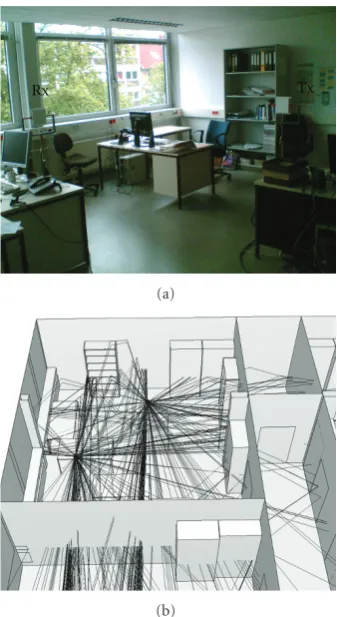
4.1. Measurement Campaign. The measurements have been conducted within an indoor office building environment, for which the antenna placements are depicted inFigure 2. In the frequency domain, a vector network analyzer is connected through a GPIB connection to a notebook. It sweeps the channel with a bandwidth of 100 MHz around the central frequency 2.45 GHz. The channel impulse response
Rx Tx
(a)
(b)
Figure1: (a) A measurement configuration within an office room
with (b) a 3D ray tracing.
Tx1
2.51 2.51 2.51 2.51
2.51
Figure2: Indoor transmitter and receiver locations.
gathers 900 elementary planes constituting the structures (walls, doors, windiws, cupboards, bookshelves, and tables), as shown inFigure 1.
The offices where the measurements have been con-ducted are representative of the entire institute building and gather most of the building structures. Moreover, 9 aligned measurements starting at 3 m from the transmitter have been conducted on the floor (as depicted in Figure 2) due to its characteristics enabling LOS conditions and wave-guiding effects.
4.2. Calibration Performance. The calibration has been per-formed using a set of three measurements for LOS (Tx2-Rx1, Tx2-Rx2) and for NLOS (Tx1-Rx5) as presented in bold squares inFigure 2.Figure 3displays the PDP (before and after calibration).
The positions Tx2-Rx1 is included in the calibration, Tx1-Rx2 in the neighbor room, and Tx4-Rx1 situated on the corridor are both not used as calibration data. The initial cost function prior to calibration amounts to 5.2 dB, whereas the one after calibration is 1.3 dB. The PDPs have been normalized referring to the direct path power. The good match of the model is resumed inTable 2regarding channel parameters.
Though initially not included in the calibration, the measurements Tx1-Rx2 and Tx4-Rx1 show a good match with the calibrated model. As expected, the measurement Tx2-Rx1 shows a better match than the other measurements not included in the calibration. However, the advantage of the model resides in providing globally more accurate parameters at any location within the environment without need of huge measurement campaigns to cover the whole
Table2: Summary of results for the three positions.
Position Parameter Measurement Uncalibrated Calibrated
Tx2-Rx1
building. This is an advantage over the statistical modeling as presented, for example, in [6].
4.2.1. Overall Analysis. An overall improvement of the cali-brated model compared to the uncalicali-brated one is obviously noticeable in most cases. The delay dispersion parameters are considerably improved as the power taps are calibrated. This is demonstrated inTable 3showing the overall improvement by the new calibrated model in terms of prediction error over all measurements, where the mean, the standard deviation, the minimum, and the maximum error are denoted byΔ,Δσ,
Δmin, andΔmax. Hence, the calibrated model delivers globally
−60
−50
−40
−30
−20
−10 0
P
ath
loss
(dB)
0 50 100 150 200 250 300
Excess delay time (ns) Power delay profile
(a)
−60
−50
−40
−30
−20
−10 0
P
ath
loss
(dB)
0 50 100 150 200 250 300
Excess delay time (ns) Power delay profile
(b)
−60
−50
−40
−30
−20
−10 0
P
ath
loss
(dB)
0 50 100 150 200 250 300
Excess delay time (ns) Measurement
Uncalibrated model
Calibrated model Propagation paths Power delay profile
(c)
Figure 3: PDP for the measurements (a) Tx2-Rx1 (used as
calibration data), (b) Tx1-Rx2 (not used as calibration data), and (c) Tx4-Rx1 (not used as calibration data).
Table3: Overall prediction error of the model before and after
calibration.
Parameter Statistics Uncalibrated Calibrated
στ[ns]
Δ 8 4
Δσ 5.1 4.7
Δmin 1.5 −5.6
Δmax 22.8 18.1
τmax[ns]
Δ 46 11.9
Δσ 48.1 30.1
Δmin −40 −30
Δmax 140 80
L[dB]
Δ 1.6 1.3
Δσ 9.1 4
Δmin −23.5 −10.5
Δmax 21.1 7.3
Table4: Path loss prediction error statistics of COST 231 models and calibrated ray tracing.
Model OSM MWM Ray tracing
Δ −5.3 −4.1 1.3
Δσ 10.5 9.2 4
Δmax 26.8 17.8 7.3
Δmin −14.8 −17.4 −10.5
of other objects with different materials or due to other propagation mechanisms not considered by the model.
4.2.2. Performance Over COST 231 Models. COST 231 models (one slope model and multiwall model) [12] are narrowband indoor prediction models. These models have been fitted using the same measurements used for the ray tracing. These models are given by the following equations
LOSM=50.7 + 17.3 log(d) [dB], (5) whereas the MWM model is given by
LMWM=40 + 20 log(d) +c+
w
Lwkw[dB], (6)
where the constant lossc= −6.7 dB and the wall lossLw =
15.7 dB have been determined by calibration. A comparison of the results of the calibrated model performance over the conventional COST 231 models for all 38 measurements are summarized inTable 4. It is obvious that the calibrated model outperforms the two empirical models. An average error of 1.3 dB is achieved by the ray tracing model, whereas the ones of OSM and MWM remain between−6 and−4 dB. Compared to the COST 231 models, which have a standard deviation between 11 and 9 dB, the calibrated ray tracing model achieves a smaller standard deviation of 4 dB.
0
Figure4: Cost function using one measurement.
5. Sensitivity of the Calibration to
the Measurements
Analyzing the performance of the calibration reveals some investigations to be dealt with comprehensively. In this section, the degree of the model performance improvement added by the calibration is assessed as a function of the calibration set size. First, the effect of one measurement is investigated. Subsequently, the impact of increasing the calibration set size has been analyzed.
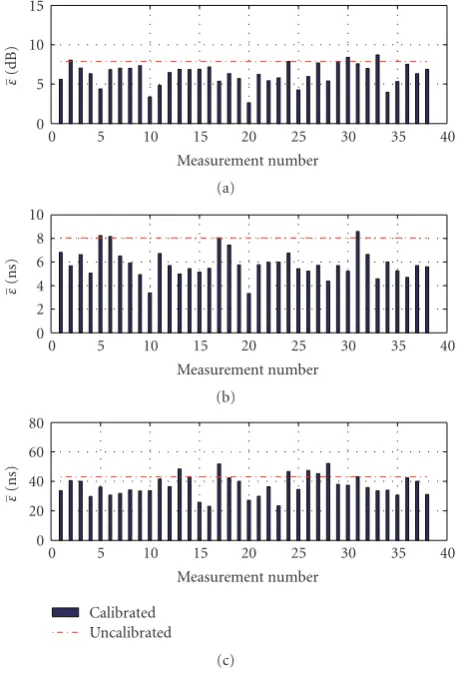
5.1. Single Measurement-Based Calibration. The optimiza-tion on a single measurement is useful to provide an insight into the degree of improvement to be expected with an adequate choice of material parameters. Each of the 38 measurements has been used for calibration of the model and the cost function for this measurement as well as the modeling error are computed for all measurements. Obviously, by virtue of their representative locations in the building, some measurements perform better than others when used for calibration. For instance, measurements 10 and 20 provide the best match with a cost of 1.2 to 1.5 dB
(seeFigure 4), whereas other measurements (2, 13, and 31)
deliver the worst match with an error between 5 and 7 dB. Each measurement of the 38 has been used singularly for calibration. The overall results of the improvement using one measurement are shown in Figure 5, where ε denotes the absolute average prediction error between the model and the measurements for the complete set of 38 measurements, expressed by
whereΔiis the prediction error for theith measurement.
The uncalibrated plot (dashed line) is constant as it is the difference between the measurement and prediction for all the set of data before calibration. It is noticeable that the average error reaches an optimum of 3 dB. However, at some
0
Figure5: Average error for all measurements with a calibration set of one measurement for (a) path loss, (b) RMS delay spread, and (c) maximum excess delay.
other, less representative locations of the entire building, the calibration results are rather degraded.
5.2. Measurement Set Size Influence. In order to keep the computation time reasonable with the increasing number of possible combinations, all possible combinations from the first 15 measurements have been considered (n=1,. . ., 15). The remaining 15 measurements have been added to the set (one each new calibration process) without combination. At each calibration computation, the resulting cost function is recorded and plotted versus the calibration set size (number of measurements) inFigure 6. The cost function undergoes an exponential decay with the variation trend given by the equation in the figure.
Figure 7 shows the average of the errors between the
1
Figure 6: Cost function with increasing size of the calibrating
measurement set.
error. The overall degree of improvement in terms of time dispersion and path loss parameters is illustrated inFigure 7. Henceforth, the remarkable fact which flows from these results is that the error diminishes as the calibration set size increases. This error reaches a fluctuation status around the number of 10, where the modeling error starts to fluctuate around a constant value. This reveals effectively the performance boundary of this deterministic model. It is noteworthy that the prediction error of path loss and time dispersion parameters exhibits a general decay trend with increasing calibration set size. However, a judicious calibra-tion requires a compromise between a best performance and a lower computation time and complexity.
6. Conclusions
This paper addresses the subject of a new deterministic model calibration technique based on simulated annealing, which improves the model performance by means of a few pilot measurements.
The basic facts that emerge from this paper are mainly the model performance improvement and the performance limit reached with more measurements. Indeed, the calibrated model outperforms the standard uncalibrated one with a mean error of 1.3 dB and a standard deviation of 4 dB. With an increasing size of the calibration set, the calibration reaches a steady state for a number of measurements of 10 and starts to deviate around a constant value which shows the performance limit of the ray tracing modeling method. The calibration positions should be chosen in a way to cover the different kinds of rooms in the building in order to enable the coverage of major structures within the environment.
Besides its advantage of compensating for the tedious task of manually tuning the building dielectric parameters plan, the calibration produces an optimized building plan
0
Figure7: Average error for all measurements in terms of (a) path loss, (b) RMS delay spread, and (c) maximum excess delay with increasing size of the calibrating measurement set.
that works for any conventional ray tracing model. It has been shown that, though the model accuracy improves with an increasing number of measurements used for the opti-mization, it is indeed bounded and tends to a steady state. The calibration modeling error starts to fluctuate around its extremum after a certain number of measurements, which obviously shows the limits of the deterministic modeling by means of ray tracing.
Directional antennas (as used in this paper) enhance the signal strength and the impinging waves from a certain direc-tion. Omnidirectional antennas can also be used as in [6].
The more the structures a floor plan has the bigger the calibration set size should be in order to optimize all material parameters. Furthermore, the calibrating measure-ments should involve main propagation paths reflected on the structures to be calibrated.
References
[1] G. W¨olfle, Adaptive Modelle zur Funknetzplanung und zur Berechnung der Empfangsqualit¨at in Geb¨auden, Ph.D. thesis, Institut f¨ur Hochfrequenztechnik der Universit¨at Stuttgart, Stuttgart, Germany, 1999.
system design,”IEEE Transactions on Vehicular Technology, vol. 43, no. 4, pp. 879–891, 1994.
[3] J. Beneat and N. Bailey, “Optimization of building mate-rial properties for accurate indoor ray tracing models,” in Proceedings of the IEEE Military Communications Conference (MILCOM ’04), vol. 2, pp. 1010–1014, Monterey, Calif, USA, October-November 2004.
[4] J. Jemai and T. K¨urner, “Calibration of indoor channel models,” inProceedings of the ITG/VDE Mobile Radio Con-ference, Technologies and Applications, pp. 31–36, Osnabr¨uck, Germany, May 2007.
[5] J. Jemai and T. K¨urner, “Broadband WLAN channel sounder for IEEE 802.11b,”IEEE Transactions on Vehicular Technology, vol. 57, no. 6, pp. 3381–3392, 2008.
[6] J. Jemai, I. Schmidt, and T. K¨urner, “UWB channel: from statistical aspects to calibration-based deterministic model-ing,” in Proceedings of the German Microwave Conference (GeMIC ’08), Hamburg, Germany, March 2008, European Microwave Journal. In press.
[7] R. A. Valenzuela, S. Fortune, and J. Ling, “Indoor propagation prediction accuracy and speed versus number of reflections in image-based 3-D ray-tracing,” inProceedings of the 48th IEEE Vehicular Technology Conference (VTC ’98), vol. 1, pp. 539– 543, Ottawa, Canada, May 1998.
[8] D. A. McNamara, C. W. I. Pistorius, and J. A. G. Malherbe, Introduction to the Uniform Geometrical Theory of Diffraction, Artech House, Boston, Mass, USA, 1990.
[9] F. Gil, A. R. Claro, J. M. Ferreira, C. Pardelinha, and L. M. Correia, “A 3D interpolation method for base-station-antenna radiation patterns,”IEEE Antennas and Propagation Magazine, vol. 43, no. 2, pp. 132–137, 2001.
[10] R. M. Buehrer, A. Safaai-Jazi, W. Davis, and D. Sweeney, “Ultra-wideband propagation measurements and modeling,” Final Report, DARPA NETEX Program, Virginia Technology, Blacksburg, Va, USA, January 2004.
[11] H. C. Rhim and O. B¨uy¨uk¨ozt¨urk, “Electromagnetic properties of concrete at microwave frequency range,” ACI Materials Journal, vol. 95, no. 3, pp. 262–271, 1998.