CSEIT1722183 | Received : 25 March 2017 | Accepted: 06 April 2017 | March-April-2017 [(2)2: 586-591]
International Journal of Scientific Research in Computer Science, Engineering and Information Technology © 2017 IJSRCSEIT | Volume 2 | Issue 2 | ISSN : 2456-3307
586
Secured Electronic Voting Machine Using Biometric
Dr. S. Karthikeyan, J. Nithya
Department of EEE, Annamalai University, Chidambaram, Tamilnadu, India
ABSTRACT
Fingerprint verification is an important biometric technique for personal identification his is largely due to its easy and cost effective integration in existing and upcoming technologies. The integration of biometric with electronic voting machine requires less manpower, save much time of voters and eliminate rigging, ensure accuracy, transparency and fast results in election. In this paper, a framework for electronic voting machine based on biometric verification is proposed and implemented. The proposed framework ensures secured identification and authentication processes for the voters and candidates through the use of fingerprint biometrics.
Keywords: Finger Print, Arduino, AADHAR CARD.
I.
INTRODUCTION
This paper examines policy regarding the electronic approaches and developments towards avoidance of bogus voting and secured voting system. Finger print scanner is used for identity of voter and discussed other parameter which is implemented in this paper.
The user should show his voter ID card whenever he goes to the booth to poll his vote. This is often a time consuming method because the person needs to check the voter ID card with the list he has, make sure it as an authorized card and then enable the person to poll his vote. Thus, to avoid this type of issues, designed a finger print based voting machine wherever the individuals no need to carry his/her ID which contains his/her entire details. The person at the booth should show his Finger. This Finger print reader reads the details from the tag. This information is passed to the controlling unit for the verification. The controller reads DATA from the reader and compares this data with the already existing data. If the data matches with the already stored information, the person is allowed to poll his vote. If not, a message is displayed on LCD and therefore the person isn't allowed to poll his vote. The polling mechanism carries out manually using the switches. LCD is employed to display the related messages.
The objective of voting is to permit voters to exercise their right to express their choices regarding specific issues, items of legislation, citizen initiatives, constitutional amendments, recalls and to decide on their government and political representatives. Technology is being employed additional and more as a tool to help voters to cast their votes. To permit the exercise of this right, the majority voting systems around the world include the following steps: citizen identification and authentication, voting and recording of votes cast, vote counting, publication of election results. Voter identification is needed during two phases of the electoral process, first for voter registration so as to determine the right to vote and subsequently at voting time, to allow a citizen to exercise their right to vote by verifying if the person satisfies all the necessities required to vote (authentication).
The secured e-voting process can be done by linking the voting machines with the AADHAR, an Indian citizen identification data base with a unique identification number for every citizen. The AADHAR based EVM can result in secured e-voting process. As a result of this process one person cannot cast the vote of any other members.
Biometrics is the science and technology of measuring and analyzing biological data. In information technology, biometrics refers to technologies that measure and analyze human body characteristics, such as DNA, fingerprints, eye retinas and irises, voice patterns, facial patterns and hand measurements, for authentication purposes. In this paper finger print identification is used for the purpose of voter identification or authentication. Illegal votes and repetition of votes is checked for in this system. Hence if this system is utilized the elections would be truthful and free from rigging.
II.
METHODS AND MATERIAL
1. Existing E-Voting System
Electronic voting system has brought revolutionary change in the traditional manual voting system. It can easily make that voting process simple and joyful. Main purpose of a Voting machine is to record vote and provide result very fast. The category “electronic voting” is potentially broad, referring to several distinct possible stages of electronic usage during the course of an election.
A. Electronic voting: Electronic voting refers to any system where a voter casts his or her ballot using an electronic system, rather than a paper. Once recorded, an electronic vote is stored digitally and transferred from each electronic voting machine to a counting system.
B. Electronic vote counting: Electronic vote counting refers to the system that is used to tabulate ballots and award seats. It would be possible to vote using a non-electronic medium and then convert these votes to an electronic system and award seats through an electronic vote counting system.
Issues of Existing Voting System
There are many types of problems with EVM which is currently in use they are
1. Accuracy: It is not possible for a vote to be altered e laminated the invalid vote cannot be counted from the finally tally.
2. Democracy: It permits only eligible voters to vote and, it ensures that eligible voters vote only once.
3. Security Problems :One can change the program installed in the EVM and tamper the results after the polling. By replacing a small part of the machine with a look-alike component that can be silently instructed to steal a percentage of the votes in favour of a chosen candidate. These instructions can be sent wirelessly from a mobile phone.
4. Illegal Voting (Rigging): The very commonly known problem Rigging which is faced in every electoral procedure. One candidate casts the votes of all the members or few amounts of members in the electoral list illegally. This results in the loss of votes for the other candidates participating and also increases the number votes to the candidate who performs this action. This can be done externally at the time of voting.
5. Privacy: Neither authority nor anyone else can link any ballot to the voter
6. Verifiability: Independently verification of that all votes have been counted correctly.
7. Resistance: No electoral entity (any server participating in the e lection) or group of entities, running the election can work in a conspiracy to introduce votes or to prevent voters from voting.
8. Availability: The system works properly as long as the poll stands and any voter can have access to it from the beginning to the end of the poll.
PIC
MICROCONTROLLER
ARDUINO
MICROCONTROLLER
PIC microcontroller is mainly used by beginners
Programming of these
controllers is very easy
compared to PIC
microcontroller. PIC needs multiple clock
cycles per instruction.
ARDUINO executes most instruction in one clock
switched using extra
instructions.
ARDUINO can directly address 64kB
PIC has a W register ARDUINO has 32 general
purpose register In PIC microcontroller
you can‟t directly load the program
In ARDUINO you can directly load the programs into the device without the
need of a hardware
programmer to burn the program
2. Different Steps Of E-Voting
A. Button Verification: Button verification is very important. In every center, presiding officer will verify the button before voting starts. He will check every button by pressing them and sound coming from the pressed button will confirm its workability. The process is called “Pre armed check”. After verification of all the buttons the machine will start.
B. Finger Print Verification: Finger print or biometric voting process is a highly advanced system that allows enrolling and identifying millions of voters quickly and unmistakeably.
Use of biometric information will minimize the possibility of illegal vote casting. Ensuring quick and precise voter identification and enrolment is the
cornerstone of any credible election. A full range of biometric parameters to identify the voters by fingerprints requires highly customizable software modules for both input and output settings. Fingerprint scanners are used here.
They provide a quick, easy, efficient, and secure measurement. For example the fingerprint of an employee is stored in a database that the scanner queries every time it is used. The scanner goes through two basic Boolean conditions when an individual‟s print is scanned. First, the print is usually searched in a database of fingerprints. Once it is found, then it looks at the print to see what access privileges are associated with the print and compares them to the access they are trying to gain. If everything matches, then the subject is allowed access and if not, they are not allowed. A log of the event is usually stored for security purposes. The size of these devices is another reason for becoming so main stream recently. The objective of voting is to allow voters to exercise their right to express their choices regarding specific issues, pieces of legislation, citizen initiatives, Constitutional amendments, recalls and/or to choose their government and political representatives. Technology is being used more and more as a tool to assist voters to cast their votes. To allow the exercise of this, almost all voting systems around the world include the following steps:
Voter identification and authentication Voting and recording of casted vote Vote counting
Publication of election result
III.
RESULTS AND DISCUSSION
Proposed Electronic Voting Machine
In the proposed machine there is no network connection, that‟s why there is no chance to manipulate the result remotely. There is no way to change the processor code.
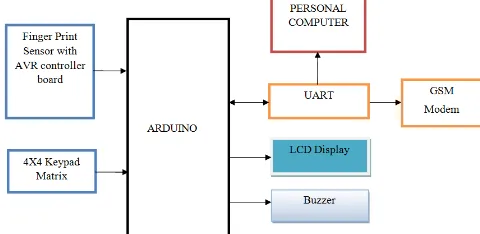
with their finger print over the scanner. Then the machines will direct the voter to place his/her fingers on a finger print scanner for authentication.
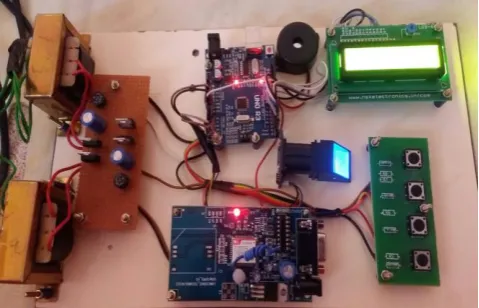
After that the machine will perform a checking between two templates of the finger print. One taken from the live scan and the other stored previously in the system database. If these two templates are matched then the voter will get an OTP through the GSM modem. After receiving the OTP they want enter the same OTP into the keypad. The amount of vote counting will be automatically updated in the LCD display.
If the voter enters the wrong OTP the buzzer will on and therefore the person is not allowed to poll his/her vote. Finally the thank u message will be displayed on the screen after that the machine will ready for the next use. As the result of this process one person cannot cast the vote of another person.
Figure 1. Block diagram of proposed system
The working of system explained in two modes:
1. Enrolling mode
2. Punching and identification mode
When power on, whole system is active. Micro controller ready to gate signal from fingerprint sensor.
Enrolling Mode
This mode is hidden part of system. By using Enrolling mode we store the few collection of finger print. In this mode, we enroll the finger print of user by sending appropriate command. When user put the finger print on finger print scanner, generate the Image file of finger. We know that user‟s finger print based on AADHAR CARD already saved in database of system. After completion of this step generate unique number of template file by combination of both Image file. This
unique number store in the EEPROM of finger print scanner.
Punching and Identification Mode
After enrolling all finger print successfully, the system is ready for vote cast. Now user punches his/her finger on fingerprint scanner. During this mode the fingerprint of the user is compared with the finger prints already enrolled in the memory which is embedded in micro controller.
The main two devices that we used in our project paper are:
1. AVR ATMEGA328:
The Arduino atmega 328device contains a non-volatile 64KB Flash program memory that is both parallel Programmable and serial Programmable. The device is a single-chip 28-pin Microcontroller manufactured in advanced CMOS process.
2. Finger Print:
The fingerprint identification module is used for verifying each and every person before allowing them to vote. This is the important module which is used for providing authentication to each and every user.
Unique Characteristics or Features of Fingerprints:
Each and every individual has a different or unique fingerprint. Even twins also share unique fingerprints. A fingerprint is made of a number of ridges and valleys on the surface of the finger. Ridges are the upper skin layer segments of the finger and valleys are the lower segments. The ridges form so-called minutiae points. Minutiae and patterns are very important in the analysis of fingerprints since no two fingers can have these things to be identical.
Finger Print Module
Figure 2. Fingerprint
Fingerprinting is a mean of hardware intellectual property protection (IP) focus on low design effort and less attention on the integration of IP. The authorship is detected through different data of fingerprints without continuous separation of IP owner‟s signature in the instant of fingerprinting. The fingerprinting challenges considerate IP voter marking and creditability of low
design overheads and transparency of flow
specifications.
This paper gives the pattern of fingerprint matching and its accuracy in identification procedures compared to other authentication processes. The fingerprinting is now a day‟s taken for all fingers in a hand for the sake of occupational workers who have a lot of works which are manual, prone to get injuries in hands (e.g. cuts and bruises).
Benefits and Applications of Fingerprint Biometric Systems:
Cheap
Small size
Low power
Non-intrusive Easy to use
IV.CONCLUSION
This paper “Biometric secured Electronic voting machine with embedded security” has been successfully designed and tested. As the normal EVM is the burning issue in recent days, this Electronic
voting system will be a solution for all those problems in the following ways
The voter‟s right is preserved. It is biometrically secured
The democracy of the nation is protected by using this safe and secured system
V.
RESULT ANALYSIS AND FUTURE SCOPE
In this project, a framework for electronic voting system based on fingerprint biometric is proposed and implemented with the Objective of eliminating bogus voting and vote repetition, less election expenditure, more transparency.
Electronic voting systems have many advantages over the traditional way of voting. Some of these advantages are lesser cost, faster tabulation of results, improved accessibility, greater accuracy, and lower risk of human and mechanical errors. It is very difficult to design ideal e-voting system which can allow security and privacy on the high level with no compromise. Future enhancements focused to design a system which can be easy to use and will provide security and privacy of votes on acceptable level by concentrating the authentication and processing section .In future face recognition can also included in the election process.
VI.
REFERENCES
[1] Ashok Kumar D., Ummal Sariba Begum T., "A Novel design of Electronic Voting System Using Fingerprint", International Journal of Innovative
Technology & Creative Engineering
[2] Finger print liveness detection based on quality measures, IEEE, 08 July 2009
[3] Prasad, H. K., Halderman, A. J., & Gonggrijp, R., "Security Analysis of India‟s Electronic Voting Machines," International Journal For Research In Emerging Science And Technology, Volume-2, Issue-3.E-Issn: 2349-7610, March-2015.
[4] Q. UIDAI."Role of Biometric Technology," AADHAR Authentication, (2012).
[5] Yinyeh, M. O., & Gbolagade, K. A., "Overview of Biometric Electronic Voting System," International Journal of Advanced Research in Computer Science and Software Engineering, (2013).
[6] Firas I, Haze, Seifedine Kadry, „Biometrics-Based Voting System Using Fingerprint: Design and Implementation‟, International Journal of Computer Applications in Engineering Sciences, VOL II, ISSUE IV, DECEMBER 2012.
[7] Mayuri U. Chavan, Priyanka V. Chavan, Supriya S. Bankar, „Online Voting System Powered by
Biometric Security using Cryptography
International Journal of Advance Research in Computer Science and Management Studies, Volume 1, Issue 7, December 2013.
[8] Khasawneh, M., Malkawi, M., & Al-Jarrah, O., "A Biometric-Secure e-Voting System for Election Process," Proceeding of the 5th International Symposium on Mechatronics and its Applications (ISMA08), (2008), Amman, Jordan.
[9] Prasad, H. K., Halderman, A. J., & Gonggrijp, R., "Security Analysis of India‟s Electronic Voting Machines," International Journal For Research In Emerging Science And Technology, Volume-2, Issue-3, E-Issn: 2349-7610, March-2015.