CSEIT17221 | Received: 05 March 2017 | Accepted: 15 March 2017 | March-April-2017 [(2)2: 56-61]
International Journal of Scientific Research in Computer Science, Engineering and Information Technology © 2017 IJSRCSEIT | Volume 2 | Issue 2 | ISSN : 2456-3307
56
Privacy Protected Keyword Search Method in Cloud Data
N. S. Akhil Krishnan
1, A. Sundersingh
2¹PG Scholar, Department of M.Sc(Software Engineering), PSN College of Engineering & Technology, Tirunelveli,Tamilnadu, India ² Research Supervisor, Department of M.Sc(Software Engineering), PSN College of Engineering & Technology, Tirunelveli,Tamilnadu, India
ABSTRACT
Cloud data owners prefer to outsource documents in an encrypted form for privacy preserving. Therefore, it is essential to develop efficient and reliable cipher text search techniques. In this paper, a hierarchical clustering method is proposed to support more semantistics and meet the command for fast cipher text search with in a big data environment. The proposed hierarchical approach clusters the documents based on the minimum relevance threshold. The results show that with a sharp increase of documents in the data set. The search time of the proposed method increases exponentially. Furthermore, the proposed method has advantage over the traditional method in the rank privacy and relevance of retrieved documents.
Keywords : PrefDB, data, SQL, Query Parser, Tuples.
I.
INTRODUCTION
PrefDB, a preference-aware relational system that transparently and efficiently handles queries with preferences. In its core, PrefDB employs a preference-aware data model and algebra, where preferences are treated as first-class citizens. We define a reference using a condition on the tuples affected, a scoring function that scores these tuples, and a confidence that shows how confident these scores are. In our data model, tuples carry scores with confidences. Our algebra comprises the standard relational operators extended to handle scores and confidences. For example, the join operator will join two tuples and compute a new score-confidence pair by combining the scores and confidences that come with the two tuples. In addition, our algebra
contains a new operator, prefer, that evaluates a preference on a relation, i.e., given as inputs a relation and a preference on this relation, prefer outputs the relation with new scores and confidences. During preference evaluation, both the conditional and the scoring part of a preference are used. The conditional part acts as ‘soft’ constraint that determines which tuples are scored without disqualifying any tuples from the query result. In this way, PrefDB separates
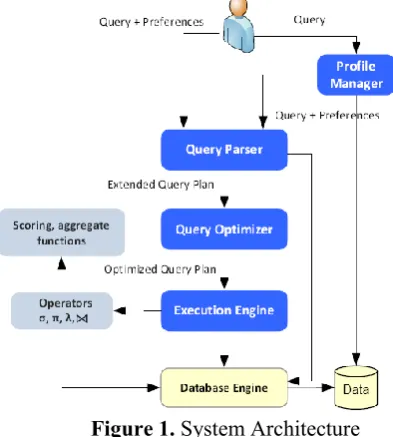
not be feasible or practical in real life. Overall, both preference and extended relational data and query models that we presented earlier. Section 2 provides an overview of its functionality and architecture and also describes the implementation of p-relations and the operators. Query processing in PrefDB Figure 2 depicts the system’s architecture. Modules depicted in yellow are provided by the native DBMS, whereas the blue-colored ones are those developed for PrefDB. As shown, PrefDB offers two alternative query options: preferences can be provided along with the input query or the system can enrich a non-preferential query with related preferences. In the first query option, preferences are specified in a declarative way, additionally to the standard SQL query part. In the second case, relevant preferences are provided by the profile manager module, which accesses user preferences stored in the database. Stored preferences can be collected from user ratings or by analyzing past queries or clickthrough data [7]. Since preference collection is orthogonal to query processing, which is the primary goal of PrefDB, in our implementation, we simply store preferences specified by users through a visual tool we have developed [7] as well as preferences specified in past Query Parser Query + Preferences Query Optimizer Extended Query Plan SQL Execution Engine Database Engine Scoring, aggregate functions Data Operators σ, π, λ, Optimized Query Plan Profile manager Query + Preferences user queries. For both query options, the query and the preferences are given as input to the query parser. Apart from the core PrefDB query processing strategies that blend preference evaluation into query processing, we have also implemented a set of plug-in methods, which are described in the Appendix. Below is an overview of the core PrefDB modules.
Figure 1. System Architecture
• The profile manager selects from the database preferences that can be combined with the conditions of the issued query. For this purpose, we use the preference selection algorithm proposed in [20]
• The query parser takes as input the query and preferences and generates an extended query plan that is passed to the PrefDB query optimizer. • The query optimizer improves the input plan by
applying a set of algebraic rules. This improved plan and a cost model for preference evaluation are used for generating alternative plans that interleave preference evaluation and query processing in different ways and for picking the plan with the cheapest estimated cost.
• The execution engine realizes the execution of the query plan selected by the query optimizer using one of our execution methods.
III.
RELATED WORK
specified based on any combination of scores, confidences and context. Our framework allows us to process in a uniform way all these different query and preference types. In terms of preference integration and processing, one approach is to translate preferences into conventional queries and execute them over the DBMS [14], [19], [20], [21], [24]. Several efficient algorithms have been proposed for processing different types of queries, including top-k queries [13] and skylines [9]. These algorithms as well as query translation methods are typically implemented outside the DBMS. Thus, they can only apply coarse grained query optimizations, such as reducing the number of queries sent to the DBMS. Further, as we will also demonstrate experimentally plug-in methods do not scale well when faced with multi-join queries or queries involving many preferences. Native implementations modify the database engine by adding specific physical operators and algorithms. RankSQL [23] extends the relational algebra with a new operator called rank that enables pipelining and hence optimizing top-k queries. Another example of operator is the winnow operator [10], which selects all tuples corresponding to the Pareto optimal set. Our approach is different from existing works in several ways. First, existing techniques are limited to a particular type of query. In contrast to these approaches, we consider preference evaluation (how preferences are evaluated on data) and selection of the preferred tuples that will comprise the query answer as two operations. We focus on preference evaluation as a single operator that can be combined with other operators and we use its algebraic properties in order to develop generic query optimization and processing techniques. Finally, we follow a hybrid implementation that is closer to the database than plug-in approaches yet not purely native, thus combining the pros of both worlds. A different approach to flexible processing of queries with preferences is enabled in FlexPref [22]. FlexPref allows integrating different preference algorithms into the database with minimal changes in the database engine by simply defining rules that determine the most preferred tuples. Once these rules are specified a new operator can be used inside queries. It is worth noting that both FlexPref and our work are motivated by the limitations of plug-in and native approaches. FlexPref approaches the problem from an extensibility viewpoint. Our focus is on the problem of preference evaluation as an operator that is separate from the selection of preferred answers, and we study how this
operator can be integrated into query processing in an effective yet not obtrusive to the database engine way.
IV.
PROPOSED METHODOLOGY
In this paper, we first construct an extended query plan that contains all operators that comprise a query and we optimize it. Then, for processing the optimized query plan, our general strategy is to blend query execution with preference evaluation and leverage the native query engine to process parts of the query that do not involve a prefer operator. Given a query with preferences, the goal of query optimization is to minimize the cost related with preference evaluation. Based on the algebraic properties of prefer, we apply a set of heuristic rules aiming to minimize the number of tuples that are given as input to the prefer operators. We further provide a cost-based query optimization approach. Using the output plan of the first step as a skeleton and a cost model for preference evaluation, the query optimizer calculates the costs of alternative plans that interleave preference evaluation and query processing in different ways. Two plan enumeration methods, i.e., a dynamic programming and a greedy algorithm are proposed. For executing an optimized query plan with preferences, we describe an improved version of our processing algorithm (GBU) (an earlier version is described in. The improved algorithm uses the native query engine in a more efficient way by better grouping operators together and by reducing the out-of-the-engine query processing.
Modules:
Registration & Interest Sum up Query Formation
Query Optimization & Execution
operators, such that these attributes will be projected as well.
Proportional to the number of tuples flowing through the operators in the query plan. Assuming a fixed position for the other operators, the goal of our query optimizer is essentially to place the prefer operators inside the plan, such that the number of tuples flowing through the score tables is minimized. The execution engine of PrefDB is responsible for processing a preferential query and supports various algorithms.
V.
EXPERIMENTAL RESULTS
The implementation results can be shown as figure below
VI.
CONCLUSIONS
In this project, we investigated an Efficient, Personalized Movie Recommendations by query optimization giving first class importance to user’s preferences. Existing a technique uses multiple sorting
and filtering operations on result set which is heavy weighted and time consuming. Query Reformulation is used to modifying the Object Oriented Query with Users Current Preference, which is extracted previously from user’s session information with some special operators. Here as soon as the Object Oriented query is injected in the execution engine so no need to perform Filtering and sorting operations. As a Separate Session will be maintained for each individual user for maintaining the profile, our system gives account level security.
VII.
REFERENCES
[1]. DBLP computer science bibliography. http://dblp.uni-trier.de/.
[2]. IMDB movie database. http://www.imdb.com. [3]. Query templates. http://tinyurl.com/8zs3e77. [4]. G. Adomavicius and A. Tuzhilin. Toward the
next generation of recommender systems: A survey of the state-of-the-art and possible extensions. TKDE, 17(6):734–749, 2005.
[5]. R. Agrawal, R. Rantzau, and E. Terzi. Context-sensitive ranking. In SIGMOD, pages 383–394, 2006.
[6]. R. Agrawal and E. L. Wimmers. A framework for expressing and combining preferences. In SIGMOD, pages 297–306, 2000.
[7]. A. Arvanitis and G. Koutrika. PrefDB: Bringing preferences closer to the DBMS. In SIGMOD, pages 665–668, 2012.
[8]. A. Arvanitis and G. Koutrika. Towards preference-aware relational databases. In ICDE, pages 426–437, 2012.
[9]. S. Borzs ¨ onyi, D. Kossmann, and K. Stocker. The skyline operator. ¨ In ICDE, pages 421–430, 2001.
[10]. J. Chomicki. Preference formulas in relational queries. TODS, 28(4):427–466, 2003.
[11]. V. Christophides, D. Plexousakis, M. Scholl, and S. Tourtounis. On labeling schemes for the semantic web. In WWW, pages 544–555, 2003. [12]. W. W. Cohen, R. E. Schapire, and Y. Singer.
Learning to order things. J. Artif. Intell. Res. (JAIR), 10:243–270, 1999.
[13]. R. Fagin, A. Lotem, and M. Naor. Optimal aggregation algorithms for middleware. In PODS, pages 102–113, 2001.
Efficient rewriting algorithms for preference queries. In ICDE, pages 1101–1110, 2008. [15]. S. Holland, M. Ester, and W. Kießling.
Preference mining: A novel approach on mining user preferences for personalized applications. In PKDD, pages 204–216, 2003.
[16]. I. F. Ilyas, W. G. Aref, and A. K. Elmagarmid. Supporting top-k join queries in relational databases. In VLDB, pages 754–765, 2003. [17]. T. Joachims. Optimizing search engines using
clickthrough data. In KDD, pages 133–142, 2002.
[18]. W. Kießling. Foundations of preferences in database systems. In VLDB, pages 311–322, 2002.
[19]. W. Kießling and G. Kostler. Preference SQL - design, implementation, experiences. In VLDB, pages 990–1001, 2002.
[20]. G. Koutrika and Y. E. Ioannidis. Personalization of queries in database systems. In ICDE, pages 597–608, 2004.
[21]. M. Lacroix and P. Lavency. Preferences: Putting more knowledge into queries. In VLDB, pages 217–225, 1987.
[22]. J. Levandoski, M. Mokbel, and M. Khalefa. FlexPref: A framework for extensible preference evaluation in database systems. In ICDE, pages 828–839, 2010.
[23]. C. Li, K. C.-C. Chang, I. F. Ilyas, and S. Song. RankSQL: Query algebra and optimization for relational top-k queries. In SIGMOD, pages 131– 142, 2005.
[24]. C. Mishra and N. Koudas. Stretch 'n' shrink: Resizing queries to user preferences. In SIGMOD, pages 1227–1230, 2008.
[25]. P. G. Selinger, M. M. Astrahan, D. D. Chamberlin, R. A. Lorie, and T. G. Price. Access path selection in a relational database management system. In SIGMOD, pages 23–34, 1979.