Research Article
GC - MS ANALYSIS OF LEAF AND STEM BARK OF CLEIDION NITIDUM (MUELL. – ARG.) THW.
EX KURZ. (EUPHORBIACEAE)
1P.G& Research Department of Botany, South Travancore Hindu College, Nagercoil-629002, Kanyakumari Dist, TN, India, 2Department of
Plant Biology and Plant Biotechnology, Arignar Anna College, Aralvoimozhi – 629 301, 3Department of Botany, The Madura College
(Autonomous), Madurai – 625 011, 4Ethnopharmacology Unit, Research Department of Botany, V.O.Chidambaram College, Tuticorin -
629008 TN, India. Email: [email protected]
Received: 25 November 2013, Revised and Accepted: 5 January 2014
ABSTRACT
Objective: GC-MS (Gas chromatography and mass spectroscopy) analysis of ethanol extracts of leaf and stem bark of Cleidion nitidum was carried
out to detect the bioactive components.
Methods: The chemical compositions of the ethanolic extract of leaves and bark of Cleidion nitidum were investigated using Perkin – Elmer Gas
Chromatography – Mass Spectra while mass spectra of the compounds found in the extract was matched with the National Institute of Standards of Technology (NIST) library.
Results: Gas chromatography mass spectra (GC-MS) analysis revealed the presence of 16 compounds from leaves and 5 compounds from bark of the Cledion nitidum were identified. In GC-MS analysis , some of the phytocomponents screened were squalene, 3, 7, 11, 15-Tetramethyl-2, hexadecen-1-ol , Phytol and Vitamin E in leaves whereas, Thiophene-3-carbonitrite tetrahydro-4-oxo-, Dimethyl-2,6,10-dodecatrien-1-ol , D-Mannotetradecane-1,2,3,4,5-pentaol and Octanal 7-methoxy-3-7-dimethyl (5.13%) major compounds in the bark extract.
Conclusion: These results indicate the ethanol extract of leaf and stem bark of Cleidion nitidum possesses potent anti-tumor, anticancer, cancer preventive, anti-inflammatory, antioxidant, antibacterial and pesticide effects so that it can be recommended as a plant of phytopharmaceutical importance.
Keywords:Cleidion nitidum, GC-MS, Squalene, Phytol, vitamin-E and various applications
INTRODUCTION
Higher plants are sources of bioactive compounds to play a crucial role in the maintenance of human health since time immemorial. Reports available on green plants represent a reservoir of effective chemotherapeutants; these are non-phytotoxic, more systemic and easily biodegradable[1-4].
Cleidion nitidum (Muell. – Arg.) Thw. ex Kurz. belongs to Euphorbiaceae family. This genus comprises about 33 species, which are pantropical in Asia and the South West Pacific[5]. The taxa are
speciflorum Merr. are used as medicine traditionally in Thailand and Philiphines. Several parts of the above two plant species have been employed as analgesic, antipyretic and diaphoretic[9]. Decoction of its leaves is reputed to cause abortion; where as a decoction of the bark is used for treatment of stomachic. Its seeds are used for treatment of constipation[10]. GC-MS analysis of phytochemical compounds present in the various medicinal plants was made by various workers[11-14]. Isolation and structure determination of two flavone glycosides, a phenylpropanoid glycoside, D– glucopyranoside, a linear diterpene, trans–phytol and a lanostane
triterpene from leaves of C. spiciflorum was already reported[15].
The chemical composition and the biological activities of the
750m (msl) Kanyakumari wildlife sanctuary, Kanyakumari District, Tamilnadu. The plant materials were taxonomically identified and authenticated by the Sri Ganesan Herbarium (SGH), Madura College Herbarium, Madurai (Ac. No. 1583). Voucher specimen (No. BPN & SSS 2674) was deposited in the STHC herbarium, Dept of Botany, South Travancore Hindu College, Nagercoil, Kanyakumari District, Tamilnadu, India.
Preparation of extract
The leaf and stem bark were shade dried and pulverized to powder in a mechanical grinder. Required quantity of powder was weighed and transferred to stoppered flask and treated with ethanol until the powder is fully immersed. The flask was shaken every hour for the first 6 hours and then it was kept aside and again shaken after 24 hours. This process was repeated for 3 days and then the extract was filtered. The extract was collected and evaporated to dryness by using a vacuum distillation unit. The final residue thus obtained was then subjected to GC-MS analysis.
Gas Chromatography –Mass Spectroscopy Analysis
GC-MS analysis of the extract was performed using a Perkin – Elmer GC Clarus 500 system and Gas Chromatograph interfaced to a mass spectrometer (GC-MS) equipped with a Elite-1, fused silica capillary
column (30 mm x 0.25 mm 1DX 1 Mdf, composed of 100%
system with ionizing energy of 70 eV was used. Helium gas (99.999%) was used as the carrier gas at constant flow rate 1ml/ min and an injection volume of 2 l was employed (Split ratio of
10:1); injector temperature 250oC; Ion – source temperature 280oC.
The oven temperature was programmed from 110oC (isothermal for
2 min.), with an increase of 10oC/ min, to 200oC, then 5oC / min to
280oC, ending with a 9 min isothermal at 280oC. Mass spectra were
taken at 70 eV; a scan interval of 0.5 seconds and fragments from 45 to 450 Da. Total GC running time was 36 minutes. The relative % amount of each component was calculated by comparing its average peak area, to the total areas, software adopted to handle mass spectra and chromatograms was a Turbomass.
Interpretation on mass spectrum GC-MS was conducted using the database of National Institute of Standard and Technology (NIST) having more than 62,000 patterns. The spectrum of the unknown component was compared with the spectrum of the known components stored in the NIST library. The name, molecular weight and structure of the components of the test materials were ascertained. For the identification of biological potential of the analyzed compounds were checked the Dr. Dukes library and
enumerated the biological properties of the known compounds[17].
RESULTS AND DISCUSSIONS
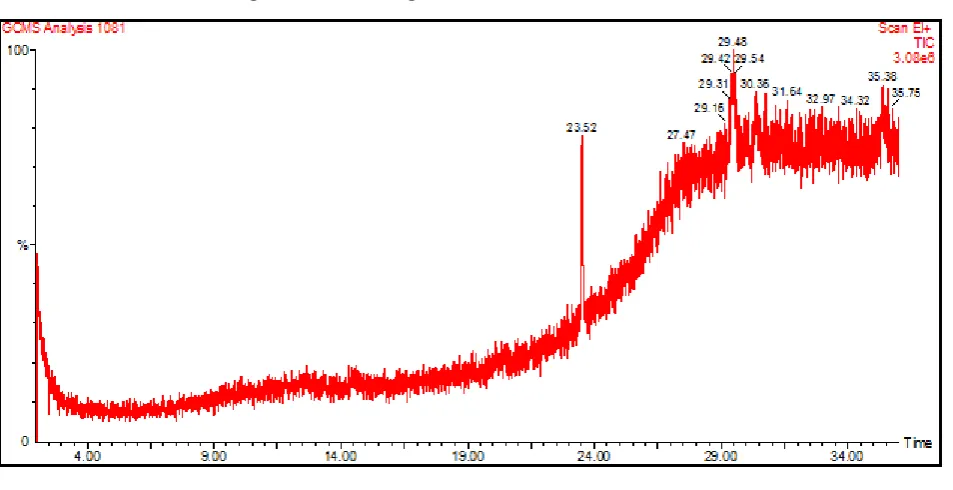
The components present in the ethanol extracts of leaves and barks of C. nitidum were identified by GC-MS analysis (Figures 1 and 2).
Fig. 1: GC-MS chromatogram of ethanolic extract of leaves of C. nitidum
Fig. 2: GC-MS chromatogram of ethanolic extract of bark of C. nitidum
The active principles with their retention time (RT), Molecular formula, Molecular weight (MW) and concentration (%), compound nature and
Table 1: Phytocomponents identified in the ethanolic leaf extract of C. nitidum by GC – MS
No. RT Name Mol.
Formula MW
Peak Area %
Structure
1 2.03 1,3-Propanediol,
2-nitro-2-[(nitrooxy)methyl]-, dinitrate (ester) C4H6N4O11 286 6.42
2 11.05 3,7,11,15-Tetramethyl-2-hexadecen-1-ol C20H40O 296 17.52
3 11.31 7-Octen-1-ol, 3,7-dimethyl-, (S)-[
.alpha.-Citronellol] C10H20O 156 4.86
4 11.51 Dodeca-1,6-dien-12-ol, 6,10-dimethyl- C14H26O 210 5.50
5 13.07 Cyclopentaneundecanoic acid C16H30O2 254 0.78
6 13.31 2-Trifluoroacetoxydodecane C14H25F3O2 282 0.69
7 14.24 Phytol C20H40O 296 15.61
8 15.06
1,6,10-Dodecatrien-3-ol, 3,7,11-trimethyl-, [S-(Z)]-
[D-nerolidol]
C15H26O 222 5.51
9 23.49 Squalene C30H50 410 17.68
10 26.55
Table 2: Phytocomponents identified in the ethanolic extract of the stem bark of C. nitidum by GC - MS
No. RT Name Mol. Formula MW Peak Area % Structure
1 2.04 Thiophene-3-carbonitrile, tetrahydro-4-oxo- C5H5NOS 127 51.12
2 23.52 6,11-Dimethyl-2,6,10-dodecatrien-1-ol C14H24O 208 21.43
3 29.48 D-Mannotetradecane-1,2,3,4,5-pentaol C14H30O5 278 20.31
4 30.36 Isopropyl
5,11-dihydroxy-3,7,11-trimethyl-2-dodecenoate C18H34O4 314 2.01
5 35.38 Octanal, 7-methoxy-3,7-dimethyl- C11H22O2 186 5.13
11 27.21 Isopropyl
5,11-dihydroxy-3,7,11-trimethyl-2-dodecenoate C18H34O4 314 2.18
12 27.71 Vitamin E C29H50O2 430 7.88
13 29.55 Spiro[androst-5-ene-17,1'-cyclobutan]-2'-one,
3-hydroxy-, (3á,17á)- C22H32O2 328 2.84
14 31.23
7,9-Dimethyl-8-nitrobicyclo[4.3.1]decan-10-one C12H19NO3 225 5.17
15 31.83 5à-Androstan-16-one, cyclic ethylene
mercaptole C21H34S2 350 3.22
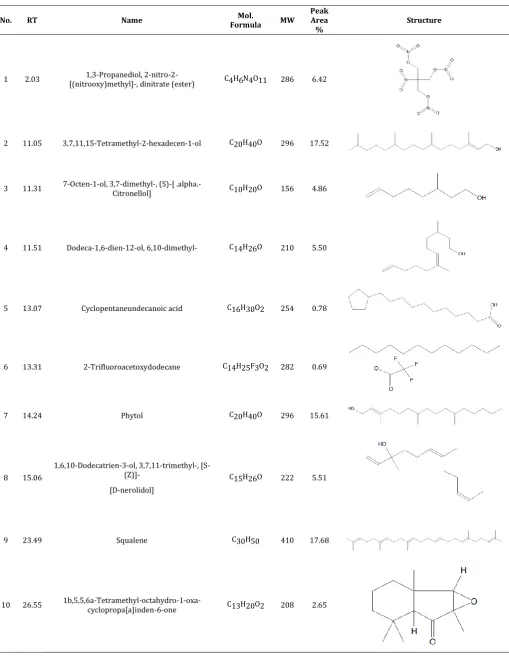
Sixteen compounds were identified in ethanolic extracts of leaves of C. nitidum.The results showed the presence of 1,3-Propanediol,
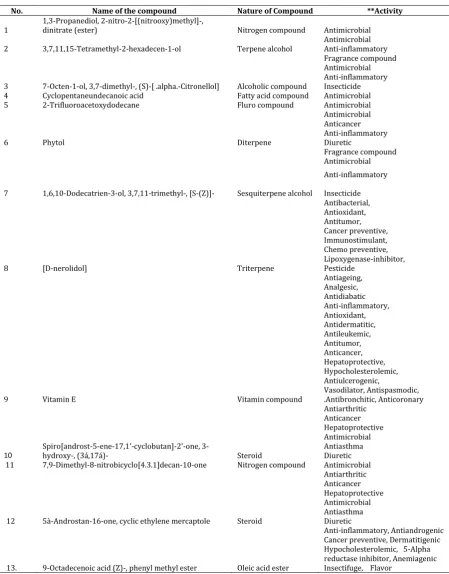
2-nitro-2-[(nitrooxy)methyl]-, dinitrate (ester) 6.42(%), 3,7,11,15-Tetramethyl-2-hexadecen-1-ol1(17.52%),7-Octen-1-ol, 3,7-dimethyl-, (S)-(4.86%), Dodeca-1,6-dien-12-ol, 6,10-dimethyl-(5.50%), Cyclopentaneundecanoic acid (0.78%), 2-Trifluoroacetoxydodecane (0.69%), Phytol (15.61%), 1,6,10-Dodecatrien-3-ol, 3,7,11-trimethyl-, [S-(Z)]- (5.51%), Squalene (17.68%), 1b, 5, 5, 6a-Tetramethyl-octahydro-1-oxa-cyclopropa[a]inden-6-one (2.65%), Isopropyl 5,11-dihydroxy-3,7,11-trimethyl-2-dodecenoate (2.18%), Vitamin E (7.88%), Spiro[androst-5-ene-17,1'-cyclobutan]-2'-one, 3-hydroxy-, (3á,17á)- (2.84%), 7,9-Dimethyl-8-nitrobicyclo[4.3.1]decan-10-one (5.17%), 5à-Androstan-16-one, cyclic ethylene mercaptole (3.22%) and 9-Octadecenoic acid (Z)-, phenylmethyl ester (1.47%) are the major compounds available in the leaf of the C. nitidum (Table-1). The major phyto components and its biological activities obtained through the GC-MS study of leaves of C.nitidum was provided in table 3.
Table 3: Activity of phytocomponents identified in the ethanolic extracts of leaf of C. nitidum
No. Name of the compound Nature of Compound **Activity
1
1,3-Propanediol, 2-nitro-2-[(nitrooxy)methyl]-,
dinitrate (ester) Nitrogen compound Antimicrobial
2 3,7,11,15-Tetramethyl-2-hexadecen-1-ol Terpene alcohol
Antimicrobial Anti-inflammatory
3 7-Octen-1-ol, 3,7-dimethyl-, (S)-[ .alpha.-Citronellol] Alcoholic compound
Fragrance compound Antimicrobial Anti-inflammatory Insecticide
4 Cyclopentaneundecanoic acid Fatty acid compound Antimicrobial
5 2-Trifluoroacetoxydodecane Fluro compound Antimicrobial
6 Phytol Diterpene
Antimicrobial Anticancer Anti-inflammatory Diuretic
7 Sesquiterpene alcohol
Fragrance compound Antimicrobial
Anti-inflammatory
1,6,10-Dodecatrien-3-ol, 3,7,11-trimethyl-, [S-(Z)]- Insecticide
8 [D-nerolidol] Triterpene
Antibacterial, 11 7,9-Dimethyl-8-nitrobicyclo[4.3.1]decan-10-one Nitrogen compound Antimicrobial
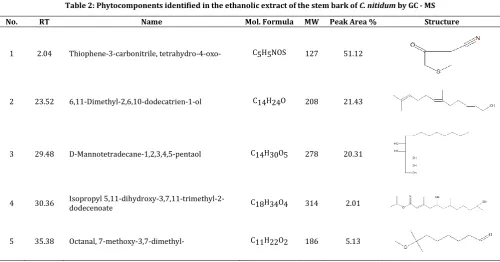
Five compounds were identified from the ethanolic extract of stem bark of C. nitidum. The results revealed Thiophene – 3 – carbonitrile, tetrahydro – 4- oxo – (51.12%), 6, 11 – Dimethyl – 2, 6, 10 – dodecatrien – 1 – ol (21.43%), D – Mannotetradecane – 1, 2, 3, 4, 5 – pentaol (20.31%), Isopropyl 5, 11 – dihydroxy – 3, 7, 11 – trimethyl – 2 – dodecenoate (2.01%) and Octanal, 7 – methoxy – 3, 7 – dimethyl – (5.13%) were found as the major
components in the ethanolic extracts of bark of C. nitidum (Table-2). Major phyto compounds and its biological activities obtained through GC-MS
study of bark of C. nitidum has been tabulated (Table 4)
Table 4: Activity of phyto components identified in the ethanolic extracts of bark of C. nitidum
No. Name of the compound Nature of Compound **Activity
1. Thiophene-3-carbonitrile, tetrahydro-4-oxo- Sulfur compound Antimicrobial
2. 6,11-Dimethyl-2,6,10-dodecatrien-1-ol Alcoholic compound Antimicrobial
3. D-Mannotetradecane-1,2,3,4,5-pentaol Alcoholic compound Antimicrobial
4. Octanal, 7-methoxy-3,7-dimethyl- Aldehyde compound Antimicrobial
Anti-inflammatory
**Activity Source: Dr Duke’s Phytochemical and Ethnobotanical databases
The GC-MS analysis of C. nitidum leaves revealed the presence of 16
compounds. The identified compounds possess many biological properties. Among the identified phytochemicals, Squalene has the property of antioxidant activity [18,19] and chemopreventive activity against colon carcinogensis [20,21]. Squalene has been
reported in Canthium parviflorum and its anticancer activity was
mentioned [22].
Phytol is one among the 16 compounds from the leaves of C. nitidum.
Presence of Phytol in the leaves of Kirganelia reticulata aerial parts,
which was also found to be effective in different stages of arthritis [19]. It was found to give good as well as preventive and therapeutic results against arthritis. The results show that reactive oxygen species promoting substances such as Phytol constitute a promising novel class of pharmaceuticals for the treatment of rheumatoid arthritis and possibly other chronic inflammatory diseases [23]. Phytol is a key acyclic diterpene alcohol that is a precursor for vitamin E and K1[24]. It is used along with simple sugar on corn syrup as a hardener in candies [25].
In the present study 16 and 5 phyto-components have been
identified from ethanol extract of leaves and stem bark of C. nitidum
respectively by Gas Chromatography and Mass Spectrometry analysis. Thus this type of GC-MS analysis is the first step towards understanding the nature of active principles in the medicinal plants and this type of study will be helpful for further detailed study. However, isolation of individual phytochemical constituent and subjecting it to biological activity will definitely give fruitful results.
It could be concluded that, C. nitidum contains various bioactive
compounds. So it is recommended as plant of pharmaceutical importance. However, further studies are needed to undertake its bioactivity and toxicity profile.
CONCLUSIONS
The result of the present investigation reveals that the ethanol extract of leaves and stem bark of C. nitidum possessed significant
anti-inflammatory, anticancer, antioxidant, antitumor,
immunostimulant and antimicrobial properties. The GC-MS analysis
of the ethanol extract of C. nitidum reveals the presence of
phytoconstituents belonging to the type acids, esters, alcohols,
ethers, etc. Thus, the medicinal plant C. nitidum is found to possess
significant phytoconstituents such as Squalene, Phytol, Vitamin E and Octanol, 7 – methoxy – 3, 7 – dimethyl etc. The presence of such a variety of phytochemicals may be attributed to the medicinal characteristics of this plant C. nitidum.
ACKNOWLEDGEMENT
We would like to thank Mr. S. Kumaravel, Senior Scientist, Indian Institute of Crop Processing Technology (Ministry of Food Processing Industries, Government of India). Tanjavore, Tamilnadu for providing all the facilities and support to carry out the work.
REFERENCES
1. Vyas GD. Soil Fertility Deterioration in crop land due to
pesticide. J Indian Bot Soc 1999; 78: 177-178.
2. Kaushik JC, Sanjay A, Tripathi NN, Arya S. Antifungal
fungi of forest nurseries. Indian J Forestry2002; 25:
359-361.
3. Chaman Lal Verma LR. Use of certain bio-products for
insect-pest control. Indian J Traditional Knowledge 2006; 5(1): 79-82.
4. Padmavathy S, Dhanya NN, Shanthi T. GC-MS analysis of
bioactive components in Gaultheria fragratissima Wall. Asian
J Pharm Clin Res 2014; 7: 83-85.
5. Kulju, Kristo KM, Van Welzen PC. Revision of the genus
Cleidion (Euphorbiaceae) in Malesia Blumea-Biodiversity, Evolution and Biogeography of Plants 2005; 50: 197-219.
6. Balakrishnan NP, Chakrabarty T. The family Euphorbiaceae
in India. Editor Bishen Singh Mahendra Pal Singh, Dehra Dun; 2007.
7. Kottaimuthu R. Cleidion nitidum (Muell.-Arg.) Thw. ex Kurz.
(Euphorbiaceae): A new record for peninsular India. Life
Sciences Leaflets2012; 4: 31-35.
8. Karuppusamy S, Sivakamasundari S, Parthipan B. Extended
distribution of Cleidion nitidum (Muell-Arg.) Thw. ex Kurz.
(Euphorbiaceae) in Southern Western Ghats Tamilnadu. J Econom Taxon Bot 2013; 37(1): 113-115.
9. Boonyaprapatsorn N, Chokchaichareunporn A, Local
Medicinal Plants (2) Bangokok1996; P. 28.
10. Perry LM. Medicinal plants of East and Southeast Asia. MIT
Press. London. 1980; p. 139-140.
11. Elizabeth T, Aneesh TP, Della GT, Anandan R. GC-MS analysis
of phytochemical compounds present in the rhizomes of
Nervilia aragoana Gaud. Asian J Pharm Clinical Res 2013; 6(3):68-74.
12. Akhilesh U, Anusha B. Characterization and medicinal
importance of phytoconstiuents of Carica papaya from down
south Indian region using gas chromatography and mass spectroscopy Asian J Pharm Clinical Res 2013; 6(4): 101-106.
13. Padmavathy S, Nair DN, Shanthi T. GC-MS analysis of
bioactive components in Gaultheria Fragratissima Wall.
Asian J Pharm Clinical Res 2014; 7(1): 83-85.
14. Mahadkar S, Valvi S, Jadhav V. Gas chromatography mass
spectroscopic (GCMS) analysis of some bioactive compounds forms five medicinally relevant wild edible plants. Asian J Pharm Clin Res 2013; 6: 136-139.
15. Menkham S, Suttisri R. Chemical constituents of Cleidion
spiciflorum Leaves. Thai J Pharm Sci 2003; 27(1-2): 33-39.
16. Sanseera D, Niwatananun W, Liawruangrath B,
Liawruangrath S, Baramee A, Pyne SG. Chemical composition and biological activities of the essential oil from leaves of Med Toxicol 2009; 3: 159-160.
19. Sudha T, Chidambaram Pillai S, Mohan VR. GC-MS Analysis of
bioactive components of leaf and stem bark of Kirganelia
20. Roa CV, Newmark HL, Reddy BS. Chemopreventive effect of squalene on colon cancer. Carcinogensis, 1998; 19(2): 287-290.
21. Alagammal M, Tresina PS, Mohan VR. GC-MS Determination
of bioactive components of Polygala javana Dc. Int. J.
Current Pharm Res 2012; 4(2): 42-44.
22. Purushoth Prabhu T, Panneerselvam P, Suresh R. Clement
Atlee W and Balasubramanian S GC-MS analysis of
ethanolic extract of Canthium parviflorum Lamk leaf. J.
Applied Pharm Sci, 2013; (2): 166-168.
23. Ogunlesi, M, Okiei W, Ofor E, Osibote AE. Analysis of the
essential oil from the dried leaves of Euphorbia hirta L.
(Euphorbiaceae), a potential medication for athma. Afric J Biotech 2009; 8: 7042-7050.
24. Sathyaprabha G, Kumaravel S, Ruffina D, Praveen Kumar P. A
comparative study on antioxidant, proximate analysis,
antimicrobial acivity and phytochemical analysis of Aloe vera
and Cissus quadrangularis by GC-MS. J Pharm Res2010; 3(12): 2970-2973.
25. Sermakkani, M, Thangapandian V. GC-MS analysis of Cassia