PHYSICOCHEMICAL EVALUATION AND TABLET FORMULATION PROPERTIES
OF SHEA TREE GUM
SAMUEL LUGRIE KIPO
1*, ESTHER ESHUN OPPONG
1,2, KWABENA OFORI-KWAKYE
11Department of Pharmaceutics, Faculty of Pharmacy and Pharmaceutical Sciences, College of Health Sciences, Kwame Nkrumah University of Science and Technology, Kumasi, Ghana. 2Department of Pharmaceutical Science, School of Applied Sciences, Central
University College, Miotso, Ghana. Email: [email protected] Received: 10 June 14, Revised and Accepted: 27 July 14 ABSTRACT
Objective: This study focused on evaluating the physicochemical and tablet formulation properties of shea tree (Vitellaria paradoxa) gum, using paracetamol as a model drug.
Methods: Crude shea gum was purified and the physicochemical properties, namely: Moisture content, insoluble matter, solubility, swelling capacity, viscosity, hydration capacity, flow properties, and metallic ion content evaluated. The binding properties of shea gum (5-20% w/v) were investigated, using acacia gum as a standard binder. The physical properties, in vitro dissolution and dissolution efficiency (DE) of the tablets, were determined. The dissolution data were statistically evaluated using the T-test and the similarity factor (f2).
Results: The physicochemical properties of the gum evaluated were found to be satisfactory and within official specifications. Atomic absorption spectrophotometric analysis of the gums showed that the crude gum had higher metallic ion content than the purified gum. The gum purification process caused a substantial reduction (17-74%) in the mineral ion content of shea gum. Granules prepared with shea gum exhibited good flow properties evidenced by their optimal Hausner ratio, angle of repose and Carr’s index values. The granule flow properties, as well as the physical properties of shea gum tablets, were similar to that prepared with acacia gum. The DE of both shea gum and acacia gum tablets decreased with increase in binder concentration. Comparative studies on the tablets using DE, T-test and similarity factor (f2), showed that the binding effect of shea gum was comparable to that of acacia gum (p>0.05; f2 ≥50) at the same concentration.
Conclusion: Shea tree gum has potential as a binder in pharmaceutical tablet formulations.
Keywords:Vitellaria paradoxa, Viscosity, Wet granulation, Tablet binder, Dissolution efficiency, Similarity factor
INTRODUCTION
Gums are translucent amorphous substances and polymers of a monosaccharide or mixed monosaccharides. Gums being hydrocolloids contain hydrophilic molecules that can combine with water to form viscous solutions or gels [1]. Gums can be neutral (xanthan, guar, etc.), anionic (tragacanth, karaya, etc.) or cationic (chitosan) [2,3]. It is the structure, type and number of monosaccharides and their configuration, number and location of the linked groups that gives each gum its peculiar physicochemical characteristics. The chemical nature of a gum dictates the type of gel or texture formed [4]. The degree of polymerization influences a gum’s viscosity and hydration rate. Longer molecules tend to produce higher viscosities and take longer to hydrate than shorter ones. A highly branched molecule takes up less space than a straight one with the same molecular weight and therefore provides less viscosity [5-7].
Natural products like gums used as excipients have advantages of being biodegradable, biocompatible, nontoxic, and cheaper [2,8]. Natural gums from plant origin have diverse application in drug formulation and delivery as binders, suspending agents, disintegrating agents, emulsifiers, gelling agents, thickening agents and many others depending on their exhibited properties [1]. Gums have been found useful in producing tablets of different mechanical strength and drug release properties for different pharmaceutical purposes. As a result of the versatile applications of gums, gums that have benefited from little or no scientific research are being studied and developed for various pharmaceutical uses.
The shea tree (Vitellaria paradoxa) family Sapotacea is a small to medium-sized tree. The plant is readily available in Ghana, with the
densest strands in the Northern, Upper East and Upper West regions, and a sparse cover in Brong-Ahafo, Ashanti, Eastern and Volta regions in the south of the country [9,10]. The shea tree is generally found extensively over the African continent [11]. The tree grows in the wild and is usually devastated by annual bush-fire leading to stunted growth. The stem of the shea tree has deep fissures some of which are usually covered with gums. Gums can also be found in areas of injury on the stem as well as on broken twigs or petioles. The gum when freshly oozes out, is a whitish liquid and takes about 1-3 hr to solidify to malleable solid for few days but becomes very hard and breaks with glassy appearance as it ages on the tree. The gum has a bland taste and has no distinctive smell differentiating it from some resins and oleo-resins [12].
The shea tree can produce large amounts of gum that can serve as a cheaper replacement for synthetic gums if found to be useful in pharmaceutical formulations. However, a little investigation of the potential economic uses of this gum, especially for pharmaceutical purposes, has been conducted. Despite the lack of scientific research of the shea tree gum, it has some small-scale traditional uses. Farmers, especially women, use shea tree gum to mend broken calabashes [13]. In Burkina Faso, Bobo musicians use it to repair cracked drums and punctured drumheads. The fresh latex is heated and mixed with palm oil to make glue [14]. Furthermore, the gum is chewed as a gum and made into balls for children to play with. The gum contains only 15-25% of carotene and is, therefore, unsuitable for the manufacture of rubber [15].
of Ghana and also evaluate the tablet binding properties of the gum in paracetamol tablet formulations in comparison with acacia, a commercial tablet binder. This study will provide the scientific basis for the acceptance or otherwise of shea tree gum as an alternative to conventional hydrocolloids used as binding agents in the manufacture of tablets.
METHODS Materials
Crude shea gum (CSG) was obtained from the wild as partially dried tears of exudates from the stem bark of the plant V. paradoxa at Bolgatanga in the Upper East Region of Ghana. It was authenticated at the Cocoa Research Institute of Ghana Subsidiary Research Substation for the shea tree at Bole in the Northern Region. Paracetamol powder from China was supplied by UK Chemicals Ltd. (Kumasi, Ghana). Lactose, maize starch, acacia powder, talc, ethanol, hydrochloric acid, diethyl ether, perchloric acid, and other laboratory grade reagents were obtained from the chemical stores of Departments of Pharmaceutics and Pharmaceutical Chemistry, Faculty of Pharmacy and Pharmaceutical Sciences, Kwame Nkrumah University of Science and Technology, Kumasi. All materials used were within their shelf life.
Purification of shea gum
Purification of the gum was undertaken using a previously reported method [16], with minor modifications. The crude gum was air-dried for 4 weeks until it became sufficiently brittle. The bark and other extraneous materials were scraped manually, and the gum was separated and powdered in a porcelain mortar with pestle to a fine powder. Part of the fine powder of the gum was used in some subsequent tests and analysis as CSG. To purify the gum, 100 g of the CSG powder was dispersed in 200 ml of distilled water and allowed to stay on the bench for 14 days with intermittent stirring for dissolution of the gum. Using a piece of calico linen, the mucilage was strained into a basin. The filtrate was re-filtered through calico linen to ensure that all debris were removed and precipitated with 400 ml of 96% ethanol. The precipitated gum was filtered and washed with di-ethyl ether and dried in hot air oven at 40°C for 24 hr. The percentage yield of the purification process was calculated by the formula:
Final weight of gum (after purification) Initial weight of ggum (before purification)´
100
The dried purified shea gum (PSG) was pulverized using a mortar and pestle and sieved through sieve # 80. The purified gum was stored in an airtight container and used for all subsequent analysis and tablet formulation.
Phytochemical screening of PSG
A previously reported method [17] was modified and employed to determine the phytochemical constituents of PSG. For reducing sugars, 1 ml each of Fehling’s solutions A and B was added to 2 ml dilute dispersion of the gum in water. The mixture was shaken and heated in a water bath for 10 minutes. The formation of a brick red precipitate indicated the presence of reducing sugars. Saponins were tested for by heating 2 ml dispersion of gum in water on a water bath until it began to boil. This was shaken vigorously and left to stand for 10 minutes. The absence of froth indicated no saponins were present. The phytochemical screening also covered other phytochemical constituents such as flavonoids, tannins, alkaloids and carbohydrates. The authenticity of the PSG was also evaluated by adding ruthenium red (ammoniated ruthenium oxychloride) to the gum mucilage, and a red color indicated the presence of a gum [18].
Physicochemical properties of shea gum Moisture content of gum
The method used was that described by Mahmud et al. [19]. 2 g of powdered CSG was weighed accurately into a dry porcelain crucible. The gum was allowed to dry in a desiccator and weighed daily until a constant weight was obtained (after 5 days). The weight of the crucible
and the gum were recorded. This determination was done in triplicate. The moisture content or loss on drying was expressed as a percentage of the shea gum sample. The entire process was repeated for the PSG.
Insoluble matter in crude and purified gum
The percentage content of insoluble matter in CSG and PSG was determined according to the British Pharmacopoeia method [20].
Swelling capacity of gum
A total of 5 g of PSG was placed in a 100 ml measuring cylinder and tapped 200 times after which the volume of gum was noted (V0). Distilled water was added to the 80 ml mark and left to stand for 24 hr after which the new volume obtained was recorded (V1). This process
was carried out in triplicate and the swelling capacity Φ, was calculated as the ratio of the final volume to initial volume (Φ = V1/V0) [19].
Hydration capacity of gum
One gram of PSG was placed in a weighed thermofisher laboratory bench top (low speed, 80-2) centrifuge tube and covered with 10 ml of purified water. The tube was manually shaken intermittently over a 2 hr period and left to stand for 30 minutes. This was then centrifuged at 3000 rpm for 10 minutes. The supernatant was decanted, and the weight of the gum after uptake of water and centrifugation was determined (X g).
Hydration capacity = X g/1 g [21].
Approximate solubility of shea gum in water
The solubility of shea gum was determined in cold and hot distilled water. 1 g of gum was added to 10 ml each of cold and hot water and left overnight. 5 ml of the clear supernatants were taken and placed in small pre-weighed evaporating dishes and heated to dryness over a digital thermostatic water bath. The weights of the dried residue with reference to the volume of the solutions were determined and recorded [22].
Metallic ion content of gums
The metallic ions in CSG and PSG were quantitated according to a previously reported method with minor modifications [16]. 25 ml of concentrated nitric acid was added to 1 g of each gum in 250 ml beakers and covered with a watch glass. The samples were digested with great care on a hot plate in a fumed chamber until the solutions were pale yellow. The solutions were cooled, and 1 ml perchloric acid (70% HClO4) added to each. The digestion was continued until solutions were colorless. The solutions were cooled slightly, and 30 ml of distilled water added to each and boiled for about 10 minutes, and filtered hot into a 100 ml volumetric flask using a Whatman No. 4 filter paper. The solutions were then made to the mark with distilled water. The contents of Ca2+, Mg2+, Zn2+ and Fe2+ in 1 ml of each digest were determined using a perkin elmer precisely an analyst 400 atomic absorption spectrophotometer (AAS) fitted with an acetylene flame. The AAS was fitted with Zn and Fe EDL lamps and Mg and Ca CHCl
lamps set at wavelengths of 213.86 λ, 248.33 λ, 285.21 λ, and 422.67 λ
respectively. The determinations were done in triplicate. Sodium (Na) and potassium (K) ion content was determined with 2 ml of each digest solution using the flame photometer (Jenway, United Kingdom, model PF P7) operated on methane gas. The determinations were done in triplicate.
Flow properties of PSG powder Bulk and tapped density
Ten grams of PSG was weighed into a 100 ml measuring cylinder. The initial volume was recorded as the bulk volume (Vb). The bottom of the cylinder was tapped 200 times, and the volume obtained was recorded as the tapped volume (Vt). This process was repeated in triplicate. The bulk and tapped densities and consequently the Hausner ratio and compressibility index (Carr’s index) were calculated with the equations:
Tapped density (g/ml)=Mass of PSG (10 g) Vt
Hausner ratio=Tapped density Bulk density
and
Carr's index (%)=Tapped density bulk density Tapped density
−
× ×100
Angle of repose
The static angle of repose was measured according to the fixed funnel and free standing cone method. A funnel was clamped with its tip 2 cm above a paper placed on a flat horizontal surface. The purified gum powder was carefully poured through the funnel until the apex of the cone formed just reached the tip of the funnel. The heights (h) of the powder cones were determined and the mean diameters (D), of the base of the powder cones were determined and the tangent of the angle
of repose calculated using the equation: Tan Ɵ = 2h/D. This process was
conducted in triplicate.
pH of PSG
A dispersion of PSG was prepared with distilled water to a concentration of 2% w/v and the pH at 25°C determined in triplicate using a standardized pH meter.
Viscosity of gum mucilage
PSG mucilage of concentrations 2, 5, 10, 15 and 20% w/v were prepared using distilled water. The viscosities of the samples were determined at shear rates of 0.5, 1, 1.5, 2, 2.5 and 3 rpm using a Brookfield viscometer (spindle number 2) at 25°C. The effect of temperature on viscosity of gum mucilage was determined using 20% w/v shea gum. The viscosity was determined with a Brookfield viscometer (spindle number 2) at temperatures of 25, 30, 35, 45, 50 and 60°C and shear rate of 1 rpm.
Effect of pH on viscosity of gum mucilage
One liter of 20% w/v PSG mucilage was prepared using distilled water. The mucilage was divided into five portions each of 200 ml and was labeled A - E according to their desired pH values. The pH of all the five portions was predetermined and recorded. To the bottles labeled A and B, small quantities of 0.1 M HCl was added to each until the pH of 3 and 5, respectively were obtained. To portions D and E, 0.1 M NaOH was added gradually until pH values of 9 and 11, respectively were also obtained. The portion labeled C was maintained at its initial pH as standard. A small quantity of distilled water was added to each portion to make volumes of each portion equal. This was followed by the determination of the viscosities of each sample using a Brookfield viscometer at 25°C and shear rate of 1 rpm.
Effect of electrolyte on viscosity of gum mucilage
A volume of 800 ml of 20% w/v PSG dispersion was prepared in distilled water. 50 ml of the dispersion was diluted with water to 55 ml and the viscosity determined with a Brookfield viscometer spindle 2 at 27°C and shear rate of 1 rpm. The remaining 750 ml gum dispersion was divided into three equal parts (250 ml) and labeled A, B and C. Sample A was further divided into five portions (50 ml each) and 5 ml of 0.125, 0.250, 0.5, 1.0 and 1.5 M solutions of AlCl3 was added to each 50 ml portion of gum dispersion and the viscosities determined with a Brookfield viscometer. The process was repeated for the B and C parts of gum dispersion using molar solutions of CaCl2 and KCl, respectively [23].
Tablets formulation properties Preparation of granules
The wet granulation method was employed to produce 4 batches of granules each suitable for preparing 100 tablets using PSG mucilage of 5% w/v, 10% w/v, 15% w/v and 20% w/v as binders. For each batch, 50 g of paracetamol powder (500 mg/tablet), 4 g of lactose (40 mg/tablet) and 1.56 g of maize starch (15.6 mg/tablet) were dry
mixed according to bulk in a porcelain mortar and moistened with appropriate amounts of binder solutions to produce a wet powder mass containing 1.25, 2.5, 3.45 and 4.4 g of PSG respectively. The wet mass was screened with sieve # 10 and dried in a hot air oven at 60°C for 1 hr. The dry mass was screened using sieve # 20 to obtain dry granules. The whole procedure was repeated using the acacia mucilage as binder. The dry granules were stored in air-tight plastic containers for subsequent analysis.
Evaluation of flow properties of granules
The methods used to determine the flow properties of PSG were used; except that 30 g weight was used instead of 10 g used for the bulk and tapped density determinations.
Compression of tablets
The granules of each batch of formulation were lubricated with 1% w/w talc and compressed into tablets using DP30 Single Punch Tablet (Press Pharmao Industries Co. Ltd., India).
Quality assessment of tablets
The uniformity of weight, disintegration and drug content of the tablets were determined using procedures outlined in the British Pharmacopoeia (BP) [20]. The friability and hardness of the tablets were evaluated using tests specified in the USP-NF [24].
In vitro dissolution test
In vitro drug release, studies were carried out using the British Pharmacopoeia dissolution apparatus II (paddle method) [20]. Drug release studies were conducted in an Erweka dissolution machine (Type DT6, Heustenstamm, Germany). The dissolution parameters maintained throughout the studies were: Dissolution medium: 900 ml of phosphate buffer pH 5.8; temperature: 37±0.5°C; paddle speed: 50 rpm. Three tablets of 5% PSG batch of paracetamol tablets were randomly selected, and each placed alternately in three (labeled) of the six vessels of the dissolution machine. This was repeated for the other three vessels with 5% acacia gum batch of paracetamol tablets. At 5-minute intervals, 5 ml samples were withdrawn from the dissolution medium and immediately filtered into corresponding labeled test tubes rejecting the first 2 ml of the filtrate in each case for 40 minutes. To operate at sink conditions, each withdrawal was replaced with 5 ml of fresh medium from the seventh vessel [25]. Samples of each filtrate were appropriately diluted, and the paracetamol content quantified with Cecil CE 8020
ultraviolet (UV)/visible spectrophotometer at a λmax of 247 nm using a 1 cm cell and drug-free dissolution medium as reference. The UV spectrophotometer was calibrated at each use with series of standard paracetamol solutions prepared with the medium. Regression line (from each calibration) was used to calculate the actual amounts of drug released at each time. A plot of the cumulative percentage drug release against time was then obtained.
Statistical analysis of estimated dissolution parameters
Dissolution test parameters estimated were time for 85% drug dissolution (D85%) and dissolution efficiency (DE).
DE = {(0∫tY.dt)/Y100. (t
2−t1)} × 100, where,
(0∫tY.dt) = Area under the dissolution curve
Y = The percentage dissolved at t2
t2 = Time for all active ingredient to dissolve t1 = Time at which first sample was withdrawn
Statistical tests were carried out on the dissolution data using the GraphPad Prism 5 program (GraphPad Software Inc., San Diego, USA). Paired T-test was used to compare each batch of shea gum tablets against the equivalent batch of acacia gum tablets to see any difference
between the paired groups. The level of significance was set at p˂0.05.
f2 = 50 + log {[1+ (1/n) ∑t=1 * n (Rt−Tt)2]−0.5 *100}; where,
n = Time points
Rt = Cumulative percentage dissolved at time t for the reference Tt = Cumulative percentage dissolved at time t for the test [26].
RESULTS AND DISCUSSION
CSG was successfully purified with a percentage yield of 63.26%. This yield was good considering the fact that the crude gum collected from dry bark of the shea tree was malleable and sticky making it prone to collection of dirt and debris. Hence, the water-alcohol purification process could be considered successful and efficient. Table 1 presents summarized results of physicochemical studies conducted on the purified shea tree gum. Both the crude and purified gums were odorless and possessed bland taste, suggesting shea gum as a potential excipient for the pharmaceutical industry since it will not affect the taste and smell of the final product.
Phytochemical identity tests carried out on the PSG confirmed the presence of carbohydrates, reducing sugars and flavonoids. However, alkaloids, tannins and saponins were absent. The presence of carbohydrates and reducing sugars suggests the presence of gum as gums are known to be polysaccharides, which are composed of monosaccharides linked together in a long chain or in their free state; sugar acids in a bound or free state and also derivatives of sugar and sugar acids [27]. The identity of gum was confirmed by the positive result of Ruthenium red treatment of the purified gum mucilage.
The moisture content of the crude and PSG was found to be 16% and 9.80% respectively. The moisture content of the crude gum exceeded the USP [24] and BP [20] maximum limit of 15% w/w for gums while that of PSG was within the permissible limits. The insoluble matter content of the crude gum was 0.205%, and that of the purified gum was 0.165%. Although both values fell within the stated USP [24] and BP [20] permissible maximum limit of 0.5% w/w, it was evident from this study that the purification process reduced the amount of moisture and contaminants in the crude gum to pharmaceutically acceptable limits.
The hydrophilic properties of PSG are summarized as swelling capacity (1.146±0.004) and hydration capacity or water retention capacity (1.875±0.021). The swelling capacity of the gum demonstrates its hydrophilic nature and also its ability to swell into gel in aqueous media
to release the embedded drug. It gives an idea about the viscous nature and binding character of the gum as well as its disintegrant property. The hydration capacity, on the other hand, suggests how the gum retains water or how rapid water penetrates the gum. The hydration capacity of the gum obtained in the current study meant it retained about 87% of its weight of water in <3 hr hence water penetration was rapid and can help potentiate the action of disintegrants in tablets [21]. Hydration properties can also be linked to the chain length or degree of polymerization of the gum as longer molecules tend to take longer to hydrate than shorter ones. Hence, the hydration and swelling capacity values obtained for shea gum suggest shorter chains or highly branched molecules and ultimately less viscous gum.
The results of flow properties of PSG are as summarized in Table 1. The bulk and tapped density values showed there was a reduction in volume of the gum powder due to packing under applied pressure from tapping. The Hausner ratio, Carr’s index and the angle of repose values obtained showed that the gum powder had good flow properties [28]. These results suggest that granules prepared with shea gum as a diluent or direct compression excipient may require a minimum amount of glidant for free flow from the hopper during compression to obtain uniform weight of tablets [29].
From Table 1, the CSG exhibited poor solubility in both hot and cold water, however, the purified gum showed better solubility, especially in hot water. The low solubility of the crude gum may be due to the presence of impurities and insoluble metallic compounds in the gum. From the results, it was obvious the gum purification method employed could not eliminate completely these undesirable metallic ions but reduced them. Most salts of calcium and magnesium (Group 2 elements) are usually insoluble in water, and therefore the solubility profile exhibited by the purified gum was the result of the significant reduction of the metallic ions through the purification process.
Table 2 shows the mineral ion content of crude and PSG. The mineral ion with the highest concentration in the crude and PSG was calcium while the lowest concentration was copper. Purification of the CSG reduced drastically the level of mineral ions in the gum (range 17.04-74.63%). The highest reduction was observed for zinc and the lowest reduction for potassium. The ingestion of very high levels of certain metals such as lead (Pb2+) and copper (Cu2+) can be poisonous. The quantity of copper in the purified gum was less than the acceptable limit of 1.3 mg/l prescribed by WHO guidelines, while the quantity of copper in the crude gum was over the acceptable limit.
Fig. 1 shows the influence of concentration on the viscosity of shea gum mucilage. There was non-linear increase in viscosity of the PSG mucilage with increase in concentration at the same shear rate. For different concentrations, the viscosity of the gum dispersion decreased with an increase in shear rate (Fig. 1), exhibiting a shear thinning behavior, typical of a pseudoplastic rheogram. At high shear rates, the decrease in viscosity can be attributed to a decrease in the number of chain entanglement [29]. At low concentrations (2 and 5% w/v), the curves were almost linear exhibiting Newtonian flow. This behaviour of shea gum is consistent with the behavior of most gums. The viscosity of most fluids decreases as temperature increases. This is as a result of Table 1: Physicochemical properties of shea tree gum
Parameter Value
pH of 2% w/v PSG @26°C 7.133±0.120
Flow properties of PSG
CSG: Crude shea gum, PSG: Purified shea gum
Table 2: The mineral ion content of shea tree gum Mineral ion
(mg/kg) CSG Purified shea gum Reduction in mineral ion content (%)
a decrease in density due to the volume increase that accompanies temperature rise. Therefore, a decrease in viscosity of 20% w/v shea gum mucilage with temperature shown in Fig. 2 was consistent with the trend. However, the decrease in viscosity with an increase in temperature of gum dispersions may partly be due to disentanglement of the polymer structure of the gum [30].
The effect of pH on viscosity of shea gum is shown in Fig. 3. The viscosity of the gum increased with increase in pH and peaked at pH 7.55 (@112 cP). The viscosity dropped sharply to 74 cP at pH 9.18 and increased again to 94 cP at pH 11.09. The gum viscosity was, therefore, highest at pH of 7-7.55, just about the pH of the gum mucilage (7.133±0.120) (Table 1). This is an indication that some of the physical properties of the gum would be affected by pH changes. Fig. 4 shows the effect of electrolyte on the viscosity of shea gum mucilage. The electrolyte content affected the viscosity of the gum. For the three electrolytes used, there was an initial rapid fall of viscosity followed by a gradual reduction in viscosity as the concentration of the electrolyte solution increased. However, there was no direct link between the fall in viscosity and the valence of the metallic ion involved. The decrease in viscosity of shea gum mucilage by these salts was more pronounced with aluminum chloride than calcium chloride and potassium chloride.
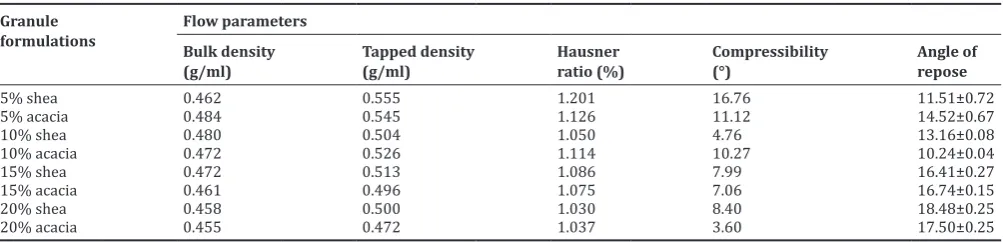
The granules formulated with shea gum or acacia gum as binder had good physical properties and were suitable for tablet compression. The flow properties of the mass of granules is important to ensure uniform die filling during compression that will ultimately lead to uniform weight of the tablets compressed. Table 3 shows the flow properties of the various batches of acacia gum and shea gum granules. All the batches of granules prepared exhibited good flow properties as exemplified by optimal Hausner ratio (1.030-1.201), Carr’s index (3.60-16.76%) and angle of repose (11.51-18.48°) values. The flow properties of shea gum granules were comparable to that of acacia gum granules at the same concentration.
Table 4 presents the physical properties of paracetamol tablets produced with shea gum and acacia gum as binding agents. Tablets produced with shea gum and acacia gum as binders passed the uniformity of weight, hardness, friability, disintegration and assay tests. The tablets passed
Table 4: Physical properties of paracetamol tablets formulated with purified shea gum compared to acacia gum Parameters aTablet formulations
5% Shea 10% Shea 15% Shea 20% Shea
Tablet weight (mg) 560.5±1.2 (562.9±1.5) 561.5±5.2 (561.9±0.5) 564.0±0.9 (561.9±0.5) 564.5±1.7 (562.3±0.7) Assay (%) 100.46±0.13 (98.72±0.03) 103.13±0.13 (101.60±0.43) 101.89±0.06 (101.27±0.59) 100.93±0.07 (100.16±0.01) Hardness (kg) 4.55±0.10 (4.13±0.01) 5.54±0.02 (5.25±0.03) 6.17±0.01 (5.53±0.01) 6.97±0.02 (6.16±0.02) Friability (%) 0.73±0.08 (0.58±0.41) 0.53±0.23 (0.58±0.12) 0.44±0.04 (0.19±0.02) 0.87±0.08 (0.21±0.02) Disintegration time (min) 3.17±0.18 (4.33±0.03) 4.21±0.01 (6.06±0.04) 5.42±0.06 (7.16±0.03) 7.03±0.05 (8.11±0.03)
DE (%) 94.98 (96.0) 91.77 (94.11) 91.39 (92.55) 87.97 (88.69)
aValues in parenthesis are for acacia gum tablet formulations
Table 3: Flow properties of granule formulations containing shea gum and acacia gum as binding agents Granule
formulations Flow parametersBulk density
(g/ml) Tapped density (g/ml) Hausner ratio (%) Compressibility (°) Angle of repose
5% shea 0.462 0.555 1.201 16.76 11.51±0.72
5% acacia 0.484 0.545 1.126 11.12 14.52±0.67
10% shea 0.480 0.504 1.050 4.76 13.16±0.08
10% acacia 0.472 0.526 1.114 10.27 10.24±0.04
15% shea 0.472 0.513 1.086 7.99 16.41±0.27
15% acacia 0.461 0.496 1.075 7.06 16.74±0.15
20% shea 0.458 0.500 1.030 8.40 18.48±0.25
20% acacia 0.455 0.472 1.037 3.60 17.50±0.25
ZY
ZY ZY ZY ZY
6KHDUUDWHV
9LVFRVLW\F3
Fig. 1: Flow curves of different concentrations of purified shea gum at 25°C
7HPSHUDWXUH&
9LVFRVLW\F3
the uniformity of weight test due to the good flow properties of the granules that ensured the uniform filling of the tablet dies. An increase in the binder concentration in tablets leads to the formation of harder tablets with increased disintegration times. The shea gum tablets were slightly harder than corresponding acacia gum tablets but had comparatively lower disintegration times due ostensibly to relatively high friability of the tablets.
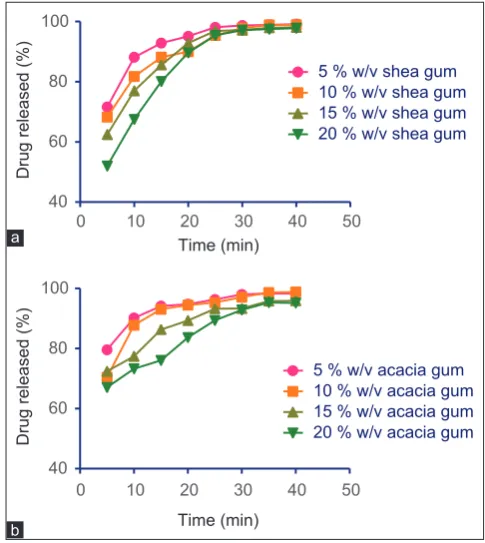
Comparative in vitro dissolution profiles of the various batches of paracetamol tablets formulated with shea and acacia gums are shown in Fig. 5. The in vitro dissolution profiles were found to vary for each batch of tablets, but the dissolution rate was inversely proportional to binder concentration of the gums. Tablet formulations of both gums showed good dissolution profiles and comparable rates of dissolution were observed for corresponding batches. From the dissolution profiles the dissolution test parameters of time for 85% drug dissolution (D85%) and DE were estimated (Table 4). For shea gum tablets, D85% increased from 9.63 minutes (5% shea) to 15.94 minutes (20% shea), while in the case of acacia gum tablets D85% increased from 9.43 minutes (5% acacia) to 20.31 minutes (20% acacia). Thus, for both shea gum tablets and acacia gum tablets, D85% increased with increase in binder concentration. On the other hand, the DE decreased with increase in binder concentration [31].
The release profiles of shea gum tablets were comparable to that of acacia gum tablets and this was confirmed using the T-test and the similarity factor (f2) of dissolution efficiencies of the various batches (Table 5). Using the T-test the “p” values obtained for equivalent tablets
of the same concentration of gums were in the range of 0.5162-0.8531, far in excess of 0.05, showing that batches of the same concentration were not significantly different. The similarity factors obtained were also in the range of 51.16-51.49, all between 50 and 100 and therefore equivalent batches are likely to possess similar dissolution characteristics. Hence, the shea gum could be substituted for acacia gum as a binder in the formulation of the tablets.
CONCLUSIONS
CSG was successfully purified with a percentage yield of 63.26% and the tablet formulation properties of the purified gum evaluated. The results proved that the PSG can be used as an effective binding agent at concentrations of 5% w/v to 20% w/v. The binding effect of shea gum was comparable to that of acacia at the same concentrations.
ACKNOWLEDGMENTS
The authors are gratefully acknowledge the kind assistance and technical support provided by the technicians of the Department of Pharmaceutics, Kwame Nkrumah University of Science and Technology, Kumasi, Ghana.
REFERENCES
1. Jani GK, Shah DP, Prajapati VD, Jain VC. Gums and muscilages:
S+
9LVFRVLW\F3
Fig. 3: Effect of pH on viscosity of 20% w/v shea gum mucilage at 25°C and shear rate of 1 rpm
$OFO &D&O .&O
&RQF0
9LVFRVLW\F3
Fig. 4: Effect of electrolyte concentration on viscosity of 20% w/v shea gum mucilage determined at 27°C and shear rate of 1 rpm
Table 5: Comparative statistical analysis of shea gum and acacia gum tablet formulations
Concentration of gum Statistical parameter p value Similarity
factor (f2) 5% shea gum versus 5% acacia gum 0.5162 51.49 10% shea gum versus 10% acacia gum 0.7191 51.47 15% shea gum versus 15% acacia gum 0.8531 51.37 20% shea gum versus 20% acacia gum 0.8345 51.16
ZYVKHDJXP ZYVKHDJXP ZYVKHDJXP ZYVKHDJXP
7LPHPLQ
'UXJUHOHDVHG
ZYDFDFLDJXP ZYDFDFLDJXP ZYDFDFLDJXP ZYDFDFLDJXP
7LPHPLQ
'UXJUHOHDVHG
Fig. 5: Dissolution profiles of paracetamol tablets formulated with different concentrations of (a) shea gum and (b) acacia gum, in
phosphate buffer pH 5.8
Versatile excipients for pharmaceutical formulations. Asian J Pharm Sci 2009;4(5):308-22.
2. Tekade BW, Chaudhari YA. Gums and mucilages: Excipients for modified drug delivery system. J Adv Pharm Educ Res 2013;3(4):359-67. 3. Reddy K, Mohan GK, Satla S, Gaikwad S. Natural polysaccharides:
Versatile excipients for controlled drug delivery systems. Asian J Pharm Sci 2011;6(6):275-86.
4. Kuntz LA. Special effects with gums. Food product design. Boardr J 1999;2.
5. Al-Assaf S, Phillips GO. Hydrocolloids: Structure-function relationships. A review on the factors influencing the functionality of acacia gum and other hydrocolloids of interest to the food industry. J Inst Food Sci Technol 2009;23(4):17-20.
6. Whistler RL. Introduction to industrial gums. In: BeMiller JN, Whistler RL, editors. Industrial Gums, Polysaccharides and Their Derivatives. 3rd ed. New York: Academic Press; 1993. p. 8-10.
7. Mantell CL. The Water Soluble Gums. New York: Reinhold Publishing Corp.; 1947. p. 80-90.
8. Bhardwaj TR, Kanwar M, Lal R, Gupta A. Natural gums and modified natural gums as sustained-release carriers. Drug Dev Ind Pharm 2000;26(10):1025-38.
9. Frimpong EB, Adomako D. Vegetative Propagation of Shea, Kola and Pentadesma. Annual Report 1987/88. Ghana: Cocoa Research Institute; 1989. p. 98-100.
10. FAO. Appendix 5, Forest Genetic Resource Priorities 10, Africa. Report of Sixth Session of the FAO Panel of Experts on Forest Gene Resources, Held in Rome, Italy, December 8-11, 1988. Rome: FAO; 1985. p. 86-9. 11. Coull GC. Distribution and yields of Shea butter nut trees in the Northern territories. Gold Coast: Yearbook of Department of Agriculture; 1928. p. 130-7.
12. Jain A, Gupta Y, Jain SK. Perspectives of biodegradable natural polysaccharides for site-specific drug delivery to the colon. J Pharm Pharm Sci 2007;10(1):86-128.
13. Wallace-Bruce S, Appleton H. Shea butter extraction in Ghana. In: Appleton H, editor. Do it Herself: Women and Technical Innovation. London: Intermediate Technology Publications; 1995. p. 157-61. 14. Hall JB, Aebischer DP, Tomlinson HF, Osei-Amaning E, Hindle JR.
Vitellaria paradoxa: A Monograph, No. 8. Bangor, UK: School of Agricultural and Forest Sciences Publication, University of Wales; 1996. p. 105.
15. Diarrassouba N, Fofana IJ, Issali AE, Bup Nde D, Sangare A. Typology of shea trees (Vitellaria paradoxa) using qualitative morphological traits in Cote d’Ivoire. Gene Conserve 2009;8(33):752-80.
16. Ofori Kwakye K, Asantewaa Y, Kipo SL. Physicochemical and binding
properties of cashew tree gum in metronidazole tablet formulations. Int J Pharm Pharm Sci 2010;2(4):105-9.
17. Onwukaeme DN, Ikuegbvweha TB, Asonye CC. Evaluation of phytochemical constituents, antibacterial activities and effect of exudate of Pycanthus angolensis Weld Warb (Myristicaceae) on the corneal ulcers in rabbits. Trop J Pharm Res 2007;6(2):725-30. 18. Evans WC. Trease and Evans’ Pharmacognosy. 13th ed. London:
Bailliere Tindall; 1989.
19. Mahmud HS, Oyi AR, Allagh TS. Studies on some physicochemical properties of khaya senegalensis gum. Nig J Pharm Sci 2008;7(1):146-52.
20. British Pharmacopoeia Commission. British Pharmacopoeia. London, UK: Her Majesty’s Stationery Office; 2009.
21. Mahmud HS, Oyi AR, Allagh TS, Gwarzo MS. Evaluation of the suspending property of Khaya snegalensis gum in co-trimoxazole suspensions. Res J Appl Sci Eng Technol 2010;2(1):50-5.
22. Pendyala V, Baburao C, Chandrasekhar KB. Studies on some physicochemical properties of leucaena leucocephala bark gum. J Adv Pharm Technol Res 2010;1(2):253-9.
23. Nep EI, Conway BR. Characterisation of grewia gum, a potential pharmaceutical excipient. J Excip Food Chem 2010;1(1):30-40. 24. United States Pharmacopoeia and National Formulary. Rockville:
U.S.P Convention Inc.; 2008.
25. Ofori-Kwakye K, Amekyeh H, El-Duah M, Kipo SL. Mechanical and tablet coating properties of cashew tree (Anacardium ocidentale L) gum-based films. Asian J Pharm Clin Res 2012;5 Suppl 4:62-8. 26. Dash S, Murthy PN, Nath L, Chowdhury P. Kinetic modeling on
drug release from controlled drug delivery systems. Acta Pol Pharm 2010;67(3):217-23.
27. Dror Y, Cohen Y, Yerushalmi-Rozen R. Structure of gum arabic in aqueous solution. J Polym Sci Part B Polym Phys 2006;4(22):3265-71. 28. Jena K, Das M, Das M, De A, Mitra D, Samanta A. Determination of
efficacy of a natural tablet binder: Characterization and in-vitro release study. Asian J Pharm Clin Res 2014;7(3):184-68.
29. Aulton ME. Pharmaceutics - The Science of Dosage Form Design. Edinburgh: Churchill Livingstone; 1995.
30. Wang Q, Cui SW. Understanding the physical properties of food polysaccharides. In: Cui SW, editor. Food Carbohydrates; Chemistry, Physical Properties and Applications. Boca Raton, Florida, USA: CRC Press, Taylor and Francis Group; 2005. p. 161-262.