R E S E A R C H
Open Access
Mean square numerical solution of stochastic
differential equations by fourth order
Runge-Kutta method and its application in
the electric circuits with noise
Morteza Khodabin
1*and Majid Rostami
2*Correspondence:
1Department of Mathematics,
College of Basic Sciences, Karaj Branch, Islamic Azad University, Alborz, Iran
Full list of author information is available at the end of the article
Abstract
We consider numerical solutions of stochastic initial value problems via the random Runge-Kutta method of the fourth order. A random mean value theorem is
established and the mean square convergence of these methods is proved. The expectation and variance of the solution are derived. We supplement this method by plotting computational errors.
Keywords: stochastic differential equation; random fourth order Runge-Kutta method; random mean value theorem; mean square solution
1 Introduction
Stochastic differential equations (SDEs) have many applications in economics, ecology, and finance [–]. In recent years, the development of numerical methods for the approx-imation of SDEs has become a field of increasing interest; seee.g.[–] and references therein. For example in [], a numerical solution of SDEs is given by a random Euler method and in [–], we obtain the expectation and variance of a numerical solution of these equations by a random Runge-Kutta method of the second order that have good ac-curacy, with respect to the Euler method [], and in this paper we obtain the expectation and variance of numerical solution of these equations by a random Runge-Kutta method of the fourth order.
A stochastic differential equation of the form
˙
X(t) =f(X(t),t), t∈I= [t,T],
X(t) =X, ()
where X is a random variable, and the unknown X(t) as well as the right-hand side
f(X(t),t) are stochastic processes defined on the same probability space (,,P), are pow-erful tools to model real problems with uncertainty. The authors of [] treated the nu-merical solution of stochastic initial value problems based on a sample treatment of the right-hand side of the differential equations. The sample treatment approach developed in [] has the advantage that conclusions remain true in the deterministic case, but in
many situations the hypotheses assumed in [] are not satisfied. This fact motivates re-search for alternative conditions under which good numerical approximations could be constructed. Here we do not assume any trajectorial condition but mean square change information off(X(t),t) is expressed in terms of its mean square modulus of continuity. Other numerical schemes for stochastic differential equations may be found in [, , , ].
This paper is organized as follows: Section deals with some preliminaries addressed to clarify the presentation of concepts and results used later. A mean value theorem for stochastic processes is given in Section and in Section the mean square convergence of a random fourth order Runge-Kutta method is established. In Section some examples of [, ] illustrate the accuracy of the presented results. Finally, Section gives some brief conclusions.
2 Preliminaries
Definition We are interested in second order random variablesX, having a density func-tionfX,
EX= ∞
–∞x
f
X(x)dx<∞,
whereEdenotes the expectation operator, and it allows the introduction of the Banach spaceLof all the second order random variables endowed with the norm
X=
EX.
Definition A stochastic processX(t) defined on the same probability space (,,P) is called a second order stochastic process if for eacht,X(t) is a second order random variable. Hence the meaning ofX˙(t) in () is the mean square limit inLof the expression
X(t+t) –X(t)
t , ast→.
Lemma Let Xnand Ynbe two sequences of second order random variables mean square convergent to the second order random variable X,Y,respectively,i.e.,
Xn→X and Yn→Y as n→ ∞,
then
E[XnYn]→E[XY] as n→ ∞,
and so
lim
n→∞E[Xn] =E[X] and nlim→∞Var[Xn] =Var[X].
Definition Letg:I−→Lbe a mean square bounded function and leth> , then the
mean square modulus of continuity ofgis the function
ω(g,h) = sup
|t–t∗|≤h
Definition The functiongis said to be mean square uniformly continuous inI, if
lim
h→ω(g,h) = .
Definition Letf(X,t) be defined onS×IwhereSis a bounded set inL. We say thatf
is randomly bounded uniformly continuous inS, if
lim
h→ω
f(X,·),h = ,
uniformly forX∈S, and finally we have
sup
X∈S
ωf(X,·),h =ω(h)→.
Definition Let{Nt}t≥be an increasing family ofσ-algebras of sub-sets of. A process g(t,ω) from [,∞)×toRnis calledNt-adapted if for eacht≥ the functionω→g(t,ω)
isNt-measurable, [].
Definition Letν=ν(S,T) be the class of functionsf(t,ω) : [,∞)×→Rsuch that: (i) (t,ω)→f(t,ω)isB×F-measurable, whereBdenotes the Borelσ-algebra on
[,∞)andFis theσ-algebra on,
(ii) f(t,ω)isFt-adapted, whereFtis theσ-algebra generated by the random variables Bs;s≤t,
(iii) E[STf(t,ω)dt] <∞, [].
Definition (The Itô integral), [] Letf ∈ν(S,T), then the Itô integral off (fromSto
T) is defined by
T
S
f(t,ω)dBt(ω) = lim
n→∞
T
S
φn(t,ω)dBt(ω),
whereφnis a sequence of elementary functions such that
E
T
S
f(t,ω) –φn(t,ω) dt
→, asn→ ∞.
Theorem (The Itô isometry), [] Let f ∈ν(S,T),then
E
T
S
f(t,ω)dBt(ω)
=E
T
S
f(t,ω)dt
.
Definition (-dimensional Itô processes), [] LetBt be -dimensional Brownian
mo-tion on (,F,P). A (-dimensional) Itô process (or stochastic integral) is a stochastic pro-cessXton (,F,P) of the form
Xt=X+ t
u(s,ω)ds+ t
where
P
t
v(s,ω)ds<∞, for allt≥
= ,
P
t
u(s,ω)ds<∞, for allt≥
= .
The Itô processesXtis sometimes written in the shorter differential form
dXt=u dt+v dBt. ()
Theorem (The -dimensional Itô formula), [] Let Xtbe an Itô process given by()and g(t,x)∈C([,∞)×R),then
Yt=g(t,Xt)
is again an Itô process,and
dYt=∂g
∂t(t,Xt)dt+ ∂g
∂x(t,Xt)dXt+
∂g
∂x(t,Xt)(dXt)
, ()
where(dXt)= (dXt)(dXt)is computed according to the rules
dt·dt=dt·dBt=dBt·dt= , dBt·dBt=dt. ()
Lemma [] Let X(t)be a second order stochastic process,mean square continuous on I= [t,T],then there existsη∈I such that
t
t
X(s)ds=X(η)(t–t), t<t<T.
The purpose of the theorem below is to establish a relationship between the increment
X(t) –X(t) of a second order stochastic process, and its mean square derivativeX˙(η) for someηin [t,t] fort>t. The result will be used to prove the convergence of the random Runge-Kutta method.
Theorem Let X(t)be a mean square differentiable second order stochastic process in
I= [t,T]and mean square continuous in it.Then there existsη∈I such that
X(t) –X(t) =X˙(η)(t–t).
Proof See [].
3 Convergence of random fourth order Runge-Kutta method A random fourth order Runge-Kutta method will have the following form:
Xn+=Xn+
where ⎧ ⎪ ⎪ ⎪ ⎨ ⎪ ⎪ ⎪ ⎩
k=hf(Xn,tn), k=hf(Xn+k
,tn+ h ), k=hf(Xn+k
,tn+ h ), k=hf(Xn+k,tn+h).
()
Theorem Let f(X(t),t)be defined on S×I to L,where S is a bounded set in L.If f(X(t),t) satisfies the conditions(C)and(C),
(C) f(X,t)is randomly bounded uniformly continuous,
(C) f(X,t)satisfies the mean square Lipschitz condition,that is,
f(X,t) –f(Y,t)≤k(t)X–Y, ()
wheretT
k(t)dt<∞,
then the random fourth order Runge-Kutta scheme()is mean square convergent.
Proof Note that under hypotheses (C) and (C), we are interested in the mean square convergence to zero of the error
en=Xn–X(tn), ()
whereX(t) is the theoretical solution of the fourth order stochastic process of the prob-lem ().
From Theorem it follows that
X(tn+) =X(tn) +hfX(tη),tη , tη∈(tn,tn+). ()
By (), (), (), and () it follows that
en+ ≤ en+h
f(Xn,tn) –f
X(tη),tη +
h
f
Xn+ k
,tn+
h
–fX(tη),tη
+h f
Xn+k ,tn+
h
–fX(tη),tη
+h
f(Xn+k,tn+h) –f
X(tη),tη . ()
By assumption
M= sup
t≤t≤T
X˙(t), ()
and using (C), (C), and Theorem we have
f(Xn,tn) –f
X(tη),tη ≤f(Xn,tn) –f
X(tn),tn +f
X(tn),tn –f
X(tη),tn
+fX(tη),tn –fX(tη),tη
and
and by setting
an= + h
the inequality () gets the following form:
en+ ≤anen+bn, n= , , , . . . , ()
and by successive substitution, () will become
en+ ≤
and by () and geometrical progression we conclude
Finally, from () and substituting () and () in (), we obtain the following error bound:
en+ ≤ exp
(n+ )h
k(tn) + k
tn+h
+k(tn+h)
e
+exp((n+ )
h
[k(tn) + k(tn+ h
) +k(tn+h)]) – h
[k(tn) + k(tn+ h
) +k(tn+h)]
×
Mh
k(tn) +Mh
k
tn+h
+Mh
k(tn+h) +hω(h)
; ()
by assumptione= andnh=T–t, the above inequality can be written as
en+ ≤ exp( T–t+h
[k(T) + k(T+ h
) +k(T+h)]) – k(T) + k(T+h) +k(T+h)
×
Mhk(T) + Mhk
T+h
+ Mhk(T+h) + ω(h)
; ()
sinceω(h)→ ash→, by condition (C) and inequality () we can deduce that the sequenceenis mean square convergent to zero ash→. Thus we have established the
theorem.
4 Numerical examples
Here we present some examples. Since these examples can be found in [, ], we can com-pare the results.
Example Consider the following problem:
˙
X(t) = tX(t) +exp(–t) +B(t), t∈[, ],
X() =X,
()
where B(t) is a Brownian motion process and X is a normal random variable, X∼ N(,) independent ofB(t) for eacht∈[, ].
For computing the exact solution of the problem, by multiplying the equation by exp(–t) and usingW(t) =dB(t)
dt , we have
–texp–t X(t)dt+exp–t dX(t) =exp–t exp(–t) +B(t) dt
using the Itô formula [], we deduce
dexp–t X(t) = –texp–t X(t)dt+exp–t dX(t) =exp–t exp(–t) +B(t) dt
and so
X(t) =expt X+
t
exp–s exp(–s) +B(s) ds
Iff(X(t),t) = tX(t) +exp(–t) +B(t), we have
f(X,t) –fX,t∗ ≤X+ t–t∗+t–t∗ ()
sof(X,t) is randomly bounded uniformly continuous in any bounded setS⊂L. Now, from the random fourth order Runge-Kutta method we have
Xn+=Xn+
and by setting
Table 1 Absolute error of the expectation ofX(t) with the Euler, RK2, and RK4 methods and h=201,h=501
t Euler RK2 RK4
h =201 h =501 h =201 h =501 h =201 h =501
t Euler RK2 RK4
h =201 h =501 h =201 h =501 h =201 h =501
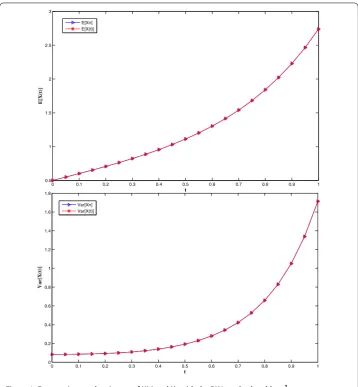
The absolute error of the expectation and variance ofX(t) with the Euler, RK and RK methods and h=, h= are shown in Tables , . In Figure , the expectation and variance of the exact and numerical solutions of Example with the RK method and
Figure 1 Expectations and variances ofX(t) andXnwith the RK4 method andh=201.
Example Consider the following initial value problem:
˙
X(t) =tX(t) +W(t), t∈[, ],
X() =X, ()
whereW(t) is a Gaussian white noise process with mean zero andXis an exponential
ran-dom variable with parameterλ=, independent ofW(t) for eacht∈[, ]. Heref(X(t),t) involves the white noise process with mean zeroW(t),i.e. f(X(t),t) =tX(t) +W(t).
The covariance ofW(t) is
CovW(t),W(s)=δ(t–s), ()
for multiplication,
δ∗g=g.
So, takingg(s) =h(s)χ[,t](s), whereh(s) is aC∞function andχ[,t](s) denotes the
charac-teristic function on the interval [,t], from () it follows that ∞
For computing the exact solution of the problem, by multiplying both sides of () by exp(–t), and usingW(t) =dB(t)dt , we have
using the Itô formula, [], we conclude
d
Now, we computeXnfrom the random fourth order Runge-Kutta method,
Xn+=Xn+
and by setting
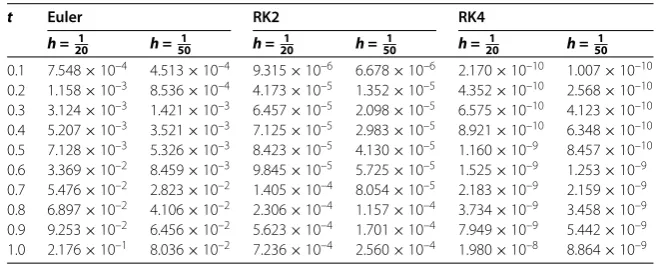
Table 3 Absolute error of the expectation ofX(t) with the Euler, RK2 and RK4 methods and h=201,h=501
t Euler RK2 RK4
h =201 h =501 h =201 h =501 h =201 h =501
0.1 7.548×10⁻⁴ 4.513×10⁻⁴ 9.315×10⁻⁶ 6.678×10⁻⁶ 2.170×10⁻¹⁰ 1.007×10⁻¹⁰ 0.2 1.158×10⁻³ 8.536×10⁻⁴ 4.173×10⁻⁵ 1.352×10⁻⁵ 4.352×10⁻¹⁰ 2.568×10⁻¹⁰ 0.3 3.124×10⁻³ 1.421×10⁻³ 6.457×10⁻⁵ 2.098×10⁻⁵ 6.575×10⁻¹⁰ 4.123×10⁻¹⁰ 0.4 5.207×10⁻³ 3.521×10⁻³ 7.125×10⁻⁵ 2.983×10⁻⁵ 8.921×10⁻¹⁰ 6.348×10⁻¹⁰ 0.5 7.128×10⁻³ 5.326×10⁻³ 8.423×10⁻⁵ 4.130×10⁻⁵ 1.160×10⁻⁹ 8.457×10⁻¹⁰ 0.6 3.369×10⁻² 8.459×10⁻³ 9.845×10⁻⁵ 5.725×10⁻⁵ 1.525×10⁻⁹ 1.253×10⁻⁹ 0.7 5.476×10⁻² 2.823×10⁻² 1.405×10⁻⁴ 8.054×10⁻⁵ 2.183×10⁻⁹ 2.159×10⁻⁹ 0.8 6.897×10⁻² 4.106×10⁻² 2.306×10⁻⁴ 1.157×10⁻⁴ 3.734×10⁻⁹ 3.458×10⁻⁹ 0.9 9.253×10⁻² 6.456×10⁻² 5.623×10⁻⁴ 1.701×10⁻⁴ 7.949×10⁻⁹ 5.442×10⁻⁹ 1.0 2.176×10⁻¹ 8.036×10⁻² 7.236×10⁻⁴ 2.560×10⁻⁴ 1.980×10⁻⁸ 8.864×10⁻⁹
Table 4 Absolute error of variance ofX(t) with the Euler, RK2, and RK4 methods andh=201, h=501
t Euler RK2 RK4
h =201 h =501 h =201 h =501 h =201 h =501
0.1 5.425×10⁻¹ 4.215×10⁻¹ 9.914×10⁻² 9.807×10⁻² 9.74098×10⁻² 6.206×10⁻² 0.2 6.456×10⁻¹ 5.452×10⁻¹ 2.243×10⁻¹ 1.968×10⁻¹ 1.95502×10⁻¹ 8.245×10⁻² 0.3 8.425×10⁻¹ 6.152×10⁻¹ 3.654×10⁻¹ 2.980×10⁻¹ 2.96196×10⁻¹ 1.312×10⁻¹ 0.4 8.896×10⁻¹ 7.431×10⁻¹ 5.756×10⁻¹ 4.049×10⁻¹ 4.02421×10⁻¹ 2.318×10⁻¹ 0.5 9.476×10⁻¹ 8.189×10⁻¹ 7.265×10⁻¹ 5.219×10⁻¹ 5.18782×10⁻¹ 3.436×10⁻¹ 0.6 3.523×10–0 1.078×10–0 8.438×10⁻¹ 6.558×10⁻¹ 6.51931×10⁻¹ 4.540×10⁻¹ 0.7 4.247×10–0 3.368×10–0 9.457×10⁻¹ 8.164×10⁻¹ 8.11499×10⁻¹ 7.243×10⁻¹ 0.8 6.235×10–0 4.236×10–0 1.214×10–0 1.017×10–0 1.01174×10–0 9.345×10⁻¹ 0.9 7.369×10–0 5.348×10–0 2.125×10–0 1.282×10–0 1.27442×10–0 1.895×10–0 1.0 8.563×10–0 6.831×10–0 4.425×10–0 1.644×10–0 1.63398×10–0 2.213×10–0
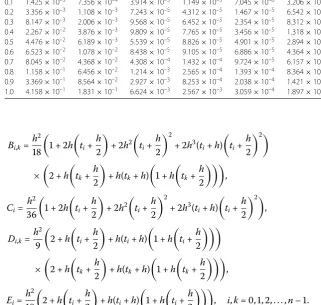
Ci= h
+h
ti+ h
+h
ti+ h
+h (ti+h)
, i,k= , , , . . . ,n– .
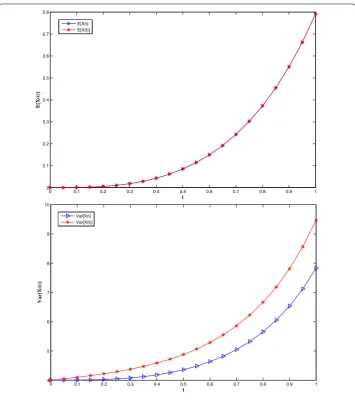
The absolute errors of the expectation and variance ofX(t) with the Euler, RK, and RK methods andh= ,h= are shown in Tables , . In Figure , the expectation and variance of the exact and numerical solutions of Example with the RK method and
h=
are compared.
Figures , show thatE[Xn] andVar[Xn] of the numerical solutions of stochastic initial value problems via random Runge-Kutta methods of the fourth order are close toE[X(t)] andVar[X(t)], respectively, ash→.
5 Applications in the electric circuits with noise Consider the following RC circuit with constant parameters:
RdQ(t)dt +CQ(t) =V(t) +α(t)W(t),
Q() =Q, ()
Figure 2 Expectations and variances ofX(t) andXnwith the RK4 method andh=201.
Brownian motion andα(t) is a nonrandom function that shows the infirmity and intensity of noise at timet.
Now, solving this stochastic differential equation, we have
eRCt dQ(t) + RCe
t
RCQ(t)dt= Re
t
RCV(t)dt+ Rα(t)e
t
RCdB(t). ()
Now, by assumingg(t,x) =eRCt xand using Theorem , we conclude
deRCt Q(t) = RCe
t
RCQ(t)dt+eRCt dQ(t). ()
By () and () we have
Q(t) =eRC–t
Q+
R
t
eRCs V(s)ds+ R
t
α(s)eRCs dB(s)
Now, we computeQnfrom the random fourth order Runge-Kutta method,
and by setting
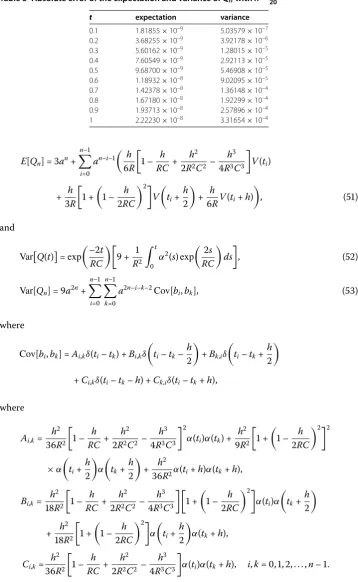
Table 5 Absolute error of the expectation and variance ofQnwithh=201
t expectation variance
Figure 3 Expectations and variances ofQ(t) andQnwithh=201.
6 Conclusion
In this paper, the numerical solution of a stochastic differential equation is discussed by fourth order Runge-Kutta methods in detail. The results can be compared with [, ]. Our comparison showed that this method has more accuracy than the Euler method and the second order Runge-Kutta methods in [, ].
Competing interests
The authors declare that they have no competing interests.
Authors’ contributions
All authors contributed equally to the writing of this paper. All authors read and approved the final manuscript.
Author details
1Department of Mathematics, College of Basic Sciences, Karaj Branch, Islamic Azad University, Alborz, Iran.2Department
of Mathematics, Naragh Branch, Islamic Azad University, Naragh, Iran.
Acknowledgements
Received: 22 June 2014 Accepted: 30 January 2015
References
1. Cortés, JC, Jódar, L, Villafuerte, L: Numerical solution of random differential equations: a mean square approach. Math. Comput. Model.45, 757-765 (2007)
2. Khodabin, M, Maleknejad, K, Rostami, M, Nouri, M: Numerical solution of stochastic differential equations by second order Runge-Kutta methods. Math. Comput. Model.53, 1910-1920 (2011)
3. Khodabin, M, Maleknejad, K, Rostami, M, Nouri, M: Interpolation solution in generalized stochastic exponential population growth model. Appl. Math. Model.36, 1023-1033 (2012)
4. Soboleva, TK, Pleasants, AB: Population growth as a nonlinear stochastic process. Math. Comput. Model.38, 1437-1442 (2003)
5. Koskodan, R, Allen, E: Construction of consistent discrete and continuous stochastic models for multiple assets with application to option valuation. Math. Comput. Model.48, 1775-1786 (2008)
6. Cortés, JC, Jódar, L, Villafuerte, L: Random linear-quadratic mathematical models: computing explicit solutions and applications. Math. Comput. Simul.79, 2076-2090 (2009)
7. Kloeden, PE, Platen, E: Numerical Solution of Stochastic Differential Equations. Applications of Mathematics. Springer, Berlin (1999)
8. Milstein, GN: Numerical Integration of Stochastic Differential Equations. Kluwer Academic, Dordrecht (1995) 9. Calbo, G, Cortés, JC, Jódar, L: Random analytic solution of coupled differential models with uncertain initial condition
and source term. Comput. Math. Appl.56, 785-798 (2008)
10. Cortés, JC, Jódar, L, Camacho, F, Villafuerte, L: Random Airy type differential equations: mean square exact and numerical solutions. Comput. Math. Appl.60, 1237-1244 (2010)
11. Cortés, JC, Jódar, L, Villafuerte, L, Company, R: Numerical solution of random differential models. Math. Comput. Model.54, 1846-1851 (2011)
12. Cortés, JC, Jódar, L, Villafuerte, L, Villanueva, RJ: Computing mean square approximations of random diffusion models with source term. Math. Comput. Simul.76, 44-48 (2007)
13. Maleknejad, K, Khodabin, M, Rostami, M: Numerical solution of stochastic Volterra integral equations by stochastic operational matrix based on block pulse functions. Math. Comput. Model.55, 791-800 (2012)
14. Cortés, JC, Jódar, L, Villafuerte, L: Mean square numerical solution of random differential equations: facts and possibilities. Comput. Math. Appl.53, 1098-1106 (2007)
15. Soong, TT: Random Differential Equations in Science and Engineering. Academic Press, New York (1973)
16. Calbo, G, Cortés, JC, Jódar, L, Villafuerte, L: Analytic stochastic process solutions of second-order random differential equations. Appl. Math. Lett.23, 1421-1424 (2010)
17. Oksendal, B: Stochastic Differential Equations: An Introduction with Applications, 5th edn. Springer, New York (1998) 18. Lighthill, MJ: An Introduction to Fourier Analysis and Generalised Functions. Cambridge University Press, Cambridge