R E S E A R C H
Open Access
Sparse channel estimation of MIMO-OFDM systems
with unconstrained smoothed
l
0
-norm-regularized
least squares compressed sensing
Xinrong Ye
1,2*, Wei-Ping Zhu
1,3, Aiqing Zhang
1,2and Jun Yan
1Abstract
This paper investigates the sparse channel estimation issue of multiple-input multiple-output orthogonal frequency division multiplexing (MIMO-OFDM) systems. Beginning with the formulation of least squares (LS) solution to sparse MIMO-OFDM channel estimation, a compressed channel sensing (CCS) framework based on the new smoothed l0-norm-regularized least squares (l2-Sl0) algorithm is proposed. Three methods, namely quasi-Newton, conjugate gradient, and optimization in the null and complement spaces of the measurement matrix, are then proposed to solve thel2-Sl0unconstrained optimization problem. Moreover, the two former are also applied to solve thel2-Sl0 channel estimation. A number of computer simulation-based experiments are conducted showing a better reconstruction accuracy of thel2-Sl0algorithm as compared with the smoothedl0-norm (Sl0) algorithm in the presence of noise. The proposed CCS approach can save nearly 25% pilot signals to maintain the same mean square error (MSE) and bit error rate (BER) performances as given by the conventional LS method.
Keywords:Sparse channel estimation; Smoothedl0-norm;l2-norm; MIMO-OFDM
1. Introduction
Coherent detection and equalization in multiple input multiple output orthogonal frequency division multiplexing (MIMO-OFDM [1]) systems require channel state informa-tion (CSI) at the receiver. In real wireless environments, however, the CSI is not known. Therefore, channel estima-tion is of crucial importance to MIMO-OFDM systems. In various wireless propagation environments, the channel may consist of only a few dominant propagation (non-zero) paths, even though it has a large propagation delay. Thus, the channel impulse response has a sparse nature [2-4]. However, conventional methods, such as least squares (LS), ignore this prior information about the unknown channel leading to lower spectral efficiency. Recently, sparse channel estimation with an objective of decreas-ing the traindecreas-ing sequence to improve spectral efficiency is becoming a hot research topic.
Previously reported approaches for sparse channel esti-mation can broadly be categorized into two types, namely the most significant tap (MST) detection and compressed channel sensing (CCS). The MST detection methods [4-6] used a measure to determine if a channel tap was non-zero (‘active’). The disadvantage of this type of methods is that a large number of pilots are needed to render an accurate MST detection and effective channel estima-tion. The CCS methods are based on the compressed sensing (CS [7]) technology. In [8], the authors formal-ized the notion of multipath sparsity and proposed the CCS approach. In [9], the orthogonal matching pursuit (OMP) and basis pursuit (BP) algorithms were applied to estimate underwater acoustic channels with large Doppler spread. In [10], the authors proposed an overcomplete basis for doubly selective channels and a metric called localized coherence for selecting training signals to ensure good estimation performance. In [11], a CCS approach for doubly selective channels and a sparsity-enhancing basis expansion with a method for optimizing it were proposed. In [12], two criteria as guiding principles to optimize the pilot pattern for CCS in OFDM systems were proposed. Methods of this type utilize the prior sparse information * Correspondence:[email protected]
1
Institute of Signal Processing and Transmission, Nanjing University of Posts and Telecommunications, Nanjing 210003, China
2
College of Physics and Electronic Information, Anhui Normal University, Wuhu 241000, China
Full list of author information is available at the end of the article
of the unknown channel and the advantage of CS and thus can improve the spectral efficiency by reducing the number of pilot symbols to be transmitted.
Different from literatures [9-12] that used the existing sparse reconstruction algorithms for CCS in OFDM or single carrier systems, we aim to exploit a novel recon-struction algorithm for CCS in MIMO-OFDM systems. The proposed smoothedl0-norm-regularized least squares reconstruction algorithm is named l2-Sl0 in this paper, which differs from the smoothedl0-norm reconstruction algorithm (Sl0 [13]) in two aspects. First, Sl0 is a con-strained optimization problem which is solved in [13] using the steepest descent approach. However, l2-Sl0is an unconstrained minimization problem which is to be solved in this paper by using three methods, namely quasi-Newton approach, conjugate gradient approach, and optimization in the null and complement spaces of the measurement matrix. Second, unlike theSl0using a fixed step size to control the decrease of the parameterσ, which determines the degree of smoothness and the approximation accuracy ofl0-norm,l2-Sl0uses a variable one. Simulation results show that the proposed l2-Sl0 reconstruction approach outperforms the Sl0approach in the presence of noise, and at the cost of slightly more computational time, the CCS approach using l2-Sl0 in conjunction with conjugate gradient yields a performance slightly better than that of the CCS method using fast iterative shrinkage-thresholding algorithm (FISTA [14]) or orthogonal matching pursuit (OMP [15]) algorithm.
The remainder of the paper is organized as follows: Section 2 formulates the sparse channel estimation prob-lem of MIMO-OFDM systems based on LS, ideal-LS, and compressed sensing. Section 3 presents three sparse reconstruction algorithms using the proposedl2-Sl0 ob-jective function, based on which a new CS-based sparse channel estimation approach is developed. Section 4 comprises a number of experiments showing a better reconstruction accuracy of the l2-Sl0-based method as compared with theSl0algorithm, and a higher spectrum efficiency of the sparse channel estimation employing
l2-Sl0 than that using the LS method. Section 5 con-cludes this paper by highlighting some of the contribu-tions presented.
2. The sparse channel estimation problem of MIMO-OFDM systems
Consider a similar MIMO-OFDM system as described in [16] with NT transmit and NRreceive antennas. The MIMO channel can be characterized by an array ofL-tap finite impulse response (FIR) filters given by a number of
NR×NT matrices H(n), (n= 0,1,…,L−1), whose (iR,iT)-th element hiR;iTð Þl ;ð0≤l≤L−1Þ represents thel-th tap of the
channel response between the iR-th receive antenna and
the iT-th transmit antenna. In the case of uniform sam-pling, a wireless channel can often be modeled as a sparse channel [17-19], i.e., only a few elements are nonzero in hiR;iTð Þ0 ;hiR;iTð Þ1 ;…;hiR;iTðL−1Þ
. If the length of the cyclic prefix (CP) is not less than the channel length L, the received pilot signal iniR-th receiver antenna can be written as
are the pilot signals in the iT-th transmit antenna andiR-th receive antenna, diag(X1,pilot) is a diagonal matrix with Xl,pilot as the main diagonal elements, hiR ¼ h
, and niR,pilot represents the frequency domain noise. Let FL be a K×L matrix formed by the first L columns of a K×K DFT matrix
F, then Fpilot can be formed by taking only the rows of FL associated with the KPpilot sub-carriers.
By lettingA¼INR⊗ diag X1;pilot
, where⊗represents Kronecker product, we can get
Ypilot¼Ahþnpilot; ð2Þ
which can be solved by the conventional LS method, givingh^¼A†Ypilot, where†represents the pseudoinverse. Assuming the positions ld (d = 0,1,…,D-1, and l0<
l1<…<lD-1) of the MST are correctly estimated, Equation 1 can be rewritten as
Yi
, D is the number of nonzero taps, and Wpilot can be formed by taking only the D columns ofFpilotassociated with the nonzero tap positions
When npilot is white noise and the positions ld of MST are correctly estimated, we can obtain the estimate of the MST as ^z¼A~†Ypilot. We can also obtain the Cramer-Rao bound of the sparse channel estimate h^
through setting the elements of the positions ld equal to ^z and other elements equal to zero [4]. The above method to obtain the Cramer-Rao bound ofh^ is named as ideal-LS for comparison in this paper.
Note that the dimension ofYpilotis proportional to the number of pilot subcarriers, and Equation 2 is an under-determined problem when the dimension of Ypilot is smaller than that of h. Therefore, the sparse channel estimation in MIMO-OFDM systems can be viewed as solving an underdetermined linear inverse problem with sparsity constraint, i.e.,
min
h jjhjj0 s:t: Ypilot¼Ahþnpilot; ð5Þ
where || · ||0 represents the number of nonzero compo-nents named asl0-norm.
3. Sparse channel estimation usingl2-Sl0
reconstruction algorithm
The sparse signal reconstruction problem in CS is to esti-mate a sparse vectorx∈ℂNfrom an observed vectory∈ℂM
based on the linear model
y¼Φxþw; ð6Þ where w ∈ ℂM is unknown noise and Φ∈ℂM×N is a known measurement matrix, typically with M≪N. This means that the signalx is‘sensed’by a reduced or‘ com-pressed’ number of measurements. Therefore, the signal reconstruction problem can be described as the following constrained minimization problem,
min
x jjxjj0 s: t: jjΦx−yjj2≤ε; ð7Þ where the boundε≥0 is used to allow certain error toler-ance. In general, ε is related to the variance of noise w. Unfortunately, the problem in Equation 7 is a NP-hard combinatorial problem, whose computational complexity grows exponentially with the increase of the signal size and becomes prohibitive even for signals of moderate sizes. Consequently, several techniques have been proposed to tackle this difficult problem. One of the approaches is the convex relaxation, such as BP [20], which replaces ||x||0 with ||x||1to make the problem easier to solve. Another approach, such as matching pursuit (MP [21]) or OMP, is much faster than BP but is a greedy algorithm and does not have provable reconstruction quality at the level of BP method [22]. Different from the above techniques, the smoothed l0-norm approach [13] is to approximate the discontinuousl0-norm by a suitable continuous one and then minimize it by an optimization algorithm
dedicated to continuous functions. For example, the following continuous function
Fσð Þ ¼x
XN
i¼1
fσð Þxi with fσð Þxi
¼1−exp −x
2 i 2σ2
; ð8Þ
where σ is a small value, has been proposed to approxi-mate ||x||0in [13]. In other words, the minimuml0-norm solution is then found by minimizingFσ(x) for a very small value of σ. The parameterσ determines how smooth the functionFσ(x) would be and the accuracy of the approxi-mation. Generally speaking, for larger values ofσ,Fσ(x) is smoother and contains less local minima, but the ap-proximation tol0-norm is worse. On the other hand, for smaller values of σ, a highly nonsmooth Fσ(x) results, which gives a better approximation to l0-norm but a difficult minimization problem. Consequently, the Sl0 approach used a‘decreasing’sequence forσ.
The Sl0 reconstruction algorithm is typically 2 to 3 orders of magnitude faster than BP, while resulting in the same or better accuracy [13]. However, in the presence of noise, the accuracy ofSl0algorithm needs to be im-proved. Therefore, in the next section, we will propose several improvedSl0reconstruction algorithms.
3.1 Thel2-Sl0-BFGS reconstruction algorithm for channel
estimation
Like l1-regularized l2 approach (l2-l1 [14,23,24]) and
lp-regularized l2algorithm [25], we use a parameterλ> 0 to balance the twin objectives of minimizing both error and sparsity, giving the following unconstrained optimiza-tion problem:
min x Fð Þ ¼x
1
2jjΦx−yjj
2 2þλ
XN
i¼1
1−exp −x
2 i 2σ2
: ð9Þ
The objective function in Equation 9 remains differen-tiable, and its gradient can be obtained as
∇Fð Þ ¼x ΦTðΦx−yÞ þg; ð10Þ
whereg= [g1,g2,…,gN]Twithgibeing given by
gi¼λ xi=σ2
e−x2
i=2σ2: ð11Þ
The quadratic (l2-norm) error term 12jjΦx−yjj22 in Equation 9 is a convex function, but the convex region of
the approximatel0-norm term Fσð Þ ¼x XN
i¼1
1−exp
½ −x2
i 2σ2
depends on parameter isσ. In general, the greater the value ofσ, the larger the convex region is. To see this, we com-pute the gradient ofFσ(x), denoted asg0¼g01;g02;…;g0NT, whose element is given by
g0i¼ xi=σ2
e−x2i=2σ
2
: ð12Þ
Also, the Hessian of Fσ(x) is a diagonal matrix as given by
∇2F
σð Þ ¼x diag h11;f h22;…;hNNg with hii
¼ 1
σ2− x2i σ4
e −x2i
2σ2 ð13Þ
Therefore,Fσ(x) is convex if and only if xi
j j≤σ; 1≤i≤N: ð14Þ
Since Equation 14 defines anN-dimensional hypercube whose volume is (2σ)N, the size of the convex region in the x-space is proportional to σ. On the other hand, in order to better approximate thel0-norm,σmust be suffi-ciently small. Consequently, to avoid getting trapped into local minima, we gradually decrease the value ofσ, as in theSl0approach. More specifically, for minimum F(x) at σi, the initial point is x*(σi-1) obtained in the previous iteration, which is near the global optimal solution.
Since a broadband wireless channel response h usu-ally consists of a few dominant propagation paths and Equation 2 has a similar form as Equation 6, the estima-tion ofh can be viewed as a sparse signal reconstruction in compressed sensing. Thus, we refer to this kind of sparse channel estimation method as CCS. Using Equations 2, 6, and 9, we can obtain the objective function of CCS based on thel2-Sl0reconstruction algorithm,
min
h Fð Þ ¼h
1
2jjAh−Ypilotjj
2 2
þλX
N
i¼1
1−exp −h
2 i 2σ2
: ð15Þ
From the above analysis, the proposed CCS using the l2-Sl0-BFGS algorithm can be implemented by the pseudo-code in Algorithm 1.
Algorithm 1 CCS using thel2-Sl0-BFGS algorithm
Note that in Algorithm 1, the values of δr and rJ are chosen such that 0 <δr< 0.1 and 0.5 <rJ< 1. The method ofl2-Sl0uses a variable factorri=ri−1+δrto control the decrease of the parameterσ. Our idea is to use an‘ increas-ing’step size corresponding to the decreasing values ofσ.
3.2 Thel2-Sl0-CG reconstruction algorithm for channel
estimation
The Hessian matrix of the objective function F(x) in Equation 9 can be computed as
∇2F
x
ð Þ ¼ΦTΦþλ∇2F
σð Þx ; ð16Þ
where∇2Fσ(x) is computed using Equation 13. Since the
gradient and Hessian matrix of F(x) can be efficiently evaluated using the closed-form formula in Equations 10 and 16, it is convenient to apply the conjugate gradient method to solve the l2-Sl0 optimization problem. The algorithm is thus referred to as thel2-Sl0-CG algorithm. In the k-th iteration of the conjugate gradient tech-nique,xkis updated as
xkþ1¼xkþαkdk; ðk¼0;1;…;L−1Þ: ð17Þ The conjugate directiondkis computed as
dk¼
(
−g0; k¼0
−gkþβk−1dk−1; k¼1;2;…;L−1 with
βk−1¼
gT kgk
gT k−1gk−1
;
ð18Þ
and thek-th step sizeαkis computed using
αk¼
gTkgk
dTkHkdk
Where gk is the gradient vector computed using Equation 10 andHkis the Hessian matrix obtained using Equation 16 at x=xk, respectively. The proposed CCS using l2-Sl0-CG algorithm can be implemented by the pseudo-code in Algorithm 2.
Algorithm 2 CCS usingl2-Sl0-CG algorithm
3.3 Signal reconstruction via optimization in null and
complement spaces ofΦ
LetΦ=UΣVTbe the singular value decomposition (SVD) of Φ whereUM×M and VN×N are unitary matrices, and
Σ= [S,0]M×N with S= diag(s1,…,sM) being a diagonal matrix composed by the singular values of Φ. Let V= [Vr,Vn], where the columns ofVnspan the null space of
Φ and the columns ofVrspan the orthogonal comple-ment of the null space. Using Vn and Vr, a signalx of lengthNcan be expressed as
x¼VrαþVnβ; ð20Þ Where αand β are vectors of length M and N−M, respectively. Applying the SVD ofΦ, thel2-norm term in Equation 9 can be simplified as [25]
1
Using Equations 20 and 21, the optimization problem in Equation 9 can be recast as
min
Vn, respectively.
An iterative algorithm to solve the optimization prob-lem in Equation 22 is proposed as follows. In the k-th iteration of the optimization process, signal x(k) is updated as line search method of Roger Fletcher [26]. Assuming that the updating vectorsdð Þrk and dð Þnk are written as
which are determined by minimizing F(α,β) along each of the directions defined by the column vectors of [Vr,Vn]. Therefore, dð Þrk and dk
ð Þ
n become descent direc-tions ofF(α,β), and in the case of realΦandx,dð Þrk;i can be calculated via iteration as
Similarly,dð Þnk;i in Equation 25 is given by
dð Þnk;i
ð Þq
¼
−XN
j¼1
exp
− xjþvð Þnj;i dð Þnk;i
ðq−1Þ
2
2σ2
0 B B B @
1 C C C Axjvð Þnj;i
2 6 6 6 4
3 7 7 7 5
XN
j¼1
exp
− xjþvð Þnj;i dð Þnk;i
ðq−1Þ
2
2σ2
0 B B B @
1 C C C A vð Þnj;i
2
2 6 6 6 4
3 7 7 7 5
; ð1≤i≤N−MÞ; ð27Þ
where vð Þnj;i is the (j,i)-th component of matrix Vn, and d
k ð Þ n;i
ð Þq
is the q-th iteration value of dð Þnk;i with the
initialization value dð Þnk;i
ð Þ0
¼0. The derivation of Equations 26 and 27 is given in the Appendix. In addition, the
computation ofdð Þrk;i using Equation 26 requires vectorα(k)to be computed first as
VTrxð Þk ¼VTr Vrαð Þk þVnβð Þk
¼αð Þk: ð28Þ
The reconstruction algorithm via optimization in null and complement spaces of measurement matrix Φ is referred to hereafter as thel2-Sl0-NC algorithm, which can be implemented by the pseudo-code in Algorithm 3.
4. Simulation results
In this section, the reconstruction performance of the pro-posed approach (l2-Sl0) is evaluated by computer simula-tions. The spectral efficiency of the CCS using l2-Sl0 algorithm is also discussed. More specifically, the l2-Sl0 algorithm includes l2-Sl0-BFGS, l2-Sl0-CG, andl2-Sl0-NC in the scenario where y, Φ ,x are real-valued. While in complex-valued scenarios, l2-Sl0 only means l2-Sl0-BFGS andl2-Sl0-CG. Note that Equations 26 and 27 are obtained only in the case wherey,Φ,xare real-valued. Namely, the
l2-Sl0-NC is not suitable to reconstruct complex signals. In all the experiments, the initial value ofris set to 0.5 for bothSl0andl2-Sl0algorithms. The values ofδrandrJ re-quired by thel2-Sl0algorithm are chosen as 0.05 and 0.7, respectively.
In experiments 1 and 2, the signal length and the num-ber of measurements are set toN= 1,000 and M= 400, respectively. AK-sparse sourcex was artificially created as follows: (1) set x to a zero vector of length N, (2) generate a vector z of length K assuming that each element zi is a random value drawn from the normal distribution N(0,1) in the real-valued scenario or from
N(0,1/2)+jN(0,1/2) in the complex-valued scenario, and (3) randomly select K components of x and set them to z. Each element of the measurement matrix Φ is randomly generated using the normal distributionN(0,1) or N(0,1)+jN(0,1), and each row is normalized to unity. Then, the mixtures are generated using the noisy model
y=Φx+w, where w is an additive white Gaussian noise with covariance matrix σwΙM (IM stands for the M × M identity matrix). To evaluate the estimation accuracy, the signal-to-noise ratio (SNR) defined as 20 logð jjjjx 2=jjx−^xjj2Þ
is used, where x and ^x denote the true value and its estimate, respectively.
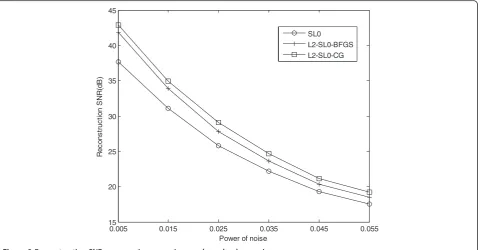
In experiment 1, we compare the reconstruction per-formance ofl2-Sl0with that ofSl0. Figures 1 and 2 show the reconstruction SNR at different powers of noise σw in real and complex signal scenarios, respectively. For each value of σw, the reconstruction SNR is averaged over 100 runs. It is seen thatl2-Sl0produces a better SNR than Sl0, which shows the robustness of l2-Sl0 against noise. The objective function of l2-Sl0 algorithm in Equation 15 comprises the quadratic error term1
2jjAh−
Ypilotjj22 which permits a small perturbation. Therefore,
thel2-Sl0algorithm has a larger capability to reconstruct sparse signal in the presence of noise than Sl0. For smaller values of σ, Fσ(x) contains more local minima. Therefore, the decrease ofσshould not be too quick in theSl0andl2-Sl0algorithms. Moreover, unlikeSl0using a fixed step size to control the decrease of the parameter σ,l2-Sl0uses a variable one, and the step sizeδrslightly increasing with the reduction of σ may also help the
l2-Sl0to improve its estimation accuracy.
In experiment 2, thel2-Sl0algorithms are tested using
N= 1,000, M= 400, and various K sparse signals with
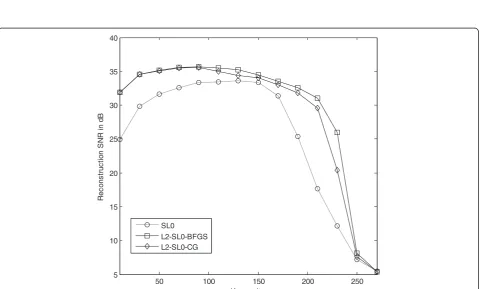
σω= 0.01, to examine the algorithms' performance for signals of different sparsity levels. The results obtained are plotted in Figures 3 and 4 with y, Φ, x being real and complex values, respectively. It is observed that the performance of the l2-Sl0 algorithm is better than theSl0algorithm in most cases. In real-valued scenario, the l2-Sl0-BFGS, l2-Sl0-CG, and l2-Sl0-NC are compar-able for K smaller than 130, but l2-Sl0-BFGS performs better for K between 130 and 210. In addition, when
K is smaller than 90, the final SNR of theSl0algorithm increases with the rise of sparsityK. This is because the initial estimate ^x0 is set to the minimuml2-norm solution ofy=Φx+w, which has few zero elements and is far away from the actual signal with many zero elements, and^x0 is
gradually close to the actual signal with the rise of sparsity
K. However, this phenomena is not obvious in l2-Sl0 algorithm, since the initial estimate x^0 is set to zeros
in l2-Sl0-CG and l2-Sl0-NC, which is near the actual solution for a small value ofK. Because of x^0 being set
to zeros and the thresholds ofδ1andδ2being not small enough for the value sparsityKabove 230, thel2-Sl0-NC performs the worst among the algorithms tested.
Next, we investigate the accuracy and the spectral efficiency of CCS method using l2-Sl0. We consider a MIMO-OFDM system with two transmit and two re-ceive antennas (NT=NR= 2). The number of subcarriers is 512, and the QPSK modulation is used. The length of cyclic prefix is 20, which equals the length of wireless channel impulse response. In experiment 3, a Rayleigh channel modeled by a 4-tap MIMO-FIR filter is assumed, in which each tap corresponds to a 2 × 2 random matrix whose elements are i.i.d. complex Gaussian variables with zero mean and unit variance, and the positionldof MSTs is {2, 6, 13, 19}. The estimation performance is evaluated in terms of the bit error rate (BER) and mean square error
(MSE) given by MSE(Δh) = XM
i¼1jjh^i−hijj
2 2 XM
i¼1jjhijj
2 2
, where M
represents the number of simulations and hi and h^i represent the actual and the estimated channels from the i-th simulation, respectively.
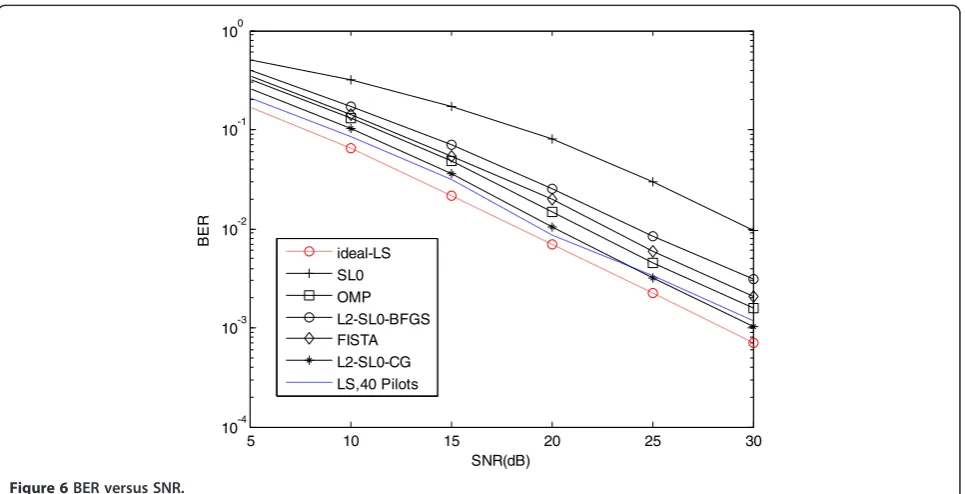
resulting from the above five CCS methods and the con-ventional LS method, respectively. As can be seen, the CCS method usingl2-Sl0-CG only needs 30 pilot signals to obtain the approximate performance of the LS method using 40 pilot signals which implies that the CCS using
l2-Sl0-CG can save nearly 25% pilot signals. This merit
of CCS is due to the prior sparse information of the wireless channel utilized and the efficient reconstruc-tion of sparse signals from a very limited number of measurements allowed by CS. In addition, the CCS applyingl2-Sl0-CG orl2-Sl0-BFGS outperforms the CCS using Sl0 more obviously than that in experiment 1,
0.005 0.015 0.025 0.035 0.045 0.055
15 20 25 30 35 40 45
Power of noise
R
e
c
ons
tr
uc
ti
on S
N
R
(dB
)
SL0 L2-SL0-BFGS L2-SL0-CG
Figure 2Reconstruction SNR versus noise power in complex-valued scenario.
0.005 0.015 0.025 0.035 0.045 0.055
15 20 25 30 35 40
Power of noise
R
e
c
o
ns
tr
uc
ti
on S
N
R
(dB
)
SL0 L2-SL0-BFGS L2-SL0-CG L2-SL0-NC
50 100 150 200 250 5
10 15 20 25 30 35 40
K-sparsity
Re
c
o
n
s
tr
u
c
ti
o
n
S
NR i
n
d
B
SL0 L2-SL0-BFGS L2-SL0-CG
Figure 4Reconstruction SNR at various sparsity levels over 100 runs in complex-valued scenario.
50 100 150 200 250
0 5 10 15 20 25 30 35
K-sparsity
R
e
c
o
n
s
tr
u
c
ti
o
n
SN
R
i
n
d
B
SL0 L2-SL0-BFGS L2-SL0-CG L2-SL0-NC
which shows that the l2-Sl0 has a larger capability to reconstruct sparse signal thanSl0in the case when each row of measurement matrix is not normalized to unity. Since thel2-Sl0algorithm is halted after a fixed number of iterations, furthermore, the fixed number does not depend on the sparsity of the signal directly; it is convenient to set the number in practical applications.
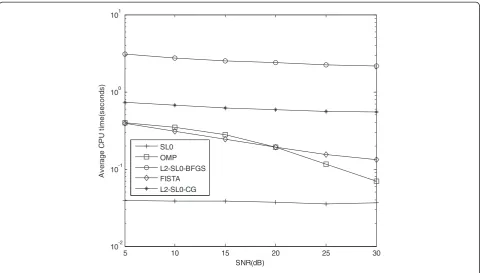
We use the CPU time as a measure of complexity. The simulations are performed in MATLAB R2009b environ-ment using an Intel Core i3, 2.53-GHz processor with
2 GB of memory, and under Microsoft Windows XP operating system. The results shown in Figure 7 indicate that the CCS using l2-Sl0 requires more computational time than that using other algorithms tested. The l2-Sl0 algorithm needs an iterative process to find the optimal solution at each value of σ; therefore, the running time ofl2-Sl0is longer than that of others tested. However, at the cost of slightly more computational time, the CCS using l2-Sl0-CG yields slightly better performance than the CCS using OMP or FISTA, and the threshold value
5 10 15 20 25 30
-40 -30 -20 -10 0 10 20
SNR(dB)
MS
E
(d
B
)
ideal-LS SL0 OMP L2-SL0-BFGS FISTA L2-SL0-CG LS,40 Pilots
Figure 5MSE versus SNR.
5 10 15 20 25 30
10-4 10-3 10-2 10-1 100
SNR(dB)
BER
ideal-LS SL0
OMP L2-SL0-BFGS FISTA L2-SL0-CG
LS,40 Pilots
for termination iteration in thel2-Sl0algorithm is easier to be set. More specifically, it is shown in Algorithm 2 that l2-Sl0-CG applies a constant value L to stop the iteration, and the constant value is independent of the sparsity of signal and the power of noise. However, the valid threshold values for termination iteration in the OMP and FISTA algorithms always depend on the power of noise or the sparsity of signal, which are both quite difficult to estimate beforehand in practical applications.
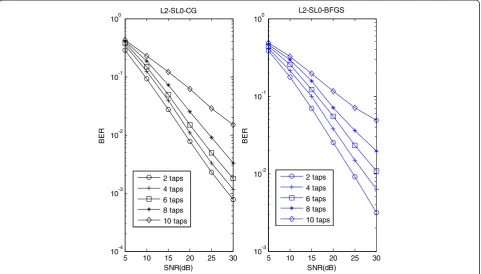
In experiment 4, we investigate the BER of the CCS using 30 pilot signals in each transmit antenna under different channel sparsities, namely for different numbers of MSTs. Moreover, the position ld of MST is randomly selected in each Monte Carlo simulation. Figure 8 shows the BER plots of CCS using l2-Sl0-CG andl2-Sl0-BFGS algorithms. The figure shows that a better BER perform-ance can be expected in general for less number of MSTs. In addition, when the length of channel response is 20, the CCS using l2-Sl0-CG and that using l2-Sl0-BFGS are found to yield acceptable BERs for up to 8 and 4 MSTs, respectively.
5. Conclusion
In this paper, a new approach for sparse channel estima-tion of MIMO-OFDM systems based on compressed sensing has been presented. The new approach uses a smoothed l0-norm-regularized least squares (l2-Sl0) ob-jective function and solves the optimization problem by three reconstruction algorithms: quasi-Newton, conjugate
gradient (CG), and optimization in the null and comple-ment spaces of measurecomple-ment matrix (ONCS). The better reconstruction accuracy of thel2-Sl0as compared with the
Sl0 algorithm and the higher spectrum efficiency of the CCS usingl2-Sl0-CG orl2-Sl0-BFGS as compared with the conventional LS method have been shown by computer simulations.
Appendix
Derivation of Equations 26 and 27
Suppose that eiis the i-th column of an M×M identity matrix, and the vectorsαandβin Equation 22 are fixed. At pointα, a line search along directioneiis carried out by solving the one-dimensional optimization problem
mindr;i F αþdr;iei;β
Wherexjis thej-th component of vectorx, andvj;i
Note that dr,ican be solved via iterations with the ini-tial value ofdr,ibeing set to zero in the right side of (30). In a similar manner,dn,ican be obtained as
dn;i¼
The authors declare that they have no competing interests. Acknowledgements
We express our thanks to the anonymous reviewers for their valuable comments to improve the quality and the presentation of this paper. This work is supported by the National Natural Science Foundation of China under grant nos. 61372122 and 61302104 and the Basic Research Program of Jiangsu Province under grant no. BK2011756.
Author details 1
Institute of Signal Processing and Transmission, Nanjing University of Posts and Telecommunications, Nanjing 210003, China.2College of Physics and
Electronic Information, Anhui Normal University, Wuhu 241000, China.
3Department of Electrical and Computer Engineering, Concordia University,
Montreal QCH3G1M8, Canada.
Received: 19 July 2013 Accepted: 21 November 2013 Published: 10 December 2013
References
1. G Stuber, JR Barry, SW Mclaughlin, Y Li, MA Ingram, TG Pratt, Broadband MIMO-OFDM wireless communications. Proc IEEE92(2), 241–294 (2004) 2. MR Raghavendra, K Giridhar, Improving channel estimation in OFDM
systems for sparse multipath channels. IEEE Signal Process Lett12(1), 52–55 (2005)
3. JK Hwang, RL Chung, MF Tsai, JH Deng, Highly efficient sparse multipath channel estimator with Chu-sequence preamble for frequency-domain MIMO DFE receiver. IEICE Trans CommunE90B(8), 2103–2110 (2007) 4. C Carbonelli, S Vedantam, U Mitra, Sparse channel estimation with zero-tap
detection. IEEE Trans Wireless Commun6(5), 1743–1763 (2007)
5. F Wan, W-P Zhu, MNS Swamy, Semiblind most significant tap detection for sparse channel estimation of OFDM systems. IEEE Trans Circuits Syst I: Reg Papers57(3), 703–713 (2010)
6. F Wan, W-P Zhu, MNS Swamy, Semiblind sparse channel estimation for MIMO-OFDM systems. IEEE Trans Vehicular Technol60(6), 2569–2582 (2011) 7. D Donoho, Compressed sensing. IEEE Trans Inf Theory52(4), 1289–1306 (2006)
5 10 15 20 25 30
8. WU Bajwa, J Haupt, AM Sayeed, R Nowak, Compressed channel sensing: a new approach to estimating sparse multipath channels. IEEE Trans on Signal Processing98(6), 1058–1076 (2010)
9. CR Berger, S Zhou, JC Preisig, P Willet, Sparse channel estimation for multicarrier underwater acoustic communication: from subspace methods to compressed sensing. IEEE Trans Signal Process58(3), 1708–1721 (2010) 10. M Sharp, A Scaglione, A useful performance metric for compressed channel
sensing. IEEE Trans Signal Process59(6), 2982–2988 (2011)
11. G Taubock, F Hlawatsch, D Eiwen, H Rauhut, Compressive estimation of doubly selective channels in multicarrier systems: leakage effects and sparsity-enhancing processing. IEEE J Sel Top Signal Process
4(2), 255–271 (2010)
12. X He, R Song, W Zhu, Optimal pilot pattern design for compressed sensing-based sparse channel estimation in OFDM systems. Circuits Syst Signal Process31, 1379–1395 (2012)
13. H Mohimani, M Babaie-Zadeh, C Jutten, A fast approach for overcomplete sparse decomposition based on smoothedl0norm. IEEE Trans Signal
Process57(1), 289–301 (2009)
14. A Beck, M Teboulle, A fast iterative shrinkage-thresholding algorithm for linear inverse problems. SIAM J Imaging Sci2(1), 183–202 (2009) 15. JA Tropp, AC Gilbert, Signal recovery from random measurements via
orthogonal matching pursuit. IEEE Trans Inf Theory53(12), 4655–4666 (2007) 16. X Ye, W Zhu, A Zhang, Q Meng, Sparse channel estimation in MIMO-OFDM
systems based on an improved sparse reconstruction by separable approximation algorithm. Journal of Information and Computational Science10(2), 609–619 (2013)
17. WU Bajwa, A Sayeed, R Nowak, Sparse multipath channels: modeling and estimation, inProceedings of the 13th IEEE Digital Signal Processing Workshop
(Marco Island). 4–7 Jan 2009
18. G Gui, F Adachi, Improved least mean square algorithm with application to adaptive sparse channel estimation. EURASIP J Wirel Commun Netw2013, 204 (2013)
19. G Gui, A Mehbodniya, F Adachi, Bayesian sparse channel estimation and data detection for OFDM communication systems, in2013 IEEE 78th Vehicular Technology Conference (VTC2013-Fall)(, Las Vegas). 2–5 Sept 2013 20. SS Chen, DL Donoho, MA Saunders, Atomic decomposition by basis pursuit.
SIAM J Scientif Comput20(1), 33–61 (1999)
21. S Mallat, Z Zhang, Matching pursuits with time-frequency dictionaries. IEEE Trans Signal Process41(12), 3397–3415 (1993)
22. W Dai, O Milenkovic, Subspace pursuit for compressive sensing signal reconstruction. IEEE Trans Inf Theory55(5), 2230–2249 (2009)
23. M Zibulevsky, M Elad, L1-L2 optimization in signal and image processing. IEEE Signal Process Mag27(5), 76–88 (2010)
24. SJ Wright, RD Nowak, MAT Figueiredo, Sparse reconstruction by separable approximation. IEEE Trans Signal Process57(7), 2479–2493 (2009) 25. JK Pant, W-S Lu, A Antoniou, Recovery of sparse signals from noisy measurements
using anlpregularized least-squares algorithm, inIEEE Pacific Rim Conference on
communications, computers and signal processing(University of Victoria, Canada), pp. 48–53. 23–26 Aug 2011
26. A Antoniou, W-S Lu,Practical Optimization: Algorithms and Engineering Applications
(Springer, New York, 2007)
27. JK Pant, W-S Lu, A Antoniou, Reconstruction of sparse signals by minimizing a re-weighted approximatel0-norm in the null space of the measurement
matrix, inProceedings of the Midwest Symposium on Circuits and Systems
(Seattle), pp. 430–433. 1–4 Aug 2010
28. JK Pant, W-S Lu, A Antoniou, Unconstrained regularizedlpnorm based
algorithm for the reconstruction of sparse signals, inProceedings of the IEEE International Symposium on Circuits and Systems(Brazil), pp. 1740–1743. 15–18 May 2011
doi:10.1186/1687-1499-2013-282
Cite this article as:Yeet al.:Sparse channel estimation of MIMO-OFDM systems with unconstrained smoothedl0-norm-regularized least squares
compressed sensing.EURASIP Journal on Wireless Communications and
Networking20132013:282.
Submit your manuscript to a
journal and benefi t from:
7Convenient online submission
7Rigorous peer review
7Immediate publication on acceptance
7Open access: articles freely available online
7High visibility within the fi eld
7Retaining the copyright to your article